Orbital Elements: Questions
How to use these questions
These questions go with the note Orbital Elements. They are the master set for the topic, and the class tests and examinations are drawn from them.
There are \(46\) objective questions. Each has four options and exactly one correct answer. They come in three levels. Level 1 asks for one definition, one fact or one formula used once. Level 2 needs two or three steps. Level 3 needs several steps, a limit, a symmetry, or a point that is easy to get wrong. Choose an option before you open the Answer, which gives the reason and, for a number, the calculation. The \(8\) drills are plain numericals on the methods of the note. The \(11\) extensions go beyond the note, analytically or analytically and numerically. Every problem has a worked solution, folded under Solution. Try the problem on paper before you open it.
Some problems need ideas from several notes at once. The Indian missions problems are of that kind, and are kept as a separate set.
Every number in the answers and solutions is checked by orbital-elements-questions-verify.py.
Data. The objective questions use \(\mu_\oplus=398\,600\ \mathrm{km^3/s^2}\), \(R_\oplus=6378\) km, \(g_0=9.80665\ \mathrm{m/s^2}\), \(G=6.674\times10^{-11}\ \mathrm{m^3\,kg^{-1}\,s^{-2}}\), \(\mu_\odot=1.327\times10^{11}\ \mathrm{km^3/s^2}\), \(1\ \mathrm{AU}=1.496\times10^8\) km, \(M_\odot/m_{\rm Jupiter}=1047.6\) and \(J_2=1.08263\times10^{-3}\), unless a question says otherwise. Each problem gives the data it needs. Where it does not, use the constants of the notation page. Burns are impulsive and orbits are two-body, unless a question says otherwise. Angles in Kepler’s equation are in radians.
Objective questions
Level 1 — very easy
1. Why are exactly six classical orbital elements needed?
- Because the two-body equations of motion need six initial conditions
- Because the orbit lies in a plane
- Because the ellipse has six symmetries
- Because Kepler stated three laws, each fixing two numbers
Answer
(A) The relative motion is three second-order ODEs, i.e. six first-order ones, so a state needs six numbers; the elements are just a more meaningful choice of those six.
2. In the geocentric equatorial frame, the inclination \(i\) of an orbit is the angle between
- the eccentricity vector and the equator
- \(\hat{\mathbf I}\) and the node vector
- the orbit plane and the ecliptic
- \(\hat{\mathbf K}\) and the angular momentum \(\mathbf h\)
Answer
(D) \(\cos i=h_K/h\), measured from the north pole \(\hat{\mathbf K}\) to \(\mathbf h\). It is also the angle between the orbit plane and the equator.
3. An orbit with \(i=120^\circ\) is
- equatorial
- prograde
- polar
- retrograde
Answer
(D) For \(90^\circ<i\le180^\circ\), \(h_K<0\): the body moves westward, against the Earth’s rotation.
4. The node vector \(\mathbf n=\hat{\mathbf K}\times\mathbf h\) points towards
- the descending node
- periapsis
- the vernal equinox
- the ascending node
Answer
(D) At the ascending node the body crosses the equator going north. The orbital-elements note shows that \(\hat{\mathbf K}\times\mathbf h\) picks out that node, not the descending one.
5. The right ascension of the ascending node \(\Omega\) is measured
- in the equatorial plane, from \(\hat{\mathbf I}\) to the ascending node
- in the ecliptic, from the Sun to the node
- from \(\hat{\mathbf K}\) to \(\mathbf h\)
- in the orbit plane, from the node to periapsis
Answer
(A) \(\Omega\) is the angle from \(\hat{\mathbf I}\) to \(\mathbf n\), measured about \(\hat{\mathbf K}\), between \(0^\circ\) and \(360^\circ\).
6. The argument of periapsis \(\omega\) is measured
- from the ascending node to the body
- from periapsis to the body
- in the equatorial plane, from \(\hat{\mathbf I}\) to periapsis
- in the orbit plane, from the ascending node to periapsis, in the direction of motion
Answer
(D) It is the angle from \(\mathbf n\) to \(\mathbf e\) about \(\hat{\mathbf h}\). The angle from the node to the body is the argument of latitude \(u\).
7. For a circular orbit, which element is undefined?
- \(\Omega\)
- \(a\)
- \(i\)
- \(\omega\)
Answer
(D) \(e=0\), so \(\mathbf e=\mathbf 0\) has no direction and there is no periapsis to measure \(\omega\) (or \(f\)) from.
8. For an equatorial orbit (\(i=0\)), which element is undefined?
- \(\Omega\)
- \(f\)
- \(a\)
- \(e\)
Answer
(A) \(\mathbf n=\hat{\mathbf K}\times\mathbf h=\mathbf 0\) when \(\mathbf h\parallel\hat{\mathbf K}\): the orbit never crosses the equator, so it has no node.
9. The direction \(\hat{\mathbf I}\) of the geocentric equatorial frame points towards
- the vernal equinox, along the line where the equator meets the ecliptic
- the Greenwich meridian
- the Sun at noon
- the north celestial pole
Answer
(A) It is where the Sun crosses the equator going north, around 20 March. It is fixed to the sky, not to the rotating Earth.
10. The precession of the equinoxes moves \(\hat{\mathbf I}\) round the ecliptic once in about
- \(1\) year
- \(18.6\) years
- \(2600\) years
- \(26\,000\) years
Answer
(D) The Earth’s axis precesses with a period of about \(26\,000\) years, about \(50''\) per year. (\(18.6\) years is the period of the Moon’s nodal regression.) That is why every set of elements needs an epoch.
11. The argument of latitude \(u\) is
- \(\Omega+\omega+f\)
- \(\Omega+\omega\)
- \(f-\omega\)
- \(\omega+f\)
Answer
(D) \(u\) is the angle in the orbit plane from the ascending node to the body. \(\Omega+\omega\) is the longitude of periapsis, and \(\Omega+\omega+f\) the true longitude.
12. Which two elements fix the size and shape of an orbit?
- \(i\) and \(\Omega\)
- \(\omega\) and \(f\)
- \(e\) and \(\omega\)
- \(a\) and \(e\)
Answer
(D) \(a\) fixes the size (and the energy and period), and \(e\) the shape. \(i\), \(\Omega\), \(\omega\) orient the orbit, and \(f\) places the body on it.
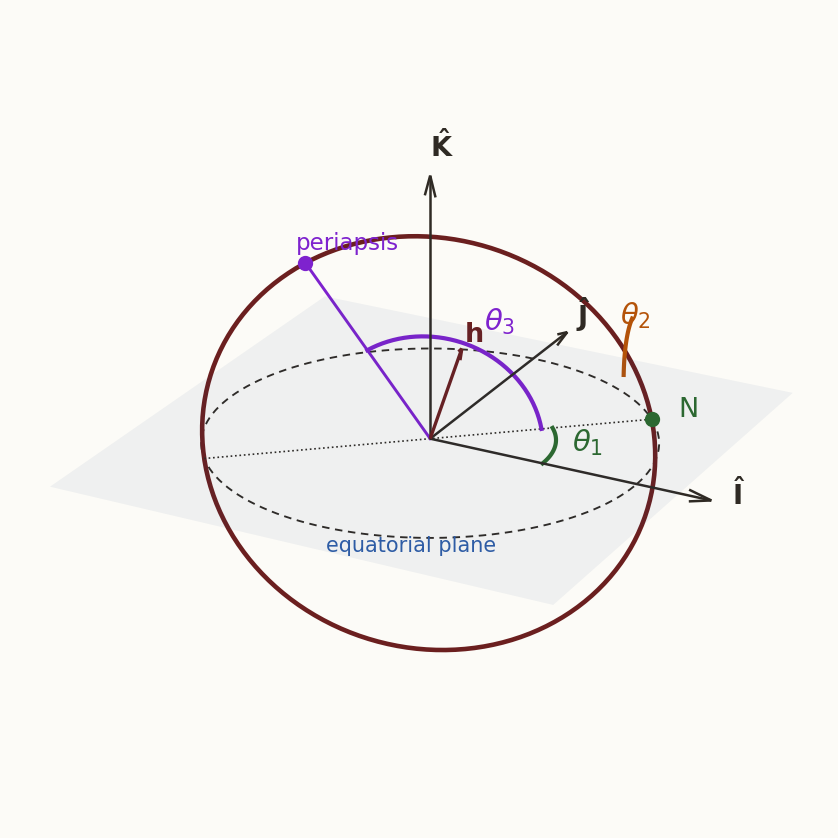
13. In Figure 1, which angle is the argument of periapsis?
- \(\theta_1\)
- \(\theta_2\)
- \(\theta_3\)
- none of them
Answer
(C) \(\theta_3\) lies in the orbit plane, from the ascending node N to periapsis. \(\theta_1\) (in the equator, from \(\hat{\mathbf I}\) to N) is \(\Omega\), and \(\theta_2\) (between the planes, at the node) is \(i\).
14. A polar orbit has inclination
- \(180^\circ\)
- \(90^\circ\)
- \(45^\circ\)
- \(0^\circ\)
Answer
(B) \(i=90^\circ\) makes \(\mathbf h\) lie in the equatorial plane, so the orbit passes over both poles.
15. A sun-synchronous orbit is one whose
- apse line points at the Sun
- period is one solar day
- plane always contains the Sun
- node moves east at the Sun’s mean rate, about \(0.986^\circ\) per day
Answer
(D) \(\dot\Omega=360^\circ/365.2422\ \mathrm d=0.9856^\circ/\)day keeps the orbit plane at a fixed angle to the Sun, so the local solar time of each pass is fixed.
16. An orbit has \(\mathbf h=(0,\ -h,\ 0)\). Its inclination is
- undefined
- \(180^\circ\)
- \(90^\circ\)
- \(0^\circ\)
Answer
(C) \(\cos i=h_K/h=0\), so \(i=90^\circ\): \(\mathbf h\) lies in the equatorial plane.
17. Why does a set of orbital elements need an epoch for its reference frame (for example J2000)?
- Because the equator and the equinox themselves move slowly, so \(\hat{\mathbf I}\) and \(\hat{\mathbf K}\) must be fixed at a stated date
- Because the elements are not unique
- Because the Earth rotates
- Because the orbit changes with time
Answer
(A) Precession and nutation move the frame directions. Without an epoch, \(i\) and \(\Omega\) of the same physical orbit would differ between catalogues.
18. A program computes \(\Omega=\arccos(n_I/n)\), the first step of the table in the orbital-elements note (which then prefers \(\operatorname{atan2}\)). When must this be replaced by \(360^\circ-\arccos(n_I/n)\)?
- when \(e_K<0\)
- when \(h_K<0\)
- when \(n_I<0\)
- when \(n_J<0\)
Answer
(D) \(\arccos\) returns \(0^\circ\) to \(180^\circ\). The node is in the lower half of the equator (\(180^\circ<\Omega<360^\circ\)) exactly when \(n_J<0\).
Level 2 — a little difficult
19. An orbit has \(\mathbf h\) along \((0,\ -\sqrt3,\ 1)\). Its inclination is
- \(150^\circ\)
- \(120^\circ\)
- \(60^\circ\)
- \(30^\circ\)
Answer
(C) \(|\mathbf h|\propto2\), so \(\cos i=1/2\) and \(i=60^\circ\). Also \(\mathbf n\propto(\sqrt3,\,0,\,0)\), so \(\Omega=0^\circ\).
20. An orbit has \(\mathbf h\) along \((1,\ 1,\ 1)\). Its right ascension of the ascending node is
- \(315^\circ\)
- \(225^\circ\)
- \(135^\circ\)
- \(45^\circ\)
Answer
(C) \(\mathbf n=\hat{\mathbf K}\times\mathbf h=(-h_J,\ h_I,\ 0)\propto(-1,\ 1,\ 0)\), which is at \(135^\circ\) from \(\hat{\mathbf I}\). (Its inclination is \(\arccos(1/\sqrt3)=54.7^\circ\).)
21. The eccentricity vector of an inclined orbit has \(e_K<0\). Then
- the orbit is retrograde
- \(\Omega>180^\circ\)
- \(0^\circ<\omega<180^\circ\)
- \(180^\circ<\omega<360^\circ\)
Answer
(D) \(e_K=e\sin i\sin\omega\), with \(\sin i>0\). So \(e_K<0\) means \(\sin\omega<0\): periapsis is south of the equator.
22. At some instant \(\mathbf r\cdot\mathbf v<0\). Then the true anomaly is
- between \(0^\circ\) and \(180^\circ\)
- undefined
- exactly \(180^\circ\)
- between \(180^\circ\) and \(360^\circ\)
Answer
(D) \(\mathbf r\cdot\mathbf v=rv_r\) and \(v_r=(\mu/h)e\sin f\). Negative \(v_r\) means the body is falling towards periapsis, so \(\sin f<0\).
23. A satellite has \(i=98^\circ\). The greatest latitude its ground track reaches is (Uses the ground-tracks note.)
- \(98^\circ\)
- \(90^\circ\)
- \(82^\circ\)
- \(8^\circ\)
Answer
(C) \(\sin\delta=\sin i\sin u\), so \(|\delta|_{\max}=i\) for a prograde orbit and \(180^\circ-i=82^\circ\) for a retrograde one.
24. Sriharikota is at latitude \(13.7^\circ\) N. Ignoring range-safety limits on the launch azimuth, the smallest inclination reachable by a direct launch from there is
- \(76.3^\circ\)
- \(13.7^\circ\)
- \(6.9^\circ\)
- \(0^\circ\)
Answer
(B) \(\cos i=\cos\phi\sin\beta\le\cos\phi\), so \(i\ge\phi\), with equality for a launch due east. Lower inclinations need a plane change later.
25. Why must a sun-synchronous orbit be retrograde?
- Because \(J_2\) makes \(\dot\Omega\propto-\cos i\), and the node must move east (\(\dot\Omega>0\))
- Because the Earth rotates eastward
- Because the Sun moves westward in the sky
- Because only retrograde orbits are polar
Answer
(A) \(\dot\Omega=-\tfrac32nJ_2(R_\oplus/p)^2\cos i\). A positive rate needs \(\cos i<0\), i.e. \(i>90^\circ\).
26. For a polar orbit, the \(J_2\) drift of the node is
- zero
- the largest possible
- equal to the Sun’s rate
- westward
Answer
(A) \(\dot\Omega\propto\cos i=0\) at \(i=90^\circ\): the plane stays fixed in inertial space. (The apse line still drifts.)
27. A body is at \(\mathbf r=(7000,0,0)\) km with \(\mathbf v=(0,8,0)\) km/s. Its eccentricity is about
- \(0.50\)
- \(0.25\)
- \(0.12\)
- \(0.06\)
Answer
(C) The velocity is horizontal, so the body is at an apsis, with \(e=|\nu-1|\) for \(\nu=rv^2/\mu=7000\times64/398\,600=1.124\). Hence \(e=0.124\); \(\nu>1\), so this is periapsis, \(f=0^\circ\).
28. For the state of Question 27, the semi-major axis is about
- \(7000\) km
- \(7990\) km
- \(8930\) km
- \(56\,500\) km
Answer
(B) \(a=r/(2-\nu)=7000/0.876=7990\) km. Check: \(r_p=a(1-e)=7000\) km.
29. For a circular equatorial orbit, which single angle can describe where the body is?
- \(\Omega+\omega\)
- \(\omega+f\)
- \(f\)
- the true longitude, \(\Omega+\omega+f\), measured from \(\hat{\mathbf I}\)
Answer
(D) Neither \(\Omega\) nor \(\omega\) exists, but the angle from \(\hat{\mathbf I}\) to the body does. It is what \(\Omega+\omega+f\) tends to as \(i\) and \(e\) go to zero.
30. The longitude of periapsis \(\varpi\) is
- \(\Omega+\omega\)
- \(\omega\) measured in the ecliptic
- \(\omega+f\)
- \(\Omega-\omega\)
Answer
(A) \(\varpi=\Omega+\omega\), a “broken” angle: \(\Omega\) in the equator, then \(\omega\) in the orbit plane. It stays defined as \(i\to0\), where \(\Omega\) does not.
31. A satellite is at \(\mathbf r=(0,\ 7000,\ 0)\) km with \(\mathbf v=(0,\ 0,\ 7.546)\) km/s. Its \(i\) and \(\Omega\) are
- \(i=90^\circ\), \(\Omega=270^\circ\)
- \(i=0^\circ\), \(\Omega\) undefined
- \(i=90^\circ\), \(\Omega=90^\circ\)
- \(i=90^\circ\), \(\Omega=0^\circ\)
Answer
(C) \(\mathbf h=\mathbf r\times\mathbf v=(7000\times7.546,\ 0,\ 0)\), along \(+\hat{\mathbf I}\), so \(i=90^\circ\). \(\mathbf n=\hat{\mathbf K}\times\mathbf h\) is along \(+\hat{\mathbf J}\), so \(\Omega=90^\circ\). The body is at the ascending node, moving north.
32. The ISS orbit has \(i=51.6^\circ\). When its argument of latitude is \(u=30^\circ\), its latitude is about
- \(15.0^\circ\)
- \(23.1^\circ\)
- \(25.8^\circ\)
- \(30.0^\circ\)
Answer
(B) \(\sin\delta=\sin i\sin u=0.7837\times0.5=0.392\), so \(\delta=23.1^\circ\). (Halving \(i\), \(25.8^\circ\), is the common mistake.)
33. A program finds \(\arccos(n_I/n)=60^\circ\) and \(n_J<0\). The correct \(\Omega\) is
- \(300^\circ\)
- \(240^\circ\)
- \(120^\circ\)
- \(60^\circ\)
Answer
(A) With \(n_J<0\) the node is in the lower half-plane, so \(\Omega=360^\circ-60^\circ=300^\circ\).
Level 3 — hard
34. The velocity of a satellite is reversed at some instant, \(\mathbf v\to-\mathbf v\). Its new \((i,\Omega,\omega)\) are
- \((180^\circ-i,\ \Omega+180^\circ,\ 180^\circ-\omega)\)
- \((i,\ \Omega,\ \omega)\)
- \((i,\ \Omega+180^\circ,\ \omega+180^\circ)\)
- \((180^\circ-i,\ \Omega,\ \omega)\)
Answer
(A) \(\mathbf h\to-\mathbf h\) but \(\mathbf e\) is unchanged. So \(\cos i\) flips, the node becomes the old descending node, and since \(e_K=e\sin i\sin\omega\) keeps its value while \(\cos\omega\) flips, \(\omega\to180^\circ-\omega\). Option (C) is the reflection in the equator (Question 43).
35. A rocket is launched from latitude \(13.72^\circ\) on an inertial azimuth of \(135^\circ\) (south-east). The inclination of the orbit is about
- \(13.7^\circ\)
- \(45.0^\circ\)
- \(46.6^\circ\)
- \(133.4^\circ\)
Answer
(C) \(\cos i=\cos\delta\sin\beta=\cos13.72^\circ\times\sin135^\circ=0.687\), so \(i=46.6^\circ\). Launching south-east or north-east gives the same inclination.
36. For an exactly equatorial orbit, a program evaluates \(\Omega=\operatorname{atan2}(h_I,-h_J)\). What happens?
- It returns \(90^\circ\)
- It raises an error
- It returns NaN
- It returns \(0^\circ\) or \(180^\circ\), depending on the signs of the zeros, without any warning
Answer
(D) \(h_I=h_J=0\). In IEEE arithmetic \(\operatorname{atan2}\) of two zeros is defined, but its value depends on their signs: \(\operatorname{atan2}(+0,+0)=0\) and \(\operatorname{atan2}(+0,-0)=180^\circ\). For \(\mathbf r=(7000,0,0)\) km and \(\mathbf v=(0,7.546,0)\) km/s, \(h_I=+0\) and \(-h_J=-0\), so the program prints \(\Omega=180^\circ\). Either way it prints a confident angle with no warning, so a test on \(\sin i\) (or on \(n\)) is still needed.
37. A small impulse along \(\hat{\mathbf h}\) is applied exactly at the ascending node. To first order it changes
- \(i\) only
- \(a\) and \(e\)
- \(\Omega\) only
- \(i\) and \(\Omega\)
Answer
(A) An out-of-plane push rotates the orbit about \(\mathbf r\). At the node \(\mathbf r\) lies along the node line, so the rotation tilts the plane about that line (\(\Delta i=r\Delta v/h\)) and leaves \(\Omega\) and \(\omega\) alone.
38. An orbit has \(e=10^{-4}\). A small error \(\delta e=10^{-5}\) in the eccentricity vector, perpendicular to it, changes \(\omega\) by about
- \(57^\circ\)
- \(5.7^\circ\)
- \(0.06^\circ\)
- \(0.0006^\circ\)
Answer
(B) \(\delta\omega=|\delta\mathbf e|/e=0.1\) rad \(=5.7^\circ\). For a nearly circular orbit \(\omega\) is ill-conditioned, although the position barely changes; \((e\cos\omega,e\sin\omega)\) are well behaved.
39. A Molniya orbit has \(e=0.74\) and \(\omega=270^\circ\). The fraction of each period it spends north of the equator is about
- \(50\%\)
- \(74\%\)
- \(92\%\)
- \(99\%\)
Answer
(C) The southern arc is the half centred on periapsis, \(|f|<90^\circ\), which takes \((\arccos e-e\sqrt{1-e^2})/\pi=0.076\) of the period. So \(92\%\) is spent north, near apoapsis.
40. With \(J_2=1.08263\times10^{-3}\), a circular sun-synchronous orbit at \(700\) km altitude needs an inclination of about
- \(90.0^\circ\)
- \(96.5^\circ\)
- \(98.2^\circ\)
- \(101.4^\circ\)
Answer
(C) \(n=\sqrt{\mu/a^3}=1.060\times10^{-3}\) rad/s for \(a=7078\) km. Then \(\cos i=-\dfrac{2\dot\alpha_\odot}{3nJ_2(R_\oplus/a)^2}=-\dfrac{2\times1.991\times10^{-7}}{3\times9.32\times10^{-7}}=-0.142\), so \(i=98.2^\circ\).
41. A body is at \(\mathbf r=(7000,0,0)\) km with \(\mathbf v=(1,\ 7.546,\ 0)\) km/s, where \(7.546\) km/s is the circular speed at \(7000\) km. Its eccentricity and true anomaly are
- \(e=0\), \(f\) undefined
- \(e=0.13\), \(f=90^\circ\)
- \(e=0.13\), \(f=0^\circ\)
- \(e=0.13\), \(f=270^\circ\)
Answer
(B) The transverse speed is circular, so \(h^2/\mu=r\): the body is at \(r=p\), i.e. \(\cos f=0\). Moving outwards (\(v_r>0\)) gives \(f=90^\circ\), and \(e=v_r/(\mu/h)=1/7.546=0.13\).
42. Why is \(i=\operatorname{atan2}\bigl(\sqrt{h_I^2+h_J^2},\ h_K\bigr)\) preferred to \(i=\arccos(h_K/h)\) for nearly equatorial orbits?
- They give different answers for retrograde orbits
- \(\arccos\) is very steep near \(1\), so it loses precision as \(i\to0\)
- \(\arccos\) cannot return angles below \(1^\circ\)
- \(\operatorname{atan2}\) gives the quadrant of \(i\)
Answer
(B) \(\cos i\approx1-i^2/2\), so a rounding error in \(h_K/h\) becomes a much larger error in \(i\); below \(i\approx10^{-8}\) rad, \(\arccos\) returns exactly \(0\). The \(\operatorname{atan2}\) form uses \(\sqrt{h_I^2+h_J^2}\approx h\,i\) directly.
43. A satellite’s state is reflected in the equatorial plane, \((x,y,z,\dot x,\dot y,\dot z)\to(x,y,-z,\dot x,\dot y,-\dot z)\). Its new \((i,\Omega,\omega)\) are
- \((i,\ \Omega+180^\circ,\ \omega+180^\circ)\)
- \((-i,\ \Omega,\ \omega)\)
- \((180^\circ-i,\ \Omega+180^\circ,\ 180^\circ-\omega)\)
- \((i,\ \Omega,\ -\omega)\)
Answer
(A) \(\mathbf h\) is a pseudovector: \(\mathbf h\to(-h_I,-h_J,h_K)\), so \(i\) is kept and the node turns by \(180^\circ\). \(\mathbf e\) reflects like \(\mathbf r\), so \(e_K\) flips sign and \(\omega\) moves by \(180^\circ\).
44. A small push along \(\hat{\mathbf h}\) is applied at \(u=90^\circ\) to an orbit with \(i=0.5^\circ\). Which statement is correct?
- \(\Omega\) and \(\omega\) change by large, nearly opposite amounts, while \(\Omega+\omega\) hardly changes
- only \(i\) changes
- \(a\) changes
- \(\Omega\) and \(\omega\) hardly change
Answer
(A) \(\Delta\Omega\propto1/\sin i\) is large and \(\Delta\omega=-\cos i\,\Delta\Omega\) nearly cancels it: \(\Delta\varpi=(1-\cos i)\Delta\Omega\to0\). The orbit barely moves; only the split into \(\Omega\) and \(\omega\) is ill-defined.
45. A small impulse purely along \(\hat{\mathbf r}\) is applied at a general point of an elliptical orbit. To first order, which quantities are certainly unchanged?
- \(i\), \(\Omega\) and \(p\); while \(a\), \(e\), \(\omega\) and \(f\) may all change
- \(a\) and \(e\) only
- \(a\), \(i\) and \(\Omega\); while \(e\), \(\omega\) and \(f\) change
- none of the elements
Answer
(A) \(\mathbf r\times\Delta\mathbf v=\mathbf 0\), so \(\mathbf h\) is unchanged in size and direction: the plane (\(i\), \(\Omega\)) and \(p=h^2/\mu\) stay fixed. But the energy changes by \(v_r\,\Delta v\), which is first order unless the burn is at an apsis (\(v_r=0\)). So \(a\) changes in general, and with it \(e\), the apse line and \(f\).
46. The equinox drifts along the ecliptic by about \(50.3''\) per year. Over a century this is about
- \(0.014^\circ\)
- \(0.14^\circ\)
- \(1.4^\circ\)
- \(14^\circ\)
Answer
(C) \(50.3''\times100=5030''=1.40^\circ\). Elements referred to a frame a century old can be off by more than a degree in \(\Omega\), which is why the epoch must be stated.
Answer key
All \(46\) answers.
Answer
| 1 A | 2 D | 3 D | 4 D | 5 A | 6 D | 7 D | 8 A | 9 A | 10 D |
| 11 D | 12 D | 13 C | 14 B | 15 D | 16 C | 17 A | 18 D | 19 C | 20 C |
| 21 D | 22 D | 23 C | 24 B | 25 A | 26 A | 27 C | 28 B | 29 D | 30 A |
| 31 C | 32 B | 33 A | 34 A | 35 C | 36 D | 37 A | 38 B | 39 C | 40 C |
| 41 B | 42 B | 43 A | 44 A | 45 A | 46 C |
Drills
These are plain numericals. Each one practises a method of the note on a concrete case, and none of them adds anything that is not already in the note. Work each one through before you open its solution.
1. Geostationary
What are the elements of a geostationary satellite above \(75^\circ\)E at a given instant? Which of them are undefined, and what would you quote instead?
Solution
We start from what “geostationary” demands, and then go through the six elements one at a time.
A geostationary satellite stays above one point of the equator. So it must move in the equatorial plane, on a circle, with the period of the Earth’s rotation relative to the stars, one sidereal day, \(T=86\,164.09\) s. Each of these three requirements fixes one element.
- Size. Kepler’s third law gives \(a=\bigl(\mu T^2/4\pi^2\bigr)^{1/3}=42\,164\) km. The speed is \(\sqrt{\mu/a}=3.0747\) km/s.
- Shape. A circle, so \(e=0\).
- Tilt. The equatorial plane, moving east with the Earth, so \(i=0^\circ\).
The other three are where the trouble lies. With \(i=0^\circ\) the orbit plane coincides with the equator, the node vector \(\mathbf n=\hat{\mathbf K}\times\mathbf h\) is zero, and there is no line of nodes. So \(\Omega\) is undefined. With \(e=0\) the eccentricity vector is zero, and there is no periapsis. So \(\omega\) is undefined, and so is \(f\), which is measured from periapsis. These are the two breakdowns of the section When the elements break down of the orbital-elements note happening together.
What remains well defined is the direction of the satellite itself. We quote the true longitude \(\lambda\), the angle of \(\mathbf r\) from \(\hat{\mathbf I}\) measured eastward about \(\hat{\mathbf K}\). The satellite is above \(75^\circ\)E, so its angle from the Greenwich meridian is \(75^\circ\). The Greenwich meridian itself stands at the angle \(\theta_G\) (the Greenwich sidereal time of the time note) east of \(\hat{\mathbf I}\) at that instant. Hence
\[ \lambda=\theta_G+75^\circ . \]
So the set we quote is \(a=42\,164\) km, \(e=0\), \(i=0^\circ\) and \(\lambda=\theta_G+75^\circ\). That is four numbers, not six, because a circular equatorial orbit is a special orbit. Only one number changes with time, \(\lambda\), which grows by \(360^\circ\) every sidereal day, exactly as \(\theta_G\) does.
In practice. A real geostationary satellite never has exactly \(e=0\) and \(i=0^\circ\). The Sun, the Moon and the Earth’s flattening keep pushing \(e\) to around \(10^{-4}\) and \(i\) to a fraction of a degree. Then \(\Omega\) and \(\omega\) do exist, but they swing wildly with tiny changes of the state, as the section When the elements break down of the orbital-elements note warns. This is why operators quote these satellites with the non-singular equinoctial elements, or simply by their longitude and the small drifts in longitude and latitude.
2. The ISS
The space station has \(i=51.6^\circ\). What is the highest latitude it flies over? Why can it not be reached from a launch site at latitude \(60^\circ\) without a plane change?
Solution
The highest latitude. Let the satellite be at the argument of latitude \(u\), the angle from the ascending node to the satellite, measured in the orbit plane. Its height above the equatorial plane is the component of \(\mathbf r\) along \(\hat{\mathbf K}\). The orbit plane is tilted by \(i\) about the line of nodes, so a point at the angle \(u\) from the node is at the height \(r\sin u\sin i\). Its latitude \(\varphi\) therefore satisfies
\[ \sin\varphi=\frac{z}{r}=\sin i\,\sin u . \]
This is largest when \(\sin u=1\), that is, \(90^\circ\) after the ascending node, where \(\varphi=i\). So the station reaches latitude \(51.6^\circ\)N, and by symmetry \(51.6^\circ\)S half an orbit later. For a prograde orbit the highest latitude is the inclination itself.
Why not from \(60^\circ\). At the instant of launch the rocket is at the launch site. A short burn cannot carry the rocket far from the plane that contains the centre of the Earth, the site and the direction in which it is heading. So the orbit it reaches passes over the site. By the result above, every point of an orbit with inclination \(i\) is at a latitude between \(-i\) and \(+i\). A site at \(60^\circ\) is outside that band when \(i=51.6^\circ\), so no direct launch can put the vehicle into the station’s orbit. The lowest inclination reachable from \(60^\circ\) is \(60^\circ\) itself, with a launch due east.
The difference of \(8.4^\circ\) must then be removed by a plane change. At the station’s altitude of about \(400\) km, \(r=6778\) km and the circular speed is \(\sqrt{\mu/r}=7.669\) km/s. A plane change by \(\Delta i\) at the speed \(v\) costs \(2v\sin(\Delta i/2)\) (derived in the plane-change note), here
\[ 2\times7.669\times\sin4.2^\circ=1.12\ \text{km/s}. \]
That is about a seventh of the speed of the orbit itself, a very heavy price. This is why the station’s inclination was chosen to suit the launch sites that serve it, not the other way round. It can be reached directly from any site at a latitude below \(51.6^\circ\), such as Baikonur at \(45.9^\circ\)N, Cape Canaveral at \(28.5^\circ\)N or Sriharikota at \(13.7^\circ\)N, by launching in the right direction.
3. State to elements
Find the elements of \(\mathbf r=(7000,\ 0,\ 0)\) km, \(\mathbf v=(0,\ 5,\ 5)\) km/s. Which angles are delicate, and why?
Solution
We follow the algorithm of the section The algorithm of the orbital-elements note step by step and look at every quadrant test as we go.
Steps 1 to 4. We have \(r=7000\) km and \(v=\sqrt{50}=7.0711\) km/s. The dot product \(\mathbf r\cdot\mathbf v=0\), so \(v_r=0\). Then
\[ \mathbf h=\mathbf r\times\mathbf v=(0,\ -35\,000,\ 35\,000)\ \text{km}^2/\text{s},\qquad h=49\,497.5\ \text{km}^2/\text{s}, \]
and \(\cos i=h_K/h=1/\sqrt2\), so \(i=45^\circ\).
Steps 5 and 6. The node vector is \(\mathbf n=(-h_J,\ h_I,\ 0)=(35\,000,\ 0,\ 0)\). So \(\cos\Omega=n_I/n=1\) and \(\Omega=0^\circ\). The test asks for the sign of \(n_J\), which is exactly zero.
Step 7. Since \(\mathbf r\cdot\mathbf v=0\), only the first term survives,
\[ \mathbf e=\frac1\mu\Bigl(v^2-\frac\mu r\Bigr)\mathbf r=\frac{50-56.9429}{398\,600}\,(7000,\,0,\,0)=(-0.12193,\ 0,\ 0), \qquad e=0.12193 . \]
The bracket is negative because \(v^2<\mu/r\). The satellite is slower than the circular speed at its radius, \(7.546\) km/s, so the eccentricity vector points away from it.
Steps 8 and 9. \(\cos\omega=\mathbf n\cdot\mathbf e/(ne)=-1\), so \(\omega=180^\circ\), and the test quantity \(e_K\) is zero. \(\cos f=\mathbf e\cdot\mathbf r/(er)=-1\), so \(f=180^\circ\), and the test quantity \(v_r\) is zero. The satellite is at apoapsis, which agrees with \(v_r=0\) and \(v^2<\mu/r\).
Step 10. \(a=(2/r-v^2/\mu)^{-1}=6239.3\) km and \(p=h^2/\mu=6146.5\) km. Then \(r_a=a(1+e)=7000\) km, as it must be, and \(r_p=a(1-e)=5478.5\) km.
So the elements are \(a=6239.3\) km, \(e=0.12193\), \(i=45^\circ\), \(\Omega=0^\circ\), \(\omega=180^\circ\) and \(f=180^\circ\).
Which angles are delicate. All three angles that carry a quadrant test, \(\Omega\), \(\omega\) and \(f\), are delicate here, for two reasons.
- Each test quantity, \(n_J\), \(e_K\) and \(v_r\), is exactly zero. The slightest error in the state, such as a rounding error, decides its sign at random. Fortunately the two branches agree here. For \(\Omega\) they give \(0^\circ\) and \(360^\circ\), which are the same direction, and for \(\omega\) and \(f\) they both give \(180^\circ\). So the wrong branch does no harm in this case.
- Each cosine is exactly \(\pm1\), where \(\arccos\) is at its worst. Near \(x=1\) we have \(\arccos(1-\delta)\approx\sqrt{2\delta}\), so an error of \(10^{-10}\) in the cosine gives an error of about \(1.4\times10^{-5}\) rad in the angle. Half the significant digits are lost. The quadrant-safe \(\operatorname{atan2}\) form of Equation (2) of the orbital-elements note does not have this trouble.
Reading the result. The perigee radius, \(5478.5\) km, is less than the Earth’s radius. This is not an orbit at all. The satellite is at the top of a trajectory that would enter the atmosphere less than half an orbit later. The elements tell us at once what the state alone hides.
4. The sign tests
Construct a state with \(n_J<0\), \(e_K>0\) and \(v_r<0\), compute its elements, and confirm with a round trip.
Solution
The easy way to construct such a state is backwards. We choose elements for which each sign comes out as required, build the state with the forward map of the section From the elements to \((\mathbf r,\mathbf v)\) of the orbital-elements note, and then run the algorithm of the section The algorithm of the orbital-elements note on it.
Choosing the elements. Each sign condition picks out a range of one angle.
- The node vector points along \((\cos\Omega,\ \sin\Omega,\ 0)\), so \(n_J<0\) needs \(\sin\Omega<0\), that is, \(180^\circ<\Omega<360^\circ\). We take \(\Omega=250^\circ\).
- The periapsis direction is the first column of Equation (3) of the orbital-elements note, whose third entry is \(\sin\omega\sin i\). So \(e_K=e\sin\omega\sin i\), and for a prograde orbit \(e_K>0\) needs \(0^\circ<\omega<180^\circ\). We take \(\omega=60^\circ\) and \(i=40^\circ\).
- The radial speed is \(v_r=(\mu/h)\,e\sin f\), so \(v_r<0\) needs \(180^\circ<f<360^\circ\). We take \(f=250^\circ\).
The size and shape do not affect the signs, so we take \(a=10\,000\) km and \(e=0.3\). Then \(p=a(1-e^2)=9100\) km and \(h=\sqrt{\mu p}=60\,226.7\) km\(^2\)/s.
The forward map. In the perifocal frame,
\[ r=\frac{p}{1+e\cos f}=10\,140.47\ \text{km},\qquad v_r=\frac\mu h\,e\sin f=-1.86576\ \text{km/s},\qquad v_\theta=\frac\mu h\,(1+e\cos f)=5.93924\ \text{km/s}. \]
Rotating with \(\mathbf Q\) of Equation (3) of the orbital-elements note gives the state
\[ \mathbf r=(-7821.151,\ -4089.827,\ -4993.209)\ \text{km},\qquad \mathbf v=(2.631062,\ -4.523091,\ 3.372658)\ \text{km/s}. \]
Back to the elements. Now we forget where the state came from. The algorithm gives \(\mathbf h=(-36\,378.32,\ 13\,240.63,\ 46\,136.36)\), so \(i=\arccos(h_K/h)=40.000^\circ\). Then \(\mathbf n=(-13\,240.63,\ -36\,378.32,\ 0)\) and \(\mathbf e=(0.135719,\ -0.209024,\ 0.167001)\), with \(e=0.30000\), and \(\mathbf r\cdot\mathbf v=-18\,920\) km\(^2\)/s. The three angles are
| angle | \(\cos\) | \(\arccos\) | test | corrected |
|---|---|---|---|---|
| \(\Omega\) | \(-0.34202\) | \(110.000^\circ\) | \(n_J=-36\,378<0\) | \(250.000^\circ\) |
| \(\omega\) | \(+0.50000\) | \(60.000^\circ\) | \(e_K=+0.167>0\) | \(60.000^\circ\) |
| \(f\) | \(-0.34202\) | \(110.000^\circ\) | \(v_r=-1.866<0\) | \(250.000^\circ\) |
Finally \(a=(2/r-v^2/\mu)^{-1}=10\,000.00\) km. Every element comes back as chosen, to the digits shown, so the round trip closes.
Reading the result. Two of the three tests fire and one does not, as the signs demand. The test for \(\omega\) stays silent because the perigee is north of the equator, where the principal value of \(\arccos\) is already right. Had we forgotten the tests, the raw \(\arccos\) would have put the node at \(110^\circ\) and the satellite on its way out instead of on its way in. Constructing a state backwards like this is the standard way to test a program. Every branch of the program can be exercised on purpose, and the true answer is known in advance.
5. Sun-synchronous design
For a \(700\) km circular sun-synchronous orbit, find \(i\). How many revolutions does it make per day? Is the ground track repeated after one day?
Solution
The inclination. For a circle, \(e=0\), and \(a=R_\oplus+700=7078.137\) km. The boxed formula after Equation (1) of the orbital-elements note, with \(\dot\alpha_\odot=2\pi/(365.2422\times86\,400)=1.991\times10^{-7}\) rad/s, gives
\[ \cos i=-\frac{2\,\dot\alpha_\odot\,a^{7/2}}{3\sqrt\mu\,J_2R_\oplus^2}=-0.14242,\qquad i=98.19^\circ . \]
It falls between the \(600\) and \(800\) km rows of the table in the section The three orientation angles of the orbital-elements note, as it should.
Revolutions per day. The period is \(T=2\pi\sqrt{a^3/\mu}=5926.4\) s \(=98.77\) min. In one solar day of \(86\,400\) s the satellite makes \(86\,400/5926.4=14.579\) revolutions.
Is the track repeated after one day? The ground track repeats when the satellite is back at the same point of its orbit and the Earth has also turned back to the same position under the orbit plane. The plane of a sun-synchronous orbit turns with the Sun, so the Earth turns once relative to this plane in exactly one mean solar day. A daily repeat would therefore need a whole number of revolutions in \(86\,400\) s. With \(14.579\) revolutions it is not repeated.
We can see how far it misses. During one revolution the Earth turns under the plane by \(360^\circ\times5926.4/86\,400=24.69^\circ\), so each equator crossing is \(24.69^\circ\) west of the one before. Fifteen revolutions take a little more than a day, and the fifteenth crossing is \(15\times24.69^\circ-360^\circ=10.4^\circ\) west of the first one. The next day’s tracks fall between those of the first day, \(10.4^\circ\) to the west of them.
Reading the result. This is what an imaging mission wants. If the track repeated daily, the satellite would see only fifteen strips of the Earth and never what lies between them. Instead the tracks interleave day after day, and the pattern closes only after many days. The orbit is then tuned so that it closes after a chosen number of days. Landsat, at about \(705\) km, makes \(233\) revolutions in \(16\) days. Its design is the subject of the ground-tracks note, which also takes account of the small change that \(J_2\) makes to the period.
6. Molniya
A Molniya orbit has a period of half a sidereal day and \(e=0.74\). Find \(a\), \(r_p\), \(r_a\), and explain why \(i=63.4^\circ\) is chosen.
Solution
Size and shape. Half a sidereal day is \(T=43\,082.05\) s. Kepler’s third law gives
\[ a=\left(\frac{\mu T^2}{4\pi^2}\right)^{1/3}=26\,561.8\ \text{km}. \]
Then \(r_p=a(1-e)=6906.1\) km and \(r_a=a(1+e)=46\,217.4\) km, at altitudes of \(528\) km and \(39\,839\) km.
Why \(63.4^\circ\). A Molniya satellite serves high northern latitudes, such as Russia, which a geostationary satellite sees only very low on the horizon or not at all. By Kepler’s second law the satellite moves slowly near apogee. With the apogee over the northern hemisphere, at \(\omega=270^\circ\), it spends about eight of its twelve hours high over the north, and it rushes through the south near perigee.
This only works if the apogee stays where it is put. The Earth’s flattening turns the apse line at a rate proportional to \(5\cos^2i-1\) (the section The three orientation angles of the orbital-elements note). For an orbit with a low perigee and this large eccentricity the rate is large. Using the formula of the gravity note, \(\dot\omega=\tfrac34\,nJ_2(R_\oplus/p)^2(5\cos^2i-1)\), it would be \(0.66^\circ\) per day in the equatorial plane, and \(0.18^\circ\) per day at \(i=50^\circ\). At the second rate the apogee would leave the north in a few months. The rate vanishes when
\[ 5\cos^2i-1=0,\qquad\cos i=\frac1{\sqrt5},\qquad i=63.43^\circ . \]
At this critical inclination the apogee stays fixed, and no propellant is spent to hold it. A retrograde orbit at \(116.6^\circ\) would also do, but it would lose the help of the Earth’s rotation at launch. There is a bonus. An inclination of \(63.4^\circ\) also suits the high-latitude launch sites from which these satellites are launched.
7. A spent upper stage
A launch from Sriharikota leaves its spent upper stage in a geosynchronous transfer orbit. Tracking gives its state in the geocentric equatorial frame at one instant, \[ \mathbf r=(-799.0,\ 6769.9,\ -993.1)\ \text{km},\qquad \mathbf v=(-9.4378,\ 0.4934,\ -3.1788)\ \text{km/s}. \] For this exercise take \(\mu=398\,600\) km\(^3\)/s\(^2\) and \(R_\oplus=6378\) km.
(a) Find the specific angular momentum \(h\), the eccentricity \(e\), the semi-major axis \(a\), the perigee and apogee altitudes, and the period.
(b) Find the inclination \(i\), the right ascension of the ascending node \(\Omega\), the argument of perigee \(\omega\) and the true anomaly \(f\). Justify each quadrant choice.
(c) How long ago did the stage pass perigee? How long after the given instant does it reach apogee?
Solution
The plan follows the algorithm of the section The algorithm of the orbital-elements note. The angular momentum vector gives \(h\), \(i\) and the node. The eccentricity vector gives \(e\) and \(\omega\). The energy gives \(a\). Kepler’s equation then turns angles into times.
(a) First the magnitudes and the radial velocity, \[ r=6888.8\ \text{km},\qquad v=9.9710\ \text{km/s},\qquad v_r=\frac{\mathbf r\cdot\mathbf v}{r}=2.0378\ \text{km/s}. \] Then \[ \mathbf h=\mathbf r\times\mathbf v=(-21\,030.2,\ 6832.8,\ 63\,498.7)\ \text{km}^2/\text{s},\qquad h=67\,238.7\ \text{km}^2/\text{s}. \] The eccentricity vector, from step 7 of the algorithm, is \[ \mathbf e=\frac1\mu\Bigl[\Bigl(v^2-\frac\mu r\Bigr)\mathbf r-(\mathbf r\cdot\mathbf v)\,\mathbf v\Bigr]=(0.24908,\ 0.68846,\ 0.00841),\qquad e=0.7322. \] The specific energy is \(\varepsilon=v^2/2-\mu/r=-8.1515\ \mathrm{km^2/s^2}\), so \[ a=-\frac{\mu}{2\varepsilon}=24\,449\ \text{km}. \] As a check, \(p=h^2/\mu=11\,342.3\) km, and \(p/(1-e^2)\) gives the same \(a\). The apsides are at \(r_p=a(1-e)=6548\) km and \(r_a=a(1+e)=42\,351\) km, that is, at altitudes of \(170\) km and \(35\,973\) km. The period is \(T=2\pi\sqrt{a^3/\mu}=10.568\) h.
(b) The inclination needs no quadrant test, because \(i\) lies between \(0^\circ\) and \(180^\circ\), \[ \cos i=\frac{h_K}{h}=0.94438,\qquad i=19.20^\circ . \] The node vector is \(\mathbf n=\hat{\mathbf K}\times\mathbf h=(-h_J,\ h_I,\ 0)=(-6832.8,\ -21\,030.2,\ 0)\), with \(n=22\,112.3\). Then \(\cos\Omega=n_I/n=-0.30900\), whose principal value is \(108.00^\circ\). But \(n_J<0\), so the ascending node is in the half of the equator with \(J<0\), and \[ \Omega=360^\circ-108.00^\circ=252.00^\circ . \] For the argument of perigee, \(\cos\omega=\mathbf n\cdot\mathbf e/(ne)\) gives \(178.00^\circ\). Here \(e_K>0\), so the perigee is north of the equator and the principal value stands, \(\omega=178.00^\circ\). For the true anomaly, \(\cos f=\mathbf e\cdot\mathbf r/(er)\) gives \(28.00^\circ\). Here \(v_r>0\), so the stage is moving away from perigee and again the principal value stands, \(f=28.00^\circ\).
(c) We need the time from perigee to \(f=28^\circ\). Time is uniform in the mean anomaly, so we go from \(f\) to \(E\) to \(M\): \[ \tan\frac E2=\sqrt{\frac{1-e}{1+e}}\tan\frac f2\ \Rightarrow\ E=11.20^\circ,\qquad M=E-e\sin E=0.05326\ \text{rad}. \] The mean motion is \(\sqrt{\mu/a^3}=1.6514\times10^{-4}\) rad/s, so the stage passed perigee \[ t=\frac{M}{\sqrt{\mu/a^3}}=322\ \text{s}=5.37\ \text{min} \] before the given instant. Perigee to apogee takes half the period, \(5.284\) h, so the stage reaches apogee \(5.284-0.090=5.19\) h after the given instant.
8. From a state vector to the elements, and back
A launch from Sriharikota puts a satellite on a geostationary transfer orbit. Some time later its tracking gives the position and velocity, in the geocentric equatorial frame,
\[ \mathbf r=(12\,806.3,\ -16\,065.0,\ 6104.1)\ \text{km},\qquad \mathbf v=(0.3344,\ 4.5392,\ -0.4312)\ \text{km/s}. \]
- Find \(r\), \(v\) and the radial velocity \(v_r\). Is the satellite moving towards the Earth or away from it?
- Find \(\mathbf h\) and the inclination \(i\).
- Find the node vector \(\mathbf N\) and the right ascension of the ascending node \(\Omega\). Say which quadrant test you use.
- Find the eccentricity vector, \(e\) and the argument of perigee \(\omega\), with its quadrant test.
- Find the true anomaly \(f\), with its quadrant test.
- Find \(a\), the altitudes of perigee and apogee, and the period.
- Now go back the other way. Find the position and velocity vectors of the satellite at its next apogee, in the geocentric equatorial frame. Use the perifocal unit vectors \(\hat{\mathbf p}\) and \(\hat{\mathbf q}\), expressed in the equatorial frame. Check that the two vectors you find are perpendicular.
Solution
The plan follows the algorithm of the orbital-elements note. Three vectors do all the work, \(\mathbf h\), \(\mathbf N\) and \(\mathbf e\). Each angle comes from an \(\arccos\), which cannot tell an angle from its mirror image, so each needs a quadrant test. In this problem all three tests fire.
(a) Magnitudes and radial velocity. \(r=21\,432.35\) km and \(v=4.57188\) km/s. The dot product is \(\mathbf r\cdot\mathbf v=-71\,271.9\) km\(^2\)/s, so \[ v_r=\frac{\mathbf r\cdot\mathbf v}{r}=-3.32544\ \text{km/s}. \] It is negative, so the satellite is moving towards the Earth. It has passed apogee and is on its way down.
(b) Angular momentum and inclination. \[ \mathbf h=\mathbf r\times\mathbf v=(-20\,780.50,\ 7563.29,\ 63\,502.49)\ \text{km}^2/\text{s},\qquad h=67\,242.84\ \text{km}^2/\text{s}. \] Then \(\cos i=h_Z/h=0.94438\) and \(i=19.200^\circ\). This is the inclination of a launch from Sriharikota heading south of east, as in the plane-change note.
(c) The node. \(\mathbf N=\hat{\mathbf K}\times\mathbf h=(-h_Y,\ h_X,\ 0)=(-7563.29,\ -20\,780.50,\ 0)\) km\(^2\)/s, with \(N=22\,114.08\) km\(^2\)/s. The \(\arccos\) gives \(\arccos(N_X/N)=110.000^\circ\). But \(N_Y<0\), so the node is in the lower half of the equatorial plane, and \[ \Omega=360^\circ-110.000^\circ=250.000^\circ . \]
(d) The eccentricity vector and \(\omega\). \[ \mathbf e=\frac1\mu\Bigl[\Bigl(v^2-\frac\mu r\Bigr)\mathbf r-rv_r\,\mathbf v\Bigr], \] with \(v^2-\mu/r=2.30402\) km\(^2\)/s\(^2\) and \(rv_r=-71\,271.9\) km\(^2\)/s. This gives \(\mathbf e=(0.133816,\ 0.718773,\ -0.041818)\) and \(e=0.73232\). Then \(\arccos\bigl(\mathbf N\cdot\mathbf e/(Ne)\bigr)=170.00^\circ\). But \(e_Z<0\), so the perigee is south of the equator, and \[ \omega=360^\circ-170.00^\circ=190.00^\circ . \]
(e) The true anomaly. \(\arccos\bigl(\mathbf e\cdot\mathbf r/(er)\bigr)=130.00^\circ\). But \(v_r<0\), so the satellite is past apogee, and \(f=360^\circ-130.00^\circ=230.00^\circ\).
(f) Size and period. From vis-viva, \(a=1/(2/r-v^2/\mu)=24\,462.9\) km. As a check, \(p=h^2/\mu=11\,343.69\) km and \(p/(1-e^2)\) gives the same \(a\). The perigee radius \(p/(1+e)\) is at an altitude of \(170.1\) km and the apogee radius \(p/(1-e)\) at \(35\,999.5\) km. The period is \(10.577\) h. This is a standard geostationary transfer orbit, \(170\times36\,000\) km.
(g) The state at apogee. At apogee \(f=180^\circ\), so \(r_a=p/(1-e)=42\,377.6\) km. In the perifocal frame the velocity is \(\sqrt{\mu/p}\,(-\sin f,\ e+\cos f)\). At \(f=180^\circ\) this is \((0,\ -\sqrt{\mu/p}\,(1-e))\), with \(\sqrt{\mu/p}=5.92778\) km/s, so \(v_a=1.58675\) km/s. Vis-viva gives the same value. So \[ \mathbf r_a=-r_a\,\hat{\mathbf p},\qquad \mathbf v_a=-v_a\,\hat{\mathbf q}. \] We need \(\hat{\mathbf p}\) and \(\hat{\mathbf q}\) in the equatorial frame. There are two ways to get them. The quick way uses the vectors we already have. The unit vector \(\hat{\mathbf p}\) points to perigee, so it is \(\mathbf e/e\). The unit vector \(\hat{\mathbf w}\) is \(\mathbf h/h\), and \(\hat{\mathbf q}=\hat{\mathbf w}\times\hat{\mathbf p}\). \[ \hat{\mathbf p}=(0.18273,\ 0.98150,\ -0.05710),\quad \hat{\mathbf w}=(-0.30904,\ 0.11248,\ 0.94438),\quad \hat{\mathbf q}=(-0.93333,\ 0.15492,\ -0.32387). \] The other way is the rotation matrix \(R_3(\Omega)R_1(i)R_3(\omega)\) of the perifocal note, built from the three angles. Its first two columns are the same \(\hat{\mathbf p}\) and \(\hat{\mathbf q}\). Either way, \[ \mathbf r_a=(-7743.6,\ -41\,593.8,\ 2419.9)\ \text{km},\qquad \mathbf v_a=(1.4810,\ -0.2458,\ 0.5139)\ \text{km/s}. \] Their dot product is zero, as it must be at an apsis, where the velocity is perpendicular to the radius.
Extensions
These problems go beyond the note. Some are purely analytical, and some ask for a derivation and then a number. Most take longer than a drill, and several end with a remark on what the result means for a real mission.
9. Rotation matrices
Show that \(\mathbf R_3(\Omega)\mathbf R_1(i)\mathbf R_3(\omega)\), applied to \((0,0,1)\), gives \(\hat{\mathbf h}\), and applied to \((1,0,0)\) gives the unit vector towards periapsis.
Solution
The plan has two parts for each vector. First we multiply out, applying the three rotations from right to left. Then we work out \(\hat{\mathbf h}\) and the periapsis direction directly from the definitions of \(i\), \(\Omega\) and \(\omega\), and compare.
The normal. \(\mathbf R_3(\omega)\) turns about the third axis, so it leaves \((0,0,1)\) unchanged. \(\mathbf R_1(i)\) then gives \((0,\ -\sin i,\ \cos i)\), and \(\mathbf R_3(\Omega)\) gives
\[ \mathbf Q\begin{bmatrix}0\\0\\1\end{bmatrix}=\begin{bmatrix}\sin\Omega\sin i\\ -\cos\Omega\sin i\\ \cos i\end{bmatrix}. \]
Now from the definitions. The inclination is the angle between \(\hat{\mathbf h}\) and \(\hat{\mathbf K}\), so \(h_K/h=\cos i\), and the part of \(\hat{\mathbf h}\) in the equatorial plane has length \(\sin i\). The node vector \(\mathbf n=\hat{\mathbf K}\times\mathbf h=(-h_J,\ h_I,\ 0)\) points along \((\cos\Omega,\ \sin\Omega,\ 0)\), by the definition of \(\Omega\). So \(-h_J\) is proportional to \(\cos\Omega\) and \(h_I\) to \(\sin\Omega\), which gives \(\hat{\mathbf h}=(\sin i\sin\Omega,\ -\sin i\cos\Omega,\ \cos i)\). This is the vector found above.
The periapsis direction. Multiplying out again, \(\mathbf R_3(\omega)\) turns \((1,0,0)\) into \((\cos\omega,\ \sin\omega,\ 0)\), then \(\mathbf R_1(i)\) gives \((\cos\omega,\ \sin\omega\cos i,\ \sin\omega\sin i)\), and \(\mathbf R_3(\Omega)\) gives
\[ \mathbf Q\begin{bmatrix}1\\0\\0\end{bmatrix}= \begin{bmatrix}\cos\Omega\cos\omega-\sin\Omega\sin\omega\cos i\\ \sin\Omega\cos\omega+\cos\Omega\sin\omega\cos i\\ \sin\omega\sin i\end{bmatrix}. \]
Now from the definitions. The argument of periapsis \(\omega\) is the angle from the ascending node to periapsis, measured in the orbit plane in the direction of motion. Two unit vectors in the plane make this easy to use. The first is \(\hat{\mathbf n}=(\cos\Omega,\ \sin\Omega,\ 0)\). The second, \(\hat{\mathbf m}=\hat{\mathbf h}\times\hat{\mathbf n}\), is \(\hat{\mathbf n}\) turned by \(90^\circ\) about \(\hat{\mathbf h}\), which is the direction of motion. Using the \(\hat{\mathbf h}\) found above,
\[ \hat{\mathbf m}=\hat{\mathbf h}\times\hat{\mathbf n}=(-\sin\Omega\cos i,\ \cos\Omega\cos i,\ \sin i). \]
The unit vector at the angle \(\omega\) from \(\hat{\mathbf n}\) towards \(\hat{\mathbf m}\) is \(\hat{\mathbf p}=\cos\omega\,\hat{\mathbf n}+\sin\omega\,\hat{\mathbf m}\). Adding the components,
\[ \hat{\mathbf p}=\bigl(\cos\Omega\cos\omega-\sin\Omega\sin\omega\cos i,\ \ \sin\Omega\cos\omega+\cos\Omega\sin\omega\cos i,\ \ \sin\omega\sin i\bigr), \]
which is the vector found above.
Reading the result. The columns of \(\mathbf Q\) are the perifocal unit vectors written in the inertial frame. This is true of any rotation matrix, since \(\mathbf Q\) applied to the \(k\)-th unit vector picks out the \(k\)-th column. The third column is the orbit normal, and it contains no \(\omega\), because turning the apse line within the plane cannot move the plane. Its third entry, \(\sin\omega\sin i\), is also the sign test of step 8 of the algorithm. The perigee is north of the equator exactly when \(\sin\omega>0\).
10. What the constants know
Prove that \(\mathbf h\cdot\mathbf e=0\) and \(e^2=1+2\varepsilon h^2/\mu^2\).
Hence show that the seven scalars in \((\mathbf h,\mathbf e,\varepsilon)\) hold only five independent numbers, and name the five classical elements they fix.
Show that, of all orbits with a given \(h\), the circle has the least energy, and that of all orbits with a given \(a\), the circle has the greatest \(h\).
Answer
(a) The vector \(\mathbf e\) is built from two pieces, \(\mathbf v\times\mathbf h\) and \(\hat{\mathbf r}\). Both are perpendicular to \(\mathbf h\): the first because it is a cross product with \(\mathbf h\), and the second because \(\mathbf h=\mathbf r\times\mathbf v\) is perpendicular to \(\mathbf r\). So \(\mathbf h\cdot\mathbf e=0\), which says that \(\mathbf e\) lies in the orbit plane.
For the magnitude, expand \(\mathbf e\cdot\mathbf e\):
\[ e^2=\frac{|\mathbf v\times\mathbf h|^2}{\mu^2}-\frac{2\,(\mathbf v\times\mathbf h)\cdot\hat{\mathbf r}}{\mu}+1 . \]
We need two quantities.
- \(|\mathbf v\times\mathbf h|=vh\), because \(\mathbf v\) is perpendicular to \(\mathbf h\).
- \((\mathbf v\times\mathbf h)\cdot\mathbf r\): a scalar triple product does not change when its factors are cycled, so \((\mathbf v\times\mathbf h)\cdot\mathbf r=\mathbf h\cdot(\mathbf r\times\mathbf v)=\mathbf h\cdot\mathbf h=h^2\). Hence \((\mathbf v\times\mathbf h)\cdot\hat{\mathbf r}=h^2/r\).
Putting these in,
\[ e^2=\frac{v^2h^2}{\mu^2}-\frac{2h^2}{\mu r}+1=1+\frac{2h^2}{\mu^2}\Bigl(\frac{v^2}{2}-\frac{\mu}{r}\Bigr) =1+\frac{2\varepsilon h^2}{\mu^2}. \]
(b) Count the numbers: \(\mathbf h\) has three, \(\mathbf e\) three and \(\varepsilon\) one, seven in all. But (a) gives two relations among them. \(\mathbf h\cdot\mathbf e=0\) fixes one component of \(\mathbf e\) once the others are known, and \(e^2=1+2\varepsilon h^2/\mu^2\) fixes \(\varepsilon\) once \(\mathbf h\) and \(\mathbf e\) are known. That leaves five independent numbers. They are:
- from \(\mathbf h\): the plane (\(i\) from \(h_K/h\), and \(\Omega\) from the node vector \(\mathbf n=\hat{\mathbf K}\times\mathbf h\)), and the size \(p=h^2/\mu\);
- from \(\mathbf e\), which lies in that plane: \(e\), and \(\omega\), its angle from \(\mathbf n\).
\(\varepsilon\) adds nothing new: \(\varepsilon=-\mu^2(1-e^2)/(2h^2)\). The sixth element, \(f\) or the time of periapsis, says where the body is on the orbit. No constant of the motion can give it, because it changes with time.
(c) Since \(e^2\ge0\), the relation in (a) gives \(1+2\varepsilon h^2/\mu^2\ge0\), i.e.
\[ \varepsilon\ \ge\ -\frac{\mu^2}{2h^2}, \]
with equality only when \(e=0\). So, of all orbits with a given \(h\), the circle has the least energy. For the second statement, write the energy in terms of \(a\) instead, \(\varepsilon=-\mu/(2a)\). Then (a) becomes \(e^2=1-h^2/(\mu a)\), so
\[ h^2=\mu a\,(1-e^2)\ \le\ \mu a , \]
again with equality only for the circle. Of all orbits with a given \(a\) (a given energy), the circle has the greatest angular momentum. This is the fact behind the Hohmann optimality proof in the Hohmann note, where the cost decreases with \(h\) and increases with \(\varepsilon\).
11. One state
A body at distance \(r\) moves with speed \(v\) at flight-path angle \(\gamma\). Put \(\nu=rv^2/\mu\) (take \(\nu<2\)).
- Show that
\[ a=\frac{r}{2-\nu},\qquad e^2=1-\nu(2-\nu)\cos^2\gamma,\qquad \tan f=\frac{\nu\sin\gamma\cos\gamma}{\nu\cos^2\gamma-1}. \]
For fixed \(r\) and \(v\), show that \(e\) is least when the velocity is horizontal, and that its least value is \(|\nu-1|\). Where on the orbit is the body then?
Show that the empty focus is at distance \(2a-r\) from the body, on the line from the body to the attracting focus reflected in the normal to \(\mathbf v\). Hence, as the direction of \(\mathbf v\) varies at fixed speed, the empty focus moves on a circle. Use this to rederive (b), and find the direction of \(\mathbf v\) that gives the greatest \(e\).
Answer
We are given the state in the form \((r,v,\gamma)\) and want \(a\), \(e\) and \(f\). The plan:
- \(a\) from the energy (vis-viva), which needs only \(r\) and \(v\);
- \(e\) from Problem 10, which needs \(\varepsilon\) and \(h\);
- \(f\) from the orbit equation and the radial velocity, which give \(e\cos f\) and \(e\sin f\).
Why \(\nu\)? In all three, the speed enters only through the combination \(rv^2/\mu=v^2/(\mu/r)\). That is the square of the speed measured in units of the local circular speed. So \(\nu=1\) is circular speed, \(\nu=2\) is escape speed, and \(\nu<2\) means an ellipse. Writing everything in terms of \(\nu\) makes the formulas dimensionless.
(a) Semi-major axis. Vis-viva, \(v^2=\mu(2/r-1/a)\), gives \(1/a=2/r-v^2/\mu=(2-\nu)/r\).
Eccentricity. Only the transverse part of \(\mathbf v\) contributes to \(h\), so \(h=r\,v\cos\gamma\). The energy is \(\varepsilon=v^2/2-\mu/r=\frac{\mu}{2r}(\nu-2)\). Then
\[ \frac{2\varepsilon h^2}{\mu^2}=2\cdot\frac{\mu}{2r}(\nu-2)\cdot\frac{r^2v^2\cos^2\gamma}{\mu^2} =(\nu-2)\,\frac{rv^2}{\mu}\cos^2\gamma=(\nu-2)\,\nu\cos^2\gamma , \]
and Problem 10 gives \(e^2=1-\nu(2-\nu)\cos^2\gamma\).
True anomaly. We want two equations, one for \(e\cos f\) and one for \(e\sin f\), so that we get both the angle and its quadrant. The orbit equation \(r=p/(1+e\cos f)\), with \(p=h^2/\mu\), gives
\[ e\cos f=\frac{h^2}{\mu r}-1=\frac{r^2v^2\cos^2\gamma}{\mu r}-1=\nu\cos^2\gamma-1 . \]
The radial velocity \(v_r=v\sin\gamma=(\mu/h)\,e\sin f\) gives
\[ e\sin f=\frac{h\,v\sin\gamma}{\mu}=\frac{rv^2}{\mu}\sin\gamma\cos\gamma=\nu\sin\gamma\cos\gamma . \]
Their ratio is the stated \(\tan f\), and their signs give its quadrant.
(b) At fixed \(r\) and \(v\), \(\nu\) is fixed and only \(\gamma\) varies. In \(e^2=1-\nu(2-\nu)\cos^2\gamma\) the factor \(\nu(2-\nu)\) is positive for \(0<\nu<2\), so \(e\) is least when \(\cos^2\gamma\) is greatest, \(\cos^2\gamma=1\): horizontal velocity. Then \(e^2=1-2\nu+\nu^2=(\nu-1)^2\), so \(e_{\min}=|\nu-1|\).
Where is the body? With \(\gamma=0\), \(e\sin f=0\) and \(e\cos f=\nu-1\). So it is at periapsis if \(\nu>1\) and at apoapsis if \(\nu<1\). That makes sense: moving horizontally and faster than circular, the body is at the lowest point of its orbit. The orbit is a circle only if \(\nu=1\) and \(\gamma=0\).
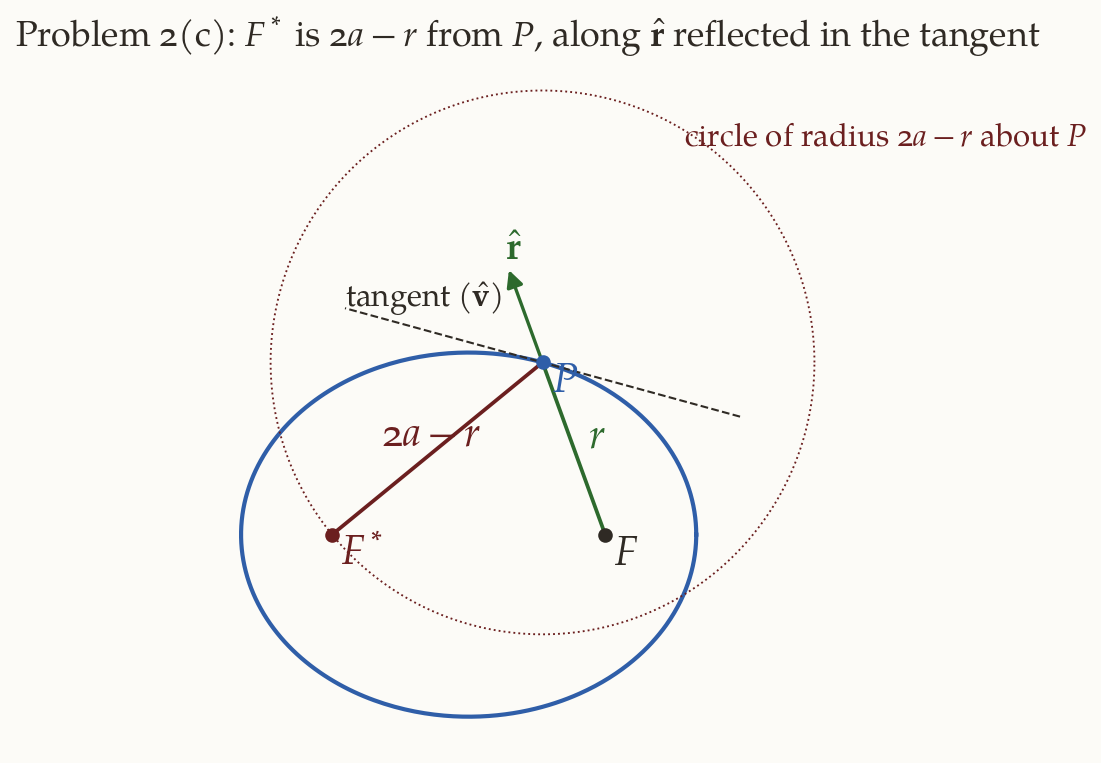
(c) Let \(P\) be the body, \(F\) the attracting focus and \(F^*\) the empty one. Two facts about the ellipse locate \(F^*\).
- Its distance. The sum of the distances from the foci is \(PF+PF^*=2a\), so \(PF^*=2a-r\).
- Its direction. The reflection property: the tangent at \(P\) makes equal angles with \(PF\) and \(PF^*\). (Proof: along the ellipse \(PF+PF^*\) is constant, so its derivative along the tangent vanishes. The derivative of a distance \(PF\) along a unit vector \(\hat{\mathbf t}\) is \(\hat{\mathbf t}\cdot\widehat{FP}\), so \(\hat{\mathbf t}\cdot\widehat{FP}=-\hat{\mathbf t}\cdot\widehat{F^*P}\): the two unit vectors from the foci make supplementary angles with the tangent, which is the same as equal angles with the tangent line.) So the direction from \(P\) to \(F^*\) is the outward radial direction \(\hat{\mathbf r}\) reflected in the tangent line. Reflecting a unit vector in the line along \(\hat{\mathbf v}\) keeps its component along \(\hat{\mathbf v}\) and reverses the rest, which gives \(2(\hat{\mathbf r}\cdot\hat{\mathbf v})\,\hat{\mathbf v}-\hat{\mathbf r}\).
So
\[ \mathbf F^*=\mathbf r+(2a-r)\bigl[2(\hat{\mathbf r}\cdot\hat{\mathbf v})\,\hat{\mathbf v}-\hat{\mathbf r}\bigr]. \]
Now keep the speed fixed and turn the direction of \(\mathbf v\). Then \(a\) is fixed, by (a), and so is the distance \(2a-r\). Only the direction changes, so \(F^*\) moves on the circle of radius \(2a-r\) about \(P\).
This gives (b) without any algebra. The distance between the foci is \(FF^*=2ae\). So to make \(e\) small we want the point of that circle nearest to \(F\), and \(F\) is at distance \(r\) from the centre \(P\) of the circle. The nearest point is at distance \(|r-(2a-r)|\), so
\[ 2ae\ \ge\ \bigl|\,r-(2a-r)\,\bigr|\quad\Longrightarrow\quad e\ \ge\ \Bigl|1-\frac ra\Bigr|=|1-(2-\nu)|=|\nu-1| . \]
Equality needs \(F^*\) between \(P\) and \(F\) on the line \(PF\), which happens when the reflected direction is \(-\hat{\mathbf r}\), i.e. when \(\hat{\mathbf r}\cdot\hat{\mathbf v}=0\): horizontal velocity, as in (b).
The greatest \(e\) comes from the far point of the circle, where \(FF^*=r+(2a-r)=2a\) and \(e=1\). That needs the reflected direction to be \(+\hat{\mathbf r}\), which happens for \(\hat{\mathbf v}=\pm\hat{\mathbf r}\). A radial launch gives the degenerate, straight-line ellipse.
12. Averages over one orbit
For an ellipse \((a,e)\) with semi-minor axis \(b\), show that the time averages over one period are
\[ \Bigl\langle\frac1r\Bigr\rangle=\frac1a,\quad \Bigl\langle\frac1{r^2}\Bigr\rangle=\frac1{ab},\quad \langle r\rangle=a\Bigl(1+\frac{e^2}{2}\Bigr),\quad \langle r^2\rangle=a^2\Bigl(1+\frac{3e^2}{2}\Bigr),\quad \langle v^2\rangle=\frac{\mu}{a}, \]
while the average of \(r\) over true anomaly is \(b\). Show that the body spends the fraction \(\frac12-\frac e\pi\) of each period inside the circle \(r=a\). In what sense is \(a\) the “mean distance”?
Answer
A time average is \(\langle g\rangle=\frac1T\oint g\,dt\). We cannot do these integrals in \(t\) directly, because \(r(t)\) has no closed form. So we change variable to one of the anomalies, and choose the one that makes each integrand simplest.
- Eccentric anomaly. \(r=a(1-e\cos E)\) is linear in \(\cos E\). Kepler’s equation \(M=E-e\sin E\) gives \(dM=(1-e\cos E)\,dE=(r/a)\,dE\), and \(M\) grows uniformly in time. So \[ \langle g\rangle=\frac1{2\pi}\oint g\;\frac ra\,dE . \]
- True anomaly. Angular momentum gives \(dt=r^2df/h\). This is the better choice when \(g\) has a factor \(1/r^2\).
The five time averages.
- \(g=1/r\): the factor \(r\) cancels, \(\langle 1/r\rangle=\frac1{2\pi}\oint\frac{dE}{a}=\frac1a\). This is the simplest average of all.
- \(g=r\): \(\langle r\rangle=\frac{a}{2\pi}\oint(1-e\cos E)^2dE=a\bigl(1+\frac{e^2}2\bigr)\), using \(\oint\cos E\,dE=0\) and \(\oint\cos^2E\,dE=\pi\).
- \(g=r^2\): \(\langle r^2\rangle=\frac{a^2}{2\pi}\oint(1-e\cos E)^3dE\). Expand the cube; the odd powers of \(\cos E\) integrate to zero, leaving \(\frac{a^2}{2\pi}(2\pi+3e^2\pi)=a^2\bigl(1+\frac{3e^2}2\bigr)\).
- \(g=1/r^2\): use the true anomaly. \(\langle1/r^2\rangle=\frac1T\oint\frac1{r^2}\frac{r^2df}{h}=\frac{2\pi}{hT}\). The areal velocity \(h/2\) times the period \(T\) is the area \(\pi ab\), so \(hT=2\pi ab\) and \(\langle1/r^2\rangle=1/(ab)\).
- \(g=v^2\): vis-viva writes \(v^2=\mu(2/r-1/a)\) in terms of \(1/r\), whose average we already have: \(\langle v^2\rangle=\mu(2/a-1/a)=\mu/a\). This is the virial theorem: the mean kinetic energy \(\frac12\langle v^2\rangle=\mu/(2a)\) is \(-\varepsilon\).
The average over true anomaly. This one is not a time average, so no \(dt\) appears:
\[ \langle r\rangle_f=\frac{1}{2\pi}\oint\frac{p\,df}{1+e\cos f}=\frac{p}{\sqrt{1-e^2}}=a\sqrt{1-e^2}=b, \]
using the standard integral \(\oint\frac{df}{1+e\cos f}=\frac{2\pi}{\sqrt{1-e^2}}\). (It follows from the eccentric anomaly. With \(1+e\cos f=p/r\) and \(df/dE=b/r\), the integrand is \((r/p)(b/r)\,dE=(b/p)\,dE=dE/\sqrt{1-e^2}\), and \(E\) also runs once round.)
Inside \(r=a\). From \(r=a(1-e\cos E)\), the body is inside \(r=a\) exactly when \(\cos E>0\), i.e. \(|E|<\frac\pi2\). At \(E=\pm\frac\pi2\), Kepler’s equation gives \(M=\pm(\frac\pi2-e)\). \(M\) is uniform in time, so the fraction of the period is \((\pi-2e)/(2\pi)=\frac12-\frac e\pi\). The body is in the inner half of its range for less than half the time, because it moves fast there.
“Mean distance”. The three averages of \(r\) are in the order \(\langle r\rangle_f=b<a<a(1+\frac{e^2}{2})=\langle r\rangle_t\). Kepler’s “mean distance” was \((r_p+r_a)/2=a\). That is also the average of \(r\) over the eccentric anomaly, \(\frac{1}{2\pi}\oint a(1-e\cos E)\,dE=a\), and the reciprocal of the time average of \(1/r\). That last one is the average that enters the energy, which is why \(a\) alone fixes \(\varepsilon\) and \(T\).
13. Symmetries
- The velocity of a body is reversed at some instant. Show that its new elements are
\[ (a,\ e,\ 180^\circ-i,\ \Omega+180^\circ,\ 180^\circ-\omega,\ 360^\circ-f). \]
The state is reflected in the equatorial plane, \((x,y,z,\dot x,\dot y,\dot z)\mapsto(x,y,-z,\dot x,\dot y,-\dot z)\). Show that the new elements are \((a,\ e,\ i,\ \Omega+180^\circ,\ \omega+180^\circ,\ f)\).
An observer sees the orbit only as a curve in space, without the sense of motion. Which elements can the observer determine?
Answer
Every element is computed from \(\mathbf h\), \(\mathbf e\) and the state. So for each symmetry we first ask what happens to the vectors \(\mathbf h\) and \(\mathbf e\), and then read off the elements.
(a) Replace \(\mathbf v\) by \(-\mathbf v\) and keep \(\mathbf r\).
- \(\mathbf h'=\mathbf r\times(-\mathbf v)=-\mathbf h\): the angular momentum reverses.
- \(\mathbf e'=(-\mathbf v)\times(-\mathbf h)/\mu-\hat{\mathbf r}=\mathbf e\): the two sign changes cancel, so the eccentricity vector is unchanged.
The speed and \(r\) are unchanged, so the energy is too, and \(a'=a\), \(e'=e\). Now the angles.
- \(\cos i'=h'_K/h=-\cos i\), so \(i'=180^\circ-i\).
- \(\mathbf n'=\hat{\mathbf K}\times\mathbf h'=-\mathbf n\): the ascending node becomes the descending one, so \(\Omega'=\Omega+180^\circ\).
- For \(\omega\) we need its sine and its cosine. \(\cos\omega'=\mathbf n'\cdot\mathbf e/(ne)=-\cos\omega\). For the sine, the periapsis direction has \(K\) component \(e_K=e\sin i\sin\omega\). (This is the third component of \(\mathbf R_3(\Omega)\mathbf R_1(i)(\cos\omega,\ \sin\omega,\ 0)^{\mathsf T}\): \(\mathbf R_1(i)\) sends the second component \(\sin\omega\) to height \(\sin i\sin\omega\), and \(\mathbf R_3\) does not change heights. Problem 14 derives the same fact for any \(u\).) Both \(e_K\) and \(\sin i'=\sin i\) are unchanged, so \(\sin\omega'=\sin\omega\). Hence \(\omega'=180^\circ-\omega\).
- \(\cos f'=\mathbf e\cdot\mathbf r/(er)=\cos f\) is unchanged, but \(\mathbf r\cdot\mathbf v'=-\mathbf r\cdot\mathbf v\), so the body is now moving the other way along the same curve: inbound where it was outbound. Hence \(f'=-f\), i.e. \(360^\circ-f\).
(b) Let \(\mathbf M=\operatorname{diag}(1,1,-1)\) be the reflection, so \(\mathbf r'=\mathbf M\mathbf r\) and \(\mathbf v'=\mathbf M\mathbf v\). The one fact we need is how a cross product behaves under a reflection: \((\mathbf M\mathbf a)\times(\mathbf M\mathbf b)=-\mathbf M(\mathbf a\times\mathbf b)\). (Check it on \(\hat{\mathbf I}\times\hat{\mathbf J}=\hat{\mathbf K}\): the left side is still \(\hat{\mathbf K}\), and \(-\mathbf M\hat{\mathbf K}=\hat{\mathbf K}\).) So
\[ \mathbf h'=-\mathbf M\mathbf h=(-h_I,\,-h_J,\,h_K), \]
and the angular momentum does not reflect like an ordinary vector. Then:
- \(h'_K=h_K\), so \(i'=i\).
- \(\mathbf n'=\hat{\mathbf K}\times\mathbf h'=(-h'_J,\,h'_I,\,0)=(h_J,\,-h_I,\,0)=-\mathbf n\), so \(\Omega'=\Omega+180^\circ\).
- \(\mathbf e'=(\mathbf M\mathbf v)\times(-\mathbf M\mathbf h)/\mu-\mathbf M\hat{\mathbf r}=\mathbf M(\mathbf v\times\mathbf h)/\mu-\mathbf M\hat{\mathbf r}=\mathbf M\mathbf e\): the eccentricity vector is an ordinary vector, and reflects.
- \(\cos\omega'=\mathbf n'\cdot\mathbf M\mathbf e/(ne)=-\cos\omega\), because \(\mathbf n\) has no \(K\) component. And \(e'_K=-e_K\) gives \(\sin\omega'=-\sin\omega\). So \(\omega'=\omega+180^\circ\).
- \(\mathbf M\mathbf e\cdot\mathbf M\mathbf r=\mathbf e\cdot\mathbf r\) and \(\mathbf M\mathbf r\cdot\mathbf M\mathbf v=\mathbf r\cdot\mathbf v\), so \(f'=f\).
As a check, \(u'=\omega'+f'=u+180^\circ\), so \(\sin\delta'=\sin i\sin(u+180^\circ)=-\sin\delta\): the image is south whenever the body is north, as a reflection in the equator should be.
(c) Reversing the motion maps the curve onto itself. So the curve alone cannot tell apart the two sets of elements in (a). It does fix \(a\), \(e\), the plane (without a sense of rotation) and the direction of periapsis. Hence it fixes \((i,\Omega,\omega)\) up to the map in (a). The one bit of information it cannot give is the sense of motion, which the elements store in whether \(i\) is below or above \(90^\circ\).
14. Latitude, right ascension and heading
- A body is at argument of latitude \(u\) on an orbit \((i,\Omega)\). Show that its declination \(\delta\) and right ascension \(\alpha\) satisfy
\[ \sin\delta=\sin i\sin u,\qquad \tan(\alpha-\Omega)=\cos i\,\tan u , \]
with \(\alpha-\Omega\) in the quadrant of \((\cos u,\ \cos i\sin u)\). Hence find the greatest latitude the orbit reaches.
Let \(\beta\) be the azimuth of the inertial velocity, measured from north towards east. Show that \(\cos i=\cos\delta\,\sin\beta\).
Prove that a launch from latitude \(\phi\) cannot go directly into an orbit with \(i<|\phi|\), and that a launch due east gives \(i=|\phi|\). Where on its orbit does a body move due east?
Answer
(a) We want the direction of the body in the equatorial frame. The 3-1-3 rotation of the perifocal note does exactly this: in the orbit plane, measured from the node, the body is at \((\cos u,\ \sin u,\ 0)\), and
\[ \hat{\mathbf r}=\mathbf R_3(\Omega)\,\mathbf R_1(i)\,(\cos u,\ \sin u,\ 0)^{\mathsf T}. \]
Do the two rotations one at a time. \(\mathbf R_1(i)\) tilts the plane about the node line, giving \((\cos u,\ \cos i\sin u,\ \sin i\sin u)\). Its \(K\) component is the sine of the declination, so \(\sin\delta=\sin i\sin u\). Then \(\mathbf R_3(\Omega)\) turns everything about \(\hat{\mathbf K}\) by \(\Omega\). That adds \(\Omega\) to the azimuth in the \(IJ\) plane and leaves the \(K\) component alone. So \(\alpha-\Omega\) is the azimuth of the pair \((\cos u,\ \cos i\sin u)\), which gives the stated \(\tan(\alpha-\Omega)\) and its quadrant.
The greatest latitude. \(|\sin\delta|=\sin i\,|\sin u|\le\sin i\), with equality at \(u=90^\circ\) and \(u=270^\circ\). So the orbit reaches latitude \(i\) if \(i\le90^\circ\), and \(180^\circ-i\) if it is retrograde.
(b) The heading \(\beta\) is defined in the local horizontal frame, and \(i\) is defined by \(\cos i=h_K/h\). So we compute \(\mathbf h\) in the local frame and take its \(K\) component. Take the local unit vectors \(\hat{\mathbf r}\), east \(\hat{\mathbf E}=\hat{\mathbf K}\times\hat{\mathbf r}/\cos\delta\), and north \(\hat{\mathbf N}=\hat{\mathbf r}\times\hat{\mathbf E}\). Their \(K\) components are \(\sin\delta\), \(0\) and \(\cos\delta\). Write \(\mathbf v=v_r\hat{\mathbf r}+v_E\hat{\mathbf E}+v_N\hat{\mathbf N}\). Since \(\hat{\mathbf r}\times\hat{\mathbf E}=\hat{\mathbf N}\) and \(\hat{\mathbf r}\times\hat{\mathbf N}=-\hat{\mathbf E}\),
\[ \mathbf h=r\,\hat{\mathbf r}\times\mathbf v=r\,(v_E\hat{\mathbf N}-v_N\hat{\mathbf E}),\qquad h_K=r\,v_E\cos\delta . \]
Only the eastward velocity contributes to \(h_K\). The horizontal velocity is \(v\cos\gamma\), and its east part is \(v_E=v\cos\gamma\sin\beta\). Also \(h=rv\cos\gamma\). So
\[ \cos i=\frac{h_K}{h}=\frac{r\,v\cos\gamma\sin\beta\cos\delta}{r\,v\cos\gamma}=\cos\delta\sin\beta . \]
(c) A launch from latitude \(\phi\) starts with \(\delta=\phi\). By (b), \(|\cos i|=\cos\phi\,|\sin\beta|\le\cos\phi\). For a prograde orbit this says \(\cos i\le\cos|\phi|\), i.e. \(i\ge|\phi|\). Equality needs \(\sin\beta=1\): a launch due east. (The azimuth here is inertial. The Earth’s rotation tilts the launcher’s own heading slightly.)
The same formula, applied at every point of the orbit, tells us where the body moves due east: where \(\sin\beta=1\), i.e. where \(\cos\delta=\cos i\), the extreme latitudes \(u=90^\circ\) and \(u=270^\circ\). This is just the statement that a launch due east puts the launch site at the most northerly (or southerly) point of the orbit.
15. No quadrant tests
Show that
\[ \begin{aligned} \Omega&=\operatorname{atan2}(h_I,\,-h_J), & i&=\operatorname{atan2}\bigl(\sqrt{h_I^2+h_J^2},\,h_K\bigr),\\ \omega&=\operatorname{atan2}\bigl(h\,e_K,\ h_Ie_J-h_Je_I\bigr), & u&=\operatorname{atan2}\bigl(h\,r_K,\ h_Ir_J-h_Jr_I\bigr),\\ f&=\operatorname{atan2}\bigl(h\,(\mathbf r\cdot\mathbf v),\ h^2-\mu r\bigr) \end{aligned} \]
reproduce the algorithm of the orbital-elements note (\(\arccos\) followed by a quadrant test) without any test. Where has each test gone? What do these formulas return for \(i=0\) or \(e=0\), and why is that dangerous? Why is the formula for \(i\) better than \(\arccos(h_K/h)\) when \(i\) is small?
Answer
The orbital-elements note finds each angle with \(\arccos\), which only returns values in \([0^\circ,180^\circ]\), and then a test decides whether the true angle is \(360^\circ\) minus that. \(\operatorname{atan2}(y,x)\) returns the angle whose sine and cosine are in the ratio \(y:x\), over the whole circle, as long as \(y\) and \(x\) are the sine and cosine multiplied by the same positive factor. So the plan for each angle is: write its sine and its cosine with a common positive factor, and drop the factor. The sign of the sine, which is what each test checked, is then built into \(\operatorname{atan2}\).
We need the node vector, \(\mathbf n=\hat{\mathbf K}\times\mathbf h=(-h_J,\,h_I,\,0)\), whose length is \(n=h\sin i\).
- \(\Omega\): \(\cos\Omega=n_I/n=-h_J/(h\sin i)\) and \(\sin\Omega=n_J/n=h_I/(h\sin i)\). The common positive factor is \(1/(h\sin i)\). The table’s test “\(n_J<0\)” is now the sign of \(h_I\).
- \(i\): \(\cos i=h_K/h\) and \(\sin i=\sqrt{h_I^2+h_J^2}/h\). Here the sine is never negative, so \(i\) is in \([0^\circ,180^\circ]\) automatically, and there was never a test.
- \(\omega\): \(\cos\omega=\mathbf n\cdot\mathbf e/(ne)=(h_Ie_J-h_Je_I)/(he\sin i)\). For the sine, Problem 14 with \(u=\omega\) says that the periapsis direction has \(K\) component \(\sin i\sin\omega\), so \(e_K=e\sin i\sin\omega\) and \(\sin\omega=e_K/(e\sin i)\). Multiply both by \(he\sin i>0\). The test “\(e_K<0\)” is now the sign of \(h\,e_K\).
- \(u\): the same argument with \(\mathbf r\) in place of \(\mathbf e\).
- \(f\): the orbit equation gives \(e\cos f=p/r-1=(h^2-\mu r)/(\mu r)\), and the radial velocity gives \(e\sin f=hv_r/\mu=h(\mathbf r\cdot\mathbf v)/(\mu r)\). Multiply both by \(\mu r>0\). The test “\(\mathbf r\cdot\mathbf v<0\)” is now the sign of the first argument.
Degeneracies. The common factor we dropped was \(h\sin i\) or \(e\), and those vanish exactly when an element ceases to exist. For \(i=0\), \(h_I=h_J=0\), so the formulas for \(\Omega\), \(\omega\) and \(u\) all become \(\operatorname{atan2}(0,0)\). For \(e=0\), \(\mathbf e=\mathbf 0\), \(h^2=\mu r\) and \(\mathbf r\cdot\mathbf v=0\), so the formulas for \(\omega\) and \(f\) do too. That is as it should be. The danger is that \(\operatorname{atan2}(0,0)\) returns \(0^\circ\) or \(180^\circ\) (depending on the signs of the zeros) without complaint, so a program prints a confident angle unless it tests \(\sin i\) and \(e\) first. That is why the tolerance tests of the orbital-elements note are still needed.
Small \(i\). Near \(i=0\), \(\cos i\approx1-i^2/2\). In double precision \(\cos i\) cannot be told apart from \(1\) once \(i\lesssim10^{-8}\), so \(\arccos(h_K/h)\) returns \(0\); and well before that it has lost half its digits, because \(\arccos\) is very steep near \(1\). The \(\operatorname{atan2}\) form uses \(\sqrt{h_I^2+h_J^2}\approx h\,i\) directly, and keeps full relative precision.
16. A push out of the plane
A small impulse \(\Delta v_W\) is applied along \(\hat{\mathbf h}\) when the body is at argument of latitude \(u\), on an orbit of any eccentricity.
Show that, to first order, the impulse rotates the whole orbit rigidly about the radius vector through the angle \(\varphi=\Delta v_W/v_\theta=r\Delta v_W/h\). Hence show that \(a\), \(e\) and \(f\) do not change.
Show that
\[ \Delta i=\frac{r\cos u}{h}\,\Delta v_W,\qquad \Delta\Omega=\frac{r\sin u}{h\sin i}\,\Delta v_W,\qquad \Delta\omega=-\cos i\;\Delta\Omega . \]
- Where should the push be made to change only \(i\), and where to change only \(\Omega\)? Why does \(\omega\) change, and what happens to \(\varpi=\Omega+\omega\) as \(i\to0\)?
Answer
(a) What does the impulse do? It leaves \(\mathbf r\) unchanged and adds \(\Delta v_W\hat{\mathbf h}\), perpendicular to the orbit plane, to \(\mathbf v\). Let \(\hat{\mathbf s}=\hat{\mathbf h}\times\hat{\mathbf r}\) be the transverse unit vector, so that \(\mathbf v=v_r\hat{\mathbf r}+v_\theta\hat{\mathbf s}\) and \(h=rv_\theta\).
Compare this with a rotation through a small angle \(\varphi\) about \(\hat{\mathbf r}\). Such a rotation leaves \(\mathbf r\) and the radial part \(v_r\hat{\mathbf r}\) alone, and turns \(v_\theta\hat{\mathbf s}\) into \(v_\theta(\cos\varphi\,\hat{\mathbf s}+\sin\varphi\,\hat{\mathbf h})\approx v_\theta\hat{\mathbf s}+v_\theta\varphi\,\hat{\mathbf h}\). So, to first order, the impulse is a rotation of the velocity about \(\hat{\mathbf r}\), through
\[ \varphi=\frac{\Delta v_W}{v_\theta}=\frac{r\,\Delta v_W}{h}. \]
Now use a symmetry. The gravity of a point mass looks the same after any rotation about the centre. So if we take the old orbit and rotate it as a whole through \(\varphi\) about the line along \(\hat{\mathbf r}\), we get another Kepler orbit. At the instant of the burn, that rotated orbit passes through the same \(\mathbf r\), with the old velocity rotated, which is the new velocity. A Kepler orbit is fixed by a single state, so the new orbit is the old one, rotated rigidly about \(\mathbf r\).
A rotation keeps lengths and angles. So the size and shape of the orbit, \(a\) and \(e\), are unchanged, and so is the angle \(f\) between \(\mathbf e\) and \(\mathbf r\). Only the orientation \((i,\Omega,\omega)\) changes. (Exactly, the speed rises slightly, \(v'^2=v^2+\Delta v_W^2\), so the energy changes by \(\frac12\Delta v_W^2\). That is second order.)
(b) The orientation of the plane is carried by \(\hat{\mathbf h}\), so we follow it under the rotation. A small rotation by \(\varphi\) about \(\hat{\mathbf r}\) changes a vector \(\mathbf a\) by \(\varphi\,\hat{\mathbf r}\times\mathbf a\), so
\[ \Delta\hat{\mathbf h}=\varphi\,\hat{\mathbf r}\times\hat{\mathbf h}=-\varphi\,\hat{\mathbf s}. \]
We need two components of \(\hat{\mathbf s}\). It is the in-plane direction at argument of latitude \(u+90^\circ\). So by Problem 14 its \(K\) component is \(\sin i\sin(u+90^\circ)=\sin i\cos u\), and its component along the node direction \(\hat{\mathbf n}\) is \(\cos(u+90^\circ)=-\sin u\).
- Inclination. \(\hat h_K=\cos i\), so \(\Delta(\cos i)=-\sin i\,\Delta i\) must equal \(\Delta\hat h_K=-\varphi\sin i\cos u\). Hence \(\Delta i=\varphi\cos u\).
- Node. The horizontal part of \(\hat{\mathbf h}\) is \(\sin i\,(\sin\Omega,\ -\cos\Omega,\ 0)\). When \(\Omega\) changes, this turns about \(\hat{\mathbf K}\), and its change along \(\hat{\mathbf n}=(\cos\Omega,\ \sin\Omega,\ 0)\) is \(\sin i\,\Delta\Omega\). The change along \(\hat{\mathbf n}\) is also \(-\varphi\,\hat{\mathbf s}\cdot\hat{\mathbf n}=\varphi\sin u\). So \(\sin i\,\Delta\Omega=\varphi\sin u\).
- Periapsis. We know \(f\) is unchanged, so \(\Delta\omega=\Delta u\). And the body has not moved, so its declination is unchanged. Differentiating \(\sin\delta=\sin i\sin u\) gives \(\cos i\sin u\,\Delta i+\sin i\cos u\,\Delta u=0\). Substitute \(\Delta i=\varphi\cos u\) and cancel \(\cos u\): \(\Delta u=-\varphi\cos i\sin u/\sin i=-\cos i\,\Delta\Omega\). At \(u=\pm90^\circ\), where \(\cos u=0\), the cancellation is not allowed and the equation says nothing; but the effect of a given push changes continuously with the point where it is applied, so the formula holds there too, by continuity.
With \(\varphi=r\Delta v_W/h\) these are the three stated formulas.
(c) For \(i\) alone we need \(\sin u=0\): burn at the nodes, \(u=0^\circ\) or \(180^\circ\). The sign of \(\cos u\) is opposite at the two nodes, so the push must be in opposite directions there. For \(\Omega\) alone we need \(\cos u=0\): burn at \(u=\pm90^\circ\), the extreme latitudes, as in Problem 5 of the Plane Changes questions.
Why does \(\omega\) change? The periapsis has simply turned with the rest of the orbit. But \(\omega\) is measured from the node, and the node has moved. Add the two changes:
\[ \Delta\varpi=\Delta\Omega+\Delta\omega=(1-\cos i)\,\Delta\Omega=\frac{1-\cos i}{\sin i}\,\sin u\;\varphi=\tan\frac i2\,\sin u\;\varphi\ \to\ 0 \quad(i\to0). \]
For a near-equatorial orbit the push swings \(\Omega\) and \(\omega\) by large and nearly opposite amounts (because \(\Delta\Omega\propto1/\sin i\)), while their sum \(\varpi\), the quantity that survives at \(i=0\), hardly moves.
17. Nearly circular orbits
For \(e\ll1\), let \(\xi=e\cos\omega\), \(\eta=e\sin\omega\) and \(\ell=\omega+M\), the mean argument of latitude (the mean anomaly counted from the node instead of from periapsis; adding \(\Omega\) would give the mean longitude).
From Kepler’s equation, show that \(r=a(1-e\cos M)+O(e^2)\) and \(f=M+2e\sin M+O(e^2)\).
Hence show that
\[ r=a\bigl(1-\xi\cos\ell-\eta\sin\ell\bigr)+O(e^2),\qquad u=\ell+2\bigl(\xi\sin\ell-\eta\cos\ell\bigr)+O(e^2). \]
So the motion depends smoothly on \((\xi,\eta,\ell)\) as \(e\to0\), although \(\omega\) does not exist at \(e=0\).
- Show that a small change of the state changes \(\omega\) by \(\delta\omega=(\xi\,\delta\eta-\eta\,\delta\xi)/e^2\), and explain why \(\omega\) is ill-conditioned for small \(e\) while \(\xi\), \(\eta\) and \(\ell\) are not.
Answer
The difficulty with \(\omega\) for a nearly circular orbit is that it is the direction of a very short vector. So the idea is to describe the orbit by the components of that vector, \(\xi=e\cos\omega\) and \(\eta=e\sin\omega\), instead of by its length and direction. To use them we need \(r\) and \(u\) to first order in \(e\) (a), then we rewrite them in the new variables (b).
(a) Radius. Kepler’s equation is \(E=M+e\sin E\). To first order in \(e\) we may put \(E=M\) on the right, so \(E=M+e\sin M+O(e^2)\). Then \(r=a(1-e\cos E)=a(1-e\cos M)+O(e^2)\), because the difference between \(\cos E\) and \(\cos M\) is already multiplied by \(e\).
True anomaly. Start from \(\cos f=(\cos E-e)/(1-e\cos E)\). To first order, \(1/(1-e\cos E)\approx1+e\cos E\), so
\[ \cos f\approx(\cos E-e)(1+e\cos E)\approx\cos E-e+e\cos^2E=\cos E-e\sin^2E . \]
Write \(f=E+\epsilon\) with \(\epsilon\) small. Then \(\cos(E+\epsilon)\approx\cos E-\epsilon\sin E\). Comparing the two, \(\epsilon=e\sin E\). So \(f=E+e\sin E+O(e^2)=M+2e\sin M+O(e^2)\), using the expansion of \(E\).
(b) The formulas in (a) contain \(e\cos M\) and \(e\sin M\). Put \(M=\ell-\omega\) and expand:
\[ \begin{aligned} e\cos M&=e\cos\omega\cos\ell+e\sin\omega\sin\ell=\xi\cos\ell+\eta\sin\ell,\\ e\sin M&=e\cos\omega\sin\ell-e\sin\omega\cos\ell=\xi\sin\ell-\eta\cos\ell . \end{aligned} \]
The radius follows at once. For the argument of latitude, \(u=\omega+f=\omega+M+2e\sin M=\ell+2e\sin M\). So
\[ r=a\bigl(1-\xi\cos\ell-\eta\sin\ell\bigr)+O(e^2),\qquad u=\ell+2\bigl(\xi\sin\ell-\eta\cos\ell\bigr)+O(e^2). \]
Neither formula contains \(\omega\) on its own, only \(\xi\), \(\eta\) and \(\ell\), and both are smooth through \(\xi=\eta=0\). To first order the orbit is a circle shifted by \(a\) times the small vector \((\xi,\eta)\), traversed with a small along-track wobble. This is why the non-singular elements of the orbital-elements note use \((e\cos\varpi,\,e\sin\varpi)\) and a mean longitude.
(c) \(\omega\) is the polar angle of the point \((\xi,\eta)\), \(\omega=\operatorname{atan2}(\eta,\xi)\). Differentiating,
\[ \delta\omega=\frac{\xi\,\delta\eta-\eta\,\delta\xi}{\xi^2+\eta^2}=\frac{\xi\,\delta\eta-\eta\,\delta\xi}{e^2}. \]
A small error of size \(|\delta\mathbf e|\), perpendicular to \((\xi,\eta)\), turns \(\omega\) by \(|\delta\mathbf e|/e\), and that grows without bound as \(e\to0\). Yet, by (b), the position changes only by \(O(a\,|\delta\mathbf e|)\).
The two statements agree because \(u=\omega+f\) is measured from the node, which does not depend on \(\mathbf e\). A large error in \(\omega\) comes with an equal and opposite error in \(f\) (or \(M\)). So the physical state is well conditioned; only the split of \(u\) into \(\omega\) and \(f\) is not.
18. North of the equator
Show that the fraction of each period that a body spends north of the equatorial plane depends only on \(e\) and \(\omega\) (for \(0<i<180^\circ\)), and that it is \(\frac12\) for \(\omega=0^\circ\) or \(180^\circ\).
Show that the half of the orbit with \(|f|<90^\circ\) takes the fraction
\[ \tau_{\rm near}=\frac{\arccos e-e\sqrt{1-e^2}}{\pi} \]
of the period.
- Hence find the fraction for \(\omega=90^\circ\) and for \(\omega=270^\circ\), and prove that \(270^\circ\) gives the largest fraction of all. At what latitude is the apoapsis then? Why do Molniya orbits use this \(\omega\)?
Answer
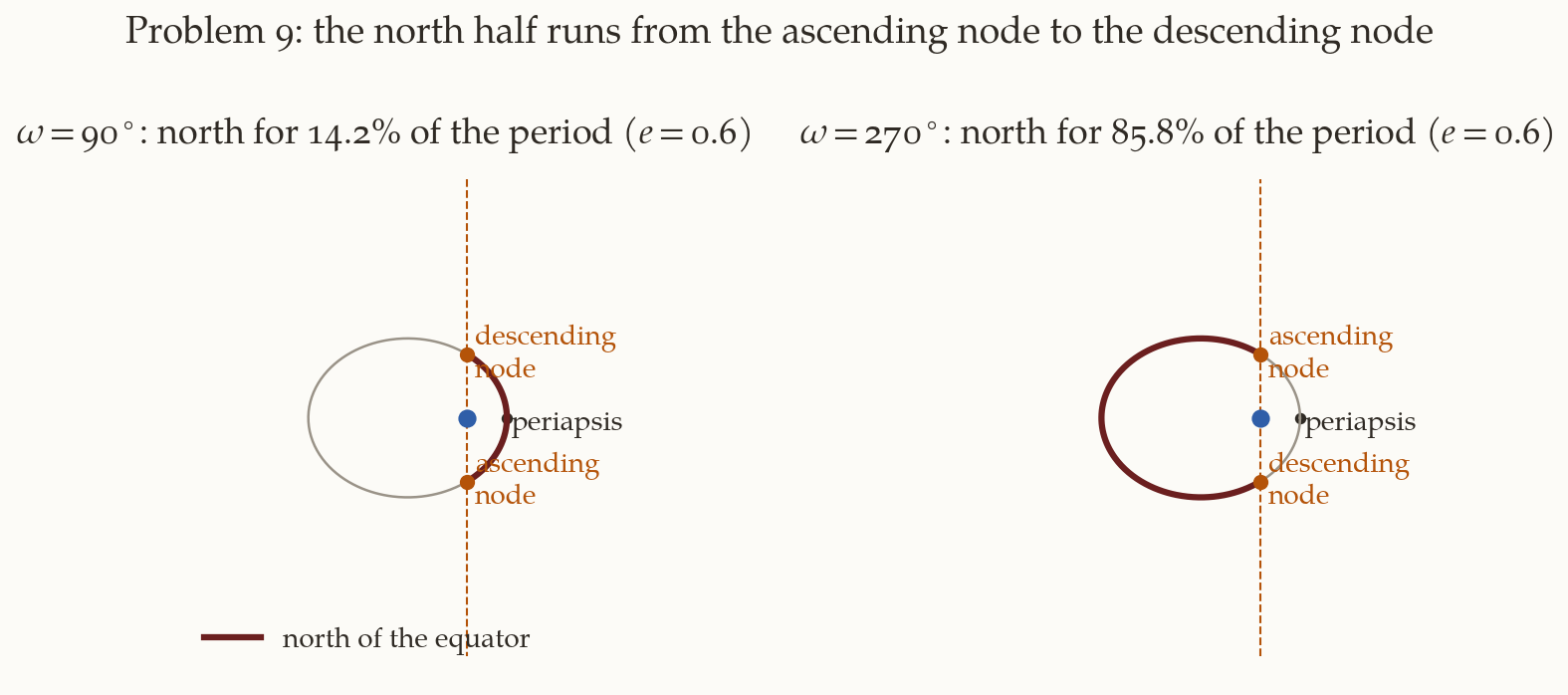
(a) “North” means \(z>0\). With \(z=r\sin i\sin u\) and \(\sin i>0\), that is \(\sin u>0\), i.e. \(0^\circ<u<180^\circ\). In terms of the true anomaly, \(f=u-\omega\) runs from \(-\omega\) to \(180^\circ-\omega\). How long the body takes over that arc, as a fraction of \(T\), depends only on \(e\) (through Kepler’s equation) and on where the arc starts, \(\omega\). It does not depend on \(a\), \(i\) or \(\Omega\).
For \(\omega=0^\circ\) the arc runs from periapsis to apoapsis, which takes half the period by symmetry. For \(\omega=180^\circ\) it runs from apoapsis to periapsis, which again takes half.
(b) We need the time from \(f=-90^\circ\) to \(f=90^\circ\). Time is uniform in the mean anomaly, so find \(M\) at \(f=90^\circ\). There \(r=p=a(1-e^2)\). With \(r=a(1-e\cos E)\) this gives \(\cos E=(1-r/a)/e=e\), so \(E=\arccos e\) and \(\sin E=\sqrt{1-e^2}\). Kepler’s equation then gives \(M=\arccos e-e\sqrt{1-e^2}\). By symmetry the arc \(|f|<90^\circ\) takes \(2M/(2\pi)\) of the period, which is \(\tau_{\rm near}\).
(c) For \(\omega=90^\circ\) the northern arc is \(-90^\circ<f<90^\circ\), the half of the orbit nearer periapsis, which takes \(\tau_{\rm near}\). For \(\omega=270^\circ\) it is \(90^\circ<f<270^\circ\), the other half, which takes \(1-\tau_{\rm near}\).
Is \(\tau_{\rm near}\) less than \(\frac12\)? At \(e=0\) it is \((\pi/2)/\pi=\frac12\), and
\[ \frac{d}{de}\Bigl(\arccos e-e\sqrt{1-e^2}\Bigr)=-\frac{1}{\sqrt{1-e^2}}-\sqrt{1-e^2}+\frac{e^2}{\sqrt{1-e^2}}=-2\sqrt{1-e^2}<0, \]
so \(\tau_{\rm near}<\frac12\) for every \(e>0\). The half near periapsis is passed quickly.
Why \(270^\circ\) is the maximum. Every northern arc is a half-orbit, \(180^\circ\) of true anomaly. So we ask which half-orbit takes the longest. Let \(\tau(c)\) be the fraction of the period spent on the half \(c-90^\circ<f<c+90^\circ\), centred on \(f=c\). Since \(dt/df=r^2/h\),
\[ \frac{d\tau}{dc}=\frac{r^2(c+90^\circ)-r^2(c-90^\circ)}{hT} =\frac{p^2}{hT}\Bigl[\frac{1}{(1-e\sin c)^2}-\frac{1}{(1+e\sin c)^2}\Bigr], \]
using \(\cos(c\pm90^\circ)=\mp\sin c\). The bracket has the sign of \(\sin c\). So \(\tau\) rises for \(0^\circ<c<180^\circ\) and falls for \(180^\circ<c<360^\circ\): it is greatest for the half centred on apoapsis (\(c=180^\circ\)), and least for the half centred on periapsis. The northern half is centred on \(u=90^\circ\), i.e. on \(f=90^\circ-\omega\), so \(c=180^\circ\) means \(\omega=270^\circ\).
The apoapsis is then at \(u=\omega+180^\circ=90^\circ\), so by Problem 14 its latitude is \(\delta=i\): the most northerly point of the orbit. A Molniya satellite (\(e\approx0.74\)) therefore spends about \(92\%\) of each period in the north, hanging slowly over high northern latitudes. That only lasts if \(\omega\) does not drift, which is what the critical inclination of Problem 19 provides.
19. What \(J_2\) does to the elements
To first order, the Earth’s oblateness leaves \(a\), \(e\) and \(i\) unchanged on average and makes the node and the periapsis drift at
\[ \dot\Omega=-\tfrac32\,k\cos i,\qquad \dot\omega=\tfrac34\,k\,(5\cos^2i-1),\qquad k=nJ_2\Bigl(\frac{R_\oplus}{p}\Bigr)^2>0 . \]
A sun-synchronous orbit needs \(\dot\Omega\) equal to the Sun’s eastward rate, which is positive. Show that it must be retrograde, that its inclination increases with \(a\) (for a given \(e\)), and that there is a largest \(a\) for which one exists.
Show that the apse line is fixed within the orbit plane only at \(i=\arctan2\) and at \(i=180^\circ-\arctan2\).
For an equatorial orbit neither \(\Omega\) nor \(\omega\) exists. Show that \(\varpi=\Omega+\omega\) nevertheless advances at \(\frac32k\), and that \(\xi=e\cos\varpi\), \(\eta=e\sin\varpi\) obey \(\dot\xi=-\frac32k\,\eta\), \(\dot\eta=\frac32k\,\xi\). Why is this statement well posed even as \(e\to0\)?
Show that a polar orbit keeps its node fixed and its apse line regresses at \(\frac34k\).
Answer
All four parts come from reading the two rates. \(k\) is positive, so the signs of \(\dot\Omega\) and \(\dot\omega\) are set by \(\cos i\) and by \(5\cos^2i-1\).
(a) \(\dot\Omega=-\frac32k\cos i\) must equal the Sun’s rate \(\dot\alpha_\odot>0\). With \(k>0\) that needs \(\cos i<0\): the orbit must be retrograde. To see how \(i\) depends on \(a\), write out \(k\). With \(n=\sqrt{\mu}\,a^{-3/2}\) and \(p=a(1-e^2)\),
\[ k=nJ_2\Bigl(\frac{R_\oplus}{p}\Bigr)^2=\sqrt\mu\,J_2R_\oplus^2\,a^{-7/2}(1-e^2)^{-2}. \]
Setting \(\dot\Omega=\dot\alpha_\odot\) and solving for \(\cos i\),
\[ \cos i=-\frac{2\dot\alpha_\odot}{3k}=-\frac{2\dot\alpha_\odot(1-e^2)^2a^{7/2}}{3\sqrt\mu\,J_2R_\oplus^2}. \]
So \(|\cos i|\) grows like \(a^{7/2}\): as \(a\) grows, \(i\) climbs from just above \(90^\circ\) towards \(180^\circ\). The higher the orbit, the weaker the \(J_2\) effect, and the closer to the equator the orbit must be to drift fast enough. A solution needs \(|\cos i|\le1\), which fails beyond the \(a\) at which the right-hand side reaches \(-1\). (The orbital-elements note finds \(a=12\,352\) km for circular orbits.)
(b) The apse line is fixed when \(\dot\omega=0\), i.e. \(\cos^2i=\frac15\). To put this in terms of \(\tan i\), use \(\tan^2i=(1-\cos^2i)/\cos^2i=(4/5)/(1/5)=4\). So \(\tan i=\pm2\), which gives \(i=\arctan2\) (\(63.4^\circ\)) or \(180^\circ-\arctan2\) (\(116.6^\circ\)).
(c) At \(i=0\), \(\Omega\) and \(\omega\) do not exist separately, but the formulas still give their sum:
\[ \dot\varpi=\dot\Omega+\dot\omega=k\Bigl(-\frac32+\frac34\cdot4\Bigr)=\frac32k . \]
For an equatorial orbit \(\varpi\) is the angle of the periapsis from \(\hat{\mathbf I}\), so \((\xi,\eta)=(e\cos\varpi,\,e\sin\varpi)\) are the components of the eccentricity vector in the equatorial plane. Since \(\dot e=0\), differentiating gives
\[ \dot\xi=-e\sin\varpi\,\dot\varpi=-\tfrac32k\,\eta,\qquad \dot\eta=e\cos\varpi\,\dot\varpi=\tfrac32k\,\xi . \]
So the eccentricity vector rotates rigidly at \(\frac32k\). Unlike \(\Omega\), \(\omega\) and \(\varpi\), the pair \((\xi,\eta)\) needs neither a node nor a periapsis to be defined. The equations are linear, and they stay valid through \(e=0\), where they simply say that a circular orbit stays circular. This is the cure for the degeneracies that Problems 15 and 17 exposed.
(d) At \(i=90^\circ\), \(\cos i=0\), so \(\dot\Omega=0\) and \(\dot\omega=\frac34k(0-1)=-\frac34k\). The plane stays fixed in inertial space, while the periapsis regresses within it. This is what the ground-tracks note means by “a polar orbit has \(\dot\Omega=0\): its plane stays fixed in inertial space”; the periapsis still moves.