Plane Changes
1 Plane changes
Suppose a spacecraft is on an orbit and we want to move it to an orbit in a different plane. Why would we need this? A geostationary satellite has to be in the equatorial plane in order to stay over one point on the Earth. But ISRO launches from Sriharikota, which is at a latitude of \(13.7^\circ\), and the orbit a launcher reaches from there is inclined to the equator. In this note we will take that inclination to be \(19.2^\circ\). So the plane has to be turned by this angle somewhere along the way.
We will first see why this angle is \(19.2^\circ\) and not simply the latitude, \(13.7^\circ\). We will then answer three questions. Where can a plane change be made, and what does it cost? Can we reduce the cost by combining it with a burn that we have to make anyway? If two burns are available, how should the turn be shared between them? We will then look at a different kind of plane change, in which the node moves and the inclination stays fixed.
This note follows the impulsive-model note, which derives the impulse formulas, and the Hohmann note, which derives the transfer used here. Throughout, \(\mu=398\,600.4418\) km\(^3\)/s\(^2\) and \(R_\oplus=6378.137\) km. “LEO” means the circular orbit at \(300\) km altitude, \(r_1=6678.137\) km, and “GEO” means the circular orbit of radius \(r_2=42\,164\) km. On the Hohmann transfer between them, \(v_{c1}\) and \(v_{c2}\) are the circular speeds at \(r_1\) and \(r_2\), and \(v_{t1}\) and \(v_{t2}\) are the speeds on the transfer ellipse at the same two radii.
1.1 Why the inclination is not the latitude
Sriharikota is at a latitude of \(13.7^\circ\), so why do we not simply take \(\Delta i=13.7^\circ\)? We will show that the latitude is only the lowest inclination that a launch can reach, and that it is reached only by a launch due east. ISRO’s launches to transfer orbits do not head due east. We will find the inclination that their heading gives, and compare it with the inclination they actually reach.
1.1.1 The heading sets the inclination
At launch, the orbital plane contains the launch site and the centre of the Earth. A third piece of information then fixes the plane, which is the direction in which the rocket flies. Let \(\varphi\) be the latitude of the site. Let \(A\) be the launch azimuth, which is the heading of the rocket measured clockwise from north, so that due east is \(A=90^\circ\).
We wish to find the inclination in terms of \(\varphi\) and \(A\). At the launch site, take the unit vectors \(\hat{\mathbf r}\) pointing up, \(\hat{\mathbf e}\) pointing east and \(\hat{\mathbf n}\) pointing north. These form a right-handed set, so \(\hat{\mathbf r}\times\hat{\mathbf e}=\hat{\mathbf n}\) and \(\hat{\mathbf r}\times\hat{\mathbf n}=-\hat{\mathbf e}\). The horizontal direction of flight is
\[ \hat{\mathbf u}=\sin A\,\hat{\mathbf e}+\cos A\,\hat{\mathbf n}. \]
Any vertical part of the velocity stays in the same plane, so it does not matter here. The normal to the orbital plane is
\[ \hat{\mathbf h}=\hat{\mathbf r}\times\hat{\mathbf u}=\sin A\,\hat{\mathbf n}-\cos A\,\hat{\mathbf e}. \]
The Earth’s spin axis, in the same three vectors, is \(\hat{\mathbf K}=\sin\varphi\,\hat{\mathbf r}+\cos\varphi\,\hat{\mathbf n}\). The inclination is the angle between \(\hat{\mathbf h}\) and \(\hat{\mathbf K}\), so \(\cos i=\hat{\mathbf h}\cdot\hat{\mathbf K}\). Only the \(\hat{\mathbf n}\) terms survive the dot product, which gives
\[ \boxed{\;\cos i=\cos\varphi\,\sin A .\;} \tag{1}\]
This answers the question. Since \(\sin A\) cannot exceed \(1\), we have \(\cos i\le\cos\varphi\), and therefore \(i\ge\varphi\). The two are equal only when \(\sin A=1\), which is a launch due east. So the latitude is a lower limit on the inclination, and any heading away from due east gives an inclination above it.
1.1.2 Why the rocket does not head due east
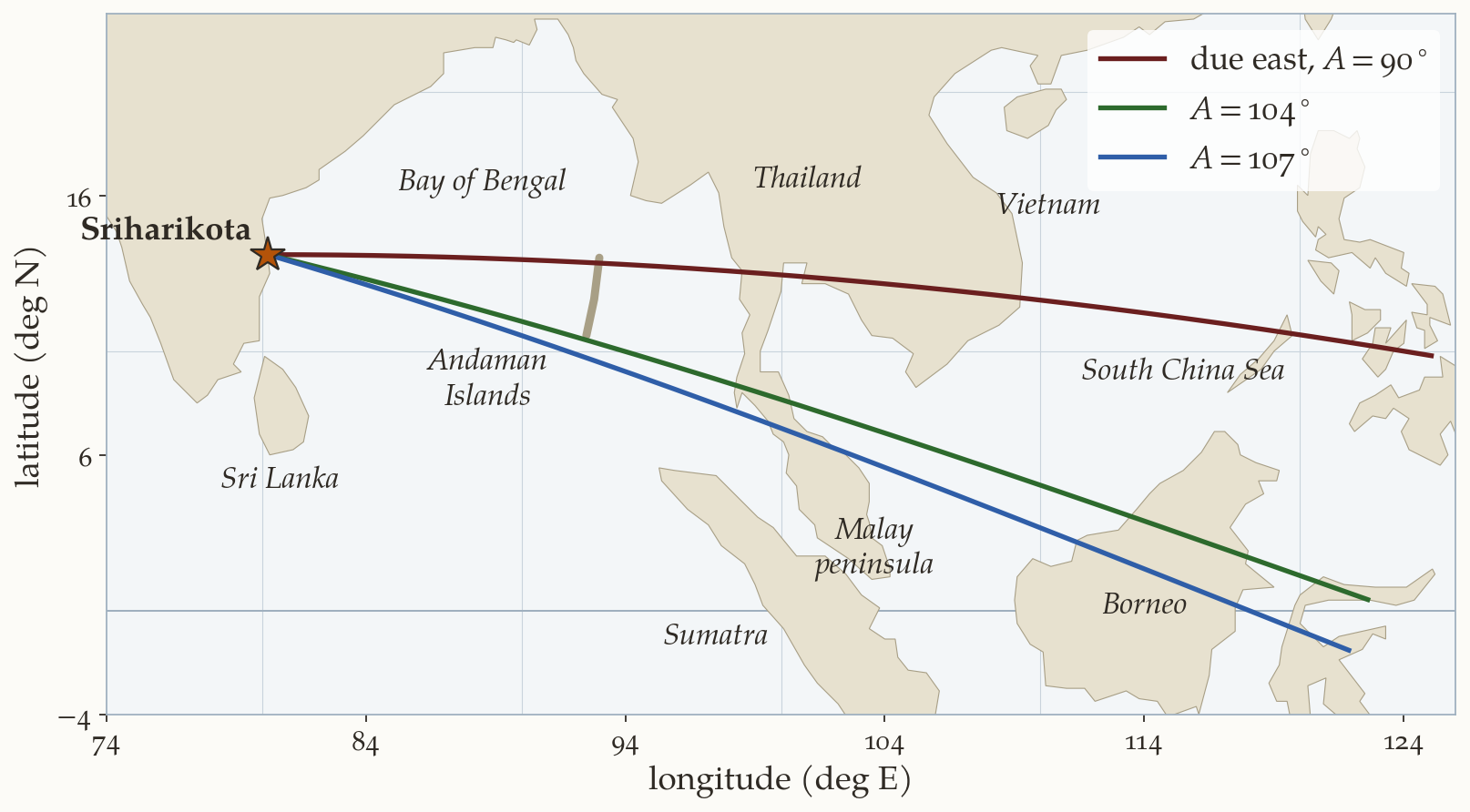
A launcher drops its spent stages along its path, and it can fail during the ascent. So its path is chosen to keep it away from populated land while it is low, and to let the stages fall into the open sea. For this reason, every launch site has a limited range of allowed headings.
Figure 1 shows the choice at Sriharikota. A track due east, in maroon, passes over the Andaman Islands and then runs along the length of Thailand, Cambodia and Vietnam. The tracks about \(15^\circ\) south of east, in green and blue, stay over the sea for much longer. They cross the narrow Malay peninsula and do not reach land again until Borneo, far downrange.
We should be careful about how much we read into this map. It suggests why these headings are preferred, but the mission documents that we use below give the heading and not the reasons for it. What we can test is the effect of the heading on the inclination.
So we now test Equation 1 against real flights, using the heading and inclination that ISRO publishes for each mission.
| Mission | Heading \(A\) | \(i\) from Equation 1 | \(i\) published by ISRO |
|---|---|---|---|
| GSLV-F12 | \(104^\circ\) | \(19.49^\circ\) | \(19.36^\circ\) |
| LVM3-M5 | \(107^\circ\) | \(21.71^\circ\) | \(21.4^\circ\) |
The formula agrees with both flights to within a few tenths of a degree. It leaves out the Earth’s rotation and the steering of the rocket during the ascent, so we should not expect exact agreement. The heading alone therefore explains why the inclination is well above \(13.7^\circ\). Flights from Sriharikota have reached inclinations from about \(19^\circ\) up to \(21.7^\circ\), depending on the mission. In this note we will use \(19.2^\circ\), which is a representative value near the low end of this range.
For a launch from a latitude of \(\varphi=13.7^\circ\), use \(\cos i=\cos\varphi\sin A\) to find the heading \(A\) that gives \(i=19.2^\circ\). Choose the solution that heads south of east.
What you should find
We have \(\sin A=\cos19.2^\circ/\cos13.7^\circ=0.9720\). This has two solutions, \(A=76.4^\circ\) and \(A=103.6^\circ\), which give the same inclination. The one south of east is \(A=103.6^\circ\), close to the heading of GSLV-F12.You may have read that rockets from Sriharikota make a turn called a dog-leg to avoid Sri Lanka. That turn belongs to a different kind of launch. Sri Lanka lies south of Sriharikota, so it is in the way of southbound launches to polar orbits. Launches to transfer orbits head east-south-east, away from it. The agreement in Table 1 shows that these launches do not need a large dog-leg to explain their inclination.
What does this heading cost a mission? It gives up a little of the Earth’s rotation, which helps a launch by the speed \(\omega_\oplus R_\oplus\cos\varphi\,\sin A\) along the track. This is about \(13\) m/s less at \(A=104^\circ\) than due east. It also leaves a larger turn to make later. The exercise at the end of this note finds the cost of that larger turn, after we have the tools to do so.
1.2 The cost of turning the plane
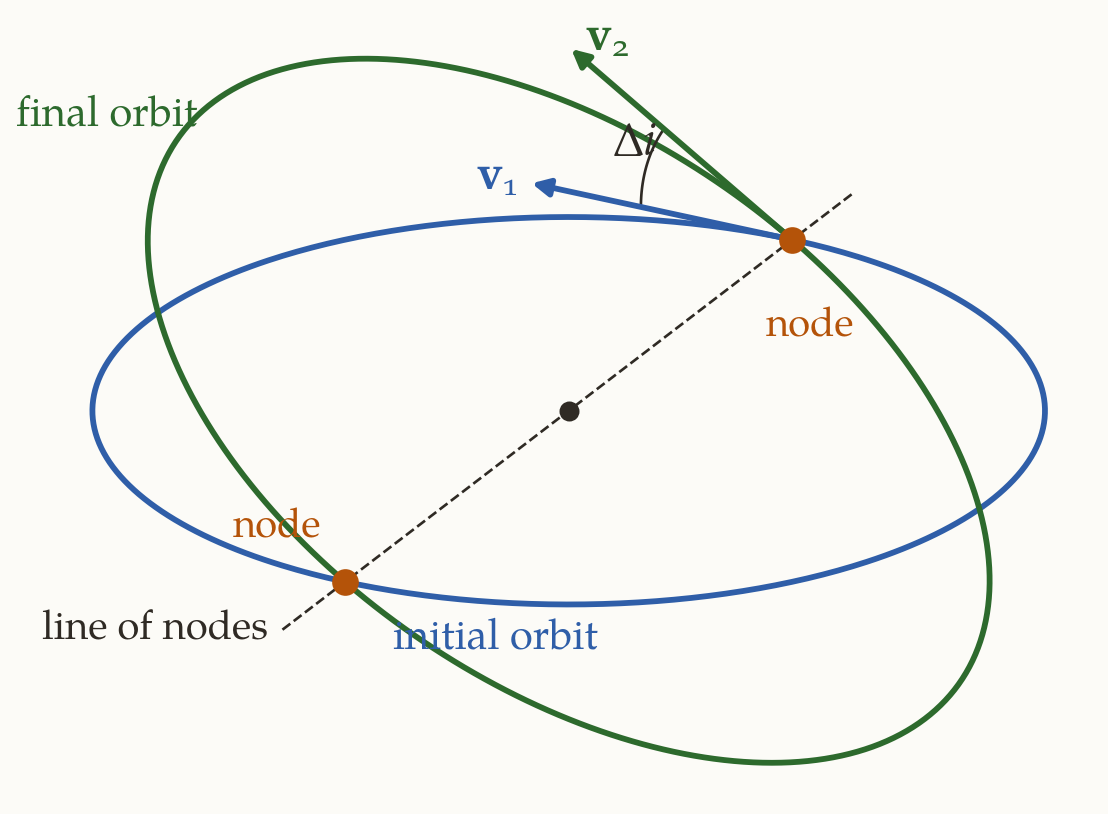
Figure 2 shows the initial orbit in blue and the desired final orbit in green. Each orbital plane passes through the centre of the Earth, so the two planes meet along a straight line through the centre. This is called the line of nodes.
Where can the burn be made? An impulse changes the velocity of the spacecraft but not its position. So the burn has to be made at a point that lies on both orbits. Such a point has to lie in both planes, and therefore on the line of nodes. In Figure 2 these points are the two nodes.
What does the burn have to do? At a node, it has to turn the velocity from \(\mathbf v_1\) to \(\mathbf v_2\). We want to find the cost of this turn. We will show that it is proportional to the speed, and this will tell us where to make the plane change.
1.2.1 The velocity triangle
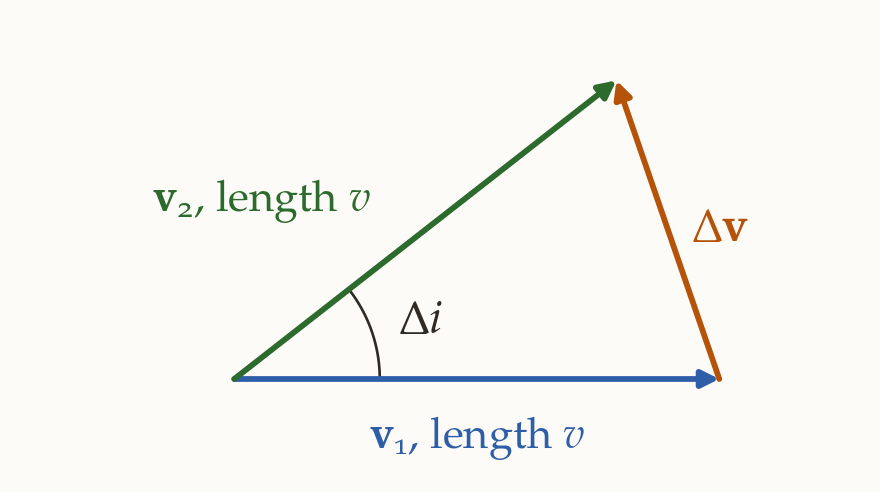
Consider an orbit where the velocity at the node is perpendicular to the line of nodes. This is true on a circular orbit, and at a node that is also an apsis. Suppose the speed \(v\) is to stay the same. Then \(\mathbf v_1\), \(\mathbf v_2\) and \(\Delta\mathbf v\) form the isosceles triangle of Figure 3. Its two equal sides have length \(v\) and the angle between them is \(\Delta i\). The law of cosines gives
\[ \Delta v^2=v^2+v^2-2v^2\cos\Delta i=2v^2(1-\cos\Delta i). \]
Using \(1-\cos\Delta i=2\sin^2(\Delta i/2)\), this becomes \(\Delta v^2=4v^2\sin^2(\Delta i/2)\). Taking the square root gives the cost of the plane change.
\[ \boxed{\;\Delta v=2v\sin\frac{\Delta i}2 .\;} \tag{2}\]
Notice the direction of this impulse. The base angles of the triangle are each \(90^\circ-\Delta i/2\), so \(\Delta\mathbf v\) makes an angle of \(90^\circ+\Delta i/2\) with \(\mathbf v_1\). The engine does not fire exactly sideways. It also points a little backward. A burn exactly at right angles to \(\mathbf v_1\) would make the spacecraft go faster, and we want its speed to stay the same.
What if the velocity at the node is not perpendicular to the line of nodes? This happens on an eccentric orbit when the node is not at an apsis. The line of nodes is a radial line, so the velocity then has a component \(v_r\) along it, and turning the plane about this line leaves \(v_r\) unchanged. Only the transverse component \(v_\theta\) turns. The same triangle then has equal sides of length \(v_\theta\), and the cost is \(2v_\theta\sin(\Delta i/2)\). Every example below has its node at an apsis or on a circle, so Equation 2 applies directly.
What does a \(60^\circ\) plane change cost, according to Equation 2? What does a \(180^\circ\) plane change cost, and what does that turn do to the orbit?
Answer
For \(60^\circ\) the cost is \(2v\sin30^\circ=v\), which is the whole orbital speed. For \(180^\circ\) the cost is \(2v\sin90^\circ=2v\). This turn reverses the direction of motion, which means stopping the spacecraft and then accelerating it to the same speed the other way.1.2.2 Where to make the turn
Equation 2 says that the cost is proportional to \(v\). So the turn is cheapest where the spacecraft is slowest. This is the opposite of what we found for energy, where a burn is most effective at high speed. A burn that adds energy belongs where the speed is high, and a burn that turns the plane belongs where the speed is low.
Example. A launch from Sriharikota leaves a satellite in LEO with an inclination of \(19.2^\circ\). The satellite is wanted in GEO, in the equatorial plane. Find the cost of the \(19.2^\circ\) plane change if it is made in LEO, in GEO, and at the apoapsis of the Hohmann transfer ellipse between them.
Solution. The speed in each place is different, so we find the three speeds first. The two circular speeds are
\[ v_{c1}=\sqrt{\frac{\mu}{r_1}}=7.726\text{ km/s},\qquad v_{c2}=\sqrt{\frac{\mu}{r_2}}=3.075\text{ km/s}. \]
The transfer ellipse has \(a_t=(r_1+r_2)/2=24\,421\) km, and vis-viva gives its speed at apoapsis.
\[ v_{t2}=\sqrt{\mu\left(\frac{2}{r_2}-\frac{1}{a_t}\right)}=1.608\text{ km/s}. \]
All three places have the velocity perpendicular to the line of nodes, provided that the apse line of the transfer ellipse lies along the line of nodes. So we can use Equation 2 with \(\Delta i=19.2^\circ\).
| Where | \(v\) (km/s) | \(\Delta v=2v\sin9.6^\circ\) (km/s) |
|---|---|---|
| LEO | \(7.726\) | \(2.577\) |
| GEO | \(3.075\) | \(1.026\) |
| Apoapsis of the transfer ellipse | \(1.608\) | \(0.536\) |
The same turn is \(4.8\) times cheaper at the best of these places than at the worst. Apoapsis of the transfer ellipse is the best, because the speed there is lower than the speed on either circle.
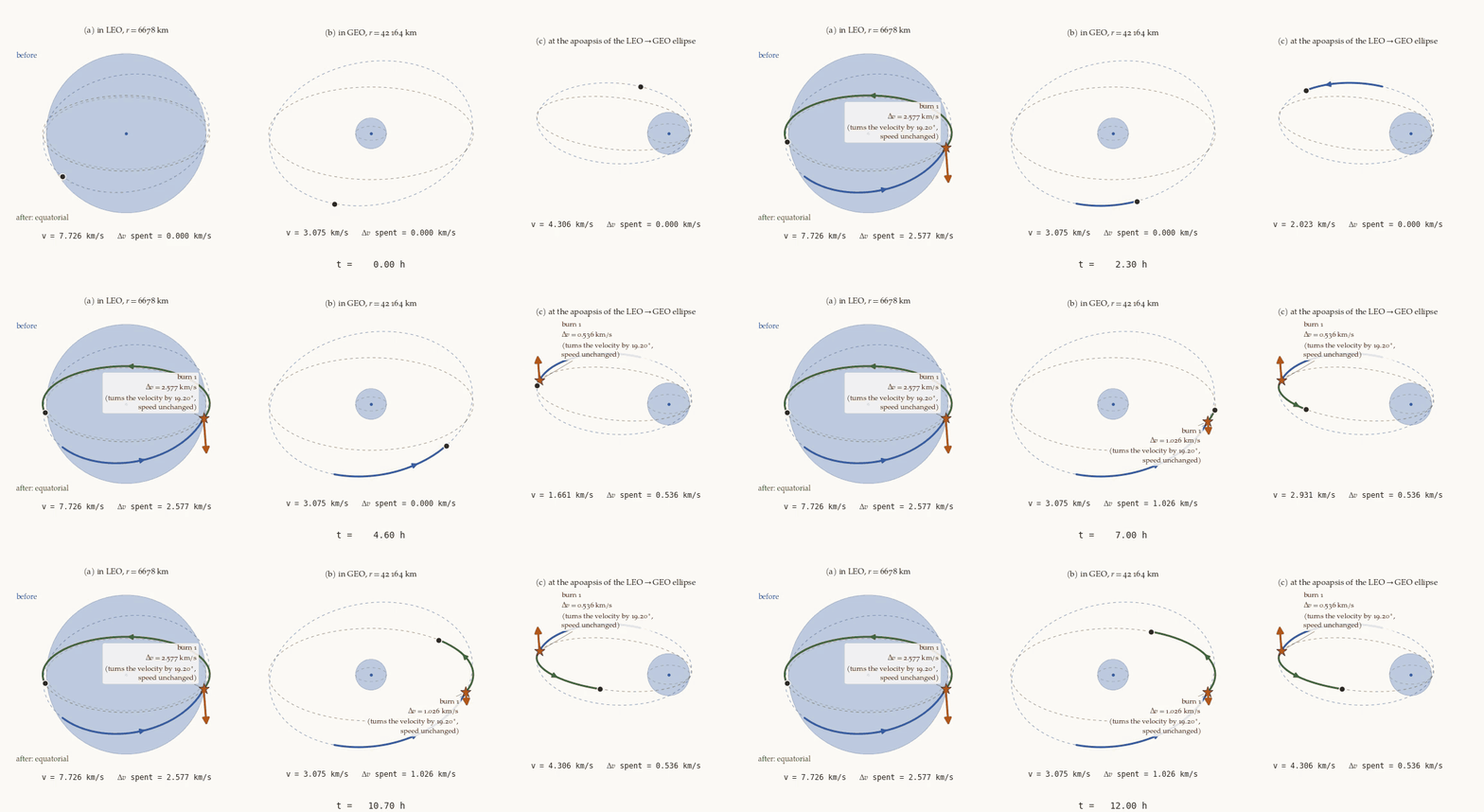
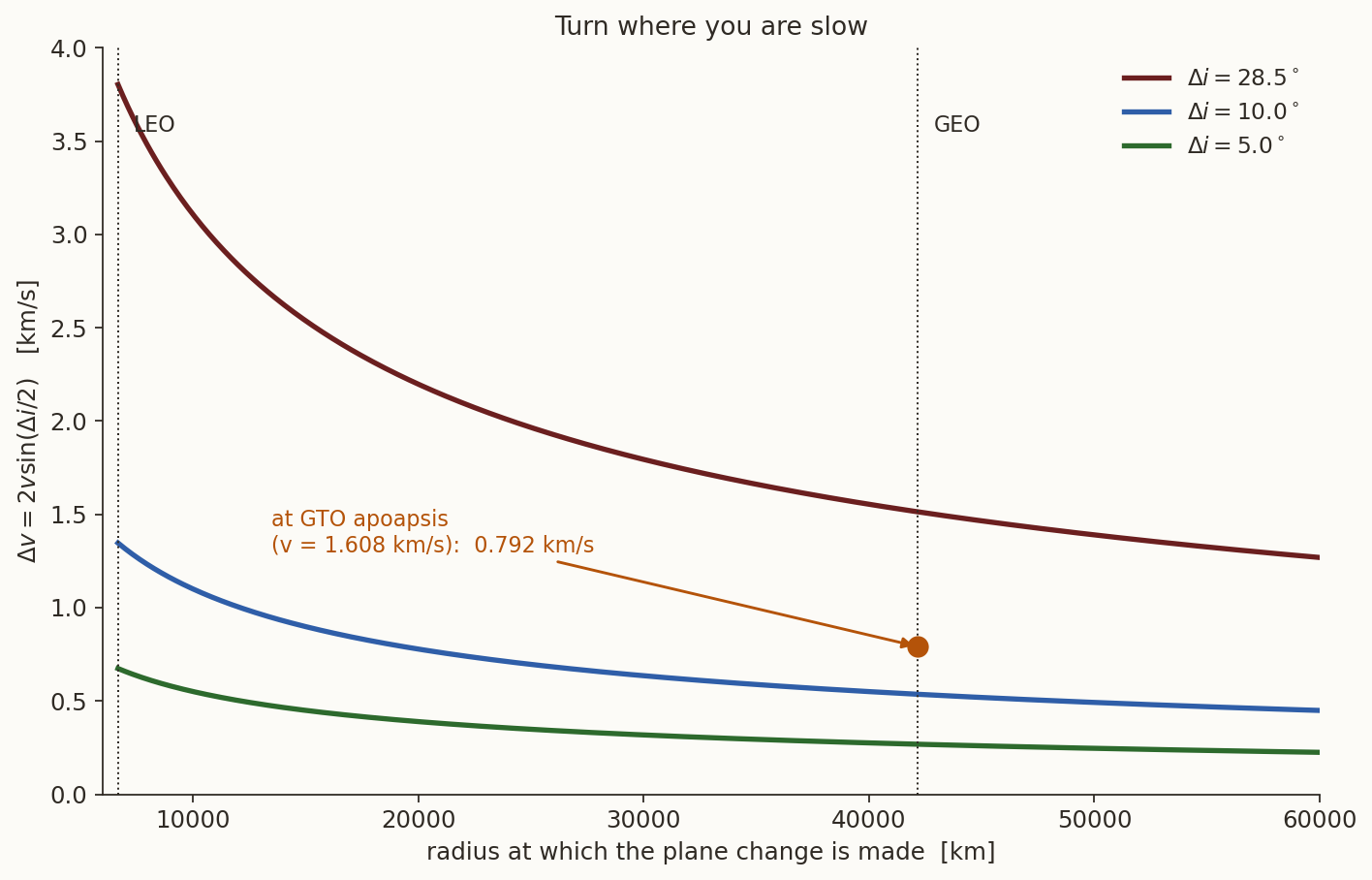
What does this mean for a mission? Figure 5 shows that the cost falls quickly as the radius grows, so a turn in low orbit is very expensive. Take the \(60^\circ\) turn of the check above. In LEO it costs the whole orbital speed, \(7.726\) km/s. With the rocket equation and a typical chemical engine with \(I_{sp}=320\) s, only \(8.5\%\) of the spacecraft’s mass would remain after the burn. This is why missions avoid large plane changes in low orbit, and launch close to the plane they want.
The speeds in LEO and GEO are \(7.726\) km/s and \(3.075\) km/s. What does a plane change of only \(5^\circ\) cost in each orbit, using \(\Delta v=2v\sin(\Delta i/2)\)? Is the difference between the two orbits still large?
What you should find
The costs are \(2(7.726)\sin2.5^\circ=0.674\) km/s in LEO and \(2(3.075)\sin2.5^\circ=0.268\) km/s in GEO. Even a small turn is expensive in LEO. The ratio is the ratio of the speeds, \(2.5\), for any angle.1.3 Combining the plane change with a transfer burn
So far we have treated the plane change as a separate burn. But a transfer from LEO to GEO has two burns that we must make anyway. Can we turn the plane during one of them? If we do, there is one impulse instead of two, and we pay for the size of a sum of two vectors instead of the sum of their sizes. The size of a sum is never greater than the sum of the sizes. So at any one point, combining the two burns can only help. We will now find out how much it helps, and at which point we should do it.
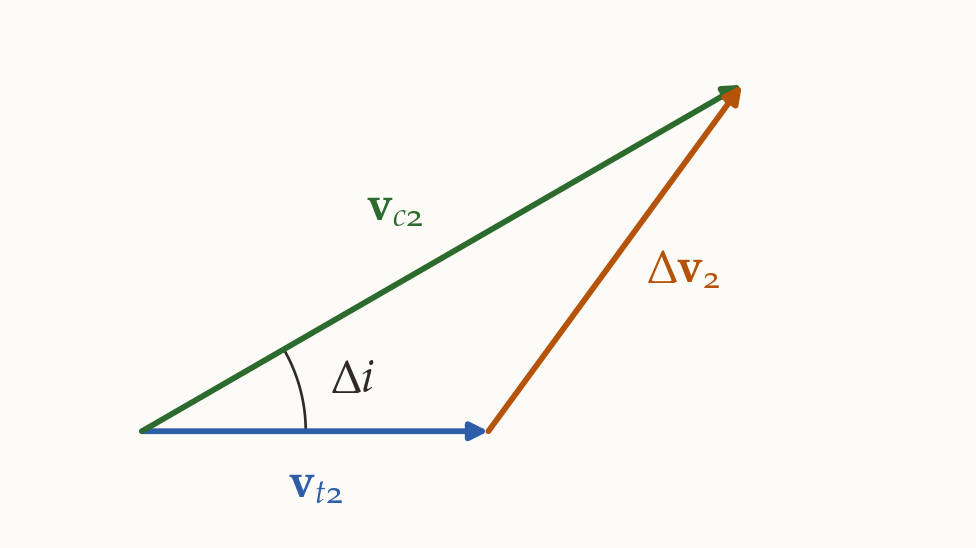
Figure 6 shows the burn at GEO. The spacecraft arrives with the speed \(v_{t2}\) and leaves with the speed \(v_{c2}\), and the angle between the two velocities is \(\Delta i\). The two sides of the triangle are now of different lengths, but the law of cosines still applies.
\[ \boxed{\;\Delta v_2=\sqrt{v_{t2}^2+v_{c2}^2-2v_{t2}v_{c2}\cos\Delta i}\;.} \tag{3}\]
We can check this formula in two limits. If \(\Delta i=0\), the square root becomes \(v_{c2}-v_{t2}\), which is the ordinary tangential burn. If \(v_{t2}=v_{c2}=v\), it becomes \(2v\sin(\Delta i/2)\), which is Equation 2.
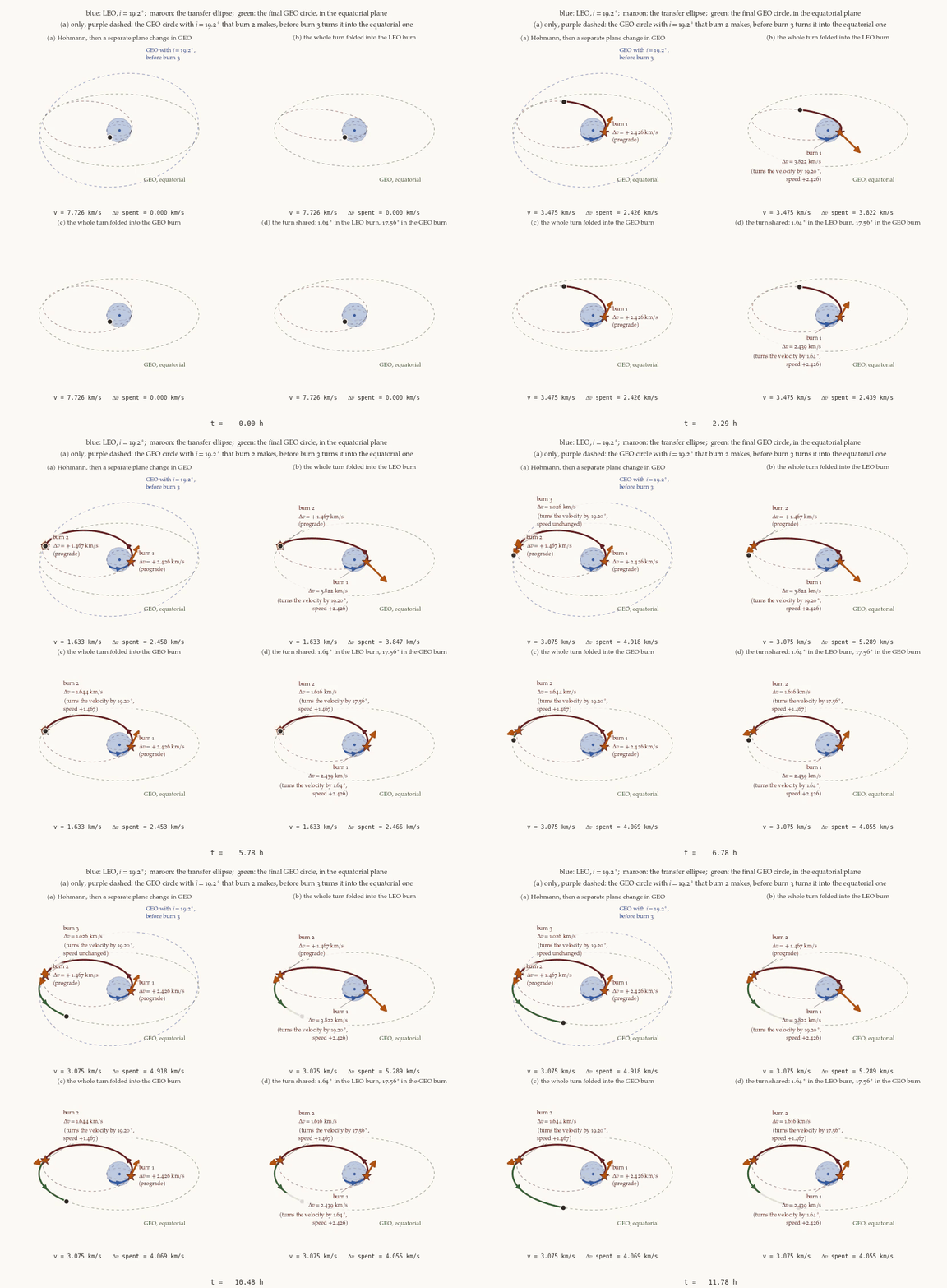
Example. A spacecraft launched from Sriharikota goes from LEO to GEO with \(\Delta i=19.2^\circ\). Compare the total \(\Delta v\) of three strategies. In strategy (a) it flies a Hohmann transfer and then makes a separate plane change in GEO. In strategy (b) it makes the whole plane change in the LEO burn. In strategy (c) it makes the whole plane change in the GEO burn. Which is the cheapest?
Solution. We need the speed \(v_{t1}\) at the periapsis of the transfer ellipse as well as the three speeds of the previous example. Vis-viva gives
\[ v_{t1}=\sqrt{\mu\left(\frac{2}{r_1}-\frac{1}{a_t}\right)}=10.151\text{ km/s}. \]
The tangential burns without any turn are \(v_{t1}-v_{c1}=2.42573\) km/s at LEO and \(v_{c2}-v_{t2}=1.46682\) km/s at GEO. We keep five decimals in these sums, so that the rounded values add up correctly.
In strategy (a), we add the separate plane change of the previous example to these two burns.
\[ \Delta v=2.42573+1.46682+1.02552=4.91807\text{ km/s}. \]
In strategy (b), the LEO burn turns the velocity as well. Equation 3, with the speeds at LEO, gives \(\sqrt{7.726^2+10.151^2-2(7.726)(10.151)\cos19.2^\circ}=3.82218\) km/s, so
\[ \Delta v=3.82218+1.46682=5.28900\text{ km/s}. \]
In strategy (c), the GEO burn turns the velocity. Equation 3 gives \(\sqrt{1.608^2+3.075^2-2(1.608)(3.075)\cos19.2^\circ}=1.64363\) km/s, so
\[ \Delta v=2.42573+1.64363=4.06936\text{ km/s}. \]
Strategy (c) is the cheapest. It saves \(0.849\) km/s, or about \(17\%\), against strategy (a). Strategy (b) is the worst of the three, even though it combines two burns. It makes the turn where the speeds are highest, and this costs more than a separate turn at the low speed of GEO. So where we make the turn matters more than whether we combine it.
What is this saving worth? Table 2 uses the rocket equation with \(I_{sp}=320\) s, for the idealised case of one engine making all the burns. Strategy (c) delivers \(1.31\) times as much mass to GEO as strategy (a). The way we arrange the burns has made a large difference, with no new hardware at all.
| Strategy | Total \(\Delta v\) (km/s) | Mass left in GEO |
|---|---|---|
| (a) Separate plane change in GEO | \(4.918\) | \(20.9\%\) |
| (b) Whole turn in the LEO burn | \(5.289\) | \(18.5\%\) |
| (c) Whole turn in the GEO burn | \(4.069\) | \(27.3\%\) |
1.3.1 Why launch sites near the equator are valuable
We can now see why the latitude of a launch site matters so much for geostationary missions. A launch from a site close to the equator leaves a smaller turn to be made at GEO. How does Sriharikota compare with other sites? Table 3 uses strategy (c) with the inclinations at which transfer orbits typically start from three launch sites.
| Launch site | \(\Delta i\) | GEO burn (km/s) | Total \(\Delta v\) (km/s) | Mass left in GEO |
|---|---|---|---|---|
| Kourou | \(7^\circ\) | \(1.492\) | \(3.917\) | \(28.7\%\) |
| Sriharikota | \(19.2^\circ\) | \(1.644\) | \(4.069\) | \(27.3\%\) |
| Cape Canaveral | \(28.5^\circ\) | \(1.830\) | \(4.256\) | \(25.8\%\) |
The same spacecraft, launched from Sriharikota, arrives in GEO with \(1.06\) times the mass it would have from Cape Canaveral. Launched from Kourou, it would arrive with \(1.05\) times the mass it has from Sriharikota. That extra mass can be payload, or propellant for a longer life on orbit. The site of a launch is therefore a real part of the design of the mission.
1.4 Sharing the turn between two burns
Strategy (c) put the whole turn into the GEO burn. Is that the best we can do? So the natural question is, should a little of the turn go into the LEO burn as well? We will show that it should, and find how much.
Let the LEO burn turn the velocity by an angle \(\delta\) and let the GEO burn turn it by the rest, \(\Delta i-\delta\). Each burn is then a triangle like Figure 6, so the total cost is
\[ \Delta v(\delta)= \underbrace{\sqrt{v_{c1}^2+v_{t1}^2-2v_{c1}v_{t1}\cos\delta}}_{\Delta v_1,\ \text{at }r_1} +\underbrace{\sqrt{v_{t2}^2+v_{c2}^2-2v_{t2}v_{c2}\cos(\Delta i-\delta)}}_{\Delta v_2,\ \text{at }r_2} . \]
To find the best \(\delta\), we differentiate each square root. The derivative of \(\sqrt{X}\) is \(X'/(2\sqrt X)\). For the first term, \(X'=2v_{c1}v_{t1}\sin\delta\). For the second term, the chain rule brings in a minus sign, because \(\delta\) appears as \(\Delta i-\delta\), so \(X'=-2v_{t2}v_{c2}\sin(\Delta i-\delta)\). Therefore
\[ \frac{d\Delta v}{d\delta}=\frac{v_{c1}v_{t1}\sin\delta}{\Delta v_1}-\frac{v_{t2}v_{c2}\sin(\Delta i-\delta)}{\Delta v_2}. \]
The best share makes this derivative zero, which gives the condition
\[ \boxed{\;\frac{v_{c1}v_{t1}\sin\delta}{\Delta v_1}=\frac{v_{t2}v_{c2}\sin(\Delta i-\delta)}{\Delta v_2}.\;} \tag{4}\]
Should \(\delta\) be zero, as in strategy (c)? We can settle this without solving anything.
The derivative of the total cost is \(d\Delta v/d\delta=v_{c1}v_{t1}\sin\delta/\Delta v_1-v_{t2}v_{c2}\sin(\Delta i-\delta)/\Delta v_2\). Evaluate it at \(\delta=0\). What does its sign tell you?
Answer
At \(\delta=0\) the first term vanishes and the second is negative, so \(d\Delta v/d\delta<0\). Moving a little of the turn into the first burn therefore always reduces the cost.Why does this happen? The LEO burn is mainly a long tangential vector, of length \(v_{t1}-v_{c1}\). A small tilt adds a short vector at right angles to it. By Pythagoras, this changes its length only at second order in \(\delta\). The saving at GEO is first order in \(\delta\). For a small enough \(\delta\) the saving must win.
Example. A spacecraft launched from Sriharikota goes from LEO to GEO with \(\Delta i=19.2^\circ\). Find the share \(\delta\) of the turn that should be made in the LEO burn, and the total cost. How much does this save against strategy (c)?
Solution. Equation 4 has no closed-form solution, so we solve it numerically. We find \(\delta^{*}=1.64^\circ\), which leaves \(17.56^\circ\) for the GEO burn. To check this, we evaluate the two burns.
\[ \Delta v_1=2.43901\text{ km/s},\qquad \Delta v_2=1.61619\text{ km/s}. \]
With these values both sides of Equation 4 equal \(0.92263\) km/s, as they should. The total is \(4.05520\) km/s, against \(4.06936\) km/s for strategy (c). The saving is \(14.2\) m/s.
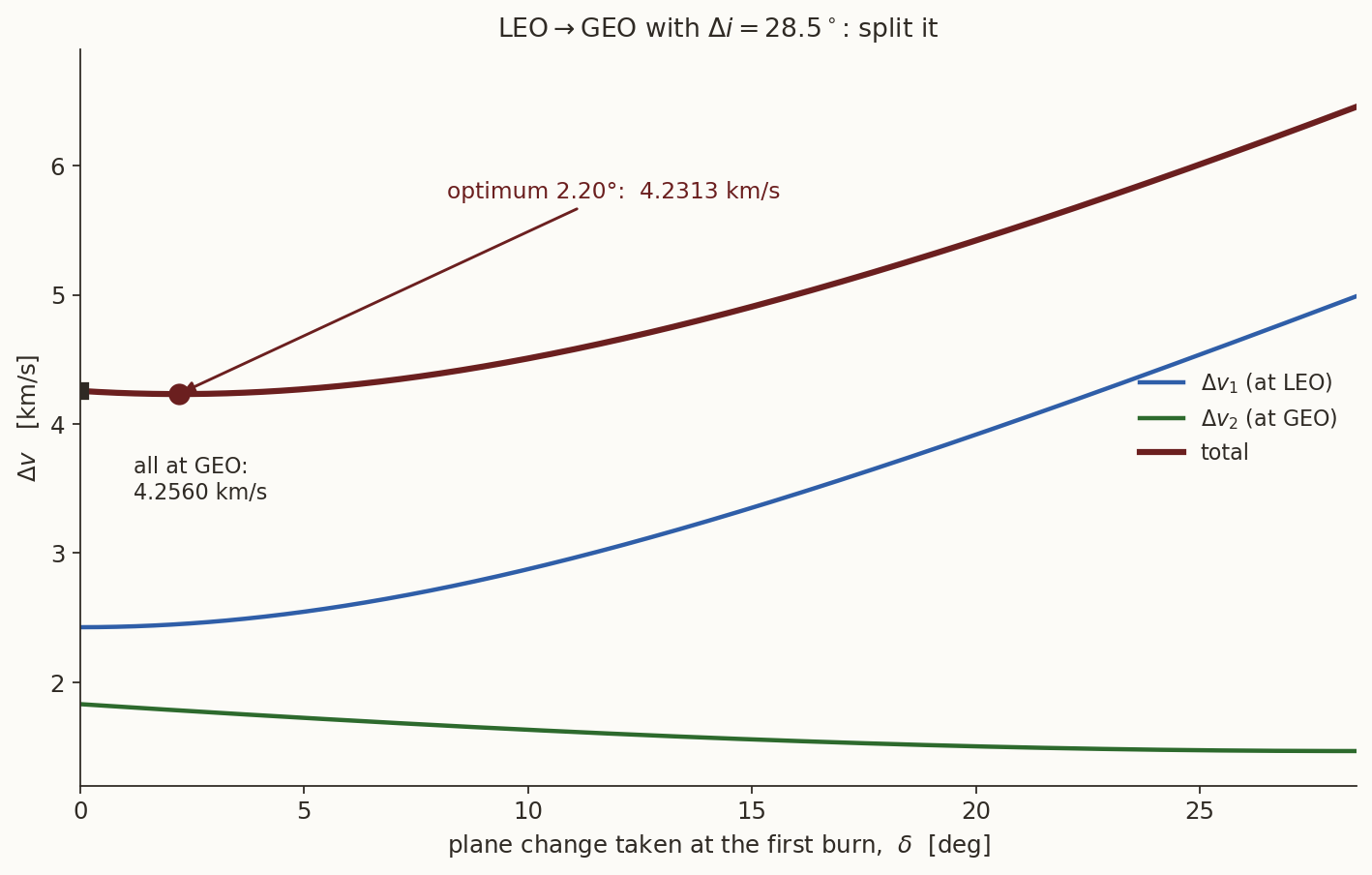
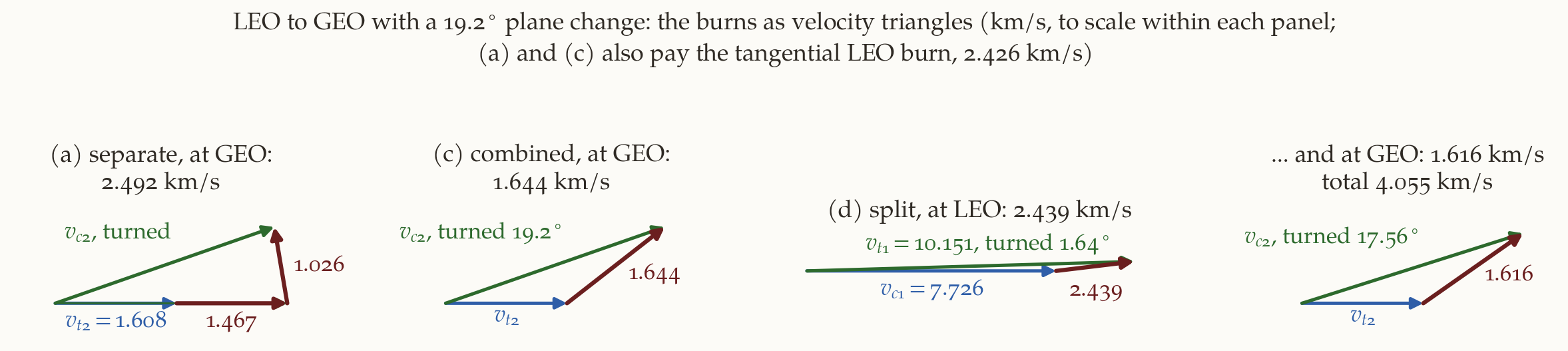
Figure 7 shows that the minimum is shallow, so the exact value of \(\delta\) is not critical. Figure 8 shows the reason for the saving. In the LEO burn, the small turn lengthens the burn by only \(13\) m/s. In the GEO burn, it shortens the burn by \(27\) m/s.
Is a saving of \(14.2\) m/s worth having? It increases the final mass by only about \(0.5\%\). But it costs nothing, since it needs no extra burn and no extra hardware. It only changes the direction of a burn that is being made anyway. Sharing the turn in this way is standard practice on missions to geostationary orbit.
1.4.1 How the best share depends on the size of the turn
We solved for one value of \(\Delta i\). Can we find a simple rule for any small turn? We will expand each square root for small angles. Rewrite the expression under the first root as
\[ v_{c1}^2+v_{t1}^2-2v_{c1}v_{t1}\cos\delta=(v_{t1}-v_{c1})^2+2v_{c1}v_{t1}(1-\cos\delta). \]
For a small \(\delta\) in radians, \(1-\cos\delta\approx\delta^2/2\). For a small \(\epsilon\), we also have \(\sqrt{X^2+\epsilon}\approx X+\epsilon/(2X)\). Together these give
\[ \Delta v_1\approx(v_{t1}-v_{c1})+\frac12\,\frac{v_{c1}v_{t1}}{v_{t1}-v_{c1}}\,\delta^2 . \]
The GEO burn works in the same way, with \(\Delta i-\delta\) in place of \(\delta\). So the total cost is
\[ \Delta v\approx\text{const}+\frac A2\,\delta^2+\frac B2\,(\Delta i-\delta)^2,\qquad A=\frac{v_{c1}v_{t1}}{v_{t1}-v_{c1}},\quad B=\frac{v_{t2}v_{c2}}{v_{c2}-v_{t2}}. \]
The constants \(A\) and \(B\) measure how quickly each burn grows when it is tilted. Setting the derivative with respect to \(\delta\) to zero gives \(A\delta=B(\Delta i-\delta)\), and therefore
\[ \delta^{*}\approx\frac{B}{A+B}\,\Delta i\qquad\text{for small }\Delta i . \]
For the transfer from LEO to GEO, the speeds of our examples give \(A=32.33\) km/s and \(B=3.370\) km/s, so \(\delta^{*}\approx0.0944\,\Delta i\). Only about a tenth of a small turn goes into the first burn. The reason is that \(A\) is about \(9.6\) times \(B\). Both speeds are high at LEO, so the product \(v_{c1}v_{t1}=78.4\) km\(^2\)/s\(^2\) is about sixteen times the product \(v_{t2}v_{c2}=4.94\) km\(^2\)/s\(^2\) at GEO. The same tilt therefore costs much more at LEO.
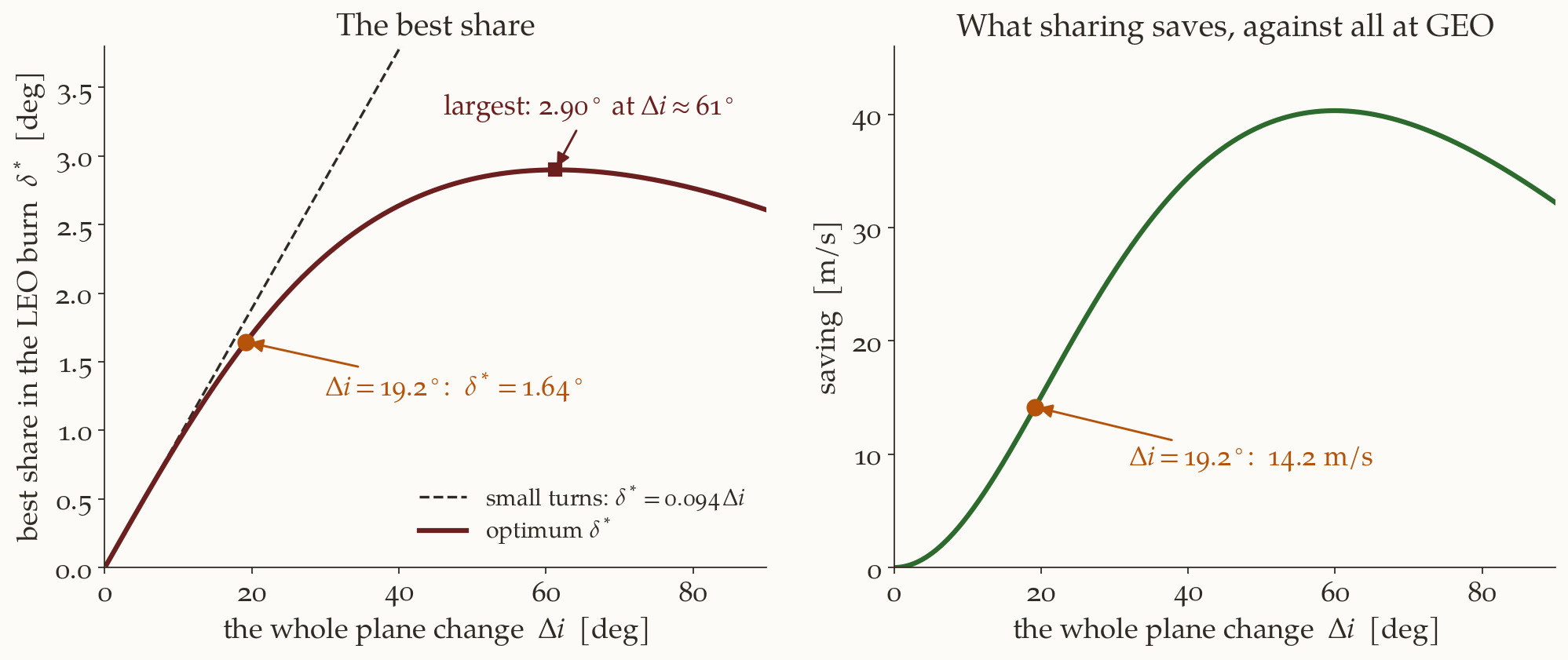
The left panel of Figure 10 shows the exact optimum, found numerically, for turns from \(0\) to \(90^\circ\). It follows the dashed small-turn line at first and then falls below it. At \(\Delta i=19.2^\circ\) the small-turn rule predicts \(1.81^\circ\) and the exact value is \(1.64^\circ\), which is \(8.6\%\) of the turn. The largest value of \(\delta^{*}\) is \(2.90^\circ\), at about \(\Delta i=61^\circ\), and after that it declines slowly.
The right panel shows the saving. It grows from \(14.2\) m/s at \(19.2^\circ\) to about \(40\) m/s near \(60^\circ\). So for any plane change on this transfer, sharing the turn is a small adjustment to the aim of the burns. Most of the benefit comes from the step we took earlier, which is making the turn in the GEO burn.
1.5 Changing the node instead
So far we have changed the inclination. A mission may instead need to change the right ascension of the ascending node \(\Omega\) and keep the inclination \(i\) fixed. Two satellites in a constellation, for example, can have the same inclination and different nodes. This also turns the orbital plane. We wish to find the angle through which the plane turns, because Equation 2 then gives the cost.
The angle \(\alpha\) between two planes is the angle between their normals. The unit normal of an orbit with inclination \(i\) and node \(\Omega\) is \(\hat{\mathbf h}=(\sin i\sin\Omega,\ -\sin i\cos\Omega,\ \cos i)\), as we saw in the orbital-elements note. Both orbits have the same \(i\). So their dot product is
\[ \cos\alpha=\hat{\mathbf h}_1\cdot\hat{\mathbf h}_2=\sin^2i\left(\sin\Omega_1\sin\Omega_2+\cos\Omega_1\cos\Omega_2\right)+\cos^2i . \]
The bracket is \(\cos(\Omega_1-\Omega_2)\), which we write as \(\cos\Delta\Omega\). This gives the angle, and Equation 2 gives the cost.
\[ \boxed{\;\cos\alpha=\cos^2i+\sin^2i\cos\Delta\Omega,\qquad\Delta v=2v\sin\frac\alpha2 .\;} \tag{5}\]
The burn is again made where the two planes intersect. On a circular orbit, the velocity there is perpendicular to the line of intersection, so it turns through the full angle \(\alpha\). On an eccentric orbit, we would replace \(v\) by \(v_\theta\), as we found in Section 1.2.1, so Equation 5 then gives too high a cost.
Using \(\cos\alpha=\cos^2i+\sin^2i\cos\Delta\Omega\), find \(\alpha\) for a polar orbit (\(i=90^\circ\)) and for an orbit that is nearly equatorial (\(i\to0\)). Do the results make sense?
Answer
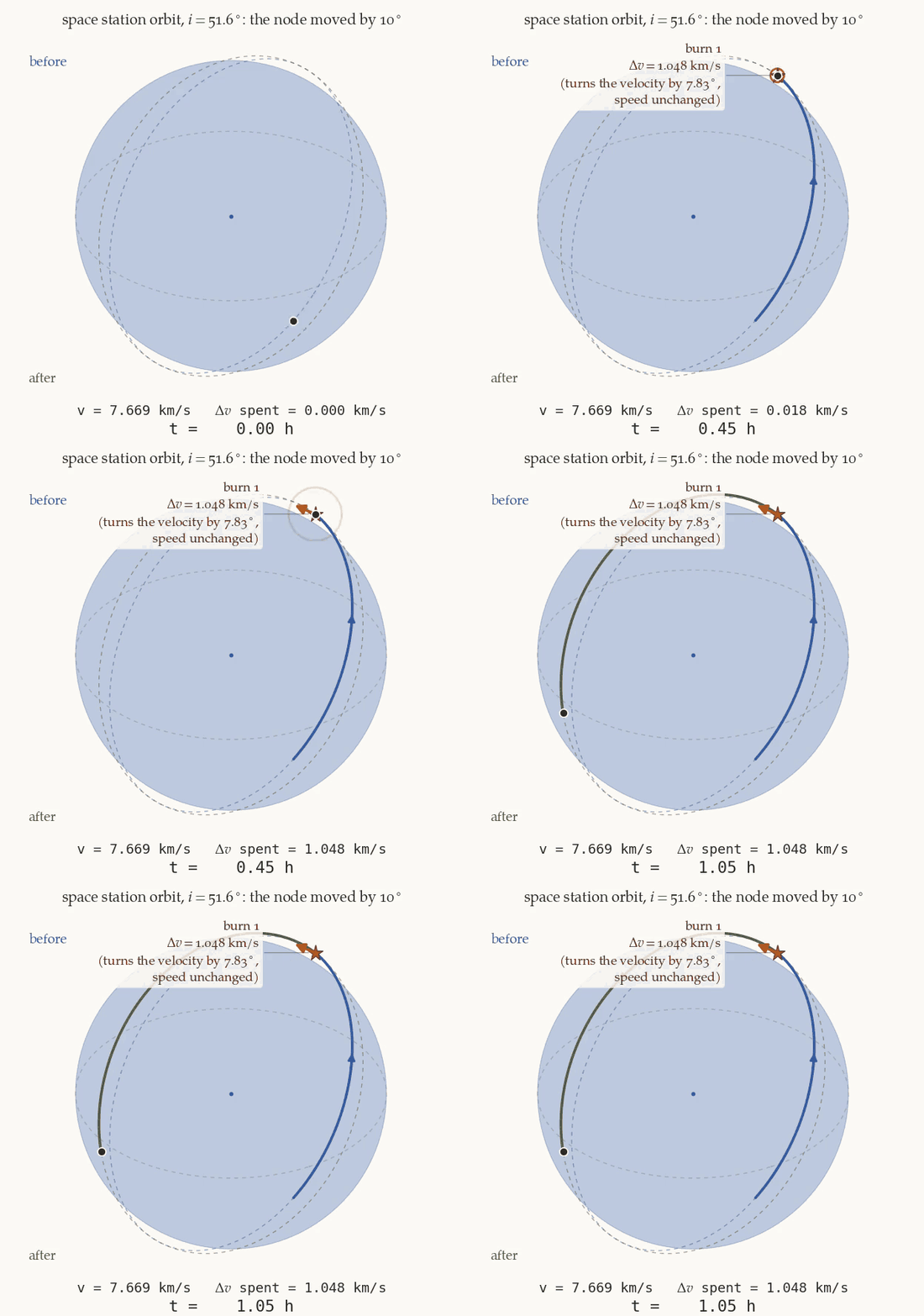
For \(i=90^\circ\), \(\cos\alpha=\cos\Delta\Omega\), so \(\alpha=\Delta\Omega\). The planes of all polar orbits meet at the poles, and changing the node is then the whole turn. For \(i\to0\), \(\cos\alpha\to1\), so \(\alpha\to0\). An equatorial orbit has no node to move.Example. A space station orbits at \(r=6778\) km with \(i=51.6^\circ\). Find the cost of changing its node by \(10^\circ\) with a burn. Then find the time the same change would take if we simply waited for the Earth’s oblateness to move the node. That drift is \(\dot\Omega=-\frac32J_2\left(R_\oplus/p\right)^2n\cos i\), with \(J_2=1.08263\times10^{-3}\) and \(n\) the mean motion (derived in the gravity note).
Solution. Equation 5 gives
\[ \cos\alpha=\cos^251.6^\circ+\sin^251.6^\circ\cos10^\circ=0.99067,\qquad\text{so}\quad\alpha=7.833^\circ . \]
The orbit is circular, with speed \(v=\sqrt{\mu/r}=7.669\) km/s. The cost of the burn is therefore
\[ \Delta v=2(7.669)\sin3.917^\circ=1.048\text{ km/s}. \]
For the drift we use \(p=r\), since the orbit is circular, and \(n=\sqrt{\mu/r^3}\). This gives \(\dot\Omega=-5.00^\circ\) per day. At this rate the node moves by \(10^\circ\) in \(2.0\) days, without using any propellant.
1.5.1 Burn or wait?
The burn takes a moment and uses \(28\%\) of the spacecraft’s mass, with \(I_{sp}=320\) s. Waiting takes two days and uses none. So when time allows, a mission lets the Earth do the work. There are two cautions.
The first is the direction. For \(i<90^\circ\) the node moves only westward, so \(\dot\Omega\) is negative. A change of \(10^\circ\) to the east would mean waiting for the node to travel the other \(350^\circ\), which takes \(70\) days.
The second is that the drift moves the planes of nearby spacecraft as well. Suppose we want to change our plane relative to another satellite in the same orbit, such as a space station. Both planes drift at the same rate, so waiting achieves nothing. To gain on it, we can park for a while at a different altitude or inclination, where the drift rate is different. This uses less propellant than the direct burn, but it takes more time.
The same thinking applies to a launch. A launcher that misses its moment does not fire harder to reach the plane. The Earth’s rotation brings the launch site back under the plane within about a day, so the launch simply waits.
2 Summary and exercise
A plane change costs \(2v\sin(\Delta i/2)\) when it is a separate burn, so it should be made where the speed is low. It costs less again when it is combined with a transfer burn, and a little less when it is shared between two burns. A change of the node can be left to \(J_2\) when time allows, at no cost in propellant.
Exercise. Repeat the optimal split for an idealised launch from Sriharikota due east, so that \(\Delta i=13.7^\circ\), the latitude of the launch site. How much does sharing the turn save? How much does heading south of east cost, in total \(\Delta v\) from LEO to GEO? (The answers are \(\delta^{*}=1.23^\circ\) and a total of \(3.977\) km/s, against \(3.985\) km/s with the whole turn at GEO, which is a saving of \(8.0\) m/s. Against the total of \(4.055\) km/s with \(\Delta i=19.2^\circ\), the extra turn costs about \(78\) m/s.)
All the numbers in this note are checked by plane-changes-verify.py.