Indian Missions — Trajectory Problems
How Chandrayaan, Mangalyaan and Aditya-L1 reached their targets, and what the other routes would have cost
How to use these problems
Every Indian deep-space mission so far has been launched by a rocket that could not send it directly to its target. Chandrayaan-1, Mangalyaan and Aditya-L1 flew on the PSLV, and even the LVM3 (GSLV Mk III) that launched Chandrayaan-2 and -3 placed them in a high elliptical Earth orbit, not on a trajectory to the Moon. Each spacecraft then had to finish the job with its own small engine: a \(440\) N liquid engine, burning for minutes at a time. The trajectories that ISRO flew are shaped by that constraint, and by the need to save propellant at every step.
Each problem follows the same pattern:
- Background: what the mission was, and the numbers ISRO published.
- The trajectory: a figure, reconstructed from those numbers.
- Analysis: the \(\Delta v\) and the time of each phase, from the published orbits.
- Alternatives: what a direct route, or some other route, would have cost.
Attempt each part before opening its answer. Problem 6 uses the circular restricted three-body problem (CR3BP), and is meant for after it has been covered in class; the others need only the two-body problem, patched conics and the rocket equation.
| # | mission | year | what it shows |
|---|---|---|---|
| 1 | Chandrayaan-1 | 2008 | reaching the Moon on a PSLV: many small perigee burns |
| 2 | Chandrayaan-2 | 2019 | what a bigger launcher buys; capturing safely at the Moon |
| 3 | Chandrayaan-3 | 2023 | a staged lunar capture that costs nothing extra; bringing the module home |
| 4 | Mangalyaan (MOM) | 2013 | a failed burn that cost no propellant; the launch window; the Mars orbit |
| 5 | Aditya-L1 (two-body) | 2023 | escaping to \(1.5\) million km, and why the cruise took \(110\) days |
| 6 | Aditya-L1 (CR3BP) | 2023–24 | the halo orbit, and why a slow transfer makes the insertion almost free |
Data. \(\mu_\oplus=398\,600.4418\ \mathrm{km^3/s^2}\), \(R_\oplus=6378.137\) km; Moon: \(\mu_{\rm M}=4902.80\ \mathrm{km^3/s^2}\), \(R_{\rm M}=1737.4\) km, mean distance \(r_{\rm M}=384\,400\) km; Mars: \(\mu=42\,828.37\ \mathrm{km^3/s^2}\), \(R=3396.2\) km; Sun: \(\mu_\odot=1.32712\times10^{11}\ \mathrm{km^3/s^2}\), \(1\ \mathrm{AU}=1.495\,979\times10^8\) km; \(g_0=9.80665\ \mathrm{m/s^2}\).
Engine. All five spacecraft used a \(440\) N liquid apogee motor. Take \(I_{sp}=310\) s, so \(v_e=I_{sp}g_0=3.040\) km/s and the propellant flow is \(\dot m=F/v_e=0.1447\) kg/s.
Assumptions (unless a part says otherwise). Orbits are given as perigee \(\times\) apogee altitude. Each apogee-raising burn is impulsive and tangential, at the perigee of the orbit before it. Successive Earth-bound orbits share one apse line. The arrival at the Moon is a coplanar patched conic: the transfer orbit’s apogee is at the Moon’s distance, and the Moon moves on a circle.
All the numbers in the answers are recomputed by codes/indian-missions-verify.py, using the models in codes/_imcommon.py. The figures are reconstructions from the published orbits, not flight data.
Problems
1. Chandrayaan-1: reaching the Moon on a PSLV
Background. Chandrayaan-1, India’s first mission to the Moon, was launched on 22 October 2008 by PSLV-C11, the first flight of the more powerful PSLV-XL. The PSLV could lift the \(1380\) kg spacecraft only into an elliptical orbit of \(255\times22\,860\) km, a little smaller than a geostationary transfer orbit. Over the next thirteen days the spacecraft’s own \(440\) N engine raised the apogee in five burns, each made near perigee, the last of which (4 November) put it on the lunar transfer trajectory. On 8 November an \(817\) s burn captured it into a \(504\times7502\) km lunar orbit, and four more burns brought it down to a \(100\) km circular polar orbit by 12 November. Its mass in lunar orbit was \(675\) kg.
| date (2008) | event | orbit after [km] | reported burn |
|---|---|---|---|
| 22 Oct | PSLV injection | \(255\times22\,860\) | — |
| 23 Oct | Earth-bound burn 1 | \(305\times37\,900\) | about \(18\) min |
| 25 Oct | Earth-bound burn 2 | \(336\times74\,715\) | about \(16\) min |
| 26 Oct | Earth-bound burn 3 | \(348\times164\,600\) | about \(9.5\) min |
| 29 Oct | Earth-bound burn 4 | \(465\times267\,000\) | about \(3\) min |
| 4 Nov | lunar transfer burn | apogee about \(380\,000\) (take perigee \(465\)) | about \(2.5\) min |
| 8 Nov | lunar orbit insertion | \(504\times7502\) (Moon) | \(817\) s |
| 9–12 Nov | four lowering burns | \(200\times7502\), \(187\times255\), \(101\times255\), \(100\times100\) | — |
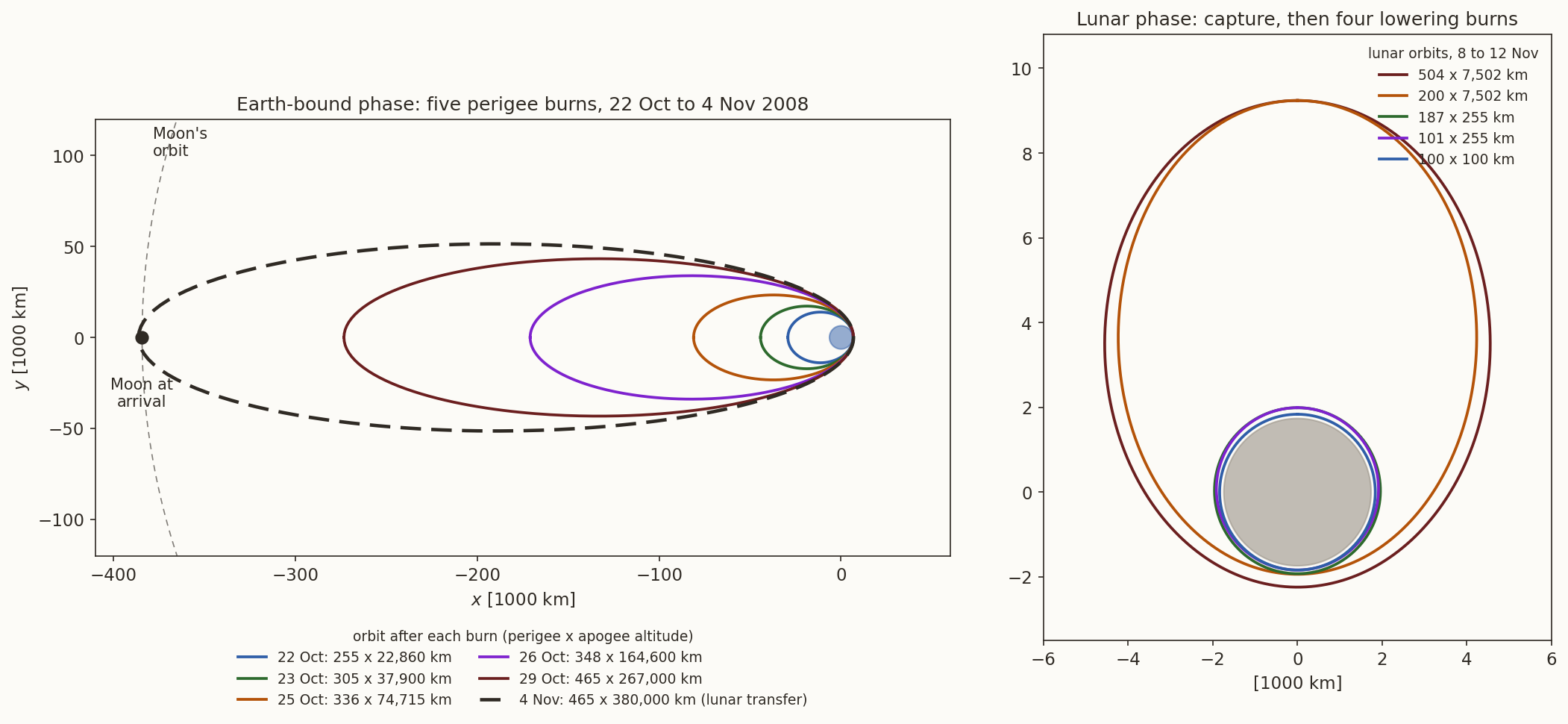
(a) Find the impulsive \(\Delta v\) of each of the five Earth-bound burns, and their total. Show that, to within a few m/s, the total is what a single burn at perigee from the launch orbit to the lunar transfer orbit would need. Why must that be so?
Answer
Each burn is tangential at perigee, so it changes only the speed at that point. Before the burn the speed is that of the old orbit at its perigee; after it, that of the new orbit at the same radius. Vis-viva gives both. For burn 1, at \(r_b=R_\oplus+255=6633.1\) km:
\[ \begin{aligned} a_{\rm old}&=\tfrac12(2R_\oplus+255+22\,860)=17\,935.6\ \mathrm{km},\qquad a_{\rm new}=\tfrac12(2R_\oplus+305+37\,900)=25\,480.6\ \mathrm{km},\\ \Delta v_1&=\sqrt{\mu\Bigl(\frac{2}{r_b}-\frac{1}{a_{\rm new}}\Bigr)}-\sqrt{\mu\Bigl(\frac{2}{r_b}-\frac{1}{a_{\rm old}}\Bigr)} =10.225-9.898=327.0\ \mathrm{m/s}. \end{aligned} \]
The same steps for the other four burns give
| burn | orbit before \(\to\) after | \(\Delta v\) [m/s] |
|---|---|---|
| 1 | \(255\times22\,860\to305\times37\,900\) | \(327.0\) |
| 2 | \(305\times37\,900\to336\times74\,715\) | \(317.4\) |
| 3 | \(336\times74\,715\to348\times164\,600\) | \(217.1\) |
| 4 | \(348\times164\,600\to465\times267\,000\) | \(76.6\) |
| 5 | \(465\times267\,000\to465\times380\,000\) | \(38.3\) |
| total | \(\mathbf{976.4}\) |
A single burn at \(255\) km from the launch orbit to a \(255\times380\,000\) km orbit needs \(972.5\) m/s. The two agree because every burn is made at (nearly) the same point and along the velocity: the speed there just steps up, \(v_0\to v_1\to\dots\to v_5\), and the sum of the steps is \(v_5-v_0\) whatever the number of steps. The \(4\) m/s difference comes only from the perigee creeping up from \(255\) to \(465\) km.
(b) Find the period of each Earth-bound orbit. Using the dates in the table, how many times did the spacecraft pass perigee in each orbit before the next burn? How long would the lunar transfer take on a Kepler ellipse, and how does that compare with the four days from 4 to 8 November?
Answer
\(T=2\pi\sqrt{a^3/\mu}\):
| orbit | \(a\) [km] | \(T\) [h] | days to next burn | revolutions |
|---|---|---|---|---|
| \(255\times22\,860\) | \(17\,936\) | \(6.64\) | \(1\) | \(\approx3.6\) |
| \(305\times37\,900\) | \(25\,481\) | \(11.24\) | \(2\) | \(\approx4.3\) |
| \(336\times74\,715\) | \(43\,904\) | \(25.43\) | \(1\) | \(\approx1\) |
| \(348\times164\,600\) | \(88\,852\) | \(73.2\) | \(3\) | \(\approx1\) |
| \(465\times267\,000\) | \(140\,111\) | \(145.0\) | \(6\) | \(\approx1\) |
In the small orbits there are several perigee passes to choose from. In the large ones there is only one per period, and the burn has to wait for it: the Earth-bound phase is slow because the orbits become slow.
The lunar transfer orbit (\(465\times380\,000\) km, \(a=196\,600\) km) has a half-period of \(\pi\sqrt{a^3/\mu}=5.0\) days. The actual trip took about four days because, on its last part, the spacecraft fell towards the Moon, whose pull our two-body ellipse leaves out.
(c) Alternative: one long burn. The engine is small, so each burn lasts minutes. Using the rocket equation with \(F=440\) N and \(I_{sp}=310\) s, estimate the duration of each of the five burns, and compare with the reported durations. Then consider making the whole \(976\) m/s in one burn, centred on perigee, from the launch orbit. A numerical integration of that burn (with the thrust along the velocity) gives a burn of \(2931\) s that costs \(1116\) m/s and lifts the perigee to \(683\) km. Explain why it costs more.
Answer
For a burn of \(\Delta v\) starting at mass \(m_0\), the mass drops to \(m_0e^{-\Delta v/v_e}\) at the rate \(\dot m=F/v_e\), so
\[ t_b=\frac{m_0v_e}{F}\Bigl(1-e^{-\Delta v/v_e}\Bigr). \]
Burn 1 starts at \(m_0=1380\) kg: \(m_0v_e/F=9535\) s and \(1-e^{-0.327/3.040}=0.1020\), so \(t_b\approx973\) s. Carrying the mass down the chain, and integrating each burn numerically (which also accounts for the finite arc), gives
| burn | \(\Delta v\) (impulsive) | integrated burn | reported |
|---|---|---|---|
| 1 | \(327\) m/s | \(993\) s | about \(18\) min (\(1080\) s) |
| 2 | \(317\) m/s | \(860\) s | about \(16\) min (\(960\) s) |
| 3 | \(217\) m/s | \(531\) s | about \(9.5\) min (\(570\) s) |
| 4 | \(77\) m/s | \(177\) s | about \(3\) min |
| 5 | \(38\) m/s | \(86\) s | about \(2.5\) min |
The agreement is good: the small engine and the published orbits tell the same story. The five integrated burns cost \(988.8\) m/s in all, only \(12\) m/s more than the impulsive total.
A single burn of \(2931\) s (\(49\) min) is only \(12\%\) of the launch orbit’s \(6.6\) h period, but it is centred on perigee, where the spacecraft moves fastest: by Kepler’s equation it spans \(176^\circ\) of true anomaly, from \(88^\circ\) before perigee to \(88^\circ\) after. The spacecraft sweeps halfway round its orbit while the engine fires, so much of the thrust is applied well away from perigee, where the speed is lower and each m/s buys less energy (\(\Delta\varepsilon=v\,\Delta v\)). Part of it also goes into raising the perigee instead of the apogee. The result is \(1116\) m/s, \(13\%\) more. Splitting the burn into five short ones, each centred on a perigee, keeps every burn close to the point where it is most effective. The price is time: thirteen days instead of one orbit.
(d) Alternative: a direct trans-lunar injection. Suppose instead that the launcher had left Chandrayaan-1 in a \(255\) km circular orbit, and the spacecraft had to make the whole trans-lunar injection itself. What \(\Delta v\) would that need, and what fraction of the spacecraft’s mass would be propellant? How much of this did the PSLV supply by placing it in \(255\times22\,860\) km?
Answer
At \(r=6633.1\) km the circular speed is \(\sqrt{\mu/r}=7.752\) km/s, and the speed on a \(255\times380\,000\) km orbit is \(10.870\) km/s. So a direct injection needs \(\Delta v=3118\) m/s, i.e. a propellant fraction \(1-e^{-3.118/3.040}=64\%\): about \(890\) kg of the \(1380\) kg, before any of the lunar burns. That was not possible.
The PSLV’s elliptical orbit already has a perigee speed of \(9.898\) km/s, so the launcher supplied \(9.898-7.752=2146\) m/s of the \(3118\) m/s; the spacecraft added the remaining \(972\) m/s at perigee. This is the general strategy of all five missions in this set: let the launcher do as much as it can, at perigee, and finish at perigee with the spacecraft’s engine.
(e) Capture at the Moon. Find the arrival excess speed \(v_\infty\) at the Moon for a transfer with perigee \(465\) km. Then find (i) the insertion burn into \(504\times7502\) km, (ii) the total of the insertion and the four lowering burns, and (iii) the single burn that would put the spacecraft directly into the \(100\) km circular orbit. Why was the staged route worth its extra cost? Compare the impulsive insertion with what an \(817\) s burn delivers.
Answer
Arrival. On the transfer orbit (\(r_p=6843.1\) km, apogee at \(r_{\rm M}\)), the speed at the Moon’s distance is \(\sqrt{\mu(2/r_{\rm M}-1/a)}=0.190\) km/s. The Moon moves at \(\sqrt{\mu/r_{\rm M}}=1.018\) km/s in the same direction, so relative to the Moon the spacecraft arrives at \(v_\infty=0.828\) km/s.
At perilune. On the approach hyperbola the speed at radius \(r\) is \(\sqrt{v_\infty^2+2\mu_{\rm M}/r}\). Each capture burn is that minus the speed on the target orbit at the same \(r\).
- At \(r=R_{\rm M}+504=2241.4\) km: hyperbola \(2.249\) km/s, orbit \(504\times7502\) km \(1.876\) km/s, so \(\Delta v_{\rm LOI}=373\) m/s.
- The four lowering burns, each tangential at the apsis that the two orbits share: \(26\) m/s (perilune lowered to \(200\) km at the \(7502\) km apolune), \(446\) m/s (apolune lowered to \(255\) km at the \(200\) km perilune), \(18\) m/s and \(33\) m/s. Total with insertion: \(897\) m/s.
- Directly into the \(100\) km circle: hyperbola \(2.454\) km/s at \(r=1837.4\) km, circular speed \(1.634\) km/s, so \(820\) m/s.
The staged route costs about \(76\) m/s more, because the insertion was made at \(504\) km, not at \(100\) km, where the spacecraft is faster and each m/s is worth more. It buys safety. The smallest burn that captures at all is \(v_{\rm hyp}-v_{\rm esc}=158\) m/s at \(504\) km, so the \(373\) m/s insertion would still have captured the spacecraft even if the engine had delivered less than half of it. The burn is also shorter, so its finite-burn losses are smaller, and the high orbit gives the ground days to measure it before the next burn.
Check. After the integrated Earth-bound burns the mass is \(997\) kg. An \(817\) s burn uses \(0.1447\times817=118\) kg, so it delivers \(3.040\ln\bigl(997/879\bigr)=384\) m/s: the impulsive \(373\) m/s plus about \(3\%\) of finite-burn loss.
(f) The mass budget. From \(1380\) kg at launch to \(675\) kg in lunar orbit, what \(\Delta v\) does the rocket equation give? Compare it with your impulsive total for the Earth-bound and lunar phases, and list what could account for the difference.
Answer
\(\Delta v=v_e\ln(1380/675)=3.040\times0.715=2174\) m/s. The impulsive estimates give \(976+897=1873\) m/s, which leaves about \(300\) m/s (\(14\%\)) unaccounted for. Candidates:
- finite-burn losses (\(12\) m/s on the Earth-bound burns, about \(11\) m/s on the insertion);
- trajectory-correction manoeuvres on the way to the Moon;
- propellant used by the \(22\) N attitude-control thrusters, whose \(I_{sp}\) is lower than the main engine’s;
- the burns were not exactly tangential, nor exactly at the apsides;
- the assumed \(I_{sp}=310\) s, and the exact meaning of “mass in lunar orbit”.
Even so, the published orbits explain about \(86\%\) of the propellant that was used.
2. Chandrayaan-2: what a bigger launcher buys
Background. Chandrayaan-2 (orbiter, the Vikram lander and the Pragyan rover; \(3850\) kg in all) was launched on 22 July 2019 by the first operational GSLV Mk III (LVM3-M1), after a launch attempt on 15 July was called off less than an hour before lift-off. The launcher placed it in a \(169.7\times45\,475\) km orbit. The first Earth-bound burn (\(48\) s, 24 July) mainly trimmed the perigee; four more raised the apogee, and the trans-lunar injection of 14 August (\(1203\) s) sent it to the Moon. On 20 August a \(1738\) s burn captured it into a \(114\times18\,072\) km lunar orbit, and four lowering burns brought it to \(119\times127\) km by 1 September. (Vikram was lost during its landing attempt on 7 September; the orbiter carried on operating.)
| date (2019) | event | orbit after [km] |
|---|---|---|
| 22 Jul | GSLV Mk III injection | \(169.7\times45\,475\) |
| 24 Jul | burn 1 (\(48\) s, trim) | \(230\times45\,163\) |
| 26 Jul – 6 Aug | burns 2–5 | \(251\times54\,829\), \(276\times71\,792\), \(277\times89\,472\), \(276\times142\,975\) |
| 14 Aug | trans-lunar injection (\(1203\) s) | target \(266\times413\,623\) |
| 20 Aug | lunar orbit insertion (\(1738\) s) | \(114\times18\,072\) (Moon) |
| 21 Aug – 1 Sep | four lowering burns | \(118\times4412\), \(179\times1412\), \(124\times164\), \(119\times127\) |
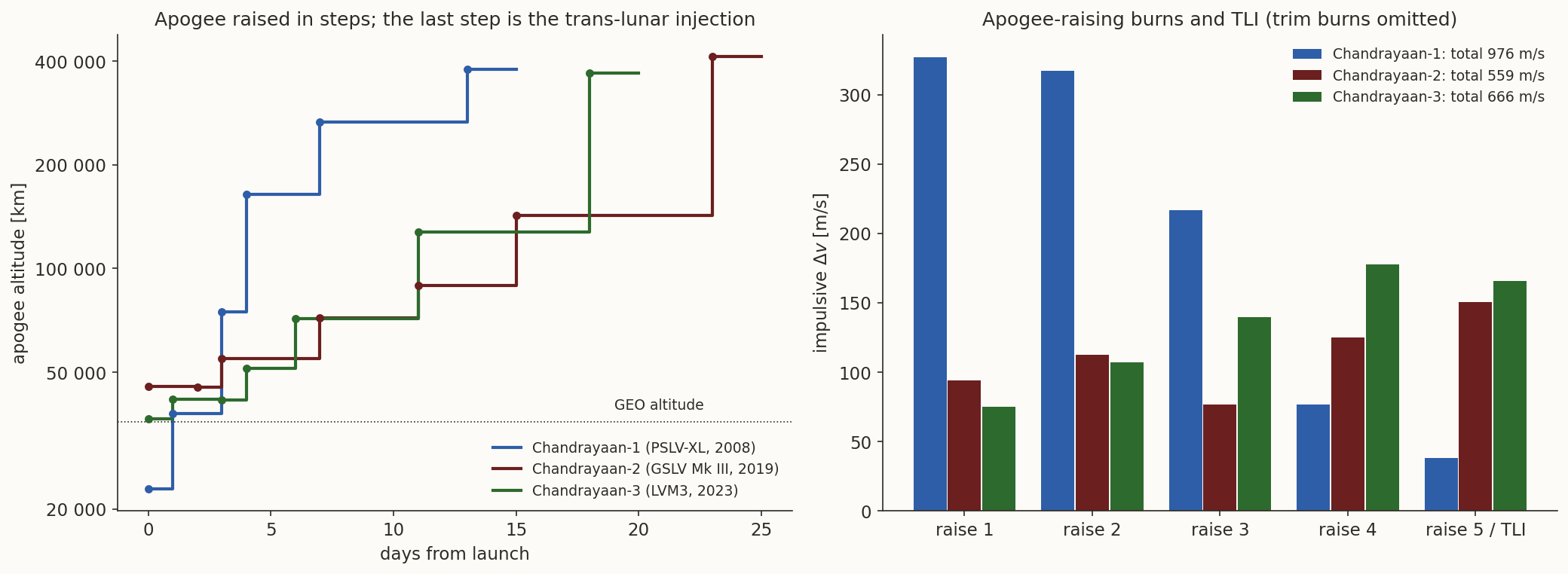
(a) Find the impulsive \(\Delta v\) of Chandrayaan-2’s apogee-raising burns and its trans-lunar injection (leave out the \(48\) s trim burn), and compare the total with Chandrayaan-1’s and Chandrayaan-3’s (Figure 2). How much propellant did each spacecraft spend in its Earth-bound phase? (Chandrayaan-3: \(3900\) kg at launch.)
Answer
The method of Problem 1(a), burn by burn at the perigee of the orbit before it, gives \(94.2\), \(112.4\), \(76.9\), \(125.3\) m/s for the raising burns and \(150.3\) m/s for the injection: \(559\) m/s in all. With the rocket equation, \(m_{\rm prop}=m_0\bigl(1-e^{-\Delta v/v_e}\bigr)\):
| mission | launch orbit [km] | Earth-bound \(\Delta v\) | \(m_0\) | propellant |
|---|---|---|---|---|
| Chandrayaan-1 | \(255\times22\,860\) | \(976\) m/s | \(1380\) kg | \(379\) kg |
| Chandrayaan-2 | \(169.7\times45\,475\) | \(559\) m/s | \(3850\) kg | \(647\) kg |
| Chandrayaan-3 | \(170\times36\,500\) | \(666\) m/s | \(3900\) kg | \(768\) kg |
The spacecraft’s share is set by how much energy the launcher left it with. The energy of the launch orbit, \(\varepsilon=-\mu/2a\), is \(-11.1\), \(-6.8\) and \(-8.1\ \mathrm{km^2/s^2}\) for the three missions: the GSLV Mk III’s orbit for Chandrayaan-2 was the most energetic, and the spacecraft’s own \(\Delta v\) was the smallest. A higher apogee from the launcher saves Chandrayaan-2 about \(107\) m/s against Chandrayaan-3, which on a \(3850\) kg spacecraft is about \(130\) kg of propellant.
(b) How much \(\Delta v\) did each launcher give beyond a circular orbit at its injection perigee? Why do the launchers stop short of a trans-lunar injection, when their upper stages could in principle burn longer?
Answer
At the injection perigee \(r_p\), the launcher’s contribution beyond circular speed is \(v_p-\sqrt{\mu/r_p}\):
- Chandrayaan-1 (PSLV-XL): \(2146\) m/s;
- Chandrayaan-2 (GSLV Mk III): \(2595\) m/s;
- Chandrayaan-3 (LVM3): \(2475\) m/s.
A trans-lunar injection from about \(170\) km needs roughly \(3.1\) km/s beyond circular speed, so the launcher would have to supply another \(0.6\) to \(1\) km/s. The upper stage is a heavy, inefficient mass to accelerate that far; every m/s it adds is paid for by a smaller payload. The spacecraft’s engine is lighter, and it can make its share in several burns, each at perigee, with tracking in between. The cost is time: compare the \(23\) days of Chandrayaan-2’s Earth-bound phase with the three days of an Apollo trans-lunar coast, whose Saturn V upper stage did the whole injection.
(c) Capture with a safety margin. Find Chandrayaan-2’s arrival \(v_\infty\) (transfer perigee \(276\) km), its insertion \(\Delta v\) into \(114\times18\,072\) km, and the smallest burn that would have captured it at all. What fraction of the insertion burn could the engine have lost without the spacecraft escaping? Check the insertion against the \(1738\) s burn.
Answer
As in Problem 1(e): \(v_\infty=0.830\) km/s. At \(r=R_{\rm M}+114=1851.4\) km the hyperbola speed is \(\sqrt{0.830^2+2(4902.8)/1851.4}=2.447\) km/s and the orbit speed is \(2.201\) km/s, so \(\Delta v_{\rm LOI}=246\) m/s.
The escape speed at that radius is \(\sqrt{2\mu_{\rm M}/r}=2.301\) km/s, so any burn above \(2.447-2.301=145\) m/s captures. The engine could have delivered only \(145/246=59\%\) of the burn and the spacecraft would still have stayed at the Moon, in a very long orbit that later burns could correct. Capturing into a high ellipse gives this margin; a direct capture into a low circle leaves none, because then the whole \(820\) m/s must be delivered correctly in one burn.
Check. The mass at insertion is \(3850e^{-0.559/3.040}=3203\) kg. A \(1738\) s burn uses \(252\) kg, so it delivers \(3.040\ln\bigl(3203/2952\bigr)=249\) m/s, against the impulsive \(246\) m/s.
(d) Alternative: capture directly into the final orbit. Find the total \(\Delta v\) of the insertion and the four lowering burns (take each lowering burn at the perilune of the orbit before it), and the single burn that would capture directly into \(119\times127\) km. How long would that single burn last?
Answer
The four lowering burns cost \(183\), \(185\), \(199\) and \(9\) m/s, so the staged total is \(246+576=822\) m/s. A direct capture into \(119\times127\) km needs \(817\) m/s. The staged route costs only \(5\) m/s more, because, unlike Chandrayaan-1’s, all its burns are at nearly the same low perilune: the speeds at that point step down, and the steps add up to the same total (Problem 1(a) in reverse).
A single \(817\) m/s burn from \(3203\) kg would last \(\dfrac{3203(3.040)}{0.440}\Bigl(1-e^{-0.817/3.040}\Bigr)=5215\) s, i.e. \(87\) minutes, against an orbit whose perilune passage lasts a few minutes. Its finite-burn losses would be far larger, and it would have no margin at all. Splitting the capture costs almost nothing and removes both problems.
3. Chandrayaan-3: a staged capture, and bringing the module home
Background. Chandrayaan-3 (\(3900\) kg: a \(2148\) kg propulsion module carrying the Vikram lander and the Pragyan rover) was launched by LVM3-M4 on 14 July 2023 into a \(170\times36\,500\) km orbit. After the Earth-bound burns and the trans-lunar injection of 1 August, a \(1835\) s burn on 5 August captured it into a \(164\times18\,074\) km lunar orbit. Four lowering burns brought it to \(153\times163\) km by 16 August; the lander separated on 17 August, lowered its own orbit to \(25\times134\) km, and landed near the south pole on 23 August.
ISRO later reported that the precise injection by LVM3 and the planning of the Earth and lunar burns had left over \(100\) kg of propellant in the propulsion module (dry mass \(448.6\) kg). That was used to bring the module back to an Earth orbit: on 9 October 2023 its apolune was raised from \(150\) km to \(5112\) km (period from \(2.1\) h to \(7.2\) h), and on 13 October a trans-Earth injection sent it away from the Moon. After four lunar flybys it left the Moon’s sphere of influence on 10 November, and by early December it was in an Earth orbit with a first perigee of about \(154\,000\) km, a period of about \(13\) days and an inclination of \(27^\circ\). The planned orbit had been about \(1.8\) lakh \(\times\) \(3.8\) lakh km, chosen to keep clear of the GEO belt and of the Moon.
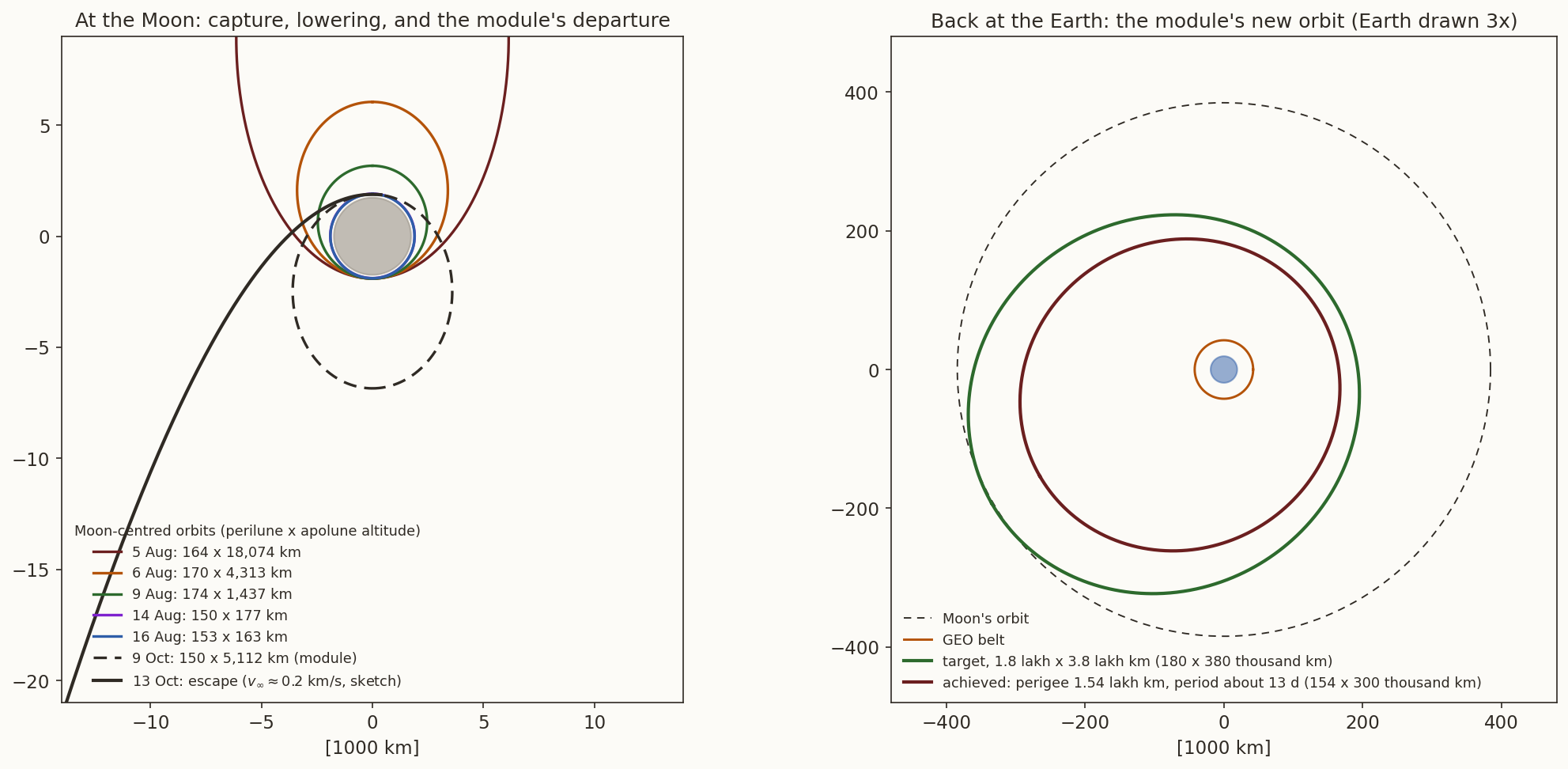
(a) Find the insertion \(\Delta v\) (transfer perigee \(288\) km) and the four lowering burns, each taken at the perilune of the orbit before it. Compare their total with a single capture into \(153\times163\) km. How long would that single burn have lasted? Compare the insertion with what the \(1835\) s burn delivers.
Answer
\(v_\infty=0.830\) km/s. At \(r=R_{\rm M}+164=1901.4\) km the hyperbola speed is \(2.418\) km/s and the \(164\times18\,074\) km orbit’s speed is \(2.169\) km/s, so \(\Delta v_{\rm LOI}=249\) m/s. The lowering burns then cost \(188\), \(185\), \(192\) and \(2\) m/s, so the staged total is \(816\) m/s, against \(812\) m/s for a direct capture into \(153\times163\) km: a penalty of \(4\) m/s.
The mass at insertion is about \(3900e^{-0.666/3.040}=3132\) kg. A single \(812\) m/s burn would last \(5070\) s (\(85\) min), against the \(1835\) s that ISRO’s insertion took. The \(1835\) s burn uses \(266\) kg and delivers \(3.040\ln\bigl(3132/2866\bigr)=269\) m/s, about \(20\) m/s more than the impulsive estimate; that is the order of the finite-burn loss, and of the uncertainty in our coplanar arrival model.
(b) The lander’s two deboost burns took it from \(153\times163\) km to \(113\times157\) km and then to \(25\times134\) km. Assuming each is a tangential burn at the apolune, find their \(\Delta v\). Why lower the perilune to \(25\) km before starting the powered descent?
Answer
At the apolune the burn lowers the perilune and leaves the apolune where it is, so it is placed there. The two burns cost about \(10\) m/s and \(25\) m/s; the second is larger because it lowers the perilune by much more. (The two orbits in each pair do not share their apolune exactly, which the model ignores.)
The powered descent must remove the whole orbital speed, about \(1.7\) km/s, with the lander’s own engines. Starting it at the perilune of a \(25\times134\) km orbit means starting low, where the remaining descent is short and the spacecraft’s speed is close to what the descent would have to cancel anyway, so little is lost to fighting gravity; and the deboost itself is cheap, because it is made at the apolune, where the speed is lowest.
(c) Bringing the module home. Check ISRO’s periods of \(2.1\) h and \(7.2\) h. Then estimate the return with a patched conic: find the module’s \(v_\infty\) relative to the Moon for an Earth orbit of \(180\,000\times380\,000\) km whose apogee is at the Moon’s distance, and the \(\Delta v\) of the two burns. How much propellant does that need, and does it fit “over \(100\) kg”? Why make it in two burns, when one burn at the same point would cost the same?
Answer
Periods. The \(150\) km circle has \(r=1887.4\) km: \(T=2\pi\sqrt{r^3/\mu_{\rm M}}=2.04\) h. The \(150\times5112\) km orbit has \(a=4368.4\) km: \(T=7.20\) h. Both match.
The target orbit. With \(r_p=R_\oplus+180\,000\) and \(r_a=R_\oplus+380\,000\), the speed at apogee is \(\sqrt{2\mu r_p/(r_a(r_a+r_p))}=0.819\) km/s, against the Moon’s \(1.018\) km/s. The module must leave the Moon at \(v_\infty=0.199\) km/s, backwards relative to the Moon’s motion.
The burns. At \(r=1887.4\) km: the circular speed is \(1.612\) km/s, the \(150\times5112\) km orbit has \(2.018\) km/s at perilune, and the escape hyperbola needs \(\sqrt{0.199^2+2(4902.8)/1887.4}=2.288\) km/s. So the apolune raise costs \(406\) m/s and the trans-Earth injection \(270\) m/s: \(676\) m/s in all. (Merely escaping the Moon would cost \((\sqrt2-1)\times1.612=668\) m/s.)
Propellant. With the dry mass \(448.6\) kg left at the end, \(m_{\rm prop}=448.6\bigl(e^{0.676/3.040}-1\bigr)=112\) kg: “over \(100\) kg” is just enough. The margin is thin, and the four lunar flybys of the real trajectory, which exchange energy with the Moon for free, are part of how ISRO made it work.
Two burns. Both are at the perilune, so impulsively they cost the same as one. But the first puts the module on a \(7.2\) h orbit, which lets the second be timed so that the module leaves the Moon in the right direction, and halves the duration of each burn.
(d) ISRO reported a first perigee of about \(154\,000\) km altitude and a period of nearly \(13\) days. What apogee does that imply? Compare with the planned orbit, and with the alternatives: leaving the module in lunar orbit, or crashing it on the Moon.
Answer
\(a=\bigl(\mu T^2/4\pi^2\bigr)^{1/3}=233\,500\) km for \(T=13\) d, so \(r_a=2a-r_p=2(233\,500)-160\,400\), an apogee altitude of about \(300\,000\) km. The planned \(180\,000\times380\,000\) km orbit would have had a period of \(17.7\) days. The achieved orbit is smaller, with its apogee inside the Moon’s orbit; either way its perigee is far above the GEO belt at \(35\,786\) km, which was the constraint.
The alternatives are cheaper. Lowering the perilune from the \(150\) km circle to the surface costs only \(34\) m/s, and leaving the module where it was costs nothing. The return was worth its \(676\) m/s because it let the module’s SHAPE instrument keep observing the Earth from far away, and, in ISRO’s words, to gather additional information for future lunar missions: it was a rehearsal of leaving lunar orbit and returning to the Earth.
4. Mangalyaan: Mars on a PSLV
Background. The Mars Orbiter Mission (Mangalyaan, \(1337\) kg at launch, of which \(852\) kg was propellant) was launched by PSLV-C25 on 5 November 2013. The GSLV, which could have placed it in a higher orbit, was not yet flying reliably, and the PSLV could only put it into a \(264\times23\,904\) km orbit. Six perigee burns raised the apogee to \(192\,874\) km. The fourth one fell short: the engine delivered \(35\) m/s instead of the planned \(130\) m/s, raising the apogee to \(78\,276\) km instead of about \(100\,000\) km, and a supplementary burn the next day took it to \(118\,642\) km. The trans-Mars injection (TMI) of 1 December 2013 IST lasted \(1329\) s. After a \(298\)-day cruise, a \(24\)-minute burn on 24 September 2014 put the spacecraft into a \(421.7\times76\,993.6\) km Mars orbit with a period of \(72\) h \(51\) min, and only about \(40\) kg of propellant was left.
| date (2013) | event | apogee after [km] |
|---|---|---|
| 5 Nov | PSLV-C25 injection | \(23\,904\) (perigee \(264\)) |
| 7, 8, 9 Nov | burns 1–3 | \(28\,825\), \(40\,186\), \(71\,636\) |
| 11 Nov | burn 4 (short) | \(78\,276\) |
| 12 Nov | supplementary burn | \(118\,642\) |
| 16 Nov | burn 5 | \(192\,874\) |
| 1 Dec | trans-Mars injection | escape |
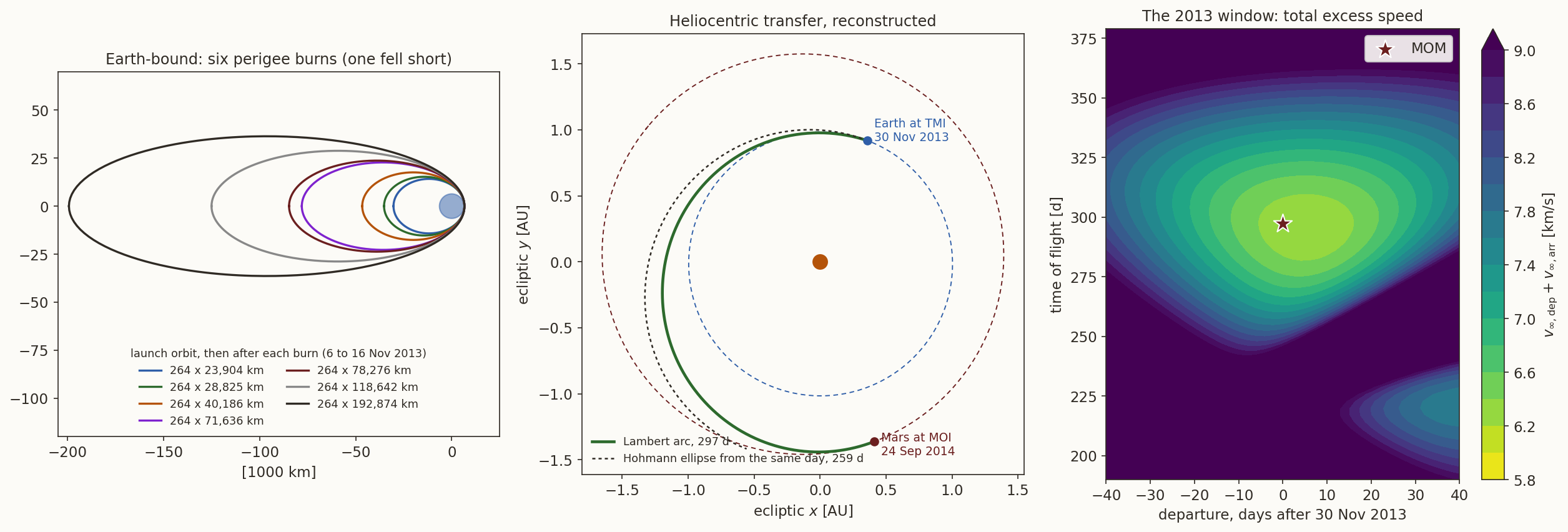
(a) Find the impulsive \(\Delta v\) of the six Earth-bound burns (hold the perigee at \(264.1\) km). Then compare the planned sequence, \(71\,636\to100\,000\to118\,642\) km, with the flown one, \(71\,636\to78\,276\to118\,642\) km. How much did the short burn cost?
Answer
The six burns cost \(127.2\), \(200.4\), \(268.1\), \(32.5\), \(126.1\) and \(101.8\) m/s: \(856\) m/s in all.
The planned pair would have been \(111.8\) m/s (to \(100\,000\) km) and \(46.9\) m/s (on to \(118\,642\) km); the flown pair was \(32.5\) m/s and \(126.1\) m/s. Both total \(158.6\) m/s. All four burns are tangential at the same perigee, so the speed there just steps from its value on the \(71\,636\) km orbit to its value on the \(118\,642\) km orbit, however the steps are divided (Problem 1(a)). The short burn cost no extra \(\Delta v\) at all, only time: one extra perigee pass, about a day, which the schedule could absorb before the TMI date.
(b) The heliocentric transfer. The Lambert arc between the Earth’s position at TMI (30 November 2013, 19:19 UTC) and Mars’s position at arrival (24 September 2014, 02:10 UTC) takes \(297.3\) days and needs a departure excess speed of \(3.129\) km/s (\(C_3=9.79\ \mathrm{km^2/s^2}\)) and an arrival excess speed of \(3.155\) km/s. Compare with a Hohmann transfer between circular orbits of \(1\) and \(1.524\) AU. Why did MOM not fly a Hohmann transfer, and why did it take longer?
Answer
The Hohmann transfer has \(a_t=1.262\) AU; vis-viva gives departure and arrival excess speeds of \(2.945\) and \(2.649\) km/s, and the transfer takes half its period, \(259\) days.
A Hohmann transfer needs Mars to be exactly \(180^\circ\) round from the Earth’s departure point when the spacecraft arrives, and it assumes circular, coplanar orbits. Mars’s orbit has \(e=0.093\) and is inclined by \(1.85^\circ\), and in 2013 the planets were not in that ideal geometry. The arc that MOM actually needed swept \(218^\circ\) round the Sun, more than half a revolution (a “type II” transfer), and that longer arc took \(297\) days. Its excess speeds are \(0.18\) and \(0.51\) km/s higher than the Hohmann ideal.
The right panel of Figure 4 shows that MOM’s dates were nevertheless very close to the best available: the lowest total \(v_{\infty,\rm dep}+v_{\infty,\rm arr}\) in the 2013 window is \(6.24\) km/s, for a departure five days later with a \(295\)-day flight, against MOM’s \(6.28\) km/s.
(c) Find the impulsive TMI \(\Delta v\) from the final Earth orbit, using \(v_\infty=3.129\) km/s. Compare it with a TMI made directly from the launch orbit, and from a \(264\) km circular parking orbit. What did the six Earth-bound burns buy?
Answer
At perigee (\(r=6642.2\) km) the escape hyperbola needs \(\sqrt{v_\infty^2+2\mu/r}=\sqrt{9.792+120.02}=11.394\) km/s.
- From the \(264\times192\,874\) km orbit (\(v_p=10.777\) km/s): \(616\) m/s. (The flown burn was reported as \(648\) m/s; the difference is the finite-burn loss of a \(22\)-minute burn.)
- From the launch orbit (\(v_p=9.921\) km/s): \(1472\) m/s, in one burn.
- From a \(264\) km circle (\(7.747\) km/s): \(3647\) m/s.
The six burns and the TMI together cost \(856+616=1472\) m/s, the same as one burn from the launch orbit (all are at perigee again). What they bought is that no single burn was longer than about \(22\) minutes, and that the departure could wait in a slowly growing orbit until the right day. A single \(1472\) m/s burn would have lasted about \(45\) minutes and lost far more to finite-burn effects (compare Problem 1(c)).
(d) The Mars orbit. Find the Mars-orbit insertion \(\Delta v\) into \(421.7\times76\,993.6\) km, and check the orbit’s period. What would a capture into a \(400\) km circular orbit have cost? The spacecraft weighed about \(815\) kg after TMI and had about \(330\) kg of propellant left. Could it have done that?
Answer
At \(r=3396.2+421.7=3817.9\) km: the hyperbola speed is \(\sqrt{3.155^2+2(42\,828)/3817.9}=5.691\) km/s and the orbit speed (with \(a=42\,104\) km) is \(4.628\) km/s, so \(\Delta v_{\rm MOI}=1063\) m/s. The period is \(2\pi\sqrt{a^3/\mu}=72.86\) h, which is ISRO’s \(72\) h \(51\) min.
Into a \(400\) km circle: \(\Delta v=5.702-3.359=2343\) m/s.
The propellant for each: \(m_{\rm prop}=815\bigl(1-e^{-\Delta v/v_e}\bigr)\). The flown orbit needs \(241\) kg, which fits in \(330\) kg (ISRO reported about \(40\) kg left after MOI, the rest having gone to corrections and finite-burn losses). The circular orbit would need \(438\) kg: impossible. A very elliptical orbit is the cheapest way to be captured, because only a little speed has to be removed at a periapsis that is reached at high speed. The high apoapsis also let MOM’s colour camera take whole-disc images of Mars.
(e) The mass budget. From \(1337\) kg at launch, with \(852\) kg of propellant of which about \(40\) kg was left after MOI, what total \(\Delta v\) did MOM make? Compare it with the sum of your impulsive estimates.
Answer
The mass after MOI was \(1337-812=525\) kg, so \(\Delta v=3.040\ln(1337/525)=2841\) m/s. The impulsive estimates add up to \(856+616+1063=2535\) m/s; the flown TMI alone was \(32\) m/s more than impulsive, and the MOI, a \(24\)-minute burn, will have lost a comparable amount. The remaining \(250\) m/s or so went into trajectory corrections, attitude control, and the departures of the real burns from our idealised tangential, coplanar ones.
5. Aditya-L1: a 110-day cruise to 1.5 million km
Background. Aditya-L1, India’s first solar observatory, was launched by PSLV-C57 on 2 September 2023 into a \(235.6\times19\,502.7\) km orbit. Its destination was a halo orbit about the Sun–Earth \(L_1\) point, about \(1.5\) million km from the Earth towards the Sun, from where it can watch the Sun without interruption. Four Earth-bound burns raised the apogee to \(121\,973\) km; ISRO describes the strategy as one that minimised \(\Delta v\) while “restricting the number of perigee passes”, to limit the time spent in the Van Allen radiation belts. The trans-\(L_1\) injection (TL1I) of 19 September sent it away; it left the Earth’s sphere of influence on 30 September, and after a cruise of about \(110\) days it was inserted into its halo orbit on 6 January 2024.
| date (2023) | event | orbit after [km] |
|---|---|---|
| 2 Sep | PSLV-C57 injection | \(235.6\times19\,502.7\) |
| 3 Sep | Earth-bound burn 1 | \(245\times22\,459\) |
| 5 Sep | Earth-bound burn 2 | \(282\times40\,225\) |
| 10 Sep | Earth-bound burn 3 | \(296\times71\,767\) |
| 15 Sep | Earth-bound burn 4 | \(256\times121\,973\) |
| 19 Sep | trans-\(L_1\) injection | departure towards \(L_1\) |
| 30 Sep | leaves the Earth’s sphere of influence | — |
| 6 Jan 2024 | halo-orbit insertion | halo, period \(\approx178\) d |
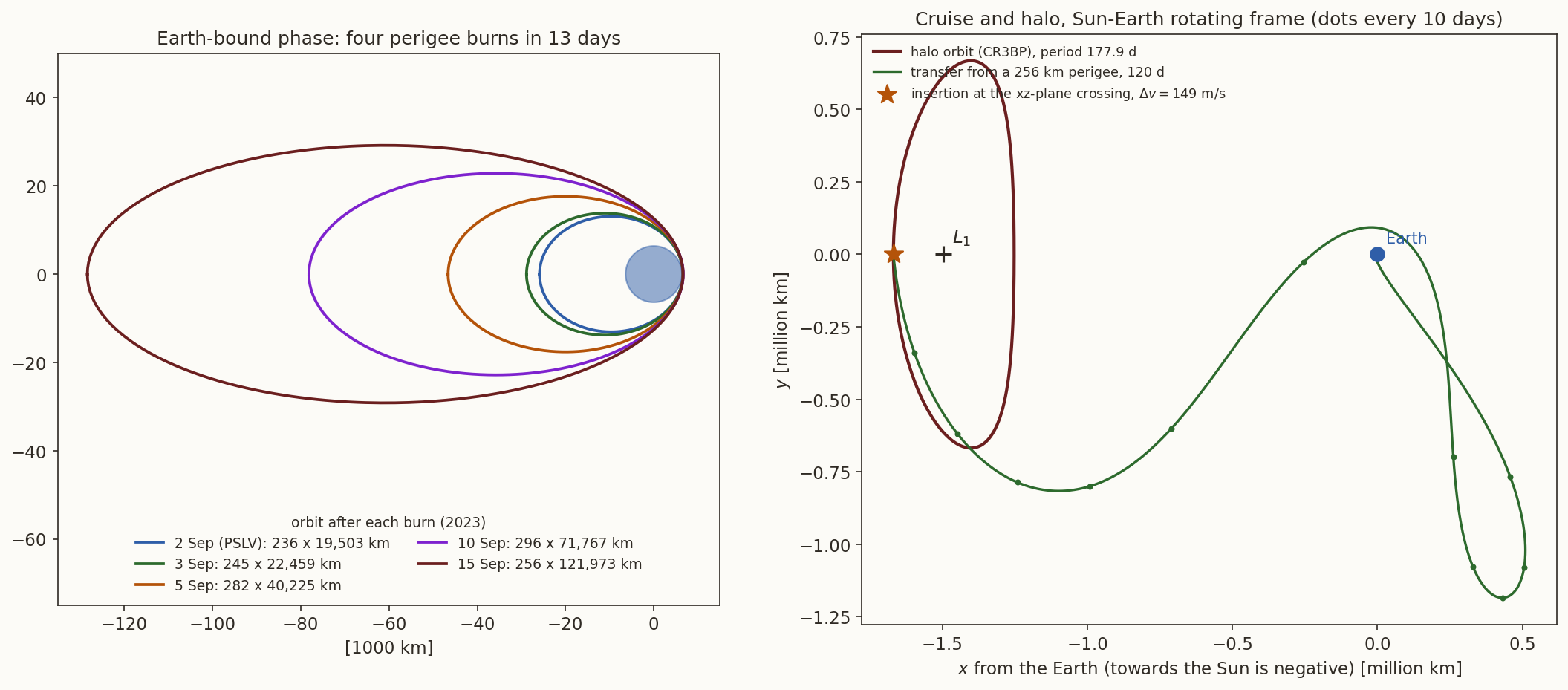
(a) Find the \(\Delta v\) of the four Earth-bound burns, and the period of each orbit. Using the dates, estimate how many perigee passes the spacecraft made before TL1I. Compare with Mangalyaan, which made six burns in eleven days. Why does the number of perigee passes matter?
Answer
The four burns cost \(104.2\), \(372.7\), \(268.5\) and \(165.2\) m/s: \(911\) m/s in all. The periods are \(5.7\), \(6.5\), \(12.0\), \(24.1\) and \(48.5\) h for the five orbits. Counting days between burns divided by the period: about \(4\) passes in the launch orbit (1 day), \(7\) in the second (2 days), \(10\) in the third (5 days), \(5\) in the fourth (5 days) and \(2\) in the last (4 days): roughly \(28\) passes.
Every perigee pass at a few hundred km means two crossings of the inner Van Allen belt, where the energetic protons degrade solar cells and electronics. Aditya-L1 did the work in four burns, the second of them large (\(373\) m/s), so that the apogee grew quickly and the number of passes stayed small. The price of a large burn is a longer firing and a larger finite-burn loss (Problem 1(c)).
(b) TL1I as a two-body problem. Find the \(\Delta v\) at the \(256\) km perigee that raises the apogee to \(1.5\times10^6\) km, and the \(\Delta v\) that would escape the Earth altogether. On the two-body ellipse, how long does the climb to \(1.5\times10^6\) km take, and how long to reach the edge of the Earth’s sphere of influence, \(r_{\rm SOI}=a_\oplus(\mu_\oplus/\mu_\odot)^{2/5}\)? Compare with the dates.
Answer
At \(r_p=6634.1\) km the \(256\times121\,973\) km orbit has \(v_p=10.689\) km/s. An ellipse with apogee radius \(1.5\times10^6\) km has \(a=753\,317\) km and \(v_p=10.938\) km/s, so TL1I \(\approx249\) m/s; escape needs \(\sqrt{2\mu/r_p}=10.962\) km/s, i.e. \(273\) m/s. The trip to \(L_1\) is nearly an escape: only \(24\) m/s separate the two.
The half-period of that ellipse is \(\pi\sqrt{a^3/\mu}=37.7\) days. The sphere of influence has \(r_{\rm SOI}=1.496\times10^8\,(3.0\times10^{-6})^{0.4}\approx925\,000\) km. To find the time to reach it, use the eccentric anomaly: \(e=1-r_p/a=0.9912\), \(\cos E=(1-r/a)/e\) gives \(E\), and Kepler’s equation \(n\,t=E-e\sin E\) gives \(t=10.0\) days. ISRO announced the exit from the sphere of influence on 30 September, \(11\) days after TL1I: the two-body model is good here, close to the Earth.
But the cruise to the halo orbit took about \(110\) days, three times the two-body \(37.7\). Near \(L_1\) the Sun’s pull is as strong as the Earth’s, by definition, and the two-body ellipse is not the right model there. Problem 6 does it properly.
6. Aditya-L1 in the three-body problem (after CR3BP)
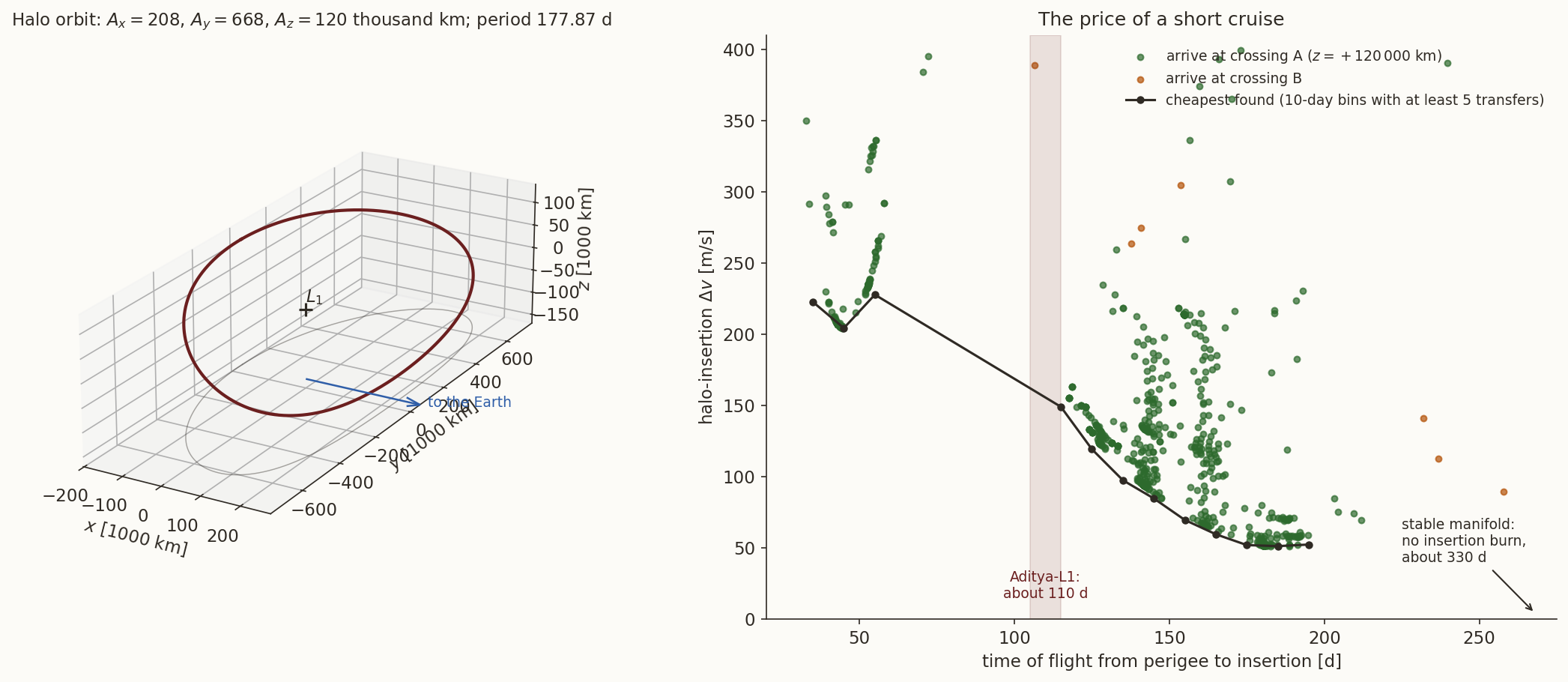
Background. In the Sun–(Earth+Moon) circular restricted three-body problem, with \(\mu=\dfrac{\mu_\oplus+\mu_{\rm M}}{\mu_\odot+\mu_\oplus+\mu_{\rm M}}=3.0404\times10^{-6}\), length unit \(1\) AU and time unit \(1/n\) (a year is \(2\pi\)), Aditya-L1’s halo orbit is a periodic orbit about \(L_1\). ISRO gave its target semi-axes as \(A_x=209\,200\) km, \(A_y=663\,200\) km and \(A_z=120\,000\) km, and its period as \(177.86\) days. The halo-orbit insertion (HOI) was made as the spacecraft crossed the \(xz\) plane of the rotating frame: the burn cancelled the \(x\) and \(z\) components of the velocity and set the \(y\) component the halo orbit needs. Two trajectory-correction manoeuvres (5 October and 14 December 2023) kept the spacecraft on course for that crossing.
(a) Units and \(L_1\). Find the time and speed units of the problem. \(L_1\) lies on the Sun–Earth line at a distance \(\gamma\) (in AU) from the Earth, where the gravity of the two bodies and the centrifugal term balance:
\[ x-\frac{(1-\mu)(x+\mu)}{|x+\mu|^3}-\frac{\mu(x-1+\mu)}{|x-1+\mu|^3}=0,\qquad x=1-\mu-\gamma . \]
Solve it numerically, and compare with the Hill estimate \(\gamma\approx(\mu/3)^{1/3}\).
Answer
The time unit is \(1/n\), with \(n\) the Earth’s mean motion: \(1/n=58.13\) days, so a year is \(2\pi\) units. The speed unit is \(\mathrm{AU}\cdot n=29.785\) km/s, the Earth’s orbital speed.
The equation has one root between the Sun and the Earth. Newton’s method from the Hill value gives \(\gamma=0.0100110\) AU, i.e. \(1.4976\times10^6\) km from the Earth: the “\(1.5\) million km” of ISRO’s descriptions. The Hill estimate is \((\mu/3)^{1/3}=0.0100447\) AU \(=1.5027\times10^6\) km, only \(0.34\%\) too far: the Sun’s and the Earth’s pulls balance where the Earth’s tidal field is as strong as its direct one, and the Hill approximation keeps exactly those two terms.
(b) Can the two-body TL1I reach \(L_1\)? The Jacobi constant is \(C=x^2+y^2+\dfrac{2(1-\mu)}{r_1}+\dfrac{2\mu}{r_2}-v^2\), with \(v\) the speed in the rotating frame; a spacecraft can never enter regions where \(x^2+y^2+2(1-\mu)/r_1+2\mu/r_2<C\). Find \(C\) at \(L_1\), on the halo orbit, and at a \(256\) km perigee with the two-body TL1I speed of Problem 5(b), \(10.938\) km/s (inertial). What perigee speed is needed to reach the halo orbit’s energy?
Answer
At \(L_1\) the speed is zero: \(C_{L_1}=3.000\,898\). On the halo orbit, \(C_{\rm halo}=3.000\,827\), slightly smaller: the halo orbit has a little more energy than \(L_1\) itself, as it must, since it moves round \(L_1\).
At the perigee, convert the inertial velocity to the rotating frame, \(\mathbf v_{\rm rot}=\mathbf v_{\rm in}-\hat{\mathbf z}\times\mathbf r\). With \(10.938\) km/s, \(C=3.002\,280\). That is larger than \(C_{L_1}\): the zero-velocity surface is closed at the \(L_1\) neck, and the spacecraft can never get there. The two-body estimate of Problem 5(b) is not enough.
Solving \(C(v)=C_{\rm halo}\) for the perigee speed gives \(10.997\) km/s; to open the \(L_1\) neck at all needs \(10.994\) km/s. Both are a little above the two-body escape speed at that perigee, \(10.962\) km/s: in the rotating frame the Sun’s pull and the frame’s rotation take back some of the energy. So the TL1I must be about \(10.9968-10.6893=307\) m/s, not \(249\) m/s. Every transfer found in part (e) has a perigee speed between \(10.997\) and \(11.003\) km/s.
(c) The halo orbit. A differential-correction computation (in the script) starting on the \(xz\) plane at \(z=120\,000\) km finds a periodic orbit with period \(177.87\) days and semi-axes \(A_x=208\,270\) km, \(A_y=667\,997\) km. Compare with ISRO’s target. Then explain why its period is so close to half a year: linearise about \(L_1\), with \(c_2=\mu/\gamma^3+(1-\mu)/(1-\gamma)^3=4.0611\), to find the in-plane frequency \(\omega_p\) and the out-of-plane frequency \(\omega_v=\sqrt{c_2}\), and their periods.
Answer
The computed orbit agrees with ISRO’s target (\(A_x=209\,200\), \(A_y=663\,200\), \(A_z=120\,000\) km, \(177.86\) d) to \(0.4\%\), \(0.7\%\), exactly (that was the input), and \(0.004\%\). A halo orbit is fixed by one amplitude; the other two, and the period, follow.
The linearised equations about \(L_1\) are
\[ \ddot\xi-2\dot\eta-(1+2c_2)\xi=0,\qquad \ddot\eta+2\dot\xi+(c_2-1)\eta=0,\qquad \ddot\zeta+c_2\zeta=0 . \]
The in-plane pair has the oscillatory root \(\omega_p^2=\tfrac12\bigl(2-c_2+\sqrt{9c_2^2-8c_2}\bigr)\), so \(\omega_p=2.0865\) and the period is \(2\pi/\omega_p\) units \(=175.06\) days. The vertical frequency is \(\omega_v=\sqrt{c_2}=2.0152\), period \(181.25\) days. The two are not equal, so the linear motion is a Lissajous figure, not a closed orbit. A halo orbit is the large-amplitude orbit for which the nonlinear terms make the two periods equal; it lands between them, at \(177.9\) days. Every \(L_1\) halo orbit of this size has a period of about half a year.
The linear theory also gives \(A_y/A_x=k=(\omega_p^2+1+2c_2)/(2\omega_p)=3.23\); the computed orbit has \(667\,997/208\,270=3.21\).
(d) Why station-keeping is needed. The monodromy matrix of the halo orbit (its state transition matrix over one period) has a real eigenvalue \(\lambda=1735\). What is the e-folding time of a small error? ISRO’s station-keeping burns came \(47\), \(106\) and \(25\) days apart. Is that consistent?
Answer
An error along the unstable direction is multiplied by \(1735\) each period, so it grows as \(e^{t/\tau}\) with \(\tau=T/\ln\lambda=177.87/7.459=23.8\) days. (The linear estimate at \(L_1\), \(1/\lambda_{\rm lin}\) with \(\lambda_{\rm lin}=2.533\), gives \(23.0\) days.) A \(1\) cm/s error grows to about \(44\) cm/s in three months, and the position error grows with it. So the orbit must be corrected every few e-folding times, which is what the spacing of \(25\) to \(106\) days does; each correction is small because the error is caught early. The same instability is what makes the transfer of part (e) possible: the halo orbit has a stable manifold too, a family of trajectories that approach it with no burn at all.
(e) The price of a short cruise. The right panel of Figure 6 shows transfers from a \(256\) km perigee to the crossing A of the halo orbit (the point \(z=+120\,000\) km on the \(xz\) plane), found by integrating backwards from the halo with a trial insertion \(\Delta v\) and keeping the trajectories whose first perigee is at \(256\) km. The cheapest found are about \(205\) m/s for a \(45\)-day transfer, \(150\) m/s at \(115\) days, \(85\) m/s at \(145\) days and \(51\) m/s at \(185\) days. Following the halo orbit’s stable manifold backwards from \(200\) km off the orbit reaches a perigee of \(64\) km after \(327\) days, with no insertion burn at all.
- Explain the trend. (ii) For a spacecraft of about \(1500\) kg, what does the fastest of these transfers cost in propellant, compared with the manifold? (iii) ISRO describes Aditya-L1’s insertion, after a cruise of about \(110\) days, as a short firing of its control engines: far less than the \(150\) m/s this model needs at \(115\) days. What does the model leave out that could account for the difference?
Answer
A trajectory on the stable manifold reaches the halo orbit with exactly the halo orbit’s velocity, so no burn is needed. But it approaches asymptotically: the distance to the orbit shrinks by a factor \(e\) every \(23.8\) days (part (d)), so getting from a few hundred km off the orbit to “on it” takes months. To arrive sooner, the spacecraft must leave the manifold and arrive with a velocity that differs from the halo orbit’s; the insertion burn is that difference, and the sooner the arrival, the larger it is. The fastest transfers, about \(40\) days, are close to the two-body ellipse of Problem 5(b) (\(37.7\) days), which arrives with no regard for the halo orbit’s velocity and pays about \(200\) m/s for it. Time and propellant trade against each other, as in the phasing problems of the Orbital Maneuvers deck, but here the trade is set by the instability of the halo orbit.
The departure burn is about \(307\) m/s for every one of these transfers (part (b)): their perigee speeds all lie between \(10.997\) and \(11.003\) km/s. So the difference is in the insertion. An extra \(205\) m/s on \(1500\) kg costs \(1500\bigl(1-e^{-0.205/3.040}\bigr)=98\) kg of propellant, about \(7\%\) of the spacecraft. The manifold costs nothing at insertion but takes three times as long, and its long, slow approach leaves a long time for errors to grow.
Several things, and none of them can be checked with this model alone:
- the real problem has the Moon’s gravity and the eccentricity of the Earth’s orbit, which the CR3BP leaves out, and both move the manifolds;
- the real transfer was shaped over the whole cruise by two trajectory-correction burns (on 5 October and 14 December), so not all the matching was left to the insertion;
- the real insertion point and the phase of the halo orbit at arrival were design choices; here both are fixed (at crossing A of one particular halo orbit), and the departure perigee is constrained only in altitude;
- the search here is local (a coarse grid refined by Nelder–Mead), so cheaper \(110\)-day transfers may well exist in this model too.
The lesson that does carry over is the shape of the curve: a slow arrival along, or near, the stable manifold is what makes the insertion small.
Sources and caveats
The mission figures are ISRO’s published values, mostly as collected in the Wikipedia articles, and checked against ISRO’s own pages where these exist. Orbits are rounded as published.
- Chandrayaan-1 (Problem 1): orbits, burn durations, the \(1380\) kg launch mass and \(675\) kg in lunar orbit from the Wikipedia article and ISRO’s status reports of October–November 2008 (for example this one). The perigee of the lunar transfer orbit was not published; \(465\) km is assumed.
- Chandrayaan-2 (Problem 2): orbits and burn durations from the Wikipedia article; the trans-lunar target orbit from ISRO’s optimised mission plan.
- Chandrayaan-3 (Problem 3): the lunar orbits from ISRO’s insertion update and the Wikipedia article; the propulsion module’s dry mass (\(448.62\) kg with pressurant) from the LVM3-M4 brochure; its return from ISRO’s report of 4 December 2023.
- Mangalyaan (Problem 4): orbits, masses and the Mars orbit from the Wikipedia article; the planned \(130\) m/s of the short burn from ISRO’s statement of 11 November 2013. Planet positions are from the
plan94analytical ephemeris of ERFA, accurate to a few thousand km, which is ample for a Lambert arc. - Aditya-L1 (Problems 5 and 6): orbits and dates from ISRO’s mission page; the parking orbit, the halo semi-axes, the insertion procedure and the \(110\)-day cruise from ISRO’s halo-insertion release; the period and the station-keeping dates from this ISRO update.
- Models. The \(I_{sp}\) of \(310\) s is assumed for all five spacecraft. The lunar arrivals are coplanar patched conics, and the actual arrivals, shaped by the inclination of the lunar orbit and by the Moon’s pull on the way in, differ by tens of m/s. The CR3BP of Problem 6 lumps the Earth and Moon together and leaves out the eccentricity of the Earth’s orbit, so it reproduces the character of Aditya-L1’s transfer, not its exact trajectory.
- Scripts.
codes/_imcommon.py(models),codes/fig-im-*.py(figures),codes/aditya-hoi-scan.pyandcodes/aditya-hoi-refine.py(the transfers of Problem 6, saved incodes/data/), andcodes/indian-missions-verify.py(every number on this page). Run them from thesfm-slidesdirectory.