Plane Changes: Questions
How to use these questions
These questions go with the note Plane Changes. They are the master set for the topic, and the class tests and examinations are drawn from them.
There are \(7\) objective questions. Each has four options and exactly one correct answer. They come in three levels. Level 1 asks for one definition, one fact or one formula used once. Level 2 needs two or three steps. Level 3 needs several steps, a limit, a symmetry, or a point that is easy to get wrong. Choose an option before you open the Answer, which gives the reason and, for a number, the calculation. The \(2\) drills are plain numericals on the methods of the note. The \(7\) extensions go beyond the note, analytically or analytically and numerically. Every problem has a worked solution, folded under Solution. Try the problem on paper before you open it.
Some problems need ideas from several notes at once. The Indian missions problems are of that kind, and are kept as a separate set.
Every number in the answers and solutions is checked by plane-changes-questions-verify.py.
Data. The objective questions use \(\mu_\oplus=398\,600\ \mathrm{km^3/s^2}\), \(R_\oplus=6378\) km, \(g_0=9.80665\ \mathrm{m/s^2}\), \(G=6.674\times10^{-11}\ \mathrm{m^3\,kg^{-1}\,s^{-2}}\), \(\mu_\odot=1.327\times10^{11}\ \mathrm{km^3/s^2}\), \(1\ \mathrm{AU}=1.496\times10^8\) km, \(M_\odot/m_{\rm Jupiter}=1047.6\) and \(J_2=1.08263\times10^{-3}\), unless a question says otherwise. Each problem gives the data it needs. Where it does not, use the constants of the notation page. Burns are impulsive and orbits are two-body, unless a question says otherwise. Angles in Kepler’s equation are in radians.
Objective questions
Level 1 — very easy
1. To change the plane of an orbit most cheaply, the burn should be made where
- the speed is greatest
- the orbit crosses the ecliptic
- the spacecraft is at periapsis
- the speed is least, for example at apoapsis
Answer
(D) A pure plane change costs \(2v\sin(\Delta i/2)\), proportional to the speed at the burn. It must be made on the line where the two planes meet, at the slower of the two crossings.
2. A spacecraft moving at \(7.5\) km/s turns its orbit plane by \(60^\circ\) without changing speed. The cost is
- \(15.0\) km/s
- \(7.50\) km/s
- \(6.50\) km/s
- \(3.75\) km/s
Answer
(B) \(\Delta v=2v\sin(\Delta i/2)=2\times7.5\times\sin30^\circ=7.5\) km/s: a \(60^\circ\) turn costs as much as the whole orbital speed.
3. At GEO arrival, combining the plane change with the circularisation burn into one burn is cheaper than doing them separately because
- the magnitude of a vector sum is less than the sum of the magnitudes
- the transfer time is shorter
- plane changes cost nothing at apoapsis
- the combined burn is made at higher speed
Answer
(A) Two burns \(\Delta\mathbf v_a\) and \(\Delta\mathbf v_b\) cost \(|\Delta\mathbf v_a|+|\Delta\mathbf v_b|\), while one burn achieving both costs \(|\Delta\mathbf v_a+\Delta\mathbf v_b|\), which is smaller unless they are parallel (triangle inequality).
Level 2 — a little difficult
4. At GEO arrival (\(v_{t2}=1.608\) km/s, \(v_{c2}=3.075\) km/s), a \(28.5^\circ\) plane change is combined with circularisation. The single burn costs about
- \(1.47\) km/s
- \(1.83\) km/s
- \(2.98\) km/s
- \(4.68\) km/s
Answer
(B) \(\Delta v=\sqrt{v_{t2}^2+v_{c2}^2-2v_{t2}v_{c2}\cos28.5^\circ}=1.830\) km/s. Done separately it would cost \(1.467+2\times3.075\sin14.25^\circ=2.981\) km/s.
5. A circular orbit with \(v=7.5\) km/s and \(i=30^\circ\) has its node moved by \(60^\circ\) at constant inclination. The single burn costs
- \(1.88\) km/s
- \(3.75\) km/s
- \(6.50\) km/s
- \(7.50\) km/s
Answer
(B) \(\Delta v=2v\sin i\sin(\Delta\Omega/2)=2\times7.5\times0.5\times0.5=3.75\) km/s, half of what an inclination change of \(60^\circ\) would cost.
Level 3 — hard
6. To turn the plane of a circular orbit by \(50^\circ\), the spacecraft first raises its apoapsis to \(Kr_1\), turns the plane there, and comes back. The best \(K\) is about
- \(1\) (turn directly)
- \(1.37\)
- \(2.73\)
- \(\infty\)
Answer
(C) With \(\sigma=\sin25^\circ=0.4226\), the optimum is \(K^*=\sigma/(1-2\sigma)=2.73\) (valid for \(\tfrac13<\sigma<\tfrac12\)). It costs \(0.794\,v_c\), against \(0.845\,v_c\) for the direct turn.
7. A small plane change \(\Delta i\) is shared between the two burns of a Hohmann transfer. To lowest order, the optimum gives the inner (first) burn
- less than half of \(\Delta i\), for every \(R>1\)
- more than half, because it is the larger burn
- exactly half
- all of it
Answer
(A) The extra cost of each burn is \(\propto v\,v'\,\delta^2/\Delta v_{\rm burn}\). The speeds at the inner circle are higher by \(R^{3/2}\), which outweighs its larger \(\Delta v\), so most of the turn goes to the outer burn (\(9.4\%\) to the inner one for LEO \(\to\) GEO, in the small-angle limit).
Answer key
All \(7\) answers.
Answer
| 1 D | 2 B | 3 A | 4 B | 5 B | 6 C | 7 A |
Drills
These are plain numericals. Each one practises a method of the note on a concrete case, and none of them adds anything that is not already in the note. Work each one through before you open its solution.
1. Sharing the turn for a launch due east
Repeat the optimal split for an idealised launch from Sriharikota due east, so that \(\Delta i=13.7^\circ\), the latitude of the launch site. How much does sharing the turn save? How much does heading south of east cost, in total \(\Delta v\) from LEO to GEO? Use the LEO and GEO radii and the speeds of the examples of the plane-change note.
Solution
The plan follows the example of the shared turn, with \(\Delta i=13.7^\circ\) in place of \(19.2^\circ\). The speeds do not depend on the turn. They are \(v_{c1}=7.726\) km/s and \(v_{t1}=10.151\) km/s at LEO, and \(v_{t2}=1.608\) km/s and \(v_{c2}=3.075\) km/s at GEO.
A first estimate. The small-turn rule of the plane-change note gives \(\delta^{*}\approx0.0944\,\Delta i=1.29^\circ\). A turn of \(13.7^\circ\) is smaller than \(19.2^\circ\), so we expect the rule to do a little better than it did there, where it was \(10\%\) too high.
The exact optimum. Equation (4) of the plane-change note has no closed-form solution, so we solve it numerically. The total cost is smallest at \(\delta^{*}=1.23^\circ\), which leaves \(12.47^\circ\) for the GEO burn. The two burns are then
\[ \Delta v_1=2.43315\ \text{km/s},\qquad \Delta v_2=1.54430\ \text{km/s}, \]
and both sides of Equation (4) of the plane-change note equal \(0.69129\) km/s, as they should. The total is \(3.97745\) km/s. The small-turn estimate was \(5\%\) high.
The saving from sharing. With the whole turn in the GEO burn, the GEO burn is \(\sqrt{v_{t2}^2+v_{c2}^2-2v_{t2}v_{c2}\cos13.7^\circ}=1.55977\) km/s, and the total is \(3.98550\) km/s. Sharing saves \(8.0\) m/s. This is less than the \(14.2\) m/s of the example, because the saving grows with the size of the turn, as the right panel of Figure 10 of the plane-change note shows.
The cost of heading south of east. Heading south of east raises the inclination from \(13.7^\circ\) to \(19.2^\circ\). With the best share in both cases, the total from LEO to GEO rises from \(3.977\) km/s to \(4.055\) km/s. The extra \(5.5^\circ\) of turn costs about \(78\) m/s. Note that the planar Hohmann transfer alone costs \(3.893\) km/s, so the turn costs \(85\) m/s from a due-east launch and \(163\) m/s from the south-of-east one.
Reading the result. With the rocket equation of the impulsive-model note and \(I_{sp}=315\) s, \(78\) m/s is about \(2.5\%\) of the mass that reaches GEO. That is a real price, paid on every mission. It is paid because a launch due east would fly low over land, as Figure 1 of the plane-change note shows, while the southern headings keep the rocket and its falling stages over the sea. Safety on the ground costs propellant in orbit.
2. From a sub-GTO to an inclined geosynchronous orbit
The satellites of India’s NavIC navigation system include some in inclined geosynchronous orbits. Suppose that a launch from Sriharikota leaves a \(1425\) kg satellite in a sub-geosynchronous transfer orbit, with perigee altitude \(280\) km, apogee altitude \(20\,650\) km and inclination \(19.2^\circ\). The satellite must reach a circular orbit of radius \(42\,164\) km with inclination \(29.0^\circ\). Its own engine has \(I_{sp}=310\) s. For this exercise take \(\mu=398\,600\) km\(^3\)/s\(^2\), \(R_\oplus=6378\) km and \(g_0=9.81\) m/s\(^2\). Assume that the line of apsides lies along the line of nodes, so that every apsis is also a node.
Plan 1. At perigee, a prograde burn raises the apogee to \(42\,164\) km with no change of plane. At the new apogee, one burn both circularises the orbit and turns the plane through the whole \(\Delta i\).
Plan 2. At the apogee of the sub-GTO, a burn turns the plane through the whole \(\Delta i\) and changes nothing else. Then, as in Plan 1, a perigee burn raises the apogee to \(42\,164\) km, and a burn at the new apogee circularises the orbit, now with no change of plane.
(a) Find each burn of Plan 1 and the total. How much of the second burn is due to the change of plane?
(b) Find each burn of Plan 2 and the total.
(c) Explain, from the velocity triangles, why Plan 1 is cheaper. Where in an orbit is a change of plane cheapest, and why?
(d) Find the propellant used by each plan.
Solution
The plan is to find the speeds at the four apsides that the plans visit, and then to work out each burn as the difference between two velocity vectors. A burn that does not turn the plane is a difference of speeds. A burn that turns the plane is the third side of a velocity triangle.
The radii are \(r_p=6658\) km, \(r_a=27\,028\) km and \(r_G=42\,164\) km, and \(\Delta i=29.0^\circ-19.2^\circ=9.8^\circ\). From the vis-viva equation \(v^2=\mu(2/r-1/a)\):
| Orbit | \(a\) (km) | speed at perigee (km/s) | speed at apogee (km/s) |
|---|---|---|---|
| sub-GTO, \(6658\times27\,028\) km | \(16\,843\) | \(9.8015\) | \(2.4145\) |
| raised ellipse, \(6658\times42\,164\) km | \(24\,411\) | \(10.1689\) | \(1.6057\) |
| final circle, \(42\,164\) km | \(42\,164\) | \(v_G=3.0747\) | \(3.0747\) |
(a) The first burn is along the velocity at perigee, so it is the difference of the speeds, \[ \Delta v_1=10.1689-9.8015=0.3674\ \text{km/s}. \] At the new apogee the velocity before the burn is \(1.6057\) km/s in the old plane, and after the burn it must be \(3.0747\) km/s in the new plane, turned through \(9.8^\circ\). Both velocities are horizontal and perpendicular to the line of nodes, so the angle between them is \(\Delta i\), and the cosine rule gives \[ \Delta v_2=\sqrt{1.6057^2+3.0747^2-2(1.6057)(3.0747)\cos9.8^\circ}=1.5172\ \text{km/s}. \] Plan 1 costs \(0.3674+1.5172=1.8846\) km/s. A coplanar circularisation would cost \(3.0747-1.6057=1.4689\) km/s, so the turn of \(9.8^\circ\) adds only \(48.3\) m/s to the second burn.
(b) A pure turn at the sub-GTO apogee keeps the speed \(2.4145\) km/s and rotates it through \(\Delta i\), so the isosceles triangle gives \[ \Delta v=2\,v\sin\frac{\Delta i}{2}=2(2.4145)\sin4.9^\circ=0.4125\ \text{km/s}. \] The other two burns are \(0.3674\) km/s and \(1.4689\) km/s, so Plan 2 costs \(2.2488\) km/s, which is \(364\) m/s more than Plan 1.
(c) A change of plane costs \(2v\sin(\Delta i/2)\) when it is made alone, so it is proportional to the speed at the burn. It is cheapest where the speed is least, at the apoapsis of the slowest orbit available. The raised ellipse is slower at its apogee (\(1.61\) km/s) than the sub-GTO is at its apogee (\(2.41\) km/s). That is one advantage of Plan 1.
The bigger advantage is the combination. In Plan 1 the turn is folded into a burn that has to happen anyway. In the velocity triangle the third side, \(\Delta v_2\), is only slightly longer than the difference of the two sides, \(v_G-v_a\), when the angle between them is small. To first order the extra cost is \(v_av_G\,\Delta i^2/[2(v_G-v_a)]\), which is quadratic in \(\Delta i\). A separate turn costs \(v\,\Delta i\), which is linear in \(\Delta i\). So the turn should go into the largest burn made at the slowest point. This is why satellites in transfer orbits make their change of plane together with the apogee circularisation.
(d) The exhaust speed is \(v_e=I_{sp}g_0=3.0411\) km/s, and the rocket equation gives the propellant as \(m_0\bigl(1-e^{-\Delta v/v_e}\bigr)\). Plan 1 uses \(658\) kg and Plan 2 uses \(745\) kg. The \(87\) kg saved by Plan 1 is mass that can stay on board as propellant for keeping the satellite on station through its life.
Extensions
These problems go beyond the note. Some are purely analytical, and some ask for a derivation and then a number. Most take longer than a drill, and several end with a remark on what the result means for a real mission.
3. Turning a plane from far away
The plane of a circle of radius \(r_1\) is to be turned through \(\theta\). Write \(v_c=\sqrt{\mu/r_1}\) and \(\sigma=\sin(\theta/2)\). Route D turns the velocity at \(r_1\) and costs \(2v_c\sigma\). Route F raises the apoapsis tangentially to \(r_b=Kr_1\), turns the plane at apoapsis, and circularises when it is back at \(r_1\).
- Show that
\[ \Delta v_F(K)=2v_c\left[\sqrt{\frac{2K}{1+K}}-1+\sigma\sqrt{\frac{2}{K(1+K)}}\right]. \]
Show that \(d\Delta v_F/dK\) has the sign of \(K-\sigma(1+2K)\). Hence show that the best \(K\) is \(1\) (Route D) for \(\sigma\le\frac13\), is \(K^*=\sigma/(1-2\sigma)\) for \(\frac13<\sigma<\frac12\), and is \(K\to\infty\) for \(\sigma\ge\frac12\).
Show that the optimal cost in the middle range is \(\Delta v^*=2v_c\bigl[2\sqrt{2\sigma(1-\sigma)}-1\bigr]\). Show that it joins the other two branches continuously.
At what angle does the limit \(K\to\infty\) first beat Route D? Compare the three thresholds \(\theta=38.9^\circ,\ 48.9^\circ,\ 60^\circ\) with the two bi-elliptic thresholds of the bi-elliptic note.
Answer
For each angle \(\theta\) we must choose the apoapsis \(K\) that makes Route F cheapest, and compare the result with Route D. The plan: write the cost as a function of \(K\) (a), find where its derivative vanishes (b), evaluate the cost there (c), and compare the cases (d).
(a) Route F has three burns.
- Raise the apoapsis. A tangential burn at \(r_1\) takes the circle to the ellipse with \(r_p=r_1\) and \(r_a=Kr_1\). By the transfer-ellipse speeds of Problem 5 of the The Hohmann Transfer questions, with \(R\) replaced by \(K\), the periapsis speed is \(v_p=v_c\sqrt{2K/(1+K)}\). The burn costs \(v_p-v_c\).
- Turn the plane at apoapsis. Angular momentum gives the apoapsis speed, \(v_b=v_p/K=v_c\sqrt{2/(K(1+K))}\). The velocity is turned through \(\theta\) with its size kept, so the old and new velocities form an isosceles triangle with two sides \(v_b\) and apex angle \(\theta\). Its base is the burn, \(2v_b\sin(\theta/2)=2v_b\sigma\).
- Circularise. The spacecraft falls back along the turned copy of the same ellipse, and reaches \(r_1\) at speed \(v_p\). Circularising costs \(v_p-v_c\) again.
The total is \(2(v_p-v_c)+2\sigma v_b\), which is the stated expression. (The first burn must be placed so that the apoapsis falls on the line where the two planes meet. Only on that line is there a point common to both orbits at which the plane can be turned.)
The structure of this cost is the whole story. The in-plane part \(2(v_p-v_c)\) grows with \(K\). The plane-change part \(2\sigma v_b\) falls with \(K\), because the spacecraft moves slowly far out. The best \(K\) balances the two.
(b) We need two derivatives. As in Problem 6 of the The Hohmann Transfer questions,
\[ \frac{d}{dK}\sqrt{\frac{2K}{1+K}}=\frac{1}{\sqrt{2K}\,(1+K)^{3/2}},\qquad \frac{d}{dK}\sqrt{\frac{2}{K(1+K)}}=-\frac{1+2K}{\sqrt2\,K^{3/2}(1+K)^{3/2}} . \]
To put them over a common denominator, write \(1/\sqrt{2K}=K/(\sqrt2\,K^{3/2})\). Then
\[ \frac{d\Delta v_F}{dK}=\frac{\sqrt2\,v_c}{K^{3/2}(1+K)^{3/2}}\Bigl[K-\sigma(1+2K)\Bigr]. \]
The factor in front is positive, so the sign is that of the bracket, which we write as \(K(1-2\sigma)-\sigma\). Now there are cases.
- \(\sigma\ge\frac12\): then \(1-2\sigma\le0\), the bracket is at most \(-\sigma<0\) for every \(K\), and the cost falls all the way as \(K\to\infty\).
- \(\sigma<\frac12\): the bracket is negative for \(K<K^*=\sigma/(1-2\sigma)\) and positive beyond, so the cost falls until \(K^*\) and rises after it. But \(K\) must be at least \(1\). If \(K^*\le1\), which means \(\sigma\le1-2\sigma\), i.e. \(\sigma\le\frac13\), the cost rises over the whole allowed range, and the best choice is \(K=1\): Route D. If \(\sigma>\frac13\), the best choice is \(K^*\).
(c) To evaluate the cost at \(K^*\) we need the two square roots there. First the pieces:
\[ 1+K^*=\frac{1-\sigma}{1-2\sigma},\qquad \frac{2K^*}{1+K^*}=\frac{2\sigma}{1-\sigma},\qquad K^*(1+K^*)=\frac{\sigma(1-\sigma)}{(1-2\sigma)^2}. \]
So the plane-change term is
\[ \sigma\sqrt{\frac{2}{K^*(1+K^*)}}=\sigma\,(1-2\sigma)\sqrt{\frac{2}{\sigma(1-\sigma)}}=(1-2\sigma)\sqrt{\frac{2\sigma}{1-\sigma}} , \]
and both terms now carry the same root:
\[ \frac{\Delta v^*}{2v_c}=\sqrt{\frac{2\sigma}{1-\sigma}}\,\bigl[1+(1-2\sigma)\bigr]-1 =2(1-\sigma)\sqrt{\frac{2\sigma}{1-\sigma}}-1=2\sqrt{2\sigma(1-\sigma)}-1 . \]
Continuity. At \(\sigma=\frac13\): \(2\sqrt{2\cdot\frac13\cdot\frac23}-1=\frac43-1=\frac13\), so \(\Delta v^*=\frac23v_c=2v_c\sigma\), the cost of Route D. At \(\sigma=\frac12\): \(2\sqrt{\frac12}-1=\sqrt2-1\), so \(\Delta v^*=2(\sqrt2-1)\,v_c\), which is the limit of \(\Delta v_F\) as \(K\to\infty\) (the plane-change term vanishes there).
(d) As \(K\to\infty\), \(\Delta v_F\to2(\sqrt2-1)\,v_c\): the plane change itself becomes free, and we pay only to go out and come back. This beats \(2v_c\sigma\) when \(\sigma>\sqrt2-1\), i.e. \(\theta>48.9^\circ\). So there are three thresholds:
| \(\sigma\) | \(\theta\) | what happens |
|---|---|---|
| \(\frac13\) | \(38.9^\circ\) | a small raise of the apoapsis starts to pay |
| \(\sqrt2-1\) | \(48.9^\circ\) | going out to infinity beats the direct turn |
| \(\frac12\) | \(60^\circ\) | infinity is the best choice |
The bi-elliptic transfer of the note also has two thresholds: infinity beats Hohmann at \(R=11.94\), but the smallest detour pays only from \(R=15.58\). Here the order is reversed: the local threshold (\(38.9^\circ\)) comes before the one at infinity (\(48.9^\circ\)). The reason is the shape of the cost. The cost of Route F has an interior minimum in \(K\), which beats both ends. The bi-elliptic cost, in the window \(11.94<R<15.58\), has an interior maximum in \(r_b\).
4. Folding a small plane change into a Hohmann transfer
A Hohmann transfer \(r_1\to r_2=Rr_1\) must also turn the plane by a small angle \(\Delta i\).
Show that a burn which changes the speed from \(v\) to \(v'\) and turns the velocity through \(\delta\) costs \(\sqrt{(v'-v)^2+4vv'\sin^2(\delta/2)}\). Hence show that folding the whole turn into the second burn raises its cost by only \(v_{t2}v_{c2}\,\Delta i^2/(2\Delta v_2)\) to lowest order, whereas a separate turn at \(r_2\) costs \(v_{c2}\,\Delta i\).
Give \(\delta\) of the turn to the first burn and \(\Delta i-\delta\) to the second. Show that, to lowest order, the best split is
\[ \frac{\delta}{\Delta i}=\frac{1}{1+R^{3/2}\,\Delta v_2/\Delta v_1}. \]
- Show that this fraction tends to \(\frac12\) as \(R\to1\) and to \(0\) as \(R\to\infty\), and that it is below \(\frac12\) for every \(R>1\). State what “small” means here.
Answer
Plan. Write the cost of a burn that changes the speed and turns the velocity, split it into the in-plane cost plus what the turn adds, and expand for a small turn; then share the turn between the two burns and minimise.
(a) First we need the cost of a burn that changes the speed and turns the velocity. The vectors \(\mathbf v\) and \(\mathbf v'\) make the angle \(\delta\), so by the law of cosines
\[ |\mathbf v'-\mathbf v|^2=v^2+v'^2-2vv'\cos\delta . \]
We want to separate the in-plane part \((v'-v)^2\), so write \(v^2+v'^2=(v'-v)^2+2vv'\):
\[ |\mathbf v'-\mathbf v|^2=(v'-v)^2+2vv'(1-\cos\delta)=(v'-v)^2+4vv'\sin^2\frac\delta2 . \]
At the second Hohmann burn, \(v=v_{t2}\), \(v'=v_{c2}\), and \(v'-v=\Delta v_2\) is the in-plane cost. Folding the whole turn \(\Delta i\) into it gives
\[ \Delta v_2(\Delta i)=\sqrt{\Delta v_2^2+4v_{t2}v_{c2}\sin^2\frac{\Delta i}{2}} . \]
To see what the turn adds when \(\Delta i\) is small, take out the in-plane part,
\[ \Delta v_2(\Delta i)=\Delta v_2\sqrt{1+\epsilon},\qquad \epsilon=\frac{4v_{t2}v_{c2}\sin^2(\Delta i/2)}{\Delta v_2^2}\approx\frac{v_{t2}v_{c2}\,\Delta i^2}{\Delta v_2^2}, \]
and use \(\sqrt{1+\epsilon}\approx1+\epsilon/2\):
\[ \Delta v_2(\Delta i)=\Delta v_2+\frac{v_{t2}v_{c2}}{2\,\Delta v_2}\,\Delta i^2+O(\Delta i^4). \]
The extra cost is second order in \(\Delta i\). A separate turn at \(r_2\) costs \(2v_{c2}\sin(\Delta i/2)=v_{c2}\,\Delta i+O(\Delta i^3)\), which is first order. The reason is Pythagoras. The plane-change part of the burn is perpendicular to the in-plane part, so the two add in quadrature, and a small perpendicular addition lengthens a vector only at second order. A small plane change folded into a burn that has to be made anyway is almost free.
(b) Now share the turn between the two burns. By (a), each burn’s extra cost is a parabola in the angle it takes. For the first burn (\(v=v_{c1}\), \(v'=v_{t1}\), in-plane cost \(\Delta v_1\)) and the second, the total extra cost is
\[ E(\delta)=\tfrac12A\,\delta^2+\tfrac12B\,(\Delta i-\delta)^2,\qquad A=\frac{v_{c1}v_{t1}}{\Delta v_1},\quad B=\frac{v_{t2}v_{c2}}{\Delta v_2}. \]
\(A\) and \(B\) measure how “stiff” each burn is against a plane change. To minimise \(E\), set its derivative to zero:
\[ E'(\delta)=A\delta-B(\Delta i-\delta)=0\quad\Longrightarrow\quad \frac{\delta}{\Delta i}=\frac{B}{A+B}=\frac{1}{1+A/B}. \]
It remains to write \(A/B\) in terms of \(R\). The circular speeds give \(v_{c1}/v_{c2}=\sqrt{r_2/r_1}=\sqrt R\). Angular momentum on the transfer ellipse, \(r_1v_{t1}=r_2v_{t2}\), gives \(v_{t1}/v_{t2}=R\). So
\[ \frac AB=\frac{v_{c1}v_{t1}}{v_{c2}v_{t2}}\cdot\frac{\Delta v_2}{\Delta v_1}=R^{3/2}\,\frac{\Delta v_2}{\Delta v_1}, \]
which gives the stated split.
(c) Limits. As \(R\to1\), \(\Delta v_2/\Delta v_1\to1\) (Problem 5 of the The Hohmann Transfer questions), so \(A/B\to1\) and the fraction tends to \(\frac12\): nearby circles share the turn equally. As \(R\to\infty\), \(\Delta v_1\to(\sqrt2-1)\,v_{c1}\) and \(\Delta v_2\approx v_{c1}R^{-1/2}\) (Problem 5 of the The Hohmann Transfer questions again), so \(A/B\approx R/(\sqrt2-1)\) and \(\delta/\Delta i\approx(\sqrt2-1)/R\to0\).
Always below \(\frac12\). We need \(A/B>1\), i.e. \(R^{3/2}\Delta v_2>\Delta v_1\). Two effects compete. The speeds at the inner circle are higher, which makes turning there dearer: this is the factor \(R^{3/2}\). But the inner in-plane burn is the larger one (Problem 5 of the The Hohmann Transfer questions), which makes turning there cheaper. We must show that the speeds win.
Both burns contain the same square root, so give it a name, \(q=\sqrt{2/(1+R)}\). Then \(\sqrt{2R/(1+R)}=\sqrt R\,q\), and from the limits part of Problem 5 of the The Hohmann Transfer questions,
\[ \Delta v_1=v_{c1}\bigl(\sqrt R\,q-1\bigr),\qquad R^{3/2}\Delta v_2=R^{3/2}\cdot\frac{v_{c1}}{\sqrt R}(1-q)=v_{c1}R\,(1-q). \]
So
\[ R^{3/2}\Delta v_2>\Delta v_1\iff R-Rq>\sqrt R\,q-1\iff R+1>q\,(R+\sqrt R) \iff (1+R)^{3/2}>\sqrt2\,(R+\sqrt R), \]
where the last step puts in \(q\) and multiplies by \(\sqrt{1+R}\). To remove the roots, put \(R=t^2\) (\(t>1\)) and square: we need
\[ (1+t^2)^3>2t^2(1+t)^2 . \]
Split the left side as \((1+t^2)^2\cdot(1+t^2)\) and bound each factor:
- \((1+t^2)^2\ge(2t)^2=4t^2\), because \(1+t^2\ge2t\) is \((t-1)^2\ge0\);
- \(1+t^2\ge\frac12(1+t)^2\), because \(2+2t^2-(1+2t+t^2)=(t-1)^2\ge0\).
Multiplying, \((1+t^2)^3\ge4t^2\cdot\frac12(1+t)^2=2t^2(1+t)^2\), and both inequalities are strict for \(t\ne1\). So \(A/B>1\) and \(\delta/\Delta i<\frac12\): most of the turn always goes to the outer burn, where the spacecraft moves slowly.
What “small” means. The expansion in (a) needs the plane-change part of each burn to be small compared with its in-plane part, \(4vv'\sin^2(\delta/2)\ll(v'-v)^2\). For LEO \(\to\) GEO the formula gives \(9.44\%\) of the turn to the first burn, i.e. \(2.69^\circ\) of \(28.5^\circ\). The exact optimum is \(2.20^\circ\). The difference is because \(28.5^\circ\) is not small at the second burn: there the \(\epsilon\) of (a) is about \(0.5\), not much less than \(1\).
5. Moving the node
The node of a circular orbit of radius \(r\) and inclination \(i\) is to be moved by \(\Delta\Omega\), keeping \(i\), with a single impulse. Let \(v=\sqrt{\mu/r}\).
Starting from \(\cos\alpha=\cos^2i+\sin^2i\cos\Delta\Omega\) (plane-changes note, “Changing the node instead”), show that the plane turns through \(\alpha\) with \(\sin\frac\alpha2=\sin i\,\sin\frac{\Delta\Omega}2\). Hence show that \(\Delta v=2v\sin i\sin\frac{\Delta\Omega}{2}\).
Show that the burn is made at argument of latitude
\[ u_1=90^\circ+\arctan\Bigl(\cos i\,\tan\frac{\Delta\Omega}{2}\Bigr) \]
on the initial orbit, or \(180^\circ\) further on, and at \(u_2=90^\circ-\arctan\bigl(\cos i\tan\frac{\Delta\Omega}2\bigr)\) on the final orbit. Where is this for a polar orbit, and for small \(\Delta\Omega\)?
- Show that moving the node through an angle never costs more than changing the inclination through the same angle. Why is moving the node of a near-equatorial orbit almost free?
Answer
Plan. Find the angle through which the plane must turn, from the two orbit normals; cost it as a plane change at the point where the planes meet; then ask where on the orbit that point is.
(a) The plane turns through the angle \(\alpha\) between the two orbit normals, and the plane-changes note gives \(\cos\alpha\). A plane-change burn costs \(2v\sin(\alpha/2)\), so we want the half-angle. Use \(1-\cos\phi=2\sin^2(\phi/2)\) on both sides:
\[ 1-\cos\alpha=1-\cos^2i-\sin^2i\cos\Delta\Omega=\sin^2i\,(1-\cos\Delta\Omega) \quad\Longrightarrow\quad 2\sin^2\frac\alpha2=2\sin^2i\,\sin^2\frac{\Delta\Omega}2 . \]
All the half-angles lie between \(0^\circ\) and \(90^\circ\), so we take the positive root, \(\sin\frac\alpha2=\sin i\sin\frac{\Delta\Omega}2\).
The burn is made at a point common to both orbits, so on the line where the two planes meet. On a circle the velocity is perpendicular to \(\mathbf r\), so at that point it is perpendicular to the line of intersection. Turning the plane through \(\alpha\) about that line therefore turns the velocity through the full \(\alpha\), at constant speed. The isosceles triangle gives \(\Delta v=2v\sin\frac\alpha2=2v\sin i\sin\frac{\Delta\Omega}2\).
(b) To find where to burn we must (1) find the direction of the line where the two planes meet, and (2) find the argument of latitude of that direction on each orbit.
Choose \(\hat{\mathbf I}\) midway between the two nodes, so that \(\Omega_1=-\frac12\Delta\Omega\) and \(\Omega_2=+\frac12\Delta\Omega\). This makes the two orbits mirror images of each other, which halves the work. With \(\hat{\mathbf h}=(\sin i\sin\Omega,\ -\sin i\cos\Omega,\ \cos i)\), the line of intersection is perpendicular to both normals, so it lies along their cross product:
\[ \hat{\mathbf h}_1\times\hat{\mathbf h}_2=2\sin i\sin\tfrac{\Delta\Omega}{2}\, \bigl(0,\ \cos i,\ \sin i\cos\tfrac{\Delta\Omega}{2}\bigr). \]
Call the normalised direction \(\hat{\mathbf x}=(0,\ \cos i,\ \sin i\cos\frac{\Delta\Omega}2)/N\), with \(N=\sqrt{\cos^2i+\sin^2i\cos^2\frac{\Delta\Omega}2}\). Its \(K\) component is positive, so it points north.
Now locate \(\hat{\mathbf x}\) on orbit 1. A point at argument of latitude \(u\) is at angle \(u\) from the ascending node \(\hat{\mathbf n}_1=(\cos\frac{\Delta\Omega}2,\ -\sin\frac{\Delta\Omega}2,\ 0)\), and it has \(z/r=\sin i\sin u\). So we can read off both \(\cos u_1\) and \(\sin u_1\):
\[ \cos u_1=\hat{\mathbf n}_1\cdot\hat{\mathbf x}=-\frac{\cos i\sin\frac{\Delta\Omega}2}{N},\qquad \sin u_1=\frac{\hat x_K}{\sin i}=\frac{\cos\frac{\Delta\Omega}2}{N}. \]
Hence \(\tan(u_1-90^\circ)=-\cos u_1/\sin u_1=\cos i\tan\frac{\Delta\Omega}2\), which is the stated \(u_1\). On orbit 2 the node is \(\hat{\mathbf n}_2=(\cos\frac{\Delta\Omega}2,\ +\sin\frac{\Delta\Omega}2,\ 0)\). That flips the sign of \(\cos u\) and gives \(u_2\). The planes also meet at \(-\hat{\mathbf x}\), \(180^\circ\) further on.
For a polar orbit, \(\cos i=0\) and \(u_1=u_2=90^\circ\). Every polar plane passes through the pole, so that is where they meet. For small \(\Delta\Omega\), the burn is near \(u=90^\circ\), the most northerly point of the orbit: just past it on a prograde orbit, and just before it on a retrograde one.
(c) Changing the inclination through \(\Delta\Omega\) turns the plane by \(\Delta\Omega\) and costs \(2v\sin\frac{\Delta\Omega}2\). The node change costs \(\sin i\) times as much: never more, and the same only for a polar orbit. As \(i\to0\) the orbit plane is nearly the equator, and moving the node moves the plane hardly at all: \(\alpha\to0\). The element \(\Omega\) swings round while the orbit barely changes. This is the degeneracy of the elements at \(i=0\) (Orbital Elements, “When the elements break down”).
6. GTO \(\to\) GEO: Kourou, Sriharikota or the Cape?
A \(3000\) kg satellite (\(I_{sp}=315\) s, \(F=440\) N) is in a GTO of \(185\times35\,786\) km. At apogee it makes one burn that circularises at GEO and removes the inclination. Compare the three launch sites (rounded GTO inclinations): Kourou \(7^\circ\), Sriharikota \(19.2^\circ\), Cape Canaveral \(28.5^\circ\). (Sriharikota lies at \(13.7^\circ\)N, the idealised minimum of the exercise in the plane-changes note; its GTOs sit near \(19\)–\(22^\circ\) because the launch heads about \(15^\circ\) south of east, as the plane-changes note explains.)
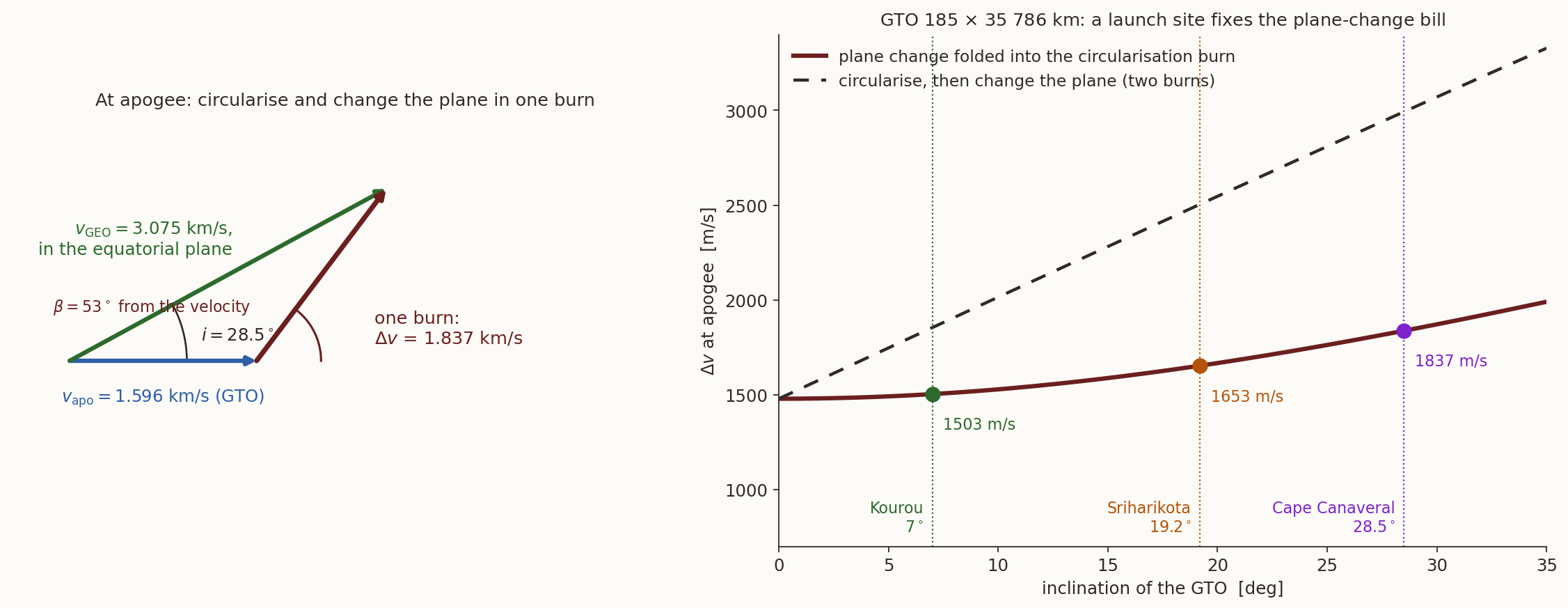
(a) Find \(\Delta v\), the thrust direction \(\beta\) from the velocity, and the propellant mass for each site. How much does folding the plane change into the circularisation save?
Answer
GTO: \(a=24\,363.6\) km, \(v_{\rm apo}=1.5958\) km/s; GEO: \(v_{\rm GEO}=3.0747\) km/s. The law of cosines and the triangle of the figure:
\[ \Delta v=\sqrt{v_{\rm apo}^{2}+v_{\rm GEO}^{2}-2v_{\rm apo}v_{\rm GEO}\cos i},\qquad \tan\beta=\frac{v_{\rm GEO}\sin i}{v_{\rm GEO}\cos i-v_{\rm apo}}, \]
\[ m_p=m_0\left(1-e^{-\Delta v/(I_{sp}g_0)}\right) \]
| site | \(i\) | \(\Delta v\) [m/s] | \(\beta\) | \(m_p\) | two burns [m/s] |
|---|---|---|---|---|---|
| Kourou | \(7^\circ\) | \(1503\) | \(14^\circ\) | \(1156\) kg (\(38.5\%\)) | \(1854\) |
| Sriharikota | \(19.2^\circ\) | \(1653\) | \(38^\circ\) | \(1243\) kg (\(41.4\%\)) | \(2504\) |
| Cape Canaveral | \(28.5^\circ\) | \(1837\) | \(53^\circ\) | \(1345\) kg (\(44.8\%\)) | \(2993\) |
The “two burns” column is \((v_{\rm GEO}-v_{\rm apo})+2v_{\rm GEO}\sin(i/2)\): \(1479\) m/s to circularise plus the plane change at GEO speed. Combining saves \(351\), \(851\) and \(1156\) m/s (\(19\), \(34\), \(39\%\)): the plane change is done at \(1.6\) km/s, not \(3.1\). The Cape-to-Kourou difference (\(334\) m/s) is \(189\) kg of propellant: about \(6\%\) of the satellite.
(b) The burn lasts \(t_b=\dfrac{m_0v_e}{F}\left(1-e^{-\Delta v/v_e}\right)\). For the three sites find \(t_b\) and the arc swept during the burn, and the loss \(\tfrac{\theta^{2}}{6}\Delta v\) (\(\theta\) = half the arc) if the thrust direction is held fixed in inertial space, so that the misalignment runs from \(-\theta\) to \(+\theta\), in one burn against three equal burns. (The radius stays close to \(r_a\), but the speed does not: it grows from \(v_{\rm apo}\) to \(v_{\rm GEO}\) during the burn, so the angular rate \(|\mathbf v|/r_a\) nearly doubles.)
Answer
\(v_e=3089.1\) m/s. The plan: the velocity moves along the straight side \(\Delta\mathbf v\) of the triangle in (a), from \(\mathbf v_{\rm apo}\) to \(\mathbf v_{\rm GEO}\), and the part of \(\Delta\mathbf v\) gained after a time \(t\) is \(s(t)=v_e\ln\bigl(m_0/m(t)\bigr)\) with \(m(t)=m_0-Ft/v_e\). The arc is then
\[ \Delta f=\frac{1}{r_a}\int_0^{t_b}\bigl|\mathbf v_{\rm apo}+s(t)\,\hat{\mathbf u}\bigr|\,dt, \]
with \(\hat{\mathbf u}\) the direction of \(\Delta\mathbf v\). The mean speed during the burn is \(2.2\) to \(2.3\) km/s, not the apogee speed \(1.60\) km/s, so using \(\dot f_a=v_{\rm apo}/r_a\) throughout would underestimate the arc by about a third.
| site | \(t_b\) | arc \(\Delta f\) | loss, 1 burn | loss, 3 burns |
|---|---|---|---|---|
| Kourou | \(8116\) s (\(2.25\) h) | \(25.1^\circ\) | \(12.0\) m/s (\(0.80\%\)) | \(1.3\) m/s |
| Sriharikota | \(8728\) s (\(2.42\) h) | \(26.7^\circ\) | \(14.9\) m/s (\(0.90\%\)) | \(1.7\) m/s |
| Cape | \(9443\) s (\(2.62\) h) | \(28.5^\circ\) | \(18.9\) m/s (\(1.03\%\)) | \(2.1\) m/s |
The misalignment is spread over \(\pm\theta\) (\(\theta=\) half the arc), so the mean loss per unit \(\Delta v\) is \(\langle1-\cos\delta\rangle\approx\langle\delta^{2}\rangle/2=\theta^{2}/6\), and it is about \(1/9\) of that when each burn is \(1/3\) as long: the same \(1/n^{2}\) as in Problem 3 of the The Impulsive Model questions. (Weighting the misalignment by the \(\Delta v\) actually delivered at each instant, instead of spreading it uniformly, changes the single-burn losses by less than \(0.2\) m/s.) A \(2.5\)-hour burn spreads over an arc of almost \(30^\circ\).
(c) A yaw error of \(1^\circ\) in the thrust direction: how much inclination is left over, and what does it cost to remove at GEO?
Answer
The final inclination follows \(\tan\Delta i=\dfrac{\Delta v\sin\beta}{v_{\rm apo}+\Delta v\cos\beta}\). Differentiating, \(\dfrac{d\tan\Delta i}{d\beta}=\dfrac{\Delta v\,(v_{\rm apo}\cos\beta+\Delta v)}{(v_{\rm apo}+\Delta v\cos\beta)^{2}}\), then \(d(\Delta i)/d\beta=\dfrac{1}{1+\tan^{2}\Delta i}\,\dfrac{d\tan\Delta i}{d\beta}\). For the Cape (\(\Delta v=1.837\), \(\beta=53^\circ\), \(\Delta i=28.5^\circ\)): \(0.544\). So \(1^\circ\) of yaw leaves \(0.54^\circ\) of inclination at GEO. Removing it later costs
\[ 2v_{\rm GEO}\sin\frac{0.544^\circ}{2}=\boxed{29\ \mathrm{m/s}}\ (\text{Kourou: }26,\ \text{Sriharikota: }27), \]
more than half a year of north-south station-keeping (\(\approx50\) m/s/yr, Problem 5 of the The Impulsive Model questions). A yaw error is paid for in propellant that was supposed to last for years.
The same error also changes the final speed, at first order, because the yaw turns \(\Delta\mathbf v\) against \(\mathbf v_{\rm apo}\) in the triangle of (a): \(d|\mathbf v_f|/d\beta=-v_{\rm apo}\,\Delta v\sin\beta/v_f\). For the Cape that is \(0.76\) km/s per radian, or \(13\) m/s per degree. With the gain of (d), \(27.4\) km per m/s, that is a semi-major axis \(364\) km off and a drift of \(4.7^\circ\)/day, a larger consequence than the leftover inclination.
(d) The burn has a \(1\%\) (\(1\sigma\)) magnitude error. Compare the final orbit after a single Cape burn with the last of three equal burns (whose error the earlier ones, tracked from the ground, have not left to correct). Use \(\delta a=(2a^{2}v/\mu)\,\delta(\Delta v)\) at GEO and \(\delta T/T=1.5\,\delta a/a\). (Strictly only the part of the error along \(\mathbf v_f\) changes \(a\); \(\Delta\mathbf v\) is \(24.5^\circ\) from \(\mathbf v_f\) at the Cape, so that part is \(0.91\) of it, and the rest goes into the inclination. The estimate below ignores this.)
Answer
At GEO radius \(2a^{2}v/\mu=27.4\) km per m/s.
| \(1\%\) error | \(\delta a\) | \(\delta T/T\) | drift | |
|---|---|---|---|---|
| single burn, \(1837\) m/s | \(18.4\) m/s | \(504\) km | \(1.8\%\) | \(\boxed{6.4^\circ\mathrm{/day}}\) |
| last of 3, \(612\) m/s | \(6.1\) m/s | \(168\) km | \(0.60\%\) | \(\boxed{2.2^\circ\mathrm{/day}}\) |
The drift is \(360^\circ\times\delta T/T\) per day. A drift of \(6.4^\circ\)/day sweeps through the whole GEO belt in two months; the cost of stopping it (\(\approx v\,\delta T/(3T)\), here \(18\) m/s) would be over a third of a year’s north-south budget. Splitting the burn, with an orbit determination between burns to size the last one, cuts the final error by \(n\); a short trim burn at the end cuts it by a further factor \(\sim10\).
Sources and caveats. The GTO inclinations, \(7^\circ\) from Kourou, \(19.2^\circ\) from Sriharikota and \(28.5^\circ\) from Cape Canaveral, are rounded representative values.
7. Folding a small plane change into an orbit raise
An Earth-observation satellite is released by its launcher into a circular orbit at an altitude of \(500\) km. Its working orbit is circular at \(520\) km, and the inclination must also be corrected by \(\Delta i=0.10^\circ\). The raise is a Hohmann transfer. The question is how to make the plane change, and how much it helps to combine it with the burns of the transfer.
- Analytical. One burn changes the speed from \(v\) to \(v'\) and turns the velocity through the angle \(\delta\). Show that its cost is \(\sqrt{(v'-v)^2+4vv'\sin^2(\delta/2)}\). Show that it is never more than the cost of doing the two jobs as separate burns at the same point, in either order. When are the two equal?
- Analytical. Now let \(v'\) be close to \(v\) and \(\delta\) be small. Write \(a=|v'-v|\) for the in-plane job and \(b=v\delta\) for the out-of-plane job. Show that the combined burn costs about \(\sqrt{a^2+b^2}\). Show that the fraction saved by combining, \(1-\sqrt{a^2+b^2}/(a+b)\), is largest when \(a=b\), and find this largest value. Explain the result with a picture.
- Analytical. Let the first burn of the Hohmann transfer turn the plane by \(\delta\) and the second by \(\Delta i-\delta\). For a small raise and a small turn, show that the equal split \(\delta=\Delta i/2\) gives a total of about \(\sqrt{\Delta v_H^2+(v\,\Delta i)^2}\), where \(\Delta v_H\) is the in-plane Hohmann cost and \(v\) the circular speed. Explain why the equal split is close to the best one.
- Numerical. Find the two Hohmann burns. Then find the total cost of four plans. Plan (i) is the Hohmann transfer followed by a separate plane change at \(520\) km. In plan (ii) the first burn makes the whole turn, and in plan (iii) the second burn does. Plan (iv) shares the turn equally. Compare plan (iv) with the formula of part (c), and find what it saves against plan (i). The satellite has a mass of \(700\) kg and thrusters with \(I_{sp}=220\) s. How much propellant does each of plans (i) and (iv) use?
- Numerical and discussion. Repeat plans (i) and (iv) for \(\Delta i=0.01^\circ\) and for \(\Delta i=1^\circ\), and find the percentage saved in each case. Explain the trend with part (b). The plane-changes note found a large saving from combining burns on the way from LEO to GEO. Is the reason for that saving the same as here?
Solution
We have to show that a combined burn is never worse than separate burns, find how much it can save, and then apply this to a small Hohmann raise. We first write the cost of a combined burn so that the in-plane part appears on its own. Then we let both jobs be small, which turns the cost into the length of the diagonal of a rectangle. The best saving and the best split of the turn both follow from that picture.
(a) The cost of a combined burn. The velocity before the burn, \(\mathbf v\), and after it, \(\mathbf v'\), make the angle \(\delta\). The impulse is \(\mathbf v'-\mathbf v\), and the law of cosines gives its size,
\[ |\mathbf v'-\mathbf v|^2=v^2+v'^2-2vv'\cos\delta . \]
We want to separate the in-plane part \((v'-v)^2\), so we write \(v^2+v'^2=(v'-v)^2+2vv'\). Then, with \(1-\cos\delta=2\sin^2(\delta/2)\),
\[ |\mathbf v'-\mathbf v|^2=(v'-v)^2+2vv'(1-\cos\delta)=(v'-v)^2+4vv'\sin^2\frac\delta2 . \]
Doing the jobs separately means passing through an intermediate velocity \(\mathbf v''\). If we change the speed first, \(\mathbf v''\) has the speed \(v'\) and the old direction, and the cost is \(|v'-v|+2v'\sin(\delta/2)\). If we turn first, \(\mathbf v''\) has the speed \(v\) and the new direction, and the cost is \(2v\sin(\delta/2)+|v'-v|\). In both cases the cost is \(|\mathbf v''-\mathbf v|+|\mathbf v'-\mathbf v''|\). The triangle inequality says that this is at least \(|\mathbf v'-\mathbf v|\), which is the cost of the combined burn. The two are equal only when the two separate impulses point the same way, which here happens only when one of the jobs is zero, \(\delta=0\) or \(v'=v\). So combining never costs more, and it costs strictly less whenever both jobs are needed.
(b) How much can combining save? Let \(v'\) be close to \(v\) and \(\delta\) small. Then \(4vv'\sin^2(\delta/2)\approx v^2\delta^2=b^2\), and the combined burn costs about \(\sqrt{a^2+b^2}\). The in-plane job is along the velocity and the out-of-plane job is at right angles to it. So the two add like two perpendicular vectors, while the separate burns add their lengths.
The fraction saved depends only on the ratio \(\rho=b/a\),
\[ s(\rho)=1-\frac{\sqrt{a^2+b^2}}{a+b}=1-\frac{\sqrt{1+\rho^2}}{1+\rho}. \]
Differentiating, and simplifying the numerator,
\[ s'(\rho)=-\frac{\rho(1+\rho)-(1+\rho^2)}{(1+\rho)^2\sqrt{1+\rho^2}}=-\frac{\rho-1}{(1+\rho)^2\sqrt{1+\rho^2}} . \]
This is positive for \(\rho<1\) and negative for \(\rho>1\). So the saving is largest at \(\rho=1\), that is \(a=b\), where
\[ s(1)=1-\frac{\sqrt2}{2}=0.293 . \]
The picture is a walk across a rectangular field. Walking along two sides costs \(a+b\), and walking along the diagonal costs \(\sqrt{a^2+b^2}\). The diagonal saves most when the field is a square. When one side is much longer than the other, the diagonal is hardly shorter than the long side, and the saving is a small fraction. But notice what happens to the short side in that case. It is almost free.
(c) Sharing the turn between the two Hohmann burns. For a small raise between nearby circles, the two Hohmann burns are nearly equal, each about \(\Delta v_H/2\), and both are made at nearly the circular speed \(v\). If the first burn turns the plane by \(\delta\) and the second by \(\Delta i-\delta\), part (b) gives the total
\[ \Delta v(\delta)\approx\sqrt{\Bigl(\frac{\Delta v_H}2\Bigr)^2+v^2\delta^2}+\sqrt{\Bigl(\frac{\Delta v_H}2\Bigr)^2+v^2(\Delta i-\delta)^2} . \]
For the equal split \(\delta=\Delta i/2\),
\[ \Delta v\approx2\sqrt{\Bigl(\frac{\Delta v_H}2\Bigr)^2+\Bigl(\frac{v\,\Delta i}2\Bigr)^2}=\sqrt{\Delta v_H^2+(v\,\Delta i)^2} . \]
So the whole manoeuvre costs as if the in-plane job \(\Delta v_H\) and the out-of-plane job \(v\,\Delta i\) were done by one burn at right angles. Why is the equal split the best one? The function \(\varphi(\delta)=\sqrt{c^2+v^2\delta^2}\) is convex, and the total is \(\varphi(\delta)+\varphi(\Delta i-\delta)\). For a convex function the average of two values is at least the value at the average, so
\[ \varphi(\delta)+\varphi(\Delta i-\delta)\ge2\varphi\Bigl(\frac{\Delta i}2\Bigr), \]
with equality at \(\delta=\Delta i/2\). In the real transfer the two burns and the two speeds differ slightly, so the best split is close to, but not exactly, one half.
(d) Numbers for \(\Delta i=0.10^\circ\). The two circles have \(r_1=6878.137\) km and \(r_2=6898.137\) km. The transfer ellipse has \(a_t=6888.137\) km. Vis-viva gives
\[ v_{c1}=7.6126\text{ km/s},\quad v_{t1}=7.6181\text{ km/s},\quad v_{t2}=7.5960\text{ km/s},\quad v_{c2}=7.6016\text{ km/s}, \]
so the Hohmann burns are \(5.52\) m/s and \(5.52\) m/s, and \(\Delta v_H=11.04\) m/s. The out-of-plane job is \(v_{c1}\Delta i=13.29\) m/s, so the two jobs are of similar size, \(\rho=1.20\). A separate plane change at \(520\) km costs \(2v_{c2}\sin(\Delta i/2)=13.27\) m/s. Each combined burn is computed with the formula of part (a).
| plan | total (m/s) |
|---|---|
| (i) Hohmann, then a separate turn at \(520\) km | \(24.31\) |
| (ii) whole turn in the first burn | \(19.91\) |
| (iii) whole turn in the second burn | \(19.89\) |
| (iv) turn shared equally | \(17.27\) |
| best share, found numerically (\(\delta=0.498\,\Delta i\)) | \(17.27\) |
| formula of part (c), \(\sqrt{\Delta v_H^2+(v_{c1}\Delta i)^2}\) | \(17.28\) |
Plan (iv) saves \(29.0\%\) against plan (i), very close to the largest possible saving of \(29.3\%\), because the two jobs are nearly equal. Plans (ii) and (iii) are in between. They combine the turn with only one of the two in-plane burns. With the rocket equation, plan (i) uses \(7.84\) kg of propellant and plan (iv) uses \(5.58\) kg.
(e) Other turns. For \(\Delta i=0.01^\circ\), plan (i) costs \(12.37\) m/s and plan (iv) \(11.12\) m/s, a saving of \(10.1\%\). For \(\Delta i=1^\circ\), plan (i) costs \(143.71\) m/s and plan (iv) \(133.23\) m/s, a saving of \(7.3\%\). The saving peaks near \(\Delta i=0.1^\circ\) because that is where the two jobs are of equal size. At \(0.01^\circ\) the raise dominates, and at \(1^\circ\) the turn dominates.
The case of \(1^\circ\) teaches the most useful lesson. The plane change alone costs \(132.67\) m/s, and the best combined plan costs \(133.22\) m/s. So the whole raise of \(20\) km has been carried along for \(0.54\) m/s. (The best share is now \(0.42\,\Delta i\), but it costs only \(0.01\) m/s less than the equal split.) A small job folded into a large burn at the same place is almost free. This is why operators fold small corrections into burns that must be made anyway.
In the transfer from LEO to GEO of the plane-changes note, the situation is different. The two burns are made at very different speeds, about \(10.2\) km/s and \(1.6\) km/s on the transfer ellipse. Most of that saving comes from making the turn where the speed is lowest, at the apogee of the transfer ellipse. Here both burns are made at the same speed. So the saving here is purely the geometric one of part (b), the diagonal of the rectangle.
8. A plane change on an eccentric orbit: which node?
A spacecraft is on an orbit with \(r_p=7000\) km, \(r_a=21\,000\) km and argument of perigee \(\omega=50^\circ\). Its inclination must be changed by \(\Delta i=6^\circ\), with the node \(\Omega\) unchanged. The turn is made by one burn at a node, which turns the plane about the line of nodes.
- Analytical. Explain why the radial component \(v_r\) of the velocity is unchanged by this turn, while the transverse component \(v_\theta\) turns through \(\Delta i\). Hence show that the cost is \(2v_\theta\sin(\Delta i/2)\). Show that the new orbit has the same \(a\) and \(e\) as the old one.
- Analytical. The ascending node is at true anomaly \(f=-\omega\) and the descending node at \(f=\pi-\omega\). Show that the ratio of the costs at the two nodes is \[ \frac{\Delta v_{\rm AN}}{\Delta v_{\rm DN}}=\frac{1+e\cos\omega}{1-e\cos\omega}. \] Which node should be used when \(0<\omega<90^\circ\)? For which \(\omega\) does the choice not matter?
- Numerical. Find \(e\) and \(p\). At each node find \(r\), \(v_r\), \(v_\theta\), the speed \(v\) and the cost of the turn. Check the ratio against part (b). By how much would \(2v\sin(\Delta i/2)\) overestimate the cost at the descending node?
- Numerical. How long after passing the ascending node does the spacecraft reach the descending node? With \(I_{sp}=315\) s, what fraction of the mass remains after the turn at each node?
- Discussion. What would the same turn cost if the orbit had \(\omega=180^\circ\), so that the apogee lies on the line of nodes? Why would the designer of a transfer orbit like to place its apogee at a node?
Solution
We have to find what a turn about the line of nodes costs on an eccentric orbit, and which of the two nodes is cheaper. We split the velocity into its radial and transverse parts, because a rotation about the radius affects only the second. The cost at each node is then fixed by \(v_\theta=h/r\), and since \(h\) is the same at both nodes, the comparison becomes a comparison of radii.
(a) Only the transverse velocity turns. At a node the spacecraft lies on the line of nodes, so this line is along its radius vector. Turning the orbital plane about this line is a rotation about the radial direction. A rotation leaves unchanged every component along its axis, so \(v_r\) is unchanged. The transverse component lies in the plane and is perpendicular to the axis, so it turns through the full angle \(\Delta i\) and keeps its size. The impulse is therefore the base of an isosceles triangle with equal sides \(v_\theta\) and apex angle \(\Delta i\),
\[ \Delta v=2v_\theta\sin\frac{\Delta i}2 . \]
The new orbit has the same \(r\) at the burn point and the same speed, since \(v_r\) and \(|v_\theta|\) are unchanged. By vis-viva it has the same \(a\). Its angular momentum \(h=rv_\theta\) has the same size, so \(p=h^2/\mu\) is the same, and then \(p=a(1-e^2)\) gives the same \(e\).
(b) The ratio of the costs. At a node, \(v_\theta=h/r\), and \(h\) is the same at both nodes. So the costs are in the inverse ratio of the radii. The orbit equation gives the radii at \(f=-\omega\) and \(f=\pi-\omega\),
\[ r_{\rm AN}=\frac{p}{1+e\cos\omega},\qquad r_{\rm DN}=\frac{p}{1-e\cos\omega}, \]
using \(\cos(-\omega)=\cos\omega\) and \(\cos(\pi-\omega)=-\cos\omega\). Therefore
\[ \frac{\Delta v_{\rm AN}}{\Delta v_{\rm DN}}=\frac{r_{\rm DN}}{r_{\rm AN}}=\frac{1+e\cos\omega}{1-e\cos\omega} . \]
For \(0<\omega<90^\circ\), \(\cos\omega>0\), so the ratio exceeds \(1\) and the descending node is cheaper. It is the node farther from the Earth, where conservation of angular momentum makes \(v_\theta\) small. The choice does not matter when \(\cos\omega=0\), that is \(\omega=90^\circ\) or \(270^\circ\). Then the nodes are at the two ends of the latus rectum, at the same radius.
(c) Numbers. From the apsides,
\[ a=14\,000\text{ km},\qquad e=\frac{21\,000-7000}{21\,000+7000}=0.5,\qquad p=a(1-e^2)=10\,500\text{ km},\qquad \sqrt{\frac\mu p}=6.1613\text{ km/s}. \]
With \(v_r=\sqrt{\mu/p}\,e\sin f\) and \(v_\theta=\sqrt{\mu/p}\,(1+e\cos f)\),
| node | \(f\) | \(r\) (km) | \(v_r\) (km/s) | \(v_\theta\) (km/s) | \(v\) (km/s) | \(\Delta v=2v_\theta\sin3^\circ\) (km/s) |
|---|---|---|---|---|---|---|
| ascending | \(310^\circ\) | \(7946.2\) | \(-2.3599\) | \(8.1415\) | \(8.4767\) | \(0.852\) |
| descending | \(130^\circ\) | \(15\,472.9\) | \(+2.3599\) | \(4.1811\) | \(4.8011\) | \(0.438\) |
The ratio of the costs is \(1.947\), and part (b) gives \((1+0.5\cos50^\circ)/(1-0.5\cos50^\circ)=1.947\). Using the full speed at the descending node would give \(2v\sin3^\circ=0.503\) km/s, which is \(14.8\%\) too high. The radial part of the velocity does not need to be turned, so we should not pay for it.
(d) Time and mass. Kepler’s equation gives the time from \(f=310^\circ\) to \(f=130^\circ\), through perigee, as \(68.6\) min. The period is \(274.8\) min, so the spacecraft reaches the cheaper node about a quarter of a period after the ascending node. With \(v_e=3.089\) km/s, a turn at the ascending node leaves \(75.9\%\) of the mass, and one at the descending node leaves \(86.8\%\). A wait of about an hour saves more than a tenth of the spacecraft.
(e) The apogee at a node. With \(\omega=180^\circ\), the ascending node is at \(f=180^\circ\), the apogee. There \(v_r=0\) and \(v_\theta=v_a=\sqrt{\mu(2/r_a-1/a)}=3.0807\) km/s, so the turn costs \(2v_a\sin3^\circ=0.322\) km/s. This is the cheapest possible place on this orbit, because \(v_\theta=h/r\) is smallest where \(r\) is largest.
A plane change can only be made at a node. A transfer orbit to GEO ends with a burn at apogee to circularise, and that burn should also remove the inclination, as the plane-changes note showed. This is possible only if the apogee lies on the line of nodes. So the designer would like the apogee of the transfer orbit to lie on a node. Otherwise the turn would have to be made at a lower, faster point, or the orbit would first have to be changed.
9. Transfer with a plane change
A computing problem. It rebuilds one chart of the survey of impulsive transfers by F. W. Gobetz and J. R. Doll (NASA CR-61999, 1968). Work in normalised units, \(\mu=1\) and \(r_1=1\), so that \(V_{c_1}=1\), and quote every \(\Delta V\) divided by \(V_{c_1}\). Do the theory (A) on paper. Write the functions of (B) in Python, with NumPy, SciPy and Matplotlib, and check them against the targets of (C). Then draw the figures of (D) and answer the question from them.
Source: Fig. 7 of the survey.
The question
Two circular orbits with \(r_2=2r_1\) (\(R=2\)) are inclined to each other by \(i_s=44^\circ\). Every burn is made at an apse on the line of nodes and is circumferential (it changes the speed and turns the plane, never the radial velocity). The flight time is free. There are three candidates: a generalised Hohmann (two burns, the turn shared between them), a three-impulse (bi-elliptic, three burns, the turn shared among them) transfer, and a transfer through infinity.
- Which is optimal for \(i_s\), and with which conjunction radius \(r_i/r_1\) and which split \((\alpha_1,\alpha_2,\alpha_3)\) of the turn?
- What does it save, in per cent, against each of the other two modes?
- For which inclinations does each mode win at \(R=2\)? Give both crossover angles to \(0.1^\circ\).
A. Theory
T1. A burn that changes the speed from \(a\) to \(b\) and turns the plane through \(\alpha\) costs \(\Delta v=\sqrt{a^2+b^2-2ab\cos\alpha}\). Prove it. Show that \(\partial\Delta v/\partial\alpha=ab\sin\alpha/\Delta v\) is zero at \(\alpha=0\) unless \(a=b\), and explain what that implies for tacking a small turn onto a burn that already changes the speed.
T2. Minimise \(\sum_j\Delta v_j\) subject to \(\sum\alpha_j=i\) with a Lagrange multiplier. Show that every burn that takes a turn has the same marginal price \(a_jb_j\sin\alpha_j/\Delta v_j=\lambda\). Which burns take most of the turn, and why?
T3. Express the three bi-elliptic burns’ speeds \((a_j,b_j)\) in terms of \(R\) and \(k=r_i/r_1\) and write the total cost \(\Delta V(k,i)\) as a minimum over the split. Show that \(k=R\) is the generalised Hohmann transfer and \(k\to\infty\) the transfer through infinity.
T4. Show that through infinity the plane change is made entirely at the third apse by an infinitesimal impulse and that \[\frac{\Delta V_\infty}{V_{c_1}}=(\sqrt2-1)\left(1+\sqrt{r_1/r_2}\right)\quad\text{independently of }i.\]
T5. Expand \(\Delta V(k,i)-\Delta V_\infty\) for large \(k\) with the whole turn at burn 2 and obtain a coefficient \(c(R,i)/k\). Show that through infinity is not even a local minimum when \(c<0\), and that \(c\ge0\) is equivalent to \(\cos i\le\left[3\left(\sqrt x+1/\sqrt x\right)-2\right]/8\) with \(x=r_1/r_2\).
B. Code
split3(R, k, i)returns the minimum of the three-burn cost over the split and the angles \((\alpha_1,\alpha_2,\alpha_3)\). The burn cost is convex for small \(\alpha\) and concave for large, so one local optimiser from one starting point is not enough: use a grid of step \(0.25^\circ\) or finer on two of the angles, then refine locally.split2(R, i)for the generalised Hohmann;dv_inf(R);best_finite(R, i)minimising over \(k>R\) (grid in \(k\), then a bounded refinement);mode(R, i)returning the best mode and all three costs;i_s(x)from T5.
C. Validation
| tag | check | target | tol |
|---|---|---|---|
| V1 | \(R=1\) (two circles of equal radius), \(i=10^\circ,\ 30^\circ,\ 50^\circ\): \(\Delta V\) and optimal \(r_i/r_1\) | \(0.17369,\ 0.50015,\ 0.75653\); \(1.02,\ 1.18,\ 1.91\) | \(2\times10^{-4}\); \(0.02\), \(0.03\), \(0.05\) |
| V2 | \(R=2\), \(i=30^\circ\), generalised Hohmann: \(\Delta V\) and the turn at burn 1 | \(0.48639\); \(5.1^\circ\) | \(2\times10^{-5}\); \(0.1^\circ\) |
| V3 | \(R=2\), \(i=50^\circ\), \(k=3.07\): \(\Delta V\) and the three turns | \(0.66855\); \(4.6^\circ,\ 41.9^\circ,\ 3.5^\circ\) | \(2\times10^{-4}\); \(0.1^\circ\) |
| V4 | \(R=2\): through infinity | \(0.70711\) | \(2\times10^{-5}\) |
| V5 | \(R=2\): tie of the three-impulse mode with through infinity | \(57.37^\circ\) | \(0.05^\circ\) |
| V6 | \(i_s(x)\) of T5 at \(x=1,\ 0.5,\ 0.25,\ 1/6,\ 1/8\) | \(60.00^\circ,\ 56.94^\circ,\ 46.57^\circ,\ 34.75^\circ,\ 19.40^\circ\) | \(0.02^\circ\) |
| V7 | independent: pure plane change \(a=b=1\), \(\alpha=40^\circ\) against \(2\sin(\alpha/2)\) | equal | \(10^{-12}\) |
| V8 | independent: \(k(\Delta V-\Delta V_\infty)\) at \(k=10^{5}\) against \(c(R,i)\) of T5 for \((R,i)=(1,50^\circ),\ (4,30^\circ),\ (4,50^\circ),\ (12,10^\circ)\) | \(-0.21887,\ -0.36867,\ +0.08270,\ +0.35824\) | \(2\times10^{-5}\) |
D. Figure and answer
Figure 5a. At \(R=2\), \(\Delta V/V_{c_1}\) against \(i\in[0^\circ,70^\circ]\) for the generalised Hohmann, the best three-impulse transfer (with \(k\) free) and through infinity; shade the region of each mode’s optimality and mark the two crossover angles.
Figure 5b. Inside the three-impulse range: the optimal \(r_i/r_1\) and the three turns \(\alpha_1,\alpha_2,\alpha_3\) against \(i\).
Answer. For \(i_s\): the optimal mode, \(\Delta V\), \(r_i/r_1\), \((\alpha_1,\alpha_2,\alpha_3)\) to \(0.1^\circ\), the savings in per cent over the other two modes, and the two crossover angles. One sentence on where the plane change is made and why (T2).
Notes
- Keep \(k\) strictly above \(R\) in the search for the finite optimum; \(k=R\) is the Hohmann mode and is evaluated separately.
- A finite \(k\) should only be called optimal if it wins by more than a small tolerance (\(10^{-7}\)), or numerical noise will invent a three-impulse region.
- Speed: precompute the burn-cost arrays on the angle grid once per \(k\).
Solution
The plan is to price one burn that both changes the speed and turns the plane, to share the turn among the burns with a Lagrange multiplier, and then to compare the three modes. The plane-change note derives the combined burn and the shared turn for the Hohmann case.
T1. Before the burn the velocity has size \(a\), after it \(b\), and the two vectors are horizontal with the angle \(\alpha\) between them. The law of cosines gives \(\Delta v=\sqrt{a^2+b^2-2ab\cos\alpha}\). Differentiating, \(\partial\Delta v/\partial\alpha=ab\sin\alpha/\Delta v\). At \(\alpha=0\), \(\Delta v=|a-b|\), which is not zero when \(a\ne b\), so the derivative is zero. A small turn added to a burn that already changes the speed costs nothing to first order. To second order it costs \(ab\,\alpha^2/(2|a-b|)\).
T2. Minimise \(\sum_j\Delta v_j(\alpha_j)\) subject to \(\sum_j\alpha_j=i\). With a multiplier \(\lambda\), every burn that takes part of the turn satisfies \(a_jb_j\sin\alpha_j/\Delta v_j=\lambda\). The burns where both speeds are small take most of the turn, because there a given angle costs least. That is the far burn at \(r_i\).
T3. The three burns change the speed as follows.
| burn | where | from \(a_j\) | to \(b_j\) |
|---|---|---|---|
| 1 | \(r_1\) | \(1\) | \(\sqrt{2k/(1+k)}\) |
| 2 | \(r_i=k\) | \(\sqrt{2/(k(1+k))}\) | \(\sqrt{2R/(k(k+R))}\) |
| 3 | \(r_2=R\) | \(\sqrt{2k/(R(R+k))}\) | \(1/\sqrt R\) |
The cost is \(\Delta V(k,i)=\min_{\alpha_1+\alpha_2+\alpha_3=i}\sum_j\sqrt{a_j^2+b_j^2-2a_jb_j\cos\alpha_j}\). At \(k=R\) burn 3 has \(a_3=b_3\), and burns 1 and 2 are those of the generalised Hohmann transfer. As \(k\to\infty\) it becomes the transfer through infinity.
T4. As \(k\to\infty\) both speeds at burn 2 tend to zero, so the whole turn can be made there for a cost that tends to zero. Burns 1 and 3 are then \(\sqrt2-1\) and \((\sqrt2-1)/\sqrt R\), so \(\Delta V_\infty=(\sqrt2-1)(1+\sqrt{r_1/r_2})\), whatever \(i\).
T5. For large \(k\), with the turn at burn 2, \(\Delta v_2\approx(\sqrt2/k)\sqrt{1+R-2\sqrt R\cos i}\), and burns 1 and 3 contribute \(-\sqrt2/(2k)\) and \(-\sqrt{2R}/(2k)\) as in Problem 5 of the The Bi-elliptic Transfer questions. So
\[ c(R,i)=\sqrt2\left[\sqrt{1+R-2\sqrt R\cos i}-\frac{1+\sqrt R}{2}\right]. \]
If \(c<0\) the cost at large finite \(k\) is below the limit, so through infinity is not even a local minimum. \(c\ge0\) means \(4(1+R-2\sqrt R\cos i)\ge(1+\sqrt R)^2\), that is \(\cos i\le\left[3(\sqrt x+1/\sqrt x)-2\right]/8\) with \(x=r_1/r_2\).
The answers, for \(i_s=44^\circ\) and \(R=2\). The three-impulse transfer is optimal, with \(r_i/r_1=2.40\) and the turn split as \((\alpha_1,\alpha_2,\alpha_3)=(5.05^\circ,\ 36.60^\circ,\ 2.36^\circ)\). It costs \(0.62143\,V_{c_1}\). The generalised Hohmann transfer costs \(0.62671\) (turns \(5.25^\circ\) and \(38.75^\circ\)) and through infinity \(0.70711\), so the saving is \(0.84\%\) against Hohmann and \(12.1\%\) against through infinity. At \(R=2\) the generalised Hohmann transfer wins below \(36.0^\circ\), the three-impulse transfer between \(36.0^\circ\) and \(57.4^\circ\), and through infinity above \(57.4^\circ\). Most of the turn is made at the far apse, where the speeds are lowest and each degree is cheapest (T2).