The Impulsive Model: Questions
How to use these questions
These questions go with the note The Impulsive Model. They are the master set for the topic, and the class tests and examinations are drawn from them.
There are \(6\) objective questions. Each has four options and exactly one correct answer. They come in three levels. Level 1 asks for one definition, one fact or one formula used once. Level 2 needs two or three steps. Level 3 needs several steps, a limit, a symmetry, or a point that is easy to get wrong. Choose an option before you open the Answer, which gives the reason and, for a number, the calculation. The \(1\) drills are plain numericals on the methods of the note. The \(4\) extensions go beyond the note, analytically or analytically and numerically. Every problem has a worked solution, folded under Solution. Try the problem on paper before you open it.
Some problems need ideas from several notes at once. The Indian missions problems are of that kind, and are kept as a separate set.
Every number in the answers and solutions is checked by impulsive-model-questions-verify.py.
Data. The objective questions use \(\mu_\oplus=398\,600\ \mathrm{km^3/s^2}\), \(R_\oplus=6378\) km, \(g_0=9.80665\ \mathrm{m/s^2}\), \(G=6.674\times10^{-11}\ \mathrm{m^3\,kg^{-1}\,s^{-2}}\), \(\mu_\odot=1.327\times10^{11}\ \mathrm{km^3/s^2}\), \(1\ \mathrm{AU}=1.496\times10^8\) km, \(M_\odot/m_{\rm Jupiter}=1047.6\) and \(J_2=1.08263\times10^{-3}\), unless a question says otherwise. Each problem gives the data it needs. Where it does not, use the constants of the notation page. Burns are impulsive and orbits are two-body, unless a question says otherwise. Angles in Kepler’s equation are in radians.
Objective questions
Level 1 — very easy
1. A burn may be treated as impulsive when
- it is made at periapsis
- its duration is short compared with the orbital period, so the position barely changes during it
- the engine has a high specific impulse
- its \(\Delta v\) is small compared with the orbital speed
Answer
(B) The impulsive model changes \(\mathbf v\) instantly at fixed \(\mathbf r\). That is accurate when the spacecraft moves through only a small arc while the engine fires.
2. An engine with \(I_{sp}=300\) s burns until the mass has halved. The \(\Delta v\) delivered is about (\(g_0=9.80665\ \mathrm{m/s^2}\))
- \(4.08\) km/s
- \(2.94\) km/s
- \(2.04\) km/s
- \(1.47\) km/s
Answer
(C) Rocket equation: \(\Delta v=g_0I_{sp}\ln(m_0/m_f)=9.80665\times300\times\ln2=2039\) m/s.
3. To add a given amount of orbital energy with the least \(\Delta v\), a tangential burn should be made
- at the end of the minor axis
- anywhere, because energy is path-independent
- where the speed is least, at apoapsis
- where the speed is greatest, at periapsis
Answer
(D) \(\Delta\varepsilon\approx v\,\Delta v\), so each m/s buys most energy where \(v\) is largest: the Oberth effect.
4. A small prograde tangential burn at periapsis
- raises the apoapsis and leaves the periapsis where it is
- lowers the apoapsis
- raises the periapsis
- rotates the apse line
Answer
(A) The radius at the burn is unchanged and the velocity stays horizontal there, so it remains the periapsis. The extra energy goes into the far side of the orbit.
5. A small purely radial impulse is applied to a spacecraft on a circular orbit. To first order it
- leaves the energy and \(a\) unchanged, and makes the orbit slightly eccentric
- raises the orbit’s energy
- changes the inclination
- leaves the orbit circular
Answer
(A) On a circle \(v_r=0\), so \(\mathbf v\cdot\Delta\mathbf v=0\) and \(\Delta\varepsilon=\tfrac12\Delta v^2\) is second order. The new radial velocity makes \(e=\Delta v/v_c\).
Level 2 — a little difficult
6. A stage with \(I_{sp}=450\) s must deliver \(3\) km/s. The fraction of its initial mass that is propellant is about
- \(68\%\)
- \(49\%\)
- \(39\%\)
- \(25\%\)
Answer
(B) \(m_f/m_0=e^{-\Delta v/(g_0I_{sp})}=e^{-0.680}=0.507\), so the propellant is \(49.3\%\) of the initial mass.
Answer key
All \(6\) answers.
Answer
| 1 B | 2 C | 3 D | 4 A | 5 A | 6 B |
Drills
These are plain numericals. Each one practises a method of the note on a concrete case, and none of them adds anything that is not already in the note. Work each one through before you open its solution.
1. Rocket equation
A spacecraft with \(I_{sp}=320\) s must deliver \(5\) km/s of \(\Delta v\). What fraction of its initial mass is left at burnout? If its empty tanks are \(10\%\) of the initial mass, what fraction is payload? Now share the \(\Delta v\) equally between two stages of equal \(I_{sp}\), each with empty tanks equal to \(10\%\) of that stage’s initial mass (the stage and everything above it), the first being dropped before the second burns. What fraction is payload now? Take \(g_0=9.80665\) m/s\(^2\).
Solution
The plan is to apply Equation (1) of the impulsive-model note once for the single stage, and then once for each stage of the two-stage vehicle, keeping careful track of which mass each fraction refers to.
One stage. The exhaust speed is \(v_e=I_{sp}g_0=320\times9.80665\times10^{-3}=3.1381\) km/s. The fraction of the initial mass left at burnout is
\[ \frac{m_f}{m_0}=e^{-\Delta v/v_e}=e^{-5/3.1381}=e^{-1.5933}=0.2033 , \]
that is, \(20.3\%\). This burnout mass is the empty tanks and the payload together. The tanks are \(10\%\) of \(m_0\), so the payload is \(20.3\%-10\%=10.3\%\) of the initial mass.
Two stages. Each stage now gives \(2.5\) km/s. The fraction left after a burn of \(2.5\) km/s is
\[ x=e^{-2.5/3.1381}=0.4508 . \]
First stage. It burns from \(m_0\) down to \(x\,m_0=0.4508\,m_0\). Its empty tanks, \(0.1\,m_0\), are then dropped. What remains is the second stage with its payload, of mass \(m_1=(x-0.1)\,m_0=0.3508\,m_0\).
Second stage. The same reasoning applies with \(m_1\) in place of \(m_0\). It burns down to \(x\,m_1\), and its tanks are \(0.1\,m_1\), so the payload is \((x-0.1)\,m_1\). Altogether,
\[ \frac{m_{ m payload}}{m_0}=(x-0.1)^2=0.3508^2=0.1231 , \]
that is, \(12.3\%\). Staging delivers \(12.3/10.3=1.19\) times the payload, \(19\%\) more, for the same \(\Delta v\), the same engine and the same fraction of structure.
Why staging helps. The single stage carries all of its empty tanks to the full \(5\) km/s. Every kilogram of that dead mass needs propellant to accelerate it, all the way. The two-stage vehicle drops its first set of tanks half way, so the propellant of the second stage only has to accelerate a lighter vehicle. The propellant saved in this way becomes payload.
A caution. It is tempting to conclude that more stages are always better. In this model they are not. With three equal stages the payload is \((e^{-5/(3\times3.1381)}-0.1)^3=0.4880^3=11.6\%\), less than with two. Each stage brings its own tanks, engine and separation hardware, and in our model this dead mass is a fixed \(10\%\) of each stage, however small the stage. Real launch vehicles face the same balance between the saving of dropping mass and the cost and risk of each extra stage. This is why most of them have two to four stages. The PSLV, for example, has four.
Extensions
These problems go beyond the note. Some are purely analytical, and some ask for a derivation and then a number. Most take longer than a drill, and several end with a remark on what the result means for a real mission.
2. How wrong is the orbit if the burn is wrong?
The first Hohmann burn of a LEO \(\to\) GEO transfer (\(r_1=6678.137\) km, \(r_2=42164\) km) is commanded as a tangential impulse \(\Delta v=2.42573\) km/s. A real burn departs from the command in three ways:
- magnitude: it delivers \((1+\kappa)\,\Delta v\);
- direction: it is turned in the orbit plane by \(\alpha\) from the tangent (towards the outward radial);
- timing: it starts \(\tau\) late.
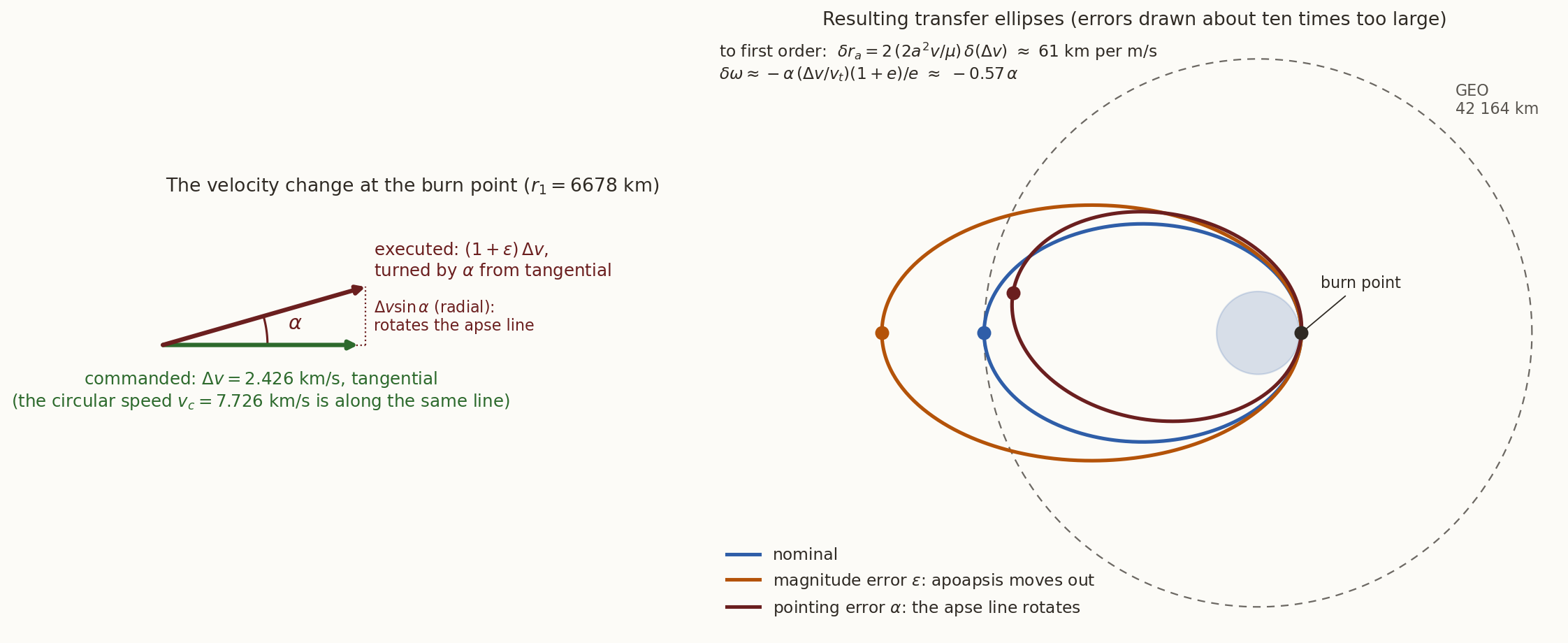
(a) Magnitude. Show that, to first order, a magnitude error \(\delta(\Delta v)\) changes the semi-major axis of the transfer ellipse by \(\delta a=\dfrac{2a^{2}v}{\mu}\,\delta(\Delta v)\), with \(v\) the speed just after the burn, and leaves the periapsis at \(r_1\), so that \(\delta r_a=2\,\delta a\). Evaluate \(\delta r_a\) per m/s, and for \(\kappa=1\%\).
Answer
Differentiate vis-viva, \(v^{2}=\mu(2/r-1/a)\), at fixed \(r\):
\[ 2v\,dv=\frac{\mu}{a^{2}}\,da \qquad\Longrightarrow\qquad \boxed{\ \delta a=\frac{2a^{2}v}{\mu}\,\delta v\ } \]
The burn is tangential at \(r_1\), so after it \(v_r=0\) at \(r_1\): that point is still the periapsis, \(r_p=r_1\), and \(r_a=2a-r_1\). Hence \(\delta r_a=2\,\delta a\).
With \(a_t=24421.07\) km and \(v_{t1}=10.15149\) km/s (the speed after the burn):
\[ \frac{\delta a}{\delta(\Delta v)}=\frac{2(24421.07)^{2}(10.15149)}{398600.44} =3.038\times10^{4}\ \frac{\rm km}{\rm km/s}=30.4\ \frac{\rm km}{\rm m/s}, \]
\[ \boxed{\ \frac{\delta r_a}{\delta(\Delta v)}=60.8\ \mathrm{km\ per\ m/s}\ } \]
For \(\kappa=1\%\), \(\delta(\Delta v)=24.3\) m/s, so \(\delta r_a=\boxed{1474\ \mathrm{km}}\): \(3.5\%\) of the GEO radius.
(b) Pointing. The thrust is turned by \(\alpha\) towards the radial direction. Show that (i) the orbital energy changes only at second order in \(\alpha\), \(\delta\varepsilon=-v_c\Delta v\,(1-\cos\alpha)\), but (ii) the apse line rotates at first order, \(\delta\omega\approx-\alpha\,\dfrac{\Delta v}{v_t}\,\dfrac{1+e}{e}\), where \(v_c\) is the circular speed before the burn, \(v_t\) the speed after it and \(e\) the eccentricity of the transfer ellipse. Evaluate for \(\alpha=1^\circ\): \(\delta a\), \(\delta\omega\), and the along-track shift of the arrival point.
Answer
(i) Energy. The velocity after the burn has components \((v_r,v_\theta)=(\Delta v\sin\alpha,\ v_c+\Delta v\cos\alpha)\), so
\[ \begin{aligned} |\mathbf v|^{2}&=v_c^{2}+2v_c\Delta v\cos\alpha+\Delta v^{2}\\ \Longrightarrow\quad \delta\varepsilon&=-v_c\Delta v\,(1-\cos\alpha)\approx-\tfrac12v_c\Delta v\,\alpha^{2}. \end{aligned} \]
The radial part of the impulse does no work (\(\mathbf v\cdot\Delta\mathbf v_r=0\)), and the tangential part is shortened only by \(\cos\alpha\). With \(\delta a=2a^{2}\delta\varepsilon/\mu\):
\[ \delta a\approx-\frac{a^{2}}{\mu}\,v_c\Delta v\,\alpha^{2}=-8.5\ \mathrm{km}\quad(\alpha=1^\circ), \qquad \delta r_a=-17\ \mathrm{km}. \]
The angular momentum \(h=r_1(v_c+\Delta v\cos\alpha)\) is also second-order.
(ii) Apse line. Take \(\hat{\mathbf r}\) along \(x\). From \(\mathbf e=\mathbf v\times\mathbf h/\mu-\hat{\mathbf r}\),
\[ e_r=\frac{v_\theta h}{\mu}-1,\qquad e_\theta=-\frac{v_r h}{\mu}. \]
Nominally \(e_\theta=0\) and \(e_r=e_t\) (periapsis at the burn point). With the error, \(e_\theta=-\Delta v\sin\alpha\;r_1v_t/\mu\) is first-order, and \(\delta\omega=e_\theta/e_r\). At periapsis \(r_1v_t^{2}=\mu(1+e)\), so \(r_1v_t/\mu=(1+e)/v_t\) and
\[ \boxed{\ \delta\omega\approx-\alpha\,\frac{\Delta v}{v_t}\,\frac{1+e}{e}\ } =-\alpha\,(0.23895)(2.3764)=-0.568\,\alpha . \]
For \(\alpha=1^\circ\): \(\delta\omega=-0.568^\circ\). The arrival point is \(180^\circ\) round the orbit at \(r_a=42164\) km, so it moves \(0.568^\circ\times(\pi/180)\times42164=\boxed{418\ \mathrm{km}}\) along the track. (A direct evaluation of the perturbed orbit gives \(-0.5679^\circ\), and \(\delta e=-9\times10^{-5}\), second order.)
(c) Timing. The burn starts \(\tau\) late on the circular orbit. With the thrust kept along the local velocity, show that the transfer is the nominal ellipse rotated rigidly by \(n\tau\) (\(n\) = mean motion). Evaluate the arrival-point shift for \(\tau=1\) s. If instead the attitude is held fixed in inertial space, what is the net apse rotation?
Answer
A circular orbit looks the same from every point, so a burn \(\tau\) late is the nominal burn at a point \(n\tau\) further along the circle; with the thrust still tangential the transfer ellipse is the nominal one rotated about the focus by \(n\tau\).
\[ n=\sqrt{\frac{\mu}{r_1^{3}}}=1.1569\times10^{-3}\ \mathrm{rad/s}=0.0663^\circ/\mathrm{s}, \]
\[ \text{arrival shift}=n\tau\,r_2=\boxed{48.8\ \mathrm{km\ per\ second}} \]
Inertial hold. The thrust still points where the velocity pointed at the nominal instant, but the velocity has turned forward by \(n\tau\). The thrust is therefore misaligned by \(\alpha=n\tau\) towards the outward radial. By (b) that rotates the apse line by \(-0.568\,n\tau\), on top of the \(+n\tau\) of the shifted burn point:
\[ \omega=n\tau\,(1-0.568)=0.432\,n\tau\ \Longrightarrow\ 21\ \mathrm{km\ per\ second.} \]
Holding attitude inertially halves the timing sensitivity, because the two errors partly cancel.
(d) Budget. Take \(1\sigma\) errors \(\kappa=0.2\%\), \(\alpha=0.3^\circ\), \(\tau=1\) s (orbit-fixed attitude). Find the radial and along-track errors at arrival. Which dominates, and what does it do afterwards?
Answer
\[ \begin{aligned} \text{radial:}&\quad 0.002\times2425.7=4.85\ \mathrm{m/s}\ \Rightarrow\ 4.85\times60.8=\boxed{295\ \mathrm{km}}\\ \text{along-track, pointing:}&\quad 0.3\times418=125\ \mathrm{km}\\ \text{along-track, timing:}&\quad 49\ \mathrm{km}\\ \text{along-track, RSS:}&\quad\sqrt{125^{2}+49^{2}}=\boxed{134\ \mathrm{km}}\ (0.18^\circ) \end{aligned} \]
The magnitude error dominates. It is also the harmful one: circularising \(295\) km too high gives a period error \(\delta T/T=1.5\,\delta a/a=1.0\%\), i.e. a drift of \(360^\circ\times1.0\%=3.8^\circ\)/day. The pointing and timing errors are phase errors, which are fixed once and stay fixed; a radius error is a rate error that keeps growing.
3. Why one long burn loses more than several short ones
The impulsive model puts the burn at a point. A real burn of duration \(t_b\) is spread over an arc. Take constant thrust acceleration \(a_T\) along the velocity, with the burn centred in time on periapsis, so that the true anomaly runs from \(-\theta\) to \(+\theta\). Write \(v_0(f)\) for the speed on the coasting orbit of eccentricity \(e\), and \(v_p=v_0(0)\).
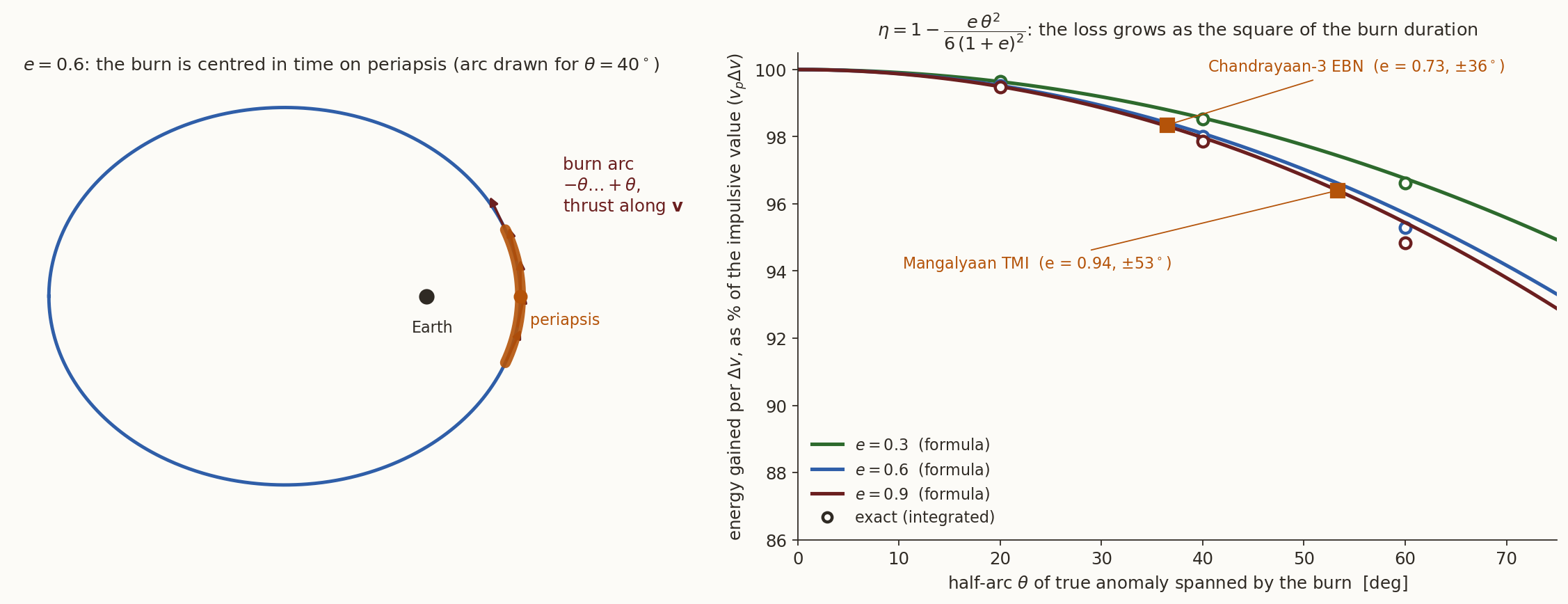
(a) Show that the thrust raises the specific energy at the rate \(\dot\varepsilon=a_Tv\), so that \(d\varepsilon=v\,d(\Delta v)\). Hence show that, if the path is not much altered, \(\Delta\varepsilon=\langle v_0\rangle\Delta v+\tfrac12\Delta v^{2}\), where \(\langle v_0\rangle\) is the time average of \(v_0\) over the burn. Compare with the impulsive value \(v_p\Delta v+\tfrac12\Delta v^{2}\).
Answer
With \(\varepsilon=v^{2}/2-\mu/r\) and \(\mathbf a=-\mu\mathbf r/r^{3}+\mathbf a_T\),
\[ \begin{aligned} \dot\varepsilon&=\mathbf v\cdot\mathbf a+\frac{\mu\dot r}{r^{2}}\\ &=-\frac{\mu\,\mathbf v\cdot\mathbf r}{r^{3}}+\frac{\mu\dot r}{r^{2}}+\mathbf v\cdot\mathbf a_T =\mathbf v\cdot\mathbf a_T=a_Tv, \end{aligned} \]
because \(\mathbf v\cdot\mathbf r=r\dot r\): gravity is conservative and drops out. With \(d(\Delta v)=a_T\,dt\), \(d\varepsilon=v\,d(\Delta v)\).
During the burn \(v=v_0(t)+u(t)\), where \(u=\int a_T\,dt\) is the \(\Delta v\) delivered so far (taking the path as unaltered). Then
\[ \Delta\varepsilon=\int_0^{\Delta v}(v_0+u)\,d(\Delta v)=\langle v_0\rangle\Delta v+\tfrac12\Delta v^{2}. \]
For the impulsive burn \(v_0\to v_p\) and the same \(\tfrac12\Delta v^{2}\) appears. The finite burn therefore falls short by exactly \((v_p-\langle v_0\rangle)\Delta v\).
(b) For small \(\theta\) show that the efficiency is \(\zeta\equiv\langle v_0\rangle/v_p=1-\dfrac{e\,\theta^{2}}{6(1+e)^{2}}\). Check it for \(e=0.5\), \(\theta=30^\circ\).
Answer
On the orbit \(v_0^{2}=(\mu/p)(1+2e\cos f+e^{2})\) and \(v_p^{2}=(\mu/p)(1+e)^{2}\), so
\[ \begin{aligned} \left(\frac{v_0}{v_p}\right)^{2}&=1-\frac{2e(1-\cos f)}{(1+e)^{2}}\approx1-\frac{e f^{2}}{(1+e)^{2}}\\ \Longrightarrow\quad\frac{v_0}{v_p}&\approx1-\frac{e f^{2}}{2(1+e)^{2}}. \end{aligned} \]
Near periapsis \(\dot f=h/r^{2}\propto(1+e\cos f)^{2}\) changes only at order \(f^{2}\), so uniform in time \(\approx\) uniform in \(f\), and \(\langle f^{2}\rangle=\frac1{2\theta}\int_{-\theta}^{\theta}f^{2}df=\theta^{2}/3\):
\[ \boxed{\ \zeta=1-\frac{e\,\theta^{2}}{6(1+e)^{2}}\ } \]
Check: \(e=0.5\), \(\theta=0.5236\) rad: \(\zeta=1-0.5(0.2742)/(6\times2.25)=0.9898\). Averaging the coasting speed exactly over the burn (numerically, in time) gives \(0.9896\).
(c) At periapsis \(\dot f_p=v_p/r_p\); use it to estimate \(\theta\approx v_pt_b/(2r_p)\). For \(r_p=7000\) km, \(e=0.5\), find \(\theta\) and the loss for \(t_b=818\) s and \(t_b=1803\) s, using Kepler’s equation for the exact \(\theta\).
Answer
\(v_p=\sqrt{\mu(1+e)/r_p}=9.2420\) km/s, so \(\dot f_p=1.3203\times10^{-3}\) rad/s and \(a=14000\) km, \(T=16486\) s, \(n=3.811\times10^{-4}\) rad/s.
| \(t_b\) | \(\theta\approx\dot f_pt_b/2\) | exact \(\theta\) (Kepler) | \(\zeta\) (formula) | loss |
|---|---|---|---|---|
| \(818\) s | \(30.9^\circ\) | \(30.0^\circ\) | \(0.9898\) | \(1.0\%\) |
| \(1803\) s | \(68.2^\circ\) | \(60.0^\circ\) | \(0.9594\) | \(4.1\%\) |
For \(818\) s: \(M=n(t_b/2)=0.1559\), \(E=0.3070\) rad, \(\tan\frac f2=\sqrt{\tfrac{1+e}{1-e}}\tan\frac E2\Rightarrow f=30.0^\circ\). For \(1803\) s: \(M=0.3436\), \(E=0.6435\), \(f=60.0^\circ\). The estimate \(\dot f_pt_b/2\) overshoots because \(\dot f\) falls as the craft leaves periapsis, so use Kepler for long burns.
(d) Split the burn into \(n\) equal burns on \(n\) successive periapsis passes. Show the total loss falls as \(1/n^{2}\). Compare with direct integration for the \(1803\) s burn.
Answer
Each burn lasts \(t_b/n\), so \(\theta\to\theta/n\) and each loses a fraction \(\propto(\theta/n)^{2}\) of its own \(\Delta v/n\). The loss, as a fraction of the total \(\Delta v\), is that of one short burn:
\[ \frac{\text{loss}(n)}{\text{loss}(1)}\approx\frac1{n^{2}}. \]
Averaging the coasting speed exactly, as in (b), for \(t_b=1803\) s: \(n=1\): \(4.39\%\); \(n=2\) (902 s each, \(\theta=32.9^\circ\)): \(1.25\%\); \(n=3\) (601 s, \(22.3^\circ\)): \(0.57\%\). The ratios (\(3.5\), \(7.7\)) fall a little short of \(4\) and \(9\) because \(\theta\) shrinks slightly slower than \(t_b\).
(e) What limits how many burns one can use?
Answer
Each burn needs its own periapsis pass: the orbit period (hours to days for the raising orbits of Problem 9 of the The Hohmann Transfer questions), one more engine restart, one more tracking arc and ground contact, and one more chance of a failure. The loss falls as \(1/n^{2}\) while the time grows as \(n\). The optimum is where the extra \(\Delta v\) is no longer worth the extra days: Chandrayaan-3 used five burns over ten days.
4. Mangalyaan: a 22-minute burn
Mangalyaan’s trans-Mars injection (1 December 2013) was flown from an orbit of \(252\times192\,874\) km. The \(440\) N engine burned for \(1328.89\) s and the reported \(\Delta v\) was \(648\) m/s (rounded ISRO figures; take \(I_{sp}=310\) s and constant thrust; the estimate of (b) treats the thrust acceleration as constant, the integration does not). The burn was centred in time on periapsis.
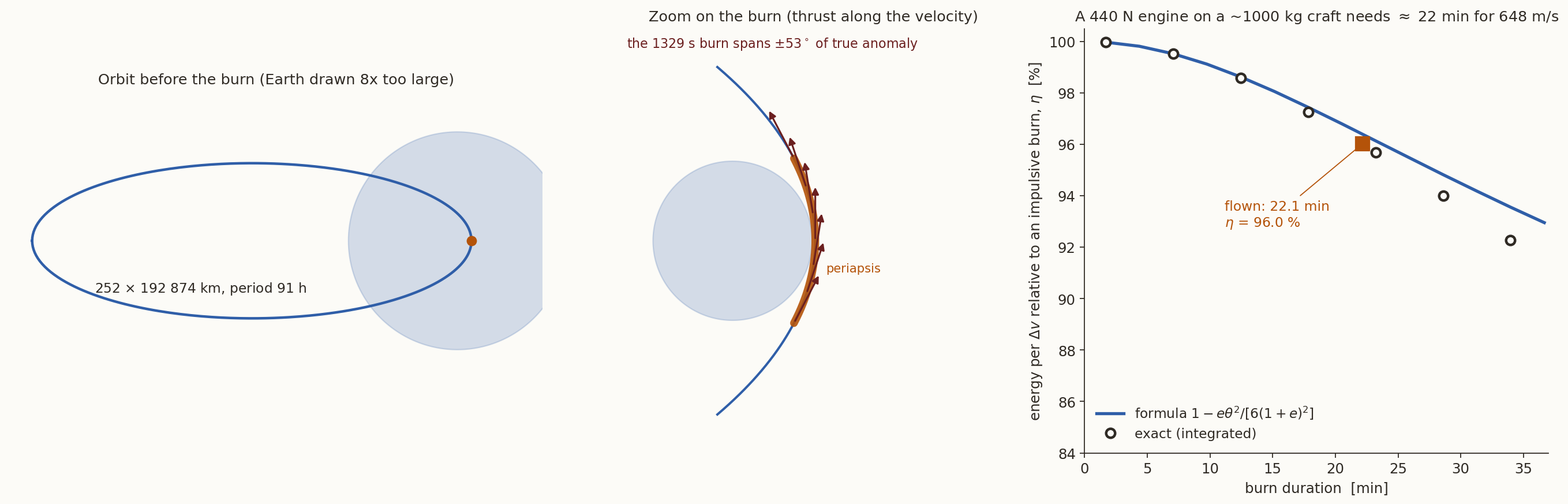
(a) Find \(e\), \(a\), the period, \(v_p\), and the true-anomaly arc spanned by the burn.
Answer
\(r_p=6630.137\) km, \(r_a=199\,252.137\) km, so \(a=102\,941\) km and \(e=0.93559\). The period is \(T=2\pi\sqrt{a^{3}/\mu}=328\,700\) s (\(91.3\) h), \(v_p=10.7873\) km/s, \(v_{\rm esc}=\sqrt{2\mu/r_p}=10.9654\) km/s and \(\varepsilon_0=-\mu/2a=-1.9361\) km\(^{2}\)/s\(^{2}\).
Arc: half the burn is \(664.4\) s; \(n=1.9116\times10^{-5}\) rad/s, so \(M=0.01270\). Solving \(E-0.93559\sin E=M\) gives \(E=0.1825\), and \(\tan\frac f2=\sqrt{1.93559/0.06441}\tan\frac E2=0.5016\Rightarrow\boxed{\theta=53.3^\circ}\).
(b) Use Problem 3 to find \(\zeta\) and the energy delivered. Hence find the \(v_\infty\) and the characteristic energy \(C_3=v_\infty^2\) the burn gave, and the impulsive \(\Delta v\) that would have done the same.
Answer
\(\zeta=1-\dfrac{e\theta^{2}}{6(1+e)^{2}}=1-\dfrac{0.93559(0.9301)^{2}}{6(1.93559)^{2}}=\boxed{0.964}\) (the exact average of the coasting speed: \(0.960\)). From Problem 3(a), \(\Delta\varepsilon=\zeta\,v_p\Delta v+\tfrac12\Delta v^{2}\):
\[ \Delta\varepsilon=0.964(10.7873)(0.648)+\tfrac12(0.648)^{2}=6.739+0.210=6.949\ \mathrm{km^{2}/s^{2}}, \]
\[ \varepsilon_f=-1.936+6.949=5.013\ \Rightarrow\ \]
\[ \boxed{v_\infty=\sqrt{2\varepsilon_f}=3.17\ \mathrm{km/s},\quad C_3=10.0\ \mathrm{km^{2}/s^{2}}} \]
(Numerical integration of the burn: \(v_\infty=3.14\) km/s, \(C_3=9.9\).) An impulsive burn at periapsis giving the same \(v_\infty\) needs \(v=\sqrt{v_{\rm esc}^{2}+v_\infty^{2}}=11.413\) km/s, i.e. \(\Delta v_{\rm imp}=\boxed{626\ \mathrm{m/s}}\). The finite burn “wastes” about \(22\) m/s (\(3.4\%\); \(28\) m/s by integration). The \(C_3\approx10\) is above the Hohmann minimum (\(v_\infty=2.94\) km/s, \(C_3=8.6\)), as it must be for a real launch window.
(c) What was the spacecraft mass at the start of the burn, and the propellant used?
Answer
\(\dot m=F/(I_{sp}g_0)=440/3040.1=0.14473\) kg/s, so \(m_{\rm prop}=0.14473\times1328.89=\boxed{192\ \mathrm{kg}}\), and from \(\Delta v=v_e\ln(m_0/m_1)\):
\[ m_0=\frac{m_{\rm prop}}{1-e^{-648/3040.1}}=\frac{192.3}{0.19196}=\boxed{1002\ \mathrm{kg}},\qquad m_1=810\ \mathrm{kg}. \]
(d) The engine cuts off \(1\) s late. By how much does \(v_\infty\) change, and what miss does it cause after a \(300\)-day cruise?
Answer
A second more of thrust at cutoff, where the mass is \(810\) kg, is \(\delta(\Delta v)=F/m_1\cdot1\,\mathrm{s}=0.54\) m/s. The burn ends \(53^\circ\) past periapsis, where (by the integration) the craft moves at \(v=10.1\) km/s, not the periapsis \(10.8\); and \(d\varepsilon=v\,d(\Delta v)\), so \(v_\infty\,dv_\infty=v\,d(\Delta v)\):
\[ \frac{dv_\infty}{d(\Delta v)}=\frac{10.1}{3.14}=3.2\ \Rightarrow\ \delta v_\infty=1.8\ \mathrm{m/s}. \]
Cruising for \(300\) d \(=2.6\times10^{7}\) s, a velocity error of \(1.8\) m/s becomes \(\approx4.7\times10^{4}\) km if the path were straight (a crude model that ignores the Sun). In the Sun’s field the error is amplified rather than just carried: \(4a^{2}v/\mu_\odot\approx3.5\times10^{4}\) km per m/s for a Mars Hohmann arc. Either way the miss is \(10^{4}\) to \(10^{5}\) km, against the few hundred km needed to hit the Mars capture window.
(e) In the same straight-line model, a correction made \(t\) days after TMI removes a miss \(d\) for \(\Delta v\approx d/(T_{\rm flight}-t)\). Evaluate for \(d=4.7\times10^{4}\) km, \(T=300\) d, at \(t=10\), \(100\), \(250\) d. When would you do TCM-1?
Answer
\[ \Delta v=\frac{4.7\times10^{7}\ \mathrm{m}}{(300-t)\times86\,400\ \mathrm{s}}: \]
\[ t=10\ \mathrm{d}:\ 1.9\ \mathrm{m/s},\quad 100\ \mathrm{d}:\ 2.7\ \mathrm{m/s},\quad 250\ \mathrm{d}:\ \boxed{10.9\ \mathrm{m/s}}. \]
The same miss costs \(6\) times more at \(250\) d than at \(10\) d: correct early. But the orbit must first be determined well enough to know the error (a few days of tracking), so TCM-1 is flown \(\sim10\) days after injection, with later TCMs trimming what navigation then refines. Compare the \(1.9\) m/s with the \(0.49\) m/s one second of cutoff error: the correction is about the size of the error it removes.
Sources and caveats. The orbit \(252\times192\,874\) km, the burn time \(1328.89\) s and the \(648\) m/s are ISRO’s reported values. \(I_{sp}\) and a constant thrust acceleration are assumed. The \(v_\infty\) and \(C_3\) that follow are a consistency check, not a quoted mission figure.
5. The \(\Delta v\) budget of a GEO satellite, and its uncertainty
A GEO satellite with a launch (wet) mass of \(3000\) kg is to operate for \(15\) years. Representative values: north–south station-keeping \(50\) m/s/yr, east–west \(3\) m/s/yr, graveyard disposal \(11\) m/s (the manoeuvres note quotes \(45\)–\(55\) and “a few” m/s/yr). Chemical propulsion has \(I_{sp}=320\) s; electric propulsion \(1800\) s.
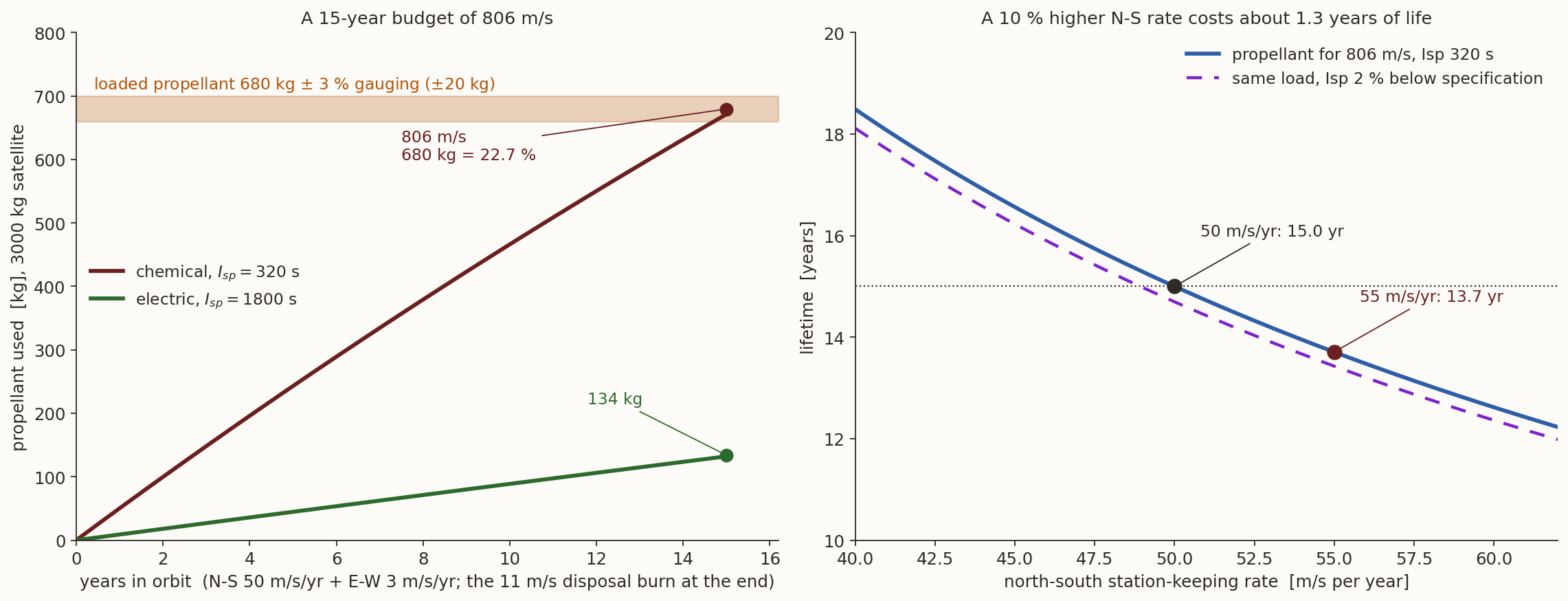
(a) Total \(\Delta v\), and the propellant mass for chemical and for electric propulsion. How much heavier is the chemical satellite at launch?
Answer
\[ \Delta v=15(50+3)+11=\boxed{806\ \mathrm{m/s}}\quad(750+45+11). \]
\(v_e=320\times9.80665=3138.1\) m/s: \(m_p=3000\left(1-e^{-806/3138.1}\right)=\boxed{680\ \mathrm{kg}}\) (\(22.7\%\)). Electric (\(v_e=17\,652\) m/s): \(3000\left(1-e^{-806/17652}\right)=\boxed{134\ \mathrm{kg}}\) (\(4.5\%\)). The chemical satellite carries \(546\) kg more propellant, \(18\%\) of the launch mass, which electric propulsion converts to payload or launch cost.
(b) The propellant gauge is good to \(\pm3\%\) of the loaded propellant mass. Find the uncertainty in the remaining \(\Delta v\) at the end of life, and in years.
Answer
End-of-life mass \(3000-680=2320\) kg. A \(3\%\) error on \(680\) kg is \(\pm20.4\) kg, so
\[ \delta(\Delta v)=v_e\,\frac{\delta m}{m_f}=3138\times\frac{20.4}{2320}=\boxed{\pm27.6\ \mathrm{m/s}}=\pm0.52\ \mathrm{yr}. \]
The operator cannot know the end of life to better than \(\pm6\) months and must reserve the \(11\) m/s disposal burn with margin: a spacecraft that runs out one month early cannot be moved out of the GEO belt.
(c) The north–south rate is not known in advance: \(50\) m/s/yr is the mean, with \(\sigma=3\) m/s/yr, a systematic uncertainty (whatever the rate is, it is the same every year). (i) With the propellant of (a), find the lifetime if the rate turns out to be \(55\) m/s/yr. (ii) What propellant guarantees \(15\) years at \(3\sigma\)?
Answer
\(\text{life}=\dfrac{806-11}{55+3}=\boxed{13.7\ \mathrm{yr}}\): a \(10\%\) higher rate costs \(1.3\) years (\(9\%\) of the life). (At \(45\): \(16.6\) yr.)
\(3\sigma\): \(50+9=59\) m/s/yr, so \(\Delta v=15(59+3)+11=941\) m/s and \(m_p=3000\left(1-e^{-941/3138.1}\right)=\boxed{777\ \mathrm{kg}}\): \(98\) kg (\(14\%\)) more than the nominal \(680\). The margin costs a lot: that is the price of an uncertain \(\Delta v\).
(d) The delivered \(I_{sp}\) is \(2\%\) below specification. What is the effect on the propellant for \(806\) m/s, or on the life with the propellant of (a)?
Answer
With \(v_e\to0.98\times3138.1=3075.3\) m/s: \(m_p=3000\left(1-e^{-806/3075.3}\right)=692\) kg: \(12\) kg more for the same \(\Delta v\). Or, with \(680\) kg loaded, the available \(\Delta v\) is \(3075.3\ln(3000/2320)=790\) m/s and the life \((790-11)/53=\boxed{14.7\ \mathrm{yr}}\): three months lost. (Compare: a \(10\%\) N–S excess costs \(1.3\) years; an \(I_{sp}\) shortfall of \(2\%\) only \(0.3\).)
Sources and caveats. The station-keeping rates are representative values.