The Bi-elliptic Transfer: Questions
How to use these questions
These questions go with the note The Bi-elliptic Transfer. They are the master set for the topic, and the class tests and examinations are drawn from them.
There are \(3\) objective questions. Each has four options and exactly one correct answer. They come in three levels. Level 1 asks for one definition, one fact or one formula used once. Level 2 needs two or three steps. Level 3 needs several steps, a limit, a symmetry, or a point that is easy to get wrong. Choose an option before you open the Answer, which gives the reason and, for a number, the calculation. The \(2\) drills are plain numericals on the methods of the note. The \(3\) extensions go beyond the note, analytically or analytically and numerically. Every problem has a worked solution, folded under Solution. Try the problem on paper before you open it.
Some problems need ideas from several notes at once. The Indian missions problems are of that kind, and are kept as a separate set.
Every number in the answers and solutions is checked by bielliptic-transfer-questions-verify.py.
Data. The objective questions use \(\mu_\oplus=398\,600\ \mathrm{km^3/s^2}\), \(R_\oplus=6378\) km, \(g_0=9.80665\ \mathrm{m/s^2}\), \(G=6.674\times10^{-11}\ \mathrm{m^3\,kg^{-1}\,s^{-2}}\), \(\mu_\odot=1.327\times10^{11}\ \mathrm{km^3/s^2}\), \(1\ \mathrm{AU}=1.496\times10^8\) km, \(M_\odot/m_{\rm Jupiter}=1047.6\) and \(J_2=1.08263\times10^{-3}\), unless a question says otherwise. Each problem gives the data it needs. Where it does not, use the constants of the notation page. Burns are impulsive and orbits are two-body, unless a question says otherwise. Angles in Kepler’s equation are in radians.
Objective questions
Level 1 — very easy
1. Comparing Hohmann and bi-elliptic transfers between coplanar circles of ratio \(R=r_2/r_1\),
- Hohmann is cheaper than every bi-elliptic for \(R<11.94\), and every bi-elliptic is cheaper for \(R>15.58\)
- bi-elliptic is cheaper for \(R<11.94\)
- Hohmann is always cheaper
- bi-elliptic is always cheaper
Answer
(A) Between \(11.94\) and \(15.58\) the answer depends on the intermediate apoapsis \(r_b\). The bi-elliptic transfer always takes much longer.
Level 2 — a little difficult
2. In a bi-elliptic transfer to a very distant circle, where does the saving over Hohmann come from?
- from the middle burn at \(r_b\), which is tiny because the spacecraft moves very slowly there
- from the shorter transfer time
- from avoiding the first burn
- from making all burns radial
Answer
(A) The first burn is nearly the escape burn either way. The middle burn at the far apoapsis costs little, and it lets the spacecraft fall back to \(r_2\) needing only a small final burn.
Level 3 — hard
3. For \(R=r_2/r_1=20\), compare the Hohmann transfer (cost \(0.535\,v_{c1}\)) with the bi-parabolic transfer (\(r_b\to\infty\)). Which is cheaper?
- bi-parabolic, by about \(5\%\)
- Hohmann, by about \(5\%\)
- they cost the same
- bi-parabolic, by about \(50\%\)
Answer
(A) Bi-parabolic: escape from \(r_1\), then fall back from infinity and slow to \(v_{c2}\): \((\sqrt2-1)(1+1/\sqrt{20})\,v_{c1}=0.507\,v_{c1}\). So it is cheaper by \(0.028\,v_{c1}\), about \(5\%\), as expected beyond \(R=15.58\) (but it takes forever).
Answer key
All \(3\) answers.
Answer
| 1 A | 2 A | 3 A |
Drills
These are plain numericals. Each one practises a method of the note on a concrete case, and none of them adds anything that is not already in the note. Work each one through before you open its solution.
1. Moon transfer
Compute the Hohmann \(\Delta v\) and the transfer time from a circle of radius \(r_1=6678.137\) km to a circular orbit of radius \(384\,400\) km, ignoring the Moon’s gravity and taking \(\mu=398\,600.4418\) km\(^3\)/s\(^2\). Would a bi-elliptic transfer help?
Solution
The plan is to find the Hohmann cost first, then to read off from the radius ratio which region of the table in the section The bi-elliptic transfer of the bi-elliptic note we are in, and only then to work out what a bi-elliptic transfer would actually save, and at what price in time.
The Hohmann transfer. The transfer ellipse has \(a_t=(r_1+r_2)/2=195\,539\) km. By vis-viva the speed at its perigee is \(10.8322\) km/s, against the circular speed \(v_{c1}=7.7258\) km/s, so \(\Delta v_1=3.106\) km/s. At apogee it is \(0.1882\) km/s, against the circular speed \(1.0183\) km/s at \(r_2\), so \(\Delta v_2=0.830\) km/s. The total is
\[ \Delta v_{\rm H}=3.106+0.830=3.937\ \text{km/s}. \]
The flight takes half a period of the ellipse, \(\pi\sqrt{a_t^3/\mu}=4.98\) days.
Which region? The radius ratio is \(R=384\,400/6678.137=57.6\). This is above \(R^{\ddagger}=15.58\), so by the table every bi-elliptic transfer with \(r_b>r_2\) is cheaper than Hohmann. In principle, yes, it would help.
How much does it save? Take \(r_b=2r_2=768\,800\) km as an example. With Equation (1) of the bi-elliptic note, or directly with vis-viva on the two ellipses, the burns are
| Burn | Where | Speed before | Speed after | \(\Delta v\) |
|---|---|---|---|---|
| 1 | \(r_1\) | \(7.7258\) | \(10.8787\) | \(3.1530\) |
| 2 | \(r_b\) | \(0.0945\) | \(0.5879\) | \(0.4934\) |
| 3 | \(r_2\) | \(1.1758\) | \(1.0183\) | \(0.1575\) |
in km/s. The total is \(3.804\) km/s, which saves \(133\) m/s. The flight is half a period of each ellipse, \(39\) days in all, eight times as long as Hohmann. Even the limit \(r_b\to\infty\), which costs \((\sqrt2-1)(1+1/\sqrt R)\,v_{c1}=3.622\) km/s, saves only \(315\) m/s, and it takes forever.
Does the model hold? Two cautions apply.
- The Earth’s sphere of influence against the Sun has a radius of about \(925\,000\) km (the patched-conics note). Our \(r_b=768\,800\) km is already near its edge. Any \(r_b\) much beyond \(2r_2\) leaves it, and the Sun then bends the trajectory. The two-body numbers, and with them most of the saving of the limit \(r_b\to\infty\), cannot be trusted there.
- We have also ignored the Moon. A spacecraft that arrives at the Moon’s distance is captured, or thrown off, by the Moon itself, which this calculation leaves out.
Reading the result. In principle the bi-elliptic transfer helps, by about \(3\%\) at \(r_b=2r_2\). In practice the saving is small and slow to collect, and it lies just where the model starts to fail. ISRO’s Chandrayaan missions reach the Moon differently. They build up the orbit in steps, with a series of burns near perigee, as the Indian missions problems show.
2. Hohmann or bi-elliptic, to Neptune’s orbit
A spacecraft is on the Earth’s orbit about the Sun, a circle of \(1\) AU. It is to reach a circular orbit at the distance of Neptune, \(30.07\) AU. Ignore the planets and use only the Sun’s gravity.
- Find the two burns, the total and the time of flight, in years, for a Hohmann transfer.
- Find the three burns, the total and the time of flight for a bi-elliptic transfer whose intermediate apoapsis is at \(60\) AU.
- Which transfer is cheaper, and by how much? Is the saving worth the time? Voyager 2 took about twelve years to reach Neptune. What did it do differently?
Use \(\mu_\odot=1.327\,124\,400\,18\times10^{11}\) km\(^3\)/s\(^2\), \(1\) AU \(=1.495\,978\,707\times10^{8}\) km and one year \(=365.25\) days of \(86\,400\) s.
Solution
The plan is to compute both transfers about the Sun and compare their costs and their times. The ratio of the radii is \(r_2/r_1=30.07\). This is above \(15.58\), the ratio beyond which the bi-elliptic note shows that any bi-elliptic transfer beats the Hohmann transfer. So we expect the bi-elliptic to win.
(a) Hohmann. The circular speeds are \(29.785\) km/s at \(1\) AU and \(5.432\) km/s at \(30.07\) AU. The two burns are \(11.654\) and \(4.054\) km/s, a total of \(15.707\) km/s. The time is half the period of an ellipse with \(a=15.535\) AU, which is \(30.6\) years.
(b) Bi-elliptic. The first ellipse runs from \(1\) to \(60\) AU, with \(a_1=30.5\) AU. The second runs from \(60\) down to \(30.07\) AU, with \(a_2=45.035\) AU. The burns are \[ \Delta v_1=11.991\ \text{km/s},\qquad \Delta v_2=3.142-0.696=2.446\ \text{km/s},\qquad \Delta v_3=0.838\ \text{km/s}, \] where \(0.696\) and \(3.142\) km/s are the speeds at \(60\) AU on the first and second ellipses. The last burn slows the spacecraft down at periapsis of the second ellipse. The total is \(15.274\) km/s. The time is \(84.2+151.1=235.3\) years.
(c) The verdict. The bi-elliptic transfer saves \(433\) m/s, less than \(3\%\), and takes \(235\) years instead of \(31\). No mission would accept that. Even the Hohmann transfer is too slow. Voyager 2, launched in 1977, reached Neptune in 1989 by flying past Jupiter, Saturn and Uranus on the way. Each flyby turned and sped up its path about the Sun at no cost in propellant. This is the subject of the flyby section of the patched-conics note.
Extensions
These problems go beyond the note. Some are purely analytical, and some ask for a derivation and then a number. Most take longer than a drill, and several end with a remark on what the result means for a real mission.
3. Bi-elliptic to lunar distance
A relay spacecraft is to be placed into a circular orbit at the Moon’s distance (\(r_2=384\,400\) km) from a \(300\) km LEO (\(r_1=6678.137\) km), so \(R=57.56\). Compare the Hohmann transfer with a bi-elliptic transfer whose intermediate apoapsis is \(r_b=10^{6}\) km.
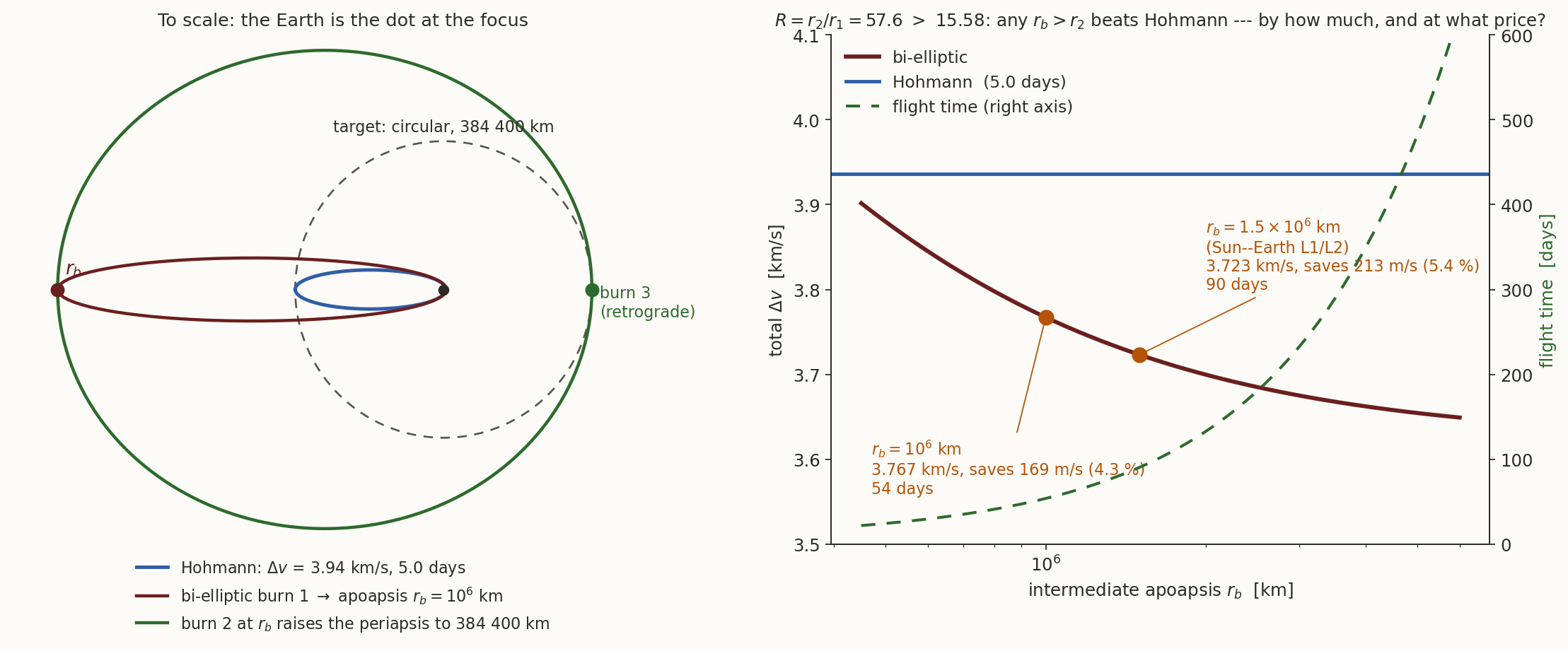
(a) Hohmann: \(\Delta v_1\), \(\Delta v_2\), total and flight time. (b) Bi-elliptic: the three burns, total, saving, flight time.
Answer
(a) \(a_t=195\,539\) km: \(v_{t1}=10.8322\), \(v_{c1}=7.7258\), \(v_{t2}=0.18819\), \(v_{c2}=1.01830\) km/s,
\[ \Delta v_1=3.1064,\quad\Delta v_2=0.8301,\quad\boxed{\Delta v_{\rm H}=3.9365\ \mathrm{km/s}},\quad t=\pi\sqrt{a_t^{3}/\mu}=\boxed{4.98\ \mathrm{d}}. \]
(b) \(a_{t1}=503\,339\) km, \(a_{t2}=692\,200\) km.
| burn | where | from \(\to\) to [km/s] | \(\Delta v\) |
|---|---|---|---|
| 1 | \(r_1\) | \(7.7258\to10.8896\) | \(3.1638\) |
| 2 | \(r_b\) | \(0.0727\to0.4705\) | \(0.3978\) |
| 3 | \(r_2\) | \(1.2239\to1.0183\) (retrograde) | \(0.2056\) |
\[ \Delta v_{\rm bi}=\boxed{3.7672\ \mathrm{km/s}},\quad\text{saving }\boxed{169\ \mathrm{m/s}\ (4.3\%)},\quad t=20.6+33.2=\boxed{53.7\ \mathrm{d}}. \]
At \(r_b\) the craft moves at only \(73\) m/s, so \(0.40\) km/s lifts the periapsis by \(378\,000\) km. For \(r_b=1.5\times10^{6}\) km the saving is \(213\) m/s (\(5.4\%\)) and the time \(90\) d.
(c) \(R=57.6>15.58\). What do the two bi-elliptic thresholds of the bi-elliptic note say? Why does the bi-elliptic transfer keep saving more as \(r_b\) grows, and where does it stop being worth it?
Answer
For \(R>15.58\) every \(r_b>r_2\) beats Hohmann, by a margin that grows with \(r_b\): the saving is \(169\) m/s at \(10^{6}\) km, \(213\) at \(1.5\times10^{6}\), \(262\) (\(6.7\%\)) at \(3\times10^{6}\) km (the figure). The saving grows because the far burn is made where the speed is smallest (\(d\varepsilon=v\,\Delta v\), small \(v\)) and changes the periapsis, which costs almost nothing. It stops being worth it because the flight time grows as \(r_b^{3/2}\) (\(5\to54\to233\) d), and because the two-body model fails at large \(r_b\) (part (e)).
(d) Compute the error gain \(\delta r/\delta(\Delta v)=4a^{2}v/\mu\) of Hohmann burn 1 (on \(r_a\)), bi-elliptic burn 1 (on \(r_b\)) and burn 2 (on the periapsis). Is the first bi-elliptic burn’s huge gain a problem?
Answer
\[ \text{Hohmann burn 1: }\frac{4(195\,539)^{2}(10.832)}{398600}=4160\ \frac{\rm km}{\rm m/s}, \]
\[ \text{bi-elliptic burn 1: }\frac{4(503\,339)^{2}(10.890)}{398600}=\boxed{27\,700}\ \frac{\rm km}{\rm m/s}, \]
\[ \text{bi-elliptic burn 2: }\frac{4(692\,200)^{2}(0.4705)}{398600}=2260\ \frac{\rm km}{\rm m/s}. \]
A \(1\) m/s error in burn 1 moves \(r_b\) by \(27\,700\) km (\(2.8\%\)) but that is harmless: the total cost is flat in \(r_b\) (\(d\Delta v/dr_b=-12.7\) m/s per \(10^{5}\) km), so a \(2.8\%\) error in \(r_b\) changes the total by only \(\approx3.5\) m/s, and burn 2 is simply computed from the orbit actually achieved (it is made at the measured apoapsis). The burn that must be right is burn 2 (the periapsis it sets, \(2260\) km per m/s) and, for the Hohmann route, burn 1 (which sets the arrival radius at \(4160\) km per m/s). The bi-elliptic route trades a precision requirement at the start for a real-time design at the apoapsis.
(e) The solar tide on the spacecraft at distance \(r\) from the Earth is about \(2\mu_\odot r/d^{3}\) (\(d=1\) AU). Compare it with the Earth’s pull at \(r_b=10^{6}\) and \(1.5\times10^{6}\) km. Is the two-body analysis valid? Is the bi-elliptic transfer worth flying?
Answer
\[ r_b=10^{6}\ \mathrm{km}:\quad \frac{2\mu_\odot r}{d^{3}}=7.9\times10^{-5}\ \mathrm{m/s^{2}},\ \ \frac{\mu_\oplus}{r^{2}}=3.99\times10^{-4} \]
\[ \text{ratio }\boxed{0.20}, \]
\[ r_b=1.5\times10^{6}\ \mathrm{km}:\quad 1.19\times10^{-4}\ \mathrm{vs}\ 1.77\times10^{-4}\ \mathrm{m/s^{2}}:\ \ \text{ratio }\boxed{0.67}. \]
The Earth’s Hill radius is \(1.50\times10^{6}\) km, so \(r_b=1.5\times10^{6}\) km (the Sun–Earth L1/L2 distance, where JWST and Aditya-L1 operate) is at the edge of the sphere where the Earth controls the motion. At \(10^{6}\) km the Sun’s tide is \(20\%\) of the Earth’s pull, and it acts for weeks of the climb and fall: the two-body \(\Delta v\) is an estimate, not a guarantee. Verdict: a \(169\) m/s saving (\(4.3\%\)) for \(49\) extra days, three burns and a poorly predictable apoapsis. Not worth it for this target. The theorem is right; its assumptions run out. A real design of this kind would use the Sun’s perturbation deliberately (weak-stability transfers).
Sources and caveats. This is a design exercise, not a flown mission. JWST and Aditya-L1 are cited only for the distance of the Sun–Earth L1 and L2 points.
4. Reaching the Sun the long way round
Problem 17 of the The Two-body Problem questions showed that it is much harder to fall into the Sun than to leave the solar system. Here we look for a cheaper way in. The target is a perihelion of \(r_p=10\,R_\odot\), about as deep as the Parker Solar Probe goes. Treat the Earth’s orbit as a circle of radius \(1\) AU with speed \(v_E\), and ignore the other planets except where a part says so. Write \(x=r_b/(1\ \text{AU})\) and \(\rho=r_p/(1\ \text{AU})\).
- Analytical. The direct route is one burn at \(1\) AU that lowers the perihelion to \(r_p\). Write its cost in terms of \(v_E\) and \(\rho\). The bi-elliptic route first raises the aphelion to \(r_b\), and then, at that aphelion, lowers the perihelion to \(r_p\). Show that its two burns are \[ \Delta v_1=v_E\Bigl(\sqrt{\tfrac{2x}{1+x}}-1\Bigr),\qquad \Delta v_2=v_E\Bigl(\sqrt{\tfrac{2}{x(1+x)}}-\sqrt{\tfrac{2\rho}{x(x+\rho)}}\Bigr). \]
- Analytical. Let \(\rho\to0\), a fall into the centre of the Sun. Show that the bi-elliptic route is then cheaper than the direct route for every \(r_b>1\) AU. Find the limit of its cost as \(x\to\infty\), and compare it with the cost of leaving the solar system.
- Numerical. For \(r_p=10\,R_\odot\), find the cost of the direct route. Take \(r_b=5.2026\) AU, the distance of Jupiter. Find \(\Delta v_1\), \(\Delta v_2\), their total, and the time from the Earth to the perihelion, in years.
- Numerical. The burn at \(1\) AU is made by the launcher, which leaves a parking orbit at \(300\) km altitude with the hyperbolic excess speed \(v_\infty=\Delta v_1\) (or the direct cost). Use the escape note to find the burn from the parking orbit for both routes. The burn \(\Delta v_2\) must be made by the spacecraft itself, far from the Earth. With \(I_{sp}=320\) s, what fraction of its mass is left after that burn?
- Discussion. Real missions do not make \(\Delta v_2\) with an engine. Ulysses used a flyby of Jupiter to leave the plane of the planets, and the Parker Solar Probe uses repeated flybys of Venus. Using the patched-conics note, explain what a flyby at aphelion can do in place of \(\Delta v_2\). Why did India’s Aditya-L1 not go near the Sun at all?
Solution
The direct route is expensive because it has to destroy almost all of the Earth’s orbital speed at \(1\) AU. The bi-elliptic route first carries the spacecraft far out, where the speed is small, and makes the large change of angular momentum there. So the plan is to write both costs, prove that the long way is always cheaper for a deep dive, and then count the price in time and in the spacecraft’s own propellant.
(a) The two routes. Distances are in AU, so the circular speed at \(1\) AU is \(v_E\) and \(\mu_\odot=v_E^2\) in these units. The direct route is a single burn at \(1\) AU onto an ellipse with aphelion \(1\) and perihelion \(\rho\). Its aphelion speed is \(v_E\sqrt{2\rho/(1+\rho)}\), so \[ \Delta v_{\rm direct}=v_E\Bigl(1-\sqrt{\tfrac{2\rho}{1+\rho}}\Bigr). \] For the bi-elliptic route, the first ellipse has perihelion \(1\) and aphelion \(x\). Its perihelion speed is \(v_E\sqrt{2x/(1+x)}\), which gives \(\Delta v_1\). At its aphelion the speed is \(v_E\sqrt{2/(x(1+x))}\), by the same vis-viva formula with the roles of the apsides swapped. The second ellipse has aphelion \(x\) and perihelion \(\rho\), with aphelion speed \(v_E\sqrt{2\rho/(x(x+\rho))}\). The retrograde burn at \(x\) is the difference, which is \(\Delta v_2\) of the statement.
(b) For a deep dive the long way always wins. With \(\rho\to0\), \(\Delta v_{\rm direct}\to v_E\) and \(\Delta v_2\to v_E\sqrt{2/(x(1+x))}\). The bi-elliptic route is cheaper when \[ \sqrt{\frac{2x}{1+x}}-1+\sqrt{\frac{2}{x(1+x)}}<1 . \] The two square roots share the factor \(\sqrt{2/(x(1+x))}\). Taking it out, \[ \sqrt{\frac{2}{x(1+x)}}\,(x+1)=\sqrt{\frac{2(1+x)}{x}}<2 \quad\Longleftrightarrow\quad 2(1+x)<4x\quad\Longleftrightarrow\quad x>1 . \] So any aphelion beyond \(1\) AU makes the route cheaper. As \(x\to\infty\), \(\Delta v_1\to(\sqrt2-1)v_E\) and \(\Delta v_2\to0\). The cost tends to \((\sqrt2-1)v_E=12.34\) km/s, which is exactly the cost of leaving the solar system. In the limit, the spacecraft escapes the Sun and then, almost for free, turns round and falls in. The second burn is cheap because at a great distance the spacecraft moves slowly, and that is where its angular momentum is small enough to remove.
(c) The numbers. Here \(v_E=29.7847\) km/s and \(\rho=10R_\odot/\text{AU}=0.04650\). The direct route costs \[ \Delta v_{\rm direct}=29.7847\Bigl(1-\sqrt{\tfrac{0.0930}{1.0465}}\Bigr)=20.905\ \text{km/s}. \] With \(x=5.2026\), \(\Delta v_1=8.793\) km/s, the Hohmann departure for Jupiter. At aphelion the speed is \(7.4150\) km/s on the first ellipse and must become \(1.7382\) km/s, so \(\Delta v_2=5.677\) km/s. The total is \(14.469\) km/s, \(6.44\) km/s less than the direct route.
The price is time. The first half-ellipse has \(a=(1+x)/2=3.101\) AU and takes half its period, \(\tfrac12(3.101)^{3/2}=2.731\) years. The second has \(a=(x+\rho)/2=2.625\) AU and takes \(2.126\) years. The spacecraft reaches the perihelion after \(4.857\) years, against about \(69\) days on the direct route.
(d) Who pays for what. From the \(300\) km parking orbit, \(v_c=7.7258\) km/s and \(v_{\rm esc}=10.9259\) km/s. The escape note gives the burn \(\sqrt{v_\infty^2+v_{\rm esc}^2}-v_c\). It is \(15.862\) km/s for the direct route, far beyond any launcher, and \(6.299\) km/s for the bi-elliptic route, a demanding but ordinary departure for an outer-planet mission.
The spacecraft must then make \(\Delta v_2=5.677\) km/s itself. With \(I_{sp}=320\) s the mass left is \(e^{-5.677/(320\times0.00980665)}=0.164\). Five sixths of the spacecraft would have to be propellant, which no science probe can afford.
(e) A flyby in place of the second burn. At aphelion the spacecraft only needs its heliocentric velocity turned and shortened. A flyby does exactly that without propellant. The planet’s gravity turns the velocity relative to the planet, and so changes the heliocentric velocity, as the patched-conics note shows. If the aphelion is placed at Jupiter, a pass in front of the planet turns \(\mathbf v_\infty\) against the planet’s motion. By the patched-conics note that lowers the heliocentric speed, and a close enough pass removes much of the remaining tangential speed. Ulysses, sent towards Jupiter, used its flyby in a different direction. The pass turned its velocity out of the plane of the planets, so that it could fly over the Sun’s poles. The Parker Solar Probe uses the same idea with smaller steps. Each pass of Venus removes a little angular momentum, and seven passes lower the perihelion step by step.
Aditya-L1 did not need to go near the Sun at all. Its purpose is to watch the Sun without interruption. From the Lagrange point \(L_1\), about \(1.5\) million km from the Earth towards the Sun, it sees the Sun continuously and measures the solar wind before it reaches the Earth, for a small fraction of the cost of a dive.
5. Hohmann against bi-elliptic
A computing problem. It rebuilds one chart of the survey of impulsive transfers by F. W. Gobetz and J. R. Doll (NASA CR-61999, 1968). Work in normalised units, \(\mu=1\) and \(r_1=1\), so that \(V_{c_1}=1\), and quote every \(\Delta V\) divided by \(V_{c_1}\). Do the theory (A) on paper. Write the functions of (B) in Python, with NumPy, SciPy and Matplotlib, and check them against the targets of (C). Then draw the figures of (D) and answer the question from them.
Source: Figs. 5 and 6 of the survey.
The question
An outward transfer between coplanar circular orbits has radius ratio \(R=r_2/r_1\). A bi-elliptic transfer goes out to a conjunction radius \(r_i=kr_1\) before dropping the pericentre to \(r_2\). For \(R=R_s=12\) (which lies between the two famous thresholds, \(11.94\) and \(15.58\)):
- What is the smallest \(k=r_i/r_1\) (and \(r_i/r_2\)) for which the bi-elliptic transfer beats Hohmann?
- How much does it save, as a percentage of the Hohmann cost, at \(r_i=10R_sr_1\) and in the limit \(r_i\to\infty\)?
- Why is the threshold so extreme for \(R_s=12\)?
A. Theory
T1. Write the two Hohmann burns and the total, with absolute values so that one expression covers \(R>1\) and \(R<1\).
T2. Derive the three bi-elliptic burns \(\Delta v_1,\Delta v_2,\Delta v_3\) for \(k\ge1\) (units \(V_{c_1}=1\); use the speed at an apsis of an ellipse with apsides \((r,s)\), \(v(r;s)=\sqrt{2\mu s/(r(r+s))}\)). Show that \(\Delta v_3\) changes sign at \(k=R\) and say what that means physically.
T3. Landmarks. Show that \(k=R\) and \(k=1\) both reproduce the Hohmann cost, and that \(k\to\infty\) gives \((\sqrt2-1)(1+R^{-1/2})\).
T4. Expand each burn for large \(k\) and show that \[\frac{\Delta V}{V_{c_1}}=\frac{\Delta V_\infty}{V_{c_1}}+\frac{\sqrt2}{2}\,\frac{\sqrt R-3}{k}+O(k^{-2}).\] What does the sign of the coefficient tell you for \(R<9\) and \(R>9\)?
T5. Two thresholds. (a) Show that the \(R\) at which Hohmann and the bi-parabolic transfer cost the same is the root of a single equation, and write it down. (b) For \(k\) just above \(R\), \(\Delta v_3\) is a braking burn; differentiate the total cost with respect to \(k\) at \(k=R^{+}\), set it to zero, and write the resulting equation for \(R\). Explain what happens to the sign of the slope for \(R\) above and below this root.
T6. For \(1<k<R\) (an interior conjunction) the cost returns to the Hohmann value at both ends. Argue why it cannot dip below that value in between, or show numerically in V7 that it does not.
B. Code
burns(R, k) returning the three burns, dv_hohmann(R), dv_inf(R), R_inf() and R_touch() for the two thresholds of T5, and threshold_ratio(R) for the smallest \(r_i/r_2\) at which the transfer beats Hohmann (bracket on a logarithmic grid, then brentq).
C. Validation
| tag | check | target | tol |
|---|---|---|---|
| V1 | \(R=2,\ 5,\ 10,\ 20,\ 100\): Hohmann cost | \(0.28446,\ 0.48001,\ 0.52979,\ 0.53473,\ 0.49312\) | \(6\times10^{-6}\) |
| V2 | the same \(R\): bi-parabolic cost | \(0.70711,\ 0.59946,\ 0.54520,\ 0.50683,\ 0.45563\) | \(6\times10^{-6}\) |
| V3 | \(\Delta V(k=1)\) equals the Hohmann cost, same five \(R\) | equal | \(6\times10^{-6}\) |
| V4 | the two thresholds of T5 | \(11.93877,\ 15.58172\) | \(2\times10^{-5}\); \(3\times10^{-4}\) |
| V5 | smallest \(r_i/r_2\) at \(R=12,\ 13,\ 14,\ 15\) | \(68.0,\ 3.76,\ 1.86,\ 1.21\) | \(1\%\) |
| V6 | independent: \(k(\Delta V-\Delta V_\infty)\) at \(k=10^{5}\) for \(R=2,\ 5,\ 9,\ 20,\ 100\) against the T4 coefficient | \(-1.121,\ -0.540,\ 0,\ 1.041,\ 4.948\) | \(3\times10^{-3}\) |
| V7 | interior crest of the cost, \(R=2\) | \(0.2907\) at \(k=1.40\) | \(10^{-4}\); \(0.02\) |
| V8 | worked example: LEO \(r_1=6678.137\) km, \(\mu=398600\) km\(^3\)/s\(^2\), \(R=15\) (\(r_2=15r_1\)), \(r_i=400\,000\) km: the three burns, km/s | \(3.1100,\ 0.4509,\ 0.5280\); total \(4.0889\) | \(5\times10^{-4}\) |
| V9 | largest saving of the bi-parabolic transfer over Hohmann | \(7.99\%\) at \(R=57.2\) | \(0.01\); \(0.3\) |
D. Figure and answer
Figure 4a. \(\Delta V/V_{c_1}\) against \(k=r_i/r_1\) (logarithmic axis, \(1\) to \(10^{4}\)) for \(R\in\{2,5,10,20,100,R_s\}\). Mark the Hohmann locus \(k=R\) (a dashed curve through the points where each exterior curve is born), the bi-parabolic asymptote of each curve (dotted), and the crest of each interior curve.
Figure 4b. The threshold \(r_i/r_2\) against \(R\) for \(11.9\le R\le15.6\) (logarithmic vertical axis), with the two thresholds of T5 as vertical lines.
Answer. For \(R_s\): \(k_{\min}=r_i/r_1\) and \(r_i/r_2\) to 3 significant figures; the saving at \(r_i=10R_sr_1\) and as \(r_i\to\infty\) (per cent of the Hohmann cost; the first may be negative, and then you must say what that means); and a two-sentence explanation of (c) that uses T4 and T5.
Notes
- Use the same function for \(\Delta v_3\) on both sides of \(k=R\): with an absolute value it is continuous, without one your interior branch is wrong.
- The threshold search must start at \(k\) slightly above \(R\), not at \(R\) itself, where the cost equals the Hohmann cost by construction.
- Near \(R=11.94\) the threshold is enormous; use a logarithmic grid reaching at least \(10^{4}R\).
Solution
The plan is to write the three burns once, with absolute values so that one formula covers every \(k\), and then to read the thresholds from two limits: \(k\to\infty\) and \(k\to R^+\). Part IV of the Advanced Manoeuvres note and the bi-elliptic note have the background.
T1. \(\Delta v_1=\left|\sqrt{2R/(1+R)}-1\right|\) and \(\Delta v_2=\left|1/\sqrt R-\sqrt{2/(R(1+R))}\right|\), and the total is their sum.
T2. With \(v(r;s)=\sqrt{2s/(r(r+s))}\),
\[ \Delta v_1=\sqrt{\frac{2k}{1+k}}-1,\qquad \Delta v_2=\sqrt{\frac{2R}{k(k+R)}}-\sqrt{\frac{2}{k(1+k)}},\qquad \Delta v_3=\left|\frac{1}{\sqrt R}-\sqrt{\frac{2k}{R(R+k)}}\right| . \]
For \(k>R\) the spacecraft reaches \(r_2\) at the pericentre of the second ellipse, faster than the circular speed, and burn 3 brakes. For \(k<R\) it arrives at the apocentre, slower than circular, and burn 3 accelerates. At \(k=R\) the arrival is already circular and burn 3 vanishes.
T3. At \(k=R\), \(\Delta v_2=1/\sqrt R-\sqrt{2/(R(1+R))}\) and \(\Delta v_3=0\), the Hohmann transfer. At \(k=1\), \(\Delta v_1=0\) and the other two burns are those of the Hohmann transfer. As \(k\to\infty\), \(\Delta v_1\to\sqrt2-1\), \(\Delta v_2\to0\) and \(\Delta v_3\to(\sqrt2-1)/\sqrt R\), so the total tends to \((\sqrt2-1)(1+R^{-1/2})\).
T4. For large \(k\), \(\sqrt{2k/(1+k)}\approx\sqrt2\,(1-1/(2k))\), \(\Delta v_2\approx\sqrt2(\sqrt R-1)/k\) and \(\sqrt{2k/(R(R+k))}\approx\sqrt{2/R}\,(1-R/(2k))\). Collecting the \(1/k\) terms,
\[ \frac{\sqrt2}{k}\left[-\frac12+\sqrt R-1-\frac{\sqrt R}{2}\right]=\frac{\sqrt2}{2}\,\frac{\sqrt R-3}{k}. \]
For \(R<9\) the coefficient is negative, so the cost approaches the bi-parabolic value from below, and a finite \(k\) beats an infinite one. For \(R>9\) it is positive, and the cost falls towards the limit from above.
T5. (a) Hohmann and bi-parabolic cost the same where \(\sqrt{2R/(1+R)}-1+1/\sqrt R-\sqrt{2/(R(1+R))}=(\sqrt2-1)(1+1/\sqrt R)\), whose root is \(R=11.939\). (b) Differentiating the total at \(k=R^+\), with burn 3 braking, and setting the slope to zero gives the cubic \(R^3-15R^2-9R-1=0\), whose root is \(R=15.582\). Above it the slope at \(R^+\) is negative, so every bi-elliptic transfer beats Hohmann. Below it the slope is positive, and between \(11.94\) and \(15.58\) the cost first rises and only later falls below the Hohmann value.
T6. For \(1<k<R\) the cost equals the Hohmann value at both ends and rises in between. For \(R=2\) the crest is \(0.2907\) at \(k=1.40\), above the Hohmann cost \(0.28446\), so an interior conjunction never helps.
The answers, for \(R_s=12\). The Hohmann transfer costs \(0.53418\,V_{c_1}\) and the bi-parabolic limit \(0.53379\,V_{c_1}\). The bi-elliptic transfer first beats Hohmann at \(k_{\min}=r_i/r_1=816\), that is \(r_i/r_2=68.0\). At \(r_i=10R_sr_1\) it is \(0.36\%\) dearer than Hohmann, and even in the limit \(r_i\to\infty\) it saves only \(0.074\%\). The threshold is extreme because \(R_s=12\) lies just above \(11.94\), where the bi-parabolic limit only just undercuts Hohmann (T5), and because for \(R>9\) the cost approaches that limit from above (T4). The curve therefore crosses the Hohmann value only very far out.