The Two-body Problem: Questions
How to use these questions
These questions go with the note The 2-body Problem. They are the master set for the topic, and the class tests and examinations are drawn from them.
There are \(48\) objective questions. Each has four options and exactly one correct answer. They come in three levels. Level 1 asks for one definition, one fact or one formula used once. Level 2 needs two or three steps. Level 3 needs several steps, a limit, a symmetry, or a point that is easy to get wrong. Choose an option before you open the Answer, which gives the reason and, for a number, the calculation. The \(14\) drills are plain numericals on the methods of the note. The \(11\) extensions go beyond the note, analytically or analytically and numerically. Every problem has a worked solution, folded under Solution. Try the problem on paper before you open it.
Some problems need ideas from several notes at once. The Indian missions problems are of that kind, and are kept as a separate set.
Every number in the answers and solutions is checked by two-body-questions-verify.py.
Data. The objective questions use \(\mu_\oplus=398\,600\ \mathrm{km^3/s^2}\), \(R_\oplus=6378\) km, \(g_0=9.80665\ \mathrm{m/s^2}\), \(G=6.674\times10^{-11}\ \mathrm{m^3\,kg^{-1}\,s^{-2}}\), \(\mu_\odot=1.327\times10^{11}\ \mathrm{km^3/s^2}\), \(1\ \mathrm{AU}=1.496\times10^8\) km, \(M_\odot/m_{\rm Jupiter}=1047.6\) and \(J_2=1.08263\times10^{-3}\), unless a question says otherwise. Each problem gives the data it needs. Where it does not, use the constants of the notation page. Burns are impulsive and orbits are two-body, unless a question says otherwise. Angles in Kepler’s equation are in radians.
Objective questions
Level 1 — very easy
1. In the relative two-body equation \(\ddot{\mathbf r}=-\mu\,\mathbf r/r^3\), the gravitational parameter is
- \(G(m_1+m_2)\)
- \(Gm_1m_2/(m_1+m_2)\)
- \(Gm_1\)
- \(Gm_2\)
Answer
(A) Subtracting the two equations of motion, \(\ddot{\mathbf R}_2-\ddot{\mathbf R}_1=-G(m_1+m_2)\mathbf r/r^3\). Both bodies accelerate towards each other, so their masses add.
2. The vector \(\mathbf r\) in \(\ddot{\mathbf r}=-\mu\,\mathbf r/r^3\) is
- the position of body 2 relative to body 1
- the position of the smaller body in an inertial frame
- the position of body 1 relative to the centre of mass
- the position of the centre of mass
Answer
(A) \(\mathbf r=\mathbf R_2-\mathbf R_1\). The equation describes the relative motion; the motion of each body about the barycentre follows from it.
3. Why does a two-body orbit lie in a fixed plane?
- Because \(\mathbf h=\mathbf r\times\dot{\mathbf r}\) is constant, and \(\mathbf r\) is always perpendicular to it
- Because the energy is conserved
- Because the force is inverse-square
- Because the centre of mass is at rest
Answer
(A) \(\dot{\mathbf h}=\mathbf r\times\ddot{\mathbf r}=\mathbf 0\) for any central force. Since \(\mathbf r\cdot\mathbf h=0\) at every instant, \(\mathbf r\) stays in the plane perpendicular to the fixed vector \(\mathbf h\).
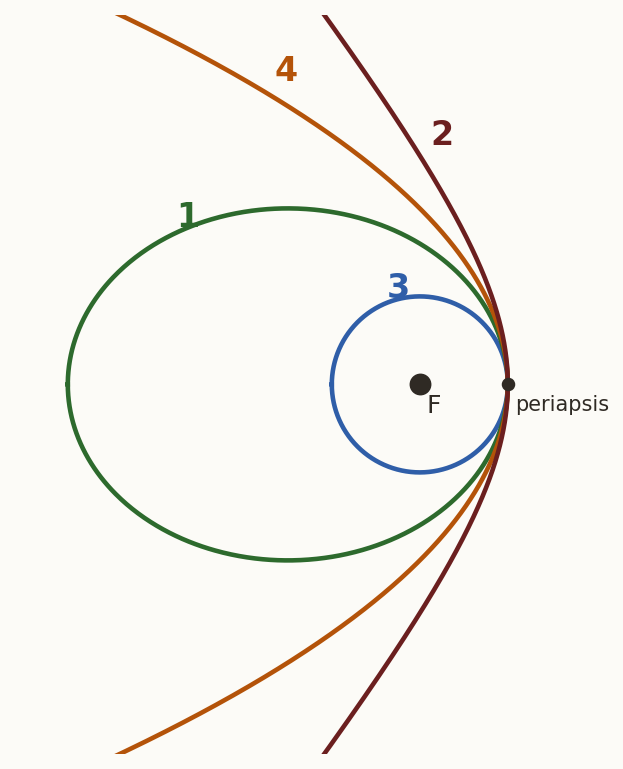
4. Figure 1 shows four trajectories with the same periapsis, \(e=0\), \(0.6\), \(1\) and \(1.6\). Which curve is the parabola?
- 1
- 2
- 3
- 4
Answer
(D) At \(f=90^\circ\) every curve is at \(r=p=r_p(1+e)\), so a larger \(e\) lies farther out. From the inside: circle (3), ellipse (1), parabola (4), hyperbola (2). The parabola’s arms keep bending back towards the axis direction; the hyperbola’s straighten out along its asymptotes.
5. In Figure 1, which trajectories have positive specific energy \(\varepsilon\)?
- 2 only
- 2 and 4
- 1 and 3
- all four
Answer
(A) \(\varepsilon=-\mu/(2a)\) is negative for the circle and the ellipse, zero for the parabola (4), and positive only for the hyperbola (2).
6. On any elliptical orbit, at the points where \(r=a\) the speed is
- the largest on the orbit
- zero
- \(\sqrt{2\mu/a}\)
- \(\sqrt{\mu/a}\), the circular speed at that radius
Answer
(D) Vis-viva: \(v^2=\mu(2/r-1/a)=\mu/a\) at \(r=a\). These are the ends of the minor axis.
7. The escape speed at radius \(r\) is larger than the circular speed at \(r\) by a factor of
- \(2\sqrt2\)
- \(2\)
- \(\sqrt2\)
- \(1\)
Answer
(C) \(v_{\rm esc}=\sqrt{2\mu/r}\) and \(v_c=\sqrt{\mu/r}\).
8. The period of a circular orbit of radius \(6678\) km (about \(300\) km altitude) is about
- \(24\) h
- \(98\) min
- \(90.5\) min
- \(84\) min
Answer
(C) \(T=2\pi\sqrt{r^3/\mu}=2\pi\sqrt{6678^3/398\,600}=5431\) s \(=90.5\) min.
9. The circular speed at \(r=7000\) km is
- \(10.67\) km/s
- \(7.91\) km/s
- \(7.55\) km/s
- \(5.34\) km/s
Answer
(C) \(v_c=\sqrt{\mu/r}=\sqrt{398\,600/7000}=7.546\) km/s. (\(10.67\) km/s is the escape speed there.)
10. An ellipse has \(a=10\,000\) km and \(e=0.2\). Its periapsis and apoapsis radii are
- \(8000\) and \(10\,000\) km
- \(8000\) and \(12\,000\) km
- \(9800\) and \(10\,200\) km
- \(2000\) and \(18\,000\) km
Answer
(B) \(r_p=a(1-e)=8000\) km and \(r_a=a(1+e)=12\,000\) km.
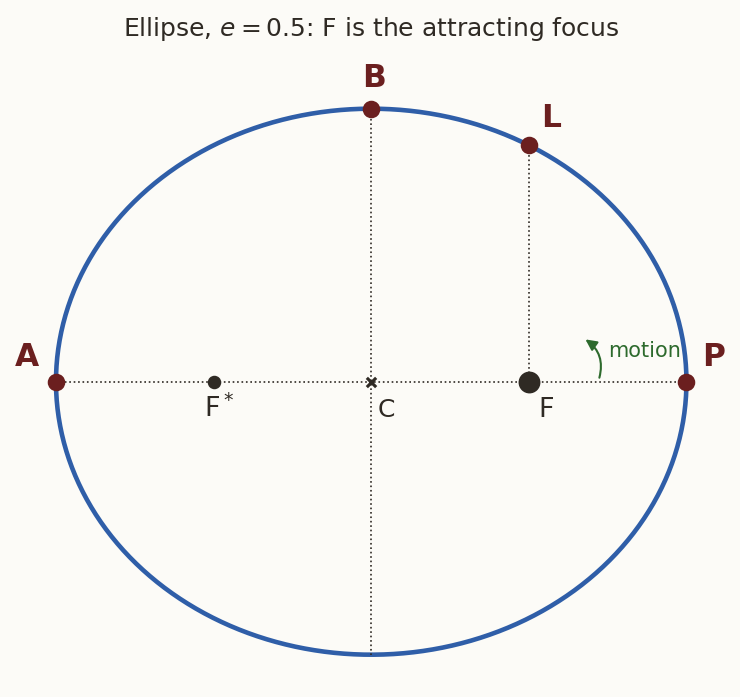
11. The semi-latus rectum \(p\) of a conic is the radius at
- true anomaly \(f=\pm90^\circ\)
- periapsis
- the end of the minor axis
- apoapsis
Answer
(A) \(r=p/(1+e\cos f)\) equals \(p\) when \(\cos f=0\). In Figure 2 this is the point L.
12. In Figure 2, at which points is the flight-path angle zero?
- B only
- B and L
- L only
- P and A
Answer
(D) \(\tan\gamma=e\sin f/(1+e\cos f)\) vanishes at \(f=0\) and \(f=180^\circ\), the apsides, where the velocity is perpendicular to \(\mathbf r\).
13. Kepler’s second law (equal areas in equal times) is equivalent to the conservation of
- the eccentricity vector
- angular momentum
- linear momentum
- energy
Answer
(B) The areal velocity is \(\tfrac12|\mathbf r\times\dot{\mathbf r}|=h/2\). It is constant for any central force.
14. Kepler’s equation, relating the mean anomaly \(M\) to the eccentric anomaly \(E\), is
- \(M=E-e\sin E\)
- \(\tan\frac M2=\sqrt{\frac{1-e}{1+e}}\tan\frac E2\)
- \(M=E-e\cos E\)
- \(M=E+e\sin E\)
Answer
(A) \(M=n(t-t_p)=E-e\sin E\). Option (B) is the half-angle relation between \(E\) and the true anomaly, with \(f\) replaced by \(M\).
15. The mean motion of an elliptical orbit is
- \(\sqrt{\mu/p^3}\)
- \(\sqrt{\mu/a}\)
- \(2\pi\sqrt{a^3/\mu}\)
- \(\sqrt{\mu/a^3}\)
Answer
(D) \(n=2\pi/T=\sqrt{\mu/a^3}\), the average angular rate. Option (C) is the period itself.
16. The geostationary orbit has period one sidereal day, \(23.9345\) h. Its radius is about
- \(35\,786\) km
- \(42\,164\) km
- \(42\,241\) km
- \(384\,400\) km
Answer
(B) \(r=(\mu T^2/4\pi^2)^{1/3}=(398\,600\times86\,164^2/4\pi^2)^{1/3}=42\,164\) km. (\(35\,786\) km is the altitude; using \(24\) h instead of the sidereal day gives \(42\,241\) km.)
17. The eccentricity vector \(\mathbf e\) of an orbit points
- from the focus towards apoapsis
- along \(\mathbf h\)
- from the focus towards periapsis
- along the velocity at periapsis
Answer
(C) At periapsis, \(\mathbf v\times\mathbf h/\mu\) and \(\hat{\mathbf r}\) both point outwards, and \(\mathbf e\) is their difference, of length \(e\), along the line to periapsis.
18. In Figure 2, where is the orbital speed greatest?
- L
- P
- A
- B
Answer
(B) By vis-viva, \(v\) is largest where \(r\) is smallest: at periapsis P.
19. An orbit has \(e=0.5\). The ratio of periapsis speed to apoapsis speed is
- \(4\)
- \(3\)
- \(2\)
- \(1.5\)
Answer
(B) \(h=r_pv_p=r_av_a\), so \(v_p/v_a=r_a/r_p=(1+e)/(1-e)=1.5/0.5=3\).
20. On a circular orbit, the ratio of the kinetic energy to the magnitude of the potential energy is
- \(2\)
- \(1\)
- \(1/2\)
- \(1/4\)
Answer
(C) \(v^2/2=\mu/(2r)\) and \(|-\mu/r|=\mu/r\). Hence \(\varepsilon=-\mu/(2r)\), half the potential energy.
Level 2 — a little difficult
21. An orbit has \(r_p=7000\) km and \(r_a=14\,000\) km. Its semi-major axis and eccentricity are
- \(a=14\,000\) km, \(e=1/3\)
- \(a=10\,500\) km, \(e=1/3\)
- \(a=10\,500\) km, \(e=0.5\)
- \(a=7000\) km, \(e=0.5\)
Answer
(B) \(a=(r_p+r_a)/2=10\,500\) km and \(e=(r_a-r_p)/(r_a+r_p)=7000/21\,000=1/3\).
22. For the orbit of Question 21, the speed at periapsis is
- \(7.55\) km/s
- \(8.71\) km/s
- \(9.27\) km/s
- \(10.67\) km/s
Answer
(B) \(v_p=\sqrt{\dfrac{2\mu r_a}{r_p(r_p+r_a)}}=\sqrt{\dfrac{2\times398\,600\times14\,000}{7000\times21\,000}}=8.713\) km/s.
23. For the ellipse of Figure 2 (\(e=0.5\)), the greatest flight-path angle is
- \(60^\circ\), at B
- \(30^\circ\), at L
- \(26.6^\circ\), at L
- \(30^\circ\), at B
Answer
(D) \(\tan\gamma=e\sin f/(1+e\cos f)\) is greatest at \(\cos f=-e\), where \(\sin\gamma=e\): \(\gamma_{\max}=\arcsin0.5=30^\circ\). That point has \(r=a\), the end of the minor axis, B. At L, \(\gamma=\arctan e=26.6^\circ\).
24. On an ellipse, the body is at \(r=a\) when
- \(\sin f=e\)
- \(\cos f=-e\)
- \(f=90^\circ\)
- \(\cos f=e\)
Answer
(B) \(a(1-e^2)/(1+e\cos f)=a\) gives \(1+e\cos f=1-e^2\), i.e. \(\cos f=-e\). In Figure 2 this is B, beyond the focus on the apoapsis side.
25. At \(r=7000\) km a spacecraft moves at \(12\) km/s. Its hyperbolic excess speed is about
- \(8.70\) km/s
- \(7.55\) km/s
- \(5.49\) km/s
- \(1.33\) km/s
Answer
(C) \(v_\infty^2=v^2-2\mu/r=144-113.9=30.1\), so \(v_\infty=5.49\) km/s. Subtracting the escape speed itself (\(12-10.67\)) is the common mistake.
26. A hyperbolic flyby has \(e=2\). The velocity is turned through
- \(120^\circ\)
- \(90^\circ\)
- \(60^\circ\)
- \(30^\circ\)
Answer
(C) \(\delta=2\arcsin(1/e)=2\arcsin\tfrac12=60^\circ\). (\(120^\circ\) is the true anomaly of the asymptote, \(f_\infty=\arccos(-1/e)\); the turn is \(2f_\infty-180^\circ\).)
27. Kepler’s third law with \(\mu=GM_\oplus\) predicts the Moon’s period for its observed \(a\). Including the Moon’s mass (\(M_\oplus/M_{\rm Moon}=81.3\)) changes the predicted period by
- about \(-1.2\%\)
- about \(-0.6\%\)
- about \(+0.6\%\)
- nothing
Answer
(B) \(T\propto1/\sqrt{G(M+m)}\), so the period is multiplied by \(1/\sqrt{1+1/81.3}=0.9939\): about \(0.6\%\) shorter.
28. An orbit has specific energy \(\varepsilon=-20\ \mathrm{km^2/s^2}\) and \(h=60\,000\ \mathrm{km^2/s}\). Its eccentricity is about
- \(0.91\)
- \(0.55\)
- \(0.31\)
- \(0.09\)
Answer
(C) \(e^2=1+2\varepsilon h^2/\mu^2=1-2\times20\times3.6\times10^9/398\,600^2=1-0.906=0.094\), so \(e=0.306\).
29. At \(r=8000\) km a spacecraft moves at \(8\) km/s, in any direction. Its semi-major axis is about
- \(8000\) km
- \(11\,180\) km
- \(13\,600\) km
- \(22\,360\) km
Answer
(B) \(1/a=2/r-v^2/\mu=2/8000-64/398\,600=8.944\times10^{-5}\ \mathrm{km^{-1}}\), so \(a=11\,181\) km. The direction does not enter: \(a\) depends only on the energy.
30. On a parabolic orbit, the speed at every point is
- the escape speed there
- the circular speed there
- zero
- constant
Answer
(A) \(e=1\) means \(\varepsilon=0\), so \(v^2/2=\mu/r\) at every point.
31. A hyperbolic flyby has \(r_p=7000\) km and \(v_\infty=3\) km/s. Its eccentricity is about
- \(2.16\)
- \(1.58\)
- \(1.16\)
- \(1.02\)
Answer
(C) \(|a|=\mu/v_\infty^2=44\,289\) km, and \(r_p=|a|(e-1)\), so \(e=1+r_pv_\infty^2/\mu=1+63\,000/398\,600=1.158\).
32. On an ellipse with \(0<e<1\), the eccentric anomaly \(E\) equals the true anomaly \(f\)
- only at the ends of the minor axis
- everywhere
- nowhere
- only at periapsis and apoapsis
Answer
(D) \(\tan\frac f2=\sqrt{\frac{1+e}{1-e}}\tan\frac E2\), so \(E=f\) only where \(\tan\frac E2=0\) or is infinite: \(E=0\) and \(E=\pi\).
33. In Figure 2, where is the radial velocity \(v_r\) greatest?
- B
- halfway between P and L
- P
- L
Answer
(D) \(v_r=(\mu/h)\,e\sin f\) is greatest at \(f=90^\circ\), which is L, the end of the latus rectum. (The flight-path angle peaks later, at B.)
34. The two-body problem has the integrals \(\mathbf h\) (3 numbers), \(\mathbf e\) (3) and \(\varepsilon\) (1). How many of these seven numbers are independent?
- \(7\)
- \(6\)
- \(5\)
- \(3\)
Answer
(C) The Casimir relations \(\mathbf h\cdot\mathbf e=0\) and \(\mu^2(e^2-1)=2\varepsilon h^2\) remove two. The sixth element, the time of periapsis, is not a function of the state alone.
Level 3 — hard
35. On an orbit with \(e=0.5\), what fraction of the period does the body take to go from periapsis to \(f=90^\circ\)?
- \(0.050\)
- \(0.098\)
- \(0.167\)
- \(0.250\)
Answer
(B) \(\tan\frac E2=\sqrt{\frac{1-e}{1+e}}\tan45^\circ=1/\sqrt3\), so \(E=60^\circ\). Then \(M=\pi/3-0.5\sin60^\circ=0.614\), and \(M/2\pi=0.098\). A quarter of the angle takes under a tenth of the time.
36. On an orbit with \(e=0.5\), what fraction of each period does the body spend inside the circle \(r=a\)?
- \(0.25\)
- \(0.34\)
- \(0.50\)
- \(0.66\)
Answer
(B) \(r<a\) when \(\cos E>0\), i.e. \(|E|<90^\circ\). At \(E=90^\circ\), \(M=\pi/2-e\). So the fraction is \((\pi-2e)/(2\pi)=\frac12-\frac e\pi=0.341\).
37. At \(r=7000\) km a body moves at \(8.266\) km/s with flight-path angle \(10^\circ\) (so \(rv^2/\mu=1.2\)). Its eccentricity is about
- \(0.35\)
- \(0.26\)
- \(0.20\)
- \(0.14\)
Answer
(B) With \(\nu=rv^2/\mu\), \(e^2=1-\nu(2-\nu)\cos^2\gamma=1-1.2\times0.8\times\cos^210^\circ=0.0689\), so \(e=0.263\). With \(\gamma=0\) it would be \(|\nu-1|=0.2\).
38. For an orbit with \(e=0.6\), the time average of the distance \(r\) over one period is
- \(0.80\,a\)
- \(a\)
- \(1.18\,a\)
- \(1.36\,a\)
Answer
(C) Using \(dt\propto(1-e\cos E)\,dE\): \(\langle r\rangle_t=\frac{a}{2\pi}\oint(1-e\cos E)^2dE=a(1+e^2/2)=1.18\,a\). The body lingers far out. (\(0.80\,a=b\) is the average over true anomaly.)
39. Solve \(M=E-e\sin E\) for \(M=1\) rad, \(e=0.1\) by Newton’s method starting from \(E_0=M\). After one step, \(E_1\) is
- \(1.0947\)
- \(1.0890\)
- \(1.0886\)
- \(1.0841\)
Answer
(B) \(E_1=E_0-\dfrac{E_0-e\sin E_0-M}{1-e\cos E_0}=1+\dfrac{0.08415}{0.94597}=1.0890\). The converged root is \(1.0886\): one step already gives three correct figures.
40. In the two-body problem, body 1 moves about the barycentre on
- an ellipse with the barycentre at its centre
- a circle
- the same ellipse as body 2
- an ellipse with the same \(e\) and period as the relative orbit, scaled by \(m_2/(m_1+m_2)\)
Answer
(D) \(\mathbf R_1-\mathbf R_{\rm cm}=-\frac{m_2}{m_1+m_2}\mathbf r\): a scaled, point-reflected copy of the relative orbit, with the barycentre at its focus.
41. If the Moon were stopped dead in its orbit, how long would it take to fall to the Earth? (Moon’s sidereal period \(27.32\) d; treat both as point masses.)
- \(2.4\) d
- \(4.8\) d
- \(6.8\) d
- \(13.7\) d
Answer
(B) The fall is half of a degenerate ellipse (\(e\to1\)) with \(a=r/2\). Its time is \(\tfrac12\cdot2\pi\sqrt{(r/2)^3/\mu}=T/(4\sqrt2)=27.32/5.657=4.83\) d.
42. A hyperbola has \(e=\sqrt2\). The true anomaly of its asymptote is
- \(90^\circ\)
- \(120^\circ\)
- \(135^\circ\)
- \(150^\circ\)
Answer
(C) \(\cos f_\infty=-1/e=-1/\sqrt2\), so \(f_\infty=135^\circ\), and the velocity is turned through \(2f_\infty-180^\circ=90^\circ\).
43. On an ellipse with \(e=0.8\), the flight-path angle is greatest at a true anomaly of
- \(143.1^\circ\)
- \(126.9^\circ\)
- \(90^\circ\)
- \(36.9^\circ\)
Answer
(A) \(\gamma\) peaks where \(\cos f=-e=-0.8\), i.e. \(f=143.1^\circ\), and there \(\gamma=\arcsin0.8=53.1^\circ\).
44. A spacecraft approaches a planet (\(\mu=398\,600\ \mathrm{km^3/s^2}\)) at \(v_\infty=3\) km/s, aimed to pass with \(r_p=7000\) km. Its impact parameter (the miss distance of the asymptote) is about
- \(7000\) km
- \(9900\) km
- \(25\,900\) km
- \(44\,300\) km
Answer
(C) \(h=bv_\infty=r_pv_p\) with \(v_p^2=v_\infty^2+2\mu/r_p\), so \(b=r_p\sqrt{1+2\mu/(r_pv_\infty^2)}=7000\times3.695=25\,866\) km. Gravity focuses the incoming stream.
45. The constancy of the eccentricity vector (the apse line stays fixed) is special to
- the inverse-square force
- every central force
- motion in a plane
- forces derivable from a potential
Answer
(A) A small extra force like \(1/r^3\) keeps the orbit planar and conserves \(\mathbf h\) and \(\varepsilon\), but \(\mathbf e\) is no longer constant: the apse line precesses. That \(\mathbf e\) is conserved is the hidden symmetry of the Kepler problem.
46. A body on a parabola has \(r_p=7000\) km about the Earth. Using Barker’s equation, \(t-t_p=\dfrac{p^2}{2h}\Bigl(D+\dfrac{D^3}{3}\Bigr)\) with \(D=\tan\frac f2\), the time from periapsis to \(f=90^\circ\) is about
- \(58.3\) min
- \(43.7\) min
- \(29.2\) min
- \(14.6\) min
Answer
(C) \(p=2r_p=14\,000\) km and \(h=\sqrt{\mu p}\), so \(p^2/(2h)=p^{3/2}/(2\sqrt\mu)\). With \(D=1\): \(t=\frac{p^{3/2}}{2\sqrt\mu}\cdot\frac43=\frac23\,\frac{14\,000^{3/2}}{631.3}=1749\) s \(=29.2\) min.
47. Two satellites have the same semi-major axis; one orbit is circular and the other has \(e=0.7\). Their time-averaged values of \(v^2\) are
- equal
- equal only if the periods differ
- larger for the circular orbit
- larger for the eccentric orbit
Answer
(A) Vis-viva gives \(\langle v^2\rangle=\mu(2\langle1/r\rangle-1/a)\), and \(\langle1/r\rangle_t=1/a\) for every ellipse, so \(\langle v^2\rangle=\mu/a\) for both.
48. In the two-body problem, the period of body 1 about the barycentre, compared with the period of the relative orbit, is
- the same
- the same only for circular orbits
- shorter by the factor \(m_2/(m_1+m_2)\)
- longer by the factor \((m_1+m_2)/m_2\)
Answer
(A) Body 1’s position about the barycentre is a fixed multiple of \(\mathbf r\) (Question 40), so it goes round exactly once per relative orbit.
Answer key
All \(48\) answers.
Answer
| 1 A | 2 A | 3 A | 4 D | 5 A | 6 D | 7 C | 8 C | 9 C | 10 B |
| 11 A | 12 D | 13 B | 14 A | 15 D | 16 B | 17 C | 18 B | 19 B | 20 C |
| 21 B | 22 B | 23 D | 24 B | 25 C | 26 C | 27 B | 28 C | 29 B | 30 A |
| 31 C | 32 D | 33 D | 34 C | 35 B | 36 B | 37 B | 38 C | 39 B | 40 D |
| 41 B | 42 C | 43 A | 44 C | 45 A | 46 C | 47 A | 48 A |
Drills
These are plain numericals. Each one practises a method of the note on a concrete case, and none of them adds anything that is not already in the note. Work each one through before you open its solution.
1. The Sun’s wobble
Jupiter (\(m_J/M_\odot=1/1047.6\), \(a=5.2026\) AU, orbital speed \(13.06\) km/s) makes the Sun circle the Sun–Jupiter barycentre. Find the radius of the Sun’s circle, in solar radii (\(R_\odot=6.96\times10^5\) km), and its speed. That speed is the radial-velocity signal an astronomer on another star would need to detect a Jupiter.
Solution
The radius. The barycentre divides the line between the two bodies in the inverse ratio of their masses (the section From two bodies to one of the two-body note). The Sun’s distance from it is therefore the fraction \(m_J/(M_\odot+m_J)=1/1048.6\) of the separation,
\[ r_\odot=\frac{5.2026\times1.495979\times10^{8}\ \text{km}}{1048.6}=742\,200\ \text{km}=1.07\,R_\odot . \]
The barycentre lies just outside the Sun’s surface.
The speed. Both bodies go round the barycentre in the same period, so their speeds are in the ratio of their distances. The relative speed of Jupiter and the Sun is \(13.06\) km/s, and the Sun’s share of it is the same fraction,
\[ v_\odot=\frac{13.06\ \text{km/s}}{1048.6}=12.5\ \text{m/s}. \]
Reading the result. An observer far away, looking along the plane of Jupiter’s orbit, would see the Sun’s light Doppler-shifted back and forth by \(\pm12.5\) m/s with a period of \(11.9\) years. That is the speed of a fast cyclist, measured on a star. Spectrographs reached this precision in the 1990s, and the first planets found around Sun-like stars were found in exactly this way. The Earth moves the Sun by only \(0.09\) m/s, far harder to detect.
2. State to elements
At some instant a satellite has \(\mathbf r=(7000,\,0,\,0)\) km and \(\mathbf v=(1.0,\,7.5,\,1.0)\) km/s. Compute \(\mathbf h\), \(\mathbf e\), \(\varepsilon\), \(a\), \(e\), \(p\) and \(f\). Check both Casimir relations numerically. Is the satellite climbing or descending? Take \(\mu=398\,600.4418\) km\(^3\)/s\(^2\).
Solution
The integrals. We have \(r=7000\) km, \(v^2=58.25\) km\(^2\)/s\(^2\), \(\mu/r=56.9429\) km\(^2\)/s\(^2\) and \(\mathbf r\cdot\mathbf v=7000\) km\(^2\)/s. Then
\[ \mathbf h=\mathbf r\times\mathbf v=(0,\ -7000,\ 52\,500)\ \text{km}^2/\text{s},\qquad h=52\,964.6\ \text{km}^2/\text{s}, \]
\[ \mathbf e=\frac1\mu\Bigl[\Bigl(v^2-\frac\mu r\Bigr)\mathbf r-(\mathbf r\cdot\mathbf v)\,\mathbf v\Bigr]=(0.005393,\ -0.131711,\ -0.017561),\qquad e=0.13299, \]
and \(\varepsilon=v^2/2-\mu/r=-27.8179\) km\(^2\)/s\(^2\).
The size and shape. \(a=-\mu/(2\varepsilon)=7164.45\) km and \(p=h^2/\mu=7037.75\) km. As a check, \(p/(1-e^2)\) gives the same \(a\).
The true anomaly. \(\cos f=\mathbf e\cdot\mathbf r/(er)=0.04055\), so \(f=87.68^\circ\) or \(272.32^\circ\). The radial speed is \(\mathbf r\cdot\mathbf v/r=+1.0\) km/s, so the satellite is moving away from the centre, and \(f=87.68^\circ\).
The Casimir relations. \(\mathbf h\cdot\mathbf e=0\times0.005393-7000\times(-0.131711)+52\,500\times(-0.017561)=0\), to rounding. And \(\mu^2(e^2-1)=-1.5607\times10^{11}\), while \(2\varepsilon h^2=-1.5607\times10^{11}\). Both hold.
Climbing or descending? Climbing, because \(\dot r=v_r>0\). The satellite is a little before the end of the latus rectum, \(f=90^\circ\), where the radial speed \((\mu/h)\,e\sin f\) is largest.
Reading the result. The two Casimir checks are worth doing every time. A sign slip in \(\mathbf h\) or \(\mathbf e\) almost always breaks one of them, and they cost two lines.
3. Same speed, different directions
A projectile leaves the surface of an airless Earth at \(v=8\) km/s. Compare the orbits for launch straight up, at \(45^\circ\), and horizontally: which have the same \(a\)? the same \(e\)? Which ones hit the ground again? Take \(R_\oplus=6378.137\) km and \(\mu=398\,600.4418\) km\(^3\)/s\(^2\).
Solution
The same \(a\). The energy depends only on the speed and the radius, \(\varepsilon=v^2/2-\mu/R_\oplus=32-62.495=-30.495\) km\(^2\)/s\(^2\), so all three orbits have the same energy and the same
\[ a=-\frac{\mu}{2\varepsilon}=6535.5\ \text{km}. \]
Different \(e\). The angular momentum depends on the direction, \(h=R_\oplus v\cos\gamma\), with \(\gamma\) the angle above the horizontal. With \(p=h^2/\mu\) and \(e=\sqrt{1-p/a}\),
| launch | \(h\) (km\(^2\)/s) | \(p\) (km) | \(e\) | \(r_p\) (km) | farthest point (km) |
|---|---|---|---|---|---|
| straight up | \(0\) | \(0\) | \(1\) | \(0\) | \(13\,071\) |
| \(45^\circ\) | \(36\,080\) | \(3265.9\) | \(0.7073\) | \(1912.9\) | \(11\,158\) |
| horizontal | \(51\,025\) | \(6531.8\) | \(0.0241\) | \(6378.1\) | \(6693.0\) |
The vertical shot is the rectilinear orbit of the section The size parameter \(a\) of the two-body note, with \(e=1\), which rises to \(2a\) and falls back. No two of the three share an eccentricity.
Which come down? The vertical shot falls straight back. The \(45^\circ\) shot has its periapsis \(1913\) km from the centre, deep inside the Earth, so it hits the ground before reaching it. The horizontal shot starts at its own periapsis, because \(v=8\) km/s is a little above the circular speed \(7.905\) km/s. It rises to \(315\) km above the far side and returns to the launch point one period later, skimming the ground there. On an airless, smooth, non-rotating Earth it would just graze it. Any hill would stop it.
Reading the result. The speed fixes the size of the orbit, the direction fixes its shape. This is the whole content of Equation (11) of the two-body note and of the second Casimir relation. Newton’s cannon is the third case, and it needs very little speed above circular to clear the ground.
4. Time to fall
Using the rectilinear limit, estimate how long a body released from rest at the Earth’s distance from the Sun would take to fall into the Sun. (Hint: it is half the period of a degenerate ellipse with \(2a=1\) AU.)
Solution
The idea. A body released from rest has \(h=0\), so it moves on the rectilinear orbit of the section The size parameter \(a\) of the two-body note. Its energy is \(\varepsilon=-\mu_\odot/(1\ \text{AU})\), so \(a=-\mu_\odot/(2\varepsilon)=0.5\) AU. A rectilinear orbit is the limit of ellipses with \(e\to1\) and this fixed \(a\), which become ever thinner. The release point is the apoapsis, at \(2a=1\) AU, and the Sun is at the periapsis end. The fall from apoapsis to periapsis is half a period.
The period. Kepler’s third law depends only on \(a\). An orbit with \(a=0.5\) AU has the period \(0.5^{3/2}=0.35355\) year, so the fall takes half of that,
\[ t=\tfrac12\times0.35355\times365.25\ \text{d}=64.6\ \text{days}. \]
Reading the result. If the Earth stopped in its orbit it would hit the Sun in about nine weeks. The fall is very uneven. Most of the time is spent near the start, where the body is still slow, and the last part is very fast. A further point is that \(64.6/365.25=0.177\) is \(1/(4\sqrt2)\), the ratio for any circular orbit, whatever the body or the planet.
5. Kepler’s equation for a highly eccentric orbit
For \(e=0.99\) and \(M=0.05\) rad, run Newton’s method from \(E_0=M\) and from \(E_0=\pi\). Which converges faster, and why?
Solution
The two runs. With Equation (42) of the two-body note, the iterates are
| \(k\) | from \(E_0=M\) | from \(E_0=\pi\) |
|---|---|---|
| \(0\) | \(0.050000\) | \(3.141593\) |
| \(1\) | \(4.453160\) | \(1.588029\) |
| \(2\) | \(0.177995\) | \(1.049047\) |
| \(3\) | \(2.022329\) | \(0.771172\) |
| \(4\) | \(1.267049\) | \(0.663733\) |
| \(5\) | \(0.880102\) | \(0.646329\) |
| \(6\) | \(0.698660\) | \(0.645892\) |
| \(7\) | \(0.649478\) | \(0.645891\) |
| \(8\) | \(0.645910\) | \(0.645891\) |
Both reach \(E=0.645891\) rad. The start at \(\pi\) settles in about seven steps and never overshoots. The start at \(M\) first jumps to \(4.45\), beyond \(\pi\), then wanders, and needs about nine steps.
Why. Newton’s method follows the tangent of \(g(E)=E-e\sin E-M\). At \(E_0=M=0.05\) the slope is \(g'=1-e\cos E_0=0.0112\), almost flat, because \(e\) is close to \(1\) and \(E_0\) close to \(0\). A nearly flat tangent meets the axis far away, so the first step overshoots wildly. At \(E_0=\pi\) the slope is \(1+e=1.99\), as steep as it ever gets. There is more. On \(0<E<\pi\) the curvature is \(g''=e\sin E>0\), so the graph bends upwards. Newton’s method started to the right of the root on such a curve stays to the right and approaches the root monotonically, each tangent landing between the root and the previous point.
Reading the result. This is why the note recommends \(E_0=\pi\) when \(e\) is close to \(1\). A program that propagates comets, or orbits just short of escape, must not start from \(M\). Near periapsis of a very eccentric orbit Kepler’s equation is at its least friendly, because the body sweeps a large angle in a short time.
6. Comets
A parabolic comet has \(r_p=0.1\) AU. How long does it spend inside the Earth’s orbit (\(r<1\) AU)? Compare with a parabola of \(r_p=0.9\) AU.
Solution
The crossing point. On a parabola \(p=2r_p\), and the orbit equation \(r=2r_p/(1+\cos f)\) gives \(r=1\) AU at \(\cos f=2r_p-1\) (with \(r_p\) in AU). The comet is inside the Earth’s orbit from \(-f\) to \(+f\), so by symmetry the time is twice the time from perihelion to \(f\). By Barker’s equation Equation (43) of the two-body note, with \(D=\tan(f/2)\),
\[ t=2\sqrt{\frac{2r_p^3}{\mu_\odot}}\Bigl(D+\frac{D^3}{3}\Bigr). \]
\(r_p=0.1\) AU. \(\cos f=-0.8\), so \(f=143.13^\circ\) and \(D=\tan71.57^\circ=3\). Then \(D+D^3/3=12\), and with \(\sqrt{2r_p^3/\mu_\odot}=2.247\times10^{5}\) s the time is \(5.39\times10^{6}\) s \(=62.4\) days.
\(r_p=0.9\) AU. \(\cos f=0.8\), so \(f=36.87^\circ\) and \(D=\tan18.43^\circ=1/3\). Then \(D+D^3/3=0.3457\), and with \(\sqrt{2r_p^3/\mu_\odot}=6.066\times10^{6}\) s the time is \(4.19\times10^{6}\) s \(=48.5\) days.
Reading the result. It is perhaps surprising that the comet that comes much closer to the Sun spends longer inside the Earth’s orbit, \(62\) days against \(49\). Close to the Sun it moves very fast, but it also has much farther to travel. It sweeps \(286^\circ\) round the Sun inside \(1\) AU, against \(74^\circ\) for the comet that only dips in. Each comet crosses the Earth’s orbit at the local escape speed of \(42.1\) km/s, so the two differ only in what they do inside.
7. Flyby design
A spacecraft approaches Mars (\(\mu=42\,828\) km\(^3\)/s\(^2\), radius \(3390\) km) with \(v_\infty=2.6\) km/s. What is the largest turning angle it can get without going below \(200\) km altitude? What aiming radius does that require?
Solution
The largest turn. By Equation (47) of the two-body note and Equation (46) of the two-body note, a smaller periapsis gives a smaller \(e\) and a larger turn. So the largest turn is at the lowest allowed periapsis, \(r_p=3390+200=3590\) km,
\[ e=1+\frac{r_pv_\infty^2}{\mu}=1+\frac{3590\times6.76}{42\,828}=1.5666,\qquad \delta=2\arcsin\frac1e=79.3^\circ . \]
The aiming radius. It is \(\Delta=b=|a|\sqrt{e^2-1}\), with \(|a|=\mu/v_\infty^2=6335.5\) km, so
\[ \Delta=6335.5\times\sqrt{1.5666^2-1}=7640\ \text{km}. \]
An equivalent route uses \(h=r_pv_p=\Delta v_\infty\) with \(v_p=\sqrt{v_\infty^2+2\mu/r_p}\), which gives the same \(7640\) km.
Reading the result. The spacecraft must be aimed \(7640\) km from the centre of Mars, more than twice the planet’s radius, to pass only \(200\) km above the surface. Gravity bends the approach inwards, so the aim is wide of the planet. The navigation tolerance is tight. Because \(\Delta\) grows with \(r_p\), an aiming error of a few kilometres changes the periapsis altitude by a similar amount, and \(200\) km leaves little margin. With only \(79^\circ\) of turn available, a single Mars flyby cannot reverse a trajectory, which is why missions that use Mars for a gravity assist plan for a moderate bend.
8. What a state vector tells you
Given the position and velocity vectors \(\mathbf r\), \(\mathbf v\) of a body at one instant and the gravitational parameter \(\mu\), write down an algorithm that returns the specific angular momentum \(h\), the specific energy \(\varepsilon\), the eccentricity \(e\), the semi-latus rectum \(p\), the semi-major axis \(a\), the periapsis distance \(r_p\) and the flight path angle \(\gamma\). State the order of the computation: which quantity needs which.
Hint
Start from the three integrals of the two-body problem. Each of them can be computed from \(\mathbf r\) and \(\mathbf v\) directly. Then ask which geometric quantity follows from which integral. For \(\gamma\), split \(\mathbf v\) into a part along \(\mathbf r\) and a part perpendicular to it.
Solution
Every line uses only quantities already computed above it.
\[ \begin{aligned} \mathbf 1.\quad&r=\lVert\mathbf r\rVert,\qquad v=\lVert\mathbf v\rVert\\ \mathbf 2.\quad&\mathbf h=\mathbf r\times\mathbf v,\qquad h=\lVert\mathbf h\rVert\\ \mathbf 3.\quad&\varepsilon=\frac{v^2}2-\frac\mu r\\ \mathbf 4.\quad&\mathbf e=\frac{\mathbf v\times\mathbf h}\mu-\frac{\mathbf r}r,\qquad e=\lVert\mathbf e\rVert\\ \mathbf 5.\quad&p=\frac{h^2}\mu\\ \mathbf 6.\quad&a=-\frac\mu{2\varepsilon}\\ \mathbf 7.\quad&r_p=\frac p{1+e}\\ \mathbf 8.\quad&\gamma=\operatorname{atan2}\left(\mathbf r\cdot\mathbf v,\ h\right) \end{aligned} \]
The order of the steps is not a chain of dependencies. What each quantity actually needs is
- \(\mathbf h\): \(\mathbf r\) and \(\mathbf v\); \(\varepsilon\): only the magnitudes \(r\) and \(v\);
- \(\mathbf e\): \(\mathbf r\), \(\mathbf v\) and \(\mathbf h\) (or \(e\) alone from \(h\) and \(\varepsilon\));
- \(p\): only \(h\); \(a\): only \(\varepsilon\);
- \(r_p\): \(p\) and \(e\); \(\gamma\): \(\mathbf r\cdot\mathbf v\) and \(h\).
So \(\mathbf h\) and \(\varepsilon\) are independent of each other, and \(a\) never needs the direction of \(\mathbf v\). Figure 3 draws the graph.
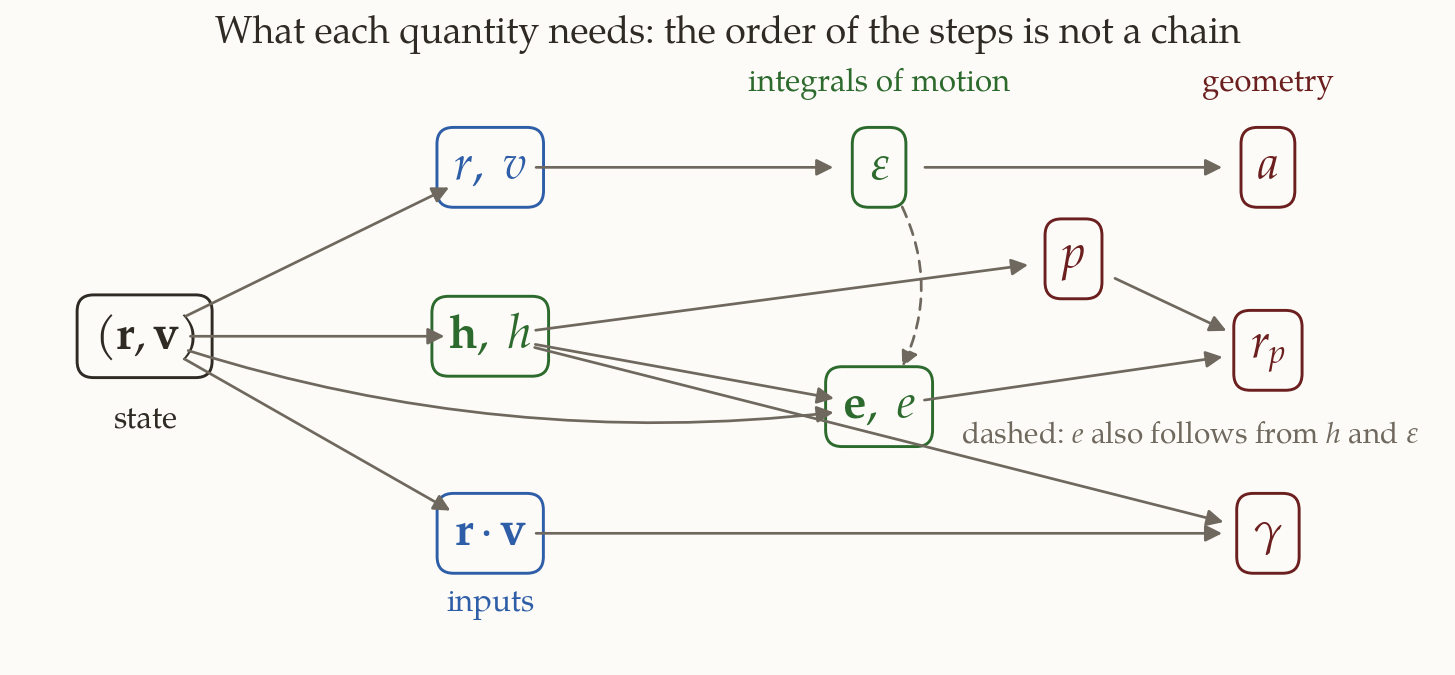
Steps 1–4 extract the three integrals of motion; steps 5–8 are geometry read off from them.
Five remarks, each worth more than the algorithm itself.
- Step 3 already classifies the orbit: \(\varepsilon<0\) ellipse, \(\varepsilon=0\) parabola, \(\varepsilon>0\) hyperbola, before any conic is drawn.
- The eccentricity needs no vectors: \(e=\sqrt{1+2\varepsilon h^2/\mu^2}\) from steps 2 and 3. The vector \(\mathbf e\) is needed only for the direction of periapsis.
- \(a\) depends only on the magnitudes \(r\) and \(v\): \(a=(2/r-v^2/\mu)^{-1}\) from vis-viva. The direction of \(\mathbf v\) enters only through \(h\), hence only through \(p\), \(e\) and \(\gamma\).
- Why \(p\) before \(a\), and \(r_p=p/(1+e)\) rather than \(a(1-e)\). The pair \((p,e)\) describes every conic, while \(a=p/(1-e^2)\) blows up at \(e=1\). So \(r_p=p/(1+e)\) works for the ellipse, the parabola (\(r_p=p/2\)) and the hyperbola alike, and in floating point \((p,e)\) is the safer pair near \(e=1\). (The apoapsis \(r_a=p/(1-e)\) exists only for the ellipse.)
- The flight path angle. With \(v_r=\mathbf r\cdot\mathbf v/r\) and \(v_\perp=h/r\), \(\tan\gamma=v_r/v_\perp=\mathbf r\cdot\mathbf v/h\), \(\sin\gamma=v_r/v\), \(\cos\gamma=h/(rv)\), so \(h=rv\cos\gamma\). The two-argument arctangent keeps the sign: \(\gamma>0\) outbound, \(\gamma<0\) inbound, and \(\gamma=0\) exactly when \(\mathbf r\cdot\mathbf v=0\), i.e. at an apsis. That is the quickest test of whether a state vector sits at periapsis or apoapsis.
Two degenerate cases: if \(h=0\) the motion is rectilinear (\(p=0\), \(e=1\) whatever the energy); if \(e=0\) the orbit is circular and has no periapsis direction.
9. Will the debris hit?
A newly catalogued piece of debris is tracked and, at one instant, its geocentric state is
\[ \mathbf r=(10\,000,\ 0,\ 0)\ \text{km},\qquad\mathbf v=(0,\ 5.15494,\ 0)\ \text{km/s}. \]
With \(\mu_\oplus=398\,600.44\) km\(^3\)/s\(^2\) and \(R_\oplus=6378\) km, find \(h\), \(\varepsilon\), \(a\), \(e\) and the perigee radius \(r_p\). Does the debris strike the Earth? If so, where on its orbit, and how fast?
Hint
Use the algorithm of Problem 8. Then compare \(r_p\) with \(R_\oplus\). Is the given point perigee, apogee, or neither? For the impact point, solve the orbit equation for the true anomaly at which \(r=R_\oplus\), and think about which of the two solutions the debris reaches first.
Solution
Angular momentum. The velocity is perpendicular to \(\mathbf r\), so \(\mathbf h=(0,\ 0,\ 51\,549.4)\) km\(^2\)/s and \(h=51\,549.4\) km\(^2\)/s.
Energy. \(v^2=26.5734\) km\(^2\)/s\(^2\), so \(\varepsilon=13.2867-39.8600=-26.5734\) km\(^2\)/s\(^2<0\): an ellipse.
Size and shape. \(a=-\mu/(2\varepsilon)=7500\) km, and \(e=\sqrt{1+2\varepsilon h^2/\mu^2}=1/3\). Since \(\mathbf r\cdot\mathbf v=0\) the given point is an apsis, and since \(r=10\,000\) km \(>a\) it is the apogee.
Perigee. \(r_p=a(1-e)=5000\) km.
\[ \boxed{\;r_p=5000\ \text{km}<R_\oplus=6378\ \text{km}\;} \]
The orbit dips \(1378\) km below the surface: the debris hits the Earth. It never reaches the mathematical perigee.
Where. With \(p=h^2/\mu=6666.7\) km, the orbit reaches \(r=R_\oplus\) where
\[ \cos f=\frac1e\left(\frac p{R_\oplus}-1\right)=3\left(\frac{6666.7}{6378}-1\right)=0.1358, \]
i.e. \(f=\pm82.2^\circ\). The debris starts at apogee (\(f=180^\circ\)) and moves on to larger \(f\), falling towards perigee, so it meets the surface first at \(f=360^\circ-82.2^\circ=277.8^\circ\), still descending The flight path angle there follows from \(\tan\gamma=v_r/v_\perp=e\sin f/(1+e\cos f)\): \(\tan\gamma=(-0.3302)/1.0453=-0.3159\), so \(\gamma=-17.5^\circ\), descending.
How fast. Vis-viva at \(r=R_\oplus\): \(v=\sqrt{\mu(2/R_\oplus-1/a)}=8.48\) km/s, ignoring the atmosphere.
“Will it hit?” is answered by one scalar, \(r_p\), extracted from one state vector: no propagation in time is needed.
10. Everything about one ellipse
A satellite has perigee altitude \(z_p=400\) km and apogee altitude \(z_a=4000\) km. With \(\mu=398\,600\) km\(^3\)/s\(^2\) and \(R_\oplus=6378\) km, find
- the eccentricity \(e\); (b) the angular momentum \(h\); (c) the perigee speed \(v_p\); (d) the apogee speed \(v_a\); (e) the semi-major axis \(a\); (f) the period \(T\); (g) the radius averaged over true anomaly, \(\bar r_f\); (h) the true anomaly at which \(r=\bar r_f\); (i) the speed there; (j) the flight path angle there; (k) the largest flight path angle \(\gamma_{\max}\), and the true anomaly at which it occurs.
Hint
First convert altitudes to radii; every orbital formula measures distance from the Earth’s centre. For (b), write \(p\) in terms of \(r_p\) and \(r_a\) alone. For (g), average \(r=p/(1+e\cos f)\) over \(0\le f<2\pi\), using \(\int_0^{2\pi}df/(1+e\cos f)=2\pi/\sqrt{1-e^2}\). For (k), maximise \(\tan\gamma=e\sin f/(1+e\cos f)\).
Solution
Altitudes are not radii. \(r_p=6378+400=6778\) km and \(r_a=6378+4000=10\,378\) km. Forgetting this is the most common slip in the whole problem.
(a) Adding and subtracting \(r_p=a(1-e)\) and \(r_a=a(1+e)\) eliminates \(a\): \(e=(r_a-r_p)/(r_a+r_p)=3600/17\,156=0.20984\).
(b) The semi-latus rectum is the harmonic mean of the apsidal radii, \(p=a(1-e^2)=2r_pr_a/(r_p+r_a)=8200.29\) km, so \(h=\sqrt{\mu p}=5.7172\times10^{4}\) km\(^2\)/s.
(c), (d) At an apsis the velocity is purely transverse, so \(h=rv\): \(v_p=h/r_p=8.435\) km/s and \(v_a=h/r_a=5.509\) km/s. Check with Problem 16: \(v_pv_a=46.47=\mu/a\).
(e) \(a=(r_p+r_a)/2=8578\) km.
(f) \(T=2\pi\sqrt{a^3/\mu}=7906.6\) s \(=131.78\) min \(=2.196\) h.
(g) Averaging over \(f\),
\[ \bar r_f=\frac1{2\pi}\int_0^{2\pi}\frac{p\,df}{1+e\cos f}=\frac p{\sqrt{1-e^2}}=a\sqrt{1-e^2}=b=8387.02\ \text{km}, \]
the semi-minor axis, which is also the geometric mean \(\sqrt{r_pr_a}\). Its altitude is about \(2009\) km. This is an average over true anomaly, not over time: the satellite lingers near apogee, so the time average is larger, \(\bar r_t=a(1+e^2/2)=8766.9\) km. Always say what you average over.
Where the time average comes from
Use the eccentric anomaly \(E\): \(r=a(1-e\cos E)\), and Kepler’s equation \(M=E-e\sin E\) gives \(dM=(1-e\cos E)\,dE\). Time is uniform in \(M\), so
\[ \bar r_t=\frac1{2\pi}\int_0^{2\pi}r\,dM=\frac a{2\pi}\int_0^{2\pi}(1-e\cos E)^2\,dE =\frac a{2\pi}\left(2\pi+\pi e^2\right)=a\left(1+\frac{e^2}2\right), \]
since \(\cos E\) averages to zero and \(\cos^2E\) to one half.
(h) Inverting the orbit equation, \(\cos f=(p/\bar r_f-1)/e=-0.10610\), so \(f=96.09^\circ\) (outbound) and \(263.91^\circ\) (inbound), mirror images about the line of apsides.
(i) Vis-viva: \(v=\sqrt{\mu(2/\bar r_f-1/a)}=6.970\) km/s, the same at both points, since \(v\) depends only on \(r\).
(j) \(\tan\gamma=e\sin f/(1+e\cos f)=0.21341\), so \(\gamma=+12.05^\circ\) outbound and \(-12.05^\circ\) inbound.
(k) With \(F(f)=e\sin f/(1+e\cos f)\),
\[ \frac{dF}{df}=\frac{e\cos f(1+e\cos f)+e^2\sin^2f}{(1+e\cos f)^2}=\frac{e\cos f+e^2}{(1+e\cos f)^2}, \]
which vanishes at \(\cos f=-e\), i.e. \(f=102.11^\circ\). There \(\sin f=\sqrt{1-e^2}\) and \(\tan\gamma_{\max}=e/\sqrt{1-e^2}\), i.e. \(\sin\gamma_{\max}=e\): the steepest climb depends on \(e\) alone. Here \(\gamma_{\max}=12.11^\circ\) at \(f=102.11^\circ\), and \(-12.11^\circ\) at \(f=257.89^\circ\).
At \(\cos f=-e\) the radius is \(r=p/(1-e^2)=a\): the steepest point is at the ends of the minor axis. Part (j) evaluated \(\gamma\) at \(r=b=8387\) km, close to but not at \(r=a=8578\) km, which is why \(12.05^\circ\) falls just short of \(12.11^\circ\).
11. Is the orbit circular?
An object was observed at a distance of \((1.05)^{\frac{2}{3}}\) Earth radii from the center of the Earth. Sixteen minutes later, the same object was observed at a position 60 deg (measured at the Earth center) from the original position. Show whether the object is in a circular orbit. Assume that \(\mu = 0.00553\) (ER³/min²).
Solution
We have to decide, from two sightings, whether the object can be on a circular orbit. On a circular orbit the speed is constant, so the angle swept at the centre of the Earth grows at the steady rate \(n=\sqrt{\mu/r^3}\). So the test is simple. We compute the angle a circular orbit of this radius would sweep in \(16\) minutes, and compare it with the \(60^\circ\) observed.
The rate on a circle of this radius. The radius is \(r=(1.05)^{2/3}\) Earth radii, so \(r^3=1.05^2\). This choice of radius makes the arithmetic clean,
\[ n=\sqrt{\frac{\mu}{r^3}}=\frac{\sqrt{0.00553}}{1.05}=0.070823\ \text{rad/min}=4.0578^\circ\ \text{per minute}. \]
The period of that circular orbit is \(2\pi/n=88.72\) minutes.
The comparison. In \(16\) minutes a circular orbit of this radius sweeps
\[ n\,t=0.070823\times16=1.1332\ \text{rad}=64.93^\circ . \]
Equivalently, it would sweep \(60^\circ\), one sixth of a revolution, in \(88.72/6=14.79\) minutes. The object took \(16\) minutes, so it is moving more slowly than the circular speed at this radius would require. It is not on a circular orbit.
Reading the result. The test needs only one radius, because a circular orbit has the same radius at both sightings. If the object were on an ellipse, its angular rate would change along the orbit, and two sightings would not be enough to find the orbit without the second radius. The value \(\mu=0.00553\) Earth radii cubed per minute squared is the Earth’s \(\mu\) in these canonical units, \(398\,600\times3600/6378.137^3=0.00553\).
12. Elements from tracking data
Tracking data of a satellite in orbit about the Earth indicates its altitude = 600 km, radial velocity = 3.5 km/s and transverse velocity = 7 km/s. Determine orbital period, eccentricity, and true anomaly of the satellite. Assume \(\mu = 398600\) km³/s² and \(R_E\) = 6378 km.
Solution
We have to find the period, the eccentricity and the true anomaly from one state, given as a radius and two velocity components. The radial and transverse components are exactly what the two-body formulas use, so no vectors are needed. The plan is to get \(h\) and the energy first, because they fix \(p\) and \(a\), and then to get \(e\) and \(f\) together from the two components of the orbit equation.
The radius and the two integrals. The radius is \(r=6378+600=6978\) km. The transverse velocity gives the angular momentum,
\[ h=r\,v_\perp=6978\times7=48\,846\ \text{km}^2/\text{s}. \]
The speed is \(v^2=v_r^2+v_\perp^2=3.5^2+7^2=61.25\) km\(^2\)/s\(^2\), so the specific energy is
\[ \varepsilon=\frac{v^2}{2}-\frac\mu r=30.625-\frac{398\,600}{6978}=-26.497\ \text{km}^2/\text{s}^2 . \]
It is negative, so the orbit is an ellipse.
The period. From \(\varepsilon=-\mu/(2a)\), the semi-major axis is \(a=398\,600/(2\times26.497)=7521.5\) km, and
\[ T=2\pi\sqrt{\frac{a^3}{\mu}}=6492\ \text{s}=108.2\ \text{min}. \]
The eccentricity and the true anomaly. The semi-latus rectum is \(p=h^2/\mu=5985.8\) km. The orbit equation \(r=p/(1+e\cos f)\) gives one component of \(e\), and the radial velocity \(v_r=(\mu/h)\,e\sin f\) gives the other,
\[ e\cos f=\frac{p}{r}-1=-0.14219,\qquad e\sin f=\frac{h\,v_r}{\mu}=0.42890 . \]
So \(e=\sqrt{0.14219^2+0.42890^2}=0.4519\). Both components fix the quadrant of \(f\). The sine is positive, because the satellite is moving away from the Earth, and the cosine is negative, so
\[ f=180^\circ-\arctan\frac{0.42890}{0.14219}=108.34^\circ . \]
As a check, \(e^2=1+2\varepsilon h^2/\mu^2\) gives the same \(e=0.4519\).
Reading the result. Look at the perigee. Its radius is \(a(1-e)=4123\) km, which is \(2255\) km below the surface of the Earth. These tracking data do not describe a satellite that can complete an orbit. The object is climbing now, at \(f=108^\circ\), but after apogee it will come down and strike the Earth before it reaches perigee. The transverse speed of \(7\) km/s looks like an orbital speed, but a radial speed of \(3.5\) km/s at this height is far too large for a working satellite. A quick perigee check of this kind is worth making whenever a state vector is turned into elements.
13. An elliptic orbit and Kepler’s equation
Before a mission leaves for the Moon, it spends some weeks raising its orbit about the Earth. Take one of these orbits to have a perigee altitude of \(200\) km and an apogee altitude of \(71\,000\) km (assumed).
- Find \(r_p\), \(r_a\), \(a\), \(e\), \(p\), the specific angular momentum \(h\), the specific energy \(\varepsilon\) and the period, in hours.
- Find the speeds at perigee and at apogee. What is their ratio?
- On its way out, the spacecraft crosses the radius of the geostationary orbit, \(r_{\rm GEO}=42\,164\) km. Find the true anomaly there, in degrees and in radians.
- Find the eccentric anomaly and the mean anomaly at that point, both in radians, and the time it takes to get there from perigee.
- Find the speed and the flight-path angle at that point.
- For how many hours of each orbit is the spacecraft closer to the Earth than \(r_{\rm GEO}\)? What fraction of the period is this?
Solution
The plan is to get the size and shape of the orbit from the two apsides, and then to find the time to a given radius. Time needs Kepler’s equation, which works only in radians.
(a) Size and shape. The radii are \(r_p=R_\oplus+200=6578.137\) km and \(r_a=R_\oplus+71\,000=77\,378.137\) km. Then \[ a=\frac{r_p+r_a}{2}=41\,978.137\ \text{km},\qquad e=\frac{r_a-r_p}{r_a+r_p}=0.84330,\qquad p=a(1-e^2)=12\,125.45\ \text{km}. \] The angular momentum is \(h=\sqrt{\mu p}=69\,521.3\) km\(^2\)/s, and the energy is \(\varepsilon=-\mu/(2a)=-4.7477\) km\(^2\)/s\(^2\). The period is \[ T=2\pi\sqrt{\frac{a^3}{\mu}}=85\,594\ \text{s}=23.776\ \text{h}. \] It is almost one day, because \(a\) is almost the radius of the geostationary orbit.
(b) Speeds at the apsides. From \(h=r_pv_p=r_av_a\), \(v_p=h/r_p=10.5685\) km/s and \(v_a=h/r_a=0.8985\) km/s. Their ratio is \(11.76\), which equals \(r_a/r_p\).
(c) The true anomaly at \(r_{\rm GEO}\). The orbit equation \(r=p/(1+e\cos f)\) gives \[ \cos f=\frac{p/r-1}{e}=\frac{12\,125.45/42\,164-1}{0.84330}=-0.84481 . \] On the way out, \(f\) lies between \(0\) and \(180^\circ\), so \(f=147.651^\circ=2.57700\) rad.
(d) Eccentric and mean anomaly, and the time. From \(\tan(E/2)=\sqrt{(1-e)/(1+e)}\,\tan(f/2)\), with \(\sqrt{(1-e)/(1+e)}=0.29157\) and \(\tan(f/2)=3.4478\), we get \(E=1.57605\) rad. As a check, \(\cos E=(1-r/a)/e=-0.00525\), which agrees. Kepler’s equation then gives \[ M=E-e\sin E=1.57605-0.84328=0.73276\ \text{rad}. \] The mean motion is \(n=2\pi/T=7.3406\times10^{-5}\) rad/s, so \[ t=\frac Mn=9982\ \text{s}=166.4\ \text{min}=2.773\ \text{h}. \] A common slip is to use \(E\) in degrees in \(E-e\sin E\). The term \(e\sin E\) is a pure number and is in radians, so \(E\) must be too.
(e) Speed and flight-path angle. Vis-viva gives \(v=\sqrt{\mu(2/r-1/a)}=3.0679\) km/s. The flight-path angle is \(\gamma=\arctan\bigl[e\sin f/(1+e\cos f)\bigr]=57.49^\circ\). The speed is close to the circular speed at that radius, \(3.0747\) km/s, because \(a\approx r_{\rm GEO}\), but the direction is very different. The spacecraft is climbing steeply.
(f) Time inside \(r_{\rm GEO}\). By symmetry, the time from the inbound crossing to perigee is the same as from perigee to the outbound crossing. So the spacecraft is inside \(r_{\rm GEO}\) for \(2t=5.546\) h of each orbit, which is \(23.3\%\) of the period. It spends three quarters of its time far out, near apogee. This is Kepler’s second law at work.
14. The hyperbola of a passing asteroid
On 13 April 2029 the asteroid Apophis will pass the Earth. Its closest approach is expected at about \(38\,012\) km from the centre of the Earth, and its speed relative to the Earth far away (its \(v_\infty\)) is about \(5.84\) km/s. Treat its path near the Earth as a hyperbola about the Earth alone.
- Find the semi-major axis \(|a|\) and the eccentricity of the hyperbola.
- Find the speed at closest approach. Published reports give the speed of the encounter as \(7.42\) km/s. Which speed do they mean?
- Find the angle through which the Earth turns the asteroid’s path.
- Find the aiming radius \(b\). Compare \(b\) and \(r_p\) with the radius of the geostationary orbit, and say what the comparison tells you.
Solution
The plan is to get the hyperbola from \(r_p\) and \(v_\infty\), and then read off the speed, the turn and the aiming radius. All the formulas are in the hyperbola part of the two-body note.
(a) Size and shape. The energy is \(v_\infty^2/2=-\mu/(2a)\), so \(|a|=\mu/v_\infty^2=11\,687\) km. The periapsis radius is \(r_p=|a|(e-1)\), so \[ e=1+\frac{r_pv_\infty^2}{\mu}=1+\frac{38\,012\times5.84^2}{398\,600.4418}=4.2524 . \]
(b) Speed at closest approach. Vis-viva for the hyperbola gives \[ v_p=\sqrt{v_\infty^2+\frac{2\mu}{r_p}}=\sqrt{5.84^2+4.5796^2}=7.4215\ \text{km/s}, \] where \(4.5796\) km/s is the escape speed at \(r_p\). This is the published \(7.42\) km/s. The reports quote the speed at closest approach. The speed far from the Earth is the smaller \(5.84\) km/s. The Earth’s gravity adds almost \(1.6\) km/s on the way in and takes it back on the way out.
(c) The turn. The turning angle is \(\delta=2\arcsin(1/e)\). With \(1/e=0.23516\), \(\delta=27.20^\circ\). The asteroid leaves the Earth on a heliocentric orbit that is noticeably different from the one it arrived on.
(d) The aiming radius. \(b=|a|\sqrt{e^2-1}=48\,306\) km. Equivalently, \(b=r_p\sqrt{1+2\mu/(r_pv_\infty^2)}\), which gives the same value.
The closest approach, \(38\,012\) km, is \(4152\) km inside the geostationary ring. Its altitude is \(31\,634\) km. Without the Earth’s gravity the asteroid would miss the Earth’s centre by \(b=48\,306\) km, well outside the ring. Gravity bends the path inwards by about \(10\,000\) km. This focusing is why the aiming radius, and not the closest approach, is what an astronomer must predict from the orbit far away.
Extensions
These problems go beyond the note. Some are purely analytical, and some ask for a derivation and then a number. Most take longer than a drill, and several end with a remark on what the result means for a real mission.
15. Apsidal speeds
Prove \(v_pv_a=\mu/a\) directly from conservation of energy and angular momentum, without using the velocity formulas.
Solution
What we use. At both apsides the velocity is perpendicular to the radius, so the angular momentum is simply \(h=r_pv_p=r_av_a\). The energy is the same at both, \(\tfrac12v_p^2-\mu/r_p=\tfrac12v_a^2-\mu/r_a\).
The plan. The product \(v_pv_a=h^2/(r_pr_a)\), so we need \(h^2\) in terms of \(r_p\) and \(r_a\). The energy equation will give it.
The algebra. Rearranging the energy equation,
\[ v_p^2-v_a^2=2\mu\Bigl(\frac1{r_p}-\frac1{r_a}\Bigr)=\frac{2\mu\,(r_a-r_p)}{r_pr_a}. \]
With \(v_p=h/r_p\) and \(v_a=h/r_a\) the left side is
\[ h^2\Bigl(\frac1{r_p^2}-\frac1{r_a^2}\Bigr)=\frac{h^2\,(r_a-r_p)(r_a+r_p)}{r_p^2r_a^2}. \]
Equating the two and cancelling \((r_a-r_p)/(r_pr_a)\), which is not zero for a non-circular orbit,
\[ \frac{h^2\,(r_a+r_p)}{r_pr_a}=2\mu\qquad\Longrightarrow\qquad h^2=\frac{2\mu\,r_pr_a}{r_p+r_a}. \]
Since \(r_p+r_a=2a\), this is \(h^2=\mu r_pr_a/a\), and so
\[ v_pv_a=\frac{h^2}{r_pr_a}=\frac{\mu}{a}. \qquad\blacksquare \]
Reading the result. The product of the apsidal speeds equals the square of the circular speed at the distance \(a\), \(v_c^2=\mu/a\). The circular speed at the mean distance is the geometric mean of the fastest and the slowest speeds on the orbit. For a circle, \(v_p=v_a=v_c\), and the relation is trivial.
16. The product of the apsidal speeds
Show that for any elliptic orbit the speeds at periapsis and apoapsis satisfy
\[ v_pv_a=\frac{\mu}{a}. \]
Interpret the result. Can you find a second proof?
Hint
Vis-viva at \(r_p=a(1-e)\) and \(r_a=a(1+e)\) gives each speed. For the second proof, use angular momentum at the two apsides, where the velocity is perpendicular to \(\mathbf r\).
Solution
From vis-viva at periapsis,
\[ v_p^2=\mu\left[\frac2{a(1-e)}-\frac1a\right]=\frac\mu a\cdot\frac{2-(1-e)}{1-e}=\frac\mu a\cdot\frac{1+e}{1-e}, \]
and in the same way \(v_a^2=\dfrac\mu a\cdot\dfrac{1-e}{1+e}\). Multiplying, the eccentricity factors are reciprocal and cancel: \(v_p^2v_a^2=\mu^2/a^2\), so \(v_pv_a=\mu/a\).
Interpretation. \(\sqrt{v_pv_a}=\sqrt{\mu/a}\): the geometric mean of the apsidal speeds is the speed of a circular orbit of radius \(a\). Stretching an ellipse at fixed \(a\) speeds up periapsis and slows apoapsis by exactly reciprocal factors \(\sqrt{(1+e)/(1-e)}\).
Second proof. \(h=r_pv_p=r_av_a\), so \(v_pv_a=h^2/(r_pr_a)=\mu a(1-e^2)/\left[a^2(1-e^2)\right]=\mu/a\).
17. How deep is the Sun’s gravity well?
A spacecraft moves with the Earth on a circular orbit about the Sun at \(1\) AU. Ignore all planetary gravity and treat the Sun as a point mass.
- Compute the potential \(\Phi=-\mu_\odot/r\) at the Sun’s surface and at \(1\) AU, and compare.
- Find the escape speed from the Sun’s surface.
- Find the escape speed from the Sun at \(1\) AU.
- Find the Earth’s orbital speed \(v_E\).
- Find the smallest prograde \(\Delta v\) at \(1\) AU that puts the spacecraft on a solar escape trajectory.
- Find the retrograde \(\Delta v\) that removes all of its velocity about the Sun.
- Explain the surprise: why is it so much harder to fall into the Sun than to leave the solar system?
- Suppose instead the speed is cut from \(v_E\) to \(10\) km/s, still along the orbit. Find \(\varepsilon\), \(h\), \(a\), \(e\) and \(r_p\). Does the spacecraft hit the Sun?
Use \(\mu_\odot=1.3271\times10^{11}\) km\(^3\)/s\(^2\), \(1\) AU \(=1.496\times10^{8}\) km and the Sun’s radius \(R_\odot=6.957\times10^{5}\) km.
Hint
(a)–(f) are one-liners with vis-viva and \(v_{\rm esc}=\sqrt{2\mu/r}\). For (g), ask what escaping needs (energy) and what hitting the Sun needs (very low perihelion, i.e. very little angular momentum). For (h), use the algorithm of Problem 8.
Solution
(a) \(\Phi(R_\odot)=-1.3271\times10^{11}/6.957\times10^{5}=-1.908\times10^{5}\) km\(^2\)/s\(^2\) and \(\Phi(1~\text{AU})=-887.1\) km\(^2\)/s\(^2\). The ratio is \(215=1~\text{AU}/R_\odot\). At \(1\) AU, \(99.5\%\) of the climb out of the Sun’s well is already done.
(b) \(v_{\rm esc}(R_\odot)=\sqrt{2\mu_\odot/R_\odot}\approx617.7\) km/s.
(c) \(v_{\rm esc}(1~\text{AU})=\sqrt{2(887.1)}\approx42.1\) km/s.
(d) \(v_E=\sqrt{\mu_\odot/r}=\sqrt{887.1}\approx29.8\) km/s, and \(v_{\rm esc}=\sqrt2\,v_E\), as for any circular orbit.
(e) \(\Delta v=(\sqrt2-1)v_E\approx12.3\) km/s.
(f) \(\Delta v=v_E\approx29.8\) km/s.
(g) Falling into the Sun costs \(2.4\) times as much as leaving the solar system. The two are different problems.
- Escape is an energy problem, and the circular orbit has paid half the bill. For a circular orbit, \(|\varepsilon|=\mu/(2r)\) equals the kinetic energy already possessed; doubling the kinetic energy is enough, and that costs only a factor \(\sqrt2\) in speed.
- Hitting the Sun is an angular-momentum problem, and gravity does not help. The Sun is a small target, \(R_\odot=1~\text{AU}/215\). What keeps the spacecraft out is its transverse speed, and lowering the perihelion to the Sun’s surface means destroying nearly all of it.
Quantitatively, a tangential burn that lowers the perihelion to exactly \(R_\odot\) needs the aphelion speed of an ellipse with \(r_a=1\) AU and \(r_p=R_\odot\):
\[ v_a=\sqrt{\frac{2\mu_\odot R_\odot}{r_a(r_a+R_\odot)}}\approx2.87\ \text{km/s},\qquad\Delta v=29.8-2.87\approx26.9\ \text{km/s}, \]
still more than twice the escape budget.
| manoeuvre from the Earth’s orbit | \(\Delta v\) |
|---|---|
| escape the solar system | \(12.3\) km/s |
| graze the Sun’s surface (\(r_p=R_\odot\)) | \(26.9\) km/s |
| fall straight into the Sun | \(29.8\) km/s |
This is why the Parker Solar Probe did not simply brake towards the Sun: it used seven Venus gravity assists to shed angular momentum over several years.
(h) With \(r=1.496\times10^{8}\) km and \(v=10\) km/s along the orbit:
\[ \varepsilon=50-887.1=-837.1\ \text{km}^2/\text{s}^2,\qquad h=rv=1.496\times10^{9}\ \text{km}^2/\text{s}, \]
\[ a=-\frac{\mu_\odot}{2\varepsilon}=7.93\times10^{7}\ \text{km}=0.53\ \text{AU},\qquad e=\sqrt{1+\frac{2\varepsilon h^2}{\mu_\odot^2}}=\sqrt{1-0.2128}=0.887, \]
\[ r_p=a(1-e)=8.94\times10^{6}\ \text{km}=0.060\ \text{AU}\approx12.8\,R_\odot . \]
(Check: \(p=h^2/\mu_\odot=1.686\times10^{7}\) km and \(p/(1+e)\) gives the same \(r_p\).) The spacecraft misses the Sun. Removing two thirds of the Earth’s orbital speed, a \(19.8\) km/s burn, still leaves a perihelion almost thirteen solar radii out; the Parker Solar Probe, after all its Venus flybys, reaches about ten.
18. A force that grows with distance
In a different universe, a pair of particles move through space under the action of a law of gravitation for which the force of attraction between the particles is directly proportional to the product of their masses and directly proportional to their separation. Derive the shape of the orbit of one body about another. Solve for conditions under which their orbits are bounded.
Solution
We have to find the relative orbit under an attraction that grows with distance, and then decide when it stays bounded. The plan is the same as for gravity. We first reduce the two bodies to one relative equation, and then we solve that equation. It turns out to be simpler than Kepler’s problem, because it is linear.
The relative equation. Write the attraction as \(\mathbf F_{12}=k\,m_1m_2\,(\mathbf R_2-\mathbf R_1)\), the force on body 1 towards body 2, with a constant \(k>0\). Its size is \(k\,m_1m_2\,r\), proportional to the product of the masses and to the separation, as the question asks. Newton’s third law gives the force on body 2 as \(-\mathbf F_{12}\). So
\[ m_1\ddot{\mathbf R}_1=k\,m_1m_2\,\mathbf r,\qquad m_2\ddot{\mathbf R}_2=-k\,m_1m_2\,\mathbf r, \qquad \mathbf r=\mathbf R_2-\mathbf R_1 . \]
Divide each equation by its mass and subtract the first from the second,
\[ \ddot{\mathbf r}=-k\,(m_1+m_2)\,\mathbf r=-\Omega^2\,\mathbf r,\qquad \Omega^2=k\,(m_1+m_2). \]
Both masses appear in \(\Omega\), for the same reason that both appear in \(\mu=G(m_1+m_2)\): each body is pulled towards the other, so their accelerations add. The force is central, so the angular momentum \(\mathbf h=\mathbf r\times\dot{\mathbf r}\) is constant, exactly as in the two-body note, and the motion lies in the plane perpendicular to \(\mathbf h\).
The shape. The equation is linear, so each Cartesian component in that plane obeys the equation of a simple harmonic oscillator, \(\ddot x=-\Omega^2x\) and \(\ddot y=-\Omega^2y\). Both have the same frequency \(\Omega\). Choose the time origin at an instant when \(r\) is largest, and the \(x\) axis along \(\mathbf r\) at that instant. There the radial velocity is zero, so the velocity is along \(y\). The solution is then
\[ x=a\cos\Omega t,\qquad y=b\sin\Omega t , \]
with \(a\) the largest distance and \(b\) the distance a quarter period later. Eliminating \(t\) gives
\[ \frac{x^2}{a^2}+\frac{y^2}{b^2}=1 . \]
The relative orbit is an ellipse with the other body at its centre, not at a focus. In polar form, \(1/r^2=\cos^2\theta/a^2+\sin^2\theta/b^2\). The two constants follow from the integrals of the motion. The angular momentum is \(h=x\dot y-y\dot x=ab\,\Omega\), and the energy per unit reduced mass is
\[ \varepsilon=\frac{v^2}{2}+\frac{\Omega^2r^2}{2}=\frac{\Omega^2}{2}\left(a^2+b^2\right), \]
since the potential of the force \(-\Omega^2\mathbf r\) is \(+\tfrac12\Omega^2r^2\). Special cases are the circle, \(a=b\), and the straight segment through the centre, \(b=0\), when \(h=0\). Each body also moves on an ellipse centred on the barycentre, scaled by \(m_2/(m_1+m_2)\) or \(m_1/(m_1+m_2)\), as in the two-body note.
When is the orbit bounded? Every orbit is bounded. The effective potential \(\tfrac12\Omega^2r^2+h^2/(2r^2)\) grows without limit as \(r\to\infty\), so for any finite energy the distance has an upper turning point. The solution above shows the same thing directly. The distance never exceeds \(\max(a,b)\). There is no escape speed, and every orbit has the same period \(2\pi/\Omega=2\pi/\sqrt{k(m_1+m_2)}\), whatever its size. If \(k\) were negative, so that the force repelled, the solutions would be \(\cosh\) and \(\sinh\) instead, and every orbit except the trivial one would run off to infinity.
Reading the result. Gravity and this law are the only two power laws for which every bounded orbit closes, a result known as Bertrand’s theorem. The two closed orbits are different, though. Under gravity the attracting body sits at a focus and the period grows as \(a^{3/2}\). Under the linear law it sits at the centre and the period does not depend on the size of the orbit at all. A spring pendulum moving in two dimensions follows the same ellipses.
19. Where the speed equals the circular speed
Determine the true anomaly \(f\) of the point(s) on an elliptical orbit at which the speed equals the speed of a circular orbit with the same radius, i.e., \(v_{\text{ellipse}}=v_{\text{circle}}\). Calculate the flight path angle at those points.
Solution
We have to find where on an ellipse the speed equals the circular speed at the same radius, and the flight-path angle there. Both speeds follow from vis-viva, so we compare them first and find the radius. Then the orbit equation turns that radius into a true anomaly.
The radius. On the ellipse vis-viva gives \(v^2=\mu\,(2/r-1/a)\). On a circle of radius \(r\) the speed satisfies \(v_c^2=\mu/r\). Setting them equal,
\[ \frac{2}{r}-\frac1a=\frac1r\quad\Longrightarrow\quad r=a . \]
The speed equals the circular speed exactly where the body is at the distance \(a\) from the focus.
The true anomaly. The orbit equation is \(r=a(1-e^2)/(1+e\cos f)\). Setting \(r=a\) gives \(1+e\cos f=1-e^2\), so
\[ \cos f=-e,\qquad f=\pm\arccos(-e)=\pm\left(90^\circ+\arcsin e\right). \]
There are two such points, symmetric about the apse line, and both lie on the apoapsis side of the focus. They are the two ends of the minor axis, because the distance from a focus to an end of the minor axis is \(\sqrt{b^2+(ae)^2}=a\).
The flight-path angle. The flight-path angle obeys \(\tan\gamma=e\sin f/(1+e\cos f)\). At these points \(1+e\cos f=1-e^2\) and \(\sin f=\pm\sqrt{1-e^2}\), so
\[ \tan\gamma=\pm\frac{e\sqrt{1-e^2}}{1-e^2}=\pm\frac{e}{\sqrt{1-e^2}},\qquad\text{that is}\qquad \sin\gamma=\pm e . \]
The angle is \(+\arcsin e\) on the way out, at \(f=90^\circ+\arcsin e\), and \(-\arcsin e\) on the way in. A second route confirms it. Since \(h=rv\cos\gamma\), with \(r=a\), \(v=\sqrt{\mu/a}\) and \(h=\sqrt{\mu a(1-e^2)}\), we get \(\cos\gamma=\sqrt{1-e^2}\), which is the same angle.
For example, with \(e=0.5\) the points are at \(f=\pm120^\circ\) and the flight-path angle there is \(\pm30^\circ\).
Reading the result. These are also the points where \(|\gamma|\) is greatest. So the body crosses the circle of radius \(a\) at its steepest, moving at the circular speed but in a direction tilted by \(\arcsin e\). The two orbits through that point, the circle and the ellipse, have the same speed and the same energy. They differ only in the direction of the velocity, which is why they have the same \(a\).
20. The orbit equation without the eccentricity vector
The two-body note obtains \(r(f)\) from the Laplace–Runge–Lenz vector. Obtain it a second, independent way.
- Using \(h = r^2 \dot f\) and the substitution \(u = 1/r\), show that \(\dot r = -h\,\dfrac{du}{df}\) and \(\ddot r = -h^{2}u^{2}\dfrac{d^{2}u}{df^{2}}\).
- Substitute into the radial equation \(\ddot r - r\dot f^{2} = -\mu/r^{2}\) to obtain Binet’s equation \[ \frac{d^{2}u}{df^{2}} + u = \frac{\mu}{h^{2}} . \]
- Solve it and show the general solution is a conic with \(p = h^2/\mu\). Identify the two constants of integration, and show that they are precisely the magnitude and direction of the eccentricity vector \(\mathbf{e}\) of the two-body note.
- Where, in this route, does the sixth constant (\(t_p\)) enter? Relate your answer to the “\(5\) (geometry) \(+\;1\) (timing)” count on the Counting the integrals slide.
Solution
(a) Change of independent variable. Angular-momentum conservation gives \(\dot f = h u^{2}\) with \(u = 1/r\). Then, writing \(u' = du/df\), \[ \dot r = \frac{d}{dt}\left(\frac1u\right) = -\frac{1}{u^{2}}\,u'\,\dot f = -\frac{1}{u^{2}}\,u'\,\left(hu^{2}\right) = -h\,u' , \] \[ \ddot r = \frac{d}{dt}\left(-h u'\right) = -h\,u''\,\dot f = -h^{2}u^{2}\,u'' . \] Note how \(h\) absorbs every trace of time: the \(r^{-2}\) non-linearity of the problem has been traded for constant coefficients.
(b) The equation. The radial component of \(\ddot{\mathbf{r}} = -\mu\mathbf{r}/r^3\) in plane polars is \(\ddot r - r\dot f^{2} = -\mu/r^{2}\). Since \(r\dot f^{2} = u^{-1}(hu^{2})^{2} = h^{2}u^{3}\), \[ -h^{2}u^{2}u'' - h^{2}u^{3} = -\mu u^{2} \quad\xrightarrow{\;\div\,(-h^{2}u^{2})\;}\quad \boxed{\;u'' + u = \frac{\mu}{h^{2}}\;} \] A linear, constant-coefficient, inhomogeneous oscillator equation — the whole Kepler problem, in one line. (That it is linear at all is a peculiarity of the inverse square: any other exponent leaves a power of \(u\) on the right.)
(c) Solution and identification of the constants. The general solution is the particular solution \(\mu/h^{2}\) plus the homogeneous solution \(A\cos(f - f_0)\): \[ u = \frac{\mu}{h^{2}} + A\cos\left(f - f_0\right) \qquad\Longrightarrow\qquad r = \frac{h^{2}/\mu}{1 + \dfrac{Ah^{2}}{\mu}\cos\left(f - f_0\right)} . \] This is a conic with semi-latus rectum \(p = h^{2}/\mu\) and eccentricity \(e = Ah^{2}/\mu\); \(r\) is smallest when \(f = f_0\), so \(f_0\) is the direction of periapsis. The two constants of integration are thus \((A, f_0)\) = (size of the radial oscillation, orientation of the apse line).
To identify them with \(\mathbf{e}\), dot the two-body note’s result \(\dot{\mathbf{r}}\times\mathbf{h} = \mu\left(\hat{\mathbf{r}} + \mathbf{e}\right)\) with \(\mathbf{r}\): \[ \mathbf{r}\cdot\left(\dot{\mathbf{r}}\times\mathbf{h}\right) = \mathbf{h}\cdot\left(\mathbf{r}\times\dot{\mathbf{r}}\right) = h^{2} = \mu\left(r + \mathbf{e}\cdot\mathbf{r}\right) = \mu\left(r + e\,r\cos\theta\right), \] where \(\theta\) is the angle from \(\mathbf{e}\) to \(\mathbf{r}\). Hence \(r = (h^{2}/\mu)/(1 + e\cos\theta)\). Comparing with the Binet solution term by term: \[ e = \frac{Ah^{2}}{\mu} \;=\;|\mathbf{e}|, \qquad f_0 = \text{direction of } \hat{\mathbf{e}} , \] so \(\theta = f - f_0\) and the constant vector \(\mathbf{e}\) is nothing but the pair \((A, f_0)\) packaged as a vector. The LRL vector is therefore not extra information; it is the two integration constants of Binet’s equation, written covariantly.
(d) The sixth constant. Binet’s equation gives the orbit as a curve, \(r(f)\), and knows nothing about time — \(t\) was eliminated in step (a). Time re-enters only when one integrates \(dt = r^{2}df/h\), whose own constant of integration is \(t_p\). Counting: \(\mathbf{h}\) (3: orientation of the plane, plus \(h\) which fixes \(p\)), \(e\) and \(f_0\) within that plane, i.e. \(5\) constants for the geometry, plus \(t_p\) for the timing — exactly the “\(5 + 1 = 6\)” of the Counting the integrals slide. The Casimir relations are automatically respected here, since we never introduced a redundant constant in the first place.
21. Why the inverse square is special: apsidal precession
The two-body note remarks that any departure from \(1/r^2\) makes \(\dot{\mathbf{e}} \ne \mathbf{0}\) and the apse line rotate. Make that quantitative.
- Consider the perturbed central acceleration \[ \ddot{\mathbf{r}} = -\left(\frac{\mu}{r^{2}} + \frac{\delta}{r^{3}}\right)\hat{\mathbf{r}}, \qquad |\delta| \ll h^{2}, \] (this is the field of a slightly oblate primary, to leading order). Show first that \(\mathbf{h}\) is still conserved, and then that Binet’s equation becomes \[ \frac{d^{2}u}{df^{2}} + k^{2} u = \frac{\mu}{h^{2}}, \qquad k^{2} = 1 - \frac{\delta}{h^{2}} . \]
- Solve exactly and show the orbit is \(r = p'/(1 + e\cos kf)\). Deduce that successive periapsis passages are separated by \(\Delta f = 2\pi/k\), so that the apse line advances per revolution by \[ \Delta\varpi = 2\pi\left(\frac{1}{k} - 1\right) \;\approx\; \frac{\pi\delta}{h^{2}} . \] For which sign of \(\delta\) does the orbit precess forwards?
- Mercury. General relativity instead adds a \(u^{2}\) term, \[ \frac{d^{2}u}{df^{2}} + u = \frac{\mu}{h^{2}} + \frac{3\mu}{c^{2}}u^{2} . \] Treating the last term as a small perturbation about the Kepler solution \(u_0 = (\mu/h^2)(1 + e\cos f)\), identify the resonant term on the right and show that the secular part of the correction gives \[ \Delta\varpi = \frac{6\pi\mu}{c^{2}p}\;\;\text{per revolution}. \] Evaluate it for Mercury (\(a = 5.79\times10^{10}\,\mathrm{m}\), \(e = 0.2056\), \(\mu_{\odot} = 1.327\times10^{20}\,\mathrm{m^3 s^{-2}}\), \(T = 87.97\) d) in arcseconds per century.
Solution
(a) Perturbed Binet equation. The perturbation is still central (\(\propto\hat{\mathbf{r}}\)), so \(\mathbf{r}\times\ddot{\mathbf{r}} = \mathbf{0}\) and \(\mathbf{h} = \mathbf{r}\times\dot{\mathbf{r}}\) is conserved exactly as before: the motion stays planar and \(h = r^2\dot f\) still holds, so the whole substitution of Problem 20 goes through unchanged. The radial equation is now \[ \ddot r - r\dot f^{2} = -\left(\mu u^{2} + \delta u^{3}\right) \quad\Longrightarrow\quad -h^{2}u^{2}u'' - h^{2}u^{3} = -\mu u^{2} - \delta u^{3} . \] Dividing by \(-h^{2}u^{2}\), \[ u'' + u = \frac{\mu}{h^{2}} + \frac{\delta}{h^{2}}u \qquad\Longrightarrow\qquad \boxed{\;u'' + k^{2}u = \frac{\mu}{h^{2}}, \qquad k^{2} = 1 - \frac{\delta}{h^{2}}\;} \] The \(1/r^{3}\) force is exactly the one perturbation that keeps the equation linear — it shifts the frequency of the radial oscillation instead of distorting it.
(b) Precession. With \(f\) measured from a periapsis, \[ u = \frac{\mu}{h^{2}k^{2}}\left(1 + e\cos kf\right) \qquad\Longrightarrow\qquad r = \frac{p'}{1 + e\cos kf}, \qquad p' = \frac{h^{2}k^{2}}{\mu} . \] The radius is periodic in \(f\) with period \(2\pi/k\), not \(2\pi\): successive periapsis passages occur at \(kf = 0, 2\pi, 4\pi,\ldots\), i.e. \(\Delta f = 2\pi/k\). The apse line therefore rotates by \[ \Delta\varpi = \frac{2\pi}{k} - 2\pi = 2\pi\left(k^{-1} - 1\right) \;\approx\; 2\pi\cdot\frac{\delta}{2h^{2}} = \frac{\pi\delta}{h^{2}}, \] expanding \(k^{-1} = (1-\delta/h^2)^{-1/2} \approx 1 + \delta/(2h^{2})\). For \(\delta > 0\) (extra attraction) \(k<1\), so \(\Delta\varpi > 0\): the orbit must turn through more than \(2\pi\) to return to periapsis and the apse line advances in the direction of motion. For \(\delta<0\) it regresses. Only \(\delta = 0\) gives \(k=1\) and a closed ellipse — which is the quantitative form of the two-body note’s statement that \(\dot{\mathbf{e}} = \mathbf{0}\) is special to the inverse square.
(c) The relativistic term. Write \(u = u_0 + u_1\), with \(u_0 = (\mu/h^{2})(1 + e\cos f)\) the Kepler solution and \(u_1\) small. To first order, \[ u_1'' + u_1 = \frac{3\mu}{c^{2}}u_0^{2} = \frac{3\mu^{3}}{c^{2}h^{4}}\left(1 + 2e\cos f + e^{2}\cos^{2}f\right). \] Of the three terms on the right, the constant and the \(\cos^2 f = \tfrac12(1+\cos 2f)\) terms force the oscillator off resonance and produce bounded, periodic corrections — tiny changes in the size and shape of the orbit, of no long-term consequence. The term \(2e\cos f\) is resonant with the left-hand side, and its particular solution grows without bound: \[ u_1'' + u_1 = C\cos f \;\Longrightarrow\; u_1 = \frac{C}{2}\,f\sin f, \qquad C = \frac{6e\mu^{3}}{c^{2}h^{4}} . \] Keeping only this secular piece, \[ u \approx \frac{\mu}{h^{2}}\left[1 + e\cos f + \alpha\,e\,f\sin f\right], \qquad \alpha = \frac{3\mu^{2}}{c^{2}h^{2}} . \] Since \(\alpha \ll 1\), use \(\cos\left[(1-\alpha)f\right] = \cos f\cos\alpha f + \sin f \sin\alpha f \approx \cos f + \alpha f\sin f\) to resum: \[ u \approx \frac{\mu}{h^{2}}\Big[1 + e\cos\big((1-\alpha)f\big)\Big] , \] which is case (b) with \(k = 1-\alpha\). Hence, using \(h^{2} = \mu p\), \[ \Delta\varpi = 2\pi\left(k^{-1}-1\right) \approx 2\pi\alpha = \frac{6\pi\mu^{2}}{c^{2}h^{2}} = \boxed{\;\frac{6\pi\mu}{c^{2}p}\;}\;\text{per revolution.} \]
Mercury. \(p = a(1-e^{2}) = 5.79\times10^{10}\times\left(1-0.2056^{2}\right) = 5.545\times10^{10}\,\mathrm{m}\), so \[ \Delta\varpi = \frac{6\pi\left(1.327\times10^{20}\right)}{\left(2.998\times10^{8}\right)^{2}\left(5.545\times10^{10}\right)} = 5.02\times10^{-7}\ \mathrm{rad/rev}. \] Revolutions per Julian century: \(36525/87.97 = 415.2\). Therefore \[ \Delta\varpi_{\text{century}} = 5.02\times10^{-7}\times415.2 = 2.08\times10^{-4}\,\mathrm{rad} = 2.08\times10^{-4}\times 206265'' \approx 43''\ \text{per century}, \] the famous residual left over after all Newtonian planetary perturbations were accounted for, and the first confirmed prediction of general relativity.
22. The hyperbolic Kepler equation
Repeat, for \(e > 1\), the auxiliary-circle construction the two-body note carried out for the ellipse. Write \(\bar a = |a| = -a > 0\), so that \(p = \bar a\,(e^{2}-1)\), and define the hyperbolic anomaly \(H\) through the perifocal coordinates
\[ x_P = \bar a\left(e - \cosh H\right), \qquad y_P = \bar a\sqrt{e^{2}-1}\,\sinh H . \]
- Verify that this parametrises the correct branch of the hyperbola and that \[ r = \bar a\left(e\cosh H - 1\right), \] the exact analogue of \(r = a(1 - e\cos E)\).
- Using \(r^{2}df = x_P\,dy_P - y_P\,dx_P\) and \(h = \sqrt{\mu p}\), show that the awkward factor again becomes linear, and integrate to obtain the hyperbolic Kepler equation \[ M_h \;\equiv\; \sqrt{\frac{\mu}{\bar a^{3}}}\,\left(t - t_p\right) \;=\; e\sinh H - H . \]
- Derive the half-angle relation \[ \tanh\frac{H}{2} = \sqrt{\frac{e-1}{e+1}}\,\tan\frac{f}{2} . \]
- From the orbit equation obtain the asymptote direction \(\cos f_\infty = -1/e\), the hyperbolic excess speed \(v_\infty = \sqrt{\mu/\bar a}\), and the turn angle \(\delta\) satisfying \(\sin(\delta/2) = 1/e\).
Solution
(a) The parametrisation. The attracting focus is at the origin of the perifocal frame and periapsis lies on the \(+x_P\) axis at \(x_P = \bar a(e-1) = p/(1+e)\), which is what the given formulae return at \(H = 0\). The centre of the hyperbola lies a further \(\bar a\) along, at \(x_P = \bar a e\). Relative to the centre, \[ X = x_P - \bar a e = -\bar a\cosh H, \qquad Y = y_P = b\sinh H, \qquad b = \bar a\sqrt{e^{2}-1}, \] so that \(X^{2}/\bar a^{2} - Y^{2}/b^{2} = \cosh^{2}H - \sinh^{2}H = 1\): the standard hyperbola, and since \(X \le -\bar a\) it is the branch on the far side of the centre from the focus — the branch that wraps around the attracting body, as gravity requires. (\(H<0\) is the inbound leg, \(H>0\) the outbound.)
The radius follows exactly as for the ellipse: \[ \begin{aligned} r^{2} &= \bar a^{2}\left(e - \cosh H\right)^{2} + \bar a^{2}\left(e^{2}-1\right)\sinh^{2}H\\ &= \bar a^{2}\left[e^{2} - 2e\cosh H + \cosh^{2}H + \left(e^{2}-1\right)\left(\cosh^{2}H - 1\right)\right]\\ &= \bar a^{2}\left[e^{2}\cosh^{2}H - 2e\cosh H + 1\right] = \bar a^{2}\left(e\cosh H - 1\right)^{2}, \end{aligned} \] giving \(\;\boxed{r = \bar a\left(e\cosh H - 1\right)}\;\) — again linear in the new variable, which is the entire point. Consistency check with the orbit equation: \(\cos f = x_P/r\) gives \[ 1 + e\cos f = \frac{e\cosh H - 1 + e^{2} - e\cosh H}{e\cosh H - 1} = \frac{e^{2}-1}{e\cosh H - 1}, \] so \(p/(1+e\cos f) = \bar a(e^2-1)\cdot\frac{e\cosh H-1}{e^2-1} = r\). ✓
(b) The time equation. With \(dx_P = -\bar a\sinh H\,dH\) and \(dy_P = \bar a\sqrt{e^{2}-1}\cosh H\,dH\), \[ \begin{aligned} r^{2}df = x_P\,dy_P - y_P\,dx_P &= \bar a^{2}\sqrt{e^{2}-1}\left[\left(e-\cosh H\right)\cosh H + \sinh^{2}H\right]dH\\ &= \bar a^{2}\sqrt{e^{2}-1}\left(e\cosh H - 1\right)dH , \end{aligned} \] using \(\sinh^2 H - \cosh^2 H = -1\). With \(h = \sqrt{\mu p} = \sqrt{\mu\bar a}\sqrt{e^{2}-1}\), the \(\sqrt{e^{2}-1}\) cancels exactly as \(\sqrt{1-e^{2}}\) did in the elliptic case: \[ dt = \frac{r^{2}df}{h} = \sqrt{\frac{\bar a^{3}}{\mu}}\left(e\cosh H - 1\right)dH . \] Integrating from periapsis (\(H = 0\) at \(t = t_p\)), \[ \boxed{\;M_h \equiv \sqrt{\frac{\mu}{\bar a^{3}}}\left(t - t_p\right) = e\sinh H - H\;} \] Unlike \(M = E - e\sin E\), this is monotonic and unbounded — the body passes periapsis once and never returns — but it is equally transcendental, and is solved by the same Newton–Raphson iteration \(H_{k+1} = H_k - \dfrac{e\sinh H_k - H_k - M_h}{e\cosh H_k - 1}\).
(c) Half-angle relation. Use \(\tan\frac f2 = \dfrac{\sin f}{1 + \cos f} = \dfrac{r\sin f}{r + r\cos f}\): \[ r\sin f = y_P = \bar a\sqrt{e^{2}-1}\,\sinh H, \qquad r + r\cos f = \bar a\left(e\cosh H - 1\right) + \bar a\left(e - \cosh H\right) = \bar a\left(e-1\right)\left(\cosh H + 1\right). \] Dividing, and using \(\tanh\frac H2 = \dfrac{\sinh H}{1+\cosh H}\), \[ \tan\frac f2 = \frac{\sqrt{(e-1)(e+1)}}{e-1}\cdot\frac{\sinh H}{1 + \cosh H} = \sqrt{\frac{e+1}{e-1}}\,\tanh\frac{H}{2} \qquad\Longleftrightarrow\qquad \boxed{\;\tanh\frac{H}{2} = \sqrt{\frac{e-1}{e+1}}\tan\frac f2\;} \] the elliptic relation with \(\tan\to\tanh\) and \(e\pm1\) interchanged — as it must be, since \(E \to iH\) maps one to the other.
(d) Asymptotic quantities. \(r\to\infty\) requires the denominator of \(r = p/(1+e\cos f)\) to vanish: \[ \cos f_\infty = -\frac1e . \] (Consistently, \(\tanh(H/2) \to \pm1\) as \(H\to\pm\infty\) gives the same \(f_\infty\).) From \(\varepsilon = -\mu/(2a) = +\mu/(2\bar a)\) and vis-viva as \(r\to\infty\), \[ \frac{v_\infty^{2}}{2} = \varepsilon \qquad\Longrightarrow\qquad v_\infty = \sqrt{\frac{\mu}{\bar a}} . \] The incoming and outgoing asymptotes make angles \(\pm f_\infty\) with the apse line, so the velocity direction is turned through \(\delta = 2f_\infty - 180^{\circ}\), whence \[ \sin\frac{\delta}{2} = \sin\left(f_\infty - 90^\circ\right) = -\cos f_\infty = \frac{1}{e} . \] This is the master equation of the gravity-assist manoeuvre: a low-\(e\) (close, slow) flyby turns the velocity sharply; \(e\to\infty\) leaves it undeflected.
23. Barker’s equation: the one conic that yields
The two-body note argues that \(f(t)\) has no closed form. The parabola is the exception.
- Put \(e = 1\) in \(t - t_p = \dfrac{p^{2}}{h}\displaystyle\int_0^f \frac{df'}{(1+e\cos f')^{2}}\) and evaluate the integral in closed form using \(D = \tan(f/2)\), obtaining Barker’s equation \[ t - t_p = \frac{1}{2}\sqrt{\frac{p^{3}}{\mu}}\left(D + \frac{D^{3}}{3}\right). \]
- Show that the resulting cubic in \(D\) has exactly one real root for every \(t\), and write that root down explicitly (Cardano, or the \(\sinh\) form).
- Explain, in one paragraph, what is structurally different about \(e = 1\) that makes the inversion elementary here but transcendental for the ellipse.
Solution
(a) The integral. With \(e = 1\) and \(1 + \cos f = 2\cos^{2}\frac f2\), \[ t - t_p = \frac{p^{2}}{h}\int_0^f \frac{df'}{4\cos^{4}\frac{f'}{2}} . \] Substitute \(D = \tan\frac{f'}{2}\), so \(dD = \tfrac12\sec^{2}\frac{f'}2\,df'\), i.e. \(df' = 2\cos^{2}\frac{f'}{2}\,dD\): \[ \frac{df'}{4\cos^{4}\frac{f'}{2}} = \frac{2\cos^{2}\frac{f'}2\,dD}{4\cos^{4}\frac{f'}2} = \frac{1}{2}\sec^{2}\frac{f'}{2}\,dD = \frac{1}{2}\left(1 + D^{2}\right)dD . \] Hence \(\int_0^f = \frac12\left(D + \frac{D^{3}}{3}\right)\) with \(D = \tan\frac f2\). The prefactor simplifies with \(h = \sqrt{\mu p}\): \[ \frac{p^{2}}{h} = \frac{p^{2}}{\sqrt{\mu p}} = \sqrt{\frac{p^{3}}{\mu}} , \] giving Barker’s equation \[ \boxed{\;t - t_p = \frac{1}{2}\sqrt{\frac{p^{3}}{\mu}}\left(D + \frac{D^{3}}{3}\right), \qquad D = \tan\frac f2 \;} \]
(b) Inversion. Write \(B = 6\left(t-t_p\right)\sqrt{\mu/p^{3}}\), so the equation is the depressed cubic \[ D^{3} + 3D = B . \] The function \(D\mapsto D^{3}+3D\) has derivative \(3D^{2}+3 > 0\) everywhere, so it is strictly increasing from \(-\infty\) to \(+\infty\): exactly one real root for every \(B\), and the map \(t \leftrightarrow f\) is a bijection. (Equivalently, Cardano’s discriminant \(\left(B/2\right)^{2} + 1\) is strictly positive.) Cardano’s formula gives \[ D = \sqrt[3]{\frac{B}{2} + \sqrt{\frac{B^{2}}{4} + 1}} \;+\; \sqrt[3]{\frac{B}{2} - \sqrt{\frac{B^{2}}{4} + 1}} , \] or, more robustly in floating point, using \(\sinh 3x = 3\sinh x + 4\sinh^{3}x\) with \(D = 2\sinh x\) (which turns the cubic into \(2\sinh 3x = B\)), \[ \boxed{\;D = 2\sinh\left[\frac{1}{3}\operatorname{arcsinh}\frac{B}{2}\right]\;} \qquad\Longrightarrow\qquad f = 2\arctan D . \] No iteration, no Newton–Raphson, no initial guess.
(c) Why \(e = 1\) is different. For \(e\ne1\) the change of variable that linearises the integrand (\(E\) or \(H\)) buys a linear integrand at the price of a transcendental relation between the new variable and time: \(M = E - e\sin E\) mixes an algebraic term with a trigonometric one, and no finite combination of elementary functions inverts it (a theorem of Liouville type, mentioned in an aside of the two-body note). At \(e = 1\) the auxiliary circle degenerates — the ellipse’s centre runs off to infinity, \(a\to\infty\) and \(n\to0\), so \(E\) and \(M\) both become useless — but the half-angle variable \(D = \tan(f/2)\) takes their place, and the integral produces a polynomial in \(D\) rather than a mixture of a polynomial and a sinusoid. A polynomial of degree three is solvable in radicals; that is the whole story. The parabola is thus the only conic on which position-versus-time is a closed-form function — which is why near-parabolic comet orbits are traditionally handled with Barker’s equation plus a correction, rather than with Kepler’s equation.
24. Rectilinear fall: the case \(h = 0\)
On the angular-momentum slide we asked whether \(h = 0\) is possible. It is: release two bodies, of masses \(m_1\) and \(m_2\), from rest at separation \(r_0\).
- Show that \(\mathbf{h} = \mathbf{0}\), that the motion is therefore confined to the line joining them, and that \(e = 1\) while \(a\) stays finite. What conic is this?
- From the energy integral, obtain \(\dot r\) and hence show by direct quadrature (substitute \(r = r_0\sin^{2}\theta\)) that the two bodies collide after \[ t_{\text{fall}} = \frac{\pi}{2}\sqrt{\frac{r_0^{3}}{2\mu}} . \]
- Obtain the same answer in one line from Kepler’s third law, by regarding the fall as half a revolution of a degenerate ellipse. What is its semi-major axis?
- Evaluate \(t_{\text{fall}}\) for the Earth released from rest at \(1\,\mathrm{AU}\) from the Sun, in days.
Solution
(a) Geometry of the degenerate orbit. Relative motion obeys \(\ddot{\mathbf{r}} = -\mu\mathbf{r}/r^{3}\) with \(\mu = G(m_1+m_2)\). At \(t=0\), \(\dot{\mathbf{r}}(0)=\mathbf{0}\), so \[ \mathbf{h} = \mathbf{r}(0)\times\dot{\mathbf{r}}(0) = \mathbf{0}, \] and since \(\mathbf{h}\) is constant it stays zero. As \(\ddot{\mathbf{r}}\) is always parallel to \(\mathbf{r}\), no transverse velocity can ever be generated: the motion is confined to the fixed line joining the bodies. The energy is \[ \varepsilon = \frac{v^{2}}{2} - \frac{\mu}{r} = 0 - \frac{\mu}{r_0} = -\frac{\mu}{r_0} < 0 \quad\Longrightarrow\quad a = -\frac{\mu}{2\varepsilon} = \frac{r_0}{2}, \] finite, while the Casimir relation gives \[ e = \sqrt{1 + \frac{2\varepsilon h^{2}}{\mu^{2}}} = 1 \quad (\text{since } h = 0), \qquad p = \frac{h^{2}}{\mu} = 0 . \] So \(e = 1\) but \(a\) finite: not a parabola (which has \(a\to\infty\)) but a degenerate ellipse — an ellipse of zero width, i.e. the straight segment of length \(2a = r_0\) traversed from the far end (\(r_a = a(1+e) = r_0\) ✓) into the focus. This is the rectilinear ellipse.
(b) Direct quadrature. From vis-viva, \[ v^{2} = 2\left(\varepsilon + \frac{\mu}{r}\right) = 2\mu\left(\frac1r - \frac1{r_0}\right), \qquad \dot r = -\sqrt{2\mu\left(\frac1r - \frac1{r_0}\right)}\;\;(\text{infalling}). \] Hence \[ t_{\text{fall}} = \int_0^{r_0}\frac{dr}{\sqrt{2\mu\left(\frac1r - \frac1{r_0}\right)}} = \frac{1}{\sqrt{2\mu}}\int_0^{r_0}\sqrt{\frac{r\,r_0}{r_0 - r}}\;dr . \] Put \(r = r_0\sin^{2}\theta\), so \(dr = 2r_0\sin\theta\cos\theta\,d\theta\), \(r_0 - r = r_0\cos^{2}\theta\), and \(\dfrac{r r_0}{r_0-r} = r_0\tan^{2}\theta\); the limits \(r: 0\to r_0\) become \(\theta: 0\to\pi/2\): \[ t_{\text{fall}} = \frac{1}{\sqrt{2\mu}}\int_0^{\pi/2}\sqrt{r_0}\tan\theta\cdot2r_0\sin\theta\cos\theta\,d\theta = \frac{2r_0^{3/2}}{\sqrt{2\mu}}\int_0^{\pi/2}\sin^{2}\theta\,d\theta = \frac{2r_0^{3/2}}{\sqrt{2\mu}}\cdot\frac{\pi}{4} , \] that is \[ \boxed{\;t_{\text{fall}} = \frac{\pi}{2}\sqrt{\frac{r_0^{3}}{2\mu}}\;} \] (The integrand diverges as \(r\to0\), but only as \(r^{-1/2}\), which is integrable — the collision happens at finite time even though the speed blows up.)
(c) One-line Kepler argument. The motion is half a revolution of an ellipse with \(a = r_0/2\): the body starts at apoapsis \(r_a = r_0\) and reaches the focus, which is the \(e\to1\) limit of periapsis. By Kepler’s third law, \[ T = 2\pi\sqrt{\frac{a^{3}}{\mu}} = 2\pi\sqrt{\frac{r_0^{3}}{8\mu}}, \qquad t_{\text{fall}} = \frac{T}{2} = \pi\sqrt{\frac{r_0^{3}}{8\mu}} = \frac{\pi}{2}\sqrt{\frac{r_0^{3}}{2\mu}} \;\;\checkmark \] identical to (b). Equivalently, in Kepler’s equation with \(r = a(1-\cos E)\) and \(M = E - \sin E\): start at apoapsis \(E = \pi\)… measuring instead from periapsis, collision corresponds to \(E = \pi\), \(M = \pi\), so \(t = \pi/n = T/2\). The agreement of the two routes is the useful check — the degenerate conic really is a member of the Kepler family, not a separate case.
(d) Earth into the Sun. With \(r_0 = 1\,\mathrm{AU} = 1.496\times10^{11}\,\mathrm{m}\) and \(\mu \simeq \mu_\odot = 1.327\times10^{20}\,\mathrm{m^{3}s^{-2}}\), \[ t_{\text{fall}} = \frac{\pi}{2}\sqrt{\frac{\left(1.496\times10^{11}\right)^{3}}{2\times1.327\times10^{20}}} = \frac{\pi}{2}\left(3.55\times10^{6}\right)\,\mathrm{s} = 5.58\times10^{6}\,\mathrm{s} \approx 64.6\ \text{days}. \] Neatly, \(t_{\text{fall}} = T_\oplus/(4\sqrt2) = 365.25/5.657\) days — stop the Earth in its orbit and it takes about two months to fall into the Sun.
25. Three different averages of \(r\), and why they differ
For a bound orbit of semi-major axis \(a\) and eccentricity \(e\), compute the mean distance — averaged three different ways.
- Over true anomaly: show \(\displaystyle \langle r \rangle_f = \frac{1}{2\pi}\int_0^{2\pi} r\,df = a\sqrt{1-e^{2}} = b\).
- Over eccentric anomaly: show \(\langle r \rangle_E = a\).
- Over time: using \(dt = (1-e\cos E)\,dE/n\), show \[ \langle r \rangle_t = \frac{1}{T}\int_0^{T} r \, dt = a\left(1 + \frac{e^{2}}{2}\right). \]
- Order the three and explain physically why the time average is the largest and the true-anomaly average the smallest.
- Show also that \(\langle 1/r\rangle_t = 1/a\), and use it together with vis-viva to prove that \(\langle v^{2}\rangle_t = \mu/a\). Verify that this is exactly the virial theorem of Problem 15 of the The N-body Problem questions(c) applied to the two-body problem.
Solution
Throughout, \(r = p/(1+e\cos f) = a(1-e\cos E)\), \(n = 2\pi/T = \sqrt{\mu/a^{3}}\).
(a) Average over true anomaly. \[ \left\langle r\right\rangle_f = \frac{1}{2\pi}\int_0^{2\pi}\frac{p\,df}{1+e\cos f} . \] Evaluate with the Weierstrass substitution \(s = \tan\frac f2\), \(\cos f = \frac{1-s^{2}}{1+s^{2}}\), \(df = \frac{2\,ds}{1+s^{2}}\). Over the half-revolution \(f: 0\to\pi\) (\(s: 0\to\infty\)), \[ \int_0^{\pi}\frac{df}{1+e\cos f} = \int_0^{\infty}\frac{2\,ds}{\left(1+e\right)+\left(1-e\right)s^{2}} = \frac{2}{\sqrt{\left(1+e\right)\left(1-e\right)}}\left[\arctan\left(s\sqrt{\tfrac{1-e}{1+e}}\right)\right]_0^{\infty} = \frac{\pi}{\sqrt{1-e^{2}}} , \] and by symmetry the full revolution gives \(2\pi/\sqrt{1-e^{2}}\). Hence \[ \left\langle r\right\rangle_f = \frac{p}{\sqrt{1-e^{2}}} = \frac{a\left(1-e^{2}\right)}{\sqrt{1-e^{2}}} = a\sqrt{1-e^{2}} = b , \] the semi-minor axis.
(b) Average over eccentric anomaly. \[ \left\langle r\right\rangle_E = \frac{1}{2\pi}\int_0^{2\pi} a\left(1-e\cos E\right)dE = a , \] since \(\int_0^{2\pi}\cos E\,dE = 0\). So \(a\) is a mean distance — but only with respect to \(E\), a variable with no direct physical meaning.
(c) Time average. From Kepler’s equation, \(dM = n\,dt\) and \(M = E - e\sin E\) give \(dt = \left(1-e\cos E\right)dE/n\). Therefore \[ \left\langle r\right\rangle_t = \frac{1}{T}\int_0^{T} r\,dt = \frac{1}{T}\int_0^{2\pi} a\left(1-e\cos E\right)\cdot\frac{\left(1-e\cos E\right)}{n}\,dE = \frac{a}{2\pi}\int_0^{2\pi}\left(1-e\cos E\right)^{2}dE , \] using \(nT = 2\pi\). Expanding, \(\int_0^{2\pi}\left(1 - 2e\cos E + e^{2}\cos^{2}E\right)dE = 2\pi + \pi e^{2}\), so \[ \boxed{\;\left\langle r\right\rangle_t = a\left(1 + \frac{e^{2}}{2}\right)\;} \]
(d) Ordering and physical reading. Since \(\sqrt{1-e^{2}} \le 1 \le 1 + e^{2}/2\), \[ \left\langle r\right\rangle_f = a\sqrt{1-e^{2}} \;\;\le\;\; \left\langle r\right\rangle_E = a \;\;\le\;\; \left\langle r\right\rangle_t = a\left(1+\tfrac{e^{2}}{2}\right), \] with equality only for the circle. The reason is what each average weights:
- \(df\) weighting counts each degree of sweep equally. But by Kepler’s second law the body sweeps angle fastest near periapsis, so equal weight per degree over-represents the part of the orbit where \(r\) is small — the smallest average.
- \(dt\) weighting counts each second equally, and the body spends most of its time crawling near apoapsis — the largest average. (For a comet with \(e\to1\) the time average tends to \(3a/2\), dominated by the long slow outer arc.)
- \(dE\) sits between the two, which is exactly why \(a\) is so often quoted, and so often misdescribed as “the mean distance”.
(e) \(\langle 1/r\rangle_t\) and the virial theorem. The factor \((1-e\cos E)\) from \(dt\) now cancels the one in \(1/r\): \[ \left\langle \frac1r\right\rangle_t = \frac{1}{T}\int_0^{2\pi}\frac{1}{a\left(1-e\cos E\right)}\cdot\frac{\left(1-e\cos E\right)}{n}\,dE = \frac{1}{2\pi a}\int_0^{2\pi}dE = \frac{1}{a} . \] Then vis-viva \(v^{2} = \mu\left(\frac2r - \frac1a\right)\) time-averages to \[ \left\langle v^{2}\right\rangle_t = \mu\left(2\cdot\frac1a - \frac1a\right) = \frac{\mu}{a} . \] Now check against Problem 15 of the The N-body Problem questions(c). Per unit reduced mass, the two-body kinetic and potential energies are \(T = v^{2}/2\) and \(U = -\mu/r\), so \[ \left\langle 2T\right\rangle = \left\langle v^{2}\right\rangle = \frac{\mu}{a}, \qquad -\left\langle U\right\rangle = \mu\left\langle \frac1r\right\rangle = \frac{\mu}{a} . \qquad\checkmark \] And \(E = -\langle T\rangle = -\mu/(2a) = \varepsilon\), which is precisely the vis-viva constant. The virial theorem, proved for \(n\) bodies without solving anything, is therefore exactly consistent with the closed-form two-body solution — a satisfying consistency check on Part A.