Escape
1 Escape
Suppose a spacecraft on an elliptic orbit about the Earth has to leave the Earth altogether, as Mangalyaan did on its way to Mars. Where along the orbit should it fire its engine?
We will show that the cheapest place is the periapsis, and that the difference between the best and the worst place can be very large. It may seem that this cheap burn must cost time, because the periapsis is the lowest point of the orbit and the spacecraft still has the whole climb ahead of it. We will show that it usually does not. Finally we will see how these results apply to Mangalyaan.
1.1 Where to burn
To leave the Earth, the spacecraft needs at least zero energy, so that \(\varepsilon=v^2/2-\mu/r=0\). This means reaching the escape speed at its current radius,
\[ v_{\rm esc}=\sqrt{\frac{2\mu}{r}} . \]
Escape depends only on the speed and not on the direction, provided that the path does not hit the planet. For a given starting speed \(v\), the smallest impulse that reaches a speed \(v_{\rm esc}\) is one along the velocity, because the size of a difference of two vectors is at least the difference of their sizes. So the burn is prograde and it costs \(v_{\rm esc}-v\). At the true anomaly \(f\) of an orbit with semi-major axis \(a\) and eccentricity \(e\), vis-viva gives
\[ \boxed{\;\Delta v_{\rm esc}(f)=\sqrt{\frac{2\mu}r}-\sqrt{\mu\left(\frac2r-\frac1a\right)},\qquad r=\frac{a(1-e^2)}{1+e\cos f}.\;} \tag{1}\]
Where is this smallest? We can see it by simplifying the expression.
The escape cost at radius \(r\) on an orbit of semi-major axis \(a\) is \(\Delta v_{\rm esc}=\sqrt{2\mu/r}-\sqrt{\mu(2/r-1/a)}\). Write \(x=a/r\) and show that \(\Delta v_{\rm esc}=\sqrt{\mu/a}\left(\sqrt{2x}-\sqrt{2x-1}\right)\). Does this increase or decrease with \(x\)? Where on the orbit is escape cheapest?
What you should find
We have \(\sqrt{2\mu/r}=\sqrt{\mu/a}\sqrt{2x}\) and \(\sqrt{\mu(2/r-1/a)}=\sqrt{\mu/a}\sqrt{2x-1}\), which gives the form asked for. Multiplying and dividing by the sum of the two roots,
\[ \sqrt{2x}-\sqrt{2x-1}=\frac{1}{\sqrt{2x}+\sqrt{2x-1}} . \]
This decreases as \(x\) grows, which means as \(r\) shrinks. So escape is cheapest at the smallest \(r\), which is the periapsis.So the cost falls steadily as the burn point moves down towards periapsis. This is the Oberth effect again. Near periapsis the spacecraft already has a large speed, so the energy gain \(v\,\Delta v\) is large for a given \(\Delta v\).
How close to escape is the spacecraft at periapsis? On an ellipse, vis-viva gives \(v_p^2=(\mu/r_p)(1+e)\), so
\[ \frac{v_p}{v_{\rm esc}}=\sqrt{\frac{1+e}{2}} . \]
At \(e=0.9\) the spacecraft is already moving at \(97\%\) of the escape speed, so it needs only the last \(3\%\).
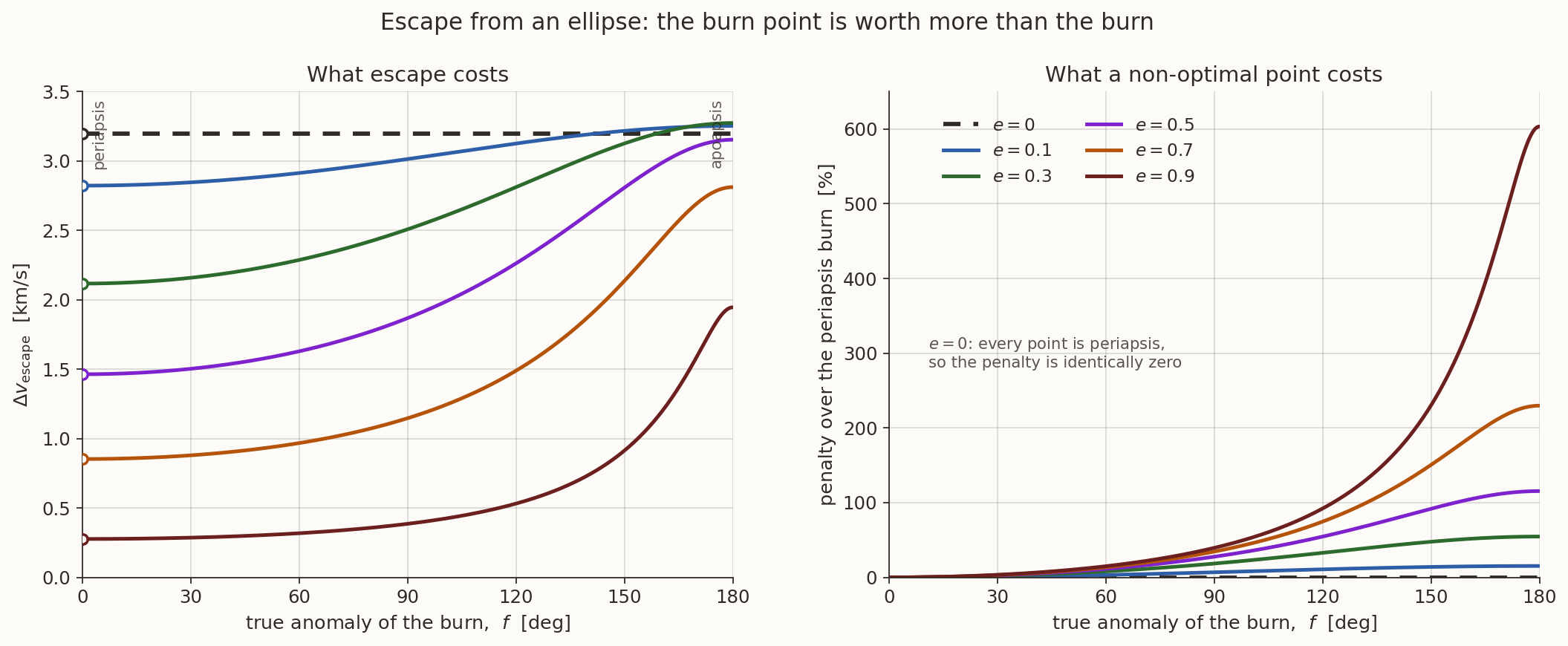
Figure 1 shows this for a family of orbits that share the same periapsis radius, \(r_p=6678\) km, which is \(300\) km altitude. Each curve starts at \(f=0\), the periapsis, and rises towards \(f=180^\circ\), the apoapsis. A higher \(e\) means a lower curve on the left, because the spacecraft already has more energy, and a much steeper rise on the right. Table 1 gives the values at the two ends, with \(\mu=398\,600.4418\) km\(^3\)/s\(^2\).
| \(e\) | \(\Delta v\) at periapsis (km/s) | \(\Delta v\) at apoapsis (km/s) | Extra cost of the apoapsis |
|---|---|---|---|
| \(0\) | \(3.2001\) | \(3.2001\) | \(0\%\) |
| \(0.3\) | \(2.1172\) | \(3.2742\) | \(55\%\) |
| \(0.5\) | \(1.4638\) | \(3.1540\) | \(115\%\) |
| \(0.7\) | \(0.8527\) | \(2.8122\) | \(230\%\) |
| \(0.9\) | \(0.2766\) | \(1.9461\) | \(603\%\) |
On a circle every point is the same, so the choice does not matter. On an eccentric orbit it is the most important decision of the manoeuvre. At \(e=0.9\) the wrong end costs seven times as much. With \(I_{sp}=320\) s, the burn at periapsis leaves \(91.6\%\) of the mass and the burn at apoapsis leaves \(53.8\%\).
1.2 Does the cheap burn cost time?
The periapsis is the cheapest point, but it is also the lowest. So we might expect to pay for the saving with a longer climb away from the Earth. To test this, we need a place to climb to. We use the distance at which the Earth stops being the main gravitational influence on the spacecraft. The patched-conics note derives this distance. Here we simply take its value as given, \(R=9.25\times10^5\) km. We will show that the climb from a lower point is actually quicker.
After a prograde burn at an apsis of radius \(q\), the escape orbit is a parabola with its periapsis at \(q\). On a parabola \(v^2=2\mu/r\) and \(h=\sqrt{2\mu q}\), because at the periapsis \(h=qv\) and \(v=\sqrt{2\mu/q}\). So the radial speed at radius \(r\) is
\[ v_r^2=v^2-\frac{h^2}{r^2}=\frac{2\mu}r-\frac{2\mu q}{r^2} \qquad\Longrightarrow\qquad v_r=\sqrt{\frac{2\mu}r}\sqrt{1-\frac qr}. \]
The time to climb from \(q\) to \(R\) is the integral of \(dr/v_r\).
A spacecraft is on a parabola with periapsis \(q\), where \(v_r=\sqrt{2\mu/r}\sqrt{1-q/r}\). Integrate \(dt=dr/v_r\) from \(q\) to \(R\), using the substitution \(u=r-q\), and show that
\[ t(q\to R)=\frac23\sqrt{\frac{R-q}{2\mu}}\,(R+2q). \]
Then differentiate with respect to \(q\). For which values of \(q\) does raising the burn point make the trip longer?
What you should find
Since \(v_r=\sqrt{2\mu}\sqrt{r-q}/r\),
\[ \begin{aligned} t&=\frac1{\sqrt{2\mu}}\int_q^R\frac{r\,dr}{\sqrt{r-q}}=\frac1{\sqrt{2\mu}}\int_0^{R-q}\frac{u+q}{\sqrt u}\,du\\ &=\frac1{\sqrt{2\mu}}\left[\tfrac23u^{3/2}+2qu^{1/2}\right]_0^{R-q}=\frac23\sqrt{\frac{R-q}{2\mu}}(R+2q). \end{aligned} \]
Differentiating by the product rule,
\[ \frac{dt}{dq}=\frac{2}{3\sqrt{2\mu}}\left[2\sqrt{R-q}-\frac{R+2q}{2\sqrt{R-q}}\right] =\frac{2}{3\sqrt{2\mu}}\cdot\frac{4(R-q)-(R+2q)}{2\sqrt{R-q}} =\frac{1}{\sqrt{2\mu}}\,\frac{R-2q}{\sqrt{R-q}} . \]
This is positive for \(q<R/2\). So raising the burn point makes the trip longer for every \(q\) below \(R/2\).With \(R=9.25\times10^5\) km, we have \(R/2=4.62\times10^5\) km, which is far above any apoapsis we are likely to meet. So a parabola from a lower periapsis reaches \(R\) sooner. The reason is that it carries more radial speed at every radius, since \(v_r^2=(2\mu/r)(1-q/r)\) grows as \(q\) falls.
1.2.1 The wait for periapsis
There is one real time cost. The spacecraft has to get down to the periapsis first, and that may take up to half a period. So let us take the worst case, in which the spacecraft is at apoapsis when the decision is made. There are two choices.
- Burn at once, at apoapsis. The time to reach \(R\) is \(t(r_a\to R)\).
- Wait, and burn at periapsis. The time is half a period plus the climb, \(\pi\sqrt{a^3/\mu}+t(r_p\to R)\).
Which arrives first? For orbits with \(r_p=6678.137\) km, we set the two times equal and solve numerically for \(e\). There are two solutions, \(e=0.216\) and \(e=0.939\). They divide the range of \(e\) into three parts.
| \(e\) | Result of waiting for periapsis |
|---|---|
| below \(0.216\) | slightly slower, for a small saving |
| \(0.216\) to \(0.939\) | cheaper and faster, so there is no trade-off |
| above \(0.939\) | still much cheaper, but half a period is now days, so there is a real trade-off |
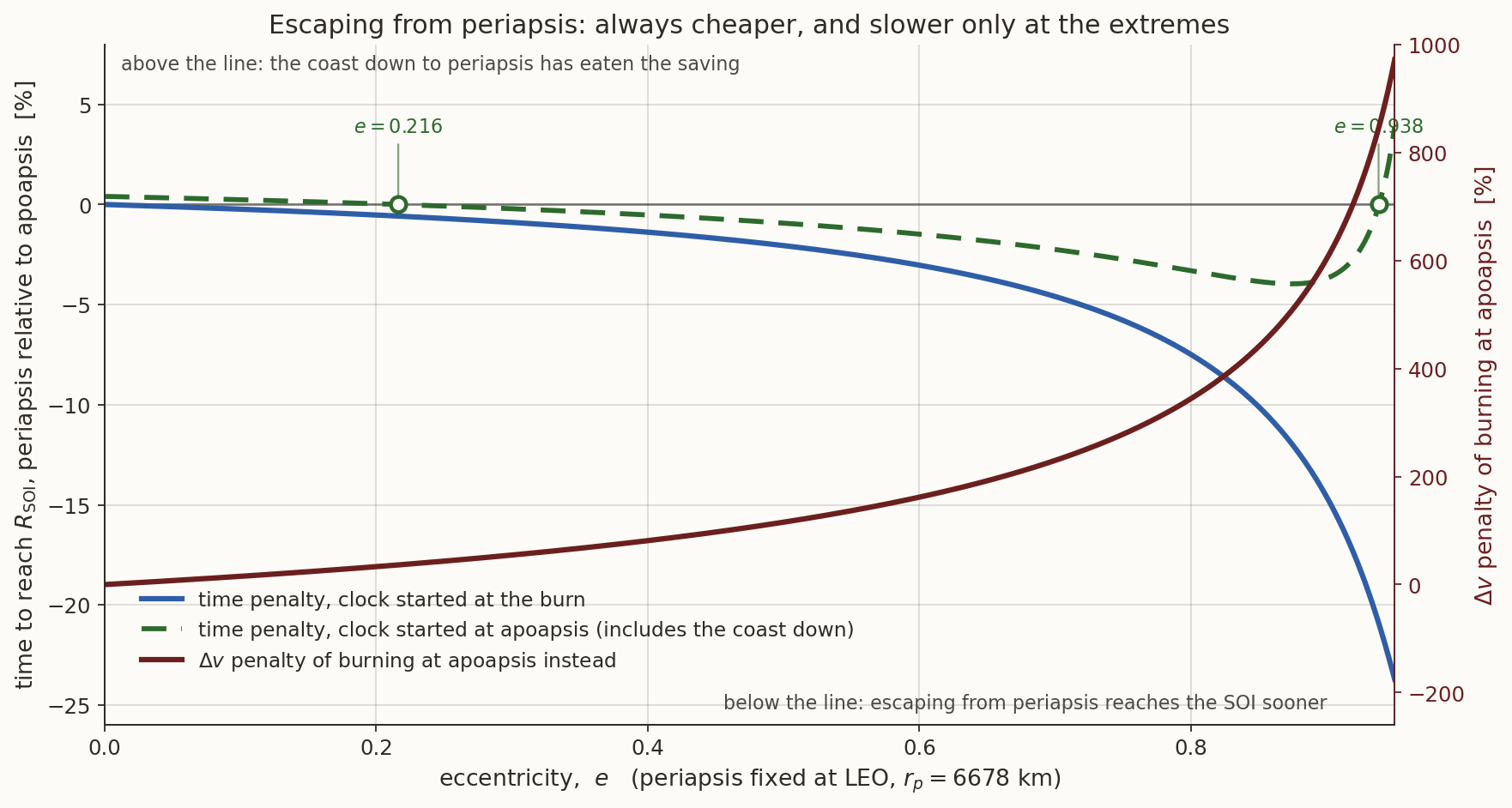
Figure 2 shows this. The solid blue curve is the time difference counted from the burn itself, so it leaves out the wait, and it is never above zero. The dashed green curve includes the wait. It crosses zero at the two values of \(e\) that we found. The maroon curve, on the right axis, is the extra \(\Delta v\) of burning at apoapsis.
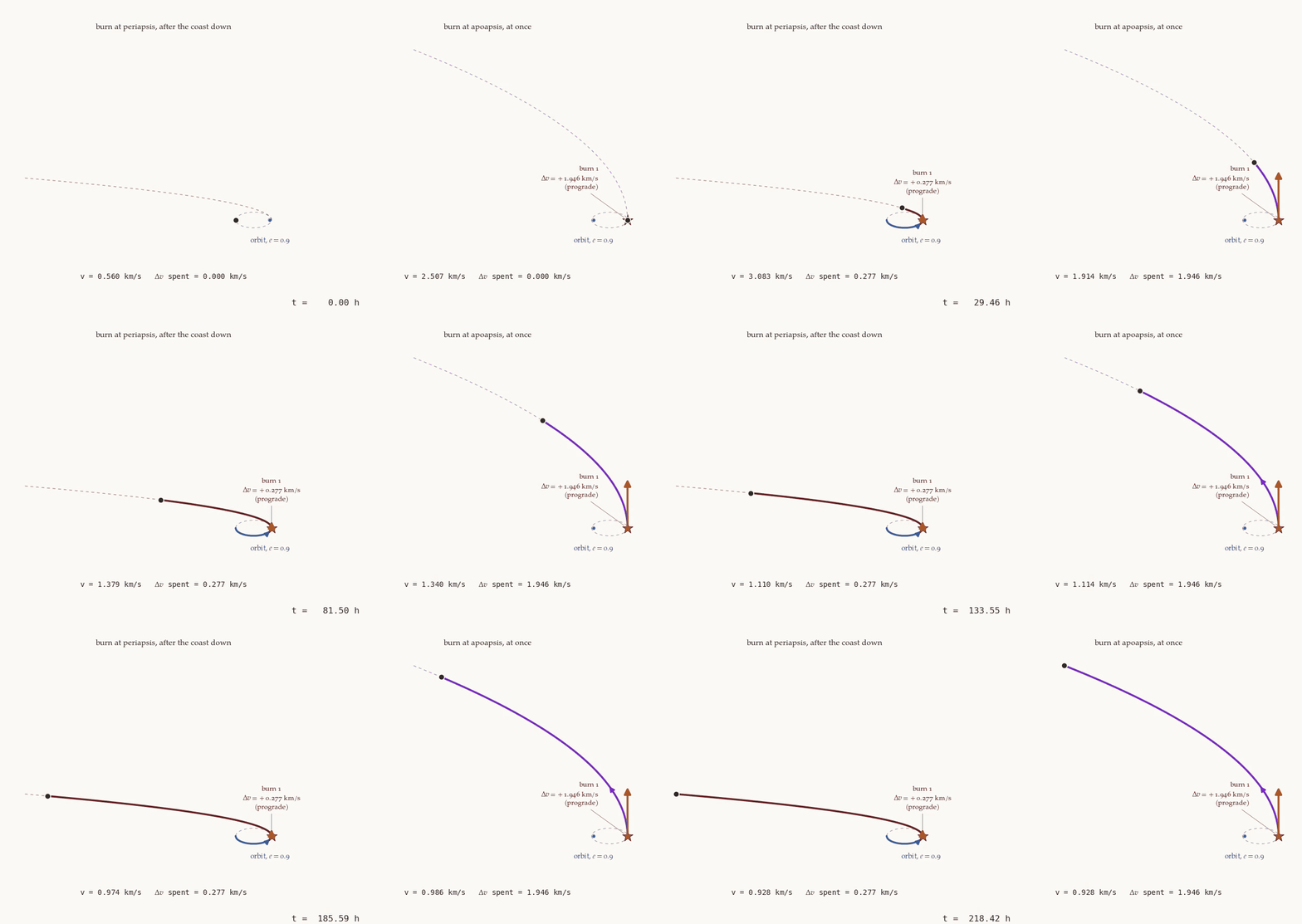
Example. A spacecraft is at the apoapsis of an orbit with \(r_p=6678.137\) km and \(e=0.9\). It must reach a distance of \(R=9.25\times10^5\) km from the Earth on a parabola. Take \(\mu=398\,600.4418\) km\(^3\)/s\(^2\). Compare burning at once with waiting for periapsis, in cost and in the total time.
Solution. The orbit has \(a=r_p/(1-e)=66\,781.37\) km and \(r_a=a(1+e)=126\,884.6\) km. From Table 1, the burn at apoapsis costs \(1.9461\) km/s and the burn at periapsis costs \(0.2766\) km/s.
If the spacecraft burns at once, the time is \(t(r_a\to R)=218.4\) h. If it waits, the half period is \(\pi\sqrt{a^3/\mu}=23.9\) h and the climb is \(t(r_p\to R)=186.5\) h, which makes \(210.4\) h. So waiting saves \(1.67\) km/s, and the spacecraft arrives about \(8\) h sooner as well.
Above \(e=0.939\) the wait does cost time. At \(e=0.95\), waiting saves \(1.34\) km/s, and half a period is about \(2.8\) days, so the spacecraft arrives about \(9.5\) h later. Given how fast the propellant needed grows with \(\Delta v\), a mission will almost always accept such a delay.
1.3 An Indian example: Mangalyaan
ISRO’s Mars Orbiter Mission gives a real case of these ideas. The PSLV could put it only into a low perigee orbit with a much lower apogee, and it then raised its apogee in several burns, each made near perigee. It left the Earth with a final burn at perigee.
To leave for Mars, the spacecraft needed more than zero energy. It had to be left with a speed \(v_\infty\) when far from the Earth. The energy equation then requires a speed \(\sqrt{v_\infty^2+2\mu/r}\) at radius \(r\), which replaces the escape speed in the cost.
Example. Before its departure burn, the Mars Orbiter Mission was on an orbit with a perigee altitude of \(264.1\) km and an apogee altitude of \(192\,874\) km. Take \(\mu=398\,600.4418\) km\(^3\)/s\(^2\) and \(R_\oplus=6378.137\) km. Find the impulsive cost to reach zero energy at perigee and at apogee. Then find both costs for a departure with \(v_\infty=3.129\) km/s.
Solution. The radii are \(r_p=6642.2\) km and \(r_a=199\,252.1\) km, so that \(a=102\,947.2\) km and \(e=0.9355\). Vis-viva gives \(v_p=10.777\) km/s and \(v_a=0.359\) km/s.
| Speed on the orbit (km/s) | Needed for \(\varepsilon=0\) (km/s) | \(\Delta v\) (km/s) | Needed for \(v_\infty=3.129\) km/s (km/s) | \(\Delta v\) (km/s) | |
|---|---|---|---|---|---|
| At perigee | \(10.777\) | \(10.955\) | \(0.178\) | \(11.393\) | \(0.616\) |
| At apogee | \(0.359\) | \(2.000\) | \(1.641\) | \(3.714\) | \(3.354\) |
So the burn at perigee costs \(0.178\) km/s for bare escape, and \(0.616\) km/s for the departure that the mission needed. At apogee these costs would be \(1.641\) km/s and \(3.354\) km/s.
The second row shows why no mission would do this. With the \(I_{sp}=315\) s of ISRO’s \(440\) N liquid apogee motor, a departure burn of \(3.354\) km/s would use about two thirds of the spacecraft. The flown burn was reported as \(648\) m/s, which is more than our \(616\) m/s because the real burn lasted about \(22\) minutes and was not an impulse. Half a period of this orbit is about \(46\) h, so even the longest possible wait for perigee would have been a small price.
2 Summary
Escape is cheapest at periapsis, because the energy gain per unit of \(\Delta v\) grows with the speed. On an eccentric orbit the choice of burn point can change the cost several times over. A parabola from a lower periapsis also reaches a given distance sooner. For orbits with \(r_p=6678\) km, waiting for periapsis is cheaper and faster when \(0.216<e<0.939\). Below that range it takes slightly longer, for a small saving. Above it, it takes longer because half a period is now days, but the saving is still large.
All the numbers in this note are checked by escape-verify.py.