The N-body Problem: Questions
How to use these questions
These questions go with the note The N-body Problem. They are the master set for the topic, and the class tests and examinations are drawn from them.
There are \(50\) objective questions. Each has four options and exactly one correct answer. They come in three levels. Level 1 asks for one definition, one fact or one formula used once. Level 2 needs two or three steps. Level 3 needs several steps, a limit, a symmetry, or a point that is easy to get wrong. Choose an option before you open the Answer, which gives the reason and, for a number, the calculation. The \(6\) drills are plain numericals on the methods of the note. The \(11\) extensions go beyond the note, analytically or analytically and numerically. Every problem has a worked solution, folded under Solution. Try the problem on paper before you open it.
Some problems need ideas from several notes at once. The Indian missions problems are of that kind, and are kept as a separate set.
Every number in the answers and solutions is checked by n-body-questions-verify.py.
Data. The objective questions use \(\mu_\oplus=398\,600\ \mathrm{km^3/s^2}\), \(R_\oplus=6378\) km, \(g_0=9.80665\ \mathrm{m/s^2}\), \(G=6.674\times10^{-11}\ \mathrm{m^3\,kg^{-1}\,s^{-2}}\), \(\mu_\odot=1.327\times10^{11}\ \mathrm{km^3/s^2}\), \(1\ \mathrm{AU}=1.496\times10^8\) km, \(M_\odot/m_{\rm Jupiter}=1047.6\) and \(J_2=1.08263\times10^{-3}\), unless a question says otherwise. Each problem gives the data it needs. Where it does not, use the constants of the notation page. Burns are impulsive and orbits are two-body, unless a question says otherwise. Angles in Kepler’s equation are in radians.
Objective questions
Level 1 — very easy
1. The \(n\)-body problem in three dimensions, written as first-order equations for the positions and velocities, is a system of how many scalar ODEs?
- \(10\)
- \(6n-10\)
- \(6n\)
- \(3n\)
Answer
(C) Each body has three position and three velocity components, so the state has \(6n\) numbers, and each needs its own first-order equation.
2. How many classical integrals (constants of the motion) does the \(n\)-body problem have?
- \(6\)
- \(9\)
- \(10\)
- \(12\)
Answer
(C) Three for the velocity of the centre of mass, three for its initial position, three for the total angular momentum, and one for the total energy: \(3+3+3+1=10\).
3. Which of the following is not one of the classical integrals of the \(n\)-body problem?
- The total angular momentum
- The total energy \(T+V\)
- The total linear momentum
- The eccentricity vector of each body
Answer
(D) Each body’s eccentricity vector is conserved only in the two-body problem. In the \(n\)-body problem every body is perturbed by the others, so its \(\mathbf e\) changes; only the ten system-wide integrals survive.
4. For an isolated system of \(n\) point masses, the centre of mass
- is always at rest
- moves on a conic section
- moves in a straight line at constant speed
- moves towards the heaviest body
Answer
(C) The internal forces cancel in pairs, so \(\sum m_i\ddot{\mathbf R}_i=\mathbf 0\). Integrating twice gives \(\mathbf R_{\rm cm}=\mathbf C_1t/M+\mathbf C_2/M\): uniform straight-line motion. We may choose a frame in which it is at rest, but that is a choice.
5. The invariable (Laplace) plane of the solar system is the plane through the barycentre that is
- the plane of the Earth’s orbit
- perpendicular to the total angular momentum of the system
- perpendicular to the Sun’s axis of rotation
- the plane of Jupiter’s orbit
Answer
(B) \(\mathbf H=\sum m_i\mathbf R_i\times\dot{\mathbf R}_i\) is constant in magnitude and direction, so the plane perpendicular to it is fixed in space. The ecliptic (Earth’s orbit) wobbles; the invariable plane does not.
6. The distance between two point masses is halved. The gravitational force between them becomes
- half as large
- twice as large
- four times as large
- eight times as large
Answer
(C) \(F=Gm_1m_2/r^2\), so \(r\to r/2\) multiplies \(F\) by \(2^2=4\).
7. The SI units of the gravitational constant \(G\) are
- \(\mathrm{m^2\,kg^{-1}\,s^{-2}}\)
- \(\mathrm{m^3\,kg^{-1}\,s^{-2}}\)
- \(\mathrm{kg\,m^{-3}\,s^{2}}\)
- \(\mathrm{N\,kg^{-2}}\)
Answer
(B) From \(F=Gm_1m_2/r^2\): \(G=Fr^2/(m_1m_2)\) has units \(\mathrm{kg\,m\,s^{-2}\cdot m^2\cdot kg^{-2}}=\mathrm{m^3\,kg^{-1}\,s^{-2}}\).
8. The mutual potential energy of two point masses, \(\Phi_{ij}=-Gm_im_j/r_{ij}\), is
- zero at \(r_{ij}=0\)
- negative, and falls further as \(r_{ij}\) grows
- positive, and decreases as \(r_{ij}\) grows
- negative, and rises towards zero as \(r_{ij}\) grows
Answer
(D) It is negative for every finite separation and tends to \(0\) as \(r_{ij}\to\infty\). Pulling the masses apart raises it, which is why work must be done against gravity to separate them.
9. The total potential energy of the Sun and eight planets is a sum over pairs. How many terms does it have?
- \(81\)
- \(72\)
- \(36\)
- \(9\)
Answer
(C) The number of pairs among \(n=9\) bodies is \(n(n-1)/2=9\cdot8/2=36\). Summing over \(i\) and \(j\) separately would count each pair twice, which is where the factor \(\tfrac12\) in \(V\) comes from.
10. The gravitational field of a point mass, \(\mathbf g=-GM\mathbf r/r^3\), has
- zero divergence and non-zero curl
- zero curl everywhere except at the mass itself
- a curl directed along \(\mathbf r\)
- a curl that falls off as \(1/r^3\)
Answer
(B) \(\mathbf g=-\nabla\phi\) with \(\phi=-GM/r\), and the curl of a gradient is zero. Any central field \(g(r)\hat{\mathbf r}\) is irrotational.
11. A probe is moved from point A to point B in the field of a planet, along three different paths. The work done by gravity is
- the same for all three paths
- zero for every path
- largest along the path that passes closest to the planet
- largest along the shortest path
Answer
(A) Gravity is conservative: \(W=\Phi(A)-\Phi(B)\) depends only on the end points. (The fuel needed is a different matter; see the N-body note.)
12. The ratio of the Sun’s radius (\(6.96\times10^5\) km) to the Sun–Earth distance (\(1\ \mathrm{AU}\)) is closest to
- \(4.7\times10^{-1}\)
- \(4.7\times10^{-2}\)
- \(4.7\times10^{-3}\)
- \(4.7\times10^{-5}\)
Answer
(C) \(6.96\times10^5/1.496\times10^8=4.65\times10^{-3}\). The bodies are tiny compared with their separations, which is the first justification for treating them as point masses.
13. Kepler’s three laws were obtained
- from Newton’s law of gravitation
- from the shape of the Moon’s orbit
- from the conservation of angular momentum
- by fitting Tycho Brahe’s observations, not by deduction from a law of force
Answer
(D) Kepler fitted Tycho’s observations of Mars (1609, 1619). He did speculate about a moving force from the Sun (his anima motrix), but the laws came from the data, not from it. Newton later derived them from his law of gravitation.
14. A planet has four times the semi-major axis of another. By Kepler’s third law its period is larger by a factor of
- \(2\)
- \(4\)
- \(8\)
- \(16\)
Answer
(C) \(T\propto a^{3/2}\), so \(T_2/T_1=4^{3/2}=8\).
15. In the \(n\)-body problem, \(\mathbf F_{ij}=-\mathbf F_{ji}\) for every pair. Which integral follows directly from this?
- conservation of total linear momentum
- conservation of each body’s energy
- conservation of each body’s angular momentum
- conservation of total energy
Answer
(A) Adding all the equations of motion, the internal forces cancel pair by pair, so \(\frac{d}{dt}\sum m_i\dot{\mathbf R}_i=\mathbf 0\).
16. In the \(n\)-body equations, the acceleration \(\ddot{\mathbf R}_i\) of body \(i\) depends on
- the masses of the other bodies and their positions, but not on \(m_i\)
- its own mass \(m_i\) and the masses of the others
- only the mass of the heaviest body
- only the total mass of the system
Answer
(A) Dividing \(m_i\ddot{\mathbf R}_i=\sum_j Gm_im_j\hat{\mathbf r}_{ij}/r_{ij}^2\) by \(m_i\) removes it: all bodies fall alike in a given field.
17. For solar-system dynamics, the best practical choice of origin for an inertial frame is
- the barycentre of the solar system
- the centre of Jupiter
- the centre of the Earth
- the centre of the Sun
Answer
(A) The barycentre moves uniformly (to excellent accuracy); the Sun’s centre circles it, mostly under Jupiter’s pull, by about a solar radius.
18. The gravitational potential (energy per unit mass) at distance \(r\) from a point mass \(M\) is
- \(+GM/r\)
- \(-GM/r\)
- \(-GM/r^2\)
- \(-GMr\)
Answer
(B) \(\phi=-GM/r\), so that \(\mathbf g=-\nabla\phi=-GM\hat{\mathbf r}/r^2\) points towards the mass. The mutual potential energy of a mass \(m\) there is \(m\phi\).
19. With \(G=6.674\times10^{-11}\) SI, \(M_\odot=1.989\times10^{30}\) kg, \(M_\oplus=5.972\times10^{24}\) kg and \(1\ \mathrm{AU}=1.496\times10^{11}\) m, the Sun’s pull on the Earth is about
- \(3.5\times10^{24}\) N
- \(3.5\times10^{22}\) N
- \(3.5\times10^{20}\) N
- \(3.5\times10^{18}\) N
Answer
(B) \(F=GM_\odot M_\oplus/r^2=6.674\times10^{-11}\times1.989\times10^{30}\times5.972\times10^{24}/(1.496\times10^{11})^2=3.54\times10^{22}\) N.
20. The invariable plane of the solar system is inclined to the ecliptic by about
- \(23.4^\circ\)
- \(7.3^\circ\)
- \(1.6^\circ\)
- \(0^\circ\)
Answer
(C) The N-body note quotes \(1.58^\circ\). (\(7.25^\circ\) is the tilt of the Sun’s equator to the ecliptic; \(23.44^\circ\) is the Earth’s obliquity.)
Level 2 — a little difficult
21. Jupiter (\(m_J=M_\odot/1047.6\)) is at \(5.203\) AU. Treating the Sun and Jupiter as a two-body pair, the Sun–Jupiter barycentre is at a distance from the Sun’s centre of about (\(R_\odot=6.96\times10^5\) km)
- \(0.1\,R_\odot\), deep inside the Sun
- \(0.5\,R_\odot\)
- \(1.07\,R_\odot\), just outside the Sun’s surface
- \(10\,R_\odot\)
Answer
(C) \(d=a_J\,m_J/(M_\odot+m_J)=5.203\times1.496\times10^8/1048.6=7.42\times10^5\) km \(=1.07\,R_\odot\). The Sun really does orbit a point outside itself.
22. The Earth–Moon distance is \(384\,400\) km and \(M_\oplus/M_{\rm Moon}=81.3\). The Earth–Moon barycentre lies
- halfway between the Earth and the Moon
- about \(4670\) km from the Earth’s centre, inside the Earth
- at the Earth’s centre
- about \(4670\) km above the Earth’s surface
Answer
(B) \(d=384\,400/(1+81.3)=4670\) km, which is less than \(R_\oplus=6378\) km. The Earth wobbles about a point about \(1700\) km below its surface.
23. With \(\mu_\odot=1.327\times10^{11}\ \mathrm{km^3/s^2}\), \(m_J=M_\odot/1047.6\) and \(a_J=5.203\) AU, the acceleration of the Sun caused by Jupiter is about
- \(2\times10^{-11}\ \mathrm{m/s^2}\)
- \(2\times10^{-7}\ \mathrm{m/s^2}\)
- \(2\times10^{-4}\ \mathrm{m/s^2}\)
- \(6\times10^{-3}\ \mathrm{m/s^2}\)
Answer
(B) \(a=\mu_J/a_J^2=(\mu_\odot/1047.6)/(7.784\times10^8\ \mathrm{km})^2=2.09\times10^{-10}\ \mathrm{km/s^2}=2.09\times10^{-7}\ \mathrm{m/s^2}\). A heliocentric frame therefore accelerates, and is not exactly inertial.
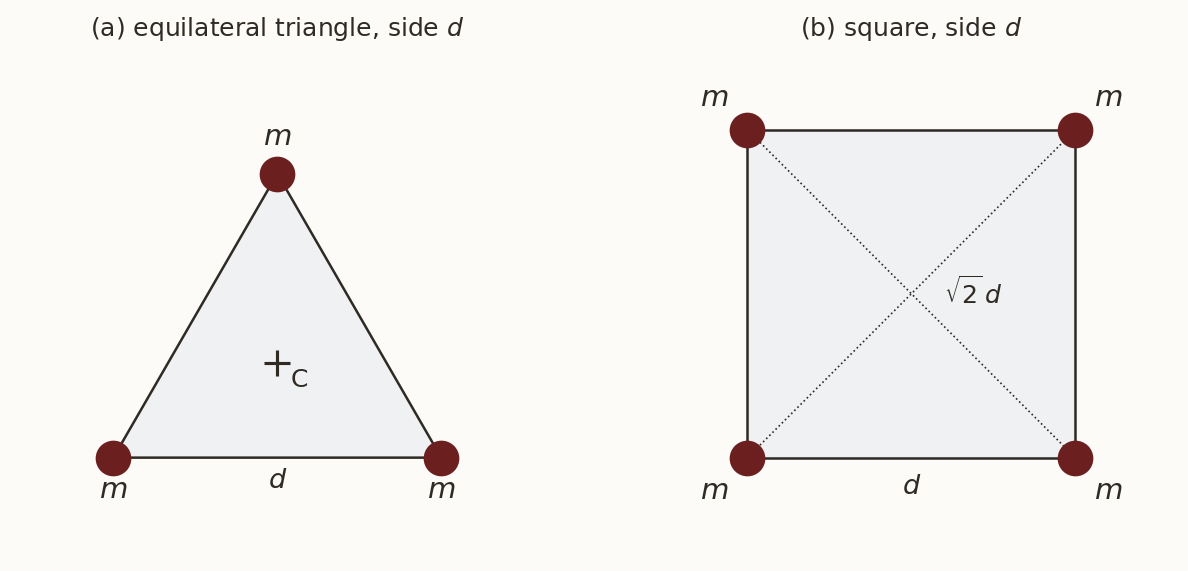
24. Three equal masses \(m\) sit at the corners of an equilateral triangle of side \(d\) (Figure 1, left). The total potential energy is
- \(-Gm^2/d\)
- \(-3Gm^2/d\)
- \(-2Gm^2/d\)
- \(-6Gm^2/d\)
Answer
(B) There are three pairs, each at distance \(d\), each contributing \(-Gm^2/d\). Counting ordered pairs would give the wrong answer \(-6Gm^2/d\).
25. A \(1\) kg mass moves at \((3,0)\) m/s and a \(2\) kg mass at \((0,3)\) m/s. The speed of their centre of mass is
- \(1.0\) m/s
- \(2.0\) m/s
- \(2.24\) m/s
- \(3.0\) m/s
Answer
(C) \(\mathbf V_{\rm cm}=(1\cdot(3,0)+2\cdot(0,3))/3=(1,2)\) m/s, whose magnitude is \(\sqrt5=2.24\) m/s.
26. A direct-summation code integrates \(1000\) bodies. How many distinct pair forces must it evaluate at each step?
- \(1000\)
- \(10^5\)
- \(499\,500\)
- \(10^6\)
Answer
(C) \(n(n-1)/2=1000\times999/2=499\,500\); Newton’s third law gives the other half for free. The cost grows like \(n^2\), which is why the numerical solution is expensive.
27. At new moon, compare the Sun’s pull on the Moon with the Earth’s pull on the Moon (\(M_\odot/M_\oplus=3.33\times10^5\), \(r_{\rm EM}=384\,400\) km, \(r_{\rm SM}\approx1\) AU). The ratio is about
- \(0.01\)
- \(0.5\)
- \(2.2\)
- \(180\)
Answer
(C) \((M_\odot/M_\oplus)(r_{\rm EM}/r_{\rm SM})^2=3.33\times10^5\times(384\,400/1.496\times10^8)^2=2.2\). Yet the Earth–Moon relative motion is well modelled as two-body, because the Sun pulls the Earth almost equally.
28. The solar system as a whole accelerates towards the galactic centre at about \(2\times10^{-10}\ \mathrm{m/s^2}\). Why can this be ignored in planetary dynamics?
- Because the barycentre does not move
- Because it is too small ever to have been measured
- Because the galactic centre is too far for gravity to act
- Because it is almost the same for every body, so it cancels from their relative motion
Answer
(D) A uniform acceleration shifts every body equally and drops out of the relative equations of motion. Only its difference across the solar system, a tidal term, could matter, and that is utterly negligible. (B) is false: Gaia measured the acceleration in 2020.
29. Two equal masses \(m\) are a distance \(d\) apart. At the midpoint, the gravitational field and potential are
- field \(0\), potential \(0\)
- field \(8Gm/d^2\), potential \(-2Gm/d\)
- field \(2Gm/d^2\), potential \(0\)
- field \(0\), potential \(-4Gm/d\)
Answer
(D) The two fields are equal and opposite, so they cancel. Potentials are scalars and add: \(2\times(-Gm/(d/2))=-4Gm/d\).
30. Which of these force fields is not conservative?
- the field of an oblate Earth
- the field of a point mass
- the field of two fixed point masses
- \(\mathbf F=k\,(-y,\ x,\ 0)\)
Answer
(D) Its curl is \((0,0,2k)\ne\mathbf 0\). Every gravitational field, however irregular the body, is a superposition of point-mass fields and so has zero curl.
31. The conservation of the total angular momentum of \(n\) bodies requires that the mutual forces
- are equal and opposite and act along the line joining each pair
- are equal and opposite only
- are attractive
- fall off as \(1/r^2\)
Answer
(A) Equal and opposite forces cancel in the sum of forces, but their torques cancel only if they also act along \(\mathbf r_{ij}\) (the “strong” form of the third law). Gravity satisfies both; the \(1/r^2\) law itself is not needed.
32. At closest approach Jupiter is \(4.203\) AU from the Earth. Its direct pull on the Earth, as a fraction of the Sun’s pull, is about (\(m_J=M_\odot/1047.6\))
- \(5\times10^{-3}\)
- \(5\times10^{-4}\)
- \(5\times10^{-5}\)
- \(5\times10^{-7}\)
Answer
(C) \((1/1047.6)\times(1\ \mathrm{AU}/4.203\ \mathrm{AU})^2=5.4\times10^{-5}\). Small, but it accumulates: this is why the planets are only nearly on Kepler orbits.
33. An isolated three-body system has total energy \(E<0\). Which statement is correct?
- The centre of mass must be at rest
- The motion must be periodic
- All three bodies must stay within a bounded region forever
- One body may still be ejected to infinity, leaving the other two more tightly bound
Answer
(D) \(E<0\) means the system as a whole cannot fly apart completely, but one body can carry away positive energy while the remaining pair sinks deeper. Ejections of this kind are common in numerical three-body runs.
34. In a numerical \(n\)-body integration, the most common check of accuracy is
- that every body stays on its initial Kepler ellipse
- that the total energy and angular momentum stay constant
- that the bodies keep their initial order of distance from the barycentre
- that the time step stays constant
Answer
(B) The ten classical integrals are exact properties of the true solution, so their drift in the computed solution measures the numerical error.
35. The invariable plane lies closest to the orbital plane of
- Mercury
- Jupiter
- the Earth
- Neptune
Answer
(B) The plane is perpendicular to the total angular momentum, which is dominated by Jupiter (\(\approx60\%\)) and Saturn. Jupiter’s orbit is inclined only about \(0.3^\circ\) to it.
Level 3 — hard
36. Treat Jupiter (\(1.898\times10^{27}\) kg, \(5.203\) AU) and Saturn (\(5.683\times10^{26}\) kg, \(9.537\) AU) as on circular orbits about the Sun. The ratio of their orbital angular momenta, \(L_J/L_S\), is about
- \(1.8\)
- \(2.5\)
- \(3.3\)
- \(6.1\)
Answer
(B) For a circular orbit \(L=m\sqrt{\mu a}\), so \(L_J/L_S=(m_J/m_S)\sqrt{a_J/a_S}=3.340\times0.7386=2.47\). Saturn’s larger distance makes up part of its smaller mass.
37. The three-body problem is of order \(18\). Using all ten classical integrals reduces its order to
- \(6\)
- \(8\)
- \(12\)
- \(16\)
Answer
(B) \(18-10=8\). Eliminating the time and the node (Jacobi) lowers it by two more, to \(6\), but no further integrals exist in general, so the problem cannot be solved by quadratures.
38. Three bodies of arbitrary masses sit at the corners of an equilateral triangle. The net gravitational force on each body
- points towards the common centre of mass, with magnitude proportional to the body’s distance from it
- points towards the heaviest body
- points towards the centre of mass only if the masses are equal
- is zero
Answer
(A) \(\mathbf F_i=\sum_j Gm_im_j(\mathbf R_j-\mathbf R_i)/d^3=Gm_iM(\mathbf R_{\rm cm}-\mathbf R_i)/d^3\). This is what allows the whole triangle to rotate rigidly: Lagrange’s equilateral solution.
39. Four equal masses \(m\) sit at the corners of a square of side \(d\) (Figure 1, right). The total potential energy is
- \(-(4+\sqrt2)\,Gm^2/d\)
- \(-8Gm^2/d\)
- \(-4Gm^2/d\)
- \(-(4+2\sqrt2)\,Gm^2/d\)
Answer
(A) Six pairs: four sides at \(d\) and two diagonals at \(\sqrt2\,d\). \(V=-Gm^2/d\,(4+2/\sqrt2)=-(4+\sqrt2)Gm^2/d\approx-5.41\,Gm^2/d\).
40. Jupiter moves at about \(13.06\) km/s about the Sun, and \(M_\odot/m_J=1047.6\). The speed of the Sun about the Sun–Jupiter barycentre is about
- \(1.2\) m/s
- \(12.5\) m/s
- \(125\) m/s
- \(13\) km/s
Answer
(B) Momentum balance about the barycentre: \(M_\odot v_\odot=m_Jv_J\), so \(v_\odot=13.06/1047.6\) km/s \(=12.5\) m/s. Stellar wobbles of this size are how many exoplanets are found.
41. For planet \(i\) moving about the Sun in the \(n\)-body problem, the heliocentric equation contains, for each other planet \(j\), the term \(-Gm_j\,\mathbf r_j/r_j^3\). This “indirect” term
- is the pull of planet \(j\) on planet \(i\)
- arises from the Sun’s rotation
- vanishes when \(m_j\ll M_\odot\)
- arises because planet \(j\) accelerates the Sun, and hence the heliocentric frame
Answer
(D) The direct term is \(Gm_j\mathbf r_{ij}/r_{ij}^3\). The indirect term is minus the Sun’s acceleration due to \(j\), which every heliocentric coordinate feels. It is small but of the same order as the direct one.
42. Let \(I=\sum m_i|\mathbf R_i-\mathbf R_{\rm cm}|^2\). For gravity, \(\ddot I=4T+2V=2E+2T\). What follows for a system with total energy \(E>0\)?
- It must be periodic
- Nothing, because \(T\) can be negative
- It collapses to a point in finite time
- It cannot stay bounded: at least one mutual distance grows without limit
Answer
(D) \(T\ge0\), so \(\ddot I\ge2E>0\) and \(I\) grows at least like \(Et^2\). This is the Lagrange–Jacobi identity.
43. A bound gravitating system (all distances stay finite) has total energy \(E\). The long-time average of its kinetic energy is
- \(-E\)
- \(E\)
- \(2E\)
- \(-E/2\)
Answer
(A) Averaging \(\ddot I=4T+2V\) over a long time gives \(0\) for a bounded system, so \(2\langle T\rangle+\langle V\rangle=0\) (the virial theorem). With \(E=\langle T\rangle+\langle V\rangle\), \(\langle T\rangle=-E\).
44. Three equal masses \(m\) on an equilateral triangle of side \(d\) rotate rigidly about their centre of mass. The angular velocity satisfies
- \(\omega^2=3Gm/d^3\)
- \(\omega^2=Gm/d^3\)
- \(\omega^2=Gm/(3d^3)\)
- \(\omega^2=\sqrt3\,Gm/d^3\)
Answer
(A) The net force on one mass is \(2(Gm^2/d^2)\cos30^\circ=\sqrt3\,Gm^2/d^2\), towards the centre at distance \(d/\sqrt3\). So \(m\omega^2d/\sqrt3=\sqrt3\,Gm^2/d^2\), i.e. \(\omega^2=3Gm/d^3=G(3m)/d^3\), Kepler’s third law with the total mass.
45. The tide-raising acceleration of a body of mass \(M\) at distance \(D\) scales as \(M/D^3\). The ratio of the Moon’s tidal effect on the Earth to the Sun’s is about (\(M_{\rm Moon}=7.342\times10^{22}\) kg, \(M_\odot=1.989\times10^{30}\) kg, \(384\,400\) km, \(1\) AU)
- \(0.46\)
- \(1.0\)
- \(2.2\)
- \(180\)
Answer
(C) \((7.342\times10^{22}/1.989\times10^{30})\times(1.496\times10^8/384\,400)^3=2.18\). The Sun pulls the Earth \(180\) times harder than the Moon does, but its pull varies less across the Earth.
46. Two planets have orbital angular momenta \(L_1\) and \(L_2=L_1/2\), and their orbit planes are inclined at \(6^\circ\) to each other. The invariable plane is inclined to the plane of planet 1 by about
- \(0.5^\circ\)
- \(2.0^\circ\)
- \(3.0^\circ\)
- \(4.0^\circ\)
Answer
(B) \(\mathbf H=\mathbf L_1+\mathbf L_2\). Its angle from \(\mathbf L_1\) is \(\arctan\dfrac{L_2\sin6^\circ}{L_1+L_2\cos6^\circ}=\arctan\dfrac{0.0523}{1.497}=2.0^\circ\): the larger angular momentum keeps the invariable plane closer to its own plane.
47. Every mass in an \(n\)-body system is multiplied by \(4\), and the initial positions are kept. To retrace exactly the same paths, the initial velocities must be multiplied by
- \(1/2\), and the motion takes twice as long
- \(16\), and the timing is unchanged
- \(4\), and the motion takes a quarter of the time
- \(2\), and the motion takes half as long
Answer
(D) At the same positions every acceleration is \(4\) times larger. Putting \(t'=t/2\) keeps \(d^2\mathbf R/dt'^2\) matched, so the same paths are followed twice as fast, with velocities doubled.
48. All initial positions in an \(n\)-body system are doubled, the masses are kept, and the velocities are scaled so that the same (scaled) paths are followed. The time to go round them changes by a factor of
- \(1/\sqrt2\)
- \(4\)
- \(2\)
- \(2\sqrt2\)
Answer
(D) Accelerations scale as \(1/L^2\) and must equal \(L/t^2\), so \(t\propto L^{3/2}\): \(2^{3/2}=2\sqrt2\). This is Kepler’s third law for any number of bodies. Velocities scale as \(L^{-1/2}\).
49. For the planets in heliocentric coordinates, \(\sum_{\rm planets}m_i\,\mathbf r_i\times\dot{\mathbf r}_i\) is
- not exactly conserved, because the heliocentric frame accelerates
- exactly conserved, as in any frame
- conserved only if the orbits are circular
- always zero
Answer
(A) The ten integrals hold in an inertial frame. The heliocentric frame is accelerated by the planets themselves (Question 41), so the naive heliocentric sum is only approximately constant.
50. Which statement about the famous “figure-eight” solution of the three-body problem is true?
- It exists only in a rotating frame
- It is chaotic: neighbouring orbits separate exponentially
- It needs one body much heavier than the other two
- Three equal masses chase one another round one curve, and the total angular momentum is zero
Answer
(D) Found numerically by Moore (1993) and proved by Chenciner and Montgomery (2000), it is periodic, uses equal masses, and has zero total angular momentum. It was the first of the three-body choreographies; numerical searches since 2013 have found hundreds of further periodic families.
Answer key
All \(50\) answers.
Answer
| 1 C | 2 C | 3 D | 4 C | 5 B | 6 C | 7 B | 8 D | 9 C | 10 B |
| 11 A | 12 C | 13 D | 14 C | 15 A | 16 A | 17 A | 18 B | 19 B | 20 C |
| 21 C | 22 B | 23 B | 24 B | 25 C | 26 C | 27 C | 28 D | 29 D | 30 D |
| 31 A | 32 C | 33 D | 34 B | 35 B | 36 B | 37 B | 38 A | 39 A | 40 B |
| 41 D | 42 D | 43 A | 44 A | 45 C | 46 B | 47 D | 48 D | 49 A | 50 D |
Drills
These are plain numericals. Each one practises a method of the note on a concrete case, and none of them adds anything that is not already in the note. Work each one through before you open its solution.
1. The Earth–Moon barycentre
With \(M_\oplus/M_{\rm Moon}=81.3\), find the distance of the Earth–Moon barycentre from the centre of the Earth. Is it inside or outside the Earth? Take the Earth–Moon distance as \(384\,400\) km and the Earth’s mean radius as \(6371\) km.
Solution
We put the origin at the barycentre, as in the section Linear momentum and the centre of mass of the N-body note. Then \(M_\oplus\mathbf R_\oplus+M_{\rm Moon}\mathbf R_{\rm Moon}=\mathbf 0\), so the Earth and the Moon lie on opposite sides of the barycentre, at distances in the inverse ratio of their masses. With the separation \(L=R_\oplus+R_{\rm Moon}\) (distances from the barycentre), the Earth’s distance is
\[ d=\frac{M_{\rm Moon}}{M_\oplus+M_{\rm Moon}}\,L=\frac{L}{1+M_\oplus/M_{\rm Moon}}=\frac{384\,400}{82.3}=4671\ \text{km}. \]
This is less than the Earth’s radius of \(6371\) km. The barycentre is inside the Earth, at about \(0.73\) of its radius from the centre, or \(1700\) km below the surface.
Reading the result. The Earth is not fixed while the Moon goes round it. Both go round a point \(4671\) km from the Earth’s centre, once a month. So the centre of the Earth traces a small circle of radius \(4671\) km each month, and it is the barycentre, not the Earth’s centre, that follows the smooth yearly orbit round the Sun. This monthly wobble is large enough to matter. It shifts the apparent position of a nearby planet or asteroid seen from the Earth, and planetary ephemerides must include it. Compare the Sun and Jupiter in the task of the section Linear momentum and the centre of mass of the N-body note, where the barycentre lies just outside the Sun.
2. Order counting
How many first-order ODEs describe the Earth–Moon–spacecraft system? Which of the ten integrals survive if the spacecraft fires its engine?
Solution
The order. There are \(n=3\) bodies. Each has three position components and three velocity components, so Equation (3) of the N-body note is a set of \(6n=18\) first-order ODEs. While the engine fires, the mass of the spacecraft also changes, and if we follow it we need one more equation, \(\dot m=-F/(g_0I_{sp})\), which makes \(19\).
Which integrals survive? Each integral of the section The ten integrals of the N-body note was found by adding up internal forces that come in equal and opposite pairs along the lines of centres. We have to ask whether the thrust is such a force. It is not. The thrust acts on the spacecraft, and the equal and opposite force acts on the exhaust gas, which is not one of the three bodies. For the three bodies the thrust is an external force.
- Linear momentum and the centre of mass (six constants). Summing the equations of motion now leaves \(\sum m_i\ddot{\mathbf R}_i=\mathbf F_{\rm thrust}\), which is not zero. Both vector integrals are lost.
- Angular momentum (three constants). The thrust has the moment \(\mathbf R_{\rm sc}\times \mathbf F_{\rm thrust}\) about the barycentre, which is not zero in general. Lost.
- Energy (one constant). The thrust does work on the spacecraft at the rate \(\mathbf F_{\rm thrust}\cdot\dot{\mathbf R}_{\rm sc}\). Lost. Indeed the purpose of most burns is to change the energy.
So none of the ten survives while the engine fires. When the engine stops, all ten hold again, with new values of the constants.
Reading the result. If we added the exhaust gas to the system, momentum and angular momentum would be conserved again, because the force between the spacecraft and its exhaust is internal. Even then the mechanical energy would not be, because the burning propellant releases chemical energy.
In practice none of this troubles a mission designer. The spacecraft is so light that its pull on the Earth and the Moon, and the thrust it puts into the system, are utterly negligible for the motion of those two bodies. Their integrals hold to any accuracy we could measure. So we let the Earth and the Moon move on their own, and we treat the spacecraft as a body of no mass that moves in their field, with the thrust as an applied force. This is the restricted three-body problem of the CR3BP note.
3. Who pulls the Moon harder?
Compute the gravitational acceleration of the Moon due to the Earth and due to the Sun. Which is larger, and by what factor? If the answer surprises you, explain in what sense the Moon can still be said to orbit the Earth.
Use \(\mu_\odot=1.3271\times10^{20}\) m\(^3\)/s\(^2\), \(\mu_\oplus=3.9860\times10^{14}\) m\(^3\)/s\(^2\), the Sun–Earth distance \(a_{SE}=1.496\times10^{11}\) m and the Earth–Moon distance \(a_{EM}=3.844\times10^{8}\) m.
Hint
A body at distance \(r\) from a mass with gravitational parameter \(\mu\) has acceleration \(\mu/r^2\). The Moon is essentially \(1\) AU from the Sun. For the second part, ask what decides the motion of the Moon relative to the Earth: the Sun’s pull on the Moon, or something else?
Solution
Due to the Earth, with \(r_{EM}=3.844\times10^{8}\) m:
\[ a_{E\to M}=\frac{3.9860\times10^{14}}{(3.844\times10^{8})^2}=\frac{3.9860\times10^{14}}{1.478\times10^{17}}\approx2.70\times10^{-3}\ \text{m/s}^2 . \]
Due to the Sun, with \(r_{SM}\approx1.496\times10^{11}\) m:
\[ a_{S\to M}=\frac{1.3271\times10^{20}}{(1.496\times10^{11})^2}=\frac{1.3271\times10^{20}}{2.238\times10^{22}}\approx5.93\times10^{-3}\ \text{m/s}^2 . \]
\[ \boxed{\;\frac{a_{S\to M}}{a_{E\to M}}\approx2.2\;} \]
The Sun pulls the Moon more than twice as hard as the Earth does.
Why the Earth–Moon two-body picture still works. The relative motion \(\ddot{\mathbf r}_{EM}\) is driven not by the Sun’s pull on the Moon, but by the difference between the Sun’s pulls on the Moon and on the Earth, since the Sun accelerates both. The Earth and Moon are at nearly the same distance from the Sun, so the difference is small. Put the Moon a distance \(r_{EM}\) beyond the Earth on the Sun–Earth line. The Sun’s pull falls off as \(\mu_\odot/R^2\), so across the extra distance it changes by \(\frac{d}{dR}\!\left(\mu_\odot/R^2\right)r_{EM}=-2\mu_\odot r_{EM}/R^3\), to first order in \(r_{EM}/r_{SE}\). This is the tidal acceleration, and along the line it has its largest value; across the line the two pulls differ only in direction, by the angle \(r_{EM}/r_{SE}\), and the difference is half as large, \(\mu_\odot r_{EM}/r_{SE}^3\). Along the line,
\[ a_{\rm tidal}\approx\frac{2\mu_\odot r_{EM}}{r_{SE}^3}=\frac{2(1.3271\times10^{20})(3.844\times10^{8})}{(1.496\times10^{11})^3}\approx3.0\times10^{-5}\ \text{m/s}^2, \]
about \(1.1\%\) of \(a_{E\to M}\). Relative to the Earth, the Sun is a small perturbation. (This is the point made in the \(N\)-body note: it is the difference of accelerations, not the accelerations themselves, that matters. The patched-conics note uses the same tidal term to size the sphere of influence.) The \(N\)-body note’s figure draws the three accelerations and the tidal pattern round the Moon’s orbit.
4. Who pulls the Earth harder?
Compute the acceleration of the Earth due to the Sun and due to the Moon, and form their ratio. Contrast it with the ratio of Problem 3 and explain the difference.
Use \(\mu_\odot=1.3271\times10^{20}\) m\(^3\)/s\(^2\), \(\mu_{\rm Moon}=4.903\times10^{12}\) m\(^3\)/s\(^2\), \(a_{SE}=1.496\times10^{11}\) m and \(a_{EM}=3.844\times10^{8}\) m.
Hint
The Earth is accelerated by the Moon through the Moon’s gravitational parameter, at the same separation \(r_{EM}\) as in Problem 3. What is the same in the two problems, and what has changed?
Solution
\[ a_{S\to E}=\frac{\mu_\odot}{r_{SE}^2}\approx5.93\times10^{-3}\ \text{m/s}^2, \qquad a_{M\to E}=\frac{\mu_{\rm Moon}}{r_{EM}^2}=\frac{4.903\times10^{12}}{1.478\times10^{17}}\approx3.32\times10^{-5}\ \text{m/s}^2, \]
\[ \boxed{\;\frac{a_{S\to E}}{a_{M\to E}}\approx179\;} \]
against \(2.2\) in Problem 3. The two ratios differ by a factor of about \(81\):
\[ \frac{a_{S\to E}/a_{M\to E}}{a_{S\to M}/a_{E\to M}}=\frac{\mu_\oplus}{\mu_{\rm Moon}}=\frac{M_\oplus}{M_{\rm Moon}}\approx81.3 , \]
because the Sun’s accelerations of the Earth and of the Moon are essentially equal (both are \(1\) AU away), while the Earth–Moon pair swaps \(\mu_\oplus\) for \(\mu_{\rm Moon}\) at the same separation.
5. A coincidence
What is the ratio of the Sun–Earth semi-major axis to the Earth–Moon semi-major axis? Compare it with the ratio of the diameters of the Sun (\(1.392\times10^{6}\) km) and the Moon (\(3475\) km), and comment on the coincidence.
Use \(a_{SE}=1.496\times10^{8}\) km and \(a_{EM}=384\,400\) km.
Hint
The angle a body subtends is about (diameter)/(distance).
Solution
\[ \frac{a_{SE}}{a_{EM}}=\frac{149.6\times10^{6}}{384\,400}\approx389, \qquad \frac{D_S}{D_M}=\frac{1.392\times10^{6}}{3475}\approx400 . \]
The two ratios nearly agree, so the Sun and the Moon subtend almost the same angle as seen from the Earth: about \(0.53^\circ\) and \(0.52^\circ\). That near-equality is why total solar eclipses, with the Moon just covering the Sun’s disc and leaving the corona visible, are possible at all. It is an accident of the present epoch: the Moon recedes by about \(3.8\) cm per year, and in some hundreds of millions of years only annular eclipses will remain.
6. Which \(\mu\)? The Earth and the Moon
The Earth and the Moon are \(D=384\,400\) km apart. Take the Moon’s orbit as a circle.
- Find the distance of the centre of mass of the Earth and the Moon from the centre of the Earth. Is it inside the Earth or outside it, and by how much?
- The period of the Moon’s orbit depends on which \(\mu\) we use. Find the period, in days, with \(\mu=G(M_\oplus+M_{\rm Moon})\), and again with \(\mu=\mu_\oplus\). How many hours apart are the two answers? Which one is correct for the relative orbit of the Moon about the Earth?
- A geostationary satellite sits on the line from the Earth to the Moon, on the side facing the Moon. Find the accelerations that the Earth, the Moon and the Sun each give it, in m/s\(^2\). For the Sun take the distance as \(1\) AU.
- What disturbs the orbit of the satellite about the Earth is not the pull of a third body but the difference between its pull on the satellite and its pull on the Earth. For the Moon this difference is \(\mu_{\rm Moon}\bigl[1/(D-r_{\rm GEO})^2-1/D^2\bigr]\). For the Sun, with the satellite on the line to the Sun, it is close to \(2\mu_\odot r_{\rm GEO}/(1\ {\rm AU})^3\). Find both, and compare each with the Earth’s pull. Which body disturbs a geostationary orbit more?
Use \(G=6.6743\times10^{-20}\) km\(^3\)/(kg s\(^2\)), \(\mu_\oplus=398\,600.4418\) km\(^3\)/s\(^2\), \(R_\oplus=6378.137\) km, \(M_\oplus=5.9722\times10^{24}\) kg, \(\mu_{\rm Moon}=4902.8\) km\(^3\)/s\(^2\), \(M_{\rm Moon}=7.342\times10^{22}\) kg, \(\mu_\odot=1.327\,124\,400\,18\times10^{11}\) km\(^3\)/s\(^2\), \(1\) AU \(=1.495\,978\,707\times10^{8}\) km, \(r_{\rm GEO}=42\,164\) km and one day \(=86\,400\) s.
Solution
The plan is to see, with real numbers, when the mass of the second body matters and when a third body matters. The centre of mass and the period both depend on the ratio of the masses. The third-body accelerations then show why the two-body model works so well near the Earth.
(a) The centre of mass. The centre of mass lies on the line joining the two bodies, at the distance \[ x_b=D\,\frac{M_{\rm Moon}}{M_\oplus+M_{\rm Moon}}=384\,400\times\frac{7.342\times10^{22}}{6.0456\times10^{24}}=4668\ \text{km} \] from the centre of the Earth. This is less than \(R_\oplus=6378\) km, so the centre of mass is inside the Earth, \(1710\) km below the surface. The Earth swings round this point once a month.
(b) The period. For a circular relative orbit, \(T=2\pi\sqrt{D^3/\mu}\). With \(\mu=G(M_\oplus+M_{\rm Moon})=403\,503\) km\(^3\)/s\(^2\) we get \(T=27.28\) days. With \(\mu=\mu_\oplus\) we get \(T=27.45\) days. The two differ by \(4.0\) hours, because the first \(\mu\) is \(1.23\%\) larger.
The first is correct. The two-body note shows that the relative position \(\mathbf r=\mathbf r_{\rm Moon}-\mathbf r_\oplus\) obeys \(\ddot{\mathbf r}=-G(M_1+M_2)\mathbf r/r^3\). Both bodies accelerate towards each other, so both masses appear. For a satellite of a few tonnes the second mass is negligible, and \(\mu_\oplus\) is the right value. For the Moon it is not. The observed sidereal month is \(27.32\) days, \(0.14\%\) longer. The eccentricity of the Moon’s orbit cannot explain this, because the period depends only on the semi-major axis, and \(D\) is essentially that. The difference comes from the Sun. On average its pull slightly weakens the Earth’s hold on the Moon, and a weaker hold means a longer month.
Note also that \(GM_\oplus=398\,603\) km\(^3\)/s\(^2\) agrees with \(\mu_\oplus\) to five figures. The value of \(\mu_\oplus\) is known far more precisely than \(G\) or \(M_\oplus\) separately, which is why we always use \(\mu\) directly.
(c) The three pulls at GEO. Each pull is \(\mu/d^2\), with \(d\) the distance from the body to the satellite. The satellite is \(D-r_{\rm GEO}=342\,236\) km from the Moon. So
| Body | \(d\) (km) | Acceleration (m/s\(^2\)) |
|---|---|---|
| Earth | \(42\,164\) | \(0.2242\) |
| Moon | \(342\,236\) | \(4.19\times10^{-5}\) |
| Sun | \(1.496\times10^{8}\) | \(5.93\times10^{-3}\) |
The Sun pulls \(142\) times harder than the Moon, and its pull is \(2.6\%\) of the Earth’s.
(d) What actually disturbs the orbit. The Earth falls towards the Sun as well, with almost the same acceleration, so most of the Sun’s pull does nothing to the orbit about the Earth. To see what is left, write the motion of both bodies in an inertial frame. Let \(\mathbf R_\oplus\) and \(\mathbf R_s\) be the positions of the Earth and the satellite, let \(\mathbf r=\mathbf R_s-\mathbf R_\oplus\) be the position of the satellite relative to the Earth, and let \(\mathbf d\) be the position of the Sun relative to the Earth. The satellite is pulled by the Earth and by the Sun, \[ \ddot{\mathbf R}_s=-\mu_\oplus\frac{\mathbf r}{r^3}+\mu_\odot\frac{\mathbf d-\mathbf r}{|\mathbf d-\mathbf r|^3}, \] and the Earth is pulled by the Sun (the satellite’s pull on the Earth is negligible), \[ \ddot{\mathbf R}_\oplus=\mu_\odot\frac{\mathbf d}{d^3}. \] Subtracting the second from the first gives the motion relative to the Earth, \[ \ddot{\mathbf r}=-\mu_\oplus\frac{\mathbf r}{r^3} +\mu_\odot\left[\frac{\mathbf d-\mathbf r}{|\mathbf d-\mathbf r|^3}-\frac{\mathbf d}{d^3}\right]. \] The first term is the two-body problem. The second is the disturbing acceleration. It is the Sun’s pull on the satellite minus its pull on the Earth, which is the same subtraction that gave the relative equation in the two-body note, now with a third body.
Now put the satellite on the line to the Sun, on the side facing it. Then \(\mathbf r\) points along \(\mathbf d\), the distance from the satellite to the Sun is \(d-r\), and both vectors in the bracket point at the Sun. The disturbing acceleration points at the Sun too, and its size is \[ a_d=\mu_\odot\left[\frac{1}{(d-r)^2}-\frac{1}{d^2}\right] =\frac{\mu_\odot}{d^2}\left[\Bigl(1-\frac{r}{d}\Bigr)^{-2}-1\right]. \] This is the expression given for the Moon, with the Sun in its place. For the Sun \(r/d=42\,164/(1.496\times10^8)=2.82\times10^{-4}\), which is very small. So we may expand with the binomial series \((1-x)^{-2}=1+2x+3x^2+\cdots\), \[ a_d=\frac{\mu_\odot}{d^2}\left[\frac{2r}{d}+\frac{3r^2}{d^2}+\cdots\right]\approx\frac{2\mu_\odot r}{d^3}. \] The first term we drop is \(\tfrac32(r/d)=4.2\times10^{-4}\) times the one we keep, so the approximation is good to \(0.04\%\). The exact form gives \(3.344\times10^{-6}\) m/s\(^2\) and the approximation \(3.343\times10^{-6}\) m/s\(^2\).
Two things are worth noticing. The pull of the Sun falls off as \(1/d^2\), but the difference falls off as \(1/d^3\). The difference is the change in the pull across the distance \(r\), that is \(r\) times the slope \(\mathrm d(\mu_\odot/d^2)/\mathrm dd=-2\mu_\odot/d^3\), and the extra power of \(d\) comes from that slope. This is why the Moon can win. The ratio \(\mu_{\rm Moon}/D^3\) is \(2.2\) times \(\mu_\odot/(1\ \text{AU})^3\), even though \(\mu_\odot\) is \(2.7\times10^7\) times \(\mu_{\rm Moon}\). The second point is that a satellite on the far side of the Earth gets \(\mu_\odot\bigl[1/d^2-1/(d+r)^2\bigr]\approx2\mu_\odot r/d^3\) as well, pointing away from the Sun. The Sun stretches the orbit along the line to it on both sides. This is the tidal acceleration, the same effect that raises two bulges in the oceans.
The question keeps the exact form for the Moon because there \(r/D=0.110\) is not small. The approximation \(2\mu_{\rm Moon}r/D^3\) gives \(7.28\times10^{-6}\) m/s\(^2\), \(16\%\) below the exact value.
With the numbers, the difference is \(8.68\times10^{-6}\) m/s\(^2\) for the Moon and \(3.34\times10^{-6}\) m/s\(^2\) for the Sun. These are \(3.9\times10^{-5}\) and \(1.5\times10^{-5}\) of the Earth’s pull. The Moon disturbs a geostationary orbit \(2.6\) times more than the Sun does, even though the Sun pulls \(142\) times harder. Both disturbances are a few parts in \(10^5\), which is why the two-body model works so well. They are small but not zero. Over a year they tilt the plane of a geostationary orbit by about \(0.8^\circ\), which is why satellites there carry propellant for north-south station keeping.
Extensions
These problems go beyond the note. Some are purely analytical, and some ask for a derivation and then a number. Most take longer than a drill, and several end with a remark on what the result means for a real mission.
7. Weighing the Earth with the Moon
The Moon’s orbit has \(a=384\,400\) km and sidereal period \(27.32\) days. Assuming \(T^2/a^3=4\pi^2/(GM)\), compute \(GM\) for the Earth (ignore the Moon’s own mass). How far off is the answer from \(3.986\times10^{5}\) km\(^3\)/s\(^2\), and why?
Solution
We wish to turn the size and the period of the Moon’s orbit into a mass. Kepler’s third law in the given form has only one unknown, so we solve it for \(GM\),
\[ GM=\frac{4\pi^2a^3}{T^2}. \]
The period must be in seconds, \(T=27.32\times86\,400=2.3604\times10^{6}\) s. Then
\[ GM=\frac{4\pi^2\,(384\,400)^3}{(2.3604\times10^{6})^2}=4.0246\times10^{5}\ \text{km}^3/\text{s}^2 . \]
This is \(1.0\%\) larger than the accepted \(3.986\times10^{5}\) km\(^3\)/s\(^2\). An error of one percent is far larger than the error in \(a\) or \(T\), so the formula itself must be leaving something out.
The Moon’s own mass. The law \(T^2/a^3=4\pi^2/(GM)\) treats the Earth as fixed and the Moon as a point of no mass. Problem 11 shows that two bodies on circles about their centre of mass obey \(T^2=4\pi^2L^3/[G(m_1+m_2)]\). So the Moon’s orbit measures the total mass,
\[ G(M_\oplus+M_{\rm Moon})=GM_\oplus\Bigl(1+\frac1{81.3}\Bigr)=4.0350\times10^{5}\ \text{km}^3/\text{s}^2 , \]
which is \(1.2\%\) above \(GM_\oplus\). Our value lies between the two, \(0.26\%\) below the total.
The Sun’s share. The last quarter of a percent comes from the Sun. Only the difference of the Sun’s pulls on the Moon and on the Earth acts on the relative motion (Figure 2 of the N-body note). Let the Sun be at the distance \(D\), and let the Moon be displaced from the Earth by \(x\) along the Sun line (away from the Sun) and by \(y\) across it. Along the line, the Sun pulls the Earth by \(GM_\odot/D^2\) and the Moon by \(GM_\odot/(D+x)^2\). The difference, to first order in \(x/D\), is \(2GM_\odot x/D^3\), and it pushes the Moon away from the Earth. Across the line, the Sun’s pull on the Moon is tilted towards the Earth–Sun line by the small angle \(y/D\), so it has the component \(GM_\odot y/D^3\) towards that line, while the Earth feels none. The stretch along the line is therefore twice the squeeze across it.
Now put the Moon on a circle of radius \(r\), at the angle \(\theta\) from the Sun line, so \(x=r\cos\theta\) and \(y=r\sin\theta\). The outward radial part of the difference is
\[ \frac{GM_\odot r}{D^3}\bigl(2\cos^2\theta-\sin^2\theta\bigr), \]
and its mean round the circle is \(\frac{GM_\odot r}{D^3}\bigl(2\cdot\tfrac12-\tfrac12\bigr)=\frac{GM_\odot r}{2D^3}\). On average the Sun pulls the Moon slightly outwards, against the Earth. By Kepler’s law for each orbit, \(GM_\odot/D^3=(2\pi/T_{\rm yr})^2\) and \(G(M_\oplus+M_{\rm Moon})/r^3=(2\pi/T)^2\). So the outward push is the fraction
\[ \frac12\left(\frac{T}{T_{\rm yr}}\right)^2=\frac12\left(\frac{27.32}{365.25}\right)^2=0.28\% \]
of the Earth’s pull. The Moon moves as if the central mass were \(0.28\%\) smaller than \(G(M_\oplus+M_{\rm Moon})\), which is \(4.0237\times10^{5}\) km\(^3\)/s\(^2\). This differs by only \(0.02\%\) from the value we found. What is left comes from the eccentricity of the Moon’s orbit and the finer details of the Sun’s pull.
Reading the result. The orbit of a moon weighs the pair, not the planet. This is how the masses of the planets were first found, from their moons, and the same correction for the moon’s mass had to be made each time. For a small moon it hardly matters. For our Moon it is one percent, because the Moon is unusually heavy for its planet.
8. Momentum without angular momentum
Construct two forces \(\mathbf F_{12}=-\mathbf F_{21}\) that are not along the line of centres. Show that \(\sum m_i\dot{\mathbf R}_i\) is still conserved but \(\mathbf H\) is not.
Solution
We need a pair of forces that are equal and opposite, so that Newton’s third law holds in its weak form, but that do not act along the line joining the bodies. The proofs of the section Linear momentum and the centre of mass of the N-body note and the section Angular momentum and the invariable plane of the N-body note then tell us what to expect. The momentum proof used only \(\mathbf F_{ji}=-\mathbf F_{ij}\). The angular-momentum proof also used the direction of the force.
A construction. Take two bodies in the \(xy\)-plane and let \(\hat{\mathbf z}\) be the normal to the plane. Define
\[ \mathbf F_{12}=k\,\hat{\mathbf z}\times\mathbf r_{12},\qquad \mathbf F_{21}=k\,\hat{\mathbf z}\times\mathbf r_{21}, \]
with \(k\) a constant and \(\mathbf r_{12}=\mathbf R_2-\mathbf R_1\) as in Equation (1) of the N-body note. Since \(\mathbf r_{21}=-\mathbf r_{12}\), we have \(\mathbf F_{21}=-\mathbf F_{12}\). Each force is a cross product with \(\mathbf r_{12}\), so it is perpendicular to the line of centres. The two forces are equal and opposite, side by side, like two hands turning a steering wheel.
Momentum is conserved. Adding the two equations of motion,
\[ m_1\ddot{\mathbf R}_1+m_2\ddot{\mathbf R}_2=\mathbf F_{12}+\mathbf F_{21}=\mathbf 0 , \]
so \(m_1\dot{\mathbf R}_1+m_2\dot{\mathbf R}_2\) is constant. The direction of the forces did not enter.
Angular momentum is not. Following the section Angular momentum and the invariable plane of the N-body note,
\[ \frac{d\mathbf H}{dt}=\mathbf R_1\times\mathbf F_{12}+\mathbf R_2\times\mathbf F_{21} =(\mathbf R_1-\mathbf R_2)\times\mathbf F_{12}=-\mathbf r_{12}\times\bigl(k\,\hat{\mathbf z}\times\mathbf r_{12}\bigr). \]
The triple product rule of the toolkit, with \(\mathbf r_{12}\cdot\hat{\mathbf z}=0\) because \(\mathbf r_{12}\) lies in the plane, gives
\[ \mathbf r_{12}\times(\hat{\mathbf z}\times\mathbf r_{12}) =\hat{\mathbf z}\,(\mathbf r_{12}\cdot\mathbf r_{12})-\mathbf r_{12}\,(\mathbf r_{12}\cdot\hat{\mathbf z}) =r_{12}^{2}\,\hat{\mathbf z}, \qquad\text{so}\qquad \frac{d\mathbf H}{dt}=-k\,r_{12}^{2}\,\hat{\mathbf z}\ne\mathbf 0 . \]
The pair of forces is a couple. It cannot move the centre of mass, but it spins the pair, and \(H_z\) changes at the rate \(-k\,r_{12}^2\) for as long as the bodies are apart.
Reading the result. The conservation of \(\mathbf H\) is a statement about the direction of the internal forces, not only about their balance. Gravity acts along the line of centres, so the solar system cannot spin itself up. This is why the invariable plane of the section Angular momentum and the invariable plane of the N-body note stays fixed for billions of years.
9. The pair sum
For \(n=4\), write \(U\) as a pair sum and as \(\tfrac12\sum_i\Phi_i\), and verify that they agree term by term. Then compute \(\nabla_1U\) and show it equals \(\nabla_1\Phi_1\).
Solution
We write both sums out in full and compare them term by term. Then we differentiate, keeping only the terms that contain \(\mathbf R_1\).
The pair sum. Four bodies make \(4\cdot3/2=6\) pairs, so Equation (8) of the N-body note has six terms,
\[ U=-G\Bigl(\frac{m_1m_2}{r_{12}}+\frac{m_1m_3}{r_{13}}+\frac{m_1m_4}{r_{14}} +\frac{m_2m_3}{r_{23}}+\frac{m_2m_4}{r_{24}}+\frac{m_3m_4}{r_{34}}\Bigr). \]
The sum over bodies. Each \(\Phi_i\) has three terms, one for each other body,
\[ \begin{aligned} \Phi_1&=-G\Bigl(\frac{m_1m_2}{r_{12}}+\frac{m_1m_3}{r_{13}}+\frac{m_1m_4}{r_{14}}\Bigr),\\ \Phi_2&=-G\Bigl(\frac{m_2m_1}{r_{21}}+\frac{m_2m_3}{r_{23}}+\frac{m_2m_4}{r_{24}}\Bigr),\\ \Phi_3&=-G\Bigl(\frac{m_3m_1}{r_{31}}+\frac{m_3m_2}{r_{32}}+\frac{m_3m_4}{r_{34}}\Bigr),\\ \Phi_4&=-G\Bigl(\frac{m_4m_1}{r_{41}}+\frac{m_4m_2}{r_{42}}+\frac{m_4m_3}{r_{43}}\Bigr). \end{aligned} \]
That is twelve terms. The distance does not depend on the order of the bodies, \(r_{ji}=r_{ij}\). So the pair \((1,2)\) appears twice, once in \(\Phi_1\) and once in \(\Phi_2\), and the same holds for each of the six pairs. Hence \(\sum_i\Phi_i\) is the pair sum counted twice, and \(\tfrac12\sum_i\Phi_i\) is exactly \(U\), term by term.
The gradient. Only three terms of \(U\) contain \(\mathbf R_1\), the pairs \((1,2)\), \((1,3)\) and \((1,4)\). The other three do not change when body 1 moves, so their gradient with respect to \(\mathbf R_1\) is zero. The three that remain are exactly the terms of \(\Phi_1\). So
\[ \nabla_1U=\nabla_1\Phi_1=-G\sum_{j=2}^{4}m_1m_j\,\nabla_1\Bigl(\frac1{r_{1j}}\Bigr) =-G\sum_{j=2}^{4}\frac{m_1m_j}{r_{1j}^{3}}\,\mathbf r_{1j}, \]
where we used \(\nabla_i(1/r_{ij})=\mathbf r_{ij}/r_{ij}^3\) from the section Energy of the N-body note. The right side is \(-\mathbf F_1\), the total force on body 1 with its sign changed, so \(m_1\ddot{\mathbf R}_1=-\nabla_1U\).
Reading the result. It is tempting to think that \(\nabla_1(\tfrac12\sum_i\Phi_i)\) should be \(\tfrac12\nabla_1\Phi_1\). It is not, because \(\mathbf R_1\) also appears in \(\Phi_2\), \(\Phi_3\) and \(\Phi_4\), through their terms with body 1. Those three terms add up to a second copy of the terms of \(\Phi_1\), and that copy cancels the \(\tfrac12\). This is the cancellation noted after Equation (8) of the N-body note.
10. Chaos and the integrator
In Figure 6 of the N-body note the energy error jumps at the same times as the separation. Explain why close encounters are hard for an integrator with a fixed tolerance, and why that does not explain the divergence of the two runs.
Solution
We have to explain two things. First, why the integrator struggles at a close encounter. Second, why its struggle is not what drives the two runs apart.
Why close encounters are hard. An integrator replaces the true motion over one step \(h\) by a polynomial in \(t\). The error of one step depends on how fast the acceleration changes during the step. In a close encounter at the distance \(r\), the acceleration is of size \(Gm/r^2\), and it turns through a large angle in a time of order \(r/v\), which is very short. An adaptive integrator with a fixed tolerance keeps the error per step below that tolerance by cutting \(h\). In the run of the figure the closest approach is \(0.015\) units, and the step falls from about \(0.16\) far from encounters to \(3\times10^{-6}\) at that approach, about fifty thousand times smaller. Thousands of tiny steps are then taken in a short time, each with an error near the tolerance, and they add up. In addition, the round-off error in the positions is magnified by the steep force. So the energy error grows in steps, one at each encounter.
Why that does not explain the divergence. There are three reasons.
- The sizes do not match. The energy error stays below \(10^{-9}\) over the whole run, while the separation grows from \(10^{-6}\) to \(3.3\). An integration error of size \(10^{-9}\) cannot by itself produce a separation of order one.
- The error of the run can be measured. Integrating run A again with a tolerance a hundred times looser, \(10^{-10}\) in place of \(10^{-12}\), moves body 1 at \(t=45\) by only \(0.0016\). The error of the run at the tighter tolerance is smaller still. Both copies are therefore correct to far better than the separation of \(3.3\) between them. The divergence is a property of the equations, not of the computer.
- The divergence scales with the starting offset. The task of the section Solving numerically, and what chaos means of the N-body note showed that an offset of \(10^{-9}\) in place of \(10^{-6}\) ends at \(0.013\) in place of \(3.3\). A numerical artefact would not care about the size of the offset we chose.
Why the jumps coincide. Both curves jump at encounters for the same reason. Near another body the force changes steeply with position. Two nearby paths through an encounter are then bent by different amounts, so their separation is multiplied by a large factor. The integrator’s own small errors are multiplied in the same way. The encounter amplifies every small difference, real or numerical. That is the mechanism of the chaos, and it is why a chaotic orbit is also a hard one to integrate.
11. Two bodies in circles
Two point masses \(m_1\) and \(m_2\) attract each other and nothing else. They move on circles about each other, with a fixed separation \(L\) and a constant angular velocity \(\omega\). Show that \(\omega^2=f(L)\), and find the function \(f\). What does the result say about Kepler’s third law?
Solution
What has to be shown. We must find how fast the pair has to turn for gravity to hold the two bodies on their circles. Gravity pulls each body towards the other. On a circle, that pull must supply exactly the centripetal force. This condition fixes \(\omega\).
The plan. First we find the centre of the circles and their radii. Then we write Newton’s second law for one body and solve it for \(\omega^2\). Last, we check that the other body gives the same answer.
The centre of the circles. No external force acts, so by the section Linear momentum and the centre of mass of the N-body note the centre of mass moves uniformly, and a frame in which it is at rest is inertial. We put the origin there. Then \(m_1\mathbf R_1+m_2\mathbf R_2=\mathbf 0\), so the two bodies are always on opposite sides of the origin, on one line through it. The separation is fixed, so the distances from the origin are fixed too. With \(R_1+R_2=L\) and \(m_1R_1=m_2R_2\),
\[ R_1=\frac{m_2}{m_1+m_2}\,L,\qquad R_2=\frac{m_1}{m_1+m_2}\,L . \]
So each body moves on a circle about the centre of mass. The line joining them always passes through the centre, so both bodies turn through the same angle in the same time. They share one \(\omega\).
Newton’s second law for body 1. A body moving on a circle of radius \(R_1\) at the angular velocity \(\omega\) has the acceleration \(\omega^2R_1\), directed towards the centre. Here the centre lies on the line from body 1 to body 2, so the direction of the acceleration is the direction of the gravitational pull. Equating the magnitudes,
\[ \frac{Gm_1m_2}{L^2}=m_1\,\omega^2R_1=m_1\,\omega^2\,\frac{m_2}{m_1+m_2}\,L . \]
We cancel \(m_1m_2\) and solve for \(\omega^2\),
\[ \boxed{\omega^2=f(L)=\frac{G\,(m_1+m_2)}{L^3}} . \]
The check with body 2. The same steps for body 2 give \(Gm_1m_2/L^2=m_2\,\omega^2R_2=m_2\,\omega^2\,m_1L/(m_1+m_2)\), which is the same equation. So one value of \(\omega\) holds both bodies on their circles. This would fail for any other choice of centre. The centre of mass is the one point about which both bodies can turn together.
Reading the result. With the period \(T=2\pi/\omega\), the result reads
\[ T^2=\frac{4\pi^2}{G\,(m_1+m_2)}\,L^3 . \]
This is Kepler’s third law, with two changes. The distance is the separation \(L\) of the two bodies, not the radius of either circle. The constant contains the total mass, not only the mass of the larger body. When \(m_2\ll m_1\) the total mass is nearly \(m_1\), and we recover the law \(T^2/a^3=4\pi^2/(Gm_1)\) quoted in the section From observations to a law of the N-body note. For the Sun and Jupiter the correction is one part in \(1047\), which Kepler could not have seen.
For the Earth and the Moon the correction is larger, because \(M_\oplus/M_{\rm Moon}=81.3\). Take \(L=384\,400\) km, \(GM_\oplus=398\,600\) km\(^3\)/s\(^2\) and \(GM_{\rm Moon}=4903\) km\(^3\)/s\(^2\). With the Earth’s mass alone the formula gives a period of \(27.45\) days. With the total mass it gives \(27.28\) days, close to the measured sidereal month of \(27.32\) days. This is also why the value of \(GM\) found in Problem 7 comes out about \(1\%\) too large. The Moon’s orbit measures \(G(M_\oplus+M_{\rm Moon})\), not \(GM_\oplus\). The small remaining difference comes from the Sun’s pull and from the eccentricity of the Moon’s orbit, which this model leaves out.
12. Three bodies that keep their shape
Three stars, each of mass \(m\), sit at the corners of an equilateral triangle of side \(L\). No other body acts on them. We look for a motion in which the triangle keeps its shape and size and turns rigidly, in its own plane, with a constant angular velocity \(\omega\).
(a) Show that the centre of mass is at the centroid of the triangle, and that the net gravitational force on each star points at the centroid. Hence show that the motion is possible if \[ \omega^2=\frac{3Gm}{L^3}. \]
(b) Show that this is Kepler’s third law for two bodies whose separation is \(L\) and whose total mass is \(3m\). Find the period in days when each star has the mass of the Sun and \(L=1\) AU. Take one year to be \(365.25\) days.
(c) Find the total kinetic energy, the total energy and the magnitude of the total angular momentum about the centre of mass, in terms of \(G\), \(m\) and \(L\). Show that the total energy is minus the kinetic energy.
(d) Each velocity is multiplied by the same factor \(\lambda\), with its direction kept, at one instant. For what value of \(\lambda\) does the total energy become zero?
Solution
The plan is to use the symmetry. Each star is the same distance from the centroid, so if the pull on each star points at the centroid, a single \(\omega\) can supply the centripetal force for all three at once.
(a) Put the centroid at the origin. The position vectors \(\mathbf r_1,\mathbf r_2,\mathbf r_3\) of the corners then add up to zero, so the centre of mass, \(m(\mathbf r_1+\mathbf r_2+\mathbf r_3)/3m\), is at the centroid. Each corner is at the distance \[ R=\frac{L}{\sqrt3} \] from it.
Star 1 is pulled towards star 2 and towards star 3, each with the force \(Gm^2/L^2\). The two pulls lie along the two sides that meet at star 1. Each side makes the angle \(30^\circ\) with the line from star 1 to the centroid, one on each side of it. So the components across that line cancel, and the components along it add to \[ F=2\,\frac{Gm^2}{L^2}\cos30^\circ=\frac{\sqrt3\,Gm^2}{L^2}, \] directed at the centroid. The same holds for every star.
The total momentum is constant and we may take it to be zero, so the centre of mass stays fixed. In the rigid rotation each star then moves on a circle of radius \(R\) about the centroid, which needs the force \(m\omega^2R\) towards the centroid. Setting the two equal, \[ m\omega^2\,\frac{L}{\sqrt3}=\frac{\sqrt3\,Gm^2}{L^2} \quad\Longrightarrow\quad \omega^2=\frac{3Gm}{L^3}. \] The force and the required acceleration both point at the centroid and both are the same for every star, so this one value of \(\omega\) keeps the triangle turning without changing its shape.
(b) By Problem 11, two bodies on circles about their centre of mass, with separation \(L\), turn with \(\omega^2=G(m_1+m_2)/L^3\). With \(m_1+m_2=3m\) this is exactly the result of (a). So \[ T=2\pi\sqrt{\frac{L^3}{3Gm}} . \] With \(Gm=\mu_\odot\) and \(L=1\) AU, \(2\pi\sqrt{L^3/\mu_\odot}\) is one year, so \(T=(365.25\ \text{days})/\sqrt3=210.9\) days.
(c) Each star moves on a circle of radius \(R=L/\sqrt3\), with the speed \(\omega R\). Since \(R^2=L^2/3\), we have \(3R^2=L^2\), and the kinetic energy of the three stars is \[ T_{\rm kin}=3\cdot\tfrac12 m\omega^2R^2=\tfrac12 m\omega^2\,(3R^2)=\tfrac12 m\omega^2L^2=\tfrac12 m\,\frac{3Gm}{L^3}\,L^2=\frac{3Gm^2}{2L}. \] There are three pairs, each at the distance \(L\), so the potential energy is \(U=-3Gm^2/L\). The total energy is \[ E=T_{\rm kin}+U=-\frac{3Gm^2}{2L}=-T_{\rm kin}. \]
(d) The kinetic energy becomes \(\lambda^2T_{\rm kin}\) and \(U\) is unchanged. Zero total energy needs \(\lambda^2T_{\rm kin}=-U=2T_{\rm kin}\), so \(\lambda=\sqrt2\). This is the same factor that turns the circular speed into the escape speed in the two-body problem.
13. Three equal masses on a triangle
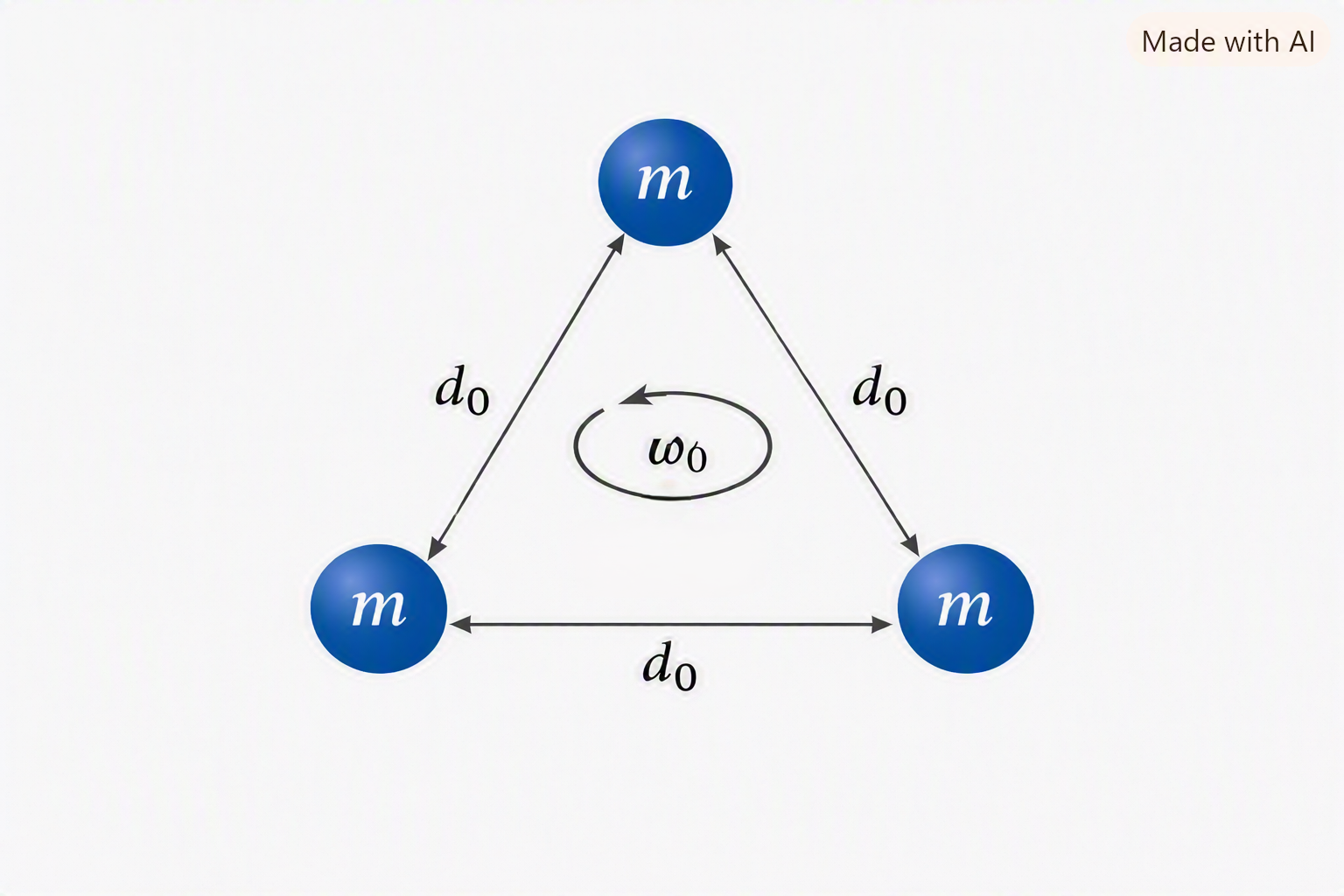
Consider a special case of a 3-body problem in which three equal mass particles are in an equilateral triangle configuration. Determine the required constant angular velocity \(\omega_0\) to maintain a constant separation distance \(d_0\) between the masses.
Solution
We have to find the angular velocity at which the triangle turns without changing its size. The plan is to use the symmetry. If the net pull on each mass points at the centre of the triangle, a single \(\omega_0\) can supply the centripetal force for all three masses at once.
Where the centre is. Put the origin at the centroid of the triangle. The three position vectors add up to zero, so the centre of mass of three equal masses is the centroid. No external force acts, so it stays at rest, and the masses turn about it. Each mass is at the distance
\[ R=\frac{d_0}{\sqrt3} \]
from the centroid.
The net pull on one mass. Each of the other two masses pulls it with the force \(Gm^2/d_0^2\), along the two sides that meet at it. Each side makes the angle \(30^\circ\) with the line from the mass to the centroid, one on each side of that line. So the components across the line cancel, and the components along it add,
\[ F=2\,\frac{Gm^2}{d_0^2}\cos30^\circ=\frac{\sqrt3\,Gm^2}{d_0^2}, \]
directed at the centroid. The same is true of every mass, by symmetry.
The angular velocity. A mass moving on a circle of radius \(R\) with angular velocity \(\omega_0\) needs the force \(m\omega_0^2R\) towards the centre. Setting the two equal,
\[ m\,\omega_0^2\,\frac{d_0}{\sqrt3}=\frac{\sqrt3\,Gm^2}{d_0^2} \quad\Longrightarrow\quad \omega_0^2=\frac{3Gm}{d_0^3},\qquad \omega_0=\sqrt{\frac{3Gm}{d_0^3}} . \]
The period of the rotation is \(2\pi\sqrt{d_0^3/(3Gm)}\).
Reading the result. This is Kepler’s third law for two bodies a distance \(d_0\) apart with the total mass \(3m\), the mass of the whole system. The configuration is one of Lagrange’s equilateral solutions of the three-body problem. It is the configuration of the Sun, Jupiter and the Trojan asteroids, although there the masses are very unequal. Problem 17 shows that the equilateral triangle still works for unequal masses.
14. The tenth integral
The N-body note lists ten classical integrals of the N-body problem but derive only nine of them (the six for the centre of mass, three for angular momentum). Supply the tenth.
Starting from
\[ m_i \ddot{\mathbf{R}}_i = G \sum_{j=1,\, j\neq i}^{n} \frac{m_i m_j}{r_{ij}^{2}}\, \hat{\mathbf{r}}_{ij}, \qquad i = 1,\ldots,n, \]
take the dot product with \(\dot{\mathbf{R}}_i\) and sum over \(i\).
- Show that the double sum on the right collapses, when reorganised over unordered pairs, to a total time derivative. You will need Newton’s third law \(\mathbf{F}_{ji} = -\mathbf{F}_{ij}\) and the identity \(\mathbf{r}\cdot\dot{\mathbf{r}} = r\dot r\).
- Hence prove that \[ E \;=\; \underbrace{\sum_{i=1}^{n} \tfrac12 m_i V_i^{2}}_{T} \;+\; \underbrace{\sum_{i<j} \Phi_{ij}}_{U}, \qquad \Phi_{ij} = -\frac{G m_i m_j}{r_{ij}}, \] is a constant of the motion.
- Explain why the sum in \(U\) runs over \(i<j\) and not over all ordered pairs, and what would go wrong numerically if you got this wrong.
Solution
(a) Collapsing the double sum. Write the force on \(i\) due to \(j\) as \[ \mathbf{F}_{ij} = G\frac{m_i m_j}{r_{ij}^{2}}\hat{\mathbf{r}}_{ij} = G m_i m_j \frac{\mathbf{r}_{ij}}{r_{ij}^{3}}, \qquad \mathbf{r}_{ij} = \mathbf{R}_j - \mathbf{R}_i . \] Dotting the equation of motion with \(\dot{\mathbf{R}}_i\) and summing over \(i\), \[ \underbrace{\sum_i m_i \ddot{\mathbf{R}}_i\cdot\dot{\mathbf{R}}_i}_{\text{LHS}} = \sum_i \sum_{j\neq i} \mathbf{F}_{ij}\cdot\dot{\mathbf{R}}_i . \] The left side is already exact: \[ \text{LHS} = \sum_i \frac{d}{dt}\left(\tfrac12 m_i \dot{\mathbf{R}}_i\cdot\dot{\mathbf{R}}_i\right) = \frac{dT}{dt}. \] On the right, the ordered double sum contains, for each unordered pair \(\{i,j\}\), the two terms \(\mathbf{F}_{ij}\cdot\dot{\mathbf{R}}_i\) and \(\mathbf{F}_{ji}\cdot\dot{\mathbf{R}}_j\). Newton’s third law \(\mathbf{F}_{ji}=-\mathbf{F}_{ij}\) lets them be combined: \[ \mathbf{F}_{ij}\cdot\dot{\mathbf{R}}_i + \mathbf{F}_{ji}\cdot\dot{\mathbf{R}}_j = \mathbf{F}_{ij}\cdot\left(\dot{\mathbf{R}}_i - \dot{\mathbf{R}}_j\right) = -\,\mathbf{F}_{ij}\cdot\dot{\mathbf{r}}_{ij}. \] This is the crucial step: the pair interaction does work only through the rate of change of the separation of that pair. Now use \(\mathbf{r}\cdot\dot{\mathbf{r}} = r\dot r\) (proved on the eccentricity-vector slide): \[ \mathbf{F}_{ij}\cdot\dot{\mathbf{r}}_{ij} = G m_i m_j \frac{\mathbf{r}_{ij}\cdot\dot{\mathbf{r}}_{ij}}{r_{ij}^{3}} = G m_i m_j \frac{\dot r_{ij}}{r_{ij}^{2}} = -\frac{d}{dt}\left(\frac{G m_i m_j}{r_{ij}}\right). \] Hence the pair contributes \[ -\mathbf{F}_{ij}\cdot\dot{\mathbf{r}}_{ij} = \frac{d}{dt}\left(\frac{Gm_im_j}{r_{ij}}\right) = -\frac{d\Phi_{ij}}{dt}, \qquad \Phi_{ij} = -\frac{Gm_im_j}{r_{ij}} . \]
(b) The integral. Summing over the \(\binom{n}{2}\) unordered pairs, \[ \frac{dT}{dt} = -\frac{d}{dt}\sum_{i<j}\Phi_{ij} = -\frac{dU}{dt} \qquad\Longrightarrow\qquad \frac{d}{dt}\left(T + U\right) = 0, \] so \(E = T + U = C_4\) is constant. Together with \(\mathbf{C}_1\) (3), \(\mathbf{C}_2\) (3) and \(\mathbf{C}_3\) (3) this completes the ten classical integrals.
(c) Why \(i<j\). Each pair carries one interaction energy. The ordered double sum \(\sum_i\sum_{j\ne i}\Phi_{ij}\) visits the pair \(\{i,j\}\) twice and therefore equals \(2U\). The forces are not double counted (body \(i\) genuinely feels \(\mathbf{F}_{ij}\) and body \(j\) feels \(\mathbf{F}_{ji}\)), but the energy is a property of the pair, not of a body. Getting this wrong doubles \(U\); in an N-body integrator this shows up immediately as an energy-conservation diagnostic that is off by a factor of two, and it corrupts any virial or escape test built on \(E\) (Problem 15). A useful check: for two bodies the correct \(U\) must reproduce \(\varepsilon = v^2/2 - \mu/r\) per unit reduced mass.
15. The Lagrange–Jacobi identity and Jacobi’s escape criterion
Let \(\boldsymbol{\rho}_i = \mathbf{R}_i - \mathbf{R}_{cm}\) and define the polar moment of inertia of the system about its barycentre,
\[ I \;=\; \sum_{i=1}^{n} m_i \, \left|\boldsymbol{\rho}_i\right|^{2}. \]
- Prove the Lagrange–Jacobi identity \[ \ddot I \;=\; 4T + 2U \;=\; 4E - 2U , \] where \(T\), \(U\), \(E\) are as in Problem 14, evaluated in the barycentric frame. (The step \(\sum_i \boldsymbol{\rho}_i \cdot \mathbf{F}_i = U\) is Euler’s theorem for a potential homogeneous of degree \(-1\); derive it directly rather than quoting it.)
- Jacobi’s criterion. Suppose the system remained bounded for all time, so that \(r_{ij} \le D\) for every pair and all \(t\). Show that \(\ddot I\) is then bounded below by a positive constant whenever \(E \ge 0\), and hence that \(I \to \infty\). Conclude: no N-body system with \(E \ge 0\) can remain bounded.
- Virial theorem. For a bounded system (so that \(I\) and \(\dot I\) stay bounded), show that the long-time averages satisfy \[ \langle 2T \rangle = -\langle U \rangle, \qquad E = -\langle T \rangle = \tfrac12 \langle U \rangle . \]
- A star cluster of total mass \(M\) and radius \(R\) has measured root-mean-square speed \(v_{rms}\). Use (c) to estimate \(M\) in terms of \(v_{rms}\) and \(R\), and comment on what this measurement told Zwicky in 1933.
Solution
Work in the barycentric frame, where \(\ddot{\mathbf{R}}_{cm} = \mathbf{0}\) implies \(\ddot{\boldsymbol{\rho}}_i = \ddot{\mathbf{R}}_i\). Note also that the mutual separations are unchanged by the shift, \(\boldsymbol{\rho}_j - \boldsymbol{\rho}_i = \mathbf{r}_{ij}\), so \(U\) is the same function as before.
(a) The identity. Differentiating \(I = \sum_i m_i\,\boldsymbol{\rho}_i\cdot\boldsymbol{\rho}_i\) twice, \[ \dot I = 2\sum_i m_i\,\boldsymbol{\rho}_i\cdot\dot{\boldsymbol{\rho}}_i, \qquad \ddot I = 2\sum_i m_i\,\dot{\boldsymbol{\rho}}_i\cdot\dot{\boldsymbol{\rho}}_i + 2\sum_i \boldsymbol{\rho}_i\cdot\left(m_i\ddot{\boldsymbol{\rho}}_i\right) = 4T + 2\sum_i \boldsymbol{\rho}_i\cdot\mathbf{F}_i , \] where \(\mathbf{F}_i = \sum_{j\ne i}\mathbf{F}_{ij}\) is the total force on body \(i\). Reorganise the last sum over unordered pairs exactly as in Problem 14: \[ \sum_i \boldsymbol{\rho}_i\cdot\mathbf{F}_i = \sum_{i<j}\left(\boldsymbol{\rho}_i - \boldsymbol{\rho}_j\right)\cdot\mathbf{F}_{ij} = -\sum_{i<j}\mathbf{r}_{ij}\cdot\mathbf{F}_{ij} = -\sum_{i<j} Gm_im_j\frac{\mathbf{r}_{ij}\cdot\mathbf{r}_{ij}}{r_{ij}^{3}} = -\sum_{i<j}\frac{Gm_im_j}{r_{ij}} = U . \] (This quantity is called the virial; the calculation just performed is Euler’s theorem \(\sum_i \mathbf{R}_i\cdot\nabla_i U = -U\) for a potential homogeneous of degree \(-1\), and note it is origin-independent because \(\sum_i\mathbf{F}_i = \mathbf{0}\).) Therefore \[ \boxed{\;\ddot I = 4T + 2U\;} \qquad\text{and, using } T = E - U, \qquad \ddot I = 4E - 2U . \]
(b) Jacobi’s criterion. \(U<0\) always, so \(-2U = 2|U| > 0\): the identity says \(\ddot I = 4E + 2|U|\). Suppose the system stayed bounded, i.e. \(r_{ij}\le D\) for all pairs and all \(t\). Then \[ |U| = \sum_{i<j}\frac{Gm_im_j}{r_{ij}} \;\ge\; \frac{1}{D}\sum_{i<j}Gm_im_j \;\equiv\; c > 0 , \] a positive constant. Hence, if \(E\ge 0\), \[ \ddot I \;\ge\; 4E + 2c \;\ge\; 2c > 0 \quad\text{for all } t, \] and integrating twice, \[ I(t) \;\ge\; I(0) + \dot I(0)\,t + c\,t^{2} \;\longrightarrow\; \infty . \] But a bounded configuration has \(I = \sum m_i\rho_i^2 \le M D^2\), bounded. This is a contradiction, so no N-body system with \(E \ge 0\) can remain bounded: at least one body must escape (or the configuration must expand without limit). Note the converse is false — \(E<0\) does not guarantee that every body stays bound, since one body may escape while the rest form a tighter binary.
(c) Virial theorem. For bounded motion \(I\) and \(\dot I\) remain bounded. Average the identity over \([0,\tau]\): \[ \frac{1}{\tau}\int_0^\tau \ddot I\,dt = \frac{\dot I(\tau) - \dot I(0)}{\tau} \xrightarrow[\tau\to\infty]{} 0 , \] because the numerator is bounded. Hence \(\langle 4T + 2U\rangle = 0\), i.e. \[ \boxed{\;\langle 2T\rangle = -\langle U\rangle\;} \] and since \(E = \langle T\rangle + \langle U\rangle = \langle T\rangle - 2\langle T\rangle\), \[ E = -\langle T\rangle = \tfrac12\langle U\rangle . \] So a gravitationally bound system has half its potential energy in kinetic form — and, notably, adding energy to it makes it hotter is false: removing energy (\(E\) more negative) increases \(\langle T\rangle\). This negative heat capacity is the reason star clusters and stars contract and heat up as they radiate.
(d) Zwicky’s argument. With \(T = \tfrac12 M v_{rms}^2\) and, for a system of size \(R\), \(U = -\alpha\,GM^2/R\) with \(\alpha\) a dimensionless structure constant of order unity (\(\alpha = 3/5\) for a uniform sphere), \[ M v_{rms}^{2} = \frac{\alpha G M^{2}}{R} \qquad\Longrightarrow\qquad \boxed{\;M = \frac{v_{rms}^{2} R}{\alpha G}\;} \] Applying this to the Coma cluster in 1933, Zwicky found a mass some two orders of magnitude larger than the mass visible as luminous galaxies — the first evidence for dark matter. The entire inference rests on the identity proved in (a), which requires no solution of the N-body problem at all.
16. Where the invariable plane really lives
The N-body note proves that \(\mathbf{H} = \sum_i m_i \mathbf{R}_i \times \dot{\mathbf{R}}_i\) is constant, and then declare the invariable plane to be the plane through the barycentre perpendicular to \(\mathbf{H}\). Justify that sentence.
- With \(\boldsymbol{\rho}_i = \mathbf{R}_i - \mathbf{R}_{cm}\), prove the König decomposition \[ \mathbf{H} \;=\; \underbrace{M\, \mathbf{R}_{cm} \times \dot{\mathbf{R}}_{cm}}_{\text{orbital}} \;+\; \underbrace{\sum_{i} m_i\, \boldsymbol{\rho}_i \times \dot{\boldsymbol{\rho}}_i}_{\mathbf{H}_{cm}} \] and show that both terms are separately constant.
- Show that under a shift of origin \(\mathbf{R}_i \mapsto \mathbf{R}_i - \mathbf{b}\) one gets \(\mathbf{H} \mapsto \mathbf{H} - \mathbf{b}\times\mathbf{C}_1\), and under a Galilean boost \(\dot{\mathbf{R}}_i \mapsto \dot{\mathbf{R}}_i - \mathbf{u}\) that \(\mathbf{H}\) also changes — but that \(\mathbf{H}_{cm}\) is invariant under both.
- Hence explain why the invariable plane is a property of the solar system and not of the observer, whereas “the plane perpendicular to \(\mathbf{H}\) through the origin” is not.
Solution
(a) König decomposition. Substitute \(\mathbf{R}_i = \mathbf{R}_{cm} + \boldsymbol{\rho}_i\) and \(\dot{\mathbf{R}}_i = \dot{\mathbf{R}}_{cm} + \dot{\boldsymbol{\rho}}_i\): \[ \mathbf{H} = \sum_i m_i\left(\mathbf{R}_{cm} + \boldsymbol{\rho}_i\right)\times\left(\dot{\mathbf{R}}_{cm} + \dot{\boldsymbol{\rho}}_i\right) = M\,\mathbf{R}_{cm}\times\dot{\mathbf{R}}_{cm} + \mathbf{R}_{cm}\times\underbrace{\sum_i m_i\dot{\boldsymbol{\rho}}_i}_{=\,\mathbf{0}} + \underbrace{\left(\sum_i m_i\boldsymbol{\rho}_i\right)}_{=\,\mathbf{0}}\times\dot{\mathbf{R}}_{cm} + \sum_i m_i\boldsymbol{\rho}_i\times\dot{\boldsymbol{\rho}}_i , \] the two middle terms vanishing by the definition of the barycentre. So \(\mathbf{H} = M\mathbf{R}_{cm}\times\dot{\mathbf{R}}_{cm} + \mathbf{H}_{cm}\). The orbital term is constant on its own, since \[ \frac{d}{dt}\left(M\mathbf{R}_{cm}\times\dot{\mathbf{R}}_{cm}\right) = M\dot{\mathbf{R}}_{cm}\times\dot{\mathbf{R}}_{cm} + M\mathbf{R}_{cm}\times\ddot{\mathbf{R}}_{cm} = \mathbf{0}, \] using \(\ddot{\mathbf{R}}_{cm}=\mathbf{0}\). Since \(\mathbf{H}\) is constant (by the N-body note) and the orbital term is constant, the difference \(\mathbf{H}_{cm}\) is constant too.
(b) Transformation properties. Under a shift of origin \(\mathbf{R}_i\mapsto\mathbf{R}_i-\mathbf{b}\) (with \(\mathbf{b}\) constant, so velocities unchanged), \[ \mathbf{H} \mapsto \sum_i m_i(\mathbf{R}_i - \mathbf{b})\times\dot{\mathbf{R}}_i = \mathbf{H} - \mathbf{b}\times\sum_i m_i\dot{\mathbf{R}}_i = \mathbf{H} - \mathbf{b}\times\mathbf{C}_1 . \] Under a boost \(\dot{\mathbf{R}}_i\mapsto\dot{\mathbf{R}}_i - \mathbf{u}\), \[ \mathbf{H}\mapsto \mathbf{H} - \left(\sum_i m_i\mathbf{R}_i\right)\times\mathbf{u} = \mathbf{H} - M\,\mathbf{R}_{cm}\times\mathbf{u}. \] Both changes are generally nonzero, and — crucially — they change the direction of \(\mathbf{H}\), not merely its magnitude. But \(\boldsymbol{\rho}_i = \mathbf{R}_i - \mathbf{R}_{cm}\) and \(\dot{\boldsymbol{\rho}}_i\) are differences, hence unchanged by both a shift (\(\mathbf{R}_{cm}\) shifts identically) and a boost (\(\dot{\mathbf{R}}_{cm}\) boosts identically). Therefore \(\mathbf{H}_{cm}\) is invariant under both.
(c) Conclusion. “The plane through the origin perpendicular to \(\mathbf{H}\)” depends on where you put the origin and how fast you are moving — two astronomers with different conventions would disagree about it. The plane through the barycentre perpendicular to \(\mathbf{H}_{cm}\) is built entirely from internal quantities and is therefore the same for every inertial observer; it is a property of the solar system itself. That is what earns it the name invariable. (In the barycentric frame, \(\mathbf{C}_1 = \mathbf{0}\) and \(\mathbf{R}_{cm}=\mathbf{0}\), so \(\mathbf{H} = \mathbf{H}_{cm}\) and the distinction disappears — which is exactly why we choose that frame.)
17. Lagrange’s equilateral solution for unequal masses
Problem 13 found \(\omega_0\) for three equal masses at the vertices of an equilateral triangle. Now let \(m_1, m_2, m_3\) be arbitrary, placed at the vertices of an equilateral triangle of side \(d\), and let the whole configuration rotate rigidly with angular velocity \(\omega\) about the axis through the barycentre, perpendicular to the plane of the triangle.
- Taking the origin at the barycentre, show that the gravitational acceleration of body \(i\) is exactly \[ \ddot{\mathbf{R}}_i \;=\; -\frac{GM}{d^{3}}\,\mathbf{R}_i, \qquad M = m_1+m_2+m_3 , \] i.e. every body is pulled straight towards the barycentre with a force proportional to its distance from it. Identify precisely where the equilateral assumption is used.
- Deduce that circular motion is consistent iff \[ \omega^{2} = \frac{GM}{d^{3}}, \] independent of the individual masses and of the (unequal) orbital radii \(\rho_i = |\mathbf{R}_i|\). Check that this reduces to your answer to Problem 13.
- The result of (a) is a linear (Hooke) force law, which is also solved by ellipses. What does this suggest about non-circular equilateral solutions of the three-body problem?
Solution
(a) The acceleration is linear in \(\mathbf{R}_i\). Put the origin at the barycentre, so \(\sum_j m_j\mathbf{R}_j = \mathbf{0}\). The acceleration of body \(i\) is \[ \ddot{\mathbf{R}}_i = G\sum_{j\ne i} \frac{m_j}{r_{ij}^{3}}\left(\mathbf{R}_j - \mathbf{R}_i\right). \] Here is the only place the geometry enters: in an equilateral configuration all three separations are equal, \(r_{12}=r_{23}=r_{31}=d\), so the factor \(1/r_{ij}^3\) is common to every term and comes out of the sum: \[ \ddot{\mathbf{R}}_i = \frac{G}{d^{3}}\left[\sum_{j\ne i} m_j\mathbf{R}_j - \mathbf{R}_i\sum_{j\ne i}m_j\right] = \frac{G}{d^{3}}\Big[\underbrace{\Big(\textstyle\sum_j m_j\mathbf{R}_j\Big)}_{=\,\mathbf 0} - m_i\mathbf{R}_i - \left(M - m_i\right)\mathbf{R}_i\Big], \] and the \(m_i\mathbf{R}_i\) terms cancel: \[ \boxed{\;\ddot{\mathbf{R}}_i = -\frac{GM}{d^{3}}\,\mathbf{R}_i\;},\qquad M = m_1+m_2+m_3 . \] Every body is accelerated exactly towards the barycentre, with magnitude proportional to its own distance \(\rho_i\) from it — even though the three distances \(\rho_i\) are different and the three masses are different.
(b) The rotation rate. Uniform circular motion of body \(i\) about the origin at rate \(\omega\) requires \(\ddot{\mathbf{R}}_i = -\omega^{2}\mathbf{R}_i\). Comparing, \[ \boxed{\;\omega^{2} = \frac{GM}{d^{3}}\;} \] The same \(\omega\) for all three bodies — which is what makes rigid rotation consistent — and it depends only on the total mass and the side length. Note the configuration is not symmetric (the heaviest body sits closest to the barycentre, on the smallest circle), yet all three complete a revolution in the same time, which is precisely the condition for the triangle to stay equilateral.
Check (Problem 13): for \(m_1=m_2=m_3=m\) the barycentre is the centroid, \(\rho = d/\sqrt3\), and the formula gives \(\omega_0^2 = 3Gm/d^3\), i.e. \(\omega_0 = \sqrt{3Gm/d_0^{3}}\) — as found there.
(c) Non-circular equilateral solutions. Since \(\ddot{\mathbf{R}}_i = -(GM/d^3)\mathbf{R}_i\) holds instantaneously for any equilateral configuration, it is not restricted to circles. Write \(\mathbf{R}_i = \sigma_i\,\mathbf{q}(t)\) for a common vector \(\mathbf{q}\) scaled by fixed factors: each body’s equation reduces to the same Kepler-type equation. Consequently the triangle may pulsate — expanding and contracting while remaining equilateral — with each body tracing a similar Keplerian conic about the barycentre, all with the same eccentricity and period. These are Lagrange’s homographic solutions; the circular case is the special \(e = 0\) member. Combined with Euler’s collinear solutions, they are the only known exact solutions of the general three-body problem, and the \(m_3 \to 0\) limit of the equilateral family gives the L4 and L5 points — where the Trojan asteroids sit.