Ballistic Trajectories
Free flight between two points of the Earth: range, flight-path angle, flight time, launch errors and the rotating Earth
Where we are going
A sounding rocket climbs for a minute or two under power, and then coasts for ten minutes, with no engine and (above about \(100\) km) no air, to a peak and back down. A spent upper stage, a capsule that is returning on a steep arc, a suborbital passenger flight: for most of its life each of them is a body moving in the gravity field of the Earth alone. That is the two-body problem of the two-body note, with one new feature. The orbit intersects the Earth. The conic is an ellipse with a focus at the Earth’s centre, but the vehicle only travels along the part of it that lies above the ground. (Whether the conic really dips below the ground is not automatic: Section 4.5.)
This note follows chapter 6 of Bate, Mueller and White (Bate, Mueller, and White 1971), who developed the idea for long-range ballistic flight, and it keeps their simple model: after thrust cutoff (“burnout”) the vehicle moves on a conic, and we ask where and when it comes down. The model is a spherical, non-rotating Earth without atmosphere, and then we add the rotation of the Earth. Within it everything can be written in closed form, and the closed forms are the best way to see how the flight depends on the burnout conditions.
The required background is the two-body note (the orbit equation, energy, the flight-path angle, Kepler’s equation) and, for the last section, the Greenwich sidereal angle and the Earth’s rotation rate of the time note; the Lambert problem is the general form of what we do here, and one of its results (the minimum-energy ellipse) turns up again below. As in the other notes, a blue Try it box asks you to do a small calculation before reading on, and a green Check yourself box asks a short question; each has a hidden answer.
Notation. Symbols and constants shared by all the notes are on the notation page. Bate uses other letters for several of them; this note uses the course’s. The table gives the translation, so that you can read the book alongside.
| this note | meaning | Bate |
|---|---|---|
| \(\gamma\) | flight-path angle, from the local horizontal | \(\phi\) |
| \(f\) | true anomaly | \(\nu\) |
| \(\varepsilon\) | specific energy | \(\mathscr E\) |
| \(\psi\) | free-flight range angle (the geocentric angle from burnout to re-entry) | \(\Psi\) |
| \(\psi_p\), \(\psi_{re}\), \(\Lambda=\psi_p+\psi+\psi_{re}\) | range angles of the powered flight, of the re-entry, and the total | \(\Gamma\), \(\Omega\), \(\Lambda\) |
| \(\varphi\), \(\lambda\) | latitude and east longitude | \(L\), \(N\) |
| \(A\) | azimuth, from north, clockwise | \(\beta\) |
| \(Q\) | \(v^2r/\mu\), local to this note (not the matrix \(\mathbf Q\) of the perifocal note) | \(Q\) |
All lengths are in km, speeds in km/s and times in s, with \(\mu=\mu_\oplus=398\,600.4418\) km\(^3\)/s\(^2\), \(R_\oplus=6378.137\) km and \(\omega_\oplus=7.292\,115\times10^{-5}\) rad/s. Bate works in “canonical units” (distance unit \(=R_\oplus\), time unit \(=\sqrt{R_\oplus^3/\mu}\)) and in nautical miles, taking \(1^\circ\) of arc \(=60\) nm; this note gives the answers in km, and the ground range \(\psi R_\oplus\) is \(0.2\%\) larger than Bate’s \(60\,\text{nm}\times\psi^\circ\), because \(60\) nm per degree describes a sphere \(0.2\%\) smaller than the equatorial radius.
1 Three phases and one symmetry
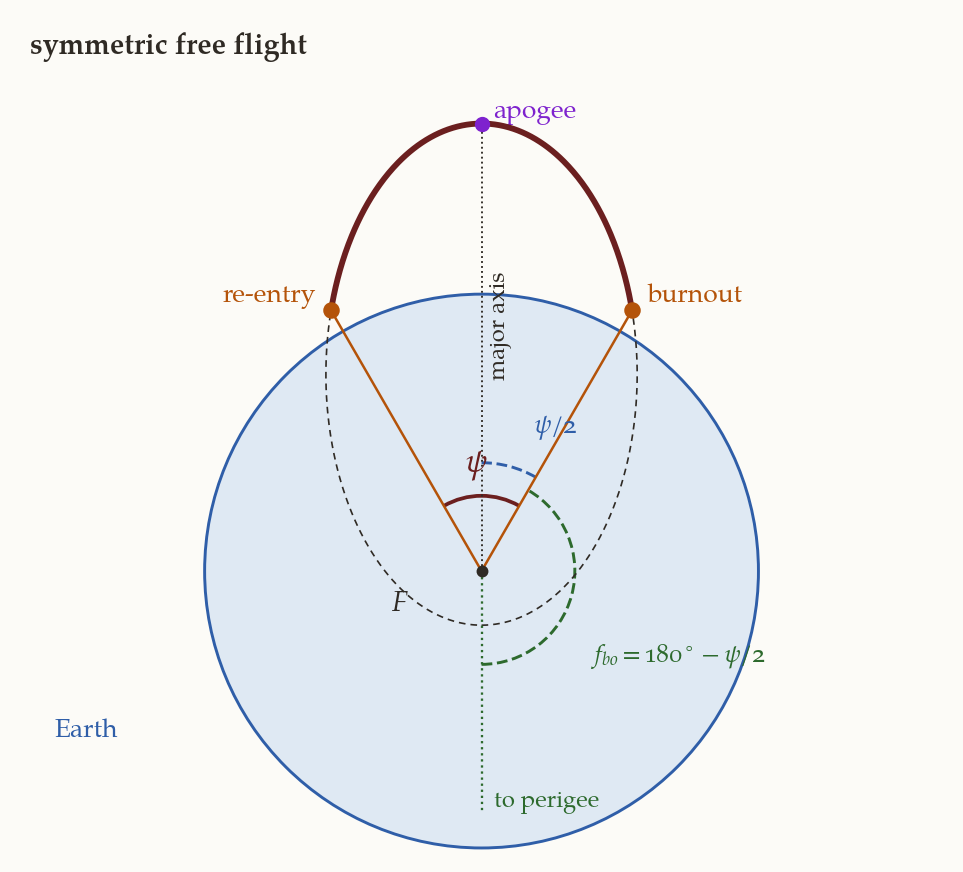
A ballistic trajectory has three parts (Figure 1).
- Powered flight from launch to burnout. Energy is added all the time, so no single conic describes it; the path is whatever the guidance and the engines make it. We do not study it. All we need from it is the burnout state: position \(r_{bo}\), speed \(v_{bo}\), flight-path angle \(\gamma\) (measured from the local horizontal) and the azimuth of the motion.
- Free flight from burnout to re-entry, on a conic, almost always an ellipse. This is most of the flight in distance and time, and it is the subject of this note.
- Re-entry, from the point where the air starts to matter until impact. Drag dissipates energy and the path leaves the conic. We do not study it either; we only need the point where it starts.
The ground range of each phase is its angle at the Earth’s centre: \(\psi_p\), \(\psi\) and \(\psi_{re}\), adding up to the total \(\Lambda\). If we know how far the vehicle travels while it is powered and while it re-enters (a few hundred km each, which is a few degrees), the free-flight range angle needed for a given \(\Lambda\) follows by subtraction. So everything below is about \(\psi\).
One symmetry. We assume that re-entry starts at the same distance from the Earth’s centre as burnout ended: \(r_{re}=r_{bo}\). An ellipse is mirror-symmetric about its major axis, so two points of the ellipse at the same distance from the focus are mirror images, and the arc between them, through the apogee, is symmetrical (Figure 1). Two consequences make everything simple. The speeds at the two ends are equal, and the flight-path angle at re-entry is \(-\gamma\), the mirror image of the one at burnout. And the true anomaly of the burnout point is fixed by the range angle alone: the apogee has \(f=\pi\), the two points are at equal angles on either side, and the angle between them is \(\psi\), so
TODO: Add a margin note explaining why perigee is ruled out.
\[ f_{bo}=\pi-\frac\psi2,\qquad f_{re}=\pi+\frac\psi2 . \tag{1}\]
This is the one fact that turns the whole problem into trigonometry.
History. Bate begins the chapter with the German A-4 (the V-2): first launched successfully on 3 October 1942, and the first long-range ballistic missile. The same technology is behind the first orbital launches: the rocket that put Sputnik 1 in orbit on 4 October 1957 was derived from the R-7, which had been developed as an intercontinental ballistic missile. A ballistic trajectory and a satellite orbit differ in one respect only, which is the one we started with: one of them hits the ground. The mathematics below stays valid all the way to \(Q=1\), where the ballistic arc turns into a circular orbit.
2 The number \(Q\)
Bate’s key idea is to describe the burnout state not by \(r_{bo}\) and \(v_{bo}\) separately, but by their combination
\[ \boxed{Q=\frac{v^2r}{\mu}=\Bigl(\frac{v}{v_c}\Bigr)^{2}}\qquad\text{with}\qquad v_c=\sqrt{\frac\mu r}. \tag{2}\]
\(Q\) is the square of the ratio of the speed to the local circular speed. It is dimensionless, and it can be worked out at any point of any orbit, not only at burnout. In this section \(r\), \(v\) and \(\gamma\) are the radius, speed and flight-path angle at the point where we evaluate it, which in the rest of the note is the burnout point. Three values stand out: \(Q=1\) is circular speed, \(Q=2\) is escape speed (\(v^2=2\mu/r\)), and \(Q>2\) is hyperbolic. A ballistic vehicle has \(0<Q<2\), and in practice \(Q\) is a little less than \(1\).
The point of introducing \(Q\) is that the three orbital quantities we need are all simple in it. We derive each in turn.
The semi-major axis. The energy integral is \(\frac12v^2-\mu/r=-\mu/(2a)\). Multiply by \(2r/\mu\):
\[ \frac{v^2r}{\mu}-2=-\frac ra\quad\Longrightarrow\quad Q-2=-\frac ra\quad\Longrightarrow\quad \boxed{a=\frac{r}{2-Q}},\qquad r=a(2-Q). \tag{3}\]
So at the burnout point, \(r/a=2-Q\). The distance from the burnout point to the other focus \(F'\) follows from the property of the ellipse that the two focal distances add up to \(2a\):
\[ r'=2a-r=2a-a(2-Q)=aQ . \tag{4}\]
The semi-latus rectum. \(p=h^2/\mu\), and the angular momentum is \(h=rv_\perp=rv\cos\gamma\) because the flight-path angle is measured from the local horizontal, which is the transverse direction. Therefore
\[ p=\frac{r^2v^2\cos^2\gamma}{\mu}=\frac{v^2r}{\mu}\,r\cos^2\gamma\quad\Longrightarrow\quad \boxed{p=rQ\cos^2\gamma}. \tag{5}\]
The eccentricity. For an ellipse \(p=a(1-e^2)\), so \(e^2=1-p/a\). Insert Equation 5 and Equation 3:
\[ e^2=1-\frac{rQ\cos^2\gamma}{r/(2-Q)}=1-Q(2-Q)\cos^2\gamma=\boxed{1+Q(Q-2)\cos^2\gamma}. \tag{6}\]
Look at what these say. The size of the ellipse depends on \(Q\) alone, not on the direction of the velocity. The shape depends on both. For a given \(Q<2\) the orbit is the longest and thinnest (\(e\) the largest) when \(\gamma=90^\circ\), a vertical shot, and it is the fattest when \(\gamma=0\).
A vehicle burns out at \(200\) km altitude, \(r=6578.137\) km, with \(v=7.3\) km/s at \(\gamma=30^\circ\). Find \(Q\), \(a\) and \(e\). Is \(a\) larger or smaller than the Earth’s radius? Is there a contradiction?
What you should find
\(Q=v^2r/\mu=53.29\times6578.137/398\,600.4=0.8794\). Then \(a=r/(2-Q)=5870\) km and \(e^2=1+0.8794(0.8794-2)\cos^230^\circ=0.2609\), \(e=0.5108\). The semi-major axis is smaller than \(R_\oplus\), and there is no contradiction: \(a\) is a property of the whole ellipse, and the perigee distance \(a(1-e)=2872\) km is below the surface. The vehicle only travels the part of the ellipse around the apogee, which is above the ground.Three short questions. (a) What is \(Q\) on a circular orbit? (b) What is \(Q\) at the end of the minor axis of an ellipse? (c) The burnout point and the re-entry point are at the same radius. What is \(Q\) at re-entry?
Answer
- \(Q=1\), since \(v=v_c\). (b) The end of the minor axis is at distance \(a\) from each focus (the two focal distances are equal there and add up to \(2a\)), so \(r=a\), and Equation 3 gives \(Q=1\). So \(Q=1\) at the end of the minor axis of every ellipse. (c) The same \(Q\): the speed and the radius are the same by symmetry. (Bate asks the question in exercise 6.5.)
3 The free-flight range equation
Now we can ask where the vehicle lands: given \(Q\) and \(\gamma\) at burnout, what is the range angle \(\psi\)?
3.1 Two equations for the burnout point
Put the burnout point on the ellipse at the true anomaly \(f_{bo}=\pi-\psi/2\) of Equation 1, and write down two things we know about it.
First, the orbit equation. \(r=p/(1+e\cos f)\), so at the burnout point \(1+e\cos f_{bo}=p/r\). The right side is \(p/r=Q\cos^2\gamma\) by Equation 5, and \(\cos f_{bo}=\cos(\pi-\psi/2)=-\cos(\psi/2)\). Therefore
\[ 1-e\cos\frac\psi2=Q\cos^2\gamma\quad\Longrightarrow\quad e\cos\frac\psi2=1-Q\cos^2\gamma . \tag{7}\]
Second, the radial velocity. Differentiate the orbit equation in time. With \(\dot f=h/r^2\),
\[ \dot r=\frac{p\,e\sin f}{(1+e\cos f)^2}\,\dot f=\frac{r^2e\sin f}{p}\,\frac{h}{r^2}=\frac hp\,e\sin f=\frac\mu h\,e\sin f, \]
where the last step used \(p=h^2/\mu\). On the other hand the radial velocity is \(\dot r=v\sin\gamma\). At the burnout point \(\sin f_{bo}=\sin(\pi-\psi/2)=\sin(\psi/2)\), so
\[ e\sin\frac\psi2=\frac{h\,v\sin\gamma}{\mu}=\frac{r\,v\cos\gamma\;v\sin\gamma}{\mu}=Q\sin\gamma\cos\gamma . \tag{8}\]
3.2 The range equation
Equation 7 and Equation 8 give \(e\cos(\psi/2)\) and \(e\sin(\psi/2)\). Their ratio removes the unknown \(e\):
\[ \boxed{\tan\frac\psi2=\frac{Q\sin\gamma\cos\gamma}{1-Q\cos^2\gamma}} \tag{9}\]
This is the free-flight range equation: the range angle for any burnout state. Notice what it does not contain: \(r_{bo}\) and \(v_{bo}\) separately. The range angle depends on them only through \(Q\), and on the direction \(\gamma\). A vehicle that burns out twice as high with \(v^2\) halved has the same \(Q\), and the same range angle; only the ground range, the angle times the Earth’s radius, is what it is.
Two comments on using it. The angle \(\psi/2\) is in \((0,\pi)\) because \(\sin(\psi/2)=Q\sin\gamma\cos\gamma/e\ge0\) for \(0\le\gamma\le\pi/2\), so \(\psi/2\) is the angle whose sine is positive and whose cosine has the sign of \(1-Q\cos^2\gamma\): use the two-argument arctangent (\(\operatorname{atan2}\)) rather than the plain one. When \(Q\cos^2\gamma>1\) the denominator is negative and \(\psi>180^\circ\): the vehicle goes more than half-way round the Earth. And squaring and adding Equation 7 and Equation 8 gives \(e^2=(1-Q\cos^2\gamma)^2+Q^2\sin^2\gamma\cos^2\gamma=1-2Q\cos^2\gamma+Q^2\cos^2\gamma\), which is Equation 6 again: the two equations are consistent.
TODO: Give a numerical example of this with given Q and gamma combination, we have psi less than or greater than pi.
Example (the range equation: a range below \(180^\circ\) and one above). A vehicle burns out with \(Q=1.2\) (for instance \(v_{bo}=8.527\) km/s at \(r_{bo}=6578.137\) km, \(200\) km above the surface). Only \(Q\) and \(\gamma\) enter Equation 9. Take two flight-path angles.
\(\gamma=30^\circ\). \(\sin30^\circ\cos30^\circ=0.4330\) and \(\cos^230^\circ=0.75\). The numerator is \(Q\sin\gamma\cos\gamma=1.2\times0.4330=0.5196\); the denominator is \(1-Q\cos^2\gamma=1-0.9=0.1\), positive. So \(\tan(\psi/2)=5.196\), \(\psi/2=79.11^\circ\) and \(\psi=158.21^\circ\): less than half-way round. (The denominator is \(e\cos(\psi/2)\) by Equation 7, and it is positive, so \(\psi/2\) is below \(90^\circ\).)
\(\gamma=10^\circ\). \(\sin10^\circ\cos10^\circ=0.1710\) and \(\cos^210^\circ=0.9698\). The numerator is \(1.2\times0.1710=0.2052\); the denominator is \(1-1.2\times0.9698=-0.1638\), negative. So \(\tan(\psi/2)=-1.2527\). The plain arctangent returns \(-51.40^\circ\), which is not an angle in \((0,\pi)\). The correct \(\psi/2\) has a positive sine (the numerator) and a negative cosine (the denominator), so it lies in the second quadrant, \(\psi/2=180^\circ-51.40^\circ=128.60^\circ\), and \(\psi=257.20^\circ\): more than half-way round. This is the \(\operatorname{atan2}\) of the numerator and the denominator.
The two cases are separated by \(Q\cos^2\gamma=1\), where the denominator is zero and \(\psi=180^\circ\): \(\cos\gamma=1/\sqrt Q\), which is \(\gamma=24.09^\circ\) for \(Q=1.2\) (the point where the \(Q=1.2\) curve of Figure 2 (a) crosses the dotted line at \(180^\circ\)). Flatter than that the vehicle goes round the far side of the Earth. For \(Q\le1\) this cannot happen, because \(Q\cos^2\gamma\le1\) always.
Bate gives the same result in two other forms, which are useful:
\[ \cos\frac\psi2=\frac{1-Q\cos^2\gamma}{\sqrt{1+Q(Q-2)\cos^2\gamma}},\qquad \cot\frac\psi2=\frac{2}{Q\sin2\gamma}-\cot\gamma . \tag{10}\]
The first is Equation 7 divided by \(e\). The second is \(\cot(\psi/2)=(1-Q\cos^2\gamma)/(Q\sin\gamma\cos\gamma)\) with the fraction split: \(\dfrac{1}{Q\sin\gamma\cos\gamma}-\dfrac{\cos\gamma}{\sin\gamma}\), and \(2\sin\gamma\cos\gamma=\sin2\gamma\). We shall differentiate the second one later.
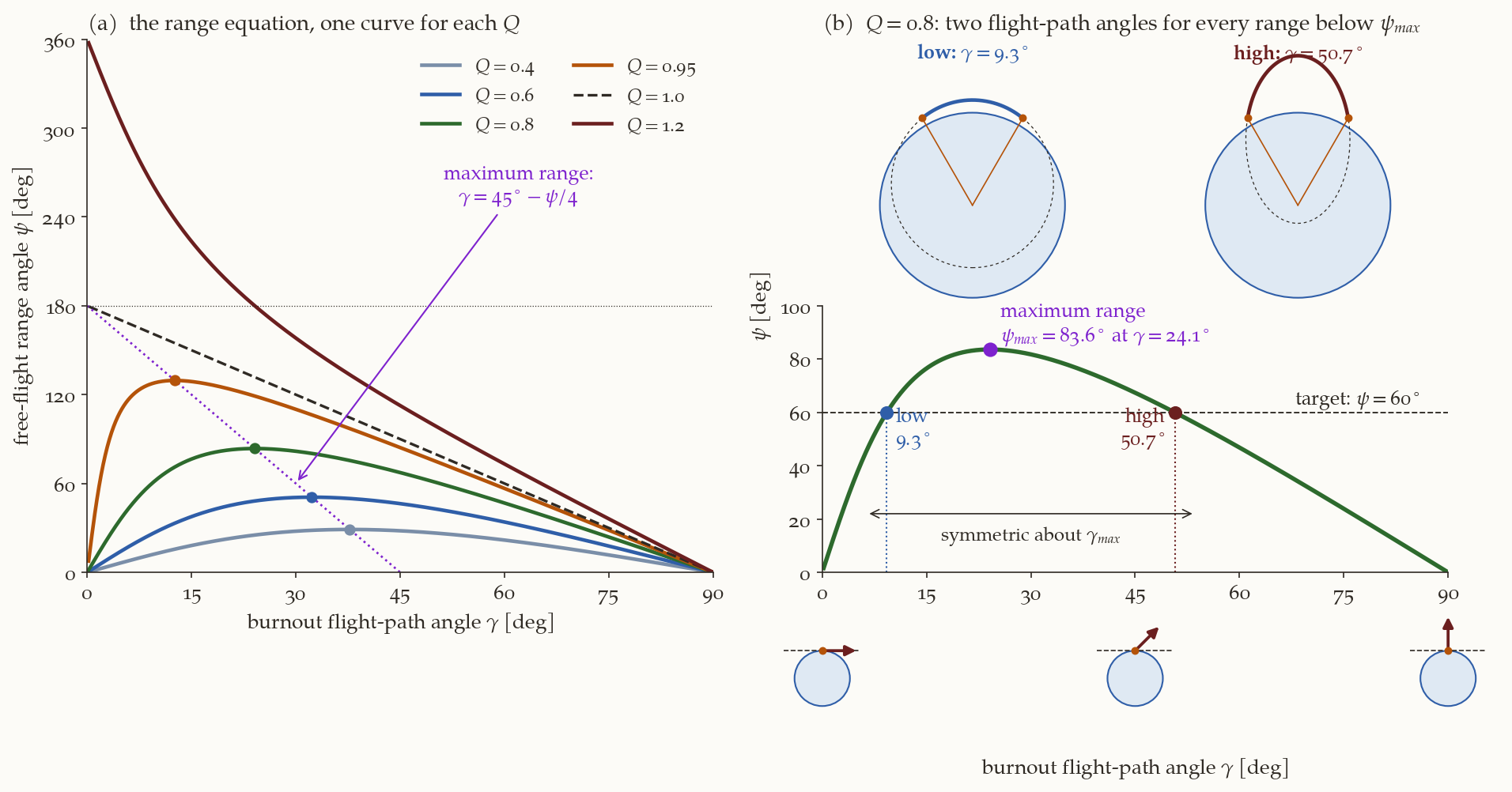
TODO: In figure 2 (b), do two things. Firstly insert small images showing the low and high trajectories around a circle. Secondly, below the x-axis, add small circles with the launch velocity vector shown for gamma = [0, 45, 90].
The flat-Earth limit. For a short hop the vehicle is much slower than circular speed, \(Q\ll1\), and Equation 9 becomes \(\psi/2\approx Q\sin\gamma\cos\gamma\), i.e. \(\psi\approx Q\sin2\gamma\). The ground range is \(r\psi=(v^2r^2/\mu)\sin2\gamma=(v^2/g)\sin2\gamma\) with \(g=\mu/r^2\). This is the school projectile range, maximal at \(45^\circ\), with \(\gamma\) and \(90^\circ-\gamma\) giving the same range. The spherical-Earth result keeps these features, with two changes that we shall find: the best angle is lower than \(45^\circ\), and the pair of equal-range angles is symmetric about that lower angle.
For \(Q=0.8\), find the range angle \(\psi\) for \(\gamma=9.295^\circ\) and for \(\gamma=50.705^\circ\).
What you should find
\(\tan(\psi/2)=0.8\sin\gamma\cos\gamma/(1-0.8\cos^2\gamma)\). For \(9.295^\circ\): \(0.8\times0.1615\times0.9869=0.1275\) over \(1-0.8\times0.9740=0.2208\), so \(\tan(\psi/2)=0.5774\) and \(\psi/2=30^\circ\). For \(50.705^\circ\): \(0.8\times0.7739\times0.6333=0.3921\) over \(1-0.8\times0.4011=0.6791\), so \(\tan(\psi/2)=0.5774\) again. Both give \(\psi=60.0^\circ\): two very different launch angles reach the same target. This is the ellipse of Figure 1 (the larger angle) and the first target of Figure 2 (b).4 The inverse problem: which flight-path angle?
In practice the question is reversed. The target and the launch point fix the total range angle, and after subtracting the powered flight and the re-entry, the free-flight range angle \(\psi\). The vehicle fixes \(r_{bo}\) and \(v_{bo}\), so \(Q\). What flight-path angle \(\gamma\) is needed? One could solve Equation 9 for \(\gamma\), but it is a quadratic in \(\cos^2\gamma\), and there is a more elegant route. We give two derivations and they agree.
4.1 From the range equation
Start from the second form in Equation 10, \(\cot(\psi/2)=2/(Q\sin2\gamma)-\cot\gamma\), and look for \(\sin(2\gamma+\psi/2)\):
\[ \sin\Bigl(2\gamma+\frac\psi2\Bigr)=\sin\frac\psi2\Bigl[\sin2\gamma\,\cot\frac\psi2+\cos2\gamma\Bigr]. \]
(We factored \(\sin(\psi/2)\) out of \(\sin2\gamma\cos(\psi/2)+\cos2\gamma\sin(\psi/2)\).) Replace \(\cot(\psi/2)\):
\[ \sin2\gamma\cot\frac\psi2=\frac2Q-\sin2\gamma\cot\gamma=\frac2Q-2\cos^2\gamma \]
because \(\sin2\gamma\cot\gamma=2\sin\gamma\cos\gamma\cdot\cos\gamma/\sin\gamma=2\cos^2\gamma\). Therefore the bracket is \(2/Q-2\cos^2\gamma+\cos2\gamma\), and \(\cos2\gamma=2\cos^2\gamma-1\) cancels the cosines:
\[ \frac2Q-2\cos^2\gamma+2\cos^2\gamma-1=\frac{2-Q}{Q}. \]
Hence
\[ \boxed{\sin\Bigl(2\gamma+\frac\psi2\Bigr)=\frac{2-Q}{Q}\,\sin\frac\psi2} \tag{11}\]
This is Bate’s flight-path angle equation (his exercise 6.29 asks for this derivation). It is explicit: the right side is known, and \(\gamma\) follows by one arcsine.
4.2 From the geometry of the ellipse
TODO: Move figure 1b here. It is not needed at the start.
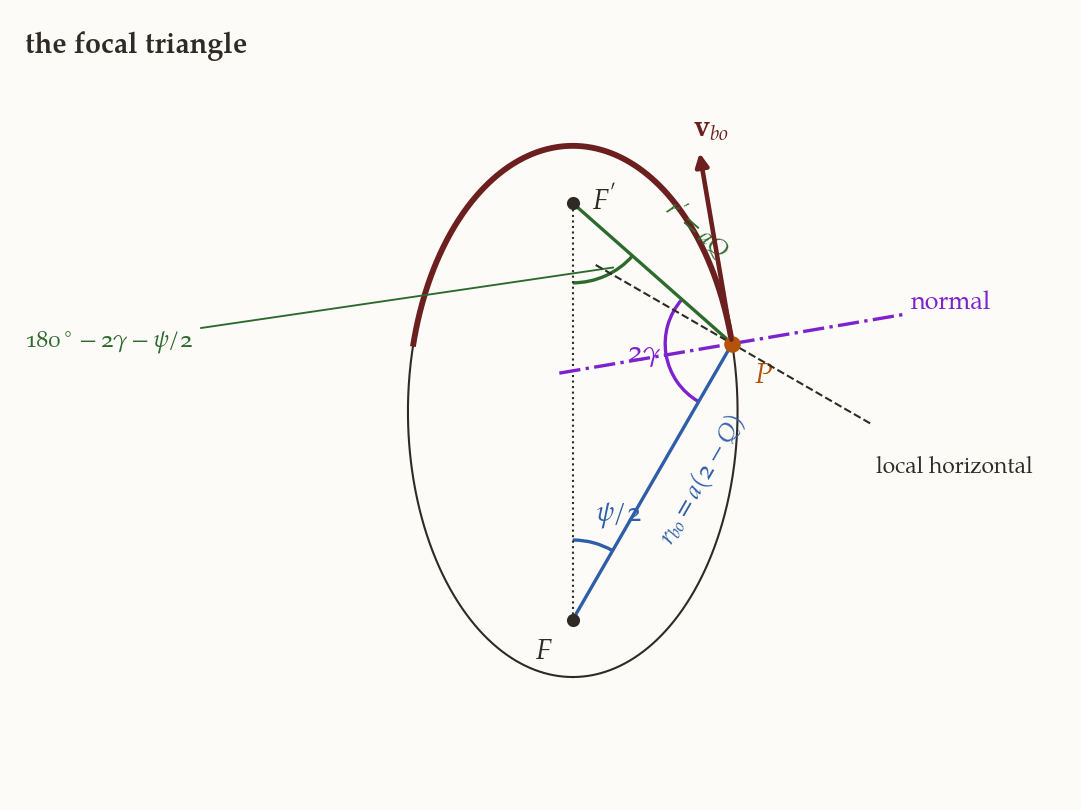
Bate derives Equation 11 from a picture, and the picture is worth having, because it explains the factor \((2-Q)/Q\). Look at the triangle \(FPF'\) of Figure 3: the focus \(F\) (the Earth’s centre), the burnout point \(P\), and the empty focus \(F'\).
Its sides. \(|FP|=r=a(2-Q)\) by Equation 3, and \(|F'P|=r'=aQ\) by Equation 4.
Its angle at \(F\). The direction from \(F\) to the apogee is the direction to \(F'\) (both lie on the major axis, on the apogee side). The angle between \(FP\) and the apogee direction is \(\pi-f_{bo}=\psi/2\) by Equation 1.
Its angle at \(P\). Here we need the reflection property of the ellipse: the normal at a point of the ellipse bisects the angle between the two focal radii. The ellipse is the curve \(r+r'=2a\), where \(r\) and \(r'\) are the distances from the two foci, and \(r\), \(r'\) and \(2a\) are all scalars. The proof turns this scalar statement into a statement about vectors, in three steps. Let \(P\) slide along the ellipse with the velocity \(\mathbf v\) (tangent to the curve; this is only a point moving along a curve, and no dynamics enter).
A second proof, by a mirror. The ellipse is convex, so every point \(X\neq P\) of the tangent at \(P\) lies outside it, where \(FX+XF'>2a=FP+PF'\). So \(P\) is the point of the tangent that makes \(FX+XF'\) smallest. Reflect \(F'\) in the tangent to get \(F''\). Then \(XF'=XF''\), and since both foci are inside the ellipse, \(F'\) and \(F\) are on the same side of the tangent, so \(F\) and \(F''\) are on opposite sides. The shortest path from \(F\) to \(F''\) is the straight segment, and it meets the tangent in exactly one point. That point minimises \(FX+XF''=FX+XF'\), so it is \(P\): the points \(F\), \(P\), \(F''\) lie on a line. Reflecting in the tangent sends the ray \(PF'\) to the ray \(PF''\), the extension of \(FP\) beyond \(P\). Reflecting in the normal instead gives the opposite ray, which is \(PF\). So \(PF\) and \(PF'\) are mirror images in the normal: it bisects the angle \(FPF'\).
Step A: the distances are lengths of vectors. Let \(\mathbf r=P-F\) and \(\mathbf r'=P-F'\) be the vectors from the foci to \(P\), so that \(r=|\mathbf r|\), \(r'=|\mathbf r'|\), and \(\hat{\mathbf r}=\mathbf r/r\), \(\hat{\mathbf r}'=\mathbf r'/r'\) are the unit vectors pointing away from the foci. The foci do not move, so both vectors change at the rate at which \(P\) moves: \(\dot{\mathbf r}=\dot{\mathbf r}'=\mathbf v\).
Step B: the rate of change of a length. Write \(r=\sqrt{\mathbf r\cdot\mathbf r}\) and differentiate:
\[ \frac{dr}{dt}=\frac{d}{dt}\sqrt{\mathbf r\cdot\mathbf r} =\frac{2\,\mathbf r\cdot\dot{\mathbf r}}{2\sqrt{\mathbf r\cdot\mathbf r}} =\frac{\mathbf r\cdot\mathbf v}{r}=\hat{\mathbf r}\cdot\mathbf v . \]
In words: the distance from a fixed point changes at the rate of the component of the velocity along the line to that point. (In coordinates, with \(F\) at \((-c,0)\): \(r=\sqrt{(x+c)^2+y^2}\) and \(\dot r=[(x+c)\dot x+y\dot y]/r\).) The same steps give \(dr'/dt=\hat{\mathbf r}'\cdot\mathbf v\).
Step C: the constraint. On the ellipse \(r+r'=2a\) is constant, so \(dr/dt+dr'/dt=0\). With Step B this reads
\[ (\hat{\mathbf r}+\hat{\mathbf r}')\cdot\mathbf v=0 . \]
(Equivalently: \(r+r'\) is constant along the curve, so its gradient \(\hat{\mathbf r}+\hat{\mathbf r}'\) is perpendicular to the curve; Step B is what shows that \(\nabla r=\hat{\mathbf r}\).)
So \(\mathbf s=\hat{\mathbf r}+\hat{\mathbf r}'\) is perpendicular to the velocity, that is, along the normal. It is not zero: \(\hat{\mathbf r}'=-\hat{\mathbf r}\) would put \(P\) on the segment \(FF'\), but \(r+r'=2a\) is larger than \(|FF'|=2ae\). Both \(\hat{\mathbf r}\) and \(\hat{\mathbf r}'\) have unit length, so \(\mathbf s\cdot\hat{\mathbf r}=1+\hat{\mathbf r}\cdot\hat{\mathbf r}'=\mathbf s\cdot\hat{\mathbf r}'\): the vector \(\mathbf s\) has equal projections on the two unit vectors, and so makes equal angles with them. (It is the diagonal of the rhombus built on \(\hat{\mathbf r}\) and \(\hat{\mathbf r}'\).) The sides of the triangle at \(P\) are \(PF=-r\hat{\mathbf r}\) and \(PF'=-r'\hat{\mathbf r}'\); reversing both vectors does not change the angle between them, so \(\angle FPF'\) is the angle between \(\hat{\mathbf r}\) and \(\hat{\mathbf r}'\), and the normal bisects it. \(\square\)
The size of the angle. The local horizontal is perpendicular to \(\hat{\mathbf r}\), and the normal is perpendicular to the velocity. The velocity is at the angle \(\gamma\) above the horizontal, so the normal is at the angle \(\gamma\) from \(\hat{\mathbf r}\). The bisector makes the angle \(\gamma\) with each focal radius, so the angle \(FPF'=2\gamma\).
Its angle at \(F'\). The three angles add up to \(\pi\), so the angle at \(F'\) is \(\pi-2\gamma-\psi/2\).
Now the sine rule: side over the sine of the opposite angle is the same for all three sides. For the sides \(FP\) (opposite \(F'\)) and \(F'P\) (opposite \(F\)):
\[ \frac{r}{\sin(\pi-2\gamma-\psi/2)}=\frac{r'}{\sin(\psi/2)}\ \Longrightarrow\ \sin\Bigl(2\gamma+\frac\psi2\Bigr)=\frac{r}{r'}\sin\frac\psi2=\frac{a(2-Q)}{aQ}\sin\frac\psi2 . \]
This is Equation 11. The factor \((2-Q)/Q\) is the ratio of the two focal distances at the burnout point, which the energy fixes.
4.3 Two answers
The sine of an angle takes the same value at two angles, \(A\) and \(\pi-A\). Let \(A=\arcsin\bigl[\frac{2-Q}{Q}\sin\frac\psi2\bigr]\). Then \(2\gamma+\psi/2\) can be \(A\) or \(\pi-A\), and
\[ \gamma_{low}=\frac12\Bigl(A-\frac\psi2\Bigr),\qquad \gamma_{high}=\frac12\Bigl(\pi-A-\frac\psi2\Bigr). \tag{12}\]
The low trajectory and the high trajectory have the same energy (the same \(Q\) and \(r\), so the same \(a\)): they are two different ellipses of the same size through the burnout point and the re-entry point. (Think of the hose: a flat jet and a lobbed jet can both hit the same target.) Adding the two roots,
\[ \gamma_{low}+\gamma_{high}=\frac{\pi-\psi}{2}, \]
so the two angles are symmetric about \(\gamma_{max}=(\pi-\psi)/4\). On a flat Earth (\(\psi\to0\)) this is \(\gamma_{low}+\gamma_{high}=90^\circ\), the complementary angles of the projectile.
Example 1 (two roads to one target). A vehicle has \(Q=0.9\). What flight-path angles reach a target at \(\psi=90^\circ\)?
Solution. \(\dfrac{2-Q}{Q}\sin\dfrac\psi2=\dfrac{1.1}{0.9}\sin45^\circ=0.8642\), so \(A=59.80^\circ\). Then \(\gamma_{low}=\tfrac12(59.80^\circ-45^\circ)=7.40^\circ\) and \(\gamma_{high}=\tfrac12(180^\circ-59.80^\circ-45^\circ)=37.60^\circ\). They add to \(45^\circ=(180^\circ-90^\circ)/2\) as they should. (The largest range at this \(Q\) is \(\psi_{max}=2\arcsin(0.9/1.1)=109.8^\circ\), so the target is within reach.)
4.4 Are there always two?
No. The right side of Equation 11 must be at most \(1\) in size, and the angles must be physically possible: \(\gamma\ge0\) (a negative \(\gamma\) means the path starts downward, below \(r_{bo}\), and never flies the arc through the apogee that lies above \(r_{bo}\) everywhere; whether such a path reaches the ground is the question of Section 4.5, not something that \(\gamma<0\) implies). Write \(\kappa=(2-Q)/Q\). Then:
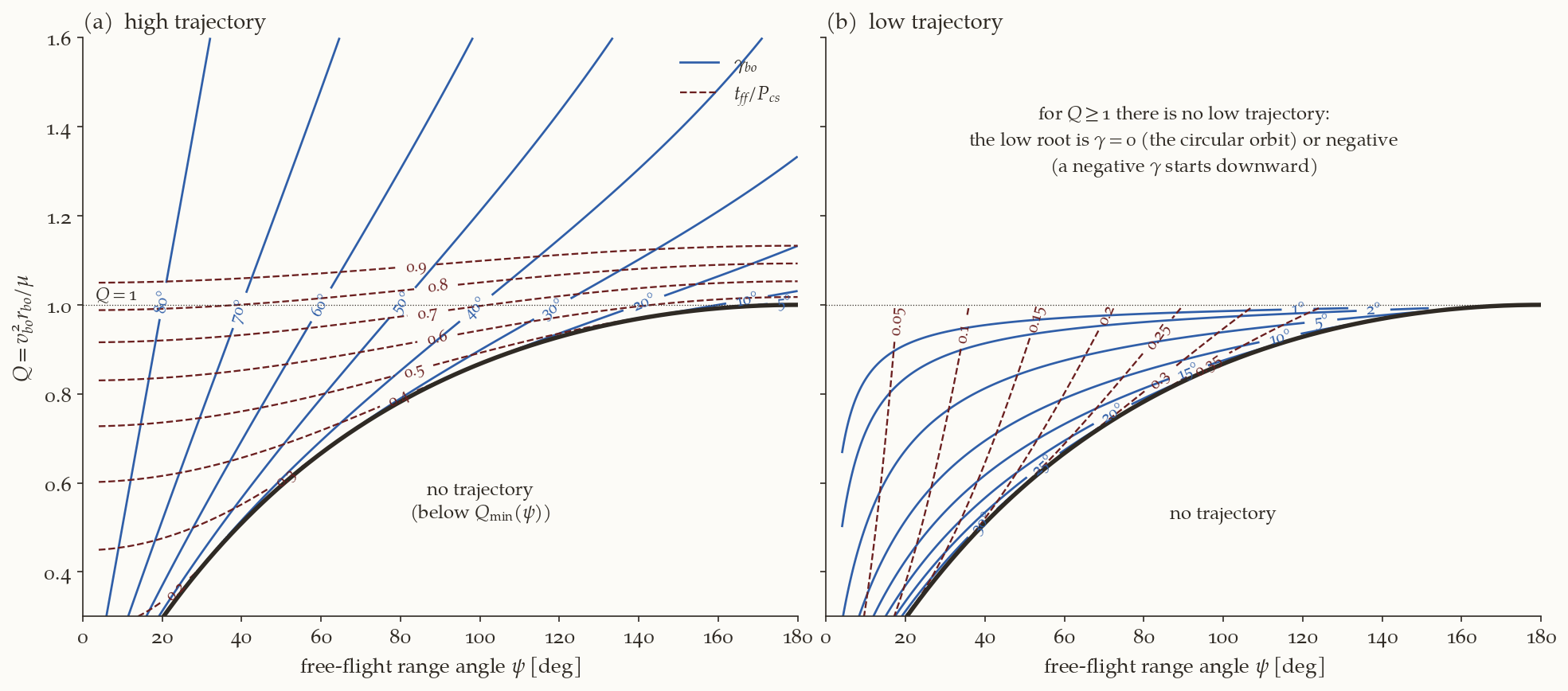
- \(Q<1\) (\(\kappa>1\)). Real roots need \(\kappa\sin(\psi/2)\le1\), which for \(\psi/2\le\pi/2\) means \(\psi\le\psi_{max}\) with \(\sin(\psi_{max}/2)=Q/(2-Q)\) (derived in Section 5). Below that there are two roots (low and high); at it, one; above, none: the vehicle cannot reach. And if \(\psi>180^\circ\) there is no root at all: with \(Q<1\) the free flight cannot go more than half-way round.
- \(Q=1\) (\(\kappa=1\)). Then \(\sin(2\gamma+\psi/2)=\sin(\psi/2)\), with the roots \(\gamma=0\) and \(\gamma=(\pi-\psi)/2\). The first is the circular orbit at the burnout radius, through the burnout and re-entry points for any \(\psi\). The second is a real flight for \(\psi<180^\circ\) and negative beyond.
- \(Q>1\) (\(\kappa<1\)). Now \(A<\arcsin(\sin\psi/2)=\min(\psi/2,\pi-\psi/2)\). Then \(\gamma_{low}<0\): there is no low trajectory, because a negative \(\gamma\) starts downward, below \(r_{bo}\). And \(\gamma_{high}>0\) for every \(\psi<360^\circ\), so there is exactly one trajectory, for any range including ranges beyond \(180^\circ\). A vehicle that is faster than circular speed can be aimed at every range angle below \(360^\circ\), in particular at the far side “the long way”. (Aimed, not delivered: when the burnout is above the ground the flattest of these flights stay above the surface and never come down; see Section 4.5.)
| \(\psi<\psi_{max}\), and \(\psi\le180^\circ\) | \(\psi=\psi_{max}\) | \(\psi>\psi_{max}\) or \(\psi>180^\circ\) | |
|---|---|---|---|
| \(Q<1\) | low and high | one, \(\gamma=45^\circ-\psi/4\) | none |
| \(Q=1\) | the circular orbit (\(\gamma=0\)), and the high one | only the circular orbit for \(\psi>180^\circ\) | |
| \(Q>1\) | the high one only | the high one only |
The case \(Q>1\), \(\psi>180^\circ\) is not a curiosity: it is the trajectory that Bate calls a “backdoor” flight, from a launch point to a target by the long way round the Earth. It is costly: at \(Q>1\) the vehicle is beyond circular speed at burnout.
Example 2 (a long range). The burnout point is at \(30^\circ\)N, \(60^\circ\)E and re-entry at \(30^\circ\)S, \(60^\circ\)W; burnout is \(159.45\) km above the surface (\(r_{bo}=6537.6\) km) at \(v_{bo}=8.551\) km/s. Which \(\gamma\) is needed?
Solution. The range angle between the two points comes from the spherical law of cosines (Section 8 has the formula, Equation 29), \(\cos\psi=\sin30^\circ\sin(-30^\circ)+\cos30^\circ\cos(-30^\circ)\cos120^\circ=-0.625\). So \(\psi=128.68^\circ\) (the short way). The burnout speed gives \(Q=8.551^2\times6537.6/398\,600.4=1.1993>1\). So there is only the high trajectory: \(\dfrac{2-Q}{Q}\sin\dfrac\psi2=0.6676\times\sin64.34^\circ=0.6018\), \(A=37.00^\circ\) and \(\gamma=\tfrac12(180^\circ-37.00^\circ-64.34^\circ)=39.33^\circ\). (The other root is \(\tfrac12(37.00^\circ-64.34^\circ)=-13.7^\circ\), below the horizon.) Bate rounds \(Q\) to \(1.2\) and gets \(39.36^\circ\).
4.5 Does the flight come down?
Everything so far was about the free-flight arc, between two points at the radius \(r_{bo}\). Nothing in it says that the vehicle will reach the ground afterwards, because the arc is only a piece of an ellipse, and what happens after re-entry depends on the rest of the ellipse. If the ellipse continues below the surface of the Earth, the vehicle hits the Earth: this is a ballistic flight in the sense of a missile, a sounding rocket or a returning capsule. If the whole ellipse stays above the surface, the vehicle never comes down (until drag or a braking burn brings it down): what we called the free-flight arc is then a piece of a satellite orbit. The difference is a question about the shape of the ellipse, and \(Q\) alone does not answer it.
The test. The point of the ellipse that is closest to the Earth’s centre is the perigee, at the distance \(r_p=a(1-e)\) from the focus. The surface is the sphere of radius \(R_\oplus\) about the same focus, so the ellipse dips below the surface exactly when \(r_p<R_\oplus\). (This is not the same as asking where the burnout point is: the burnout point is above the ground, \(r_{bo}\ge R_\oplus\), and for \(\gamma>0\) the perigee is behind it, at a smaller radius, \(r_p<r_{bo}\).) With \(a=r_{bo}/(2-Q)\) from Equation 3,
\[ r_p=a(1-e)=r_{bo}\,\frac{1-e}{2-Q}. \tag{13}\]
The threshold. We want the condition on the burnout state, so we solve \(r_p<R_\oplus\) for \(\gamma\) in three steps. First, for an ellipse \(2-Q>0\), so we can multiply by it without turning the inequality round, and
\[ \frac{1-e}{2-Q}<\frac{R_\oplus}{r_{bo}}\quad\Longleftrightarrow\quad e>e_*,\qquad e_*=1-(2-Q)\frac{R_\oplus}{r_{bo}} . \]
The ellipse must be eccentric enough: a nearly circular one at the burnout radius cannot reach the ground. Second, Equation 6 says \(e^2=1-Q(2-Q)\cos^2\gamma\), which grows as \(\gamma\) grows (\(\cos^2\gamma\) falls), so “eccentric enough” means “steep enough”. If \(e_*>0\) both sides of \(e>e_*\) are positive and we may square it:
\[ 1-Q(2-Q)\cos^2\gamma>e_*^2\quad\Longleftrightarrow\quad\cos^2\gamma<\frac{1-e_*^2}{Q(2-Q)} . \]
So the vehicle comes down if and only if \(\gamma>\gamma_*\), where
\[ \boxed{\gamma_*=\arccos\sqrt{\frac{1-e_*^2}{Q(2-Q)}}},\qquad e_*=1-(2-Q)\frac{R_\oplus}{r_{bo}} . \tag{14}\]
Third, there may be no such angle. The smallest eccentricity the ellipse can have is at the flattest burnout, \(\gamma=0\), where Equation 6 gives \(e^2=1+Q^2-2Q=(1-Q)^2\), that is \(e=|1-Q|\). If \(e_*\le|1-Q|\), even the flattest flight dips below the surface and every \(\gamma\) comes down (\(\gamma_*=0\)).
A special case: circular speed. At \(Q=1\) the eccentricity is \(e=\sin\gamma\) (Equation 6 with \(Q(2-Q)=1\)), and \(e_*=1-R_\oplus/r_{bo}=z_{bo}/r_{bo}\), where \(z_{bo}=r_{bo}-R_\oplus\) is the burnout altitude. So at circular speed
\[ \text{the vehicle comes down}\iff\sin\gamma>\frac{z_{bo}}{r_{bo}} . \]
When can a flight miss at all? Put the condition \(e_*>|1-Q|\) into words. For \(1\le Q<2\) it reads \(1-(2-Q)R_\oplus/r_{bo}>Q-1\), that is \((2-Q)(1-R_\oplus/r_{bo})>0\), which is true whenever the burnout is above the ground. So at or above circular speed there is always a band of flat burnouts, \(0\le\gamma<\gamma_*\), that stays up. For \(Q<1\) the condition reads \(1-(2-Q)R_\oplus/r_{bo}>1-Q\), that is \(Q(r_{bo}+R_\oplus)>2R_\oplus\):
\[ Q>\frac{2R_\oplus}{r_{bo}+R_\oplus}\qquad(Q<1), \]
which is \(0.9846\) for a burnout at \(200\) km, \(0.9623\) at \(500\) km and \(0.9273\) at \(1000\) km. Below that value every flight with \(Q<1\) comes down; between it and \(1\) the flattest ones do not. At the surface (\(z_{bo}=0\)) every \(\gamma>0\) comes down for every \(Q\), which is why the arcs of Figure 7, drawn from the surface, never miss.
| \(Q\) | \(z_{bo}=0\) | \(200\) km | \(500\) km | \(1000\) km |
|---|---|---|---|---|
| \(0.97\) | all | all | \(1.91^\circ\) | \(6.05^\circ\) |
| \(1\) | all | \(1.74^\circ\) | \(4.17^\circ\) | \(7.79^\circ\) |
| \(1.2\) | all | \(5.95^\circ\) | \(9.59^\circ\) | \(13.87^\circ\) |
| \(1.5\) | all | \(8.25^\circ\) | \(12.95^\circ\) | \(18.10^\circ\) |
Figure 4, Figure 5 and Figure 6 show the three regimes (\(Q<1\), \(Q=1\), \(Q>1\)), for a burnout \(1000\) km above the surface: that altitude is higher than a missile’s, and it is chosen so that the gap between a non-landing ellipse and the ground is large enough to see. The solid line is the path of the vehicle. A flight that comes down is drawn solid from burnout to the impact point (a cross), and the rest of its ellipse (the part under the ground, and the part before burnout) is dotted. A flight that stays up flies the whole ellipse, which is then closed and solid.
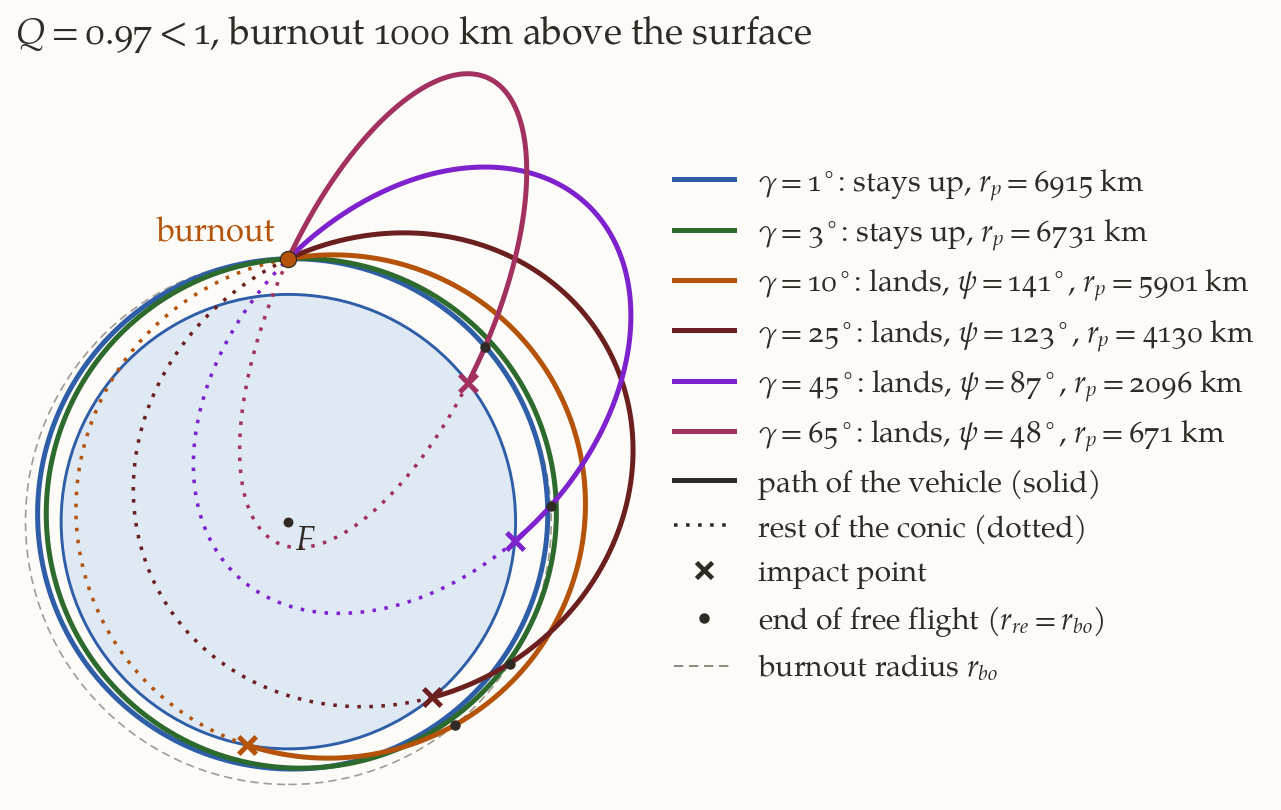
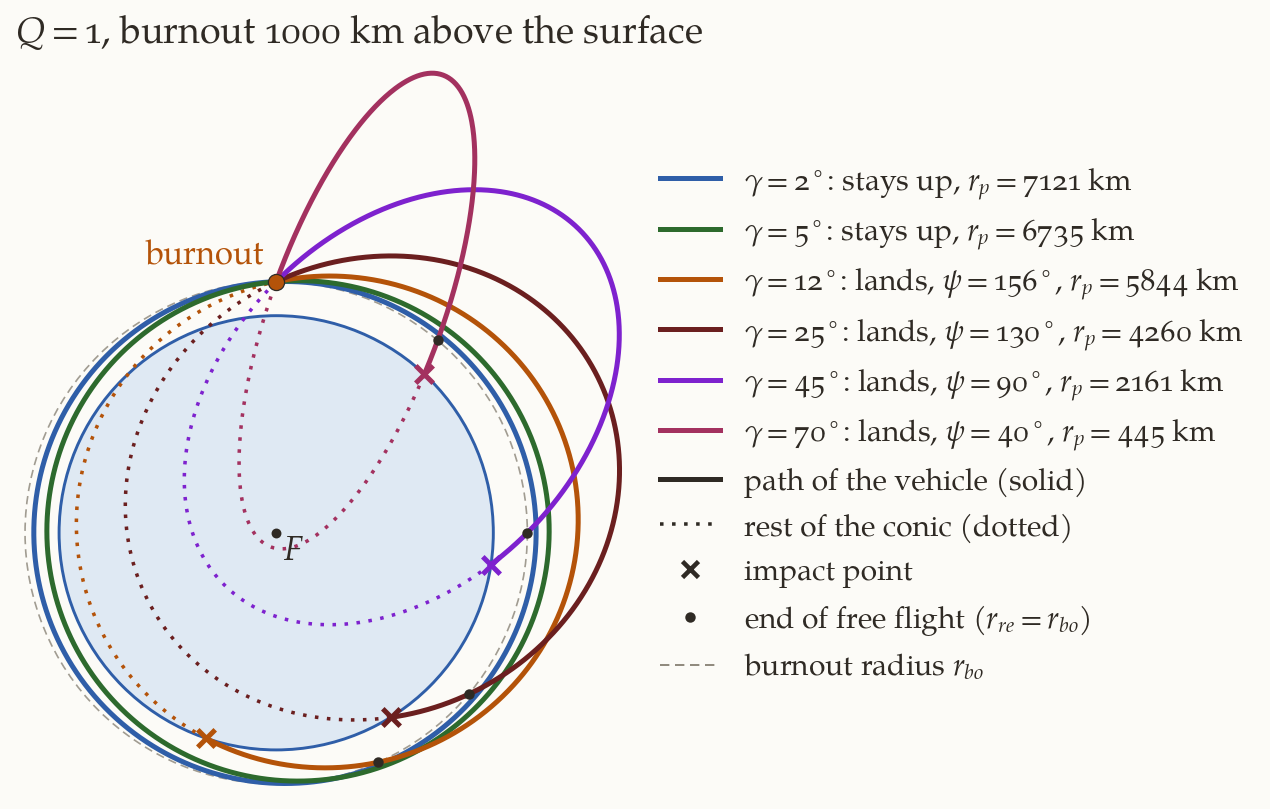
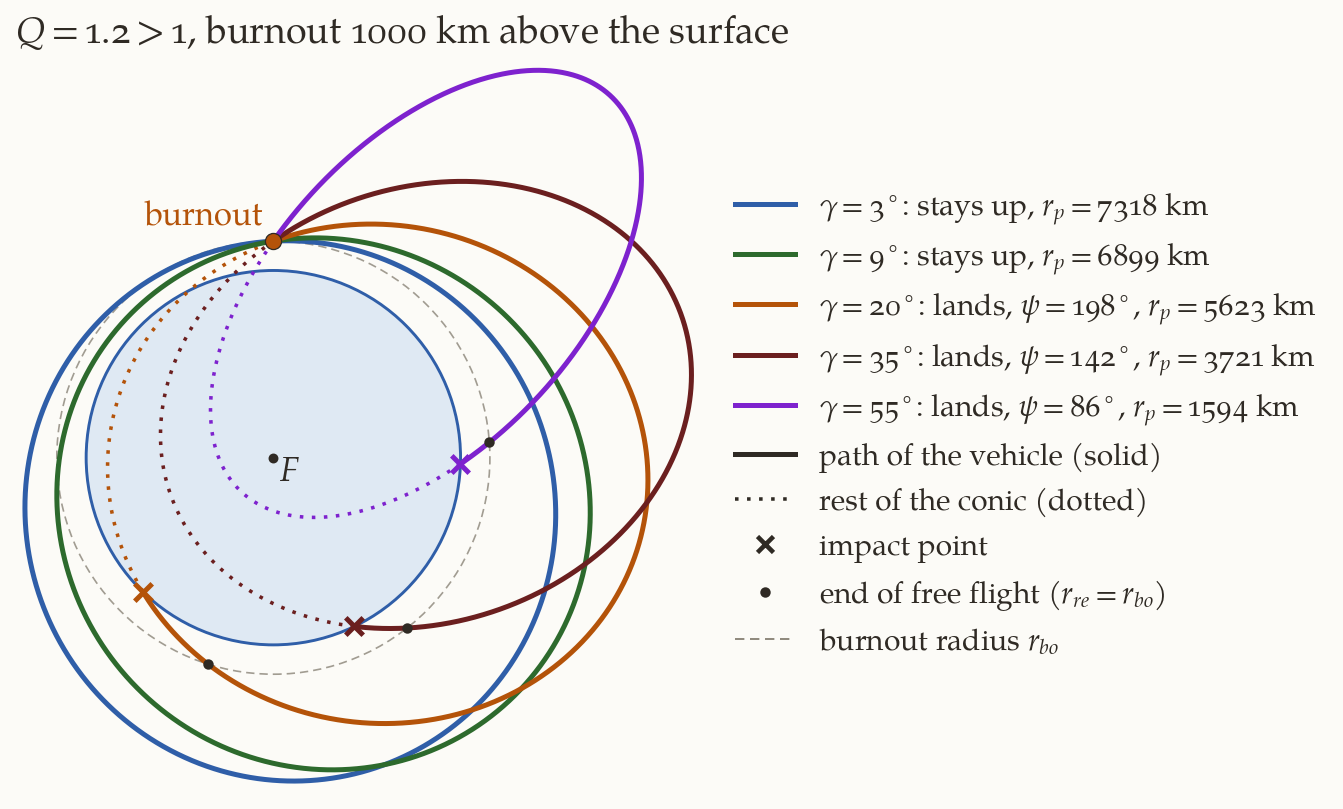
For \(Q\ge1\) the range \(\psi\) falls steadily as \(\gamma\) rises, so the flights that come down are those with \(\psi\) below its value at \(\gamma_*\). At \(200\) km and \(Q=1.2\), \(\gamma_*=5.95^\circ\) and \(\psi(\gamma_*)=293.0^\circ\): the range formulas of this note still apply to a flight with a longer range, but it is a satellite orbit. At \(Q=1\), \(\psi=180^\circ-2\gamma\), and the longest flight that comes down has \(\psi=180^\circ-2\gamma_*\); a flight of more than half-way round at circular speed is only the circular orbit.
A vehicle burns out at exactly circular speed (\(Q=1\)) at \(200\) km altitude. For which flight-path angles does it come down, and what is the longest free-flight range that ends on the ground?
Answer
At \(Q=1\) the threshold is \(\sin\gamma_*=z_{bo}/r_{bo}=200/6578.137=0.0304\), so \(\gamma_*=1.74^\circ\): the vehicle comes down for \(\gamma>1.74^\circ\). At \(Q=1\) the range is \(\psi=180^\circ-2\gamma\) (the root \(\gamma=(\pi-\psi)/2\) found above), so the longest flight that comes down has \(\psi=180^\circ-3.48^\circ=176.5^\circ\). A flatter burnout stays up, and in the limit \(\gamma\to0\) it is the circular orbit at the burnout radius.5 Maximum range, minimum speed
Fix \(Q\) and increase \(\psi\) from zero. The two roots \(\gamma_{low}\) and \(\gamma_{high}\) approach each other and merge, and beyond that point there is no flight. The merge is the maximum range, and it is where the two solutions of the sine coincide, \(A=\pi-A=\pi/2\):
\[ \frac{2-Q}{Q}\sin\frac\psi2=1,\qquad 2\gamma+\frac\psi2=\frac\pi2 . \]
Reading these off,
\[ \boxed{\gamma_{max}=\frac{\pi-\psi}{4}=45^\circ-\frac\psi4},\qquad \boxed{\sin\frac{\psi_{max}}{2}=\frac{Q}{2-Q}}\quad(Q<1), \tag{15}\]
or, solved for \(Q\) (which is the form for design: the smallest \(Q\), hence the least burnout speed at a given radius, that reaches range angle \(\psi\)):
\[ \boxed{Q_{min}=\frac{2\sin(\psi/2)}{1+\sin(\psi/2)}} . \tag{16}\]
(Check: from \(\sin(\psi/2)=Q/(2-Q)\), \(\sin(\psi/2)\,(2-Q)=Q\), so \(2\sin(\psi/2)=Q\,(1+\sin(\psi/2))\).) For a flat Earth \(\gamma_{max}=45^\circ\); on a round one it is lower, by \(\psi/4\), and for half-way round the Earth, \(\psi=180^\circ\), it is zero: \(Q_{min}=1\) and the best flight is the circular orbit. Half-way round the Earth costs full orbital speed; this is why the ranges in Figure 2 never exceed \(180^\circ\) for \(Q<1\). For the same reason, Bate’s exercise 6.8 has no answer: for \(Q=1.02\) the formula \(\sin(\psi/2)=Q/(2-Q)\) gives a number larger than \(1\), because the maximum range stops being a maximum once \(Q>1\) (there is no peak in Figure 2 (a)).
Two ways to see the same result.
It is where the slope vanishes. Section 7 shows that \(\partial\psi/\partial\gamma=2\sin(\psi+2\gamma)/\sin2\gamma-2\), which is zero when \(\sin(\psi+2\gamma)=\sin2\gamma\), i.e. \(\psi+2\gamma=\pi-2\gamma\), i.e. \(\gamma=(\pi-\psi)/4\). The same.
It is the minimum-energy ellipse of Lambert’s problem. At the maximum range the angle of the focal triangle at \(F'\) is \(\pi-2\gamma-\psi/2=\pi/2\), a right angle: the line \(F'P\) is perpendicular to the major axis, so the burnout point is at the end of the latus rectum through the empty focus. A point at the end of the latus rectum is at the distance \(p\) from the focus, so \(r'=p\), that is \(aQ=a(1-e^2)\):
\[ Q=1-e^2\quad\text{and}\quad\sin\frac{\psi_{max}}{2}=\frac{1-e^2}{1+e^2}\qquad\text{at the maximum range.} \]
(Bate’s exercise 6.18.) In the Lambert problem of the Lambert note the ellipse of least energy between two points \(\mathbf r_1,\mathbf r_2\) has \(a_m=(r_1+r_2+c)/4\), with the chord \(c\). Here \(r_1=r_2=r\) and \(c=2r\sin(\psi/2)\), so \(a_m=r(1+\sin(\psi/2))/2\) and \(Q=2-r/a_m=2\sin(\psi/2)/(1+\sin(\psi/2))\), which is Equation 16. So “the vehicle that has just enough speed to reach the target” and “the minimum-energy transfer between the burnout and re-entry points” are the same ellipse, and everything we know about minimum-energy transfers applies. For a given burnout altitude, the least speed is the least \(Q\); for a given launch vehicle that is the flight that leaves the most propellant for payload.
Example 3 (what range can this vehicle reach?). Burnout is at \(477.8\) km altitude with \(7.407\) km/s. What is the maximum range?
Solution. \(r=6855.9\) km and \(Q=7.407^2\times6855.9/398\,600.4=0.9436\). Then \(\sin(\psi_{max}/2)=Q/(2-Q)=0.8932\), \(\psi_{max}=126.55^\circ\). The ground range is \(\psi_{max}R_\oplus=14\,087\) km, at \(\gamma_{max}=45^\circ-126.55^\circ/4=13.36^\circ\). (Bate reads \(129^\circ\) from his chart, and the exact value is \(126.5^\circ\).)
Example 4 (what speed for this range?). A range of \(14\,816\) km (\(8000\) nm) is wanted, at a burnout altitude of \(637\) km. What is the least burnout speed, and what is \(\gamma\)?
Solution. \(\psi=14\,816/6378.137=133.09^\circ\). \(Q_{min}=2\sin66.55^\circ/(1+\sin66.55^\circ)=2(0.9174)/1.9174=0.9569\). With \(r=7015.2\) km, \(v=\sqrt{Q\mu/r}=7.374\) km/s and \(\gamma=45^\circ-133.09^\circ/4=11.73^\circ\). A slightly lower speed does not reach; a higher one reaches with a choice of low or high flight-path angles.
A vehicle is flown at its maximum range. Suppose we raise its speed so that \(Q\) rises from \(0.98\) to \(1.02\). Why does the formula \(\sin(\psi_{max}/2)=Q/(2-Q)\) fail?
Answer
At \(Q=0.98\) the formula gives \(\sin(\psi_{max}/2)=0.98/1.02=0.961\), \(\psi_{max}=147.8^\circ\). At \(Q=1.02\) it gives \(1.02/0.98=1.041>1\), no angle. The reason is not an error: for \(Q\ge1\) the maximum does not exist. The range keeps increasing as the flight is made flatter, up to the circle (\(\psi=360^\circ\) at \(\gamma\to0\); a satellite orbit, not a flight that comes down, when the burnout is above the ground, Section 4.5), as the \(Q=1.2\) curve of Figure 2 (a) shows. There is a peak only when \(Q<1\).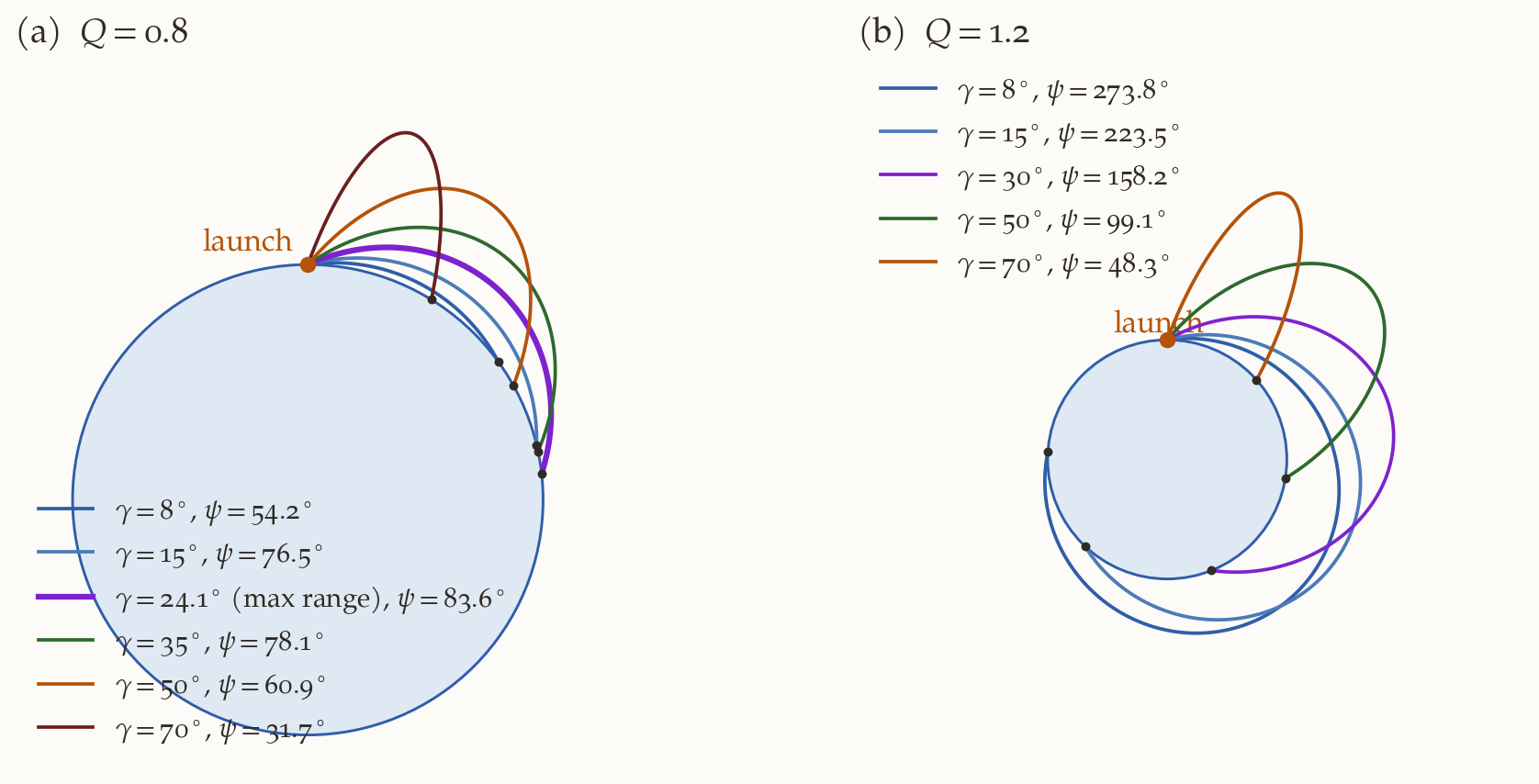
6 The time of flight
From burnout to re-entry the vehicle moves from true anomaly \(\pi-\psi/2\) to \(\pi+\psi/2\), symmetrically through the apogee (\(f=\pi\), \(E=\pi\)). So the flight time is twice the time from burnout to apogee. Kepler’s equation gives the time from the perigee, \(t=\sqrt{a^3/\mu}\,(E-e\sin E)\), and the difference between the apogee (\(E=\pi\), \(e\sin\pi=0\)) and the burnout point is \(\sqrt{a^3/\mu}\,[\pi-(E_{bo}-e\sin E_{bo})]\). Therefore
\[ t_{ff}=2\sqrt{\frac{a^3}{\mu}}\Bigl(\pi-E_{bo}+e\sin E_{bo}\Bigr). \tag{17}\]
The eccentric anomaly at burnout. We need \(E_{bo}\) in terms of \(Q\) and \(\gamma\). From \(r=a(1-e\cos E)\) and \(r=a(2-Q)\):
\[ e\cos E_{bo}=1-\frac ra=1-(2-Q)=Q-1 . \]
For the sine, use \(e^2-(e\cos E)^2=e^2\sin^2E\). By Equation 6, \(e^2-(Q-1)^2=1+Q^2\cos^2\gamma-2Q\cos^2\gamma-Q^2+2Q-1=Q(2-Q)-Q(2-Q)\cos^2\gamma=Q(2-Q)\sin^2\gamma\). Therefore, with \(\sin E_{bo}>0\) (burnout before apogee, \(0<E_{bo}<\pi\)),
\[ e\sin E_{bo}=\sqrt{Q(2-Q)}\,\sin\gamma,\qquad E_{bo}=\operatorname{atan2}\bigl(\sqrt{Q(2-Q)}\sin\gamma,\ Q-1\bigr). \tag{18}\]
(\(E_{bo}\) is below \(90^\circ\) for \(Q>1\) and above it for \(Q<1\), where the burnout point is on the apogee side of the minor axis end.) Substituting in Equation 17 and using \(a=r/(2-Q)\), \(\sqrt{a^3/\mu}=\sqrt{r^3/\mu}\,(2-Q)^{-3/2}\):
\[ \boxed{\frac{t_{ff}}{P_{cs}}=\frac{\pi-E_{bo}+\sqrt{Q(2-Q)}\,\sin\gamma}{\pi\,(2-Q)^{3/2}}},\qquad P_{cs}=2\pi\sqrt{\frac{r_{bo}^3}{\mu}} . \tag{19}\]
Here \(P_{cs}\) is the period of a fictitious circular satellite at the burnout radius (\(P_{cs}=94.2\) min at \(478\) km altitude; Bate has a graph). The flight time in units of \(P_{cs}\) depends only on \(Q\) and \(\gamma\), the same two numbers that fix \(\psi\). So one chart can show the range angle, the flight-path angle, and the flight time for every ballistic flight, which is Bate’s Fig. 6.2-9. We have redrawn it from the equations (Figure 8).
Check on the flat-Earth limit. For \(Q\to0\) the time must become the projectile’s, \(2v\sin\gamma/g\). The verify script checks numerically that Equation 19 does this (ratio \(1.00003\) at \(v=0.05\) km/s).
Example 5 (from measurements to range and time). In a test the burnout radius is \(1.2R_\oplus=7653.8\) km, the burnout speed is \(\tfrac23\sqrt{\mu/R_\oplus}=5.2702\) km/s, and the apogee is observed at \(1.5R_\oplus=9567.2\) km. Find \(\gamma\), the range and the flight time.
Solution. \(Q=v^2r/\mu=0.5333\). The flight-path angle is not given; the apogee radius gives it by angular momentum. The energy is \(\varepsilon=v^2/2-\mu/r=-38.19\) km\(^2\)/s\(^2\), so the apogee speed is \(v_a=\sqrt{2(\varepsilon+\mu/r_a)}=2.635\) km/s, and \(h=r_av_a\) equals \(rv\cos\gamma\), so \(\cos\gamma=r_av_a/(rv)=0.625\) and \(\gamma=51.32^\circ\). Then Equation 9 gives \(\tan(\psi/2)=0.5333\times0.7806\times0.625/(1-0.5333\times0.3906)=0.2602/0.7917=0.3287\), \(\psi=36.39^\circ\), and the ground range is \(\psi R_\oplus=4051\) km (Bate: \(2184\) nm \(=4045\) km). For the time, \(P_{cs}=2\pi\sqrt{r^3/\mu}=111.06\) min, the ellipse has \(a=r/(2-Q)=5218\) km and \(e=\sqrt{1+Q(Q-2)\cos^2\gamma}=0.8333\) (so its apogee is at \(a(1+e)=9567\) km, as given), and Equation 19 gives \(t_{ff}=1990.5\) s \(=33.2\) min. A direct numerical integration of the equations of motion from the burnout state gives the same \(\psi\) and \(t_{ff}\) (the verify script compares them to \(10^{-11}\) rad and \(10^{-7}\) s).
What the check is. Every formula in this note can be tested in one way that does not depend on any of its derivations: start the vehicle at \((r_{bo},v_{bo},\gamma)\), integrate \(\ddot{\mathbf r}=-\mu\mathbf r/r^3\) numerically until \(r\) returns to \(r_{bo}\), and measure the angle swept and the time. ballistic-verify.py does this for seven cases, including ones with \(\psi>180^\circ\).
7 Errors at burnout: the influence coefficients
A real burnout is never exactly the planned one. How far from the target does the vehicle land if the burnout state is off by a little? The question is the same for a sounding rocket that must land in a recovery zone. For small errors the answer is linear, and the coefficients of the linear law are called influence coefficients. There are three in the plane of the trajectory (the errors \(\Delta\gamma\), \(\Delta r\), \(\Delta v\) of the burnout state) and two out of it (a displacement of the burnout point sideways, and an error in azimuth), plus the trivial one: a burnout point displaced down-range is simply moved forward, and the vehicle lands the same distance beyond the target.
7.1 Out of the plane
A sideways displacement of the burnout point. Let the burnout point be shifted sideways, perpendicular to the trajectory plane, by the angle \(\Delta X\) at the Earth’s centre, everything else (speed, direction, flight-path angle) being nominal. The simplest case: the burnout point on the equator and the heading due north. The nominal path goes up the meridian at longitude \(0\); the actual path goes up the meridian at longitude \(\Delta X\). After the range angle \(\psi\) the two landing points are at the same latitude \(\psi\), a longitude difference \(\Delta X\) apart. The spherical law of cosines for the angular distance \(\Delta C\) between them gives
\[ \cos\Delta C=\sin^2\psi+\cos^2\psi\cos\Delta X . \]
For small angles, \(1-\Delta C^2/2\approx\sin^2\psi+\cos^2\psi\,(1-\Delta X^2/2)=1-\cos^2\psi\,\Delta X^2/2\), so
\[ \boxed{\Delta C\approx\Delta X\cos\psi} . \tag{20}\]
There is a way to see this for any launch point and azimuth, not only for the equator. The displaced trajectory is the nominal one rotated rigidly about an axis through the Earth’s centre: the axis in the trajectory plane that lies \(90^\circ\) ahead of the launch point along the track. Rotating by the angle \(\Delta X\) about that axis moves the launch point sideways by \(\Delta X\) (it is \(90^\circ\) from the axis) and moves the point at range angle \(\psi\), which is \(90^\circ-\psi\) from the axis, sideways by \(\Delta X\sin(90^\circ-\psi)=\Delta X\cos\psi\). At \(\psi=90^\circ\) the landing point is the axis, so it does not move at all: a displacement of the burnout point makes no difference for a flight of a quarter of the Earth. (The verify script checks this for three launch points and azimuths.)
An azimuth error. Let the launch azimuth be wrong by \(\Delta A\), everything else being nominal. The two paths are great circles starting from the same point at the angle \(\Delta A\), and both have the same range angle \(\psi\). The distance between the landing points follows from the spherical law of cosines in the isosceles triangle with two sides \(\psi\) and the angle \(\Delta A\) between them:
\[ \cos\Delta C=\cos^2\psi+\sin^2\psi\cos\Delta A\quad\Longrightarrow\quad\boxed{\Delta C\approx\Delta A\sin\psi} . \tag{21}\]
(Small angles again: \(1-\Delta C^2/2\approx\cos^2\psi+\sin^2\psi(1-\Delta A^2/2)\).) The azimuth error is harmless at \(\psi=180^\circ\) (every great circle from a point meets again at the antipode) and has its worst effect at \(\psi=90^\circ\) (Figure 9 (c)). Both results are Bate’s. They show a feature of the problem that is easy to miss: the same range has a different sensitivity to different errors, so one cannot say “this range is good”; one has to say for which error.
7.2 In the plane
The range angle depends on three numbers. By Equation 9, \(\psi=\psi(Q,\gamma)\), and \(Q=v^2r/\mu\). So the in-plane errors act through \(Q\) and \(\gamma\) only, and the linear law is
\[ \Delta\psi=\frac{\partial\psi}{\partial Q}\,\Delta Q+\frac{\partial\psi}{\partial\gamma}\,\Delta\gamma,\qquad \frac{\Delta Q}{Q}=\frac{\Delta r}{r}+\frac{2\,\Delta v}{v} . \tag{22}\]
(The relative change of \(Q\) follows by taking logarithms of \(Q=v^2r/\mu\) and differentiating.) Two consequences before any calculus. A burnout that is too high by \(\Delta r/r\) is compensated by a burnout that is too slow by \(\Delta v/v=-\tfrac12\Delta r/r\), and the range is unchanged. And the speed error is twice as dangerous as a height error of the same relative size. We need only two partial derivatives, \(\partial\psi/\partial Q\) and \(\partial\psi/\partial\gamma\), and both come from the cotangent form of the range equation, Equation 10.
The derivative with respect to \(Q\). Differentiate \(\cot(\psi/2)=2/(Q\sin2\gamma)-\cot\gamma\) with respect to \(Q\) at fixed \(\gamma\). The left side gives \(-\tfrac12\csc^2(\psi/2)\,\psi_Q\) and the right side \(-2/(Q^2\sin2\gamma)\), so
\[ \frac{\partial\psi}{\partial Q}=\frac{4\sin^2(\psi/2)}{Q^2\sin2\gamma}>0 . \tag{23}\]
It is positive always: more energy, more range. Bate’s exercise 6.22 asks for this. With \(\partial Q/\partial r=Q/r\) and \(\partial Q/\partial v=2Q/v\) the coefficients for the burnout radius and speed follow (Bate’s eqs. 6.3-16 and 6.3-18):
\[ \boxed{\frac{\partial\psi}{\partial r_{bo}}=\frac{4\mu\sin^2(\psi/2)}{v^2r^2\sin2\gamma}},\qquad \boxed{\frac{\partial\psi}{\partial v_{bo}}=\frac{8\mu\sin^2(\psi/2)}{v^3r\sin2\gamma}}=\frac{2r}{v}\frac{\partial\psi}{\partial r_{bo}} . \tag{24}\]
The derivative with respect to \(\gamma\). Differentiate the same cotangent form with respect to \(\gamma\) at fixed \(Q\):
\[ -\frac12\csc^2\frac\psi2\,\psi_\gamma=-\frac{4\cos2\gamma}{Q\sin^22\gamma}+\csc^2\gamma . \]
Multiply by \(-2\sin^2(\psi/2)\): \(\ \psi_\gamma=2\sin^2\frac\psi2\Bigl[\dfrac{4\cos2\gamma}{Q\sin^22\gamma}-\dfrac1{\sin^2\gamma}\Bigr]\). To simplify, use the range equation to remove \(Q\): from Equation 10, \(\dfrac{2}{Q\sin2\gamma}=\cot\dfrac\psi2+\cot\gamma\), so \(\dfrac{4\cos2\gamma}{Q\sin^22\gamma}=2\cot2\gamma\,\bigl(\cot\tfrac\psi2+\cot\gamma\bigr)\). With the double-angle identity \(2\cot2\gamma\cot\gamma=\cot^2\gamma-1\) and \(\csc^2\gamma=1+\cot^2\gamma\), the bracket becomes
\[ 2\cot2\gamma\cot\frac\psi2+(\cot^2\gamma-1)-(1+\cot^2\gamma)=2\cot2\gamma\cot\frac\psi2-2 . \]
Hence \(\psi_\gamma=4\sin^2\frac\psi2\cot2\gamma\cot\frac\psi2-4\sin^2\frac\psi2=2\sin\psi\cot2\gamma-2(1-\cos\psi)\) (using \(2\sin\frac\psi2\cos\frac\psi2=\sin\psi\) and \(2\sin^2\frac\psi2=1-\cos\psi\)). Finally \(\sin\psi\cos2\gamma+\cos\psi\sin2\gamma=\sin(\psi+2\gamma)\) gives
\[ \boxed{\frac{\partial\psi}{\partial\gamma}=\frac{2\sin(\psi+2\gamma)}{\sin2\gamma}-2} . \tag{25}\]
(Bate’s eq. 6.3-13. Bate differentiates the form with \(\psi\) and \(\gamma\) both present and takes several more lines; the result is the same, and the verify script confirms Equation 23 and Equation 25 against symbolic differentiation and against finite differences.)
What the coefficients say.
- \(\partial\psi/\partial\gamma\) vanishes at the maximum range, \(\gamma=(\pi-\psi)/4\) (Equation 15), because there \(\sin(\psi+2\gamma)=\sin2\gamma\). On the low branch (\(\gamma<\gamma_{max}\)) it is positive: too steep a launch overshoots, too flat undershoots. On the high branch it is negative, the opposite, as the hose experience says. The error caused by a flight-path error is zero to first order at the maximum range and, for the same error, smaller on the high branch than on the low one when the ranges are comparable (Figure 9 (a): the slope is \(+2.22\) on the low branch and \(-1.64\) on the high one in the example of the figure).
- All three coefficients of Equation 24 and Equation 25 contain \(1/\sin2\gamma\) or \(\sin(\psi+2\gamma)\): they blow up for very flat or very steep launches. The influence of \(r\) and \(v\) is smaller on the high branch.
- Since \(\partial\psi/\partial\gamma=0\) at the maximum range, the miss there is second order in \(\Delta\gamma\): for the vehicle of Figure 9 (\(Q=0.879\)), a flight-path error of one arcminute at \(\gamma_{max}\) moves the landing point by \(2.7\) m, against \(3\) to \(4\) km per arcminute on the low and high branches. That is why the flight-path-angle error is least damaging on the maximum-range trajectory (Bate’s observation); it also has the smallest sensitivity to \(r\) and \(v\) errors among the flights at a given \(Q\) only in the sense of the next paragraph.
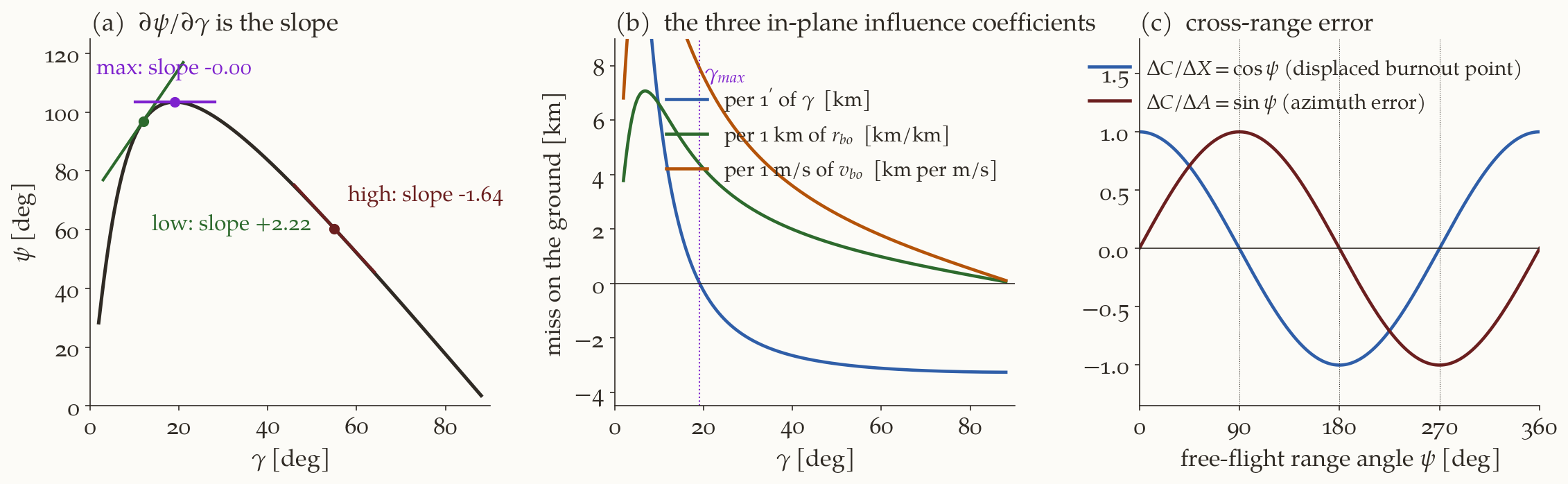
Example 6 (a combination of errors). The planned burnout is \(v_{bo}=7.154\) km/s (\(0.905\sqrt{\mu/R_\oplus}\)), \(r_{bo}=7016.0\) km (\(1.1R_\oplus\)) and \(\gamma=30^\circ\). The actual burnout is \(0.395\) m/s too slow, \(3.19\) km too high, and the flight-path angle is \(10^{-4}\) rad \(=0.0057^\circ\) too low. What is the miss, and in which direction?
Solution. First \(Q=0.9009\), and from Equation 9 the planned range angle is \(\psi=100.53^\circ\) (Bate reads \(100^\circ\) off a chart). The maximum range at this \(Q\) is \(\psi_{max}=110.1^\circ\) at \(\gamma_{max}=17.5^\circ\), so \(\gamma=30^\circ\) is on the high branch. The three coefficients (Equation 25, Equation 24):
\[ \frac{\partial\psi}{\partial\gamma}=-1.230,\qquad \frac{\partial\psi}{\partial r}=4.321\times10^{-4}\ \text{km}^{-1},\qquad \frac{\partial\psi}{\partial v}=0.8475\ \text{s/km} . \]
The contributions to the range angle times \(R_\oplus\) are: height \(+8.79\) km, speed \(-2.14\) km, flight-path angle \(+0.78\) km; sum \(+7.44\) km. The exact difference, from Equation 9 with the changed numbers, is \(+7.44\) km too. The vehicle overshoots by about \(7.4\) km, along the trajectory. (The same range could be flown on the low branch, \(\gamma=9.74^\circ\): Exercise 10.) There is no cross-range error because all the errors are in the plane. Notice that the height error, which looks tiny (\(0.05\%\)), contributes the most.
8 The rotating Earth
So far the Earth has been a fixed sphere. It is not: it turns eastward at \(\omega_\oplus=7.292\times10^{-5}\) rad/s, which is \(15.04^\circ\) per hour, and a point on the equator moves at \(0.4651\) km/s. During the free flight the vehicle moves on a conic fixed in inertial space; the Earth turns underneath it, carrying the launch point and the target. Two corrections follow, one at each end of the flight: the launch site is moving when the vehicle is launched, and the target moves while the vehicle is in the air.
8.1 The launch site is moving
An observer at the launch site (a radar, a guidance system) measures the velocity of the vehicle relative to the rotating Earth: speed \(v_{rel}\), flight-path angle \(\gamma_{rel}\) (the elevation) and azimuth \(A_{rel}\). The conic is determined by the velocity relative to the inertial frame. The two differ by the velocity of the point of the rotating Earth at the vehicle’s position, \(\boldsymbol\omega_\oplus\times\mathbf r\) (this is the same statement as the relative-velocity equation of the topocentric note, the other way round):
\[ \mathbf v=\mathbf v_{rel}+\boldsymbol\omega_\oplus\times\mathbf r . \tag{26}\]
At latitude \(\varphi\) and radius \(r\) the vector \(\boldsymbol\omega_\oplus\times\mathbf r\) points due east and has the length \(\omega_\oplus r\cos\varphi\). In north, east, up components (Bate uses south, east, up, which flips the sign of the first),
\[ v_N=v_{rel}\cos\gamma_{rel}\cos A_{rel},\quad v_E=v_{rel}\cos\gamma_{rel}\sin A_{rel}+\omega_\oplus r\cos\varphi,\quad v_Z=v_{rel}\sin\gamma_{rel}, \tag{27}\]
and then
\[ v=\sqrt{v_N^2+v_E^2+v_Z^2},\qquad \sin\gamma=\frac{v_Z}{v},\qquad \tan A=\frac{v_E}{v_N}\ \ (\text{quadrant from the signs}). \tag{28}\]
The inverse problem (given the inertial velocity the conic needs, what does the launch site have to command?) subtracts \(\omega_\oplus r\cos\varphi\) from \(v_E\) before finding the speed, elevation and azimuth.
Bate adds the surface speed of the launch site, \(1524\cos\varphi\) ft/s, which is the same thing evaluated at \(r=R_\oplus\) and at the latitude of the launch point. The exact \(\omega_\oplus r\cos\varphi\) at the burnout position differs from it by a few metres per second for a burnout at \(100\) km altitude and a few tens of km from the pad (\(\omega_\oplus\times100\text{ km}=7.3\) m/s at most), and the exact form costs nothing, so we use it.
The size of the effect is the point. A launch due east at the equator needs \(0.465\) km/s less than the same launch due west would need; it saves \(0.4519\) km/s at Sriharikota (\(13.7^\circ\)N) and \(0.4087\) km/s at \(28.5^\circ\)N. That is why launch sites are near the equator and why the satellites of the Earth are launched eastward.
Example 7 (the velocity seen from the pad). A vehicle is launched from \(30^\circ\)N on azimuth \(135^\circ\) (south-east). At burnout its speed relative to the Earth is \(4.877\) km/s (\(16\,000\) ft/s) at \(30^\circ\) above the horizon. What is its true (inertial) speed, flight-path angle and azimuth? (Take \(r=R_\oplus\).)
Solution. The site speed is \(\omega_\oplus R_\oplus\cos30^\circ=0.4028\) km/s. The components: \(v_N=4.877\cos30^\circ\cos135^\circ=-2.986\) km/s, \(v_E=4.877\cos30^\circ\sin135^\circ+0.4028=3.389\) km/s, \(v_Z=4.877\sin30^\circ=2.438\) km/s. Then \(v=\sqrt{2.986^2+3.389^2+2.438^2}=5.133\) km/s, \(\sin\gamma=2.438/5.133\), \(\gamma=28.36^\circ\), and \(\tan A=3.389/(-2.986)\) with the second quadrant, \(A=131.4^\circ\). Compared with the relative values \((4.877,30^\circ,135^\circ)\), the true speed is higher by \(0.26\) km/s, the true flight-path angle lower and the azimuth turned from south-east towards east. (Bate: \(16\,840.6\) ft/s \(=5.1331\) km/s.)
8.2 The target is moving
During the flight of duration \(t_A\) (the total, \(t_A=t_p+t_{ff}+t_{re}\)) the Earth turns by \(\omega_\oplus t_A\), and the target with it. The vehicle follows a fixed great circle in inertial space; to hit the target it must be aimed at the point of inertial space where the target will be at the end. That is the aiming point: the point on the target’s parallel, but east of the target by \(\omega_\oplus t_A\). So the trajectory is planned as a non-rotating problem between the launch point \(L\) and the aiming point \(B\):
\[ \varphi_B=\varphi_t,\qquad \lambda_B=\lambda_t+\omega_\oplus t_A . \]
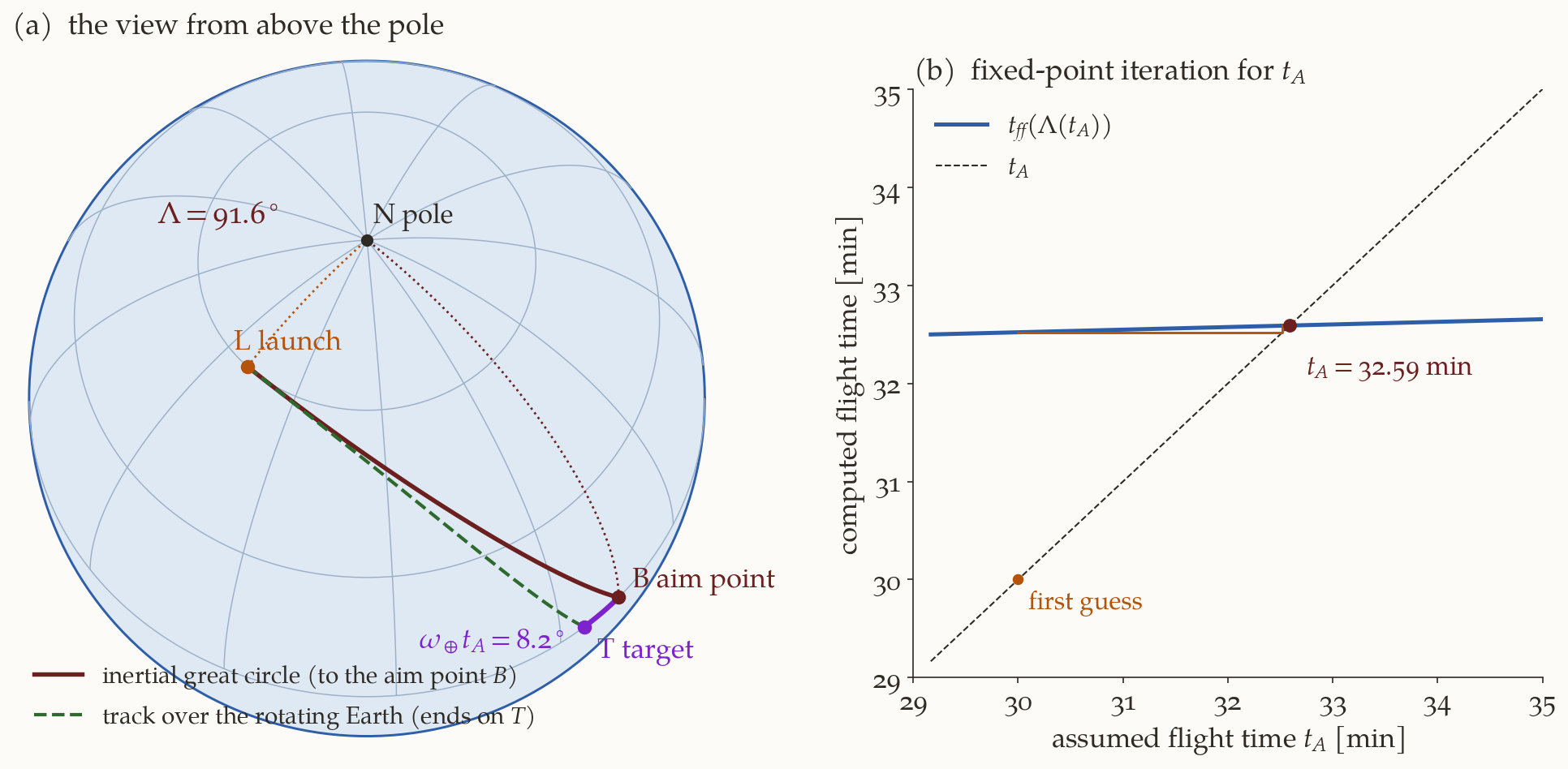
The range angle. In the spherical triangle with vertices at the pole \(N\), the launch point \(L\) and the aiming point \(B\), the sides are \(\tfrac\pi2-\varphi_0\) (\(NL\)), \(\tfrac\pi2-\varphi_t\) (\(NB\)) and the unknown total range angle \(\Lambda\) (\(LB\)), and the angle at the pole is the difference in longitude \(\Delta\lambda+\omega_\oplus t_A\), where \(\Delta\lambda=\lambda_t-\lambda_0\) is measured eastward from the launch point to the target. The law of cosines for the side \(LB\) gives
\[ \cos\Lambda=\sin\varphi_0\sin\varphi_t+\cos\varphi_0\cos\varphi_t\cos\bigl(\Delta\lambda+\omega_\oplus t_A\bigr) . \tag{29}\]
For a non-rotating Earth set \(t_A=0\) (this is the formula we used for the range angle in Example 2).
The azimuth. The law of cosines for the side \(NB\) with the included angle \(A\) at \(L\) gives \(\sin\varphi_t=\sin\varphi_0\cos\Lambda+\cos\varphi_0\sin\Lambda\cos A\), so
\[ \cos A=\frac{\sin\varphi_t-\sin\varphi_0\cos\Lambda}{\cos\varphi_0\sin\Lambda} . \tag{30}\]
The arccosine gives only an angle in \([0,\pi]\), an azimuth towards the east. If the aiming point is to the west of the launch meridian (\(\sin(\Delta\lambda+\omega_\oplus t_A)<0\)), the azimuth is \(2\pi-A\). (Bate states this as a rule about the short and long way.) The two-argument form avoids the case distinction: \(A=\operatorname{atan2}\bigl(\sin\delta\cos\varphi_t,\ \cos\varphi_0\sin\varphi_t-\sin\varphi_0\cos\varphi_t\cos\delta\bigr)\) with \(\delta=\Delta\lambda+\omega_\oplus t_A\); the verify script checks that it equals Equation 30. This \(A\) is the azimuth of the inertial path; it is the \(A\) of Equation 27, not \(A_{rel}\).
A circular dependence. To find \(\Lambda\) from Equation 29 we need \(t_A\). To find \(t_A\) we need \(t_{ff}\), which depends on \(\psi\) (Equation 19), which depends on \(\Lambda\). The way out is iteration: guess \(t_A\), compute \(\Lambda\), then \(\psi\), then \(t_{ff}\) (add the times of the powered flight and the re-entry, if they are known), compare with the guess, and repeat. The map \(t_A\mapsto t_{ff}(\Lambda(t_A))\) is nearly flat, because the aiming point moves only \(\omega_\oplus\,\delta t\) for a change \(\delta t\) of the guess. In the example below its slope is \(0.027\), so every pass gains a factor \(40\) in accuracy and four passes are enough (Figure 10 (b)). Bate suggests a computer for this iteration; a hand calculator is enough.
8.3 A complete example
Example 8. A vehicle at \(60^\circ\)N, \(160^\circ\)E is to be sent to \((0^\circ,115^\circ\text{W})\), on the minimum-speed trajectory, with burnout and re-entry at the surface (\(r_{bo}=R_\oplus\)) and without powered or re-entry range. Find the flight time, the azimuth, the true and the relative burnout velocities.
Not rotating. \(\Delta\lambda=245^\circ-160^\circ=85^\circ\) and \(\cos\Lambda=\cos60^\circ\cos85^\circ\), so \(\Lambda=87.50^\circ\) and the ground range is \(9741\) km. The minimum speed is \(Q_{min}=2\sin\frac\Lambda2/(1+\sin\frac\Lambda2)\), with \(\gamma=45^\circ-\Lambda/4\), and the flight time is \(31.71\) min.
Rotating. Iterate. Starting from \(t_A=30\) min, the successive flight times are \(32.522\), \(32.589\), \(32.5906\), \(32.5906\) min. The converged values: \(t_A=32.59\) min (Bate’s answer to his exercise 6.26: \(32.57\) min), the Earth has turned \(\omega_\oplus t_A=8.17^\circ\), the aiming point is at \(253.17^\circ\)E, and \(\Lambda=91.58^\circ\). The vehicle has to fly \(4.1^\circ\) farther than if the Earth did not turn (\(454\) km: the target runs away, by \(909\) km along the equator in \(32.6\) min), and the flight takes \(53\) s longer. The azimuth from Equation 30 is \(A=87.25^\circ\).
The burnout velocity. The minimum-speed trajectory has \(Q_{min}=0.8351\), hence the inertial speed \(v=\sqrt{Q\mu/R_\oplus}=7.224\) km/s at \(\gamma=45^\circ-91.58^\circ/4=22.10^\circ\), azimuth \(87.25^\circ\). What the pad must command is the velocity relative to the Earth. The site speed at \(60^\circ\)N is \(\omega_\oplus R_\oplus\cos60^\circ=0.2326\) km/s eastward. From Equation 27 and its inverse: \(v_N=7.224\cos22.10^\circ\cos87.25^\circ=0.3207\) km/s, \(v_E=7.224\cos22.10^\circ\sin87.25^\circ=6.6854\) km/s, and subtracting the site speed gives \(v_{E,rel}=6.4528\) km/s, with \(v_Z=7.224\sin22.10^\circ=2.7183\) km/s. So the relative burnout speed is \(7.009\) km/s at an elevation of \(22.82^\circ\) and an azimuth of \(87.16^\circ\).
A vehicle is launched due north from the equator at a range of \(60^\circ\) with a flight time of about \(20\) minutes. Does it land east or west of the great circle it follows in inertial space, as seen on the map of the rotating Earth? By how much?
Answer
The Earth turns eastward while the vehicle is in the air, so the vehicle, which keeps to its inertial great circle, lands west of where the same great circle would end on the Earth’s map at the launch instant. The shift is \(\omega_\oplus t_A\cos\varphi_{impact}\) along the parallel: for \(20\) min it is \(5.0^\circ\) of longitude, about \(5.0^\circ\cos60^\circ=2.5^\circ\) of arc at \(60^\circ\)N, about \(280\) km. This is the effect that the aiming point of Section 8.2 compensates.Summary
In one paragraph. After burnout the vehicle follows an ellipse with a focus at the Earth’s centre. With \(Q=v^2r/\mu\) the ellipse has \(a=r/(2-Q)\) and \(e^2=1+Q(Q-2)\cos^2\gamma\), and for a symmetric flight (\(r_{re}=r_{bo}\)) the burnout point is at true anomaly \(\pi-\psi/2\), which gives \(\tan(\psi/2)=Q\sin\gamma\cos\gamma/(1-Q\cos^2\gamma)\) and the explicit inverse \(\sin(2\gamma+\psi/2)=\frac{2-Q}{Q}\sin\frac\psi2\). That has two roots, a low and a high trajectory symmetric about \(\gamma_{max}=45^\circ-\psi/4\); they merge at the maximum range, \(\sin(\psi_{max}/2)=Q/(2-Q)\), equivalently the least \(Q=2\sin\frac\psi2/(1+\sin\frac\psi2)\) for a given range, which is the Lambert minimum-energy ellipse. The vehicle comes down only if the ellipse dips below the surface, \(r_p=r_{bo}(1-e)/(2-Q)<R_\oplus\), which for given \(Q\) means \(\gamma>\gamma_*\) (Equation 14); flat burnouts at or above circular speed are satellite orbits. The flight time in units of the circular period at the burnout radius is a function of \(Q\) and \(\gamma\) only (Equation 19). Errors at burnout move the landing point by \(\Delta C=\Delta X\cos\psi\), \(\Delta A\sin\psi\) across the track and by \(\Delta\psi=\psi_\gamma\Delta\gamma+\psi_Q\Delta Q\) along it; \(\psi_\gamma=0\) at the maximum range. On the rotating Earth the burnout velocity is the relative velocity plus \(\boldsymbol\omega_\oplus\times\mathbf r\), and the target is replaced by the aiming point \(\omega_\oplus t_A\) east of it, with \(t_A\) found by iteration.
The numbers of this note are checked by ballistic-verify.py (sympy identities, a direct numerical integration, the worked examples and the exercises), using the helper _ballistic.py. The figure scripts are fig-bal-geometry.py, fig-bal-range.py (which also draws Figure 8), fig-bal-paths.py, fig-bal-landing.py, fig-bal-errors.py and fig-bal-rotation.py.
What we left out. (i) The powered flight and the re-entry. Both change the range by hundreds of km and the time by minutes; they need the guidance law and the atmosphere (the re-entry range is a function of the vehicle’s ballistic coefficient). (ii) The asymmetric case \(r_{re}\ne r_{bo}\), where the conic is no longer symmetric about the major axis; the general problem is Lambert’s, and the Lambert note solves it. (iii) The oblate Earth: the geocentric radius of the burnout and landing points differs from the sphere by up to \(21\) km (the difference between the equatorial and the polar radius), and \(J_2\) perturbs the free flight itself, which a ballistic-targeting calculation includes (see the Earth-gravity note). (iv) Atmosphere and the shape of the geoid. (v) Errors that are not small: Bate’s exercise 6.31 asks for the second-order terms of the Taylor series of Equation 22, which one would need for errors of more than about a degree.
Further reading. Bate, Mueller and White (Bate, Mueller, and White 1971), chapter 6, from which the whole note is drawn; R. H. Battin, Astronautical Guidance (Battin 1964), for the free flight and the guidance equations; chapter 5 of Bate for the Gauss (Lambert) problem, of which this chapter is the special case with equal radii.
Exercises
All the answers are checked in ballistic-verify.py. Use \(R_\oplus=6378.137\) km and \(\mu=398\,600.4418\) km\(^3\)/s\(^2\), \(v_c=7.9054\) km/s at \(R_\oplus\).
- Short range. A vehicle burns out at \(r=1.1R_\oplus\) with \(v=0.5v_c\). What is its maximum range? (Answer: \(Q=0.275\), \(\psi_{max}=18.35^\circ\), \(2042\) km. Bate’s 6.3.)
- Least speed. What is the least burnout speed that reaches a target \(9334\) km away (\(5040\) nm) from burnout at \(r=R_\oplus\), and what is \(\gamma\)? (Answer: \(\psi=83.85^\circ\), \(Q_{min}=0.8011\), \(v=7.0755\) km/s \(=0.895v_c\), \(\gamma=24.04^\circ\). Bate’s 6.6.)
- Rotating Earth, the gain. How much does an eastward launch save, in burnout speed, at \(13.7^\circ\)N, at \(28.5^\circ\)N, and at the equator? (Answer: \(0.4519\), \(0.4087\), \(0.4651\) km/s.) And a due westward launch at \(28.5^\circ\)N: how much does it cost compared with a non-rotating Earth?
- A long flight. A vehicle is to cover a total range of \(7400\) nm (\(13\,705\) km), of which \(140\) nm is powered flight and \(60\) nm is re-entry, from burnout at \(r=21.8\times10^6\) ft \(=6644.6\) km, on the least-speed trajectory. Find \(v_{bo}\), \(\gamma\) and \(t_{ff}\). (Answer: \(\psi=119.78^\circ\), \(v=7.4598\) km/s, \(\gamma=15.05^\circ\), \(t_{ff}=40.1\) min. Bate’s 6.27.)
- Maximum range by two routes. A vehicle has \(v_{bo}=0.83v_c\) at \(r=1.06R_\oplus\). Find the maximum range (a) with Equation 15 and (b) by locating the maximum of Equation 9 numerically. (Answer: \(Q=0.7302\), \(\psi_{max}=70.21^\circ\), \(7816\) km; Bate’s \(4212\) nm uses \(60\) nm per degree. Bate’s 6.9.)
- A short range. What speed does a vehicle need at \(r=R_\oplus\) to reach a target \(3334\) km away (1800 nm) with the least energy? (Answer: \(\psi=29.95^\circ\), \(v=0.6408v_c=5.066\) km/s. Bate’s 6.16.)
- Two angles. Show that the two flight-path angles that reach the same target at the same \(Q\) are symmetric about \(45^\circ-\psi/4\), and that their difference is \(\gamma_{high}-\gamma_{low}=\pi/2-A\), with \(A\) of Equation 12. (Answer: from Equation 12, \(\gamma_{high}-\gamma_{low}=\tfrac12(\pi-2A)\); it vanishes at the maximum range, \(A=\pi/2\).) Show also that for \(Q\to0\) the pair is \(\gamma\), \(90^\circ-\gamma\) of the school projectile.
- Minimum-energy ellipse. Show that at the maximum range the burnout point is at the end of the latus rectum through the empty focus, and deduce \(Q=1-e^2\). (Bate’s 6.18; the argument is in Section 5.)
- Cross-range. The cross-range error must not exceed \(1.0\) nm (\(1.852\) km) for a flight of \(90^\circ\) of free-flight range. How large may the lateral displacement \(\Delta X\) of the burnout point and the azimuth error \(\Delta A\) be? (Answer: \(\Delta X\) is not limited at all, because \(\cos90^\circ=0\); \(\Delta A\le59.9''\). Bate’s 6.12 uses \(5400\) nm, which is \(90^\circ\).)
- The low trajectory. Redo Example 6 for the same vehicle, the same \(Q=0.9009\) and the same range \(\psi=100.53^\circ\), but flown on the low trajectory, \(\gamma_{low}=9.74^\circ\) from Equation 12, with the same errors. Does the miss increase or decrease? (Answer: \(\partial\psi/\partial\gamma=+3.195\), \(\partial\psi/\partial r=1.1225\times10^{-3}\) km\(^{-1}\), \(\partial\psi/\partial v=2.2015\) s/km; contributions \(+22.83\), \(-5.55\) and \(-2.04\) km; miss \(+15.2\) km, twice the high-trajectory value of \(7.4\) km. This is the reason long-range flights use the high trajectory.)