Assignment 04 — Apse Rotation, Plane Changes, Escape, Patched Conics and Ballistic Flight
This assignment covers the notes that follow phasing. These are Rotating the Apse Line, Plane Changes, Escape, Patched Conics and Ballistic Trajectory.
Every problem has three kinds of part. An analytical part asks you to derive a formula or prove a property of it, with symbols only. A numerical part asks you to evaluate the result for a concrete case. A discussion part asks what the result means for a real mission. Show every step of a derivation, and say which result of the notes you use at each step. Keep \(\mu\), \(r\) and the speeds as symbols in the algebra, and do not set any of them equal to \(1\). Give numerical answers to three or four significant figures, with units.
A worked solution follows each problem, folded under Solution. Attempt the problem on paper before you open it. Every result and every number in the solutions is checked by assignment-04-verify.py.
All burns are impulsive. The cost of a manoeuvre is the sum of the magnitudes of its impulses. Use the following constants, which are those of the notation page.
| Quantity | Value |
|---|---|
| \(\mu_\oplus\); \(R_\oplus\) | \(398\,600.4418\) km\(^3\)/s\(^2\); \(6378.137\) km |
| \(\mu_\odot\); astronomical unit | \(1.327\,124\,400\,18\times10^{11}\) km\(^3\)/s\(^2\); \(1.495\,978\,707\times10^{8}\) km |
| \(\mu_{\rm Mars}\); \(R_{\rm Mars}\); \(a_{\rm Mars}\) | \(42\,828.37\) km\(^3\)/s\(^2\); \(3396.2\) km; \(1.52368\) AU |
| \(\mu_{\rm Venus}\); \(R_{\rm Venus}\) | \(324\,858.59\) km\(^3\)/s\(^2\); \(6051.8\) km |
| \(\mu_J\); \(R_J\) | \(1.266\,865\,34\times10^{8}\) km\(^3\)/s\(^2\); \(71\,492\) km |
| \(g_0\) | \(9.80665\) m/s\(^2\) |
Treat the Earth’s orbit as a circle of radius \(1\) AU and the orbit of Mars as a circle of radius \(a_{\rm Mars}\), in the same plane.
Problem 1 — Rotating the apse line in steps
A satellite is on an orbit with a perigee altitude of \(500\) km and an apogee altitude of \(20\,000\) km. Its apse line must be turned by \(\eta=30^\circ\) in the direction of motion, with the size and the shape of the orbit unchanged. Recall from the apse-line note that one radial impulse at a crossing of the old and the new orbit does this at the cost \(2\sqrt{\mu/p}\;e\sin(\eta/2)\).
- Analytical. Suppose the rotation is made in \(N\) steps, through the angles \(\eta_1,\eta_2,\dots,\eta_N\), with \(\eta_1+\eta_2+\dots+\eta_N=\eta\). Each step is one radial impulse of the kind above. Show that the total cost is \(2\sqrt{\mu/p}\;e\,\sum_j\sin(\eta_j/2)\). Then prove that every such split costs more than a single step. (You may use \(\sin(\alpha+\beta)=\sin\alpha\cos\beta+\cos\alpha\sin\beta\).)
- Analytical. For \(N\) equal steps, show that the cost increases with \(N\), and find its limit as \(N\to\infty\).
- Numerical. Find \(p\) and \(e\), and the total cost for \(N=1\), \(2\), \(3\), \(6\) and \(N\to\infty\). Compare these with the cost of the two-burn route through a circle at apogee, from the apse-line note.
- Numerical. For the single step, the burn can be made at either of the two crossings of the old and the new orbit. For each crossing find the radius, the radial and the transverse speed, and the rate \(\dot f\) at which the satellite moves round the Earth, in degrees per minute.
- Discussion. The satellite has a mass of \(1500\) kg and an engine of \(440\) N thrust with \(I_{sp}=315\) s. How long does the burn of the single step last? Through roughly what angle does the satellite move during that burn at each crossing? Answer the same questions for the first burn of the \(N=3\) plan. Use your answers to decide which crossing you would burn at, and whether you would split the rotation.
Solution
We have to compare one radial impulse with several smaller ones that add up to the same rotation. The key observation is that every intermediate orbit has the same \(p\) and \(e\), so each step costs the same formula with its own angle. The comparison then reduces to an inequality between sines, which we prove first for two angles and then for any number. For part (e) we leave the impulsive model and ask how long a real burn lasts.
(a) Any split costs more. Each step is a radial impulse at a crossing of two orbits with the same \(p\) and \(e\), whose apse lines differ by \(\eta_j\). The intermediate orbits therefore all have the same \(p\) and \(e\), and the cost formula of the apse-line note applies to every step. Adding them up,
\[ \Delta v_{\rm total}=2\sqrt{\frac\mu p}\;e\sum_{j=1}^N\sin\frac{\eta_j}2 . \]
We have to show that this sum exceeds \(\sin(\eta/2)\), where \(\eta/2=\sum_j\eta_j/2\). Take two angles \(\alpha\) and \(\beta\) between \(0\) and \(\pi\). Then \(\sin\alpha\ge0\), \(\sin\beta\ge0\), \(\cos\alpha\le1\) and \(\cos\beta\le1\), so
\[ \sin(\alpha+\beta)=\sin\alpha\cos\beta+\cos\alpha\sin\beta\le\sin\alpha+\sin\beta . \]
The inequality is strict when both angles are strictly between \(0\) and \(\pi\), because then \(\cos\beta<1\) and \(\sin\alpha>0\). Applying this repeatedly, first to \(\eta_1/2\) and \(\eta_2/2\), then to their sum and \(\eta_3/2\), and so on, gives
\[ \sin\frac\eta2<\sum_{j=1}^N\sin\frac{\eta_j}2\qquad(N\ge2,\ \text{all }\eta_j>0). \]
Every angle here is at most \(\eta/2=15^\circ\), so the conditions hold. So every split costs more than a single step.
(b) Equal steps. For \(N\) equal steps the total is \(2N\sqrt{\mu/p}\,e\sin(\eta/2N)\). To see how this depends on \(N\), write \(y=\eta/2N\), so that
\[ N\sin\frac{\eta}{2N}=\frac\eta2\,\frac{\sin y}{y}. \]
As \(N\) grows, \(y\) shrinks. So we need to know how \(\sin y/y\) behaves. Its derivative is \((y\cos y-\sin y)/y^2\). The numerator \(g(y)=y\cos y-\sin y\) is zero at \(y=0\), and \(g'(y)=-y\sin y<0\) for \(0<y<\pi\). So \(g<0\), and \(\sin y/y\) decreases as \(y\) grows. It therefore increases as \(N\) grows, and so does the cost. As \(N\to\infty\), \(\sin y/y\to1\), and
\[ \Delta v_{\rm total}\to\sqrt{\frac\mu p}\;e\,\eta . \]
Why the factor \(\sqrt{\mu/p}\). There is a neat way to see both results, and it also shows where the factor \(\sqrt{\mu/p}\) in the cost comes from. It uses the eccentricity vector,
\[ \mathbf e=\frac{\mathbf v\times\mathbf h}{\mu}-\hat{\mathbf r}, \]
which has length \(e\) and points at perigee. Turning the apse line by \(\eta\) with the shape unchanged means replacing \(\mathbf e\) by a vector of the same length turned through \(\eta\). So we ask by how much one radial impulse changes \(\mathbf e\), and what that change costs.
An impulse \(\Delta\mathbf v=\Delta v_r\,\hat{\mathbf r}\) is instantaneous, so it changes the velocity and nothing else. The position \(\mathbf r\), and with it \(\hat{\mathbf r}\), is the same just before and just after the burn. The angular momentum \(\mathbf h=\mathbf r\times\mathbf v\) changes by \(\mathbf r\times\Delta\mathbf v\), which is zero because \(\Delta\mathbf v\) is parallel to \(\mathbf r\). So \(\mathbf h\) is unchanged, and so is \(p=h^2/\mu\). In the formula for \(\mathbf e\) only \(\mathbf v\) has changed, and
\[ \Delta\mathbf e=\frac{\Delta\mathbf v\times\mathbf h}{\mu}. \]
The impulse lies in the orbit plane and \(\mathbf h\) is perpendicular to it. So the cross product has length \(|\Delta\mathbf v|\,h\), and it lies in the plane, perpendicular to \(\hat{\mathbf r}\). Taking lengths, and using \(h=\sqrt{\mu p}\),
\[ |\Delta\mathbf e|=\frac{h}{\mu}\,|\Delta\mathbf v| \qquad\Longrightarrow\qquad |\Delta\mathbf v|=\frac{\mu}{h}\,|\Delta\mathbf e|=\sqrt{\frac\mu p}\;|\Delta\mathbf e| . \]
This is the factor. An impulse that changes \(\mathbf e\) by \(\Delta\mathbf e\) costs \(\sqrt{\mu/p}\,|\Delta\mathbf e|\). No radial impulse changes \(p\), so the rate is the same for every step of the plan, and a plan of \(N\) radial impulses costs
\[ \Delta v_{\rm total}=\sqrt{\frac\mu p}\;\sum_{j=1}^N|\Delta\mathbf e_j| . \]
Two facts about the \(\Delta\mathbf e_j\) settle both parts. First, \(\mathbf e\) does not change between burns, and at burn \(j\) it jumps by \(\Delta\mathbf e_j\). So the \(\Delta\mathbf e_j\), placed head to tail as in Figure 1 (a), lead from the old \(\mathbf e\) to the new one, and their vector sum is the same for every plan,
\[ \sum_{j=1}^N\Delta\mathbf e_j=\mathbf e_{\rm after}-\mathbf e_{\rm before}, \qquad \Bigl|\sum_{j=1}^N\Delta\mathbf e_j\Bigr|=2e\sin\frac\eta2 . \]
Second, every intermediate orbit has the same \(e\), so every intermediate \(\mathbf e\) ends on the circle of radius \(e\). Each \(\Delta\mathbf e_j\) is therefore a chord of that circle, of length \(2e\sin(\eta_j/2)\), and this gives back the cost of part (a).
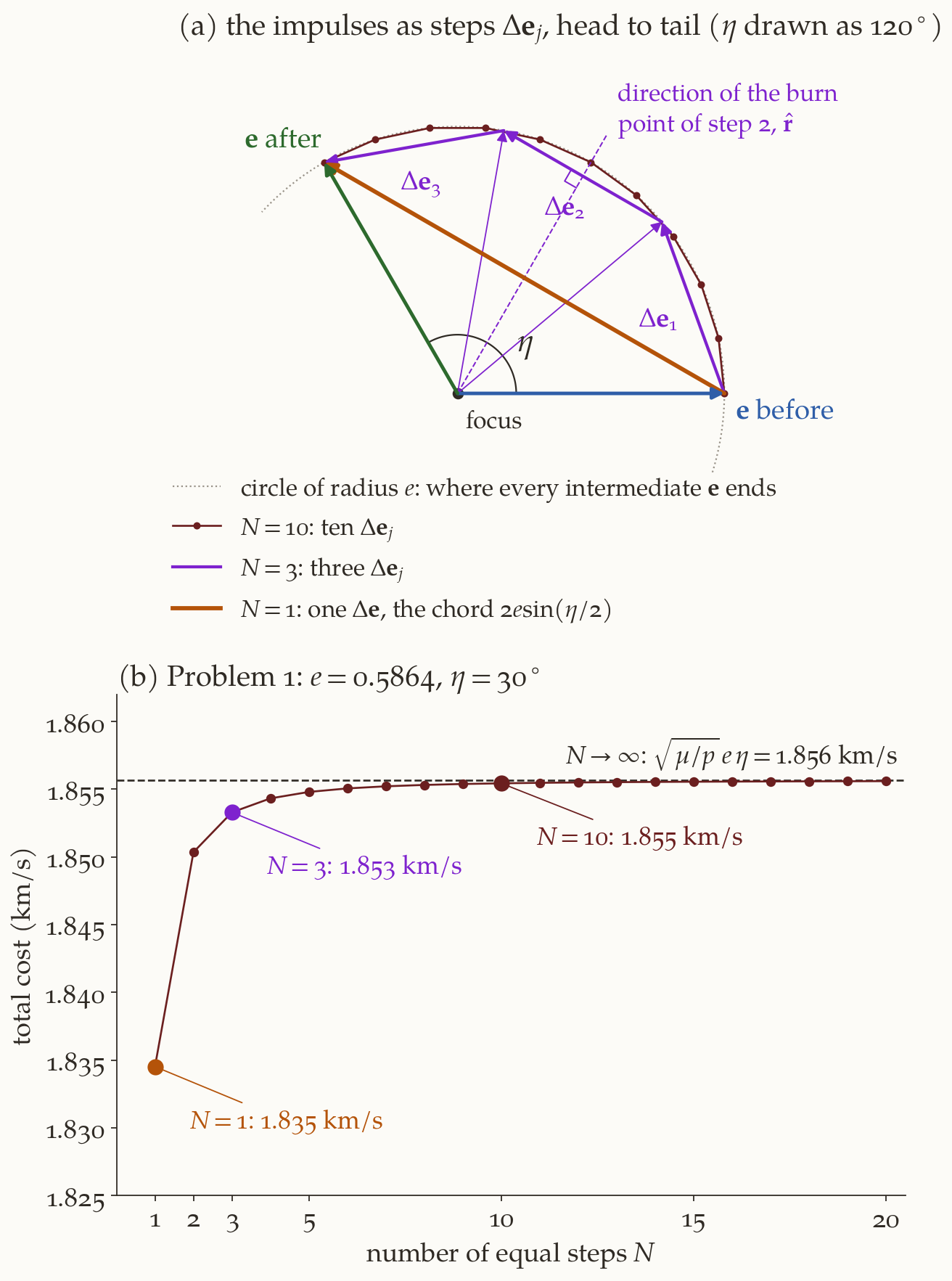
What depends on the plan is therefore not the vector sum of the \(\Delta\mathbf e_j\) but the sum of their lengths. By the triangle inequality,
\[ \sum_{j=1}^N|\Delta\mathbf e_j|\;\ge\;\Bigl|\sum_{j=1}^N\Delta\mathbf e_j\Bigr|=2e\sin\frac\eta2 , \]
with equality only when all the \(\Delta\mathbf e_j\) point the same way. Two different chords of a circle that meet end to end never do, so every plan with \(N\ge2\) costs more than the single step. This is part (a) again, now without any trigonometry, and it proves a little more. The inequality does not use the circle, so even a plan whose intermediate radial impulses changed \(e\) could not beat the single step. For \(N\) equal steps the lengths add up to \(2Ne\sin(\eta/2N)\), the perimeter of the polygon in the figure. As \(N\to\infty\) the polygon closes in on the arc, its perimeter tends to the arc length \(e\eta\), and this is the limit of part (b). Note that the arc is not a path that \(\mathbf e\) follows. The vector \(\mathbf e\) still jumps from one point of the circle to the next, and the arc length is only the limit of the sum of the jumps.
The picture also says where each burn must be made. Each \(\Delta\mathbf e_j\) is perpendicular to \(\hat{\mathbf r}\) at its burn, so the burn point lies in the direction perpendicular to that step. For a chord of a circle, that is the bisector of its two ends, the line at \(f=\eta_j/2\) and \(f=\eta_j/2+180^\circ\) from the old perigee. These are exactly the two crossings of the old and the new orbit that part (d) finds.
(c) Numbers. The radii are \(r_p=6878.137\) km and \(r_a=26\,378.137\) km, so
\[ a=16\,628.1\text{ km},\qquad e=\frac{r_a-r_p}{r_a+r_p}=0.5864,\qquad p=a(1-e^2)=10\,911.2\text{ km},\qquad \sqrt{\frac\mu p}=6.0441\text{ km/s}. \]
| \(N\) | \(1\) | \(2\) | \(3\) | \(6\) | \(10\) | \(\infty\) |
|---|---|---|---|---|---|---|
| total cost (km/s) | \(1.835\) | \(1.850\) | \(1.853\) | \(1.855\) | \(1.855\) | \(1.856\) |
Part (b) of Figure 1 plots these costs. Most of the rise comes with the second step, and by \(N=10\) the cost is within \(0.2\) m/s of the limit. Even the limit costs only \(1.15\%\) more than one step. A split that is not equal, \(20^\circ\) and then \(10^\circ\), costs \(1.849\) km/s, between the single step and two equal steps.
The two-burn route through a circle at apogee costs \(2(v_c-v_a)\), with \(v_c=\sqrt{\mu/r_a}=3.8873\) km/s and \(v_a=2.5001\) km/s. That is \(2.774\) km/s, much more than any of the single-impulse plans. This agrees with the crossover angle of the apse-line note, \(\sin(\eta_c/2)=\sqrt{1-e}/(1+\sqrt{1-e})\), which gives \(\eta_c=46.1^\circ\). A rotation of \(30^\circ\) is below it, so radial impulses are the right family here.
(d) The two crossings. The orbits cross where \(\cos f=\cos(f-\eta)\), at \(f=\eta/2=15^\circ\) and at \(f=\eta/2+180^\circ=195^\circ\). With \(r=p/(1+e\cos f)\), \(v_r=\sqrt{\mu/p}\,e\sin f\) and \(v_\theta=\sqrt{\mu/p}\,(1+e\cos f)\),
| crossing | \(f\) | \(r\) (km) | \(v_r\) (km/s) | \(v_\theta\) (km/s) | \(\dot f=v_\theta/r\) (deg/min) |
|---|---|---|---|---|---|
| near perigee | \(15^\circ\) | \(6965.9\) | \(+0.917\) | \(9.467\) | \(4.67\) |
| near apogee | \(195^\circ\) | \(25\,162.7\) | \(-0.917\) | \(2.621\) | \(0.358\) |
The impulse, \(2|v_r|=1.835\) km/s, is the same at both. At the first crossing it points inward and at the second outward.
(e) How long is the burn? The impulsive model assumes the burn is short. Let us test that. With \(v_e=I_{sp}g_0=3.089\) km/s, the rocket equation gives the propellant used. An engine of constant thrust expels it at the constant rate \(F/v_e\), so the burn lasts (the burn-time equation of the impulsive-model note)
\[ t_{\rm burn}=\frac{m_0\,v_e}{F}\Bigl(1-e^{-\Delta v/v_e}\Bigr). \]
The single step, with \(\Delta v=1.835\) km/s, lasts \(78.6\) min. The first burn of the \(N=3\) plan, with \(0.618\) km/s, lasts \(31.8\) min. Kepler’s equation gives the angle through which the satellite moves while the burn lasts, if the burn is centred on the crossing.
| burn | duration (min) | arc at the near crossing | arc at the far crossing |
|---|---|---|---|
| single step | \(78.6\) | \(219^\circ\) | \(29.2^\circ\) |
| first of three steps | \(31.8\) | \(128^\circ\) | \(11.4^\circ\) |
Near perigee the satellite would swing through most of its orbit during the burn. The burn would no longer be radial in any useful sense, and the impulsive model fails completely. Near apogee the satellite moves thirteen times more slowly, so the same burn covers a much smaller arc. So the first decision is clear. Burn at the crossing near apogee. The impulse is the same, and the satellite hardly moves while the engine fires.
Should we also split the rotation? Even at apogee, one burn spans \(29^\circ\), which is as large as the rotation itself. Over such an arc the radial direction turns by about \(15^\circ\) either side of the crossing, and the burn no longer resembles the impulse we analysed. The impulsive answer of \(1.835\) km/s is then not a reliable prediction of what the burn will really cost or where it will leave the orbit. Three burns span about \(11^\circ\) each, which is much closer to the impulsive ideal, and the ideal cost rises by only \(18.8\) m/s. The fraction of the mass left falls from \(55.2\%\) to \(54.9\%\). So the split buys a manoeuvre that behaves as planned, at a small and known price. A mission with this engine would therefore split the rotation into a few steps and make each one near apogee. With a much stronger engine it would make the rotation in one step.
Problem 2 — Folding a small plane change into an orbit raise
An Earth-observation satellite is released by its launcher into a circular orbit at an altitude of \(500\) km. Its working orbit is circular at \(520\) km, and the inclination must also be corrected by \(\Delta i=0.10^\circ\). The raise is a Hohmann transfer. The question is how to make the plane change, and how much it helps to combine it with the burns of the transfer.
- Analytical. One burn changes the speed from \(v\) to \(v'\) and turns the velocity through the angle \(\delta\). Show that its cost is \(\sqrt{(v'-v)^2+4vv'\sin^2(\delta/2)}\). Show that it is never more than the cost of doing the two jobs as separate burns at the same point, in either order. When are the two equal?
- Analytical. Now let \(v'\) be close to \(v\) and \(\delta\) be small. Write \(a=|v'-v|\) for the in-plane job and \(b=v\delta\) for the out-of-plane job. Show that the combined burn costs about \(\sqrt{a^2+b^2}\). Show that the fraction saved by combining, \(1-\sqrt{a^2+b^2}/(a+b)\), is largest when \(a=b\), and find this largest value. Explain the result with a picture.
- Analytical. Let the first burn of the Hohmann transfer turn the plane by \(\delta\) and the second by \(\Delta i-\delta\). For a small raise and a small turn, show that the equal split \(\delta=\Delta i/2\) gives a total of about \(\sqrt{\Delta v_H^2+(v\,\Delta i)^2}\), where \(\Delta v_H\) is the in-plane Hohmann cost and \(v\) the circular speed. Explain why the equal split is close to the best one.
- Numerical. Find the two Hohmann burns. Then find the total cost of four plans. Plan (i) is the Hohmann transfer followed by a separate plane change at \(520\) km. In plan (ii) the first burn makes the whole turn, and in plan (iii) the second burn does. Plan (iv) shares the turn equally. Compare plan (iv) with the formula of part (c), and find what it saves against plan (i). The satellite has a mass of \(700\) kg and thrusters with \(I_{sp}=220\) s. How much propellant does each of plans (i) and (iv) use?
- Numerical and discussion. Repeat plans (i) and (iv) for \(\Delta i=0.01^\circ\) and for \(\Delta i=1^\circ\), and find the percentage saved in each case. Explain the trend with part (b). The plane-changes note found a large saving from combining burns on the way from LEO to GEO. Is the reason for that saving the same as here?
Solution
We have to show that a combined burn is never worse than separate burns, find how much it can save, and then apply this to a small Hohmann raise. We first write the cost of a combined burn so that the in-plane part appears on its own. Then we let both jobs be small, which turns the cost into the length of the diagonal of a rectangle. The best saving and the best split of the turn both follow from that picture.
(a) The cost of a combined burn. The velocity before the burn, \(\mathbf v\), and after it, \(\mathbf v'\), make the angle \(\delta\). The impulse is \(\mathbf v'-\mathbf v\), and the law of cosines gives its size,
\[ |\mathbf v'-\mathbf v|^2=v^2+v'^2-2vv'\cos\delta . \]
We want to separate the in-plane part \((v'-v)^2\), so we write \(v^2+v'^2=(v'-v)^2+2vv'\). Then, with \(1-\cos\delta=2\sin^2(\delta/2)\),
\[ |\mathbf v'-\mathbf v|^2=(v'-v)^2+2vv'(1-\cos\delta)=(v'-v)^2+4vv'\sin^2\frac\delta2 . \]
Doing the jobs separately means passing through an intermediate velocity \(\mathbf v''\). If we change the speed first, \(\mathbf v''\) has the speed \(v'\) and the old direction, and the cost is \(|v'-v|+2v'\sin(\delta/2)\). If we turn first, \(\mathbf v''\) has the speed \(v\) and the new direction, and the cost is \(2v\sin(\delta/2)+|v'-v|\). In both cases the cost is \(|\mathbf v''-\mathbf v|+|\mathbf v'-\mathbf v''|\). The triangle inequality says that this is at least \(|\mathbf v'-\mathbf v|\), which is the cost of the combined burn. The two are equal only when the two separate impulses point the same way, which here happens only when one of the jobs is zero, \(\delta=0\) or \(v'=v\). So combining never costs more, and it costs strictly less whenever both jobs are needed.
(b) How much can combining save? Let \(v'\) be close to \(v\) and \(\delta\) small. Then \(4vv'\sin^2(\delta/2)\approx v^2\delta^2=b^2\), and the combined burn costs about \(\sqrt{a^2+b^2}\). The in-plane job is along the velocity and the out-of-plane job is at right angles to it. So the two add like two perpendicular vectors, while the separate burns add their lengths.
The fraction saved depends only on the ratio \(\rho=b/a\),
\[ s(\rho)=1-\frac{\sqrt{a^2+b^2}}{a+b}=1-\frac{\sqrt{1+\rho^2}}{1+\rho}. \]
Differentiating, and simplifying the numerator,
\[ s'(\rho)=-\frac{\rho(1+\rho)-(1+\rho^2)}{(1+\rho)^2\sqrt{1+\rho^2}}=-\frac{\rho-1}{(1+\rho)^2\sqrt{1+\rho^2}} . \]
This is positive for \(\rho<1\) and negative for \(\rho>1\). So the saving is largest at \(\rho=1\), that is \(a=b\), where
\[ s(1)=1-\frac{\sqrt2}{2}=0.293 . \]
The picture is a walk across a rectangular field. Walking along two sides costs \(a+b\), and walking along the diagonal costs \(\sqrt{a^2+b^2}\). The diagonal saves most when the field is a square. When one side is much longer than the other, the diagonal is hardly shorter than the long side, and the saving is a small fraction. But notice what happens to the short side in that case. It is almost free.
(c) Sharing the turn between the two Hohmann burns. For a small raise between nearby circles, the two Hohmann burns are nearly equal, each about \(\Delta v_H/2\), and both are made at nearly the circular speed \(v\). If the first burn turns the plane by \(\delta\) and the second by \(\Delta i-\delta\), part (b) gives the total
\[ \Delta v(\delta)\approx\sqrt{\Bigl(\frac{\Delta v_H}2\Bigr)^2+v^2\delta^2}+\sqrt{\Bigl(\frac{\Delta v_H}2\Bigr)^2+v^2(\Delta i-\delta)^2} . \]
For the equal split \(\delta=\Delta i/2\),
\[ \Delta v\approx2\sqrt{\Bigl(\frac{\Delta v_H}2\Bigr)^2+\Bigl(\frac{v\,\Delta i}2\Bigr)^2}=\sqrt{\Delta v_H^2+(v\,\Delta i)^2} . \]
So the whole manoeuvre costs as if the in-plane job \(\Delta v_H\) and the out-of-plane job \(v\,\Delta i\) were done by one burn at right angles. Why is the equal split the best one? The function \(\varphi(\delta)=\sqrt{c^2+v^2\delta^2}\) is convex, and the total is \(\varphi(\delta)+\varphi(\Delta i-\delta)\). For a convex function the average of two values is at least the value at the average, so
\[ \varphi(\delta)+\varphi(\Delta i-\delta)\ge2\varphi\Bigl(\frac{\Delta i}2\Bigr), \]
with equality at \(\delta=\Delta i/2\). In the real transfer the two burns and the two speeds differ slightly, so the best split is close to, but not exactly, one half.
(d) Numbers for \(\Delta i=0.10^\circ\). The two circles have \(r_1=6878.137\) km and \(r_2=6898.137\) km. The transfer ellipse has \(a_t=6888.137\) km. Vis-viva gives
\[ v_{c1}=7.6126\text{ km/s},\quad v_{t1}=7.6181\text{ km/s},\quad v_{t2}=7.5960\text{ km/s},\quad v_{c2}=7.6016\text{ km/s}, \]
so the Hohmann burns are \(5.52\) m/s and \(5.52\) m/s, and \(\Delta v_H=11.04\) m/s. The out-of-plane job is \(v_{c1}\Delta i=13.29\) m/s, so the two jobs are of similar size, \(\rho=1.20\). A separate plane change at \(520\) km costs \(2v_{c2}\sin(\Delta i/2)=13.27\) m/s. Each combined burn is computed with the formula of part (a).
| plan | total (m/s) |
|---|---|
| (i) Hohmann, then a separate turn at \(520\) km | \(24.31\) |
| (ii) whole turn in the first burn | \(19.91\) |
| (iii) whole turn in the second burn | \(19.89\) |
| (iv) turn shared equally | \(17.27\) |
| best share, found numerically (\(\delta=0.498\,\Delta i\)) | \(17.27\) |
| formula of part (c), \(\sqrt{\Delta v_H^2+(v_{c1}\Delta i)^2}\) | \(17.28\) |
Plan (iv) saves \(29.0\%\) against plan (i), very close to the largest possible saving of \(29.3\%\), because the two jobs are nearly equal. Plans (ii) and (iii) are in between. They combine the turn with only one of the two in-plane burns. With the rocket equation, plan (i) uses \(7.84\) kg of propellant and plan (iv) uses \(5.58\) kg.
(e) Other turns. For \(\Delta i=0.01^\circ\), plan (i) costs \(12.37\) m/s and plan (iv) \(11.12\) m/s, a saving of \(10.1\%\). For \(\Delta i=1^\circ\), plan (i) costs \(143.71\) m/s and plan (iv) \(133.23\) m/s, a saving of \(7.3\%\). The saving peaks near \(\Delta i=0.1^\circ\) because that is where the two jobs are of equal size. At \(0.01^\circ\) the raise dominates, and at \(1^\circ\) the turn dominates.
The case of \(1^\circ\) teaches the most useful lesson. The plane change alone costs \(132.67\) m/s, and the best combined plan costs \(133.22\) m/s. So the whole raise of \(20\) km has been carried along for \(0.54\) m/s. (The best share is now \(0.42\,\Delta i\), but it costs only \(0.01\) m/s less than the equal split.) A small job folded into a large burn at the same place is almost free. This is why operators fold small corrections into burns that must be made anyway.
In the transfer from LEO to GEO of the plane-changes note, the situation is different. The two burns are made at very different speeds, about \(10.2\) km/s and \(1.6\) km/s on the transfer ellipse. Most of that saving comes from making the turn where the speed is lowest, at the apogee of the transfer ellipse. Here both burns are made at the same speed. So the saving here is purely the geometric one of part (b), the diagonal of the rectangle.
Problem 3 — A plane change on an eccentric orbit: which node?
A spacecraft is on an orbit with \(r_p=7000\) km, \(r_a=21\,000\) km and argument of perigee \(\omega=50^\circ\). Its inclination must be changed by \(\Delta i=6^\circ\), with the node \(\Omega\) unchanged. The turn is made by one burn at a node, which turns the plane about the line of nodes.
- Analytical. Explain why the radial component \(v_r\) of the velocity is unchanged by this turn, while the transverse component \(v_\theta\) turns through \(\Delta i\). Hence show that the cost is \(2v_\theta\sin(\Delta i/2)\). Show that the new orbit has the same \(a\) and \(e\) as the old one.
- Analytical. The ascending node is at true anomaly \(f=-\omega\) and the descending node at \(f=\pi-\omega\). Show that the ratio of the costs at the two nodes is \[ \frac{\Delta v_{\rm AN}}{\Delta v_{\rm DN}}=\frac{1+e\cos\omega}{1-e\cos\omega}. \] Which node should be used when \(0<\omega<90^\circ\)? For which \(\omega\) does the choice not matter?
- Numerical. Find \(e\) and \(p\). At each node find \(r\), \(v_r\), \(v_\theta\), the speed \(v\) and the cost of the turn. Check the ratio against part (b). By how much would \(2v\sin(\Delta i/2)\) overestimate the cost at the descending node?
- Numerical. How long after passing the ascending node does the spacecraft reach the descending node? With \(I_{sp}=315\) s, what fraction of the mass remains after the turn at each node?
- Discussion. What would the same turn cost if the orbit had \(\omega=180^\circ\), so that the apogee lies on the line of nodes? Why would the designer of a transfer orbit like to place its apogee at a node?
Solution
We have to find what a turn about the line of nodes costs on an eccentric orbit, and which of the two nodes is cheaper. We split the velocity into its radial and transverse parts, because a rotation about the radius affects only the second. The cost at each node is then fixed by \(v_\theta=h/r\), and since \(h\) is the same at both nodes, the comparison becomes a comparison of radii.
(a) Only the transverse velocity turns. At a node the spacecraft lies on the line of nodes, so this line is along its radius vector. Turning the orbital plane about this line is a rotation about the radial direction. A rotation leaves unchanged every component along its axis, so \(v_r\) is unchanged. The transverse component lies in the plane and is perpendicular to the axis, so it turns through the full angle \(\Delta i\) and keeps its size. The impulse is therefore the base of an isosceles triangle with equal sides \(v_\theta\) and apex angle \(\Delta i\),
\[ \Delta v=2v_\theta\sin\frac{\Delta i}2 . \]
The new orbit has the same \(r\) at the burn point and the same speed, since \(v_r\) and \(|v_\theta|\) are unchanged. By vis-viva it has the same \(a\). Its angular momentum \(h=rv_\theta\) has the same size, so \(p=h^2/\mu\) is the same, and then \(p=a(1-e^2)\) gives the same \(e\).
(b) The ratio of the costs. At a node, \(v_\theta=h/r\), and \(h\) is the same at both nodes. So the costs are in the inverse ratio of the radii. The orbit equation gives the radii at \(f=-\omega\) and \(f=\pi-\omega\),
\[ r_{\rm AN}=\frac{p}{1+e\cos\omega},\qquad r_{\rm DN}=\frac{p}{1-e\cos\omega}, \]
using \(\cos(-\omega)=\cos\omega\) and \(\cos(\pi-\omega)=-\cos\omega\). Therefore
\[ \frac{\Delta v_{\rm AN}}{\Delta v_{\rm DN}}=\frac{r_{\rm DN}}{r_{\rm AN}}=\frac{1+e\cos\omega}{1-e\cos\omega} . \]
For \(0<\omega<90^\circ\), \(\cos\omega>0\), so the ratio exceeds \(1\) and the descending node is cheaper. It is the node farther from the Earth, where conservation of angular momentum makes \(v_\theta\) small. The choice does not matter when \(\cos\omega=0\), that is \(\omega=90^\circ\) or \(270^\circ\). Then the nodes are at the two ends of the latus rectum, at the same radius.
(c) Numbers. From the apsides,
\[ a=14\,000\text{ km},\qquad e=\frac{21\,000-7000}{21\,000+7000}=0.5,\qquad p=a(1-e^2)=10\,500\text{ km},\qquad \sqrt{\frac\mu p}=6.1613\text{ km/s}. \]
With \(v_r=\sqrt{\mu/p}\,e\sin f\) and \(v_\theta=\sqrt{\mu/p}\,(1+e\cos f)\),
| node | \(f\) | \(r\) (km) | \(v_r\) (km/s) | \(v_\theta\) (km/s) | \(v\) (km/s) | \(\Delta v=2v_\theta\sin3^\circ\) (km/s) |
|---|---|---|---|---|---|---|
| ascending | \(310^\circ\) | \(7946.2\) | \(-2.3599\) | \(8.1415\) | \(8.4767\) | \(0.852\) |
| descending | \(130^\circ\) | \(15\,472.9\) | \(+2.3599\) | \(4.1811\) | \(4.8011\) | \(0.438\) |
The ratio of the costs is \(1.947\), and part (b) gives \((1+0.5\cos50^\circ)/(1-0.5\cos50^\circ)=1.947\). Using the full speed at the descending node would give \(2v\sin3^\circ=0.503\) km/s, which is \(14.8\%\) too high. The radial part of the velocity does not need to be turned, so we should not pay for it.
(d) Time and mass. Kepler’s equation gives the time from \(f=310^\circ\) to \(f=130^\circ\), through perigee, as \(68.6\) min. The period is \(274.8\) min, so the spacecraft reaches the cheaper node about a quarter of a period after the ascending node. With \(v_e=3.089\) km/s, a turn at the ascending node leaves \(75.9\%\) of the mass, and one at the descending node leaves \(86.8\%\). A wait of about an hour saves more than a tenth of the spacecraft.
(e) The apogee at a node. With \(\omega=180^\circ\), the ascending node is at \(f=180^\circ\), the apogee. There \(v_r=0\) and \(v_\theta=v_a=\sqrt{\mu(2/r_a-1/a)}=3.0807\) km/s, so the turn costs \(2v_a\sin3^\circ=0.322\) km/s. This is the cheapest possible place on this orbit, because \(v_\theta=h/r\) is smallest where \(r\) is largest.
A plane change can only be made at a node. A transfer orbit to GEO ends with a burn at apogee to circularise, and that burn should also remove the inclination, as the plane-changes note showed. This is possible only if the apogee lies on the line of nodes. So the designer would like the apogee of the transfer orbit to lie on a node. Otherwise the turn would have to be made at a lower, faster point, or the orbit would first have to be changed.
Problem 4 — Leaving the Earth from an elliptic orbit
A Mars orbiter must leave the Earth with the hyperbolic excess speed \(v_\infty=2.945\) km/s, the value found for a Hohmann transfer in the patched-conics note. Its launcher can place it in an orbit with a perigee altitude of \(250\) km and one of four apogee altitudes, \(250\) km (a circle), \(23\,000\) km, \(35\,786\) km and \(200\,000\) km. The departure is one tangential burn at perigee.
- Analytical. For an orbit of perigee radius \(r_p\) and eccentricity \(e\), show that the departure burn costs \[ \Delta v(e)=\sqrt{v_\infty^2+\frac{2\mu}{r_p}}-\sqrt{\frac{\mu(1+e)}{r_p}}, \] and that this decreases as \(e\) grows. Find the limit as \(e\to1\) and show that it is always less than \(v_\infty\). Show that it is close to \(v_\infty^2/2v_{\rm esc}\) when \(v_\infty\) is much smaller than the local escape speed \(v_{\rm esc}\).
- Analytical. Show that the departure hyperbola is the same for all four orbits. Show that the outgoing asymptote makes the angle \(f_\infty=\arccos(-1/e_h)\) with the direction of perigee, where \(e_h=1+r_pv_\infty^2/\mu\). What does this mean for where the burn must be made, for the circle and for the ellipses?
- Numerical. Find \(v_{\rm esc}\), the perigee speed of the hyperbola, \(e_h\) and \(f_\infty\). For each of the four orbits, find \(e\), the speed at perigee before the burn, the cost of the burn and the fraction of the mass that remains, with \(I_{sp}=315\) s. Compare the best case with the limit of part (a).
- Discussion. The highest orbit saves the most propellant. What does the mission give up in return? Think of the launcher, of the direction of the apse line, and of what happens if a burn has to be postponed.
Solution
We have to find the departure cost from an ellipse of given perigee and show how it depends on \(e\), and then see what the ellipse fixes about the direction of departure. The cost is the difference of two speeds at the same point, the speed on the ellipse and the speed the hyperbola needs, so we write each with vis-viva. For the direction we note that the hyperbola depends only on \(r_p\) and \(v_\infty\).
(a) The departure cost. The burn is tangential at perigee, so the burn point stays an apsis of the new orbit. On the ellipse, vis-viva with \(a=r_p/(1-e)\) gives the speed at perigee before the burn,
\[ v_0^2=\mu\Bigl(\frac2{r_p}-\frac{1-e}{r_p}\Bigr)=\frac{\mu(1+e)}{r_p}. \]
On the departure hyperbola the energy is \(v_\infty^2/2\), so at the same radius the speed must be \(\sqrt{v_\infty^2+2\mu/r_p}\). Both velocities are along the same direction, so
\[ \Delta v(e)=\sqrt{v_\infty^2+\frac{2\mu}{r_p}}-\sqrt{\frac{\mu(1+e)}{r_p}} . \]
Only the second term depends on \(e\), and it grows with \(e\). So \(\Delta v\) decreases as \(e\) grows. The derivative is \(-\tfrac12\sqrt{\mu/r_p}/\sqrt{1+e}\), which is negative.
As \(e\to1\), \(\sqrt{\mu(1+e)/r_p}\to\sqrt{2\mu/r_p}=v_{\rm esc}\), the escape speed at \(r_p\). So
\[ \Delta v\to\sqrt{v_\infty^2+v_{\rm esc}^2}-v_{\rm esc}=\frac{v_\infty^2}{\sqrt{v_\infty^2+v_{\rm esc}^2}+v_{\rm esc}}, \]
where we multiplied and divided by the sum of the two roots. The denominator is larger than \(v_\infty\), because \(\sqrt{v_\infty^2+v_{\rm esc}^2}>v_\infty\). So the limit is less than \(v_\infty^2/v_\infty=v_\infty\). When \(v_\infty\ll v_{\rm esc}\) the denominator is close to \(2v_{\rm esc}\), and the limit is close to \(v_\infty^2/2v_{\rm esc}\).
This is the Oberth effect at work. The energy that must be added is \(v_\infty^2/2\) per unit mass, and a small burn at the speed \(v_{\rm esc}\) adds about \(v_{\rm esc}\Delta v\). So a spacecraft already at nearly escape speed needs only \(\Delta v\approx v_\infty^2/2v_{\rm esc}\), far less than \(v_\infty\) itself.
(b) The same hyperbola every time. The hyperbola is fixed by its periapsis radius and its energy. Both are the same for all four starting orbits, \(r_p\) and \(v_\infty^2/2\). So the hyperbola is the same, with \(e_h=1+r_pv_\infty^2/\mu\). By the patched-conics note its outgoing asymptote is at the true anomaly \(f_\infty=\arccos(-1/e_h)\), measured from the periapsis, which is the burn point.
This fixes where the burn must be. The asymptote must point along the required departure direction, so the burn point must be \(f_\infty\) behind that direction. From a circle any point can be the burn point, so the spacecraft simply waits, at most one period, until it reaches the right place. From an ellipse the burn must be at perigee, and the perigee is where the orbit puts it. So the perigee itself must already point \(f_\infty\) behind the departure direction at the moment of departure. The orientation of the ellipse, set at launch, becomes part of the design.
(c) Numbers. With \(r_p=6628.137\) km,
\[ v_{\rm esc}=\sqrt{\frac{2\mu}{r_p}}=10.967\text{ km/s},\qquad \sqrt{v_\infty^2+v_{\rm esc}^2}=11.356\text{ km/s},\qquad e_h=1.1442,\qquad f_\infty=150.9^\circ . \]
The limit of part (a) is \(0.389\) km/s, and the small-\(v_\infty\) estimate gives \(0.395\) km/s. With \(v_e=I_{sp}g_0=3.089\) km/s,
| apogee altitude (km) | \(e\) | \(v_0\) (km/s) | \(\Delta v\) (km/s) | mass left |
|---|---|---|---|---|
| \(250\) | \(0\) | \(7.755\) | \(3.601\) | \(31.2\%\) |
| \(23\,000\) | \(0.632\) | \(9.906\) | \(1.449\) | \(62.6\%\) |
| \(35\,786\) | \(0.728\) | \(10.195\) | \(1.161\) | \(68.7\%\) |
| \(200\,000\) | \(0.938\) | \(10.795\) | \(0.561\) | \(83.4\%\) |
The best case costs \(0.561\) km/s, against \(0.389\) km/s for the limit \(e\to1\). Starting from the circle, the spacecraft must supply \(3.601\) km/s, which is more than \(v_\infty\) itself, and two thirds of its mass would be propellant.
(d) What the high orbit costs. First, the saving is not free. Every burn here is tangential at the same perigee, so the speeds simply add. Going from the circle to the \(200\,000\) km orbit takes \(10.795-7.755=3.040\) km/s, and the departure then takes \(0.561\) km/s, a total of \(3.601\) km/s, exactly the cost from the circle. Someone has to supply the difference. Either the launcher does, which means a larger launcher or a lighter spacecraft, or the spacecraft raises its own apogee in several burns, as the Mars Orbiter Mission did in November 2013. That moves the propellant use earlier, but does not reduce it.
Second, the perigee must point the right way at departure, as part (b) showed. The orbit’s orientation is set at launch and changes only slowly, so the launch date and time are tied to the departure date.
Third, a high orbit has a long period. The \(250\times200\,000\) km orbit has a period of \(96.1\) h. If the departure burn has to be postponed, the next perigee is four days later, and the departure direction will have moved. From a low circle the next chance comes within about an hour and a half.
Problem 5 — The cheapest capture orbit at Mars
A spacecraft arrives at Mars with \(v_\infty=2.649\) km/s, the value of a Hohmann transfer from the Earth. It is captured by one tangential burn at the periapsis of its arrival hyperbola.
- Analytical. The capture orbit is a circle of radius \(r_p\), the periapsis radius of the hyperbola. Write \(x=\mu/r_p\) and show that the burn costs \(\sqrt{v_\infty^2+2x}-\sqrt{x}\). Show that this is smallest at \(r^*=2\mu/v_\infty^2\), that the smallest cost is \(v_\infty/\sqrt2\), and that the stationary point is a minimum.
- Analytical. The capture orbit is now an ellipse of eccentricity \(e\) with its periapsis at \(r_p\). Show that the best periapsis radius is \(r_p^*=2\mu(1-e)/\bigl((1+e)\,v_\infty^2\bigr)\) and that the smallest cost is \(v_\infty\sqrt{(1-e)/2}\). Check that these reduce to part (a) when \(e=0\).
- Numerical. Find \(r^*\), its altitude and the smallest cost. Compare it with capture into a circle at \(300\) km. The Mars Orbiter Mission was captured into an orbit of \(421.7\times76\,993.6\) km altitude. For an orbit of this size, with the \(v_\infty\) above, find \(e\), the period and the capture cost at its periapsis. Find the best periapsis of part (b) for this \(e\). Can it be used? With \(I_{sp}=315\) s, find the fraction of the mass left after each of the three captures.
- Discussion. Missions rarely capture into the circle of radius \(r^*\). Why? Discuss what a low circular orbit, the circle at \(r^*\) and a large ellipse offer to a mission, and what each one costs it.
Solution
We have to find the periapsis radius that makes capture cheapest, first into a circle and then into an ellipse of given eccentricity. The cost is again a difference of two speeds at the periapsis. Both speeds contain \(\mu/r_p\), so we take it as the variable, which makes the minimisation a matter of setting one derivative to zero.
(a) The best circle. At the periapsis of the hyperbola the speed is \(\sqrt{v_\infty^2+2\mu/r_p}\), and the speed on the circle of the same radius is \(\sqrt{\mu/r_p}\). Both are horizontal, so the burn is their difference. With \(x=\mu/r_p\),
\[ \Delta v(x)=\sqrt{v_\infty^2+2x}-\sqrt x . \]
We use \(x\) because it appears inside both roots, and it makes the derivative simple,
\[ \frac{d\Delta v}{dx}=\frac{1}{\sqrt{v_\infty^2+2x}}-\frac{1}{2\sqrt x}. \]
This is zero when \(2\sqrt x=\sqrt{v_\infty^2+2x}\). Squaring, \(4x=v_\infty^2+2x\), so \(x=v_\infty^2/2\), which is
\[ r^*=\frac{2\mu}{v_\infty^2}. \]
At this point the hyperbola’s periapsis speed is \(\sqrt{v_\infty^2+v_\infty^2}=\sqrt2\,v_\infty\) and the circular speed is \(v_\infty/\sqrt2\), so
\[ \Delta v^*=\sqrt2\,v_\infty-\frac{v_\infty}{\sqrt2}=\frac{v_\infty}{\sqrt2}. \]
Is it a minimum? Far from the planet, \(x\to0\), the cost tends to \(v_\infty\). Very close to it, \(x\to\infty\), the cost is about \((\sqrt2-1)\sqrt x\), which grows without limit. There is only one stationary point in between, and its value \(v_\infty/\sqrt2\) is less than \(v_\infty\). So it is the minimum.
The physical reason is a competition. A low periapsis helps, because a burn at high speed removes more energy per unit of \(\Delta v\). But a low circle is also a deep, fast orbit, and the spacecraft must keep a large speed there. The optimum balances the two.
(b) The best ellipse. On an ellipse of eccentricity \(e\) the periapsis speed is \(\sqrt{(1+e)x}\), so
\[ \Delta v(x)=\sqrt{v_\infty^2+2x}-\sqrt{(1+e)x},\qquad \frac{d\Delta v}{dx}=\frac{1}{\sqrt{v_\infty^2+2x}}-\frac{\sqrt{1+e}}{2\sqrt x}. \]
Setting this to zero and squaring, \(4x=(1+e)(v_\infty^2+2x)\), so \(x\,(2-2e)=(1+e)v_\infty^2\) and
\[ x^*=\frac{(1+e)\,v_\infty^2}{2(1-e)},\qquad r_p^*=\frac{2\mu(1-e)}{(1+e)\,v_\infty^2}. \]
At this point \(v_\infty^2+2x^*=2v_\infty^2/(1-e)\) and \((1+e)x^*=(1+e)^2v_\infty^2/2(1-e)\). So
\[ \Delta v^*=v_\infty\Bigl[\sqrt{\frac{2}{1-e}}-\frac{1+e}{\sqrt{2(1-e)}}\Bigr]=v_\infty\,\frac{2-(1+e)}{\sqrt{2(1-e)}}=v_\infty\sqrt{\frac{1-e}2}. \]
For \(e=0\) these become \(2\mu/v_\infty^2\) and \(v_\infty/\sqrt2\), as in part (a). A more eccentric capture orbit has a lower best periapsis and a lower cost.
(c) Numbers. With \(\mu_{\rm Mars}=42\,828.37\) km\(^3\)/s\(^2\) and \(v_\infty=2.649\) km/s,
\[ r^*=\frac{2\mu}{v_\infty^2}=12\,207\text{ km},\quad\text{an altitude of }8810\text{ km},\qquad \Delta v^*=\frac{2.649}{\sqrt2}=1.873\text{ km/s}. \]
Capture into a circle at \(300\) km costs \(2.091\) km/s, which is \(218\) m/s more.
The orbit of the Mars Orbiter Mission has \(r_p=3817.9\) km and \(r_a=80\,389.8\) km, so \(e=0.9093\) and its period is \(72.86\) h. Capture into it at periapsis costs \(0.799\) km/s. The best periapsis for this \(e\) from part (b) is \(r_p^*=580\) km, which is inside Mars, so it cannot be used. For \(r_p>r_p^*\) the derivative above is negative in \(x\), so the cost falls as the periapsis is lowered. The best usable choice is therefore the lowest safe periapsis. This is why a captured ellipse has its periapsis as low as the atmosphere allows.
With \(v_e=3.089\) km/s, the fractions of the mass left are \(50.8\%\) for the \(300\) km circle, \(54.5\%\) for the circle at \(r^*\), and \(77.2\%\) for the ellipse.
(d) What each orbit offers. The circle at \(r^*\) is the cheapest circle, but at \(8810\) km it is too high for most science. A camera or radar sees less detail from farther away, and many instruments need to be close to the planet. The low circle at \(300\) km gives the best view but costs the most. It leaves about \(4\%\) less of the mass than the circle at \(r^*\). The large ellipse costs least, by a wide margin, but the spacecraft spends most of each \(73\) h orbit far from Mars, and is close to it for only a short time near periapsis.
So a mission chooses by what it must do. A mission with a tight mass budget, such as the Mars Orbiter Mission launched on a PSLV, takes the ellipse. A mission that needs a low orbit can capture into an ellipse and then lower the apoapsis by aerobraking, dipping the periapsis into the upper atmosphere on many passes. Several NASA orbiters, among them Mars Reconnaissance Orbiter, did this. Aerobraking takes months and needs careful operation, but it saves most of the propellant of the low circle.
Problem 6 — The largest velocity change a flyby can give
In a flyby the speed of the spacecraft relative to the planet is \(v_\infty\) before and after. The relative velocity only turns, through the angle \(\delta=2\arcsin(1/e)\), with \(e=1+r_pv_\infty^2/\mu\).
- Analytical. Show that the heliocentric velocity of the spacecraft changes by a vector of magnitude \[ |\Delta\mathbf V|=\frac{2v_\infty}{e}=\frac{2v_\infty}{1+r_pv_\infty^2/\mu}. \]
- Analytical. For a fixed \(r_p\), show that \(|\Delta\mathbf V|\) is largest when \(v_\infty=\sqrt{\mu/r_p}\), and that its largest value is \(\sqrt{\mu/r_p}\), the circular speed at \(r_p\). Find \(e\) and \(\delta\) at this optimum. Explain physically why a very slow pass and a very fast pass both give a small \(|\Delta\mathbf V|\).
- Numerical. Find the largest \(|\Delta\mathbf V|\) for Venus, the Earth and Mars with a closest approach at an altitude of \(300\) km, and for Jupiter with \(r_p=3R_J\). What would it be for Jupiter at its cloud tops?
- Numerical. A spacecraft reaches Mars on the Hohmann transfer, with \(v_\infty=2.649\) km/s, and flies by at an altitude of \(300\) km instead of being captured. Find \(e\), \(\delta\) and \(|\Delta\mathbf V|\), and compare with the largest value of part (c). Do the same for Jupiter with \(v_\infty=5.643\) km/s and \(r_p=3R_J\).
- Discussion. Why are flybys of Jupiter so valuable to missions to the outer planets? Does a large \(|\Delta\mathbf V|\) guarantee a large gain of heliocentric energy? Use the patched-conics note to answer.
Solution
We have to find the change of heliocentric velocity in a flyby, and then the excess speed that makes it largest. The planet’s velocity is the same before and after, so the change is simply the change of the relative velocity, which only turns. That makes the change the base of an isosceles triangle. Its size is then a function of \(v_\infty\) alone at a fixed \(r_p\), which we maximise.
(a) The change of the heliocentric velocity. The planet’s velocity \(\mathbf V_P\) is the same at entry and exit, because the flyby is short. With \(\mathbf V=\mathbf V_P+\mathbf v_\infty\) at both ends,
\[ \Delta\mathbf V=\mathbf v_\infty^{+}-\mathbf v_\infty^{-}. \]
The two relative velocities have the same length \(v_\infty\) and make the angle \(\delta\). Their difference is the base of an isosceles triangle, so \(|\Delta\mathbf V|=2v_\infty\sin(\delta/2)\). Since \(\sin(\delta/2)=1/e\),
\[ |\Delta\mathbf V|=\frac{2v_\infty}{e}=\frac{2v_\infty}{1+r_pv_\infty^2/\mu}. \]
(b) The best excess speed. Let \(g(v_\infty)=2v_\infty/(1+r_pv_\infty^2/\mu)\). By the quotient rule,
\[ g'(v_\infty)=\frac{2\bigl(1+r_pv_\infty^2/\mu\bigr)-2v_\infty\cdot2r_pv_\infty/\mu}{\bigl(1+r_pv_\infty^2/\mu\bigr)^2} =\frac{2\bigl(1-r_pv_\infty^2/\mu\bigr)}{\bigl(1+r_pv_\infty^2/\mu\bigr)^2}. \]
This is positive below \(v_\infty=\sqrt{\mu/r_p}\) and negative above it, so the maximum is at \(v_\infty=\sqrt{\mu/r_p}\). There \(r_pv_\infty^2/\mu=1\), so \(e=2\), \(\delta=2\arcsin\tfrac12=60^\circ\) and
\[ |\Delta\mathbf V|_{\max}=\frac{2\sqrt{\mu/r_p}}{2}=\sqrt{\frac{\mu}{r_p}}, \]
which is the circular speed at \(r_p\).
A very slow pass is turned through nearly \(180^\circ\), but the vector being turned is short, so the change is small. A very fast pass has a long vector, but the planet has little time to act on it, and it is hardly turned. The best pass is in between, with the turn and the length balanced.
(c) Numbers.
| planet | \(r_p\) | largest \(\lvert\Delta\mathbf V\rvert\) (km/s), at \(v_\infty=\sqrt{\mu/r_p}\) |
|---|---|---|
| Venus | \(6351.8\) km (\(300\) km altitude) | \(7.15\) |
| Earth | \(6678.137\) km (\(300\) km altitude) | \(7.73\) |
| Mars | \(3696.2\) km (\(300\) km altitude) | \(3.40\) |
| Jupiter | \(3R_J=214\,476\) km | \(24.3\) |
At Jupiter’s cloud tops the limit would be \(\sqrt{\mu_J/R_J}=42.1\) km/s. Even at three Jupiter radii the available change is more than three times that of any terrestrial planet.
(d) Two real cases. At Mars, with \(v_\infty=2.649\) km/s and \(r_p=3696.2\) km,
\[ e=1+\frac{r_pv_\infty^2}{\mu}=1.6056,\qquad \delta=2\arcsin\frac1e=77.0^\circ,\qquad |\Delta\mathbf V|=\frac{2v_\infty}{e}=3.300\text{ km/s}. \]
This is \(96.9\%\) of the largest value at this \(r_p\), because the Hohmann arrival speed happens to be close to the optimum \(3.40\) km/s. At Jupiter, with \(v_\infty=5.643\) km/s and \(r_p=3R_J\), \(e=1.0539\), the turn is \(143.2^\circ\), and \(|\Delta\mathbf V|=10.71\) km/s. This is well below \(24.3\) km/s, because \(v_\infty\) is much less than the optimum. The turn is large, but the vector being turned is short.
(e) Discussion. Jupiter’s huge \(\mu\) makes very large changes available even at a safe distance, and missions to the outer planets cannot easily get them any other way. But a large \(|\Delta\mathbf V|\) is not the same as a large gain of energy. The patched-conics note shows that the change of heliocentric energy is \(\mathbf V_P\cdot\Delta\mathbf V\). This is largest when \(\Delta\mathbf V\) points along the planet’s motion, which means passing behind the planet. It is zero when \(\Delta\mathbf V\) is at right angles to it, and negative when the pass is in front. So the geometry of the pass decides whether the velocity change becomes energy. The planet’s own speed matters too. Jupiter moves at about \(13\) km/s, so a given \(\Delta\mathbf V\) along its motion is worth a lot of energy.
Problem 7 — A round trip to Mars
A spacecraft goes from the Earth to Mars on a Hohmann transfer, waits at Mars, and comes back to the Earth on a Hohmann transfer. Let \(n_E\) and \(n_M\) be the mean motions of the Earth and Mars, and \(t_{12}\) the flight time of one Hohmann transfer.
- Analytical. Let \(\phi\) be the angle by which the Earth leads Mars, measured in the direction of motion. Show that when the spacecraft arrives at Mars, \(\phi=n_Et_{12}-\pi\). Show that the return transfer must start when \(\phi=\pi-n_Et_{12}\). Hence show that the wait at Mars is \[ t_w=\frac{2\pi N-2n_Et_{12}}{n_E-n_M}, \] where \(N\) is the smallest whole number that makes \(t_w\) positive.
- Numerical. Find \(t_{12}\), \(n_E\), \(n_M\) and the phase angle at departure from the Earth. Find the angle \(\phi\) at arrival, the wait \(t_w\) and the duration of the whole trip, in days and in years. Find the synodic period of the Earth and Mars.
- Discussion. The Mars Orbiter Mission was launched on 5 November 2013. Use the synodic period to estimate the next opportunity. The next real opportunity was used by the European ExoMars Trace Gas Orbiter, launched in March 2016. Why does your estimate differ? What does part (b) imply for a crewed mission to Mars, and what would it cost to shorten the stay?
Solution
We have to find how long the spacecraft must wait at Mars before a Hohmann return reaches the Earth. We describe everything by one angle, the lead \(\phi\) of the Earth over Mars. We find \(\phi\) on arrival and the \(\phi\) that the return needs. The wait is then the time for \(\phi\) to change from one to the other at the rate \(n_E-n_M\).
(a) The wait at Mars. Measure every angle from the Earth’s position at departure, in the direction of motion. On a Hohmann transfer the spacecraft arrives \(180^\circ\) from where it left, after the time \(t_{12}\). So Mars must be at \(\pi\) when the spacecraft arrives, and the Earth has moved to \(n_Et_{12}\). The Earth’s lead over Mars at arrival is therefore
\[ \phi_{\rm arr}=n_Et_{12}-\pi . \]
For the return, let Mars be at \(\lambda_M\) when the spacecraft leaves. It arrives at \(\lambda_M+\pi\) after \(t_{12}\), and the Earth must be there. If the Earth is at \(\lambda_E\) at departure, \(\lambda_E+n_Et_{12}=\lambda_M+\pi\), up to whole turns. So the lead needed for the return is
\[ \phi_{\rm ret}=\lambda_E-\lambda_M=\pi-n_Et_{12} . \]
While the spacecraft waits, the Earth gains on Mars at the rate \(n_E-n_M\). The lead must change from \(\phi_{\rm arr}\) to \(\phi_{\rm ret}\), up to whole turns, so
\[ (n_E-n_M)\,t_w=\phi_{\rm ret}-\phi_{\rm arr}+2\pi(N-1)=2\pi N-2n_Et_{12} \quad\Longrightarrow\quad t_w=\frac{2\pi N-2n_Et_{12}}{n_E-n_M}, \]
with \(N\) the smallest whole number that makes \(t_w\) positive.
(b) Numbers. The transfer ellipse has \(a_t=(1+1.52368)/2\) AU, so
\[ t_{12}=\pi\sqrt{\frac{a_t^3}{\mu_\odot}}=258.9\text{ d}. \]
The periods are \(365.26\) d and \(686.97\) d, so \(n_E=0.98561^\circ\)/d and \(n_M=0.52404^\circ\)/d. At departure from the Earth, Mars must lead by \(\phi_0=180^\circ-n_Mt_{12}=44.3^\circ\).
During the transfer the Earth moves \(n_Et_{12}=255.1^\circ\). So at arrival the Earth leads Mars by \(75.1^\circ\). For the return it must trail Mars by \(75.1^\circ\). With \(2n_Et_{12}=510.3^\circ\) and \(n_E-n_M=0.46157^\circ\)/d, the formula of part (a) gives \(-325.6\) d for \(N=1\). The negative value means that the right alignment came \(325.6\) days before the spacecraft arrived. With \(N=2\),
\[ t_w=\frac{720^\circ-510.3^\circ}{0.46157^\circ/\text{d}}=454.4\text{ d}. \]
The whole trip takes \(2(258.9)+454.4=972.1\) d, which is \(2.66\) years. The synodic period is \(S=360^\circ/(n_E-n_M)=779.9\) d, about \(25.6\) months.
(c) Discussion. Adding \(779.9\) days to 5 November 2013 gives 24 December 2015. The real opportunity came about three months later, in March 2016. Our model has circular, coplanar orbits and exact Hohmann transfers. The real orbit of Mars is noticeably eccentric, so the transfer that suits each opportunity is different, and real missions fly transfer arcs chosen by solving Lambert’s problem for the actual positions. The dates therefore move by weeks to months from the simple estimate, although the average spacing of the windows stays close to \(S\).
For a crewed mission, part (b) means about two years and eight months away from the Earth, of which a year and a quarter is spent at Mars waiting for the planets to line up again. A shorter stay needs a return that is not a Hohmann transfer. It must leave before the ideal alignment and use a faster, more eccentric path, which costs much more \(\Delta v\). So a crewed mission must trade a long stay, with its burden on life support and the crew’s health, against a much more expensive trajectory.
Problem 8 — Where a spent stage comes down
A spent stage separates at an altitude of \(150\) km with a speed of \(4.0\) km/s and a flight-path angle of \(25^\circ\) above the local horizontal. Take the Earth as a sphere that does not rotate, ignore the air above \(150\) km, and assume that the stage re-enters at the altitude at which it separated.
- Analytical. Using \(Q=v^2r/\mu\) at burnout, show that the apogee radius is \(r_a=r_{bo}(1+e)/(2-Q)\) and that the apogee is \(r_{bo}(e+Q-1)/(2-Q)\) above the burnout point. Show that, when \(Q\) is small, this height is about \(v^2\sin^2\gamma/2g\) with \(g=\mu/r_{bo}^2\), which is the result of school physics.
- Numerical. Find \(Q\), \(a\), \(e\), the range angle \(\psi\), the ground range, the apogee altitude and the time of free flight. Show that the ellipse really does meet the Earth.
- Numerical. Find the other flight-path angle at the same speed that comes down at the same point. Find its apogee altitude and its time of flight.
- Numerical. Find the range, the apogee height and the flight time from the flat-Earth formulas of school physics, with \(g=\mu/r_{bo}^2\). By how much does the flat Earth underestimate the range, and why?
- Discussion. The launch range must clear a zone of sea where the stage may fall. Which simplifications of this problem would you remove first to predict that zone, and why?
Solution
We have to describe the free flight of the stage with the ballistic note’s formulas and compare it with the flat-Earth results of school physics. Everything is expressed through \(Q=v^2r/\mu\) and \(\gamma\), because the note gives \(a\), \(e\), the range and the time in those terms. For the apogee we need only \(a\) and \(e\), and for the link with school physics we expand in the small quantity \(Q\).
(a) The apogee. The ballistic note gives \(a=r_{bo}/(2-Q)\). So
\[ r_a=a(1+e)=\frac{r_{bo}(1+e)}{2-Q},\qquad r_a-r_{bo}=r_{bo}\,\frac{(1+e)-(2-Q)}{2-Q}=r_{bo}\,\frac{e+Q-1}{2-Q}. \]
For a small \(Q\) we expand \(e=\sqrt{1-Q(2-Q)\cos^2\gamma}\). To first order in \(Q\), \(e\approx1-Q\cos^2\gamma\). Then \(e+Q-1\approx Q(1-\cos^2\gamma)=Q\sin^2\gamma\), and \(2-Q\approx2\). So
\[ r_a-r_{bo}\approx\frac{r_{bo}Q\sin^2\gamma}{2}=\frac{r_{bo}^2v^2\sin^2\gamma}{2\mu}=\frac{v^2\sin^2\gamma}{2g},\qquad g=\frac{\mu}{r_{bo}^2}, \]
which is the height of a projectile in school physics.
(b) The flight. With \(r_{bo}=6528.137\) km, \(v=4.0\) km/s and \(\gamma=25^\circ\),
\[ Q=\frac{v^2r_{bo}}{\mu}=0.2620,\qquad a=\frac{r_{bo}}{2-Q}=3756.2\text{ km},\qquad e=\sqrt{1+Q(Q-2)\cos^2\gamma}=0.7912 . \]
The range equation \(\tan(\psi/2)=Q\sin\gamma\cos\gamma/(1-Q\cos^2\gamma)\) gives \(\psi=14.58^\circ\), a ground range of \(\psi R_\oplus=1623\) km. The apogee is at \(r_a=a(1+e)\), an altitude of \(349.8\) km. For the time, the eccentric anomaly at burnout is \(E_{bo}=\operatorname{atan2}(\sqrt{Q(2-Q)}\sin\gamma,\ Q-1)=158.87^\circ\), and
\[ t_{ff}=2\pi\sqrt{\frac{r_{bo}^3}{\mu}}\;\frac{\pi-E_{bo}+\sqrt{Q(2-Q)}\sin\gamma}{\pi(2-Q)^{3/2}}=477\text{ s}. \]
The perigee radius is \(a(1-e)=784\) km, far inside the Earth. So the ellipse meets the surface and the stage does come down.
(c) The other trajectory. The inverse relation \(\sin(2\gamma+\psi/2)=\frac{2-Q}{Q}\sin\frac\psi2\) has the right side \(0.8414\), so \(2\gamma+\psi/2\) is either \(A=57.29^\circ\) or \(180^\circ-A\). The first gives back \(\gamma=25.00^\circ\). The second gives
\[ \gamma=\frac{180^\circ-A-\psi/2}{2}=57.71^\circ . \]
The two angles are symmetric about \(45^\circ-\psi/4=41.36^\circ\). The high trajectory has \(e=0.9328\), an apogee altitude of \(881.7\) km and a flight time of \(896\) s, nearly twice as long.
(d) The flat Earth. With \(g=\mu/r_{bo}^2=9.35\) m/s\(^2\), the school formulas give a range \(v^2\sin2\gamma/g=1310\) km, a height of \(v^2\sin^2\gamma/2g=152.8\) km above the separation point, and a time \(2v\sin\gamma/g=361\) s. The round Earth gives \(1623\) km, \(199.8\) km and \(477\) s. The round-Earth range is \(23.8\%\) longer than the flat-Earth range.
Two effects are missing from the flat Earth. The ground curves away beneath the stage, so it has farther to fall before it reaches the re-entry radius. And gravity weakens with height and always points to the centre, so its direction turns along the path. At \(Q=0.26\) neither effect is small. The flat-Earth formulas are good only when \(Q\) is much smaller, that is for short hops.
(e) Discussion. The most important simplification is the re-entry radius. The stage does not stop at \(150\) km. It falls through the atmosphere to the sea, which is a further \(150\) km down and adds range. The fall through the air is also where the stage tumbles, slows down and may break up, so drag, not gravity, decides the last part of the path. The Earth’s rotation must be included as well, because the launch site moves eastward at about \(0.45\) km/s and the ground turns under the stage during its flight. Finally, the separation state itself is uncertain, so a launch range predicts a zone of possible impact points rather than one point. That zone is cleared of shipping and aircraft before the launch.
Problem 9 — What a little more speed buys
A vehicle burns out at an altitude of \(200\) km and flies the maximum-range trajectory for its burnout speed. The re-entry is at the burnout altitude, and the Earth is a sphere that does not rotate.
- Analytical. From \(\sin(\psi_{max}/2)=Q/(2-Q)\), show that \[ \frac{d\psi_{max}}{dQ}=\frac{2}{(2-Q)\sqrt{1-Q}} . \] At a fixed burnout radius, show that a small fractional change \(dv/v\) of the burnout speed changes the maximum range angle by \(\dfrac{4Q}{(2-Q)\sqrt{1-Q}}\,\dfrac{dv}{v}\). What happens as \(Q\to1\)?
- Analytical. The least \(Q\) that reaches the range angle \(\psi\) is \(Q_{min}=2s/(1+s)\), with \(s=\sin(\psi/2)\). Show that \(dQ_{min}/ds=2/(1+s)^2\). Explain why going from \(\psi=90^\circ\) to \(\psi=180^\circ\) needs much less extra speed than going from \(\psi=0\) to \(\psi=90^\circ\).
- Numerical. For \(Q=0.5\), \(0.8\), \(0.9\) and \(0.95\), find the burnout speed, \(\psi_{max}\) and the maximum ground range. Find how much the ground range grows if the burnout speed is raised by \(1\%\), exactly and from part (a). Why does part (a) underestimate it? What happens to a vehicle with \(Q=0.99\) whose speed is raised by \(1\%\)?
- Numerical. Find the least burnout speed, and the flight-path angle that goes with it, for ground ranges of \(1000\), \(5000\), \(10\,000\) and \(15\,000\) km. How much speed is needed to go from \(0\) to \(10\,000\) km, and how much more to go from \(10\,000\) km to half way round the Earth?
- Discussion. On 4 October 1957 a rocket derived from the R-7, which had been developed as an intercontinental ballistic missile, placed Sputnik 1 in orbit. Use parts (a) to (d) to explain why such a rocket was already close to being a satellite launcher.
Solution
We have to find how quickly the maximum range grows with the burnout speed, and how quickly the least speed grows with the range. Both follow from differentiating the two forms of the maximum-range condition. We introduce \(u=Q/(2-Q)\) for the first because it is the argument of the arcsine, and \(s=\sin(\psi/2)\) for the second because \(Q_{min}\) is simplest in it.
(a) The sensitivity of the maximum range. Write \(u=Q/(2-Q)\), so that \(\psi_{max}=2\arcsin u\). Then
\[ \frac{du}{dQ}=\frac{(2-Q)+Q}{(2-Q)^2}=\frac{2}{(2-Q)^2},\qquad 1-u^2=\frac{(2-Q)^2-Q^2}{(2-Q)^2}=\frac{4(1-Q)}{(2-Q)^2}. \]
By the chain rule,
\[ \frac{d\psi_{max}}{dQ}=\frac{2}{\sqrt{1-u^2}}\,\frac{du}{dQ}=\frac{2(2-Q)}{2\sqrt{1-Q}}\cdot\frac{2}{(2-Q)^2}=\frac{2}{(2-Q)\sqrt{1-Q}} . \]
At a fixed radius \(Q\) is proportional to \(v^2\), so \(dQ/Q=2\,dv/v\). Therefore
\[ d\psi_{max}=\frac{2}{(2-Q)\sqrt{1-Q}}\,2Q\,\frac{dv}{v}=\frac{4Q}{(2-Q)\sqrt{1-Q}}\,\frac{dv}{v}. \]
As \(Q\to1\) the factor \(\sqrt{1-Q}\) tends to zero and the sensitivity grows without limit. Close to circular speed, a tiny extra speed buys an enormous extra range.
(b) The speed needed for a range. With \(Q_{min}=2s/(1+s)\),
\[ \frac{dQ_{min}}{ds}=\frac{2(1+s)-2s}{(1+s)^2}=\frac{2}{(1+s)^2}. \]
This falls from \(2\) at \(s=0\) to \(\tfrac12\) at \(s=1\). There is a second effect. The variable \(s=\sin(\psi/2)\) itself grows more and more slowly, since \(ds/d\psi=\tfrac12\cos(\psi/2)\), which is zero at \(\psi=180^\circ\). Together, \(dQ_{min}/d\psi=\cos(\psi/2)/(1+s)^2\), which tends to zero at half way round. So each extra degree of range needs less extra speed than the one before. Going from \(\psi=0\) to \(\psi=90^\circ\) needs \(Q\) to rise from \(0\) to \(0.828\). Going on from \(\psi=90^\circ\) to \(\psi=180^\circ\) needs only the rest, up to \(Q=1\).
(c) Numbers. At \(200\) km altitude, \(v_c=7.784\) km/s.
| \(Q\) | \(v\) (km/s) | \(\psi_{max}\) | ground range (km) | \(+1\%\) speed, exact (km) | \(+1\%\) speed, part (a) (km) |
|---|---|---|---|---|---|
| \(0.5\) | \(5.504\) | \(38.94^\circ\) | \(4335\) | \(122\) | \(120\) |
| \(0.8\) | \(6.962\) | \(83.62^\circ\) | \(9309\) | \(393\) | \(380\) |
| \(0.9\) | \(7.385\) | \(109.81^\circ\) | \(12\,224\) | \(702\) | \(660\) |
| \(0.95\) | \(7.587\) | \(129.58^\circ\) | \(14\,425\) | \(1173\) | \(1032\) |
The linear estimate of part (a) is always low, because \(\psi_{max}(Q)\) curves upward. Its slope increases with \(Q\), so the slope at the starting point is the smallest along the step. The error grows near \(Q=1\), where the slope grows fastest.
At \(Q=0.99\), a \(1\%\) increase of speed gives \(Q=1.0201\times0.99=1.0099\), which is above circular speed. There is no longer a maximum range. Aimed flat enough, the vehicle does not come down at all. It is in orbit.
(d) The least speed for each range.
| ground range (km) | \(Q_{min}\) | \(v/v_c\) | \(v\) (km/s) | \(\gamma=45^\circ-\psi/4\) |
|---|---|---|---|---|
| \(1000\) | \(0.1453\) | \(0.381\) | \(2.967\) | \(42.75^\circ\) |
| \(5000\) | \(0.5528\) | \(0.744\) | \(5.788\) | \(33.77^\circ\) |
| \(10\,000\) | \(0.8277\) | \(0.910\) | \(7.082\) | \(22.54^\circ\) |
| \(15\,000\) | \(0.9600\) | \(0.980\) | \(7.627\) | \(11.31^\circ\) |
| \(20\,038\) (half way) | \(1\) | \(1\) | \(7.784\) | \(0^\circ\) |
Reaching \(10\,000\) km takes \(7.082\) km/s. Going on to half way round the Earth, twice as far, takes only \(0.702\) km/s more, and the best flight then becomes the circular orbit.
(e) Discussion. A rocket designed to throw a payload over intercontinental ranges already reaches about \(90\%\) of circular speed, as the table shows. The last \(10\%\) of speed is a small addition, and with a lighter payload the same rocket can provide it. The R-7 is the historical example. It had been developed as an intercontinental ballistic missile, and a rocket derived from it placed Sputnik 1 in orbit in 1957. The same arithmetic, read the other way, explains why a launcher that can reach orbit is so close to being a long-range ballistic vehicle.