Phasing: Questions
How to use these questions
These questions go with the note Phasing. They are the master set for the topic, and the class tests and examinations are drawn from them.
There are \(4\) objective questions. Each has four options and exactly one correct answer. They come in three levels. Level 1 asks for one definition, one fact or one formula used once. Level 2 needs two or three steps. Level 3 needs several steps, a limit, a symmetry, or a point that is easy to get wrong. Choose an option before you open the Answer, which gives the reason and, for a number, the calculation. The \(3\) drills are plain numericals on the methods of the note. The \(6\) extensions go beyond the note, analytically or analytically and numerically. Every problem has a worked solution, folded under Solution. Try the problem on paper before you open it.
Some problems need ideas from several notes at once. The Indian missions problems are of that kind, and are kept as a separate set.
Every number in the answers and solutions is checked by phasing-questions-verify.py.
Data. The objective questions use \(\mu_\oplus=398\,600\ \mathrm{km^3/s^2}\), \(R_\oplus=6378\) km, \(g_0=9.80665\ \mathrm{m/s^2}\), \(G=6.674\times10^{-11}\ \mathrm{m^3\,kg^{-1}\,s^{-2}}\), \(\mu_\odot=1.327\times10^{11}\ \mathrm{km^3/s^2}\), \(1\ \mathrm{AU}=1.496\times10^8\) km, \(M_\odot/m_{\rm Jupiter}=1047.6\) and \(J_2=1.08263\times10^{-3}\), unless a question says otherwise. Each problem gives the data it needs. Where it does not, use the constants of the notation page. Burns are impulsive and orbits are two-body, unless a question says otherwise. Angles in Kepler’s equation are in radians.
Objective questions
Level 1 — very easy
1. A chaser on the same circular orbit as its target is \(20^\circ\) behind it. To catch up with a phasing manoeuvre, it should enter a phasing orbit that is
- larger, with a longer period
- circular and higher
- the same size, but inclined
- smaller, with a shorter period
Answer
(D) In the time the target needs to cover \(2\pi k-\Delta\theta\), which is less than \(k\) target periods, the chaser must complete exactly \(k\) revolutions. A shorter period needs a smaller \(a\), so it slows down (retrograde burn) to drop into a lower ellipse.
Level 2 — a little difficult
2. A GEO satellite is to catch up a slot \(45^\circ\) ahead of it in one revolution of a phasing orbit. The phasing period must be about (GEO period \(23.9345\) h)
- \(26.93\) h
- \(23.93\) h
- \(20.94\) h
- \(11.97\) h
Answer
(C) The target covers \(360^\circ-45^\circ\) while the chaser goes round once, so \(T_{ph}=T(1-45/360)=0.875\times23.9345=20.94\) h.
Level 3 — hard
3. A chaser on a \(7000\) km circle trails its target by \(30^\circ\) and uses circular phasing with \(k\) revolutions. Taking \(R_\oplus=6378\) km, the smallest \(k\) that keeps the phasing perigee above the Earth’s surface is
- \(1\)
- \(2\)
- \(3\)
- \(4\)
Answer
(B) With \(k=1\), \(a=7000(11/12)^{2/3}=6605\) km and the perigee \(2a-7000=6211\) km is below the surface. With \(k=2\), \(a=7000(23/24)^{2/3}=6804\) km and the perigee is \(6608\) km.
4. A chaser on a \(7000\) km circle trails its target by \(10^\circ\) and closes the gap by phasing in about one day. Using \(\Delta v_{\rm total}\,t\approx\tfrac23\,r\,\Delta\theta\), the total cost is about
- \(94\) m/s
- \(28\) m/s
- \(9.4\) m/s
- \(0.9\) m/s
Answer
(C) \(\tfrac23\times7000\times0.1745=814.5\) km, divided by \(86\,400\) s: \(9.4\times10^{-3}\) km/s. Halving the time would double the cost.
Answer key
All \(4\) answers.
Answer
| 1 D | 2 C | 3 B | 4 C |
Drills
These are plain numericals. Each one practises a method of the note on a concrete case, and none of them adds anything that is not already in the note. Work each one through before you open its solution.
1. Phasing in the geostationary orbit
A geostationary satellite, with \(r=42\,164\) km and a period of one sidereal day (\(23.934\) h), must move \(10^\circ\) east in longitude. Design a phasing manoeuvre that does it in \(5\) days. Which way does it burn first? Find the period and the semi-major axis of the phasing orbit, its perigee radius, and each burn. Take \(\mu=398\,600.4418\) km\(^3\)/s\(^2\).
Solution
The plan is to see the move as a chase. The satellite has to reach the point of the geostationary orbit that sits above the new longitude. That point turns with the Earth, once per sidereal day, so it moves exactly like a target on the same circle, \(10^\circ\) ahead to the east. This is the catching-up problem at the start of the phasing note, with \(\Delta\theta=10^\circ\).
Which way to burn. A geostationary satellite stays above one longitude because its period equals the time the Earth takes to turn once. A satellite with a shorter period goes round faster than the ground below it, so it drifts east. To move east the satellite therefore needs a shorter period, which means a smaller orbit, and the first burn is retrograde. A prograde burn would raise the orbit and send it west.
The phasing period. Five days is about five revolutions, so take \(k=5\). The satellite must gain \(10^\circ/5=2^\circ\) on the target in each revolution. From the phasing formula, \[ T_{ph}=T\left(1-\frac{\Delta\theta}{2\pi k}\right)=23.934\left(1-\frac{2}{360}\right)=23.80\ \text{h}, \] which is \(8.0\) min shorter than a sidereal day. The five revolutions take \(119.0\) h, a little under five days.
The phasing ellipse. Kepler’s third law turns the period into a semi-major axis, \[ a_{ph}=\left[\mu\left(\frac{T_{ph}}{2\pi}\right)^2\right]^{1/3}=42\,008\ \text{km}. \] The burn slows the satellite, so the burn point, at \(r=42\,164\) km, becomes the apogee. The perigee radius is \(2a_{ph}-r=41\,852\) km, only \(312\) km inside the geostationary orbit. At this height there is no atmosphere to worry about, unlike the low orbit of the example.
The burns. On the circle the speed is \(v_c=\sqrt{\mu/r}=3.074666\) km/s. On the ellipse at apogee, vis-viva gives \[ v_a=\sqrt{\mu\left(\frac2r-\frac1{a_{ph}}\right)}=3.068947\ \text{km/s}. \] The first burn is retrograde, \(v_c-v_a=5.72\) m/s. After five revolutions the satellite is back at the apogee, and the point above the new longitude has arrived there too. A prograde burn of \(5.72\) m/s then restores the circular orbit. The total is \(11.4\) m/s.
A check. The small-gap law of the section Taking more revolutions of the phasing note gives \(\Delta v_{\rm total}\approx v_c\,\Delta\theta/(3\pi k)=3.074666\times0.174533/(15\pi)=11.39\) m/s, within \(0.5\%\) of the exact value. The law also shows how to save propellant. Spreading the same move over \(20\) revolutions costs \(2.84\) m/s, a quarter as much, for a move that takes about \(20\) days.
2. Spacing three satellites by phasing
A launch from Sriharikota releases three identical small satellites, A, B and C, together into a circular orbit at an altitude of \(550\) km. They are to share this orbit, \(120^\circ\) apart. Satellite A stays where it is. Satellite B must end up \(120^\circ\) ahead of A and satellite C \(120^\circ\) behind A. Each satellite uses the two-burn manoeuvre of the phasing note. It burns onto a phasing ellipse that touches the circle at the burn point, makes \(k\) whole revolutions of this ellipse, and then makes an equal and opposite burn back onto the circle. Take \(\mu=398\,600.4418\) km\(^3\)/s\(^2\) and \(R_\oplus=6378.137\) km.
(a) A satellite must move ahead along its orbit by an angle \(\Delta\theta\) in \(k\) revolutions of the phasing ellipse. A negative \(\Delta\theta\) means falling back. Show that the period of the phasing ellipse is \(T_{ph}=T\,(1-\Delta\theta/2\pi k)\), where \(T\) is the period of the circle. Then show that, when \(|\Delta\theta|/k\) is small, the total cost is approximately \(v\,|\Delta\theta|/(3\pi k)\), where \(v\) is the circular speed. In which direction does B burn first, and in which direction does C burn first?
(b) Satellite C could reach the same final position by moving \(240^\circ\) ahead instead of \(120^\circ\) back. Use the approximate cost of (a) to compare the two choices for the same \(k\). State a general rule for choosing the direction.
(c) The spacing must be complete within \(24\) h of release. For B, and for C falling back by \(120^\circ\), find the largest whole number \(k\) that meets this deadline. For each satellite find \(T_{ph}\), the semi-major axis \(a_{ph}\), the altitude of the other apsis of the phasing ellipse, the total \(\Delta v\) and the time taken. Compare each \(\Delta v\) with the approximate cost of (a).
(d) Repeat (c) for C moving \(240^\circ\) ahead within \(24\) h. Would you accept this manoeuvre? Take \(200\) km as the lowest acceptable altitude for any point of the orbit.
(e) Suppose a week is allowed instead of a day. Find the new costs of B and C. What does the comparison tell the operator about a quick and a slow deployment?
Solution
We have to find the period of the phasing ellipse from a timing condition, and then its cost. The period comes from asking when the satellite and its slot meet again. The cost then follows from Kepler’s third law and vis-viva. For the approximate cost we expand both in the small quantity \(\Delta\theta/2\pi k\), because that is what makes the phasing ellipse close to the circle. The numerical parts then only need the deadline turned into a largest \(k\).
(a) The period and the cost. We want the satellite to arrive at a slot that moves round the circle at the circular rate \(2\pi/T\) and starts \(\Delta\theta\) ahead of the satellite. After its \(k\) revolutions on the phasing ellipse, the satellite is back at the burn point, because every orbit returns to each of its points after one period. So the slot must reach the burn point at the same moment. It has to cover \(k\) whole turns less the angle \(\Delta\theta\) that it already leads by. Equating the two times, \[ k\,T_{ph}=\frac{2\pi k-\Delta\theta}{2\pi}\,T \qquad\Longrightarrow\qquad T_{ph}=T\Bigl(1-\frac{\Delta\theta}{2\pi k}\Bigr). \] This is the phasing formula of the section Taking more revolutions of the phasing note. The same argument holds for a negative \(\Delta\theta\). The slot is then behind, and it has to cover \(k\) turns and a little more.
For the cost, write \(x=\Delta\theta/2\pi k\), which is small. Kepler’s third law gives the semi-major axis of the phasing ellipse, \[ a_{ph}=r\Bigl(\frac{T_{ph}}{T}\Bigr)^{2/3}=r\,(1-x)^{2/3}\approx r\Bigl(1-\frac23x\Bigr). \] So \(a_{ph}=r(1+\alpha)\) with \(\alpha\approx-\tfrac23x\). At the burn point the radius is \(r\), and vis-viva gives the speed on the ellipse, \[ v_{ph}^2=\mu\Bigl(\frac2r-\frac1{r(1+\alpha)}\Bigr)=\frac{\mu}{r}\Bigl(2-\frac1{1+\alpha}\Bigr)\approx\frac{\mu}{r}\,(1+\alpha). \] Taking the square root, \(v_{ph}\approx v(1+\alpha/2)\), where \(v=\sqrt{\mu/r}\) is the circular speed. Each burn therefore costs \(v|\alpha|/2=v|x|/3\). There are two equal burns, so \[ \Delta v_{\rm total}\approx\frac{2v|x|}{3}=\frac{v\,|\Delta\theta|}{3\pi k}. \]
Satellite B must move ahead, so \(\Delta\theta>0\) and \(T_{ph}<T\). It needs a smaller orbit, so its first burn is retrograde. Satellite C falls back, so \(T_{ph}>T\). It needs a larger orbit, so its first burn is prograde. This is the counter-intuitive rule of the phasing note. To get ahead, slow down first.
(b) Which way should C go? For the same \(k\) the approximate cost is proportional to \(|\Delta\theta|\). Moving \(240^\circ\) ahead therefore costs twice as much as falling back \(120^\circ\). The general rule is to move through the shorter of the two arcs, \(|\Delta\theta|\) or \(2\pi-|\Delta\theta|\). There is a second reason to prefer falling back. Moving ahead lowers the perigee of the phasing ellipse, and a large forward move can take it into the atmosphere. Falling back raises the apogee instead, and the burn point remains the lowest point of the orbit.
(c) Within 24 hours. The circle has \(r=6378.137+550=6928.137\) km, so \[ T=2\pi\sqrt{\frac{r^3}{\mu}}=5739.0\text{ s}=95.65\text{ min},\qquad v=\sqrt{\frac\mu r}=7.5851\text{ km/s}. \] The time taken is \(kT_{ph}=kT-\Delta\theta\,T/2\pi\). For B, \(\Delta\theta=2\pi/3\), so the time is \(kT-T/3\). The deadline requires \(kT-T/3\le86\,400\) s, that is \(k\le(86\,400+T/3)/T=15.39\). So \(k=15\). For C, \(\Delta\theta=-2\pi/3\), the time is \(kT+T/3\), and \(k\le(86\,400-T/3)/T=14.72\). So \(k=14\).
| B, \(120^\circ\) ahead, \(k=15\) | C, \(120^\circ\) back, \(k=14\) | |
|---|---|---|
| \(T_{ph}\) (s) | \(5611.5\) | \(5875.6\) |
| \(a_{ph}\) (km) | \(6825.1\) | \(7037.7\) |
| other apsis | perigee, \(344.0\) km altitude | apogee, \(769.1\) km altitude |
| \(v_{ph}\) at the burn point (km/s) | \(7.5276\) | \(7.6439\) |
| \(\Delta v_{\rm total}\) (m/s) | \(114.9\) | \(117.6\) |
| estimate \(v\lvert\Delta\theta\rvert/3\pi k\) (m/s) | \(112.4\) | \(120.4\) |
| time (h) | \(23.38\) | \(22.85\) |
The other apsis is \(2a_{ph}-r\) from the centre. The two satellites together use \(232.5\) m/s. The estimate is within \(2.5\%\) of the exact value in both cases. It is a little low for the satellite that moves ahead and a little high for the one that falls back, because the exact cost is not quite symmetric in \(\Delta\theta\).
(d) C moving \(240^\circ\) ahead. Now the time is \(kT-2T/3\), and the largest \(k\) within \(24\) h is \(15\). Then \(T_{ph}=5483.9\) s, \(a_{ph}=6721.3\) km and \(v_{ph}=7.4675\) km/s, so \(\Delta v_{\rm total}=235.2\) m/s. The perigee is at \(2a_{ph}-r-R_\oplus=136.3\) km altitude, below our limit of \(200\) km. This manoeuvre is twice as expensive as falling back, as (b) predicted, and it also takes the satellite into the upper atmosphere. We reject it.
(e) A week instead of a day. With \(7\) days, the same method gives \(k=105\) for both satellites. B then costs \(16.1\) m/s and C costs \(16.0\) m/s, a total of \(32.1\) m/s instead of \(232.5\) m/s. The cost falls roughly as \(1/k\), so seven times the time costs about a seventh of the propellant. A small satellite typically carries only a modest propellant budget, and it also needs propellant for the rest of its life. A deployment of \(230\) m/s may simply be impossible for it, while one of \(32\) m/s is affordable. The price is that the constellation starts its full service six days later. The operator therefore takes the slow deployment unless the service is urgent.
3. Moving a geostationary satellite
ISRO sometimes moves a geostationary satellite to a new longitude. A satellite is to be moved \(6^\circ\) east, that is \(6^\circ\) ahead in the direction of its motion, and to end up on the geostationary orbit again. It does this with two burns, one to enter a phasing orbit and one to leave it at the same point.
- Should the phasing orbit be larger or smaller than the geostationary orbit? Why?
- If the move takes one revolution of the phasing orbit, find the period and the semi-major axis of the phasing orbit, the total \(\Delta v\) in m/s, and the time the move takes, in days.
- Repeat for a move that takes three revolutions.
- How far below the geostationary orbit does the satellite go in each case? Why might this matter to the operators of the other satellites in the geostationary belt?
Use \(\mu_\oplus=398\,600.4418\) km\(^3\)/s\(^2\), \(r_{\rm GEO}=42\,164\) km and a period of one sidereal day, \(86\,164.09\) s.
Solution
The plan follows the phasing note. The satellite has to gain \(6^\circ\) on its own old position, so it needs a phasing orbit with a period shorter than a sidereal day by exactly the time it takes to cover \(6^\circ\), spread over \(k\) revolutions.
(a) To get ahead, the satellite must complete each revolution sooner. A shorter period means a smaller orbit. So the first burn slows the satellite down. This feels backwards, but it is the same logic as a car on a track that takes the inside lane.
(b) One revolution. The period of the phasing orbit is \[ T_{ph}=T\Bigl(1-\frac{\Delta\theta}{2\pi k}\Bigr)=86\,164.09\Bigl(1-\frac{0.104720}{2\pi}\Bigr)=84\,728.0\ \text{s}=23.5356\ \text{h}, \] with \(\Delta\theta=6^\circ=0.104720\) rad. Then \(a_{ph}=\bigl[\mu\,(T_{ph}/2\pi)^2\bigr]^{1/3}=41\,694.4\) km. The burn point is the apoapsis of the phasing orbit, where the speed is \(3.05730\) km/s against the circular \(3.07467\) km/s. The two burns are equal, so the total is \(2(3.07467-3.05730)\) km/s \(=34.73\) m/s. The move takes \(0.981\) days.
(c) Three revolutions. Now \(T_{ph}=85\,685.4\) s \(=23.8015\) h and \(a_{ph}=42\,007.9\) km. The speed after the burn is \(3.06895\) km/s, so the total is \(11.44\) m/s. The move takes \(2.975\) days. Three times the time costs a third of the propellant. The ratio is \(3.04\), very close to \(3\), because for small changes \(\Delta v\) is proportional to \(\Delta a\), and \(\Delta a\) is proportional to the change of period per revolution.
(d) The lowest point of the phasing orbit is its periapsis, at \(2a_{ph}-r_{\rm GEO}\). This is \(41\,224.7\) km for one revolution, \(939\) km below the geostationary orbit, and \(41\,851.7\) km for three, \(312\) km below it. The geostationary belt is crowded, and operators keep other satellites in narrow longitude boxes. A satellite drifting through the belt, even a few hundred kilometres below it, has to be coordinated with every operator whose slot it passes. The slower move also keeps the satellite closer to the belt for longer, so there is a trade-off between propellant, time and how much traffic the move crosses.
Extensions
These problems go beyond the note. Some are purely analytical, and some ask for a derivation and then a number. Most take longer than a drill, and several end with a remark on what the result means for a real mission.
4. Catching up: a phasing orbit or a drift?
In ISRO’s SpaDeX experiment, two small satellites were brought together and docked in a low circular orbit. Consider a simplified version. A target and a chaser are on the same circular orbit at \(470\) km altitude. The target is \(s=20\) km ahead of the chaser, measured along the orbit. The chaser must arrive at the target’s position, on the same circular orbit and at the same time as the target, after a whole number of its own revolutions. For this exercise take \(\mu=398\,600\) km\(^3\)/s\(^2\) and \(R_\oplus=6378\) km.
Plan A (phasing orbit). The chaser makes a tangential burn, completes \(k\) revolutions on a phasing ellipse, and returns to the burn point just as the target arrives there. A second tangential burn restores the circular orbit.
Plan B (drift orbit). The chaser makes a Hohmann transfer down to a circular orbit \(\Delta h\) lower, drifts there for \(N\) full revolutions while it gains on the target, and makes a Hohmann transfer back up, arriving at the target.
To first order in small changes, three facts are useful. For a circular orbit of radius \(r\), a change \(\delta a\) in the semi-major axis changes the period by \(\delta T/T=\tfrac32\,\delta a/a\), and the mean motion by \(\delta n/n=-\tfrac32\,\delta a/a\). A small tangential burn \(\delta v\) on the circle changes the semi-major axis by \(\delta a/a=2\,\delta v/v_c\).
In (a) the burns are differences between speeds that agree to four figures, so keep the full calculator display throughout, not six figures.
(a) For Plan A with \(k=1\), find the period of the phasing ellipse, its semi-major axis, its perigee radius and the total \(\Delta v\) (in m/s), from the exact formulas. Is the phasing ellipse inside or outside the circle?
(b) Show that, to first order, Plan A costs \[ \Delta v_A=\frac{v_c\,s}{3\pi k\,r}, \] and check it against (a). What does it give for \(k=5\)?
(c) For Plan B, show that, to first order, the chaser gains the along-track distance \(3\pi\,\Delta h\,(N+\tfrac12)\) on the target, and that the four burns cost \(\Delta v_B=v_c\,\Delta h/r\) in total. Find \(\Delta h\) (in metres) and \(\Delta v_B\) (in m/s) for \(N=4\).
(d) Plan A with \(k=5\) and Plan B with \(N=4\) take the same time. Which is cheaper, and by what factor? Give one reason why a docking mission might choose the other plan anyway.
Solution
The plan is to solve Plan A exactly first, then to linearise both plans so that they can be compared by formula and not just by number.
The circle has \(r=6848\) km, \(v_c=\sqrt{\mu/r}=7.6293\) km/s and \(T=2\pi\sqrt{r^3/\mu}=94.00\) min. The target leads by the angle \[ \Delta\theta=\frac sr=2.9206\times10^{-3}\ \text{rad}=0.1673^\circ . \]
(a) In one phasing period the chaser returns to the burn point. The target must arrive there at the same moment, so in that time it covers \(2\pi-\Delta\theta\), not \(2\pi\). Hence, as in the section Phasing of the phasing note, \[ T_{ph}=T\Bigl(1-\frac{\Delta\theta}{2\pi k}\Bigr), \] which for \(k=1\) is \(2.62\) s shorter than \(T\). A shorter period means a smaller ellipse, so the chaser burns retrograde, the burn point becomes the apogee, and the ellipse lies inside the circle. From \(T_{ph}=2\pi\sqrt{a_{ph}^3/\mu}\), \[ a_{ph}=6845.88\ \text{km},\qquad r_{p}=2a_{ph}-r=6843.76\ \text{km}, \] so the perigee is only \(4.2\) km below the circle. The apogee speed is \(v_a=\sqrt{\mu(2/r-1/a_{ph})}=7.628154\) km/s. The first burn slows the chaser from \(v_c\) to \(v_a\) and the second restores \(v_c\), so the total is \[ \Delta v_A=2(v_c-v_a)=2.37\ \text{m/s}. \]
This exact value is very sensitive to rounding. If \(v_c\), \(a_{ph}\) and \(v_a\) are rounded to six significant figures, it becomes \(2.36\) m/s. So any value from \(2.36\) to \(2.38\) m/s is as close as such arithmetic can get, and (b) gives an independent check.
(b) This is the first-order cost found in the section Taking more revolutions of the phasing note, with \(\Delta\theta=s/r\). To see it again, the period must change by \(\delta T/T=-\Delta\theta/(2\pi k)\). The given relation turns this into \(\delta a/a=\tfrac23\,\delta T/T\). Each tangential burn has the size \(\tfrac12 v_c|\delta a|/a\), and there are two equal burns, so \[ \Delta v_A=v_c\,\frac{|\delta a|}{a}=v_c\cdot\frac23\cdot\frac{\Delta\theta}{2\pi k}=\frac{v_c\,\Delta\theta}{3\pi k}=\frac{v_c\,s}{3\pi k\,r}. \] This gives \(2.36\) m/s for \(k=1\), in agreement with (a). For \(k=5\) it gives \(0.473\) m/s, and the exact formulas give the same value (\(a_{ph}=6847.58\) km). The cost falls as \(1/k\). Waiting longer is cheaper because a smaller change of period, repeated more times, builds up the same lead.
(c) The gain. On the lower circle the chaser’s mean motion is larger by \(\delta n=\tfrac32 n\,\Delta h/r\). In one revolution, a time of about \(T=2\pi/n\), it gains the angle \(\delta n\,T=3\pi\,\Delta h/r\), which is the along-track distance \(3\pi\,\Delta h\). Each Hohmann leg is half a revolution on an ellipse whose semi-major axis is lower by only \(\Delta h/2\). So each leg gains half of \(3\pi(\Delta h/2)\), which is \(\tfrac34\pi\,\Delta h\), and the two legs together gain \(\tfrac32\pi\,\Delta h\). The total is \[ s=3\pi\,\Delta h\,N+\tfrac32\pi\,\Delta h=3\pi\,\Delta h\,\Bigl(N+\tfrac12\Bigr). \]
The cost. Each of the four burns changes the semi-major axis by \(\Delta h/2\), so each costs \(\tfrac12 v_c\cdot\tfrac{\Delta h}{2r}=\tfrac14 v_c\,\Delta h/r\). Four of them cost \[ \Delta v_B=\frac{v_c\,\Delta h}{r}=\frac{v_c\,s}{3\pi r\,(N+\frac12)}. \]
For \(N=4\), \(\Delta h=s/(3\pi\times4.5)=0.472\) km, that is, \(472\) m. Then \(\Delta v_B=0.525\) m/s. The exact Hohmann formulas give the same value to three figures.
(d) Both plans take five revolutions, \(469.9\) min. Plan A costs \(0.473\) m/s and Plan B costs \(0.525\) m/s. From the two formulas the ratio is \(k/(k-\tfrac12)=5/4.5=1.11\), so the drift costs \(11\%\) more. The reason is that Plan B spends one revolution’s worth of time on the two transfer legs, where it gains at only half the rate.
A docking mission may still choose the drift for safety. During the drift the chaser stays on its own circle, \(472\) m below the target, and it is never at the target’s altitude until the final raise. If a burn fails, it simply keeps drifting past, below the target. The approach is slow and steady, and it can be paused, by stopping the drift, at any revolution. In Plan A the chaser is aimed to come back to exactly the point where the target will be, so a timing error is a close approach at the docking point itself.
5. Phasing: an invariant, and an asymmetry
A chaser on a circle of radius \(r\) trails its target by a small angle \(\Delta\theta\). It closes the gap with a circular phasing manoeuvre of \(k\) revolutions (phasing note). Let \(x=\Delta\theta/(2\pi k)\) and \(v_c=\sqrt{\mu/r}\).
- Show that each of the two burns is \(v_c\bigl(\tfrac13x+\tfrac13x^2+O(x^3)\bigr)\). Show that the total cost and the total time \(t\) satisfy
\[ \Delta v_{\rm total}\;t=\tfrac23\,r\,\Delta\theta\,\bigl[1+O(x^2)\bigr], \]
whatever \(\mu\), \(k\) and \(r\).
If instead the chaser is ahead by \(\Delta\theta\) and drops back, show that each burn is \(v_c\bigl(\tfrac13x-\tfrac13x^2+O(x^3)\bigr)\). Which situation costs more, and by what factor?
The phasing perigee must stay above \(r_{\min}\). Show that the trailing chaser needs
\[ k\ \ge\ \frac{\Delta\theta}{2\pi\Bigl[1-\bigl(\tfrac{r+r_{\min}}{2r}\bigr)^{3/2}\Bigr]} . \]
Answer
The claim in (a) is that cost times time depends only on the size of the gap. Before calculating, let us see why that should be so. Then we do the calculation properly, because the question also asks how big the correction is.
Why the product is nearly constant. A small tangential burn \(\Delta v\) on a circle changes the energy by \(v_c\,\Delta v\). Since \(\varepsilon=-\mu/(2a)\), that is \(\mu\,\Delta a/(2a^2)=v_c\,\Delta v\), or \(\Delta a/a=2\,\Delta v/v_c\). By Kepler’s third law, \(\Delta T/T=\frac32\,\Delta a/a=3\,\Delta v/v_c\). On each revolution the chaser gains the angle \(2\pi\,|\Delta T|/T=6\pi\,\Delta v/v_c\) on the target, so in \(k\) revolutions it gains \(\Delta\theta=6\pi k\,\Delta v/v_c\). The manoeuvre takes \(t\approx kT=2\pi k\,r/v_c\). Multiply: \(\Delta v\cdot t=\frac13\,r\,\Delta\theta\) for one burn. There are two burns, one to enter the phasing orbit and one to leave it, so \(\Delta v_{\rm total}\,t\approx\frac23\,r\,\Delta\theta\). A cheaper manoeuvre must use a smaller \(\Delta v\). Its phasing orbit is then closer to the circle and gains angle more slowly, so it takes longer in exactly the same proportion.
(a) Now the calculation. The phasing orbit is fixed by its period. In \(k\) phasing periods the chaser must return to its burn point just as the target, which started \(\Delta\theta\) ahead, arrives there. The target covers \(2\pi k-\Delta\theta\) in that time, so
\[ T_{ph}=T\Bigl(1-\frac{\Delta\theta}{2\pi k}\Bigr)=T(1-x). \]
This is why \(x\) is the natural small quantity: it is the fractional change in the period. By Kepler’s third law \(a_{ph}=r(1-x)^{2/3}\). The phasing ellipse is smaller than the circle, so the burn point is its apoapsis, and there vis-viva gives
\[ v=\sqrt{\mu\Bigl(\frac2r-\frac1{a_{ph}}\Bigr)}=v_c\sqrt{2-(1-x)^{-2/3}} . \]
Since \(x\) is small, and we want the leading term and the first correction, we expand in powers of \(x\). The binomial series gives \((1-x)^{-2/3}=1+\tfrac23x+\tfrac59x^2+O(x^3)\), so the quantity under the root is \(1+u\) with \(u=-\tfrac23x-\tfrac59x^2\). With \(\sqrt{1+u}=1+\tfrac12u-\tfrac18u^2+O(u^3)\),
\[ \sqrt{1-\tfrac23x-\tfrac59x^2}=1-\tfrac13x-\tfrac{5}{18}x^2-\tfrac18\cdot\tfrac49x^2+O(x^3) =1-\tfrac13x-\tfrac13x^2+O(x^3). \]
So each burn is \(v_c-v=v_c\bigl(\tfrac13x+\tfrac13x^2+O(x^3)\bigr)\). Its leading term \(\tfrac13x\) is the estimate above: \(3\,\Delta v/v_c=x\).
The manoeuvre lasts \(k\) phasing periods,
\[ t=kT_{ph}=k\,\frac{2\pi r}{v_c}\,(1-x). \]
Multiply the total cost, two burns, by the time:
\[ \Delta v_{\rm total}\,t=2v_c\Bigl(\tfrac13x+\tfrac13x^2\Bigr)\cdot\frac{2\pi k\,r}{v_c}(1-x)+O(x^3) =\frac{2}{3}\,r\,(2\pi kx)\,(1+x)(1-x)+O(x^3). \]
Now \(2\pi kx=\Delta\theta\), and \((1+x)(1-x)=1-x^2\). The first-order corrections cancel: the cost carries a factor \(1+x\) and the time a factor \(1-x\). So
\[ \Delta v_{\rm total}\,t=\tfrac23\,r\,\Delta\theta\,\bigl[1+O(x^2)\bigr]. \]
That is why the estimate is so good: its error is second order. (The script carries the expansion one order further, and the factor is \(1+\tfrac{2}{27}x^2\).) For the phasing task of the phasing note (\(k=1\), \(\Delta\theta=10^\circ\)) the product is \(788.70\) km, against \(\tfrac23r\Delta\theta=788.66\) km.
(b) A chaser that is ahead must let the target catch up, so it needs a longer period, \(T_{ph}=T(1+x)\), and \(a_{ph}=r(1+x)^{2/3}\). The phasing ellipse is now larger than the circle, the burn point is its perigee, and each burn is
\[ v-v_c=v_c\Bigl[\sqrt{2-(1+x)^{-2/3}}-1\Bigr]. \]
The same two expansions, with \(x\) replaced by \(-x\) in the binomial series, \((1+x)^{-2/3}=1-\tfrac23x+\tfrac59x^2+O(x^3)\), give
\[ \sqrt{1+\tfrac23x-\tfrac59x^2}=1+\tfrac13x-\tfrac5{18}x^2-\tfrac1{18}x^2+O(x^3)=1+\tfrac13x-\tfrac13x^2+O(x^3). \]
So each burn is \(v_c\bigl(\tfrac13x-\tfrac13x^2+O(x^3)\bigr)\). Comparing with (a),
\[ \frac{\Delta v_{\rm behind}}{\Delta v_{\rm ahead}}=\frac{1+x}{1-x}+O(x^2)=1+2x+O(x^2). \]
The trailing chaser pays more, by the factor \(1+2x\). To first order the two cases are mirror images: both burns are \(\tfrac13x\,v_c\). The difference comes at second order. The cost of a burn, as a function of the change \(y\) in the period (\(T_{ph}=T(1+y)\)), is built from two increasing and concave functions: \(a\propto(1+y)^{2/3}\), and the vis-viva speed \(\sqrt{2-r/a}\). A concave function changes more on the way down than on the way up. So cutting the period by \(x\) costs more than raising it by \(x\).
(c) The phasing ellipse of the trailing chaser has its apoapsis at \(r\), so its perigee is \(2a_{ph}-r\). The perigee must stay above \(r_{\min}\):
\[ 2r(1-x)^{2/3}-r\ge r_{\min}\iff(1-x)^{2/3}\ge\frac{r+r_{\min}}{2r} \iff x\le1-\Bigl(\frac{r+r_{\min}}{2r}\Bigr)^{3/2}. \]
Putting in \(x=\Delta\theta/(2\pi k)\) and solving for \(k\) gives the stated bound. A chaser that is ahead goes higher, and has no such constraint.
6. Phasing: errors grow with the number of revolutions
A chaser trails a target by \(\Delta\theta\) on a common circular orbit (radius \(r\), speed \(v\), period \(T\)). It closes the gap in \(k\) revolutions with two equal and opposite tangential burns (phasing note). Each burn has a relative error \(\varepsilon\) and an absolute error \(\sigma\) (accelerometer bias, minimum impulse bit).
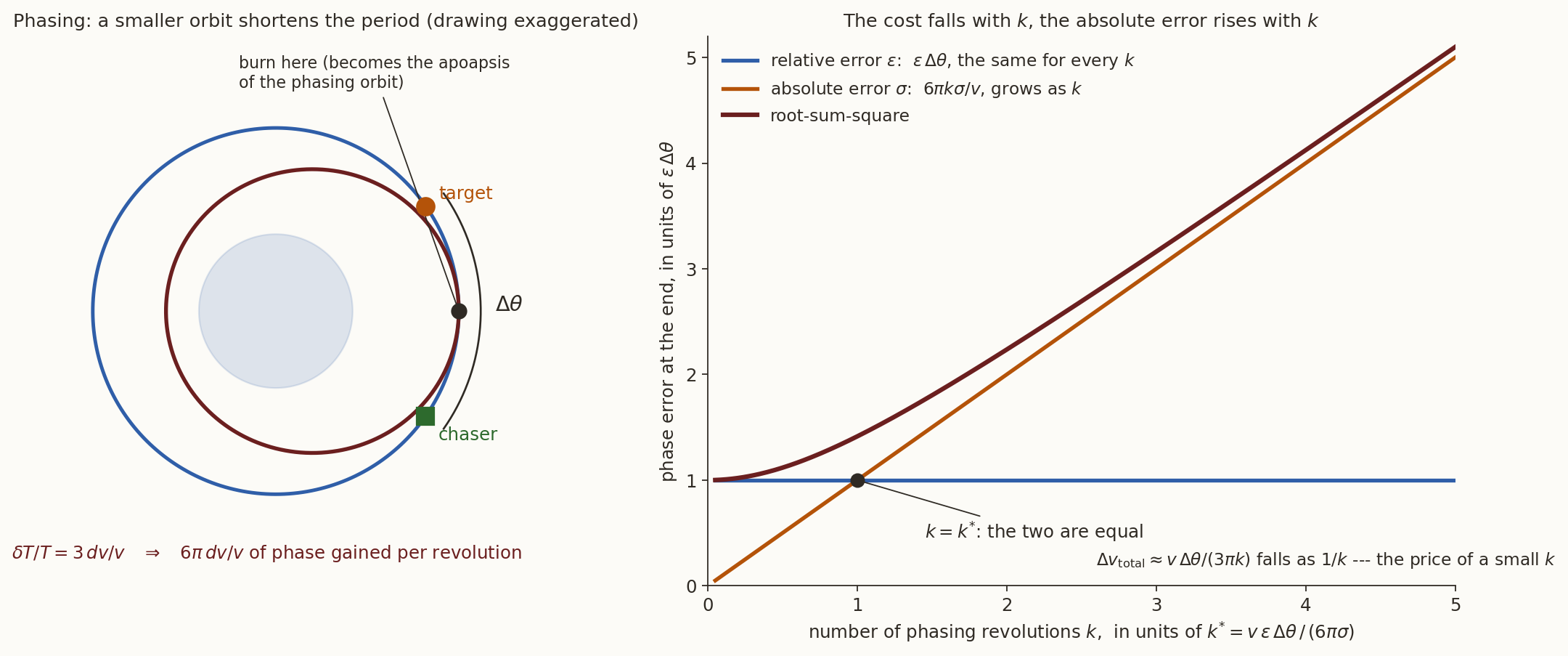
(a) Show that a tangential burn \(dv\) on a circular orbit changes the period by \(\delta T/T=3\,dv/v\), so that each revolution on the new orbit shifts the phase by \(6\pi\,dv/v\).
Answer
\(T=2\pi\sqrt{a^{3}/\mu}\Rightarrow\delta T/T=\tfrac32\,\delta a/a\). On a circle \(\mu=v^{2}a\), so \(\delta a=2a^{2}v\,dv/\mu\) gives \(\delta a/a=2\,dv/v\) and
\[ \boxed{\ \frac{\delta T}{T}=\frac{3\,dv}{v}\ } \qquad\Longrightarrow\qquad \text{phase shift per revolution}=2\pi\frac{\delta T}{T}=\boxed{\ 6\pi\,\frac{dv}{v}\ }. \]
(b) Derive the closing condition, and show that for small \(\Delta\theta\) \(\Delta v_{\rm total}\approx v\,\Delta\theta/(3\pi k)\) and the phasing perigee drops by \(2r\Delta\theta/(3\pi k)\). Compare with the exact values for \(r=6778.137\) km, \(\Delta\theta=20^\circ\), \(k=2\).
Answer
The chaser completes \(k\) revolutions in the time the target covers \(2\pi k-\Delta\theta\): \(kT_{ph}=kT\,(1-\Delta\theta/2\pi k)\), so \(\delta T/T=-\Delta\theta/(2\pi k)\). By (a),
\[ dv=-\frac v3\,\frac{\Delta\theta}{2\pi k}\quad\Longrightarrow\quad \Delta v_{\rm total}=2|dv|=\boxed{\frac{v\,\Delta\theta}{3\pi k}}. \]
The phasing orbit has its apoapsis at the burn point, \(a_{ph}=r(1+\delta T/T)^{2/3}\approx r(1-\Delta\theta/3\pi k)\), so \(r_p=2a_{ph}-r\approx r\,(1-2\Delta\theta/3\pi k)\): the perigee drops by \(\boxed{2r\Delta\theta/(3\pi k)}\).
Numbers (\(v=7.6686\) km/s, \(\Delta\theta=0.34907\) rad, \(k=2\)): \(\Delta v\approx142.0\) m/s against the exact \(146.1\) m/s, and a drop of \(251\) km against the exact \(252\) km.
(c) Show that the phase error at the end is \(\sqrt{(\varepsilon\Delta\theta)^{2}+(6\pi k\sigma/v)^{2}}\), and find the \(k^{*}\) at which the absolute error equals the relative one. Evaluate \(k^{*}\) for \(\varepsilon=0.5\%\), \(\sigma=0.1\) m/s, \(v=7669\) m/s, \(\Delta\theta=20^\circ\).
Answer
Only the first burn’s error matters for the phase at the end: it sets the period of all \(k\) phasing revolutions. The second burn, made at the rendezvous, only sets the drift after the manoeuvre, which a later trim removes. The error of the first burn is \(\delta v=\varepsilon\,dv+\sigma\). After \(k\) revolutions (a):
\[ \delta\phi=6\pi k\,\frac{\delta v}{v}. \]
The relative part: \(6\pi k\,\varepsilon\,\dfrac{|dv|}{v}=6\pi k\,\varepsilon\,\dfrac{\Delta\theta}{6\pi k}=\varepsilon\,\Delta\theta\): the burn gets smaller as \(1/k\), the drift per revolution grows as \(k\), and the two cancel. The absolute part, \(6\pi k\sigma/v\), has no such cancellation and grows with \(k\). Independent errors add in quadrature. They are equal at
\[ k^{*}=\frac{v\,\varepsilon\,\Delta\theta}{6\pi\sigma}=\frac{7669\times0.005\times0.3491}{6\pi\times0.1}=\boxed{7.1}. \]
(d) At 400 km altitude the phasing perigee must stay above 200 km. Find the smallest \(k\) for \(\Delta\theta=20^\circ\). Is a larger \(k\) better?
Answer
From (b) the perigee altitude is \(h_0-2r\Delta\theta/(3\pi k)\ge200\) km, so
\[ \begin{aligned} k\ &\ge\ \frac{2r\Delta\theta}{3\pi\,(h_0-h_{\min})}=\frac{2(6778)(0.3491)}{3\pi(200)}=2.51\\ \Longrightarrow\quad k_{\min}&=3. \end{aligned} \]
For \(k<k^{*}\) the relative error dominates and does not depend on \(k\), so nothing is gained by going beyond the minimum except a smaller \(\Delta v\). For \(k>k^{*}\approx7\) the absolute error dominates and grows linearly with \(k\). So: take the smallest \(k\) that the perigee allows if the \(\Delta v\) can be afforded; take larger \(k\) only to save propellant, and then pay for it with correction burns. (This is Problem 7.)
7. ISS rendezvous: three hours or two days?
A visiting vehicle trails the ISS (circular, altitude \(400\) km, \(r=6778.137\) km) by \(\Delta\theta=20^\circ\) and closes the gap in \(k\) revolutions with the two-burn phasing of Problem 6. The Soyuz/Progress “fast” profile takes about two orbits (about \(3\) h); the standard profile about \(34\) orbits (about \(2\) days). The phasing perigee must stay above \(200\) km. Vehicle: \(7000\) kg, \(I_{sp}=300\) s.
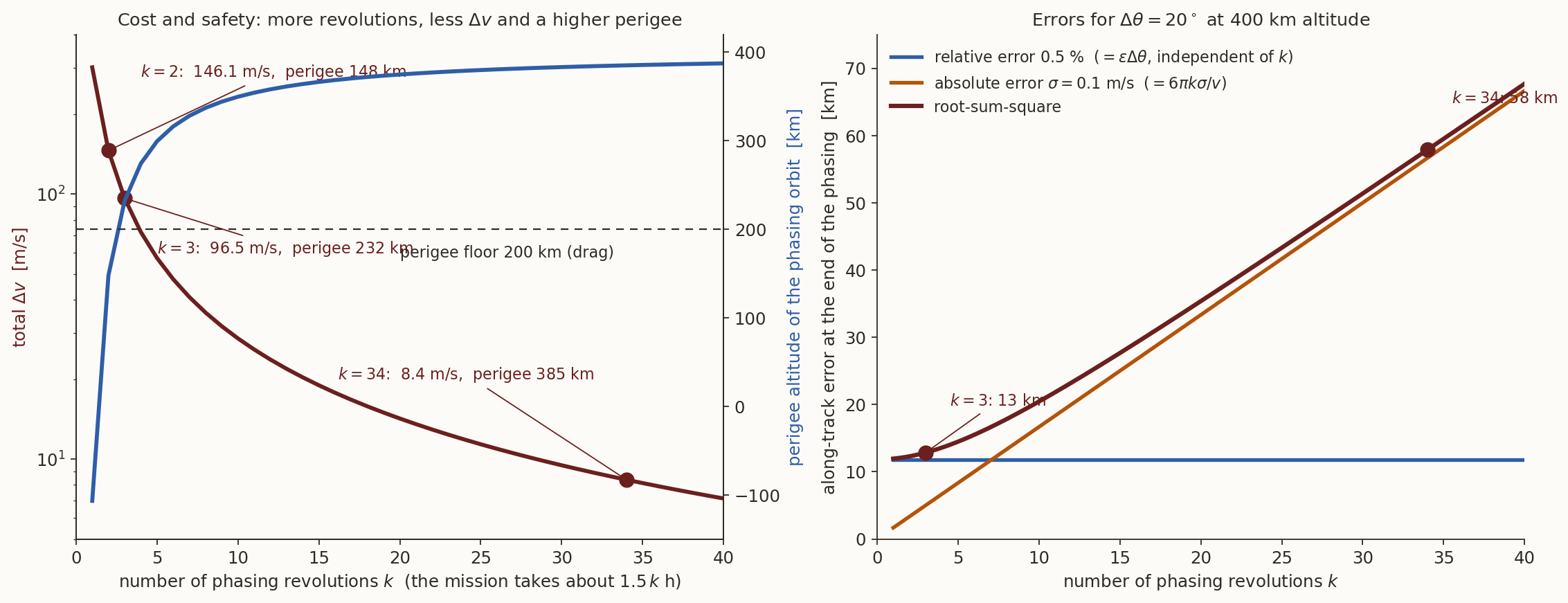
(a) For \(k=2\), \(3\) and \(34\) find \(T_{ph}\), \(a_{ph}\), the perigee altitude, \(\Delta v_{\rm total}\) and the mission duration. Which \(k\) are admissible?
Answer
\(T=2\pi\sqrt{r^{3}/\mu}=5553.6\) s, \(v=7.6686\) km/s. \(T_{ph}=T(1-\Delta\theta/2\pi k)\), \(a_{ph}=(\mu(T_{ph}/2\pi)^{2})^{1/3}\), \(r_p=2a_{ph}-r\), \(\Delta v_{\rm total}=2(v-v_{ph})\) with \(v_{ph}=\sqrt{\mu(2/r-1/a_{ph})}\):
| \(k\) | \(T_{ph}\) [s] | \(a_{ph}\) [km] | perigee alt. | \(\Delta v_{\rm total}\) | mission |
|---|---|---|---|---|---|
| 2 | \(5399.4\) | \(6652.0\) | \(148\) km | \(146.1\) m/s | \(3.0\) h |
| 3 | \(5450.8\) | \(6694.2\) | \(232\) km | \(96.5\) m/s | \(4.5\) h |
| 34 | \(5544.5\) | \(6770.8\) | \(385\) km | \(8.4\) m/s | \(52.4\) h |
\(k=2\) puts the perigee at \(148\) km, inside the drag layer: not admissible. \(k_{\min}=3\) (Problem 6(d)). The fast profile is therefore not a pure phasing manoeuvre; real fast rendezvous gets its phasing from launch timing and a lower insertion orbit, and the burns above are the equivalent cost.
(b) Propellant for \(k=3\) and \(k=34\). What does the fast profile cost?
Answer
\(m_{\rm prop}=m_0\left(1-e^{-\Delta v/(I_{sp}g_0)}\right)\) with \(I_{sp}g_0=2941.995\) m/s:
\[ k=3:\ 7000\left(1-e^{-96.46/2942}\right)=\boxed{226\ \mathrm{kg}},\qquad k=34:\ 7000\left(1-e^{-8.37/2942}\right)=\boxed{20\ \mathrm{kg}}. \]
About \(206\) kg of propellant buys \(48\) hours. On a cargo vehicle \(206\) kg is mass that cannot be cargo.
(c) The phasing burn has a relative error \(0.5\%\) and an absolute error \(\sigma=0.1\) m/s (\(1\sigma\)). Find the along-track error at the end for \(k=3\) and \(k=34\).
Answer
By Problem 6(c): relative part \(\varepsilon\Delta\theta=0.005\times20^\circ=0.100^\circ\) (\(11.8\) km), the same for both. Absolute part \(6\pi k\sigma/v\):
\[ \begin{aligned} k=3:&\quad 6\pi(3)(0.1)/7668.6=7.4\times10^{-4}\ \mathrm{rad}=0.042^\circ\ (5.0\ \mathrm{km}),\\ &\quad\mathrm{RSS}=0.109^\circ=\boxed{12.8\ \mathrm{km}}\\ k=34:&\quad 6\pi(34)(0.1)/7668.6=8.4\times10^{-3}\ \mathrm{rad}=0.479^\circ\ (56.6\ \mathrm{km}),\\ &\quad\mathrm{RSS}=0.489^\circ=\boxed{57.9\ \mathrm{km}} \end{aligned} \]
Here \(k^{*}=7.1\): the two-day profile is dominated by the absolute error. Tens of km are still inside a radar acquisition range, but this is why the long profile carries scheduled correction burns, and why it trades propellant for operations and time.
Sources and caveats. The ISS altitude of \(400\) km is a representative value.
8. Dodging a piece of debris
ISRO’s satellites make collision avoidance manoeuvres every year: \(23\) in 2023 and \(10\) in 2024, according to ISRO’s space situational assessment reports. Consider an Earth-observation satellite on a circular orbit at \(500\) km altitude. A close approach with a piece of debris is predicted. The satellite must be moved by \(s_0=1\) km from where it would otherwise be at the time of closest approach.
The phasing note gives two first-order facts for a small tangential burn \(\delta v\) on a circle of radius \(a\) and speed \(v\). The semi-major axis changes by \(\delta a/a=2\,\delta v/v\), and the period by \(\delta T/T=\tfrac32\,\delta a/a\).
- Analytical. The burn is made a whole number \(k\) of revolutions before the closest approach, at the time \(t=kT\) before it. Show that at the closest approach the satellite is displaced along its orbit by \(3\,\delta v\,t\). Which way, for a prograde burn? If the burn is made instead half a revolution before the closest approach, show that the satellite is then displaced radially by \(4a\,\delta v/v\) and along the orbit by \(\tfrac32\,T\,\delta v\).
- Numerical. Find \(\delta v\) to move the satellite by a total distance \(s_0\) with a burn half a revolution before, and with a burn one day before. How many times cheaper is the early burn?
- Analytical. The early burn has a weakness. The drag on the satellite is not known exactly, so its predicted position drifts away from the truth. Let \(\epsilon\) be the uncertainty of the drag deceleration, a small tangential acceleration that we do not know. Use part (a) to show that after a time \(t\) it moves the satellite along its orbit by \(\tfrac32\,\epsilon\,t^2\). To be safe, the planned displacement must cover the miss distance and this error, \[ 3\,\delta v\,t\ \ge\ s_0+\tfrac32\,\epsilon\,t^2 . \] Find the lead time \(t^*\) that needs the smallest \(\delta v\), and that \(\delta v^*\). Show that at \(t^*\) the two terms on the right are equal.
- Numerical. Take \(\epsilon=5\times10^{-8}\) m/s\(^2\) (assumed). Find \(t^*\) in hours, \(\delta v^*\) in mm/s, and \(\delta v\) for a burn five days before the closest approach.
- Discussion. ISRO’s report for 2024 says that fewer separate avoidance burns were needed partly because avoidance was combined with the routine burns that keep the orbit up. Why does a satellite in low orbit need such routine burns, and which direction of avoidance burn fits with them? What else must be checked before the burn is made?
Solution
A tiny tangential burn changes the period, and the change of period keeps adding up, revolution after revolution. So the plan is to turn the period change into a displacement that grows with time, and to compare it with the displacement that a burn gives at once. Then we let the uncertainty of drag grow in the same way, and find the best moment to burn.
(a) Along the orbit, and across it. A prograde burn \(\delta v\) raises the semi-major axis by \(\delta a=2a\,\delta v/v\) and lengthens the period by \[ \delta T=\tfrac32\,T\,\frac{\delta a}{a}=3T\,\frac{\delta v}{v}. \] After each revolution the satellite is back at the burn point, but \(\delta T\) later than it would have been. In that time the undisturbed satellite would have moved on by \(v\,\delta T=3T\,\delta v\). After \(k\) revolutions, that is after the time \(t=kT\), the satellite is therefore \[ s=3kT\,\delta v=3\,\delta v\,t \] behind its undisturbed position. A prograde burn makes the satellite fall behind, and a retrograde one makes it run ahead.
Half a revolution after the burn, the satellite is at the far side of the new orbit. The burn point is the perigee of the new orbit, at radius \(a\), and the far side is its apogee, \(r_a=2(a+\delta a)-a=a+2\,\delta a\). So the satellite is displaced outward by \[ 2\,\delta a=\frac{4a\,\delta v}{v}. \] It is also late. Its period is longer by \(\delta T\), so it takes \(\delta T/2\) longer to reach the far side, and in that time the undisturbed satellite moves on by \(v\,\delta T/2=\tfrac32T\,\delta v\). Half a revolution after the burn the satellite is therefore \(4a\,\delta v/v\) above and \(\tfrac32T\,\delta v\) behind its undisturbed position. The along-track part is the same rule, \(3\,\delta v\,t\), with \(t=T/2\).
(b) The numbers. At \(500\) km, \(a=6878.137\) km, \(v=7.61261\) km/s and \(T=94.62\) min. Half an orbit after the burn the two displacements are \(\delta v\) times \[ \frac{4a}{v}=3614\ \text{s}\qquad\text{and}\qquad\tfrac32T=8515\ \text{s}. \] They are at right angles, so the total displacement is \(\delta v\sqrt{3614^2+8515^2}\ \text{s}=9251\ \text{s}\times\delta v\). Note that even here the along-track part is the larger one. A total displacement of \(1\) km needs \[ \delta v=\frac{1000\ \text{m}}{9251\ \text{s}}=0.1081\ \text{m/s}, \] which puts the satellite \(0.391\) km above and \(0.921\) km behind its undisturbed position. With the burn one day before, the displacement is all along the orbit, and \(1\) km needs \[ \delta v=\frac{s_0}{3t}=\frac{1000\ \text{m}}{3\times86\,400\ \text{s}}=3.858\ \text{mm/s}, \] about \(28\) times less. A day’s notice turns a tenth of a metre per second into a few millimetres per second.
(c) The best lead time. Treat the unknown part of the drag, \(\epsilon\), as a tiny continuous burn. Up to the time \(t'\) it has given the velocity \(\epsilon t'\), and by part (a) a velocity \(\delta v\) makes the along-track position change at the rate \(3\,\delta v\). So the position error grows as \[ \frac{ds_{\rm err}}{dt'}=3\,\epsilon\,t',\qquad s_{\rm err}(t)=\tfrac32\,\epsilon\,t^2 . \] The error grows like \(t^2\), while the planned displacement grows only like \(t\). The condition \(3\,\delta v\,t\ge s_0+\tfrac32\epsilon t^2\) gives the least burn for each lead time, \[ \delta v(t)=\frac{s_0}{3t}+\frac{\epsilon\,t}{2}. \] The first term falls with \(t\) and the second rises, so there is a minimum. Setting \(d\,\delta v/dt=0\), \[ -\frac{s_0}{3t^2}+\frac{\epsilon}{2}=0\quad\Longrightarrow\quad t^*=\sqrt{\frac{2s_0}{3\epsilon}},\qquad \delta v^*=2\cdot\frac{\epsilon\,t^*}{2}=\sqrt{\frac{2s_0\,\epsilon}{3}} . \] At \(t^*\) the two terms of \(\delta v\) are equal, \(s_0/(3t^*)=\epsilon t^*/2\). Multiplying both by \(3t^*\) gives \(s_0=\tfrac32\epsilon t^{*2}\). At the best lead time the drag error equals the miss distance itself.
(d) The numbers. With \(\epsilon=5\times10^{-8}\) m/s\(^2\) and \(s_0=1000\) m, \[ t^*=\sqrt{\frac{2000}{1.5\times10^{-7}}}\ \text{s}=115\,470\ \text{s}=32.08\ \text{h},\qquad \delta v^*=5.774\ \text{mm/s}. \] That is about \(20\) revolutions, so the whole-revolution result of part (a) applies well. A burn five days before needs \(\delta v=0.772+10.80=11.57\) mm/s, twice as much, because by then the drag error alone would be \(14.0\) km. Burning too early is wasteful for the same reason as burning too late.
(e) Discussion. At \(500\) km the air is thin but not absent. Part (a) of Problem 10 of the The Hohmann Transfer questions showed that drag lowers the orbit, so the satellite needs regular prograde burns to stay on its reference orbit, and to keep its ground track for imaging. A prograde avoidance burn does the same job, so it can be an early or larger maintenance burn, with no extra propellant. That is what ISRO’s 2024 report describes.
Before any burn the new trajectory must itself be screened, because moving away from one object can bring the satellite close to another. The burn also shifts the ground track and the times of passes over ground stations and imaging targets, so later burns must restore them. And the decision depends on the probability of collision, not just the predicted distance, because the prediction itself is uncertain.
9. Rendezvous: fitting a transfer to a phase angle
A computing problem. It rebuilds one chart of the survey of impulsive transfers by F. W. Gobetz and J. R. Doll (NASA CR-61999, 1968). Work in normalised units, \(\mu=1\) and \(r_1=1\), so that \(V_{c_1}=1\), and quote every \(\Delta V\) divided by \(V_{c_1}\). Do the theory (A) on paper. Write the functions of (B) in Python, with NumPy, SciPy and Matplotlib, and check them against the targets of (C). Then draw the figures of (D) and answer the question from them.
Source: Figs. 19 and 20 of the survey.
The question
An interceptor is on a circular orbit of radius \(r_1\); the target is on a circular orbit of radius \(r_2=kr_1\), \(k=k_s=1.6\). The target is ahead of the interceptor by the phase angle \(\beta=\beta_H+\Delta\beta\), where \(\beta_H\) is the phase that suits a Hohmann transfer. For \(\Delta\beta=\Delta\beta_s\), defined as the value midway between \(\Delta\beta^{*}(k_s)\) (see T4) and \(360^\circ\), rounded to the nearest \(5^\circ\):
- A Hohmann rendezvous waits on the initial orbit for the phase to come right. How long does the whole rendezvous take?
- A bi-elliptic transfer with no waiting can absorb the offset through its intermediate radius. Find \(r_i/r_1\), the rendezvous time and the \(\Delta V\).
- How much faster is the bi-elliptic rendezvous, and how much dearer? Give the times in minutes for \(r_1=6678.137\) km, \(\mu=398600\) km\(^3\)/s\(^2\).
A. Theory
T1. A transfer that sweeps the interceptor through the angle \(\Theta\) in the time \(t\) arrives when the target has moved \(\omega_2t\). Show that rendezvous requires \(\beta+\omega_2t=\Theta\pmod{2\pi}\). In units \(r_1=1\), \(\mu=1\) the angular speeds are \(\omega_1=1\) and \(\omega_2=k^{-3/2}\). For a Hohmann transfer find \(t_H\) and the Hohmann phase angle \(\beta_H=\pi\left[1-\left(\frac{1+k}{2k}\right)^{3/2}\right]\); show that \(\beta_H\le\pi(1-2^{-3/2})=116.36^\circ\).
T2. If \(\Delta\beta\ne0\) a Hohmann rendezvous must wait. Show that the wait is \(\Delta\beta/(\omega_1-\omega_2)\) and that the longest wait is one synodic period. Write the total Hohmann rendezvous time \(t_H+\Delta\beta/(\omega_1-\omega_2)\).
T3. A bi-elliptic transfer through \(r_i\) flies half of an ellipse with apsides \((1,r_i)\) and half of one with apsides \((r_i,k)\), so \(\Theta=2\pi\). Write \(t_{bi}(r_i)\). Show that the offset it absorbs with no waiting is \[\Delta\beta=3\pi-\omega_2(t_{bi}-t_H)\ \ (r_i\ge k,\ \text{outer}),\qquad\Delta\beta=\pi-\omega_2(t_{bi}-t_H)\ \ (1\le r_i\le k,\ \text{inner}),\] by choosing the branch of “\(\pmod{2\pi}\)” that puts \(\Delta\beta\) in \([0,2\pi]\). Find the range of \(\Delta\beta\) and the rendezvous time at the two ends of each branch.
T4. Equal-time points. Show that the inner bi-elliptic and the waiting Hohmann transfer take the same total time at \(\Delta\beta=\pi(1-k^{-3/2})\), and the outer one and the waiting Hohmann at \(\Delta\beta^{*}(k)=3\pi(1-k^{-3/2})\). Show that \(\Delta\beta^{*}\ge2\pi\) exactly when \(k\ge3^{2/3}\), and say what that means for \(k=k_s\).
T5. Write the total \(\Delta V\) of the three tangential burns of the bi-elliptic transfer through \(r_i\) (any \(r_i>0\)).
B. Code
beta_H(k),t_H(k),t_bi(k, ri),dbeta(k, ri)(the two branches of T3),ri_of(k, db, branch)bybrentq,dv_bi(k, ri), andtime_hohmann(k, db).fly(k, ri, beta): the independent check. Integrate the two-body equations withscipy.integrate.solve_ivp(relative and absolute tolerances \(10^{-12}\) or tighter): start on the unit circle at angle \(0\), apply burn 1 (tangential, to the apse speed of the ellipse with apsides \((1,r_i)\)), integrate to the next apse (an event on \(\mathbf r\cdot\mathbf v=0\); take a short first step so that the event does not fire at \(t=0\)), apply burn 2, integrate to the next apse, and compare the interceptor’s position with the target’s at that instant (the target is at angle \(\beta+\omega_2t\) on the circle of radius \(k\)). Return the miss distance and \(t\).
C. Validation
| tag | check | target | tol |
|---|---|---|---|
| V1 | \(\beta_H\) at \(k\to\infty\); at \(k=2\); at \(k=10\) | \(116.36^\circ,\ 63.09^\circ,\ 106.58^\circ\) | \(0.005^\circ,\ 0.01^\circ,\ 0.01^\circ\) |
| V2 | outer \(r_i/r_1\) at \(\Delta\beta=\pi(1-k^{-3/2})\) for \(k=2,\ 3,\ 4,\ 5\) | \(3.733,\ 5.361,\ 7.017,\ 8.686\) | \(2\times10^{-3}\) |
| V3 | the corner \(k\to1\), \(\Delta\beta\to0\) (outer): \(r_i/r_1\) | \(2^{5/3}-1=2.1748\) | \(10^{-4}\) |
| V4 | smallest \(k\) for which \(\Delta\beta^{*}\ge2\pi\) | \(3^{2/3}=2.08008\) | \(10^{-8}\) |
| V5 | time at \(r_i=r_2\) and at \(\Delta\beta\to0\) (\(k=3\)), \((t_{bi}-t_H)/T_2\) | \(0.5,\ 1.5\) | \(10^{-8}\) |
| V6 | independent: fly for \(k=3\) at \(\Delta\beta=1\) rad on both branches: miss distance (units \(r_1\)) |
\(0\) | \(10^{-8}\) |
| V7 | independent: fly for the Hohmann transfer at \(\beta=\beta_H\) and at \(\beta=\beta_H+0.5\) rad |
\(0\); \(\ne0\) | \(10^{-8}\); — |
| V8 | break-even times from your own time functions, solved for \(\Delta\beta\) at \(k=2,\ 3,\ 10\) (inner) | \(116.36^\circ,\ 145.36^\circ,\ 174.31^\circ\) | \(0.01^\circ\) |
D. Figure and answer
Figure 9a. \(r_i/r_1\) (logarithmic axis, \(1\) to \(10\)) against \(\Delta\beta\): the outer branch for \(\Delta\beta\) from \(0^\circ\) to \(360^\circ\) on the left of a vertical line labelled “360/0”, the inner branch from \(0^\circ\) to \(\pi(1-k^{-3/2})\) (where \(r_i=r_1\)) on the right, for \(k\in\{1,2,3,5,10\}\). Add the two dashed loci of T4 (the outer curves evaluated at \(\pi(1-k^{-3/2})\) and at \(3\pi(1-k^{-3/2})\)) and hatch the region where the outer transfer beats the waiting Hohmann transfer.
Figure 9b. For \(k=k_s\): the total rendezvous time against \(\Delta\beta\in[0,360^\circ]\) (in units of the target period) for the waiting Hohmann transfer and the outer bi-elliptic transfer; mark \(\Delta\beta^{*}(k_s)\) and \(\Delta\beta_s\).
Answer. For \((k_s,\Delta\beta_s)\): \(\Delta\beta^{*}(k_s)\) and \(\Delta\beta_s\) (degrees); \(r_i/r_1\) for the bi-elliptic transfer; the two rendezvous times in minutes, and the percentage saved; the two \(\Delta V\) values in units of \(V_{c_1}\) and the percentage extra; and the miss distance from fly. One sentence: when is buying time with \(\Delta V\) worth it?
Notes
- The inner branch lies in \(1\le r_i\le k\), the outer in \(r_i\ge k\); at exactly \(r_i=k\) the two meet. Evaluate
dbetajust on the correct side when bracketing. - Both bi-elliptic burns 2 and 3 change sign between the inner and outer branches. Use magnitudes in the cost, and take care in the integrator that burn 2 and burn 3 set the speed to the apse speed of the next ellipse.
- The time of flight is the time to the second apse crossing; do not add the waiting time for the bi-elliptic transfer: it has none.
Solution
The plan is to write the rendezvous condition once, for any transfer, and then to compare a Hohmann transfer that waits for the right phase with a bi-elliptic transfer that leaves at once. The phasing note treats the same trade on a single orbit.
T1. The target starts \(\beta\) ahead and moves through \(\omega_2t\), while the interceptor sweeps \(\Theta\). They meet when \(\beta+\omega_2t=\Theta\pmod{2\pi}\). In units \(r_1=\mu=1\), \(\omega_1=1\) and \(\omega_2=k^{-3/2}\). A Hohmann transfer has \(\Theta=\pi\) and \(t_H=\pi\bigl((1+k)/2\bigr)^{3/2}\), so
\[ \beta_H=\pi-\omega_2t_H=\pi\left[1-\left(\frac{1+k}{2k}\right)^{3/2}\right]. \]
T2. While the interceptor waits, the phase changes at the rate \(\omega_1-\omega_2\), so an offset \(\Delta\beta\) takes \(\Delta\beta/(\omega_1-\omega_2)\) to remove. The longest wait is a whole turn of the phase, one synodic period. The total time is \(t_H+\Delta\beta/(\omega_1-\omega_2)\).
T3. The bi-elliptic transfer has \(\Theta=2\pi\) and \(t_{bi}=\pi\bigl[\bigl((1+r_i)/2\bigr)^{3/2}+\bigl((r_i+k)/2\bigr)^{3/2}\bigr]\). The rendezvous condition with \(\beta=\beta_H+\Delta\beta\) gives \(\Delta\beta=\pi-\omega_2(t_{bi}-t_H)\) modulo \(2\pi\). For the inner branch, \(1\le r_i\le k\), \(\Delta\beta\) runs from \(\pi(1-k^{-3/2})\) at \(r_i=1\) down to \(0\) at \(r_i=k\), where \(t_{bi}-t_H=\pi k^{3/2}\). For the outer branch we add \(2\pi\), and \(\Delta\beta\) falls from \(2\pi\) at \(r_i=k\) towards smaller values as \(r_i\) grows and the flight lengthens.
T4. On the inner branch at \(r_i=1\), \(t_{bi}-t_H=\pi\) and the Hohmann wait is \(\pi(1-k^{-3/2})/(1-k^{-3/2})=\pi\), so the two take the same time at \(\Delta\beta=\pi(1-k^{-3/2})\). On the outer branch, with \(D=t_{bi}-t_H\), equal times need \(D=(3\pi-\omega_2D)/(1-\omega_2)\), so \(D=3\pi\) and \(\Delta\beta^*=3\pi(1-k^{-3/2})\). This is at least \(2\pi\) when \(k^{3/2}\ge3\), that is \(k\ge3^{2/3}=2.080\). For \(k_s=1.6\) it is below \(2\pi\), so there is a band of offsets, from \(\Delta\beta^*\) to \(360^\circ\), in which the outer bi-elliptic transfer is the faster one.
T5. \(\Delta V=|v(1;r_i)-1|+|v(r_i;k)-v(r_i;1)|+|k^{-1/2}-v(k;r_i)|\), with \(v(r;s)=\sqrt{2s/(r(r+s))}\).
The answers, for \(k_s=1.6\). \(\Delta\beta^*=273.18^\circ\), and \(\Delta\beta_s=315^\circ\), midway between \(273.18^\circ\) and \(360^\circ\) rounded to \(5^\circ\). The bi-elliptic transfer that absorbs this offset has \(r_i/r_1=1.874\), on the outer branch. For \(r_1=6678.137\) km the period of the initial orbit is \(90.52\) min. The Hohmann rendezvous, with its wait, takes \(2.471\) periods, \(223.6\) min, and the bi-elliptic one \(2.006\) periods, \(181.6\) min, which is \(18.8\%\) faster. It costs \(0.2643\,V_{c_1}\) against \(0.2066\,V_{c_1}\) for Hohmann, \(27.9\%\) more. The integration of the two-body equations lands on the target to within \(3\times10^{-12}\) of \(r_1\). Buying time with \(\Delta V\) is worth it when the rendezvous is urgent, for example to reach a crew or to meet a short launch or communication window, and not for routine resupply, where propellant is the scarcer resource.