Phasing
1 Phasing
A spacecraft can be on exactly the right orbit and still be in the wrong place. Suppose a crew vehicle has reached the orbit of a space station, but the station is some distance ahead along the same orbit. How does the vehicle catch up? Moving a spacecraft along its own orbit in this way is called phasing.
The instinct is to speed up, and this instinct is wrong. We will show why, and find the right manoeuvre and its cost. We will see that we can reduce the cost as far as we like by taking more time. We will then look at phasing on an elliptic orbit, where a new question arises, which is where to make the burn.
1.1 Catching up on the same orbit
Consider a chaser and a target on the same circular orbit of radius \(r\) and period \(T\), with the chaser behind the target by an angle \(\Delta\theta\). What happens if the chaser fires its engine forward? The burn adds energy, which raises the orbit. By Kepler’s third law, a larger orbit has a longer period. So the chaser takes longer to go round and falls further behind.
The right move is therefore the opposite one. A retrograde burn drops the chaser onto a smaller orbit, with a shorter period. It goes round this orbit and arrives back at the burn point early. Every orbit returns to any of its points after one period, so the chaser is certain to come back to the burn point. We only need to choose the period so that the target arrives there at the same moment.
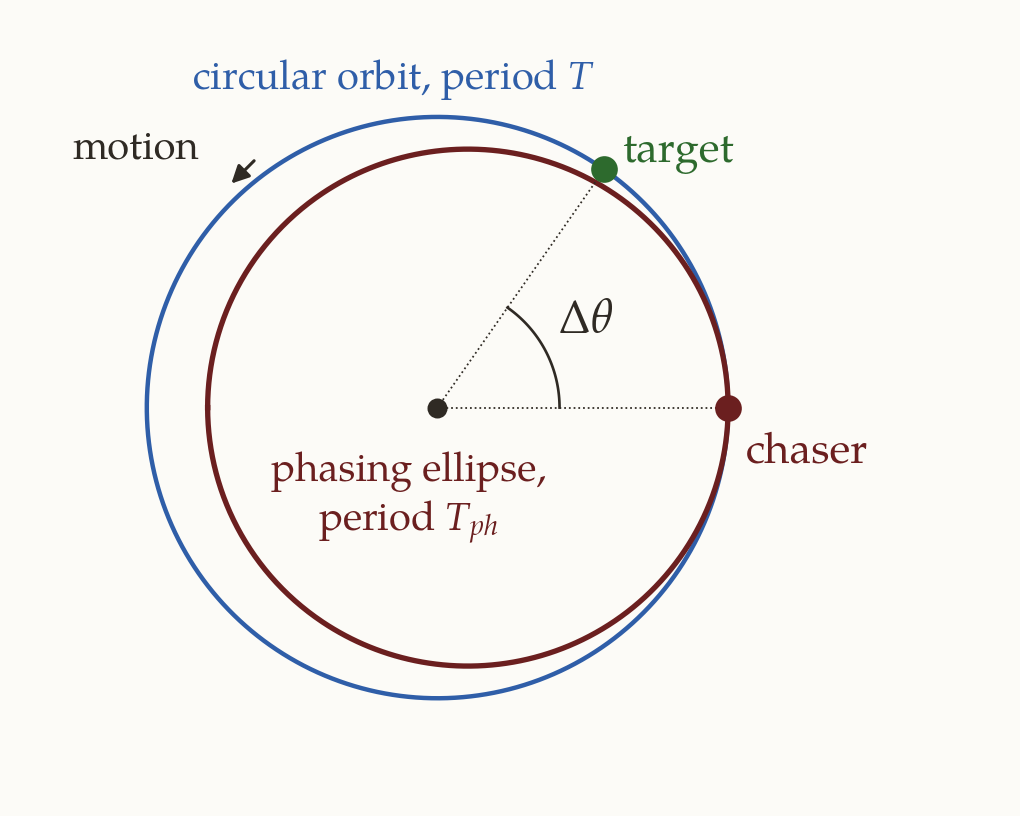
Figure 1 shows the geometry. The chaser, in maroon, is at the burn point, and the target, in green, is ahead of it by \(\Delta\theta\). The maroon curve is the phasing ellipse. It touches the circle at the burn point, which is its apoapsis because the burn has lowered the speed there.
We want the chaser to make \(k\) revolutions of the phasing ellipse, with period \(T_{ph}\), and to meet the target at the burn point at the end of them. In the same time the target must cover \(k\) whole turns less the angle \(\Delta\theta\) that it already leads by. It moves at a constant angular rate \(2\pi/T\), so
\[ kT_{ph}=\frac{2\pi k-\Delta\theta}{2\pi}\,T \qquad\Longrightarrow\qquad \boxed{\;T_{ph}=T\left(1-\frac{\Delta\theta}{2\pi k}\right).\;} \]
Kepler’s third law, \(T\propto a^{3/2}\), turns this period into a semi-major axis, \(a_{ph}=r\,(T_{ph}/T)^{2/3}\). The burn point is the apoapsis, so the perigee radius is \(2a_{ph}-r\).
We can now find the cost. The first burn takes the speed from the circular speed to the speed on the ellipse at radius \(r\). After \(k\) revolutions a second burn, equal and opposite, restores the circular orbit. Vis-viva gives the speed on the ellipse, so
\[ \boxed{\;\Delta v_{\rm total}=2\left|\sqrt{\mu\left(\frac2r-\frac1{a_{ph}}\right)}-\sqrt{\frac{\mu}{r}}\right|.\;} \tag{1}\]
Example. A chaser is on a circular orbit of radius \(r=6778\) km, which is at an altitude of \(400\) km. This is the low end of the range planned for the Bharatiya Antariksh Station and close to the altitude of the International Space Station. The target is \(10^\circ\) ahead of it. Take \(\mu=398\,600.4418\) km\(^3\)/s\(^2\) and \(R_\oplus=6378.137\) km. The chaser is to catch up in one revolution. Find the period and the semi-major axis of the phasing ellipse, the perigee altitude and the total \(\Delta v\).
Solution. The period of the circle is \(T=2\pi\sqrt{r^3/\mu}=5553.46\) s, which is \(92.558\) min. With \(k=1\) and \(\Delta\theta=10^\circ\),
\[ T_{ph}=5553.46\left(1-\frac{10}{360}\right)=5399.19\text{ s},\qquad a_{ph}=6778\left(\frac{35}{36}\right)^{2/3}=6651.89\text{ km}. \]
The perigee radius is \(2a_{ph}-r=6525.79\) km, which is an altitude of \(147.6\) km. The speeds at the burn point are \(7.668636\) km/s on the circle and \(7.595597\) km/s on the ellipse, so
\[ \Delta v_{\rm total}=2(7.668636-7.595597)=0.146078\text{ km/s}=146.1\text{ m/s}. \]
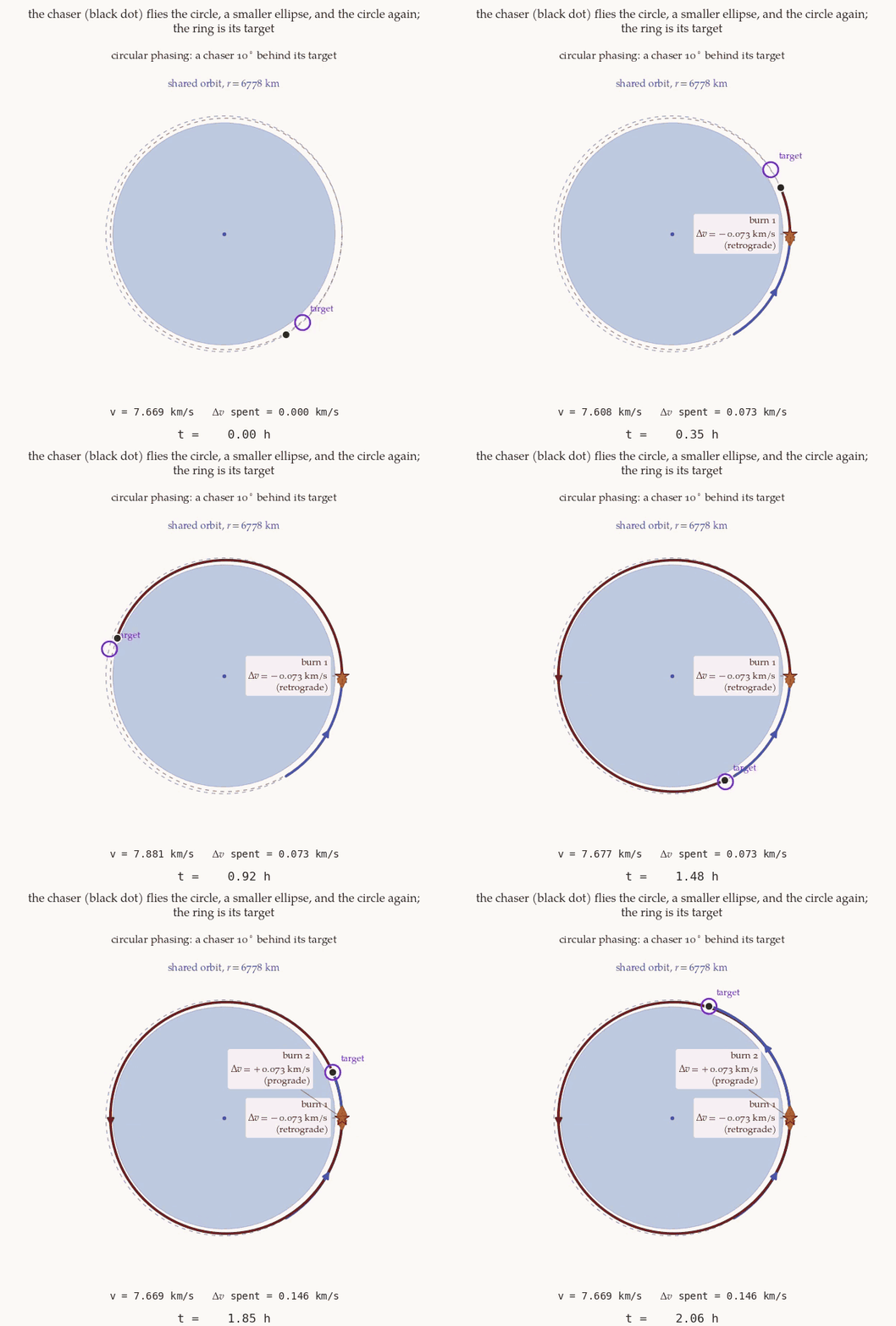
There is a problem with this answer. A perigee at \(147.6\) km is deep in the upper atmosphere, where drag would take energy from the chaser and could bring it down. How low is too low depends on the spacecraft and on how long it stays there. In this note we take \(200\) km as the lowest acceptable perigee, as a round working value. So this trajectory is correct, but it should not be flown. What can we do about it?
1.1.1 Taking more revolutions
Look again at the formula for \(T_{ph}\). If the chaser takes \(k\) revolutions, the period needs to differ from \(T\) by only a fraction \(\Delta\theta/(2\pi k)\). So the ellipse is closer to the circle, its perigee is higher and the burns are smaller. How much smaller?
To find this, we differentiate vis-viva at a fixed radius. From \(v^2=\mu(2/r-1/a)\),
\[ 2v\,dv=\frac{\mu}{a^2}\,da \qquad\Longrightarrow\qquad \boxed{\;dv=\frac{\mu}{2va^2}\,da .\;} \tag{2}\]
On our circle \(v^2=\mu/a\), so this becomes \(dv=(v/2)(da/a)\). From \(T\propto a^{3/2}\) we have \(da/a=\tfrac23\,dT/T\), and here \(dT/T=\Delta\theta/(2\pi k)\). Multiplying by two for the two burns, for small \(\Delta\theta/k\),
\[ \Delta v_{\rm total}\approx v\,\frac{da}{a}=\frac{v\,\Delta\theta}{3\pi k} . \]
So the cost falls in proportion to \(1/k\). Using this formula on our example gives \(142\) m/s for \(k=1\), which is within \(3\%\) of the exact \(146.1\) m/s.
Table 1 shows the trade-off for the same chaser and target, from Equation 1.
| Revolutions \(k\) | \(a_{ph}\) (km) | Perigee altitude (km) | \(\Delta v_{\rm total}\) (m/s) | Time (h) |
|---|---|---|---|---|
| \(1\) | \(6651.89\) | \(147.6\) | \(146.1\) | \(1.50\) |
| \(2\) | \(6715.09\) | \(274.1\) | \(72.0\) | \(3.04\) |
| \(3\) | \(6736.10\) | \(316.1\) | \(47.8\) | \(4.59\) |
| \(5\) | \(6752.87\) | \(349.6\) | \(28.6\) | \(7.67\) |
| \(10\) | \(6765.44\) | \(374.7\) | \(14.2\) | \(15.4\) |
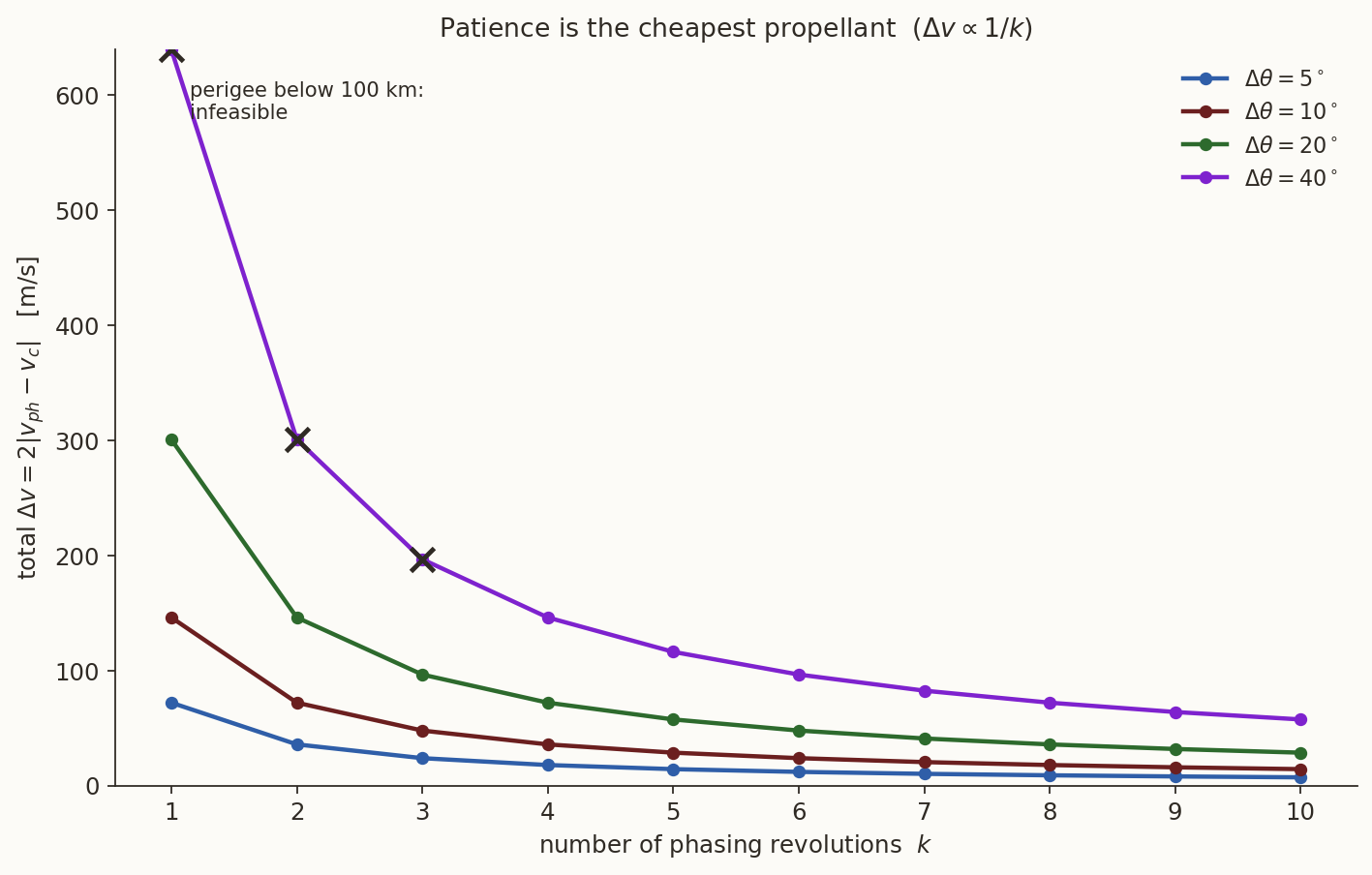
Figure 3 shows the same behaviour for other gaps. Each curve falls as \(1/k\). The larger the gap, the higher the curve, and the more revolutions are needed to keep the perigee above the atmosphere.
So in phasing we can exchange time for propellant at a very good rate. Going from one revolution to ten saves \(132\) m/s, for an extra \(14\) hours. A faster approach needs larger burns, and the perigee limit rules out the fastest ones altogether.
The caution on the other side is that time is not free. A crew has to wait in a small capsule, and every extra hour uses up consumables. So a crewed mission may well choose a small \(k\) and pay for it in propellant, while an uncrewed one can usually afford to wait. The choice of \(k\) is a balance between the two, within the perigee limit.
Suppose the chaser is instead \(10^\circ\) ahead of the target on the same circle, with \(r=6778\) km and \(\mu=398\,600.4418\) km\(^3\)/s\(^2\). It wants to fall back to the target in one revolution. Which way does it burn? What is the phasing ellipse, and what does it cost? Is the atmosphere a problem now?
Answer
It burns prograde, onto a larger ellipse with a longer period. Now \(T_{ph}=T(1+1/36)\), so \(a_{ph}=6778(37/36)^{2/3}=6902.94\) km. The burn point is the perigee and the apoapsis radius is \(7027.89\) km. The speed on the ellipse at the burn point is \(7.73773\) km/s, so the total is \(2(7.73773-7.66864)=138.2\) m/s. The burn point stays the lowest point of the orbit, at \(400\) km altitude, so the perigee limit no longer applies.1.2 Phasing on an ellipse: where to burn?
Now suppose the spacecraft is on an ellipse with semi-major axis \(a\) and eccentricity \(e\), and it must arrive at some point later by a time \(\Delta t\). One longer orbit will do this. The new period is \(T_{ph}=T+\Delta t\), so \(a_{ph}=a(1+\Delta t/T)^{2/3}\). On a circle every point was the same. An ellipse has a fast end and a slow end, so the burn point now matters. Where should we burn?
Equation 2 answers this. For a given \(da\), the impulse is inversely proportional to the speed at the burn point. So the burn should be made where the spacecraft is fastest, which is at periapsis. For a small change of the orbit, the ratio of the cost at apoapsis to the cost at periapsis is
\[ \frac{v_p}{v_a}=\frac{1+e}{1-e} , \]
where we used \(h=r_pv_p=r_av_a\) and \(r_a/r_p=(1+e)/(1-e)\). This is the same Oberth effect that we met in the Hohmann note, because a change of \(a\) is a change of energy.
Example. A spacecraft on an orbit with \(a=10\,000\) km and \(e=0.3\) must arrive \(600\) s late. It makes two equal burns, one on each side of one longer orbit. Take \(\mu=398\,600.4418\) km\(^3\)/s\(^2\). Compare the cost of doing this at periapsis and at apoapsis.
Solution. The period is \(T=9952.01\) s, so
\[ a_{ph}=10\,000\left(1+\frac{600}{9952.01}\right)^{2/3}=10\,397.99\text{ km}. \]
Vis-viva at the burn point gives the following speeds, in km/s.
| Burn at | Speed before | Speed after | \(\Delta v\), each burn | Total |
|---|---|---|---|---|
| Periapsis, \(r=7000\) km | \(8.603825\) | \(8.692036\) | \(0.088211\) | \(0.17642\) |
| Apoapsis, \(r=13\,000\) km | \(4.632829\) | \(4.794662\) | \(0.161834\) | \(0.32367\) |
Burning at periapsis costs \(45\%\) less. The ratio of the costs is \(0.32367/0.17642=1.835\), which is close to the prediction \((1+e)/(1-e)=1.857\). The two differ because the change of \(a\) here is finite.
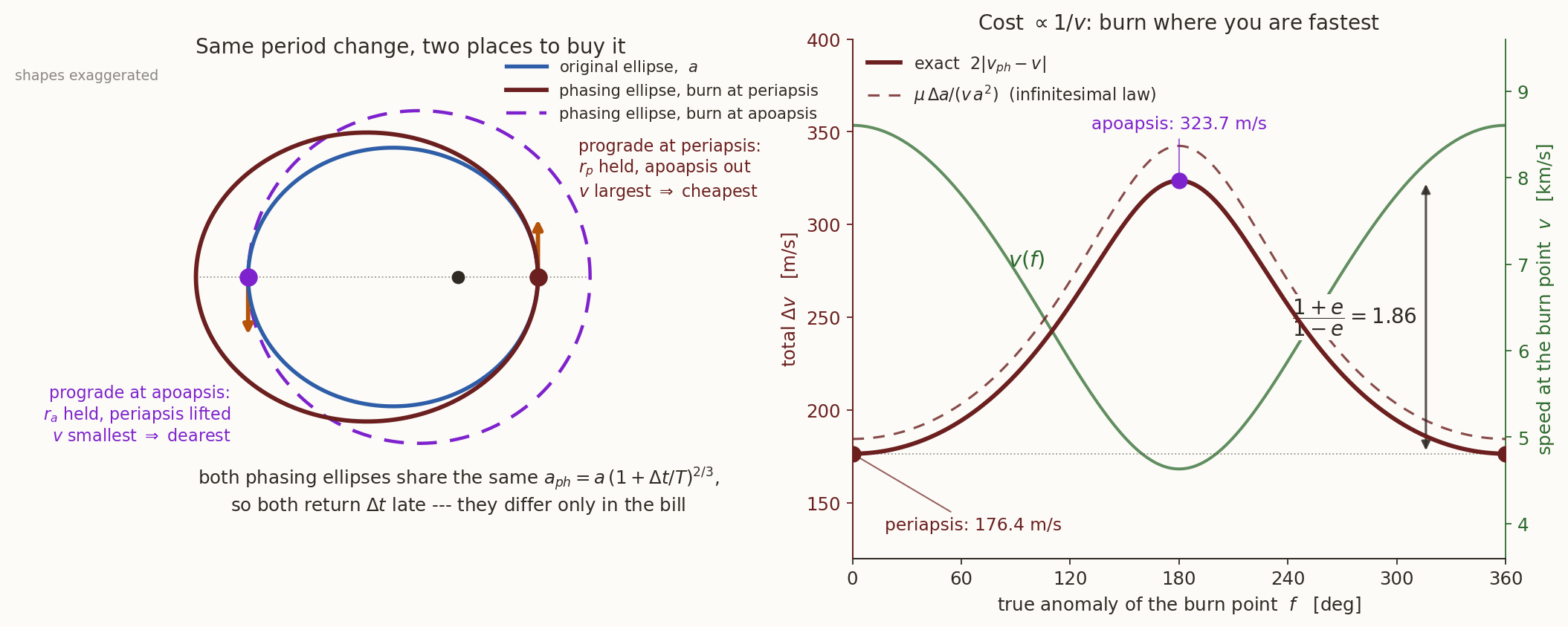
Figure 4 shows both choices. On the left, a prograde burn at periapsis keeps the periapsis where it is and pushes out the apoapsis. A prograde burn at apoapsis keeps the apoapsis and lifts the periapsis. Both new ellipses have the same \(a_{ph}\), so both return equally late. On the right, the cost is smallest where the speed is greatest and largest where the speed is smallest.
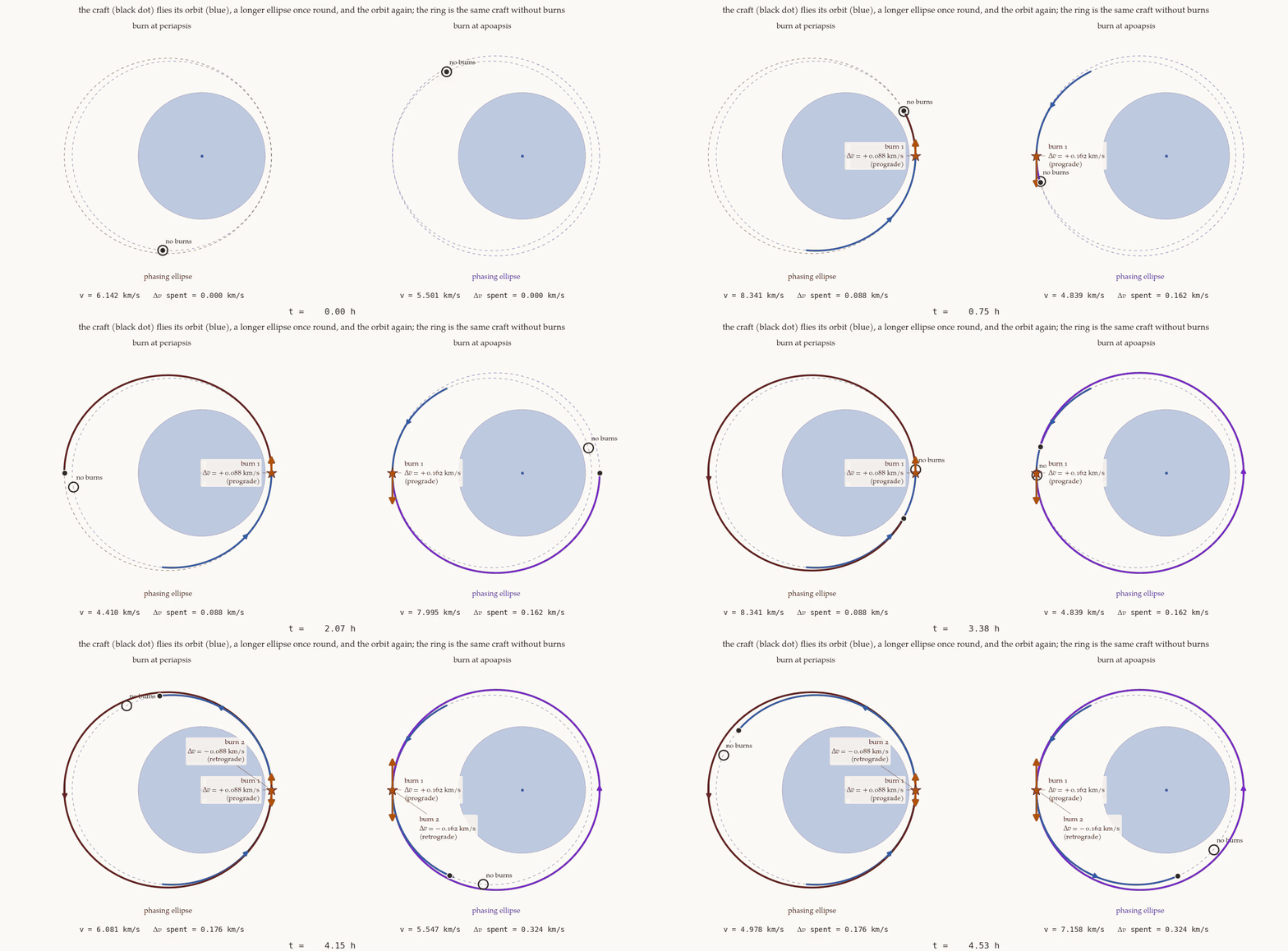
The only reason to burn at apoapsis would be that the spacecraft is there now and cannot wait. The wait for periapsis is at most half a period, \(4976\) s in this example, and the saving is \(147\) m/s. So this is rarely worth doing, except when the deadline is very close.
2 Summary and exercises
To catch up with a target ahead on the same orbit, burn retrograde. To fall back, burn prograde. The cost falls as \(1/k\) with the number of revolutions \(k\), so time can replace propellant, and the perigee of the phasing ellipse must stay above the atmosphere. On an ellipse, make the burns at periapsis.
- Phasing in the geostationary orbit. A geostationary satellite, with \(r=42\,164\) km and a period of one sidereal day (\(23.934\) h), must move \(10^\circ\) east in longitude. Design a phasing manoeuvre that does it in \(5\) days. Which way does it burn first? (Answers: to move east it must gain \(2^\circ\) per revolution, so it needs a shorter period, \(23.80\) h. It burns retrograde first, \(5.72\) m/s, into an orbit with \(a=42\,008\) km and perigee radius \(41\,852\) km, and then prograde \(5.72\) m/s after five revolutions. The total is \(11.4\) m/s.)
All the numbers in this note are checked by phasing-verify.py.