Which Ellipse?
Finding the ellipse of a ballistic flight from what we know, and choosing the one number that is missing
The question
A ballistic vehicle burns its engine for a few minutes, coasts under gravity alone, and comes down. Before the flight we know where it starts and where it has to come down. So the natural first attempt is to start from this knowledge and ask for the ellipse.
We will find that the attempt fails. Infinitely many ellipses join the two points, so we need one more piece of information to select one of them. Three choices come to mind at once. We could say how high the vehicle should go, how much energy it should have, or how long the flight should last.
The ballistic note and the book it follows (Bate, Mueller, and White 1971) do something else. They describe the flight by its burnout speed and its flight-path angle \(\gamma\) at burnout, and when the target is given they take the speed as known and solve for \(\gamma\). So the question of this note is simple. Why \(\gamma\), and how is it connected to the other three?
We need the orbit equation, the energy equation and Kepler’s equation from the two-body note. Lengths are in km, speeds in km/s, and we use \(\mu=398\,600.4418\) km\(^3\)/s\(^2\) and \(R_\oplus=6378.137\) km.
1 What we know is not enough
We use the model of the ballistic note, which is a spherical Earth that does not rotate and has no atmosphere. The vehicle burns out at the radius \(r_{bo}\). Re-entry is the point where it comes back to the same radius. The angle at the Earth’s centre between these two points is the range angle \(\psi\). The launch site, the target and the vehicle give us \(r_{bo}\) and \(\psi\), so these are the two numbers we know.
We wish to find the ellipse. The Earth’s centre \(F\) is one focus, so we need its size and shape, which we can take to be the semi-latus rectum \(p\) and the eccentricity \(e\).
The two points are at the same distance from \(F\), and the ellipse is symmetric about its major axis. So the two points are mirror images in the major axis. They divide the ellipse into two arcs, one through the apogee and one through the perigee. The vehicle flies the arc through the apogee.
Why not the arc through the perigee? On that arc the vehicle starts downward, passes the perigee, and is climbing when it arrives at the second point. A vehicle that is moving away from the Earth at the second point is not re-entering. So the arc of a flight that comes down at the second point must pass through the apogee. The other arc can still be flown, and we return to it in Section 4.2.
The apogee is at true anomaly \(f=\pi\), and the burnout point is \(\psi/2\) before it, so
\[ f_{bo}=\pi-\frac\psi2 . \]
Now we put the burnout point on the ellipse. The orbit equation \(r=p/(1+e\cos f)\) gives
\[ r_{bo}=\frac{p}{1+e\cos(\pi-\psi/2)}=\frac{p}{1-e\cos(\psi/2)} , \]
and therefore
\[ \boxed{p=r_{bo}\Bigl(1-e\cos\frac\psi2\Bigr)} . \tag{1}\]
This is one equation for two unknowns, and the re-entry point adds nothing because it is the mirror image of the burnout point. So we can pick any eccentricity in \(0\le e<1\), and Equation 1 gives a \(p\) and hence an ellipse through both points. There are infinitely many solutions. (We stop at \(e<1\) because a parabola or a hyperbola has no apogee.)
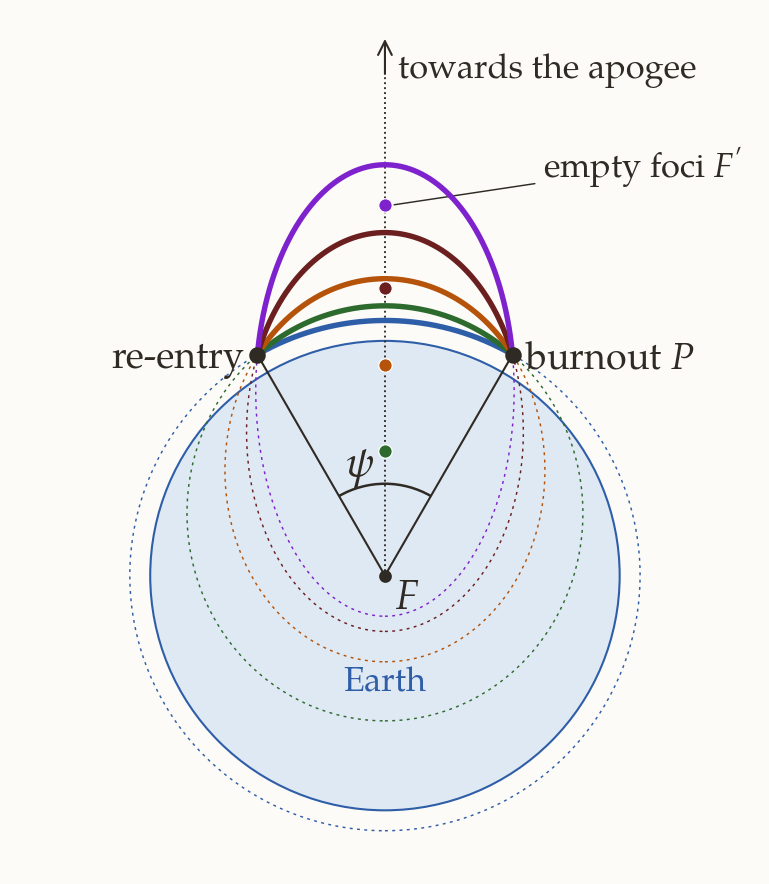
Figure 1 shows some members of this family. The lowest arc is the circle, \(e=0\). As \(e\) rises the arc rises, and the arcs do not cross each other between the two points. We can show this directly. Let \(\theta\) be the angle from the apogee direction, so that the arc is \(|\theta|<\psi/2\) and \(f=\pi+\theta\). Then the orbit equation with Equation 1 reads
\[ r(\theta)=r_{bo}\,\frac{1-e\cos(\psi/2)}{1-e\cos\theta} . \tag{2}\]
Differentiating with respect to \(e\) at fixed \(\theta\), the terms containing \(e\) in the numerator cancel, and
\[ \frac{\partial r}{\partial e}=r_{bo}\,\frac{\cos\theta-\cos(\psi/2)}{(1-e\cos\theta)^2}>0 , \]
because \(|\theta|<\psi/2\) makes \(\cos\theta\) larger than \(\cos(\psi/2)\). So at every point of the arc, a larger \(e\) means a larger radius. The family is one stack of arcs, one above another, and a single number tells us where we are in the stack.
The dots in the figure give the same result in a picture. The two focal distances of a point on an ellipse add up to \(2a\). So the empty focus \(F'\) is at the distance \(2a-r_{bo}\) from the burnout point, and at the same distance from the re-entry point. A point that is equally far from two points lies on the perpendicular bisector of the line joining them, and \(F\) lies on the same line. The empty focus lies on the apogee side of \(F\). So \(F'\) can be anywhere on the ray from \(F\) towards the apogee, and each position gives one ellipse. Choosing the ellipse is the same as sliding \(F'\) along this ray.
A conic in the plane with its focus at \(F\) has three numbers, namely \(p\), \(e\) and the direction of its major axis. How many conditions do the burnout point and the re-entry point supply, and how many numbers are left free?
Answer
Each point gives one condition, which is that the conic passes through it, so there are two conditions. Three numbers minus two conditions leaves one free number. In our symmetric case one condition has fixed the direction of the major axis, and the other is Equation 1.2 Choosing the missing number
So we need exactly one more number. We take the three natural choices in turn, and we ask the same three things of each. Does it select exactly one ellipse? Can we get the ellipse from it by a formula? And what does it mean physically?
2.1 Apogee height
Suppose we are told the apogee radius \(r_a\). At the apogee \(f=\pi\), so \(r_a=p/(1-e)\). Together with Equation 1 this gives
\[ r_a(1-e)=r_{bo}\Bigl(1-e\cos\frac\psi2\Bigr). \]
This is linear in \(e\). Collecting the terms in \(e\) we get
\[ \boxed{e=\frac{r_a-r_{bo}}{r_a-r_{bo}\cos(\psi/2)}} . \tag{3}\]
When \(r_a=r_{bo}\) this is the circle, \(e=0\), and when \(r_a\to\infty\) it tends to \(e=1\). The derivative with respect to \(r_a\) is \(r_{bo}\bigl(1-\cos(\psi/2)\bigr)/\bigl(r_a-r_{bo}\cos(\psi/2)\bigr)^2\), which is positive. So \(e\) rises steadily with \(r_a\), and every apogee above \(r_{bo}\) gives exactly one ellipse, by a formula. As a way of selecting the ellipse this is as good as we could wish for.
Example. A test vehicle launched from Sriharikota burns out \(200\) km above the ground and must travel the range angle \(\psi=60^\circ\) to its re-entry point over the Indian Ocean. The apogee is to be \(1000\) km above the ground. Find \(e\), \(p\) and \(a\).
Solution. The radii are \(r_{bo}=6578.137\) km and \(r_a=7378.137\) km. From Equation 3,
\[ e=\frac{7378.137-6578.137}{7378.137-6578.137\cos30^\circ}=\frac{800}{1681.3}=0.4758 . \]
Then Equation 1 gives \(p=6578.137(1-0.4758\cos30^\circ)=3867.5\) km, and \(a=p/(1-e^2)=4999.3\) km.
2.2 Energy
Suppose instead that we are told the energy. The specific energy is \(\varepsilon=-\mu/(2a)\), so this is the same as being told the semi-major axis \(a\). It is also the same as being told the burnout speed \(v\), because \(v^2/2-\mu/r_{bo}=-\mu/(2a)\).
Put \(p=a(1-e^2)\) into Equation 1. We get
\[ a(1-e^2)=r_{bo}\Bigl(1-e\cos\frac\psi2\Bigr), \]
which is a quadratic in \(e\),
\[ a\,e^2-r_{bo}\cos\frac\psi2\;e+(r_{bo}-a)=0 . \tag{4}\]
A quadratic is already a warning, because it can have two solutions or none. Its discriminant is \(r_{bo}^2\cos^2(\psi/2)-4a(r_{bo}-a)\). We replace \(\cos^2(\psi/2)\) by \(1-\sin^2(\psi/2)\) and complete the square, which gives
\[ \text{discriminant}=(2a-r_{bo})^2-r_{bo}^2\sin^2\frac\psi2 . \]
The roots are real only if \(2a-r_{bo}\ge r_{bo}\sin(\psi/2)\), that is, only if
\[ a\ge a_{min}=\frac{r_{bo}}{2}\Bigl(1+\sin\frac\psi2\Bigr). \tag{5}\]
A real root is not enough. We also need \(e\ge0\). For a negative root, the direction we called the apogee is in fact the perigee, and this is the arc we have rejected. So we look at the signs of the two roots. Their product is \((r_{bo}-a)/a\) and their sum is \(r_{bo}\cos(\psi/2)/a\). Three cases follow.
- If \(a>r_{bo}\) the product is negative, so one root is positive and one is negative. There is one ellipse.
- If \(a=r_{bo}\) the roots are \(0\) and \(\cos(\psi/2)\). The first is the circle. The second is a real ellipse only for \(\psi<180^\circ\).
- If \(a<r_{bo}\) the product is positive, so the two roots have the same sign, which is the sign of \(\cos(\psi/2)\). For \(\psi<180^\circ\) both are positive and there are two ellipses. For \(\psi>180^\circ\) both are negative and there is no ellipse.
So for \(\psi<180^\circ\) the count, as the energy rises from the lowest value, is none below \(a_{min}\), one at \(a_{min}\), two for \(a_{min}<a\le r_{bo}\), and one for \(a>r_{bo}\). For \(\psi>180^\circ\) there is none until \(a=r_{bo}\) and one after that, so a flight more than half-way round needs at least the energy of the circular orbit at the burnout radius.
The empty focus shows us why this happens.
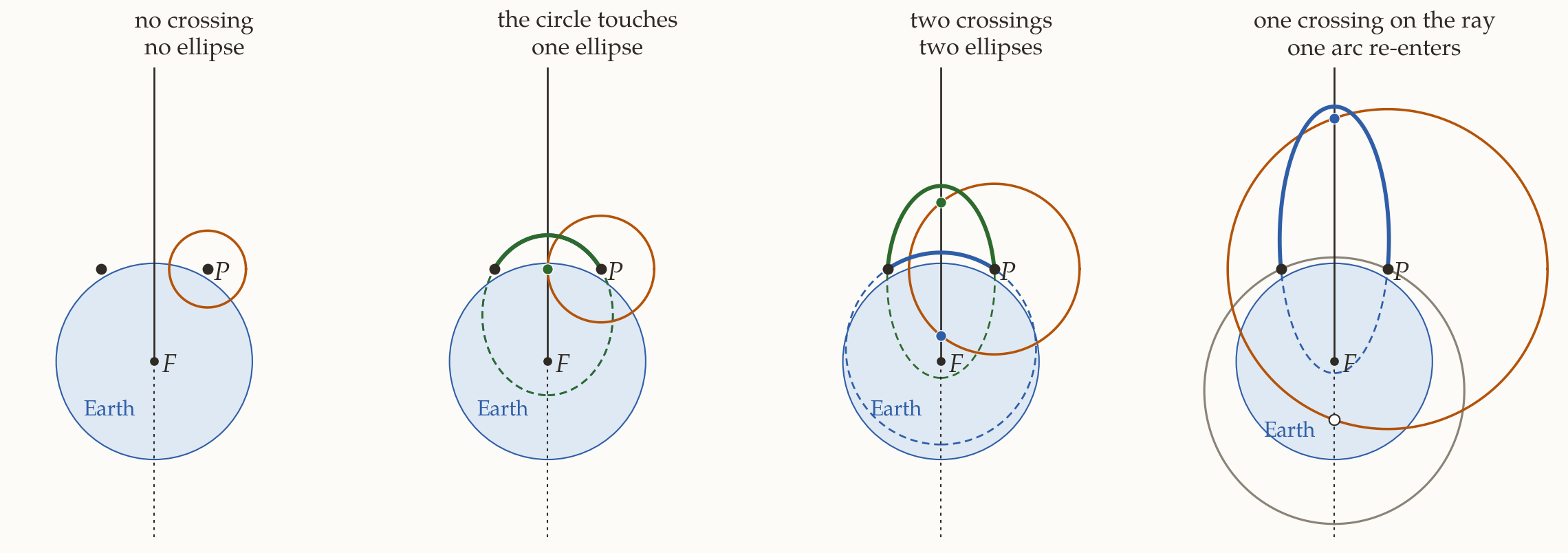
In Figure 2 the amber circle has radius \(2a-r_{bo}\), because that is the distance of \(F'\) from \(P\). So the ellipses are where the circle meets the ray. The smallest circle that can reach the ray just touches it. Its radius is the distance from \(P\) to the axis, which is \(r_{bo}\sin(\psi/2)\), and this is Equation 5. A larger circle crosses the line twice, and these are the two ellipses. When the circle is larger still, with \(2a-r_{bo}>r_{bo}\), it encloses \(F\) and the lower crossing falls behind \(F\). That crossing still gives an ellipse through the two points, drawn in grey in the last panel, and it is the negative root of Equation 4. Its apogee is below \(F\) in the figure, so its arc above the chord passes through the perigee and lies below the burnout radius. A vehicle on this arc is climbing at the second point, so it is not re-entering there. So only one flight of our family remains. For \(\psi>180^\circ\) the point \(P\) is below \(F\), and the circle has to reach \(F\) itself before it meets the ray at all, which is the condition \(a\ge r_{bo}\).
There is a physical reason for two ellipses. A flat arc is close to the circular orbit, so it needs close to the circular speed in order to stay up. A steep arc has a long way to climb, so it also needs a high speed. The cheapest flight is somewhere in between. So one speed below the circular speed belongs to one flat arc and one steep arc. Energy does not put the family in order, and that is its weakness as a label.
At the smallest energy the two roots of Equation 4 merge. Then \(e=r_{bo}\cos(\psi/2)/(2a_{min})=\cos(\psi/2)/\bigl(1+\sin(\psi/2)\bigr)\). This is the flight with the least burnout speed for this range, which the ballistic note meets as the maximum range.
Example. For the same flight, with \(r_{bo}=6578.137\) km and \(\psi=60^\circ\), the burnout speed is \(v=6.9625\) km/s. Find the lowest possible energy in terms of \(a\), and find every ellipse for this speed.
Solution. From Equation 5, \(a_{min}=\tfrac12(6578.137)(1+\sin30^\circ)=4933.6\) km. The energy equation gives \(a\) for this speed,
\[ a=\Bigl(\frac{2}{r_{bo}}-\frac{v^2}{\mu}\Bigr)^{-1}=5481.8\text{ km}. \]
This is above \(a_{min}\) and below \(r_{bo}\), so we expect two ellipses. The discriminant is \((2a-r_{bo})^2-r_{bo}^2\sin^230^\circ=4385.4^2-3289.1^2\), and its square root is \(2900.7\) km. So Equation 4 gives
\[ e=\frac{r_{bo}\cos30^\circ\mp2900.7}{2a}=\frac{5696.8\mp2900.7}{10\,963.6}, \]
which is \(e=0.2550\) and \(e=0.7842\). With \(r_a=a(1+e)\), the apogee altitudes are \(502\) km and \(3402\) km. The same speed can give a flat flight or one that climbs nearly seven times as high, and both reach the same point.
2.3 Flight time
Suppose finally that we are told the flight time \(\Delta t\) from burnout to re-entry. The flight is symmetric about the apogee, so \(\Delta t\) is twice the time from burnout to apogee. Kepler’s equation gives the time from perigee as \(\sqrt{a^3/\mu}\,(E-e\sin E)\), and the apogee has \(E=\pi\). So
\[ \boxed{\Delta t=2\sqrt{\frac{a^3}{\mu}}\,\bigl(\pi-E_{bo}+e\sin E_{bo}\bigr)},\qquad \cos E_{bo}=\frac{1-r_{bo}/a}{e}, \tag{6}\]
where the formula for \(E_{bo}\) comes from \(r_{bo}=a(1-e\cos E_{bo})\), with \(0<E_{bo}<\pi\) because burnout is before the apogee.
Given \(e\), we find \(p\) from Equation 1, \(a=p/(1-e^2)\), then \(E_{bo}\) and \(\Delta t\). So the time follows from \(e\) directly. Now we need the reverse, \(e\) from \(\Delta t\). Here \(e\) appears in \(a^{3/2}\), in \(E_{bo}\) and in \(e\sin E_{bo}\), and we cannot solve for it by algebra. This is the same difficulty as Kepler’s equation itself. It is in fact the Lambert problem in the special case of two equal radii.
Although we have no formula, we still have exactly one solution, because \(\Delta t\) rises steadily with \(e\) (the proof is in the margin). At the bottom of the range is the circle. There \(e=0\), the speed is the circular speed \(\sqrt{\mu/r_{bo}}\), and the time for the arc length \(\psi r_{bo}\) is
\[ \Delta t_{min}=\psi\sqrt{\frac{r_{bo}^3}{\mu}} . \tag{7}\]
At the top, \(e\to1\) makes \(a\to\infty\) and the time grows without limit. So every \(\Delta t\) above \(\Delta t_{min}\) gives exactly one ellipse of the family, and no flight of the family takes less time. The circular arc is the fastest flight that stays above the burnout radius. A vehicle that starts downward does not stay above it, and we come to that case in Section 4.2.
Why \(\Delta t\) rises with \(e\). With \(h=\sqrt{\mu p}\) the time is \(\int r^2\,d\theta/h\) along the arc. For \(\psi<180^\circ\), Equation 2 says that \(r\) rises with \(e\) at every \(\theta\), and Equation 1 says that \(p\), and so \(h\), falls. So \(r^2/h\) rises at every point of the arc, and so does the integral. For \(\psi>180^\circ\) write \(\Delta t=T-t_c\), with \(T\) the period and \(t_c\) the time on the other arc, through the perigee. Now \(\cos(\psi/2)<0\). So \(a=r_{bo}(1-e\cos(\psi/2))/(1-e^2)\) rises with \(e\), and so does \(T\). On the other arc, \(r\) falls with \(e\) and \(h\) rises, so \(t_c\) falls. Hence \(\Delta t\) rises again.
Because the time rises steadily, a simple search cannot go wrong. We try an \(e\), compute \(\Delta t\), and move up or down.
Example. For the same flight, with \(r_{bo}=6578.137\) km and \(\psi=60^\circ\), the flight time is to be \(30\) min. Find \(e\) and \(a\), and the apogee altitude.
Solution. First we check that this is possible. From Equation 7, \(\Delta t_{min}=(\pi/3)\sqrt{6578.137^3/\mu}=14.75\) min, so \(30\) min is allowed. Now we halve the interval \(0<e<1\) repeatedly, using Equation 1 and Equation 6 at each trial.
| trial \(e\) | \(\Delta t\) (min) | next step |
|---|---|---|
| \(0.5000\) | \(23.16\) | too short, go higher |
| \(0.7500\) | \(39.20\) | too long, go lower |
| \(0.6250\) | \(28.51\) | too short, go higher |
| \(0.6875\) | \(32.77\) | too long, go lower |
| \(0.6563\) | \(30.44\) | too long, go lower |
| \(0.6406\) | \(29.43\) | too short, go higher |
| \(0.6484\) | \(29.92\) | too short, go higher |
Continuing in this way gives \(e=0.6496\). Then \(a=4978\) km, and the apogee altitude is \(1834\) km.
History. Lambert showed in 1761 that the time on an elliptic arc depends only on \(a\), on \(r_1+r_2\) and on the chord between the two points, once we know which branch we are on. Each \(a\) has two branches, one for each side of the chord on which the empty focus can lie. Our low and high flights at one speed are these two branches, which is why they take different times. The problem of finding the orbit from two points and a time now carries his name. See the Lambert note.
So far, then, apogee height is the tidiest label, time is exact but needs a search, and energy gives one, two or no ellipses. If the only aim were to select an ellipse on paper, we would choose the apogee. So we must look at what the vehicle actually does.
3 The number we control
None of the three numbers above is something the vehicle can be told directly. During powered flight the guidance system points the thrust, and at some moment the engine stops. What that leaves us with at burnout is a velocity, with a length \(v\) and a direction above the local horizontal \(\gamma\). The vehicle follows the ellipse that this velocity gives it. So whatever requirement the mission states, it must be turned into \((v,\gamma)\) before anyone can fly it.
Two numbers are at our disposal, and hitting the target uses up one of them. So \(v\) and \(\gamma\) cannot be chosen separately. We now work out the relation between them, and then connect \(\gamma\) with each of the three other choices.
From \(\gamma\) to the eccentricity. The radial and transverse velocities on an orbit are \((\mu/h)\,e\sin f\) and \((\mu/h)(1+e\cos f)\). Their ratio is \(\tan\gamma\). At \(f_{bo}=\pi-\psi/2\) this reads
\[ \tan\gamma=\frac{e\sin(\psi/2)}{1-e\cos(\psi/2)} . \]
Solving for \(e\), and then using \(\sin\gamma\cos(\psi/2)+\cos\gamma\sin(\psi/2)=\sin(\gamma+\psi/2)\), we get
\[ \boxed{e=\frac{\sin\gamma}{\sin(\gamma+\psi/2)}} . \tag{8}\]
This is \(0\) at \(\gamma=0\). It reaches \(1\) when \(\sin\gamma=\sin(\gamma+\psi/2)\), which happens at \(\gamma=90^\circ-\psi/4\). So the family runs over
\[ 0\le\gamma<90^\circ-\frac\psi4 , \]
with \(e\) rising steadily over this range. Each \(\gamma\) gives one ellipse. A steeper launch than this limit does not return to the burnout radius at this range angle.
From \(\gamma\) to the speed. The angular momentum is \(h=r_{bo}v\cos\gamma\), and \(p=h^2/\mu\). Putting this into Equation 1 gives \(v^2=\mu\bigl(1-e\cos(\psi/2)\bigr)/(r_{bo}\cos^2\gamma)\). From Equation 8,
\[ 1-e\cos\frac\psi2=\frac{\sin(\gamma+\psi/2)-\sin\gamma\cos(\psi/2)}{\sin(\gamma+\psi/2)}=\frac{\cos\gamma\sin(\psi/2)}{\sin(\gamma+\psi/2)} , \tag{9}\]
so that
\[ \boxed{v^2=\frac{\mu}{r_{bo}}\,\frac{\sin(\psi/2)}{\cos\gamma\,\sin(\gamma+\psi/2)}} . \tag{10}\]
This is the relation we were looking for. It tells us the speed that goes with each flight-path angle, if the vehicle is to reach this range angle.
From \(\gamma\) to the energy, and back. We use the identity \(2\cos\gamma\sin(\gamma+\psi/2)=\sin(2\gamma+\psi/2)+\sin(\psi/2)\) in Equation 10. The energy equation gives \(v^2=\mu(2a-r_{bo})/(ar_{bo})\). Equating the two and simplifying, we get
\[ \boxed{\sin\Bigl(2\gamma+\frac\psi2\Bigr)=\frac{r_{bo}\sin(\psi/2)}{2a-r_{bo}}} . \tag{11}\]
This is the flight-path angle equation of the ballistic note, written with \(a\). A sine takes each value twice, so one \(a\) gives two candidate values of \(\gamma\), namely \(\gamma_1=\tfrac12(A-\psi/2)\) and \(\gamma_2=\tfrac12(180^\circ-A-\psi/2)\), where \(A\) is the arcsine of the right side. For \(\psi<180^\circ\) and \(a<r_{bo}\) both are positive, and these are the two ellipses of Section 2.2. For \(a>r_{bo}\) the right side is smaller than \(\sin(\psi/2)\), so \(\gamma_1\) is negative and only \(\gamma_2\) is a flight, which is the one ellipse we found there. The right side must be at most \(1\), which is Equation 5 again. The sine reaches \(1\) at \(2\gamma+\psi/2=90^\circ\). So the least speed is at \(\gamma=45^\circ-\psi/4\), and for \(\psi>180^\circ\) this angle is negative, so it is not a flight at all. That is why those flights need at least circular speed.
From \(\gamma\) to the apogee, and back. The apogee is \(r_a=p/(1-e)\). We have the numerator in Equation 9. For the denominator, the sum-to-product formula gives \(\sin(\gamma+\psi/2)-\sin\gamma=2\cos(\gamma+\psi/4)\sin(\psi/4)\). With \(\sin(\psi/2)=2\sin(\psi/4)\cos(\psi/4)\) everything simplifies to
\[ \boxed{r_a=r_{bo}\,\frac{\cos\gamma\,\cos(\psi/4)}{\cos(\gamma+\psi/4)}} \qquad\Longleftrightarrow\qquad \boxed{\tan\gamma=\Bigl(1-\frac{r_{bo}}{r_a}\Bigr)\cot\frac\psi4} . \tag{12}\]
The second form comes from expanding \(\cos(\gamma+\psi/4)\) in the first and solving for \(\tan\gamma\). This is the neatest link of all, and it runs in both directions.
From \(\gamma\) to the time, and back. From \(\gamma\) we get \(e\) and \(a\), and then Equation 6 gives \(\Delta t\) directly. Going back from \(\Delta t\) to \(\gamma\) needs the search of Section 2.3, followed by Equation 8.
We collect the links in one table.
| requirement | from \(\gamma\) to the requirement | from the requirement to \(\gamma\) | values of \(\gamma\) |
|---|---|---|---|
| speed or energy | Equation 10, formula | Equation 11, formula | none, one or two |
| apogee | Equation 12, formula | Equation 12, formula | exactly one |
| flight time | Equation 6, formula | a numerical search | exactly one, above \(\Delta t_{min}\) |
Example. For the same flight, with \(r_{bo}=6578.137\) km and \(\psi=60^\circ\), turn each requirement of the earlier examples into a burnout velocity. The requirements are an apogee altitude of \(1000\) km, a burnout speed of \(6.9625\) km/s, and a flight time of \(30\) min.
Solution. For the apogee, Equation 12 gives \(\tan\gamma=(1-6578.137/7378.137)\cot15^\circ=0.10843\times3.7321\), so \(\gamma=22.03^\circ\). Then Equation 10 gives \(v=6.439\) km/s.
For the speed, the earlier example has \(a=5481.8\) km, so Equation 11 gives \(\sin(2\gamma+30^\circ)=3289.1/4385.4=0.75\). The two angles with this sine are \(48.59^\circ\) and \(131.41^\circ\). So \(\gamma=\tfrac12(48.59^\circ-30^\circ)=9.30^\circ\) or \(\gamma=\tfrac12(131.41^\circ-30^\circ)=50.70^\circ\), both at \(v=6.9625\) km/s.
For the time, the earlier example has \(e=0.6496\). Then \(\tan\gamma=e\sin30^\circ/(1-e\cos30^\circ)\) gives \(\gamma=36.59^\circ\), and Equation 10 gives \(v=6.412\) km/s.
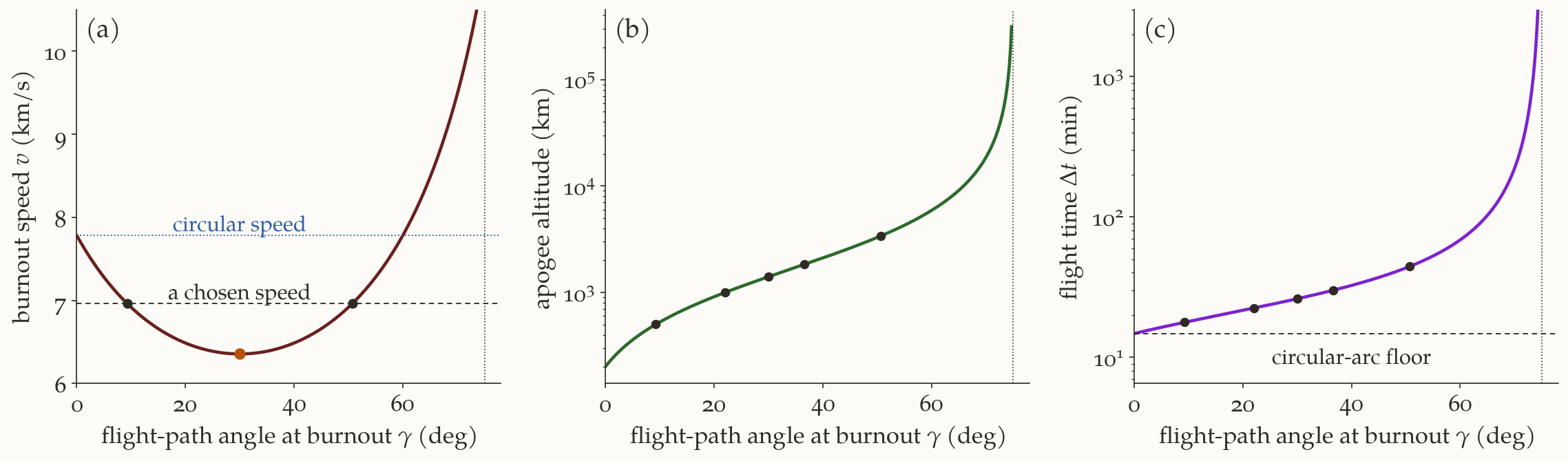
Figure 3 puts the whole argument in one picture, with \(\gamma\) along the bottom of every panel. Panel (a) is Equation 10. It starts at the circular speed at \(\gamma=0\), falls to its lowest value at \(\gamma=45^\circ-\psi/4=30^\circ\), and rises again. A horizontal line cuts it twice, and this is why energy gives two ellipses. Panels (b) and (c) only rise, so a horizontal line cuts each of them once. Both shoot up near the end of the family.
That last feature deserves a closer look. Differentiating Equation 12 gives
\[ \frac{dr_a}{d\gamma}=\frac{r_{bo}}{2}\,\frac{\sin(\psi/2)}{\cos^2(\gamma+\psi/4)} , \]
which here is about \(35\) km per degree at \(\gamma=9.30^\circ\), \(170\) km per degree at \(\gamma=50.70^\circ\) and \(3780\) km per degree at \(\gamma=70^\circ\). Near the top of the family, a tiny change in \(\gamma\) is a huge change in the flight. This is a real property of a steep flight, and it does not go away if we use a different label.
A sounding rocket burns out \(50\) km above the ground, and is to reach an apogee altitude of \(475\) km and return to the burnout radius at the range angle \(\psi=2^\circ\). Use \(\tan\gamma=(1-r_{bo}/r_a)\cot(\psi/4)\) and \(v^2=(\mu/r_{bo})\sin(\psi/2)/\bigl(\cos\gamma\sin(\gamma+\psi/2)\bigr)\) to find \(\gamma\) and \(v\) at burnout. How much does \(\gamma\) change if the apogee is to be \(5\) km higher?
What you should find
The radii are \(r_{bo}=6428.137\) km and \(r_a=6853.137\) km, so \(\tan\gamma=0.06202\times114.59\), which gives \(\gamma=81.99^\circ\). Then \(v=2.797\) km/s. An apogee of \(480\) km changes \(\gamma\) by only \(0.09^\circ\). For this flight the apogee is the sensible number to specify and \(\gamma\) is the awkward one, since all the useful flights are squeezed into a narrow band of angles.4 What each choice means for a mission
Selecting an ellipse is not only a matter of mathematics. Each flight in the family has a different cost and a different risk, and each of our three numbers is the natural one for a certain kind of mission.
4.1 Energy and early arrival
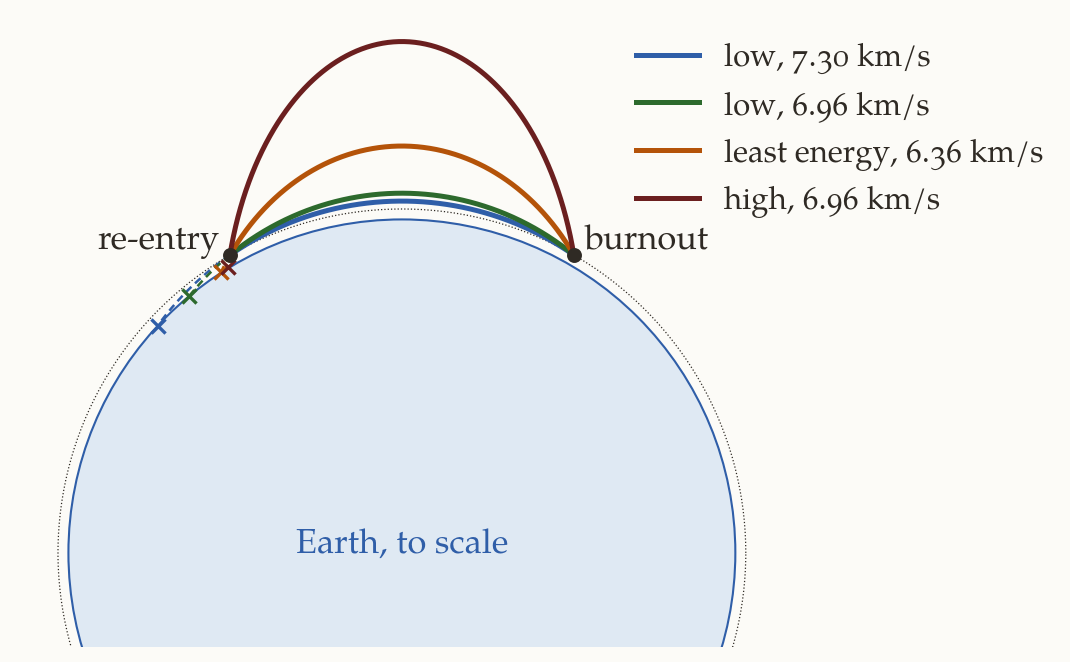
Figure 4 shows four of these flights, and Table 2 lists them with the others that we have met. All the rows have the same two end points, and \(\Delta t\) is the time from burnout to the re-entry radius. The last two columns are new. The extra angle is how much farther the vehicle travels after the re-entry radius before it reaches the ground, with no atmosphere. The miss is how far the landing point moves along the track if \(\gamma\) is wrong by one arcminute at the correct speed. It comes from the coefficient \(\partial\psi/\partial\gamma=2\sin(\psi+2\gamma)/\sin2\gamma-2\), which is derived in the ballistic note.
| flight | \(\gamma\) | \(v\) (km/s) | apogee (km) | \(\Delta t\) (min) | extra angle | miss (km per \(1'\)) |
|---|---|---|---|---|---|---|
| flattest that reaches the ground | \(0.48^\circ\) | \(7.729\) | \(215\) | \(14.90\) | \(150^\circ\) | \(189\) |
| low, at \(7.30\) km/s | \(4.79^\circ\) | \(7.300\) | \(351\) | \(16.27\) | \(17.2^\circ\) | \(17.2\) |
| low, at \(6.96\) km/s | \(9.30^\circ\) | \(6.963\) | \(502\) | \(17.74\) | \(9.6^\circ\) | \(7.7\) |
| apogee \(1000\) km | \(22.03^\circ\) | \(6.439\) | \(1000\) | \(22.41\) | \(4.2^\circ\) | \(1.5\) |
| least energy | \(30.00^\circ\) | \(6.356\) | \(1404\) | \(26.10\) | \(3.0^\circ\) | second order |
| flight time \(30\) min | \(36.59^\circ\) | \(6.412\) | \(1834\) | \(30.00\) | \(2.3^\circ\) | \(0.9\) |
| high, at \(6.96\) km/s | \(50.70^\circ\) | \(6.963\) | \(3402\) | \(44.38\) | \(1.4^\circ\) | \(2.5\) |
| high, at circular speed | \(60.00^\circ\) | \(7.784\) | \(5897\) | \(68.64\) | \(1.0^\circ\) | \(3.7\) |
Energy is what the vehicle gives us. Propellant is the expensive part of a rocket, and the rocket equation makes each extra km/s cost more than the last. A vehicle has a limited burnout speed. If the speed is what the vehicle has, then the speed is not free for us to choose, and \(\gamma\) is what we have left. That is the situation in the ballistic note, and it is why that note solves for \(\gamma\) given the speed. The least energy row leaves the most mass for the payload.
Flight time matters when we want to arrive early. Since \(\Delta t\) rises steadily with \(\gamma\), the earliest arrival in the family is the flattest flight. A vehicle whose top speed is below the circular speed therefore arrives earliest on its low trajectory at full speed, provided that this trajectory still reaches the ground. Here the first \(0.61\) km/s above the least-energy speed saves \(8.4\) min. The next \(0.34\) km/s saves only \(1.5\) min, and the \(0.43\) km/s after that saves \(1.4\) min. Extra speed has less and less to buy, because Equation 7 is the floor for every flight of the family. Above the circular speed the family holds only the high arc, which is slower. At exactly the circular speed that arc takes \(68.64\) min, which is the longest time in the table. So within the family, a vehicle with speed to spare gains nothing by using it.
There is a price for flying flat beyond the propellant. The miss grows quickly as the flight gets flatter, from \(7.7\) km to \(189\) km per arcminute in the table. The extra angle grows too. The low flight at \(7.30\) km/s reaches the re-entry radius at the correct place, and then travels \(17.2^\circ\) more, about \(1920\) km, as it descends. Over that long shallow descent the atmosphere, which our model leaves out, has plenty of time to act. So the flattest row of the table is a limit and not a design. It passes the re-entry radius on schedule and then falls \(150^\circ\) farther on, on the other side of the Earth. A flight at this end of the family needs a lower burnout altitude, and then the symmetric model of this note is no longer a good description.
4.2 Starting downward
So can a vehicle with speed to spare beat \(\Delta t_{min}\) at all? It can, if it leaves the family and points downward at burnout. This is the grey ellipse of Figure 2, the negative root of Equation 4, which needs \(a>r_{bo}\) and so a burnout speed above the circular speed. The arc through the perigee lies below the burnout radius, so it is shorter than the circular arc, and the vehicle is faster than circular speed along all of it.
Example. For \(r_{bo}=6578.137\) km and \(\psi=60^\circ\), take the ellipse with \(a=1.25\,r_{bo}=8222.7\) km whose arc between the two points passes through the perigee. Find the eccentricity, the burnout speed, the flight-path angle at burnout, the perigee altitude, and the time to reach the second point.
Solution. In Equation 4 the square root of the discriminant is \(\sqrt{(2a-r_{bo})^2-r_{bo}^2\sin^230^\circ}=9302.9\) km. The negative root is
\[ e=\frac{5696.8-9302.9}{2(8222.7)}=-0.2193 , \]
so the eccentricity is \(|e|=0.2193\), with the perigee towards the middle of the arc. The energy equation gives \(v=\sqrt{\mu(2/r_{bo}-1/a)}=8.527\) km/s, which is above the circular speed of \(7.784\) km/s. The relation \(\tan\gamma=e\sin(\psi/2)/\bigl(1-e\cos(\psi/2)\bigr)\) still holds, and it now gives \(\gamma=-5.26^\circ\), so the vehicle starts downward. The perigee altitude is \(a(1-|e|)-R_\oplus=41.5\) km.
For the time, the burnout point is at the angle \(\psi/2\) from the perigee, so its eccentric anomaly follows from \(\tan(E/2)=\sqrt{(1-|e|)/(1+|e|)}\,\tan(\psi/4)\), which gives \(E=24.2^\circ\). Twice the time from the perigee is
\[ \Delta t=2\sqrt{\frac{a^3}{\mu}}\,\bigl(E-|e|\sin E\bigr)=13.09\text{ min}, \]
which is \(1.66\) min shorter than \(\Delta t_{min}=14.75\) min.
So the time of Equation 7 is not a limit on every flight. Three things stop this example from being a useful route. The vehicle arrives at the second point climbing, and with no atmosphere it goes on to an apogee \(3648\) km above the ground and comes round again as an orbit. Its perigee of \(41.5\) km is deep in the atmosphere, which our model leaves out. And when the speed rises further, the perigee goes underground. At \(a=1.5\,r_{bo}\), where \(v=8.988\) km/s, the perigee would be \(32\) km below the surface, so the vehicle hits the Earth on the way down, before it has covered the \(60^\circ\).
That last case is a real and fast flight, launched downward. It is simply not symmetric, because it ends at a smaller radius than it started from. So Equation 1 does not describe it, and the general tool for two different radii is the Lambert problem. This is what a vehicle with speed to spare can do to arrive earlier, and it must pay for the time in speed, and in the heating of a longer path through the air.
4.3 Other requirements
Flight time matters when we must arrive at a chosen moment, if the launch time is also fixed. We have to be careful here. Suppose a vehicle must arrive at a certain clock time. If it can be launched at any moment, this says nothing about the ellipse, since we can choose any flight and start the countdown earlier or later. The requirement selects an ellipse only when the launch time is also fixed. Examples are a launch window that has already been set, a moving target to be met, and several vehicles launched together that must arrive together. So then \(\Delta t\) is the natural number to specify, and we must pay for it with the search of Section 2.3.
Time has one further advantage, which we see when the Earth rotates. The target moves during the flight, by an amount that depends on \(\Delta t\). In the ballistic note, which starts from the speed, the aim point depends on the time and the time depends on the aim point, so an iteration is needed. If we specify \(\Delta t\) at the start, the aim point is known at once. The iteration moves to the search for \(e\). It does not disappear, but it is no longer tangled up with the geometry.
Apogee height matters when height is the mission. A sounding rocket is flown to take measurements at a height, so its apogee is the requirement itself. ISRO’s sounding rockets, flown from Thumba, are quoted by their payload and their apogee, which is up to a few hundred km. The task above showed that for such a flight \(\gamma\) is a poor label. An upper limit on the apogee can also be the requirement, and then Equation 12 gives the steepest flight allowed.
The flight-path angle is itself a requirement at re-entry. The ellipse is symmetric, so the vehicle comes back to \(r_{bo}\) at the same speed \(v\) and at the angle \(\gamma\) below the horizontal. A steep vehicle crosses the dense air in a short distance, so it has to lose its speed in a short time, which gives a high peak deceleration and a high peak heating rate. A shallow vehicle loses its speed gently, but it stays longer in the air, so it absorbs heat for longer and the air has more effect on where it lands. So the structure and the heat shield may set limits on \(\gamma\) directly, without any conversion.
Two vehicles with the same burnout speed of \(6.9625\) km/s are launched at the same moment, one on the low and one on the high trajectory of Table 2. How much later does the high one reach the re-entry radius? How could we make them arrive together without changing either trajectory?
Answer
The times are \(17.74\) min and \(44.38\) min, so the high trajectory arrives about \(26.6\) min later. The two trajectories fix these two times. So the only way to make them arrive together is to launch the low-trajectory vehicle about \(26.6\) min after the other. This is the point we made above. A chosen arrival time says nothing about the ellipse unless the launch time is fixed too.5 So why \(\gamma\)?
We can now answer the question we began with. No mathematical objection stands against the other three choices. Each of them is a correct way to select the ellipse. The apogee is even tidier than \(\gamma\). The note uses \(\gamma\) for four reasons, in this order of importance.
- Energy is not really replaced, because it is already in use. The ballistic note takes the speed as given, since the vehicle fixes it. Then energy has selected what it can, which is the pair of ellipses, and \(\gamma\) is what tells them apart. So \(\gamma\) is not a rival to the energy but the partner that completes it. Together \((v,\gamma)\) make the burnout velocity.
- The burnout velocity is the initial condition of the flight. Together with \(r_{bo}\) it is what the guidance system steers towards, and what the tracking measures at the end of the burn. Everything after burnout follows from it. Any other requirement has to be turned into \((v,\gamma)\) before the vehicle can fly it, using the links in Table 1. Apogee height and flight time can be calculated before the flight, but they are consequences of the whole arc and they are not something the vehicle can steer towards at the moment of burnout.
- The error analysis needs it. A real burnout is never quite right, and what goes wrong is that the velocity and the position are a little off. The influence coefficients are derivatives with respect to exactly these quantities.
- It is also the re-entry angle. One number describes the start of the flight and, by symmetry, the end.
So \(\gamma\) is used because it is what we control, together with its partner the speed. Apogee height and flight time do not lose by this. They are what a mission may ask for, whereas \((v,\gamma)\) is what the vehicle must do, and Table 1 turns one into the other.
| selects one ellipse? | formula for the ellipse? | natural when | |
|---|---|---|---|
| apogee height | yes | yes | height is the mission, or is limited |
| energy | no, it gives none, one or two | yes | the vehicle fixes the speed |
| flight time | yes, above \(\Delta t_{min}\) | no, a search | early or timed arrival, with launch time fixed |
| \(\gamma\) | yes | yes | always needed at burnout, and limited at re-entry |
In one paragraph. With \(r_{bo}\) and \(\psi\) known, the orbit equation gives only \(p=r_{bo}(1-e\cos(\psi/2))\), so infinitely many ellipses join the two points, stacked one above another with their empty foci on the ray towards the apogee. One more number selects one of them. The apogee gives exactly one, by a formula. The flight time gives exactly one above the circular-arc time, but only by a search, because this is Lambert’s problem. The energy gives none, one or two, because a flat arc and a steep arc can both need the same speed. The vehicle itself controls a velocity, \((v,\gamma)\), and reaching the target ties these two together through \(v^2=(\mu/r_{bo})\sin(\psi/2)/(\cos\gamma\sin(\gamma+\psi/2))\). So \(\gamma\) runs over the whole family, and each mission requirement can be converted to it. We use \(\gamma\) because it is the part of the initial condition that is left once the vehicle has fixed the speed, and because the errors and the re-entry are both stated in terms of it.
All the numbers and identities in this note are checked by ballistic-family-verify.py, against the formulas of the ballistic note and against a direct numerical integration of the flight. The figures come from fig-bal-family.py.