Rotating the Apse Line: Questions
How to use these questions
These questions go with the note Rotating the Apse Line. They are the master set for the topic, and the class tests and examinations are drawn from them.
There are \(3\) objective questions. Each has four options and exactly one correct answer. They come in three levels. Level 1 asks for one definition, one fact or one formula used once. Level 2 needs two or three steps. Level 3 needs several steps, a limit, a symmetry, or a point that is easy to get wrong. Choose an option before you open the Answer, which gives the reason and, for a number, the calculation. The \(3\) drills are plain numericals on the methods of the note. The \(4\) extensions go beyond the note, analytically or analytically and numerically. Every problem has a worked solution, folded under Solution. Try the problem on paper before you open it.
Some problems need ideas from several notes at once. The Indian missions problems are of that kind, and are kept as a separate set.
Every number in the answers and solutions is checked by apse-line-rotation-questions-verify.py.
Data. The objective questions use \(\mu_\oplus=398\,600\ \mathrm{km^3/s^2}\), \(R_\oplus=6378\) km, \(g_0=9.80665\ \mathrm{m/s^2}\), \(G=6.674\times10^{-11}\ \mathrm{m^3\,kg^{-1}\,s^{-2}}\), \(\mu_\odot=1.327\times10^{11}\ \mathrm{km^3/s^2}\), \(1\ \mathrm{AU}=1.496\times10^8\) km, \(M_\odot/m_{\rm Jupiter}=1047.6\) and \(J_2=1.08263\times10^{-3}\), unless a question says otherwise. Each problem gives the data it needs. Where it does not, use the constants of the notation page. Burns are impulsive and orbits are two-body, unless a question says otherwise. Angles in Kepler’s equation are in radians.
Objective questions
Level 1 — very easy
1. An apse-line rotation keeping \(p\) and \(e\) is done with a single impulse at a point where the old and new orbits cross. That impulse is
- tangential
- inclined at \(45^\circ\)
- along \(\mathbf h\)
- purely radial
Answer
(D) At the crossing both orbits have the same \(r\), the same \(h\) (same \(p\)) and the same energy. So they share \(v_\theta\) and \(|v_r|\), and only the sign of \(v_r\) changes: \(\Delta v=2|v_r|\).
Level 2 — a little difficult
2. An orbit with \(p=10\,000\) km and \(e=0.3\) has its apse line turned by \(60^\circ\) with one impulse. The cost is about
- \(3.79\) km/s
- \(3.28\) km/s
- \(1.89\) km/s
- \(0.95\) km/s
Answer
(C) \(\Delta v=2\sqrt{\mu/p}\,e\sin(\eta/2)=2\times6.314\times0.3\times0.5=1.894\) km/s.
Level 3 — hard
3. An orbit with \(e=0.4\) is to have its apse line turned by \(\eta\), either with one radial burn or by circularising at apoapsis and leaving the circle again. The single burn is cheaper only for \(\eta\) below about
- \(30.0^\circ\)
- \(43.6^\circ\)
- \(51.8^\circ\)
- \(60.0^\circ\)
Answer
(C) The crossover is \(\sin(\eta_c/2)=s_-/(1+s_-)\) with \(s_-=\sqrt{0.6}=0.7746\): \(0.4365\), so \(\eta_c=51.8^\circ\). It tends to \(60^\circ\) as \(e\to0\).
Answer key
All \(3\) answers.
Answer
| 1 D | 2 C | 3 C |
Drills
These are plain numericals. Each one practises a method of the note on a concrete case, and none of them adds anything that is not already in the note. Work each one through before you open its solution.
1. When to go round by a circle
For an orbit with \(e=0.2\), find the crossover angle above which going via the circle is cheaper than a single radial impulse. How does it change with \(e\)?
Solution
We have already found, in the section on choosing a route, that the two costs are equal at the angle \(\eta_c\) given by
\[ \sin\frac{\eta_c}{2}=\frac{t}{1+t},\qquad t=\sqrt{1-e}, \]
and that this angle depends on \(e\) alone. So the work is to evaluate it, and then to see how the right side moves with \(e\).
For \(e=0.2\). We have \(t=\sqrt{0.8}=0.89443\), so
\[ \sin\frac{\eta_c}{2}=\frac{0.89443}{1.89443}=0.47214,\qquad \frac{\eta_c}{2}=28.17^\circ,\qquad \eta_c=56.3^\circ . \]
For a rotation of more than \(56.3^\circ\), going through the circle is cheaper. Below it, the single radial impulse is cheaper.
How it changes with \(e\). Write the right side as \(t/(1+t)=1-1/(1+t)\). This grows with \(t\). As \(e\) grows, \(t=\sqrt{1-e}\) falls, so \(t/(1+t)\) falls, and \(\eta_c\) falls with it. A few values show the trend.
| \(e\) | \(t\) | \(\sin(\eta_c/2)\) | \(\eta_c\) |
|---|---|---|---|
| \(\to0\) | \(\to1\) | \(\to0.5\) | \(\to60^\circ\) |
| \(0.2\) | \(0.8944\) | \(0.4721\) | \(56.3^\circ\) |
| \(0.4\) | \(0.7746\) | \(0.4365\) | \(51.8^\circ\) |
| \(0.8\) | \(0.4472\) | \(0.3090\) | \(36.0^\circ\) |
| \(\to1\) | \(\to0\) | \(\to0\) | \(\to0^\circ\) |
The value at \(e=0.8\) is exactly \(36^\circ\). There \(t=1/\sqrt5\), and \(t/(1+t)=1/(1+\sqrt5)=(\sqrt5-1)/4\), which is \(\sin18^\circ\).
Reading the result. On a nearly circular orbit the single impulse is the better choice for any rotation up to almost \(60^\circ\). On a very eccentric orbit, the route through the circle wins even for fairly small rotations. The reason lies in how each cost scales. The single impulse costs \(2\sqrt{\mu/p}\,e\sin(\eta/2)\), which grows with \(e\), because it has to reverse a radial speed that grows with \(e\). The route through the circle uses burns at apoapsis, where a very eccentric orbit moves slowly, so it stays comparatively cheap. In both cases, though, these are expensive manoeuvres, and the rule of the note still holds. Above \(60^\circ\) the two-burn route is always the cheaper one.
2. Turning the apse line
An Earth satellite is on an orbit with perigee radius \(7200\) km and apogee radius \(21\,600\) km. Its apse line must be turned through \(\eta=40^\circ\) in the direction of motion, with the size and shape of the orbit unchanged.
(a) A single impulse is to be used. Find the true anomalies on the present orbit at which the impulse can be made. At one of them, find the radius, the radial and transverse velocity components before the impulse, the impulse needed, and its direction.
(b) Alternatively, the satellite circularises at apogee, coasts on the circle through \(\eta\), and then makes a burn that restores the original ellipse with its apogee at the new place. Find the total \(\Delta v\) of this route.
(c) For what angle \(\eta\) do the two routes cost the same on this orbit? For what eccentricity would the two routes cost the same at exactly \(\eta=40^\circ\)? Take \(\mu=398\,600\) km\(^3\)/s\(^2\).
Solution
The plan is to find where the old orbit and the turned orbit meet, because a single impulse can only be made at a point that lies on both.
The orbit has \(a=14\,400\) km, \(e=0.5\), \(p=a(1-e^2)=10\,800\) km, \(h=\sqrt{\mu p}=65\,611.6\ \mathrm{km^2/s}\) and \(\mu/h=6.0751\) km/s.
(a) The turned orbit has the same \(p\) and \(e\), with its perigee \(\eta\) further on. A point at true anomaly \(f\) on the old orbit is at true anomaly \(f-\eta\) on the new one. The radii are equal where \(\cos f=\cos(f-\eta)\), which gives \(f=\eta/2=20^\circ\) and \(f=\eta/2+180^\circ=200^\circ\).
At \(f=20^\circ\), the radius is \(r=p/(1+e\cos20^\circ)=7347.7\) km, and \[ v_r=\frac\mu h\,e\sin f=1.0389\ \text{km/s},\qquad v_\theta=\frac\mu h(1+e\cos f)=8.9295\ \text{km/s}. \] On the new orbit the same point is at \(f-\eta=-20^\circ\). The transverse velocity, \((\mu/h)(1+e\cos f)\), is the same there, and the radial velocity has the opposite sign. So only \(v_r\) has to change, from \(+1.0389\) to \(-1.0389\) km/s, and the impulse is \[ \Delta v=2\,\frac\mu h\,e\sin\frac\eta2=2.0778\ \text{km/s}, \] directed radially inwards. The flight-path angle changes from \(+6.64^\circ\) to \(-6.64^\circ\). At \(f=200^\circ\) the impulse has the same size, \(2|v_r|\), and is directed outwards.
(b) At apogee the speed is \(v_a=(\mu/h)(1-e)=3.0376\) km/s. The circle of radius \(21\,600\) km has the speed \(\sqrt{\mu/r_a}=4.2958\) km/s. Going up to the circle and coming back down each cost \(1.2582\) km/s, so the route costs \(2.5164\) km/s, whatever the angle \(\eta\).
(c) With \(r_a=h^2/[\mu(1-e)]\) we have \(\sqrt{\mu/r_a}=(\mu/h)\sqrt{1-e}\). Equal costs then need \[ 2\,\frac\mu h\,e\sin\frac\eta2=2\,\frac\mu h\Bigl(\sqrt{1-e}-(1-e)\Bigr) \quad\Longrightarrow\quad \sin\frac\eta2=\frac{\sqrt{1-e}-(1-e)}{e}. \] For \(e=0.5\) the right side is \(\sqrt2-1=0.4142\), so \(\eta=48.9^\circ\). Below this angle the single impulse is cheaper. At \(\eta=40^\circ\) it saves \(0.44\) km/s, and it needs no coast on the circle either. For larger turns the route through the circle wins, because its cost does not grow with \(\eta\).
To turn the question round, write \(t=\sqrt{1-e}\), as in the note, so that \(e=1-t^2=(1-t)(1+t)\). The right side then simplifies to \[ \frac{t-t^2}{(1-t)(1+t)}=\frac{t}{1+t}. \] Note that \(a\) has dropped out, so the break-even angle depends on \(e\) alone. For \(\eta=40^\circ\) we need \(t/(1+t)=\sin20^\circ=0.34202\), so \(t=0.34202/0.65798=0.51980\) and \(e=1-t^2=0.7298\). A more eccentric orbit has a smaller break-even angle, and the route through the circle starts to pay sooner.
3. Turning the apse line
A satellite is on an orbit with perigee altitude \(600\) km and apogee altitude \(20\,000\) km. Its apse line is to be turned by \(\eta=40^\circ\), with the size and shape of the orbit unchanged.
- Find \(a\), \(e\) and \(p\).
- Find the cost of doing this with a single impulse. At what true anomalies on the initial orbit can the burn be made?
- At the first of these points, find the altitude, the speed and the flight-path angle. Check your answer to
- with \(\Delta v=2v\,|\sin\gamma|\).
- Find the cost of the two-burn route through the circular orbit at apogee. Which route is cheaper for \(\eta=40^\circ\)? For what angle \(\eta\) do the two routes cost the same?
Solution
The plan follows the apse-rotation note. A single impulse can only be made where the old and new orbits cross, and the note shows that this is at \(f=\eta/2\) and \(f=\eta/2+180^\circ\), with a purely radial burn.
(a) \(r_p=6978.137\) km and \(r_a=26\,378.137\) km, so \(a=16\,678.137\) km, \(e=0.58160\) and \(p=11\,036.62\) km.
(b) One burn. First, where can the burn be made? A single impulse changes the velocity but not the position, so it must be made at a point that lies on both orbits. The new orbit has the same \(p\) and \(e\), with its perigee turned by \(\eta\), so a point at true anomaly \(f\) on the old orbit is at true anomaly \(f-\eta\) on the new one. The radii agree when \[ \frac{p}{1+e\cos f}=\frac{p}{1+e\cos(f-\eta)}\quad\Longrightarrow\quad \cos f=\cos(f-\eta), \] that is when \(f=\eta/2\) or \(f=\eta/2+180^\circ\). The two orbits cross at these two points only.
Next, what must the burn do there? The two orbits have the same \(p\), so the same \(h=\sqrt{\mu p}\), and at the same \(r\) the transverse velocity \(v_\perp=h/r\) is the same on both. They also have the same \(a\), so the same energy, and at the same \(r\) the same speed. With \(v_\perp\) and \(v\) unchanged, the radial velocity can only change sign. The burn is purely radial and reverses \(v_r\). On the old orbit \(v_r=\sqrt{\mu/p}\,e\sin f\), so at \(f=\eta/2\) it is \(\sqrt{\mu/p}\,e\sin(\eta/2)\), and on the new orbit, at \(f-\eta=-\eta/2\), it is the negative of this. The cost is twice the radial velocity, \[ \Delta v=2\sqrt{\frac\mu p}\,e\sin\frac\eta2=2\times6.0097\times0.58160\times\sin20^\circ=2.3909\ \text{km/s}. \] It can be made at \(f=20^\circ\) or \(f=200^\circ\) on the initial orbit.
(c) Check at \(f=20^\circ\). There \(r=p/(1+e\cos f)=7136.4\) km, an altitude of \(758.3\) km. The speed is \(v=9.3707\) km/s and the flight-path angle is \(\gamma=\arctan\bigl[e\sin f/(1+e\cos f)\bigr]=7.329^\circ\).
The formula \(\Delta v=2v\,|\sin\gamma|\) follows from (b). The flight-path angle is the angle of the velocity above the local horizontal, so the velocity splits into \(v_\perp=v\cos\gamma\) along the horizontal and \(v_r=v\sin\gamma\) along the radius. The burn keeps \(v_\perp\) and turns \(v_r\) into \(-v_r\). So the velocity vector is reflected in the local horizontal, from \(+\gamma\) to \(-\gamma\), and the change is \(|v_r-(-v_r)|=2v\,|\sin\gamma|\). Here \(v_r=9.3707\sin7.329^\circ=1.1954\) km/s, and \(\Delta v=2v\sin\gamma=2.3909\) km/s, the same as before. The two forms agree because \(v\sin\gamma=v_r=\sqrt{\mu/p}\,e\sin f\).
(d) Two burns. The route through the circular orbit at apogee raises the speed from \(v_a=2.5144\) km/s to the circular \(3.8873\) km/s, and later lowers it again at the new apogee. The cost is \(2(3.8873-2.5144)=2.7457\) km/s, whatever the angle. So for \(\eta=40^\circ\) the single burn is cheaper by \(355\) m/s. The two routes cost the same when \(2\sqrt{\mu/p}\,e\sin(\eta/2)=2.7457\) km/s, that is at \(\eta=46.25^\circ\). Larger turns favour the two-burn route.
Notice the size of these numbers. Turning the apse line by \(40^\circ\) costs about as much as the first burn of a transfer from a low orbit to GEO. Where time allows, a mission lets the Earth’s flattening turn the apse line slowly, at no cost in propellant.
Extensions
These problems go beyond the note. Some are purely analytical, and some ask for a derivation and then a number. Most take longer than a drill, and several end with a remark on what the result means for a real mission.
4. Apse-line rotation: when to go round by a circle
The apse line of an orbit \((p,e)\) is to be turned through \(\eta\), keeping \(p\) and \(e\). Route S is the single radial impulse at a crossing point, \(\Delta v_S=2\sqrt{\mu/p}\;e\sin(\eta/2)\) (apse-line note). Route C circularises at apoapsis, coasts, and leaves the circle at the new apoapsis.
Show that \(\Delta v_C=2\sqrt{\mu/p}\;s_-(1-s_-)\), with \(s_-=\sqrt{1-e}\), whatever \(\eta\).
Prove that S is the cheaper exactly when
\[ \sin\frac{\eta}{2}<\frac{\sqrt{1-e}}{1+\sqrt{1-e}} . \]
Show that the crossover angle falls monotonically from \(60^\circ\) to \(0\) as \(e\) goes from \(0\) to \(1\). Explain the \(60^\circ\) limit by comparing how efficiently radial and tangential impulses change \(e\).
Show that going round by any other intermediate circle, joined by single burns at crossing points, costs more than Route C.
Answer
We have two routes. The cost of S is given. The cost of C can be built from Problem 8 of the The Hohmann Transfer questions. Then we find the angle at which the two are equal.
(a) Route C has two burns. The first circularises at the apoapsis of the original orbit, and by Problem 8 of the The Hohmann Transfer questions(c) it costs \(\sqrt{\mu/p}\;s_-(1-s_-)\). The coast on the circle costs nothing. The second burn leaves the circle, at the new apoapsis, onto the rotated ellipse. Run backwards in time, it is the apoapsis circularisation of the rotated ellipse. That ellipse has the same \(p\) and \(e\), so the burn costs the same. The total is \(2\sqrt{\mu/p}\;s_-(1-s_-)\). Nothing here depends on \(\eta\): a circle has no apse line, so it does not matter where we leave it.
(b) Both costs carry the factor \(2\sqrt{\mu/p}\), which cancels. S is the cheaper when
\[ e\sin\frac\eta2<s_-(1-s_-). \]
To compare the two sides we want \(e\) in terms of \(s_-\) as well. Since \(s_-^2=1-e\),
\[ e=1-s_-^2=(1-s_-)(1+s_-). \]
Now the factor \(1-s_-\) appears on both sides, and it is positive for \(e>0\), so it cancels:
\[ (1+s_-)\sin\frac\eta2<s_-\iff\sin\frac\eta2<\frac{s_-}{1+s_-}. \]
Check: for \(e=0.4\), \(s_-=0.7746\) and \(s_-/(1+s_-)=0.4365\), so the crossover is at \(\eta_c=51.8^\circ\), as in the note.
(c) Write the threshold as \(s_-/(1+s_-)=1-1/(1+s_-)\). This increases with \(s_-\), and \(s_-=\sqrt{1-e}\) decreases as \(e\) increases. So \(\eta_c\) decreases with \(e\). At the two ends: as \(e\to0\), \(s_-\to1\) and \(\sin(\eta_c/2)\to\frac12\), so \(\eta_c\to60^\circ\); as \(e\to1\), \(s_-\to0\) and \(\eta_c\to0\).
Why \(60^\circ\)? Think of the eccentricity vector \(\mathbf e\). Turning the apse line through \(\eta\) at fixed \(e\) means turning \(\mathbf e\) through \(\eta\). Its tip moves along a chord of length \(|\Delta\mathbf e|=2e\sin(\eta/2)\). Route S moves the tip straight along that chord, with a radial impulse. Route C goes round the other two sides of a triangle: it shrinks \(\mathbf e\) to zero and then grows it again in the new direction, a total path of \(2e\), with tangential impulses at apsides. How much does each kind of impulse change \(\mathbf e\)? For small \(e\) the speed is close to the circular speed \(v\), and \(h/\mu\approx1/v\).
- Radial impulse. From \(e\sin f=hv_r/\mu\), a radial \(\Delta v\) moves the tip of \(\mathbf e\) by \(h\,\Delta v/\mu=\Delta v/v\).
- Tangential impulse at an apsis. There \(e=h^2/(\mu r)-1=rv^2/\mu-1\), with \(r\) fixed. So \(\Delta e=2rv\,\Delta v/\mu=2\,\Delta v/v\).
A tangential burn is twice as effective. So
\[ \Delta v_S\approx v\cdot2e\sin\tfrac\eta2,\qquad \Delta v_C\approx v\cdot\frac{2e}{2}=e\,v , \]
and these are equal at \(\sin(\eta/2)=\frac12\). In words: going the long way round pays once the direct chord is longer than half the path round the other two sides.
(d) Take any circle of radius \(r\) between \(r_p\) and \(r_a\). The route through it costs the one-burn circularisation at \(r\) on the old ellipse, plus the reverse burn at \(r\) onto the new ellipse. The two ellipses have the same \(p\) and \(e\), so the two burns are equal, and the route costs \(2\,\Delta v(r)\), with \(\Delta v(r)\) from Problem 8 of the The Hohmann Transfer questions(a). By Problem 8 of the The Hohmann Transfer questions(b, c), that is least at \(r=r_a\), which is Route C.
5. Apse-line rotation: cheap, but fragile
In the apse-rotation example of the apse-line note (\(a=12000\) km, \(e=0.4\), so \(p=10080\) km), the apse line is rotated by \(\eta=30^\circ\) with a single impulse at the crossing \(f=\eta/2\).
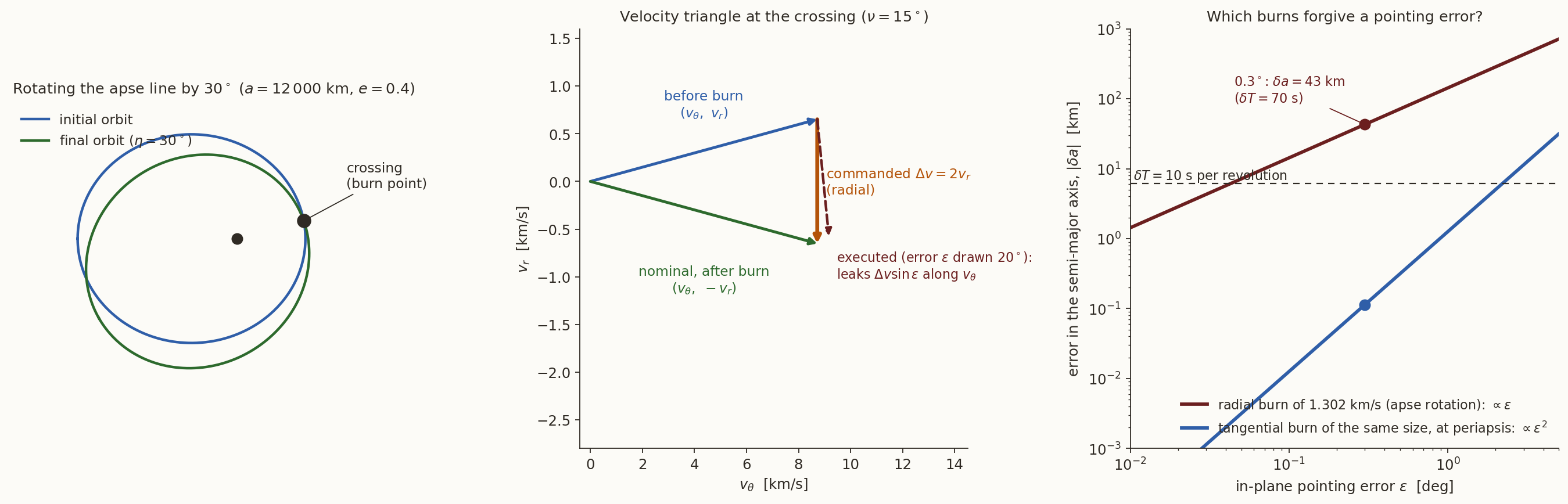
(a) Show that the two orbits (same \(p\), same \(e\), apse lines \(\eta\) apart) cross at \(f=\eta/2\) and \(\eta/2+\pi\), that the required impulse is purely radial, and that \(\Delta v=2\sqrt{\mu/p}\,e\sin(\eta/2)\), independent of \(r\).
Answer
A point at true anomaly \(f\) on the first orbit is at \(f-\eta\) on the second. Equal radii need \(\cos f=\cos(f-\eta)\), i.e. \(f=-(f-\eta)\) (the other root is \(\eta=0\)): \(f=\eta/2\), or \(\eta/2+\pi\).
With \(v_r=\sqrt{\mu/p}\,e\sin f\) and \(v_\theta=\sqrt{\mu/p}\,(1+e\cos f)\), on the second orbit \(f'=-\eta/2=-f\). Cosine is even and sine odd, so
\[ \begin{aligned} v_\theta'&=v_\theta,\qquad v_r'=-v_r\\ \Longrightarrow\quad\Delta\mathbf v&=-2v_r\hat{\mathbf e}_r,\qquad \boxed{\ \Delta v=2\sqrt{\frac\mu p}\,e\sin\frac\eta2\ } \end{aligned} \]
purely radial, with no \(r\) in it: both crossings cost the same. Here \(\sqrt{\mu/p}=6.28838\) km/s, so \(\Delta v=2(6.28838)(0.4)\sin15^\circ=1.30204\) km/s, with \(v_r=0.65102\) and \(v_\theta=8.71802\) km/s at the crossing (\(r=7270.8\) km).
(b) The pointing is off by \(\varepsilon\) (the thrust is turned from radial towards the transverse direction). Show that the burn now changes the energy at first order, \(\delta\varepsilon_{\rm orb}\approx v_\theta\Delta v\,\varepsilon\). Why does this differ from a tangential burn?
Answer
The velocity after the burn is \((v_r-\Delta v\cos\varepsilon,\ v_\theta+\Delta v\sin\varepsilon)\). Compared with the nominal \((-v_r,\ v_\theta)\) the energy changes by
\[ \begin{aligned} \delta\varepsilon_{\rm orb}&=\tfrac12\left[(v_r-\Delta v\cos\varepsilon)^{2}-v_r^{2}\right]+v_\theta\Delta v\sin\varepsilon+\tfrac12\Delta v^{2}\sin^{2}\varepsilon\\ &\approx v_\theta\,\Delta v\,\varepsilon, \end{aligned} \]
since \(\Delta v=2v_r\) makes the first bracket \(O(\varepsilon^{2})\). The cause: a nominally radial burn has \(\mathbf v\cdot\Delta\mathbf v=0\) in the energy, so any leak into the direction of \(\mathbf v_\theta\) enters at first order, weighted by the large speed \(v_\theta\). A tangential burn already sits at the maximum of \(\cos\beta\) (the Oberth figure of the impulsive-model note): its energy depends on \(\cos\varepsilon\) and so changes only at second order.
(c) For this orbit find \(\delta a\) and the period error \(\delta T\) per revolution for \(\varepsilon=1^\circ\). Compare with a tangential burn of the same size at the periapsis of this orbit. What pointing accuracy keeps \(|\delta T|<10\) s?
Answer
\(\delta\varepsilon_{\rm orb}=8.71802\times1.30204\times0.017453=0.1981\) km\(^{2}\)/s\(^{2}\). With \(\delta a=2a^{2}\,\delta\varepsilon_{\rm orb}/\mu\) and \(T=2\pi\sqrt{a^{3}/\mu}=13082\) s:
\[ \delta a=\frac{2(12000)^{2}(0.1981)}{398600}=\boxed{143\ \mathrm{km}}, \]
\[ \delta T=\frac32\,T\,\frac{\delta a}{a}=\boxed{234\ \mathrm{s\ per\ revolution}}. \]
Tangential burn of the same size at periapsis (\(v_p=8.8037\) km/s): \(\delta\varepsilon_{\rm orb}=-v_p\Delta v(1-\cos1^\circ)=-1.75\times10^{-3}\), so \(\delta a=-1.3\) km: 113 times smaller.
For \(|\delta T|<10\) s: \(\delta a=\tfrac23a\,(10/T)=6.1\) km, \(\delta\varepsilon_{\rm orb}=8.5\times10^{-3}\), and \(\varepsilon=8.5\times10^{-3}/(8.718\times1.302)=7.4\times10^{-4}\) rad \(=\boxed{0.043^\circ=2.6'}\).
(d) The two-burn alternative (circularise at apoapsis, then re-eccentricise) costs \(2.196\) km/s whatever \(\eta\) is. A \(0.3^\circ\) (\(1\sigma\)) pointing error is realistic. Which would you fly?
Answer
With \(\varepsilon=0.3^\circ\): \(\delta\varepsilon_{\rm orb}=0.0595\), \(\delta a=43\) km, \(\delta T=70\) s per revolution: too large to leave. A trim at periapsis (\(v_p=8.804\) km/s) removes it:
\[ dv=\frac{\mu\,\delta a}{2v_pa^{2}}=\frac{398600\times43}{2(8.804)(1.44\times10^{8})}=6.8\ \mathrm{m/s}. \]
Total: \(1.302+0.007=1.309\) km/s, against \(2.196\) km/s. The single radial burn still wins by nearly a kilometre per second; what changes is that it must be followed by an orbit-determination arc and a trim, and that the pointing requirement (\(0.04^\circ\) for the burn to be good without a trim) is far tighter than for the tangential burn of Problem 2 of the The Impulsive Model questions.
6. Rotating the apse line in steps
A satellite is on an orbit with a perigee altitude of \(500\) km and an apogee altitude of \(20\,000\) km. Its apse line must be turned by \(\eta=30^\circ\) in the direction of motion, with the size and the shape of the orbit unchanged. Recall from the apse-line note that one radial impulse at a crossing of the old and the new orbit does this at the cost \(2\sqrt{\mu/p}\;e\sin(\eta/2)\).
- Analytical. Suppose the rotation is made in \(N\) steps, through the angles \(\eta_1,\eta_2,\dots,\eta_N\), with \(\eta_1+\eta_2+\dots+\eta_N=\eta\). Each step is one radial impulse of the kind above. Show that the total cost is \(2\sqrt{\mu/p}\;e\,\sum_j\sin(\eta_j/2)\). Then prove that every such split costs more than a single step. (You may use \(\sin(\alpha+\beta)=\sin\alpha\cos\beta+\cos\alpha\sin\beta\).)
- Analytical. For \(N\) equal steps, show that the cost increases with \(N\), and find its limit as \(N\to\infty\).
- Numerical. Find \(p\) and \(e\), and the total cost for \(N=1\), \(2\), \(3\), \(6\) and \(N\to\infty\). Compare these with the cost of the two-burn route through a circle at apogee, from the apse-line note.
- Numerical. For the single step, the burn can be made at either of the two crossings of the old and the new orbit. For each crossing find the radius, the radial and the transverse speed, and the rate \(\dot f\) at which the satellite moves round the Earth, in degrees per minute.
- Discussion. The satellite has a mass of \(1500\) kg and an engine of \(440\) N thrust with \(I_{sp}=315\) s. How long does the burn of the single step last? Through roughly what angle does the satellite move during that burn at each crossing? Answer the same questions for the first burn of the \(N=3\) plan. Use your answers to decide which crossing you would burn at, and whether you would split the rotation.
Solution
We have to compare one radial impulse with several smaller ones that add up to the same rotation. The key observation is that every intermediate orbit has the same \(p\) and \(e\), so each step costs the same formula with its own angle. The comparison then reduces to an inequality between sines, which we prove first for two angles and then for any number. For part (e) we leave the impulsive model and ask how long a real burn lasts.
(a) Any split costs more. Each step is a radial impulse at a crossing of two orbits with the same \(p\) and \(e\), whose apse lines differ by \(\eta_j\). The intermediate orbits therefore all have the same \(p\) and \(e\), and the cost formula of the apse-line note applies to every step. Adding them up,
\[ \Delta v_{\rm total}=2\sqrt{\frac\mu p}\;e\sum_{j=1}^N\sin\frac{\eta_j}2 . \]
We have to show that this sum exceeds \(\sin(\eta/2)\), where \(\eta/2=\sum_j\eta_j/2\). Take two angles \(\alpha\) and \(\beta\) between \(0\) and \(\pi\). Then \(\sin\alpha\ge0\), \(\sin\beta\ge0\), \(\cos\alpha\le1\) and \(\cos\beta\le1\), so
\[ \sin(\alpha+\beta)=\sin\alpha\cos\beta+\cos\alpha\sin\beta\le\sin\alpha+\sin\beta . \]
The inequality is strict when both angles are strictly between \(0\) and \(\pi\), because then \(\cos\beta<1\) and \(\sin\alpha>0\). Applying this repeatedly, first to \(\eta_1/2\) and \(\eta_2/2\), then to their sum and \(\eta_3/2\), and so on, gives
\[ \sin\frac\eta2<\sum_{j=1}^N\sin\frac{\eta_j}2\qquad(N\ge2,\ \text{all }\eta_j>0). \]
Every angle here is at most \(\eta/2=15^\circ\), so the conditions hold. So every split costs more than a single step.
(b) Equal steps. For \(N\) equal steps the total is \(2N\sqrt{\mu/p}\,e\sin(\eta/2N)\). To see how this depends on \(N\), write \(y=\eta/2N\), so that
\[ N\sin\frac{\eta}{2N}=\frac\eta2\,\frac{\sin y}{y}. \]
As \(N\) grows, \(y\) shrinks. So we need to know how \(\sin y/y\) behaves. Its derivative is \((y\cos y-\sin y)/y^2\). The numerator \(g(y)=y\cos y-\sin y\) is zero at \(y=0\), and \(g'(y)=-y\sin y<0\) for \(0<y<\pi\). So \(g<0\), and \(\sin y/y\) decreases as \(y\) grows. It therefore increases as \(N\) grows, and so does the cost. As \(N\to\infty\), \(\sin y/y\to1\), and
\[ \Delta v_{\rm total}\to\sqrt{\frac\mu p}\;e\,\eta . \]
Why the factor \(\sqrt{\mu/p}\). There is a neat way to see both results, and it also shows where the factor \(\sqrt{\mu/p}\) in the cost comes from. It uses the eccentricity vector,
\[ \mathbf e=\frac{\mathbf v\times\mathbf h}{\mu}-\hat{\mathbf r}, \]
which has length \(e\) and points at perigee. Turning the apse line by \(\eta\) with the shape unchanged means replacing \(\mathbf e\) by a vector of the same length turned through \(\eta\). So we ask by how much one radial impulse changes \(\mathbf e\), and what that change costs.
An impulse \(\Delta\mathbf v=\Delta v_r\,\hat{\mathbf r}\) is instantaneous, so it changes the velocity and nothing else. The position \(\mathbf r\), and with it \(\hat{\mathbf r}\), is the same just before and just after the burn. The angular momentum \(\mathbf h=\mathbf r\times\mathbf v\) changes by \(\mathbf r\times\Delta\mathbf v\), which is zero because \(\Delta\mathbf v\) is parallel to \(\mathbf r\). So \(\mathbf h\) is unchanged, and so is \(p=h^2/\mu\). In the formula for \(\mathbf e\) only \(\mathbf v\) has changed, and
\[ \Delta\mathbf e=\frac{\Delta\mathbf v\times\mathbf h}{\mu}. \]
The impulse lies in the orbit plane and \(\mathbf h\) is perpendicular to it. So the cross product has length \(|\Delta\mathbf v|\,h\), and it lies in the plane, perpendicular to \(\hat{\mathbf r}\). Taking lengths, and using \(h=\sqrt{\mu p}\),
\[ |\Delta\mathbf e|=\frac{h}{\mu}\,|\Delta\mathbf v| \qquad\Longrightarrow\qquad |\Delta\mathbf v|=\frac{\mu}{h}\,|\Delta\mathbf e|=\sqrt{\frac\mu p}\;|\Delta\mathbf e| . \]
This is the factor. An impulse that changes \(\mathbf e\) by \(\Delta\mathbf e\) costs \(\sqrt{\mu/p}\,|\Delta\mathbf e|\). No radial impulse changes \(p\), so the rate is the same for every step of the plan, and a plan of \(N\) radial impulses costs
\[ \Delta v_{\rm total}=\sqrt{\frac\mu p}\;\sum_{j=1}^N|\Delta\mathbf e_j| . \]
Two facts about the \(\Delta\mathbf e_j\) settle both parts. First, \(\mathbf e\) does not change between burns, and at burn \(j\) it jumps by \(\Delta\mathbf e_j\). So the \(\Delta\mathbf e_j\), placed head to tail as in Figure 2 (a), lead from the old \(\mathbf e\) to the new one, and their vector sum is the same for every plan,
\[ \sum_{j=1}^N\Delta\mathbf e_j=\mathbf e_{\rm after}-\mathbf e_{\rm before}, \qquad \Bigl|\sum_{j=1}^N\Delta\mathbf e_j\Bigr|=2e\sin\frac\eta2 . \]
Second, every intermediate orbit has the same \(e\), so every intermediate \(\mathbf e\) ends on the circle of radius \(e\). Each \(\Delta\mathbf e_j\) is therefore a chord of that circle, of length \(2e\sin(\eta_j/2)\), and this gives back the cost of part (a).
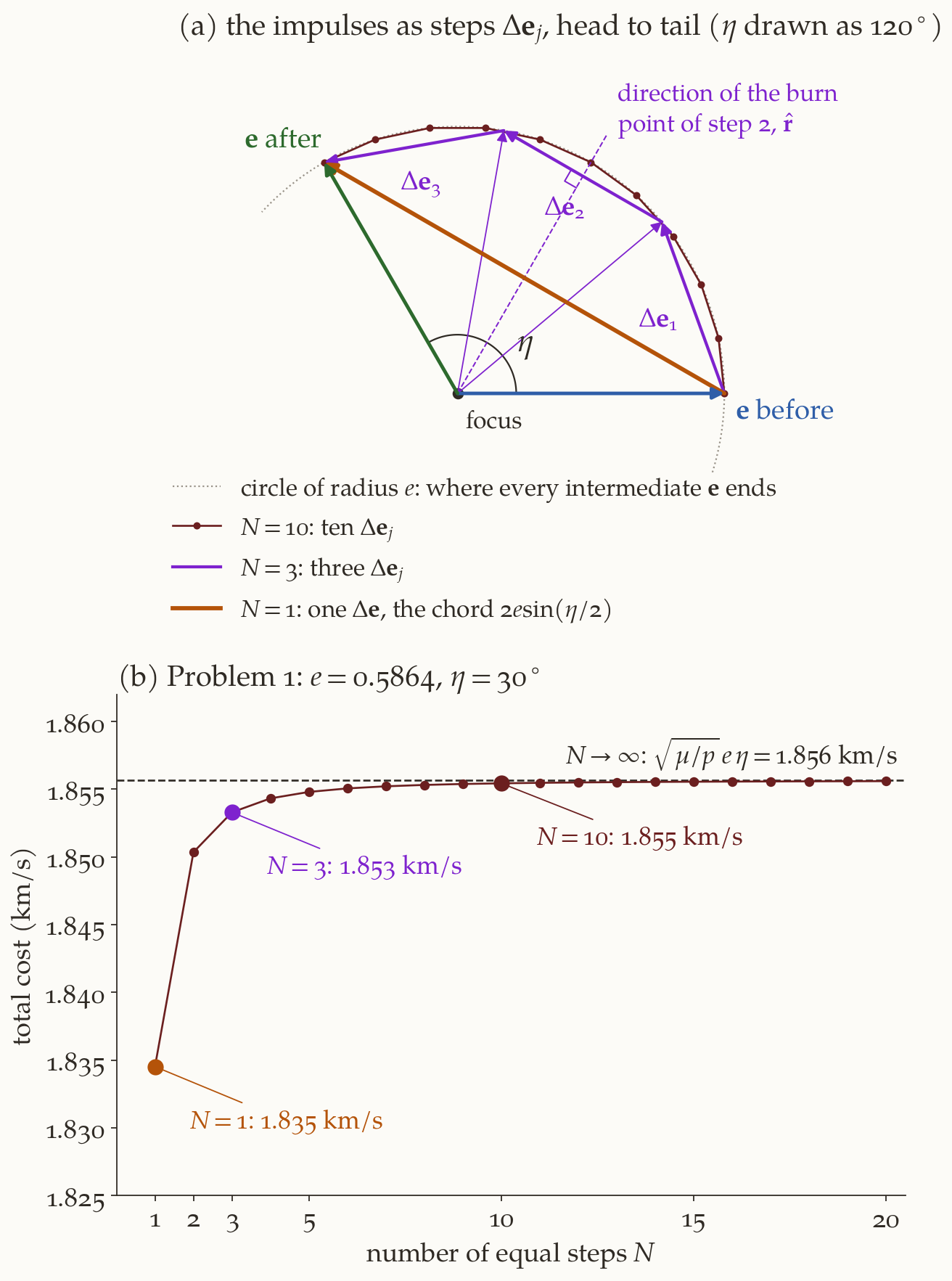
What depends on the plan is therefore not the vector sum of the \(\Delta\mathbf e_j\) but the sum of their lengths. By the triangle inequality,
\[ \sum_{j=1}^N|\Delta\mathbf e_j|\;\ge\;\Bigl|\sum_{j=1}^N\Delta\mathbf e_j\Bigr|=2e\sin\frac\eta2 , \]
with equality only when all the \(\Delta\mathbf e_j\) point the same way. Two different chords of a circle that meet end to end never do, so every plan with \(N\ge2\) costs more than the single step. This is part (a) again, now without any trigonometry, and it proves a little more. The inequality does not use the circle, so even a plan whose intermediate radial impulses changed \(e\) could not beat the single step. For \(N\) equal steps the lengths add up to \(2Ne\sin(\eta/2N)\), the perimeter of the polygon in the figure. As \(N\to\infty\) the polygon closes in on the arc, its perimeter tends to the arc length \(e\eta\), and this is the limit of part (b). Note that the arc is not a path that \(\mathbf e\) follows. The vector \(\mathbf e\) still jumps from one point of the circle to the next, and the arc length is only the limit of the sum of the jumps.
The picture also says where each burn must be made. Each \(\Delta\mathbf e_j\) is perpendicular to \(\hat{\mathbf r}\) at its burn, so the burn point lies in the direction perpendicular to that step. For a chord of a circle, that is the bisector of its two ends, the line at \(f=\eta_j/2\) and \(f=\eta_j/2+180^\circ\) from the old perigee. These are exactly the two crossings of the old and the new orbit that part (d) finds.
(c) Numbers. The radii are \(r_p=6878.137\) km and \(r_a=26\,378.137\) km, so
\[ a=16\,628.1\text{ km},\qquad e=\frac{r_a-r_p}{r_a+r_p}=0.5864,\qquad p=a(1-e^2)=10\,911.2\text{ km},\qquad \sqrt{\frac\mu p}=6.0441\text{ km/s}. \]
| \(N\) | \(1\) | \(2\) | \(3\) | \(6\) | \(10\) | \(\infty\) |
|---|---|---|---|---|---|---|
| total cost (km/s) | \(1.835\) | \(1.850\) | \(1.853\) | \(1.855\) | \(1.855\) | \(1.856\) |
Part (b) of Figure 2 plots these costs. Most of the rise comes with the second step, and by \(N=10\) the cost is within \(0.2\) m/s of the limit. Even the limit costs only \(1.15\%\) more than one step. A split that is not equal, \(20^\circ\) and then \(10^\circ\), costs \(1.849\) km/s, between the single step and two equal steps.
The two-burn route through a circle at apogee costs \(2(v_c-v_a)\), with \(v_c=\sqrt{\mu/r_a}=3.8873\) km/s and \(v_a=2.5001\) km/s. That is \(2.774\) km/s, much more than any of the single-impulse plans. This agrees with the crossover angle of the apse-line note, \(\sin(\eta_c/2)=\sqrt{1-e}/(1+\sqrt{1-e})\), which gives \(\eta_c=46.1^\circ\). A rotation of \(30^\circ\) is below it, so radial impulses are the right family here.
(d) The two crossings. The orbits cross where \(\cos f=\cos(f-\eta)\), at \(f=\eta/2=15^\circ\) and at \(f=\eta/2+180^\circ=195^\circ\). With \(r=p/(1+e\cos f)\), \(v_r=\sqrt{\mu/p}\,e\sin f\) and \(v_\theta=\sqrt{\mu/p}\,(1+e\cos f)\),
| crossing | \(f\) | \(r\) (km) | \(v_r\) (km/s) | \(v_\theta\) (km/s) | \(\dot f=v_\theta/r\) (deg/min) |
|---|---|---|---|---|---|
| near perigee | \(15^\circ\) | \(6965.9\) | \(+0.917\) | \(9.467\) | \(4.67\) |
| near apogee | \(195^\circ\) | \(25\,162.7\) | \(-0.917\) | \(2.621\) | \(0.358\) |
The impulse, \(2|v_r|=1.835\) km/s, is the same at both. At the first crossing it points inward and at the second outward.
(e) How long is the burn? The impulsive model assumes the burn is short. Let us test that. With \(v_e=I_{sp}g_0=3.089\) km/s, the rocket equation gives the propellant used. An engine of constant thrust expels it at the constant rate \(F/v_e\), so the burn lasts (the burn-time equation of the impulsive-model note)
\[ t_{\rm burn}=\frac{m_0\,v_e}{F}\Bigl(1-e^{-\Delta v/v_e}\Bigr). \]
The single step, with \(\Delta v=1.835\) km/s, lasts \(78.6\) min. The first burn of the \(N=3\) plan, with \(0.618\) km/s, lasts \(31.8\) min. Kepler’s equation gives the angle through which the satellite moves while the burn lasts, if the burn is centred on the crossing.
| burn | duration (min) | arc at the near crossing | arc at the far crossing |
|---|---|---|---|
| single step | \(78.6\) | \(219^\circ\) | \(29.2^\circ\) |
| first of three steps | \(31.8\) | \(128^\circ\) | \(11.4^\circ\) |
Near perigee the satellite would swing through most of its orbit during the burn. The burn would no longer be radial in any useful sense, and the impulsive model fails completely. Near apogee the satellite moves thirteen times more slowly, so the same burn covers a much smaller arc. So the first decision is clear. Burn at the crossing near apogee. The impulse is the same, and the satellite hardly moves while the engine fires.
Should we also split the rotation? Even at apogee, one burn spans \(29^\circ\), which is as large as the rotation itself. Over such an arc the radial direction turns by about \(15^\circ\) either side of the crossing, and the burn no longer resembles the impulse we analysed. The impulsive answer of \(1.835\) km/s is then not a reliable prediction of what the burn will really cost or where it will leave the orbit. Three burns span about \(11^\circ\) each, which is much closer to the impulsive ideal, and the ideal cost rises by only \(18.8\) m/s. The fraction of the mass left falls from \(55.2\%\) to \(54.9\%\). So the split buys a manoeuvre that behaves as planned, at a small and known price. A mission with this engine would therefore split the rotation into a few steps and make each one near apogee. With a much stronger engine it would make the rotation in one step.
7. Congruent ellipses
A computing problem. It rebuilds one chart of the survey of impulsive transfers by F. W. Gobetz and J. R. Doll (NASA CR-61999, 1968). Work in normalised units, \(\mu=1\) and \(r_1=1\), so that \(V_{c_1}=1\), and quote every \(\Delta V\) divided by \(V_{c_1}\). Do the theory (A) on paper. Write the functions of (B) in Python, with NumPy, SciPy and Matplotlib, and check them against the targets of (C). Then draw the figures of (D) and answer the question from them.
Source: Fig. 14 of the survey.
The question
A satellite on an ellipse of eccentricity \(e\) must rotate its apse line through the angle \(\omega\) in the same plane, keeping the size and shape of the orbit: the final orbit is congruent to the initial one. The flight time is free. Two modes compete: the symmetric two-impulse transfer and the transfer through infinity. Take \(\omega=\omega_s=90^\circ\) and let \(e_t=e^{*}(\omega_s)-0.05\).
- Find the boundary eccentricity \(e^{*}(\omega_s)\) above which through infinity is cheaper.
- For a satellite with \(e=e_t\) and \(\omega=\omega_s\): the cost of both modes (units \(\sqrt{\mu/a}\)), the true anomaly on the transfer ellipse at which the burn is made, and the eccentricity \(e_T\) of the transfer ellipse.
- How does \(1-e^{*}\) behave as \(\omega\to0\)?
A. Theory
T1. Units \(\mu=1\), \(a=1\) for both orbits. Take the pericentre of orbit 1 along \(\theta=0\) and that of orbit 2 along \(\theta=\omega\). Give \(p\), the position and the velocity components \((v_r,v_\theta)\) at polar angle \(\theta\) on each orbit.
T2. Mirror symmetry. Explain why the optimal two-impulse transfer between two congruent ellipses is its own mirror image in the bisector of the two apse lines, with burn points at \(\theta=\psi\pm\nu\), where \(\psi=\omega/2\) or \(\omega/2+\pi\) is the direction of the bisector, and with the transfer’s apse line on the bisector. The unknowns are then the true anomaly \(\nu\) on the transfer conic at the burn and its eccentricity \(e_T\). Derive the total cost \(\Delta V(\nu,e_T;e,\omega,\psi)\) (two equal burns). Say what \(\nu=0\) means and show that, for the right \(e_T\), it is the one-impulse transfer, with cost \(2e\sin(\omega/2)/\sqrt{1-e^2}\); conclude that the symmetric optimum is never dearer than one impulse.
T3. Through infinity: show that the cost is \(2(\sqrt2-\sqrt{1+e})/\sqrt{1-e}\), independent of \(\omega\).
T4. At \(\omega=180^\circ\) the transfer is the circle through the two apocentres. Find its cost in closed form and show that the tie with through infinity happens where \(\sqrt{1-e}+2e=\sqrt{2(1+e)}\).
T5. For \(\omega\to0\) both costs vanish and \(e^{*}\to1\). Explain why the boundary must approach \(e=1\), and estimate numerically (V5) the leading behaviour of \(1-e^{*}\).
B. Code
sym_cost(e, om, nu, eT, psi)for T2 (return \(+\infty\) for an invalid conic, i.e. \(1+e_T\cos\nu\le0\), or for \(e_T\ge1\) with \(\nu>0\)).dv_sym(e, om)minimises over \((\nu,e_T)\) for both \(\psi\): evaluate on a grid of at least \(180\times100\) points, then polish the best few withscipy.optimize.minimize(Nelder–Mead). Return the cost, \(\nu\), \(e_T\) and \(\psi\).dv_inf(e);e_star(om)by bracketing andbrentqon \(\Delta V_{\rm sym}-\Delta V_\infty\).unrestricted(e, om): an independent optimiser for the general coplanar two-impulse transfer. Its variables are \((\theta_1,\theta_2,p_T)\): burn points on orbits 1 and 2 and the semi-latus rectum of the transfer conic through them. For a conic through \((r_1,\theta_1)\) and \((r_2,\theta_2)\) sweeping \(\Delta=\theta_2-\theta_1\) (mod \(2\pi\)), \[e\cos\nu_1=\frac{p_T}{r_1}-1,\quad e\sin\nu_1=\frac{(p_T/r_1-1)\cos\Delta-(p_T/r_2-1)}{\sin\Delta},\quad e\cos\nu_2=\frac{p_T}{r_2}-1,\quad e\sin\nu_2=\frac{(p_T/r_1-1)-(p_T/r_2-1)\cos\Delta}{\sin\Delta},\] with \(v_r=e\sin\nu/\sqrt{p_T}\) and \(v_\theta=\sqrt{p_T}/r\) at each end. Use at least 60 random starts, elliptic transfers only.
C. Validation
| tag | check | target | tol |
|---|---|---|---|
| V1 | \(\Delta V_{\rm sym}\) for \((e,\omega)=(0.5,70^\circ),\ (0.6,60^\circ),\ (0.8,40^\circ),\ (0.3,100^\circ),\ (0.7,120^\circ)\) | \(0.28993,\ 0.31510,\ 0.33264,\ 0.22334,\ 0.61523\) | \(10^{-5}\) |
| V2 | \((e,\omega)=(0.5,70^\circ)\): \(e_T\) and the burn’s true anomaly | \(0.4107\); \(106.91^\circ\) | \(5\times10^{-4}\); \(0.05^\circ\) |
| V3 | \(e^{*}\) at \(\omega=16^\circ,\ 34^\circ,\ 65^\circ\) | \(0.923,\ 0.824,\ 0.697\) | \(10^{-3}\) |
| V4 | \(e^{*}(180^\circ)\) from your code and from the closed form of T4 | \(0.535334\) | \(2\times10^{-6}\) |
| V5 | \((1-e^{*})/(2\omega^2)\) (\(\omega\) in radians) at \(\omega=2^\circ\) and \(1^\circ\) | \(0.973,\ 0.997\) | \(0.01,\ 0.004\) |
| V6 | independent: unrestricted(0.5, 70°) against dv_sym |
equal | \(2\times10^{-6}\) |
| V7 | one impulse is dearer than the symmetric transfer at \((0.5,70^\circ)\) | \(0.6623>0.2899\) | — |
D. Figure and answer
Figure 7. The \((\omega,e)\) plane, \(5^\circ\le\omega\le180^\circ\) (at least 25 values of \(\omega\)): the boundary curve \(e^{*}(\omega)\) with the regions labelled “two impulses” below and “through infinity” above; mark \((\omega_s,e_t)\) and the minimum \(e^{*}(180^\circ)\). Add the small-\(\omega\) law \(1-e=2\omega^2\) as a dashed curve.
Answer. \(e^{*}(\omega_s)\); and at \((e_t,\omega_s)\): \(\Delta V_{\rm sym}\), \(\Delta V_\infty\), the saving of the cheaper one in per cent, the burn’s true anomaly \(\nu\) (degrees) and \(e_T\). For (c), the limiting value of \((1-e^{*})/(2\omega^2)\) and one sentence on why the boundary falls steeply from \(e=1\).
Notes
- A grid is not enough: the minimum is flat in some directions, and the grid values differ from the polished ones in the fifth digit. Compare with V1 only after polishing.
- Both choices of \(\psi\) must be tried; the better one depends on \((e,\omega)\).
unrestrictedis slow and noisy; it is a check, not part of the figure.
Solution
The plan is to use the mirror symmetry of two congruent ellipses to cut the unknowns of a two-impulse transfer to two, and to compare it with the transfer through infinity, whose cost has a closed form. The apse-line note treats the single-impulse and two-impulse rotations of the same problem.
T1. With \(\mu=a=1\), \(p=1-e^2\). On orbit 1 at polar angle \(\theta\): \(r=p/(1+e\cos\theta)\), \(v_r=e\sin\theta/\sqrt p\) and \(v_\theta=(1+e\cos\theta)/\sqrt p\). On orbit 2 replace \(\theta\) by \(\theta-\omega\).
T2. Reflecting the plane in the bisector of the two apse lines swaps the two orbits and reverses the direction of motion. So the mirror image of a transfer from orbit 1 to orbit 2, flown backwards, is again a transfer from 1 to 2 with the same cost. The optimum is therefore its own mirror image. Its burns are at \(\theta=\psi\pm\nu\), and the apse line of the transfer conic lies on the bisector, at \(\psi=\omega/2\) or \(\omega/2+\pi\). The unknowns are \(\nu\) and the transfer eccentricity \(e_T\).
T3. Through infinity, the first burn at the pericentre of orbit 1 raises the speed from \(\sqrt{(1+e)/(1-e)}\) to the parabolic \(\sqrt{2/(1-e)}\), a cost of \((\sqrt2-\sqrt{1+e})/\sqrt{1-e}\). The return to the pericentre of orbit 2 costs the same. So \(\Delta V_\infty=2(\sqrt2-\sqrt{1+e})/\sqrt{1-e}\), with no \(\omega\) in it.
T4. At \(\omega=180^\circ\) the two apocentres are at \(r=1+e\) on opposite sides, and the circle through them is the transfer. Each burn changes the speed from \(\sqrt{(1-e)/(1+e)}\) to \(1/\sqrt{1+e}\), so the total is \(2(1-\sqrt{1-e})/\sqrt{1+e}\). Setting it equal to \(\Delta V_\infty\) and multiplying by \(\sqrt{(1-e)(1+e)}/2\) gives \(\sqrt{1-e}-(1-e)=\sqrt{2(1+e)}-(1+e)\), that is \(\sqrt{1-e}+2e=\sqrt{2(1+e)}\). Its root is \(e^*=0.535334\).
T5. As \(\omega\to0\) the two orbits coincide and the symmetric cost tends to zero. \(\Delta V_\infty\) does not depend on \(\omega\), and it tends to zero only as \(e\to1\). So for small \(\omega\) the route through infinity can win only for orbits that are very nearly parabolic, and the boundary must approach \(e=1\). Numerically \((1-e^*)/(2\omega^2)\to1\), so \(1-e^*\approx2\omega^2\) with \(\omega\) in radians.
The answers, for \(\omega_s=90^\circ\). The boundary is at \(e^*=0.6279\), so \(e_t=0.5779\). There the symmetric transfer costs \(0.41198\sqrt{\mu/a}\) and through infinity \(0.48659\sqrt{\mu/a}\), so the two-impulse transfer is cheaper by \(15.3\%\). Its burn is at the true anomaly \(\nu=107.03^\circ\) on a transfer ellipse with \(e_T=0.4133\). For (c), \((1-e^*)/(2\omega^2)\) tends to \(1\). The boundary falls steeply from \(e=1\) because the symmetric cost grows with \(\omega\) while the cost through infinity stays fixed, so a modest rotation is enough to make the escape route uncompetitive for all but the most eccentric orbits.