Orbital Maneuvers — Problems
Execution errors, finite burns and real missions
How to use these problems
Ten problems on the Orbital Maneuvers deck. Attempt each part before reading its answer: on the web page every answer is folded under Answer (use the button at the top to open them all); in the PDF the answer follows its question.
The thread running through them: the \(\Delta v\) you command is not the \(\Delta v\) you get. It is off in magnitude (\(\varepsilon\)), in direction (\(\alpha\)), in timing (\(\tau\)), and in duration (a finite burn is not a point). Each problem exposes one of these, or the design choice that follows from it.
| # | type | topic | setting |
|---|---|---|---|
| 1 | derive | first-order burn errors | LEO \(\to\) GEO departure burn |
| 2 | derive | why a long burn loses energy | any orbit; used in 5 and 6 |
| 3 | derive | phasing errors grow with \(k\) | circular orbit; used in 7 |
| 4 | derive | apse rotation and pointing | Example 8 of the deck |
| 5 | compute | five burns to the Moon | Chandrayaan-3 |
| 6 | compute | a 22-minute injection burn | Mangalyaan |
| 7 | compute | 3 hours or 2 days? | ISS rendezvous |
| 8 | compute | plane change at apogee | GTO \(\to\) GEO from three launch sites |
| 9 | compute | bi-elliptic to lunar distance | the edge of the Hill sphere |
| 10 | compute | a \(\Delta v\) budget and its uncertainty | 15-year GEO satellite |
\(\mu_\oplus=398600.4418\ \mathrm{km^3/s^2}\), \(R_\oplus=6378.137\) km, \(g_0=9.80665\ \mathrm{m/s^2}\). Mission figures (orbits, burn durations) are rounded values from public ISRO releases; every number a problem needs is given in the problem. All motion is two-body unless a part says otherwise.
Part I — Derive
Q1 — How wrong is the orbit if the burn is wrong?
The first Hohmann burn of a LEO \(\to\) GEO transfer (\(r_1=6678.137\) km, \(r_2=42164\) km) is commanded as a tangential impulse \(\Delta v=2.42573\) km/s. A real burn departs from the command in three ways:
- magnitude: it delivers \((1+\varepsilon)\,\Delta v\);
- direction: it is turned in the orbit plane by \(\alpha\) from the tangent (towards the outward radial);
- timing: it starts \(\tau\) late.
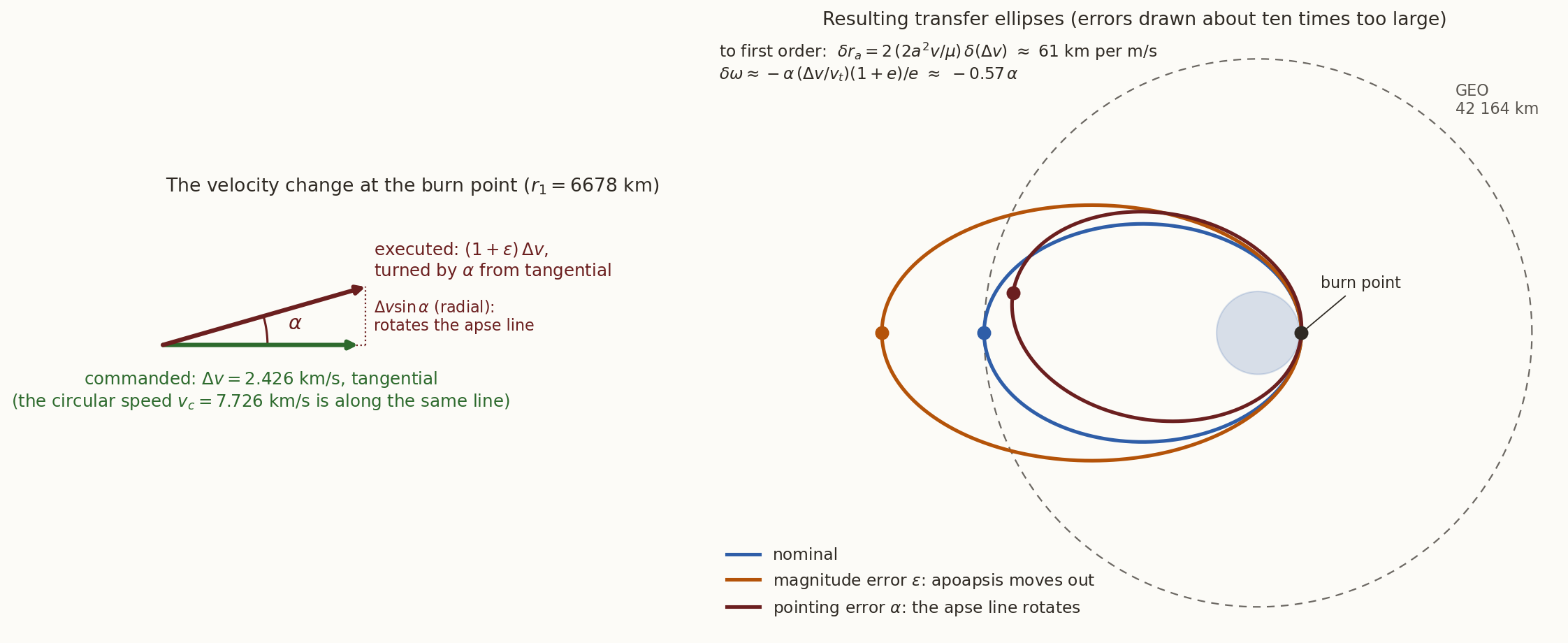
(a) Magnitude. Show that, to first order, a magnitude error \(\delta(\Delta v)\) changes the semi-major axis of the transfer ellipse by \(\delta a=\dfrac{2a^{2}v}{\mu}\,\delta(\Delta v)\) and leaves the periapsis at \(r_1\), so that \(\delta r_a=2\,\delta a\). Evaluate \(\delta r_a\) per m/s, and for \(\varepsilon=1\%\).
Answer
Differentiate vis-viva, \(v^{2}=\mu(2/r-1/a)\), at fixed \(r\):
\[ 2v\,dv=\frac{\mu}{a^{2}}\,da \qquad\Longrightarrow\qquad \boxed{\ \delta a=\frac{2a^{2}v}{\mu}\,\delta v\ } \]
The burn is tangential at \(r_1\), so after it \(v_r=0\) at \(r_1\): that point is still the periapsis, \(r_p=r_1\), and \(r_a=2a-r_1\). Hence \(\delta r_a=2\,\delta a\).
With \(a_t=24421.07\) km and \(v_{t1}=10.15149\) km/s (the speed after the burn):
\[ \frac{\delta a}{\delta(\Delta v)}=\frac{2(24421.07)^{2}(10.15149)}{398600.44} =3.038\times10^{4}\ \frac{\rm km}{\rm km/s}=30.4\ \frac{\rm km}{\rm m/s}, \]
\[ \boxed{\ \frac{\delta r_a}{\delta(\Delta v)}=60.8\ \mathrm{km\ per\ m/s}\ } \]
For \(\varepsilon=1\%\), \(\delta(\Delta v)=24.3\) m/s, so \(\delta r_a=\boxed{1474\ \mathrm{km}}\): \(3.5\%\) of the GEO radius.
(b) Pointing. The thrust is turned by \(\alpha\) towards the radial direction. Show that (i) the orbital energy changes only at second order in \(\alpha\), \(\delta\varepsilon=-v_c\Delta v\,(1-\cos\alpha)\), but (ii) the apse line rotates at first order, \(\delta\omega\approx-\alpha\,\dfrac{\Delta v}{v_t}\,\dfrac{1+e}{e}\). Evaluate for \(\alpha=1^\circ\): \(\delta a\), \(\delta\omega\), and the along-track shift of the arrival point.
Answer
(i) Energy. The velocity after the burn has components \((v_r,v_\theta)=(\Delta v\sin\alpha,\ v_c+\Delta v\cos\alpha)\), so
\[ \begin{aligned} |\mathbf v|^{2}&=v_c^{2}+2v_c\Delta v\cos\alpha+\Delta v^{2}\\ \Longrightarrow\quad \delta\varepsilon&=-v_c\Delta v\,(1-\cos\alpha)\approx-\tfrac12v_c\Delta v\,\alpha^{2}. \end{aligned} \]
The radial part of the impulse does no work (\(\mathbf v\cdot\Delta\mathbf v_r=0\)), and the tangential part is shortened only by \(\cos\alpha\). With \(\delta a=2a^{2}\delta\varepsilon/\mu\):
\[ \delta a\approx-\frac{a^{2}}{\mu}\,v_c\Delta v\,\alpha^{2}=-8.5\ \mathrm{km}\quad(\alpha=1^\circ), \qquad \delta r_a=-17\ \mathrm{km}. \]
The angular momentum \(h=r_1(v_c+\Delta v\cos\alpha)\) is also second-order.
(ii) Apse line. Take \(\hat{\mathbf r}\) along \(x\). From \(\mathbf e=\mathbf v\times\mathbf h/\mu-\hat{\mathbf r}\),
\[ e_r=\frac{v_\theta h}{\mu}-1,\qquad e_\theta=-\frac{v_r h}{\mu}. \]
Nominally \(e_\theta=0\) and \(e_r=e_t\) (periapsis at the burn point). With the error, \(e_\theta=-\Delta v\sin\alpha\;r_1v_t/\mu\) is first-order, and \(\delta\omega=e_\theta/e_r\). At periapsis \(r_1v_t^{2}=\mu(1+e)\), so \(r_1v_t/\mu=(1+e)/v_t\) and
\[ \boxed{\ \delta\omega\approx-\alpha\,\frac{\Delta v}{v_t}\,\frac{1+e}{e}\ } =-\alpha\,(0.23895)(2.3764)=-0.568\,\alpha . \]
For \(\alpha=1^\circ\): \(\delta\omega=-0.568^\circ\). The arrival point is \(180^\circ\) round the orbit at \(r_a=42164\) km, so it moves \(0.568^\circ\times(\pi/180)\times42164=\boxed{418\ \mathrm{km}}\) along the track. (A direct evaluation of the perturbed orbit gives \(-0.5679^\circ\), and \(\delta e=-9\times10^{-5}\), second order.)
(c) Timing. The burn starts \(\tau\) late on the circular orbit. With the thrust kept along the local velocity, show that the transfer is the nominal ellipse rotated rigidly by \(n\tau\) (\(n\) = mean motion). Evaluate the arrival-point shift for \(\tau=1\) s. If instead the attitude is held fixed in inertial space, what is the net apse rotation?
Answer
A circular orbit looks the same from every point, so a burn \(\tau\) late is the nominal burn at a point \(n\tau\) further along the circle; with the thrust still tangential the transfer ellipse is the nominal one rotated about the focus by \(n\tau\).
\[ n=\sqrt{\frac{\mu}{r_1^{3}}}=1.1569\times10^{-3}\ \mathrm{rad/s}=0.0663^\circ/\mathrm{s}, \]
\[ \text{arrival shift}=n\tau\,r_2=\boxed{48.8\ \mathrm{km\ per\ second}} \]
Inertial hold. The thrust still points where the velocity pointed at the nominal instant, but the velocity has turned forward by \(n\tau\). The thrust is therefore misaligned by \(\alpha=n\tau\) towards the outward radial. By (b) that rotates the apse line by \(-0.568\,n\tau\), on top of the \(+n\tau\) of the shifted burn point:
\[ \omega=n\tau\,(1-0.568)=0.432\,n\tau\ \Longrightarrow\ 21\ \mathrm{km\ per\ second.} \]
Holding attitude inertially halves the timing sensitivity, because the two errors partly cancel.
(d) Budget. Take \(1\sigma\) errors \(\varepsilon=0.2\%\), \(\alpha=0.3^\circ\), \(\tau=1\) s (orbit-fixed attitude). Find the radial and along-track errors at arrival. Which dominates, and what does it do afterwards?
Answer
\[ \begin{aligned} \text{radial:}&\quad 0.002\times2425.7=4.85\ \mathrm{m/s}\ \Rightarrow\ 4.85\times60.8=\boxed{295\ \mathrm{km}}\\ \text{along-track, pointing:}&\quad 0.3\times418=125\ \mathrm{km}\\ \text{along-track, timing:}&\quad 49\ \mathrm{km}\\ \text{along-track, RSS:}&\quad\sqrt{125^{2}+49^{2}}=\boxed{134\ \mathrm{km}}\ (0.18^\circ) \end{aligned} \]
The magnitude error dominates. It is also the harmful one: circularising \(295\) km too high gives a period error \(\delta T/T=1.5\,\delta a/a=1.0\%\), i.e. a drift of \(360^\circ\times1.0\%=3.8^\circ\)/day. The pointing and timing errors are phase errors, which are fixed once and stay fixed; a radius error is a rate error that keeps growing.
Q2 — Why one long burn loses more than several short ones
The impulsive model puts the burn at a point. A real burn of duration \(t_b\) is spread over an arc. Take constant thrust acceleration \(a_T\) along the velocity, with the burn centred in time on periapsis, so that the true anomaly runs from \(-\theta\) to \(+\theta\). Write \(v_0(f)\) for the speed on the coasting orbit of eccentricity \(e\), and \(v_p=v_0(0)\).
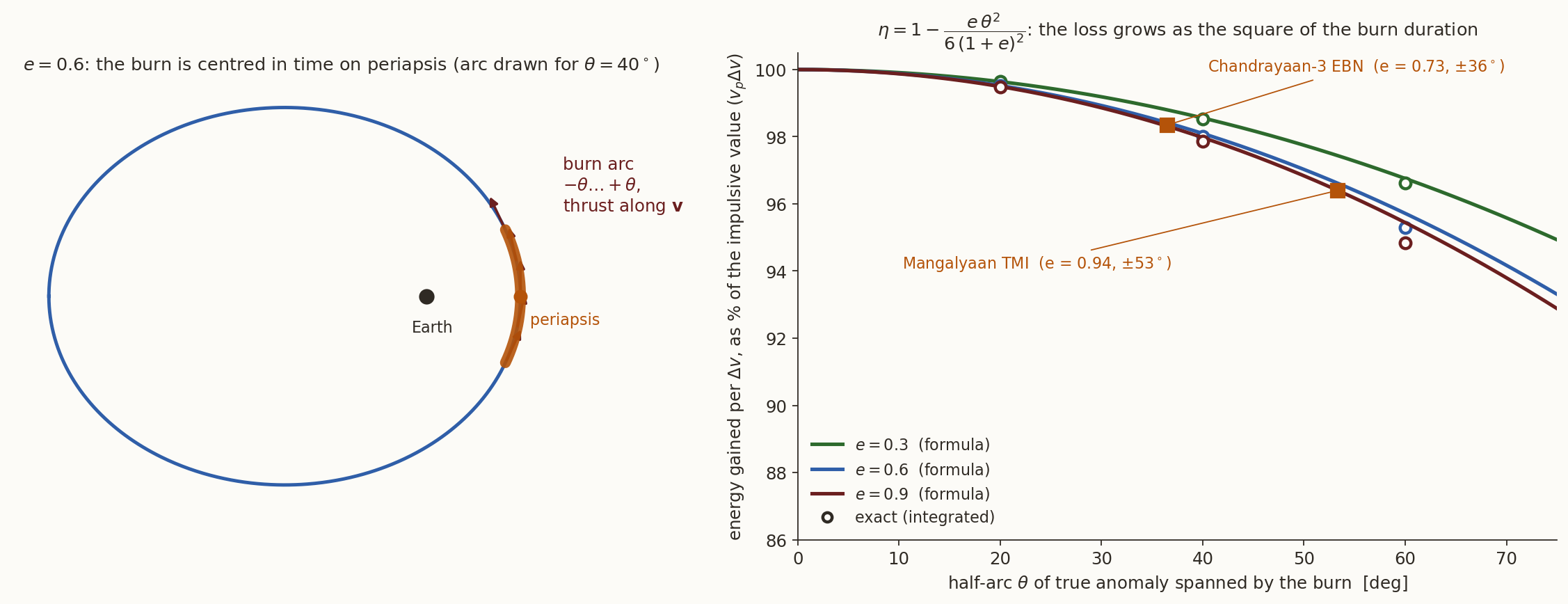
(a) Show that the thrust raises the specific energy at the rate \(\dot\varepsilon=a_Tv\), so that \(d\varepsilon=v\,d(\Delta v)\). Hence show that, if the path is not much altered, \(\Delta\varepsilon=\langle v_0\rangle\Delta v+\tfrac12\Delta v^{2}\), where \(\langle v_0\rangle\) is the time average of \(v_0\) over the burn. Compare with the impulsive value \(v_p\Delta v+\tfrac12\Delta v^{2}\).
Answer
With \(\varepsilon=v^{2}/2-\mu/r\) and \(\mathbf a=-\mu\mathbf r/r^{3}+\mathbf a_T\),
\[ \begin{aligned} \dot\varepsilon&=\mathbf v\cdot\mathbf a+\frac{\mu\dot r}{r^{2}}\\ &=-\frac{\mu\,\mathbf v\cdot\mathbf r}{r^{3}}+\frac{\mu\dot r}{r^{2}}+\mathbf v\cdot\mathbf a_T =\mathbf v\cdot\mathbf a_T=a_Tv, \end{aligned} \]
because \(\mathbf v\cdot\mathbf r=r\dot r\): gravity is conservative and drops out. With \(d(\Delta v)=a_T\,dt\), \(d\varepsilon=v\,d(\Delta v)\).
During the burn \(v=v_0(t)+u(t)\), where \(u=\int a_T\,dt\) is the \(\Delta v\) delivered so far (taking the path as unaltered). Then
\[ \Delta\varepsilon=\int_0^{\Delta v}(v_0+u)\,d(\Delta v)=\langle v_0\rangle\Delta v+\tfrac12\Delta v^{2}. \]
For the impulsive burn \(v_0\to v_p\) and the same \(\tfrac12\Delta v^{2}\) appears. The finite burn therefore falls short by exactly \((v_p-\langle v_0\rangle)\Delta v\).
(b) For small \(\theta\) show that the efficiency is \(\eta\equiv\langle v_0\rangle/v_p=1-\dfrac{e\,\theta^{2}}{6(1+e)^{2}}\). Check it for \(e=0.5\), \(\theta=30^\circ\).
Answer
On the orbit \(v_0^{2}=(\mu/p)(1+2e\cos f+e^{2})\) and \(v_p^{2}=(\mu/p)(1+e)^{2}\), so
\[ \begin{aligned} \left(\frac{v_0}{v_p}\right)^{2}&=1-\frac{2e(1-\cos f)}{(1+e)^{2}}\approx1-\frac{e f^{2}}{(1+e)^{2}}\\ \Longrightarrow\quad\frac{v_0}{v_p}&\approx1-\frac{e f^{2}}{2(1+e)^{2}}. \end{aligned} \]
Near periapsis \(\dot f=h/r^{2}\propto(1+e\cos f)^{2}\) changes only at order \(f^{2}\), so uniform in time \(\approx\) uniform in \(f\), and \(\langle f^{2}\rangle=\frac1{2\theta}\int_{-\theta}^{\theta}f^{2}df=\theta^{2}/3\):
\[ \boxed{\ \eta=1-\frac{e\,\theta^{2}}{6(1+e)^{2}}\ } \]
Check: \(e=0.5\), \(\theta=0.5236\) rad: \(\eta=1-0.5(0.2742)/(6\times2.25)=0.9898\). Integrating the orbit numerically gives \(0.9896\).
(c) At periapsis \(\dot f_p=v_p/r_p\); use it to estimate \(\theta\approx v_pt_b/(2r_p)\). For \(r_p=7000\) km, \(e=0.5\), find \(\theta\) and the loss for \(t_b=818\) s and \(t_b=1803\) s, using Kepler’s equation for the exact \(\theta\).
Answer
\(v_p=\sqrt{\mu(1+e)/r_p}=9.2420\) km/s, so \(\dot f_p=1.3203\times10^{-3}\) rad/s and \(a=14000\) km, \(T=16486\) s, \(n=3.811\times10^{-4}\) rad/s.
| \(t_b\) | \(\theta\approx\dot f_pt_b/2\) | exact \(\theta\) (Kepler) | \(\eta\) (formula) | loss |
|---|---|---|---|---|
| \(818\) s | \(30.9^\circ\) | \(30.0^\circ\) | \(0.9898\) | \(1.0\%\) |
| \(1803\) s | \(68.2^\circ\) | \(60.0^\circ\) | \(0.9594\) | \(4.1\%\) |
For \(818\) s: \(M=n(t_b/2)=0.1559\), \(E=0.3070\) rad, \(\tan\frac f2=\sqrt{\tfrac{1+e}{1-e}}\tan\frac E2\Rightarrow f=30.0^\circ\). For \(1803\) s: \(M=0.3436\), \(E=0.6435\), \(f=60.0^\circ\). The estimate \(\dot f_pt_b/2\) overshoots because \(\dot f\) falls as the craft leaves periapsis, so use Kepler for long burns.
(d) Split the burn into \(n\) equal burns on \(n\) successive periapsis passes. Show the total loss falls as \(1/n^{2}\). Compare with direct integration for the \(1803\) s burn.
Answer
Each burn lasts \(t_b/n\), so \(\theta\to\theta/n\) and each loses a fraction \(\propto(\theta/n)^{2}\) of its own \(\Delta v/n\). The loss, as a fraction of the total \(\Delta v\), is that of one short burn:
\[ \frac{\text{loss}(n)}{\text{loss}(1)}\approx\frac1{n^{2}}. \]
Integrating the orbit for \(t_b=1803\) s: \(n=1\): \(4.39\%\); \(n=2\) (902 s each, \(\theta=32.9^\circ\)): \(1.25\%\); \(n=3\) (601 s, \(22.3^\circ\)): \(0.57\%\). The ratios (\(3.5\), \(7.7\)) fall a little short of \(4\) and \(9\) because \(\theta\) shrinks slightly slower than \(t_b\).
(e) What limits how many burns one can use?
Answer
Each burn needs its own periapsis pass: the orbit period (hours to days for the raising orbits of Q5), one more engine restart, one more tracking arc and ground contact, and one more chance of a failure. The loss falls as \(1/n^{2}\) while the time grows as \(n\). The optimum is where the extra \(\Delta v\) is no longer worth the extra days: Chandrayaan-3 used five burns over ten days.
Q3 — Phasing: errors grow with the number of revolutions
A chaser trails a target by \(\Delta\theta\) on a common circular orbit (radius \(r\), speed \(v\), period \(T\)). It closes the gap in \(k\) revolutions with two equal and opposite tangential burns (phasing slides of the deck). Each burn has a relative error \(\varepsilon\) and an absolute error \(\sigma\) (accelerometer bias, minimum impulse bit).
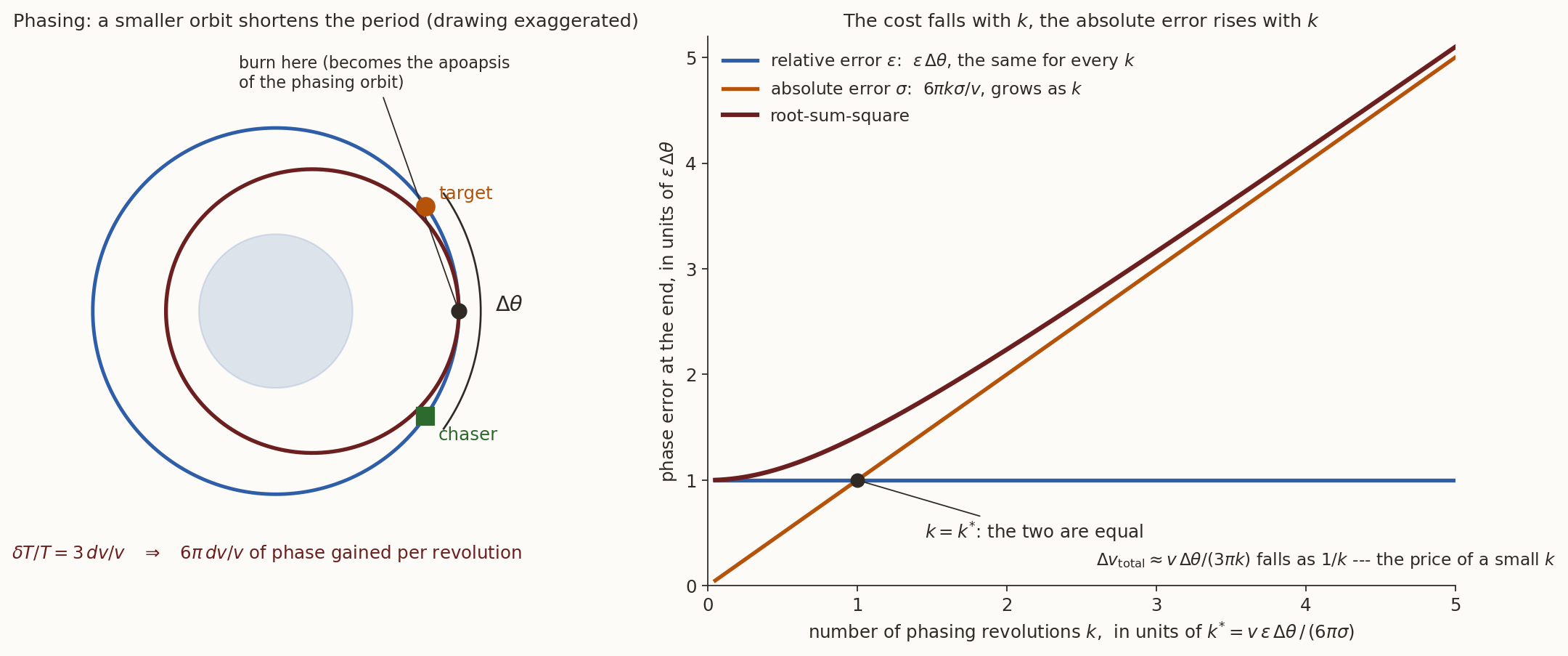
(a) Show that a tangential burn \(dv\) on a circular orbit changes the period by \(\delta T/T=3\,dv/v\), so that each revolution on the new orbit shifts the phase by \(6\pi\,dv/v\).
Answer
\(T=2\pi\sqrt{a^{3}/\mu}\Rightarrow\delta T/T=\tfrac32\,\delta a/a\). On a circle \(\mu=v^{2}a\), so \(\delta a=2a^{2}v\,dv/\mu\) gives \(\delta a/a=2\,dv/v\) and
\[ \boxed{\ \frac{\delta T}{T}=\frac{3\,dv}{v}\ } \qquad\Longrightarrow\qquad \text{phase shift per revolution}=2\pi\frac{\delta T}{T}=\boxed{\ 6\pi\,\frac{dv}{v}\ }. \]
(b) Derive the closing condition, and show that for small \(\Delta\theta\) \(\Delta v_{\rm total}\approx v\,\Delta\theta/(3\pi k)\) and the phasing perigee drops by \(2r\Delta\theta/(3\pi k)\). Compare with the exact values for \(r=6778.137\) km, \(\Delta\theta=20^\circ\), \(k=2\).
Answer
The chaser completes \(k\) revolutions in the time the target covers \(2\pi k-\Delta\theta\): \(kT_{ph}=kT\,(1-\Delta\theta/2\pi k)\), so \(\delta T/T=-\Delta\theta/(2\pi k)\). By (a),
\[ dv=-\frac v3\,\frac{\Delta\theta}{2\pi k}\quad\Longrightarrow\quad \Delta v_{\rm total}=2|dv|=\boxed{\frac{v\,\Delta\theta}{3\pi k}}. \]
The phasing orbit has its apoapsis at the burn point, \(a_{ph}=r(1+\delta T/T)^{2/3}\approx r(1-\Delta\theta/3\pi k)\), so \(r_p=2a_{ph}-r\approx r\,(1-2\Delta\theta/3\pi k)\): the perigee drops by \(\boxed{2r\Delta\theta/(3\pi k)}\).
Numbers (\(v=7.6686\) km/s, \(\Delta\theta=0.34907\) rad, \(k=2\)): \(\Delta v\approx142.0\) m/s against the exact \(146.1\) m/s, and a drop of \(251\) km against the exact \(252\) km.
(c) Show that the phase error at the end is \(\sqrt{(\varepsilon\Delta\theta)^{2}+(6\pi k\sigma/v)^{2}}\), and find the \(k^{*}\) at which the absolute error equals the relative one. Evaluate \(k^{*}\) for \(\varepsilon=0.5\%\), \(\sigma=0.1\) m/s, \(v=7669\) m/s, \(\Delta\theta=20^\circ\).
Answer
The error of the phasing burn is \(\delta v=\varepsilon\,dv+\sigma\). After \(k\) revolutions (a):
\[ \delta\phi=6\pi k\,\frac{\delta v}{v}. \]
The relative part: \(6\pi k\,\varepsilon\,\dfrac{|dv|}{v}=6\pi k\,\varepsilon\,\dfrac{\Delta\theta}{6\pi k}=\varepsilon\,\Delta\theta\): the burn gets smaller as \(1/k\), the drift per revolution grows as \(k\), and the two cancel. The absolute part, \(6\pi k\sigma/v\), has no such cancellation and grows with \(k\). Independent errors add in quadrature. They are equal at
\[ k^{*}=\frac{v\,\varepsilon\,\Delta\theta}{6\pi\sigma}=\frac{7669\times0.005\times0.3491}{6\pi\times0.1}=\boxed{7.1}. \]
(d) At 400 km altitude the phasing perigee must stay above 200 km. Find the smallest \(k\) for \(\Delta\theta=20^\circ\). Is a larger \(k\) better?
Answer
From (b) the perigee altitude is \(h_0-2r\Delta\theta/(3\pi k)\ge200\) km, so
\[ \begin{aligned} k\ &\ge\ \frac{2r\Delta\theta}{3\pi\,(h_0-h_{\min})}=\frac{2(6778)(0.3491)}{3\pi(200)}=2.51\\ \Longrightarrow\quad k_{\min}&=3. \end{aligned} \]
For \(k<k^{*}\) the relative error dominates and does not depend on \(k\), so nothing is gained by going beyond the minimum except a smaller \(\Delta v\). For \(k>k^{*}\approx7\) the absolute error dominates and grows linearly with \(k\). So: take the smallest \(k\) that the perigee allows if the \(\Delta v\) can be afforded; take larger \(k\) only to save propellant, and then pay for it with correction burns. (This is Q7.)
Q4 — Apse-line rotation: cheap, but fragile
In Example 8 of the deck (\(a=12000\) km, \(e=0.4\), so \(p=10080\) km), the apse line is rotated by \(\eta=30^\circ\) with a single impulse at the crossing \(\nu=\eta/2\).
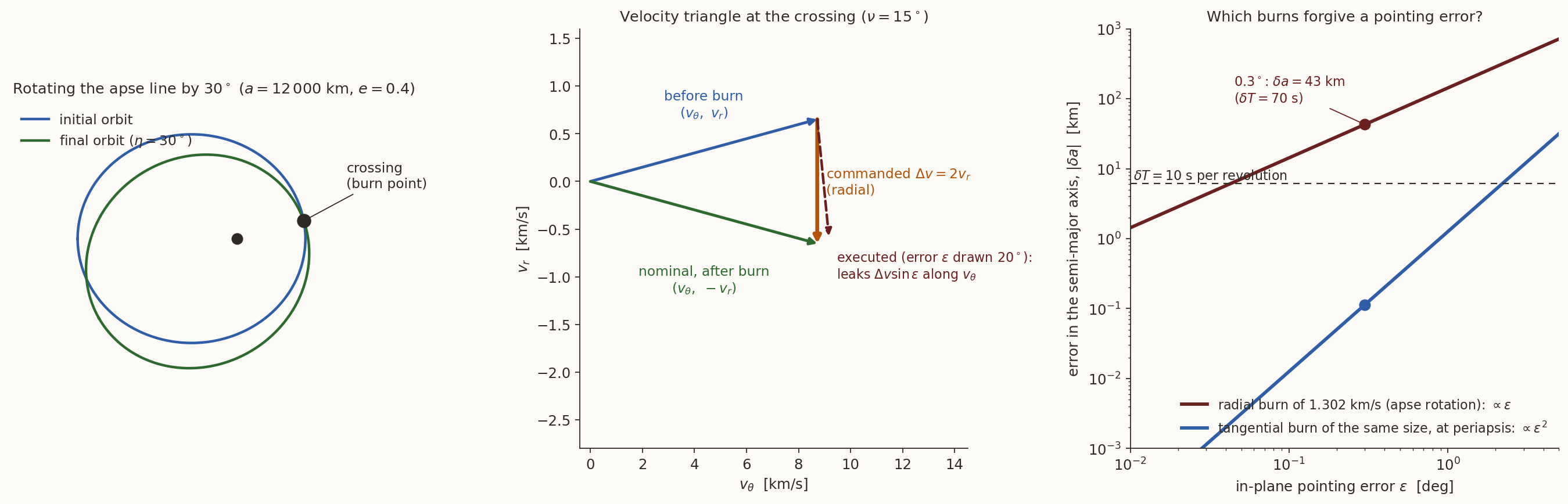
(a) Show that the two orbits (same \(p\), same \(e\), apse lines \(\eta\) apart) cross at \(\nu=\eta/2\) and \(\eta/2+\pi\), that the required impulse is purely radial, and that \(\Delta v=2\sqrt{\mu/p}\,e\sin(\eta/2)\), independent of \(r\).
Answer
A point at true anomaly \(\nu\) on the first orbit is at \(\nu-\eta\) on the second. Equal radii need \(\cos\nu=\cos(\nu-\eta)\), i.e. \(\nu=-(\nu-\eta)\) (the other root is \(\eta=0\)): \(\nu=\eta/2\), or \(\eta/2+\pi\).
With \(v_r=\sqrt{\mu/p}\,e\sin\nu\) and \(v_\theta=\sqrt{\mu/p}\,(1+e\cos\nu)\), on the second orbit \(\nu'=-\eta/2=-\nu\). Cosine is even and sine odd, so
\[ \begin{aligned} v_\theta'&=v_\theta,\qquad v_r'=-v_r\\ \Longrightarrow\quad\Delta\mathbf v&=-2v_r\hat{\mathbf e}_r,\qquad \boxed{\ \Delta v=2\sqrt{\frac\mu p}\,e\sin\frac\eta2\ } \end{aligned} \]
purely radial, with no \(r\) in it: both crossings cost the same. Here \(\sqrt{\mu/p}=6.28838\) km/s, so \(\Delta v=2(6.28838)(0.4)\sin15^\circ=1.30204\) km/s, with \(v_r=0.65102\) and \(v_\theta=8.71802\) km/s at the crossing (\(r=7270.8\) km).
(b) The pointing is off by \(\varepsilon\) (the thrust is turned from radial towards the transverse direction). Show that the burn now changes the energy at first order, \(\delta\varepsilon_{\rm orb}\approx v_\theta\Delta v\,\varepsilon\). Why does this differ from a tangential burn?
Answer
The velocity after the burn is \((v_r-\Delta v\cos\varepsilon,\ v_\theta+\Delta v\sin\varepsilon)\). Compared with the nominal \((-v_r,\ v_\theta)\) the energy changes by
\[ \begin{aligned} \delta\varepsilon_{\rm orb}&=\tfrac12\left[(v_r-\Delta v\cos\varepsilon)^{2}-v_r^{2}\right]+v_\theta\Delta v\sin\varepsilon+\tfrac12\Delta v^{2}\sin^{2}\varepsilon\\ &\approx v_\theta\,\Delta v\,\varepsilon, \end{aligned} \]
since \(\Delta v=2v_r\) makes the first bracket \(O(\varepsilon^{2})\). The cause: a nominally radial burn has \(\mathbf v\cdot\Delta\mathbf v=0\) in the energy, so any leak into the direction of \(\mathbf v_\theta\) enters at first order, weighted by the large speed \(v_\theta\). A tangential burn already sits at the maximum of \(\cos\beta\) (Oberth slide of the deck): its energy depends on \(\cos\varepsilon\) and so changes only at second order.
(c) For Example 8 find \(\delta a\) and the period error \(\delta T\) per revolution for \(\varepsilon=1^\circ\). Compare with a tangential burn of the same size at the periapsis of this orbit. What pointing accuracy keeps \(|\delta T|<10\) s?
Answer
\(\delta\varepsilon_{\rm orb}=8.71802\times1.30204\times0.017453=0.1981\) km\(^{2}\)/s\(^{2}\). With \(\delta a=2a^{2}\,\delta\varepsilon_{\rm orb}/\mu\) and \(T=2\pi\sqrt{a^{3}/\mu}=13082\) s:
\[ \delta a=\frac{2(12000)^{2}(0.1981)}{398600}=\boxed{143\ \mathrm{km}}, \]
\[ \delta T=\frac32\,T\,\frac{\delta a}{a}=\boxed{234\ \mathrm{s\ per\ revolution}}. \]
Tangential burn of the same size at periapsis (\(v_p=8.8037\) km/s): \(\delta\varepsilon_{\rm orb}=-v_p\Delta v(1-\cos1^\circ)=-1.75\times10^{-3}\), so \(\delta a=-1.3\) km: 113 times smaller.
For \(|\delta T|<10\) s: \(\delta a=\tfrac23a\,(10/T)=6.1\) km, \(\delta\varepsilon_{\rm orb}=8.5\times10^{-3}\), and \(\varepsilon=8.5\times10^{-3}/(8.718\times1.302)=7.4\times10^{-4}\) rad \(=\boxed{0.043^\circ=2.6'}\).
(d) The two-burn alternative (circularise at apoapsis, then re-eccentricise) costs \(2.196\) km/s whatever \(\eta\) is. A \(0.3^\circ\) (\(1\sigma\)) pointing error is realistic. Which would you fly?
Answer
With \(\varepsilon=0.3^\circ\): \(\delta\varepsilon_{\rm orb}=0.0595\), \(\delta a=43\) km, \(\delta T=70\) s per revolution: too large to leave. A trim at periapsis (\(v_p=8.804\) km/s) removes it:
\[ dv=\frac{\mu\,\delta a}{2v_pa^{2}}=\frac{398600\times43}{2(8.804)(1.44\times10^{8})}=6.8\ \mathrm{m/s}. \]
Total: \(1.302+0.007=1.309\) km/s, against \(2.196\) km/s. The single radial burn still wins by nearly a kilometre per second; what changes is that it must be followed by an orbit-determination arc and a trim, and that the pointing requirement (\(0.04^\circ\) for the burn to be good without a trim) is far tighter than for the tangential burns of Part I.
Part II — Real missions
Q5 — Chandrayaan-3: five burns to the Moon
After launch by LVM3 the Chandrayaan-3 propulsion module (about \(3900\) kg with lander and rover; one \(440\) N engine, \(I_{sp}\approx310\) s) was in orbit A. Five Earth-bound burns raised the apogee to orbit B, and the trans-lunar injection (TLI) of 1 August 2023 raised it to C.
| orbit | perigee \(\times\) apogee [km altitude] | after |
|---|---|---|
| A | \(170\times36\,500\) | LVM3 injection |
| B | \(236\times127\,603\) | fifth Earth-bound burn |
| C | \(288\times369\,328\) | TLI |
Assume: every burn is tangential at perigee; take the perigee radius as \(R_\oplus+200=6578.137\) km for all orbits; the five Earth-bound burns are of equal impulsive \(\Delta v\). (Values rounded from ISRO’s releases.)
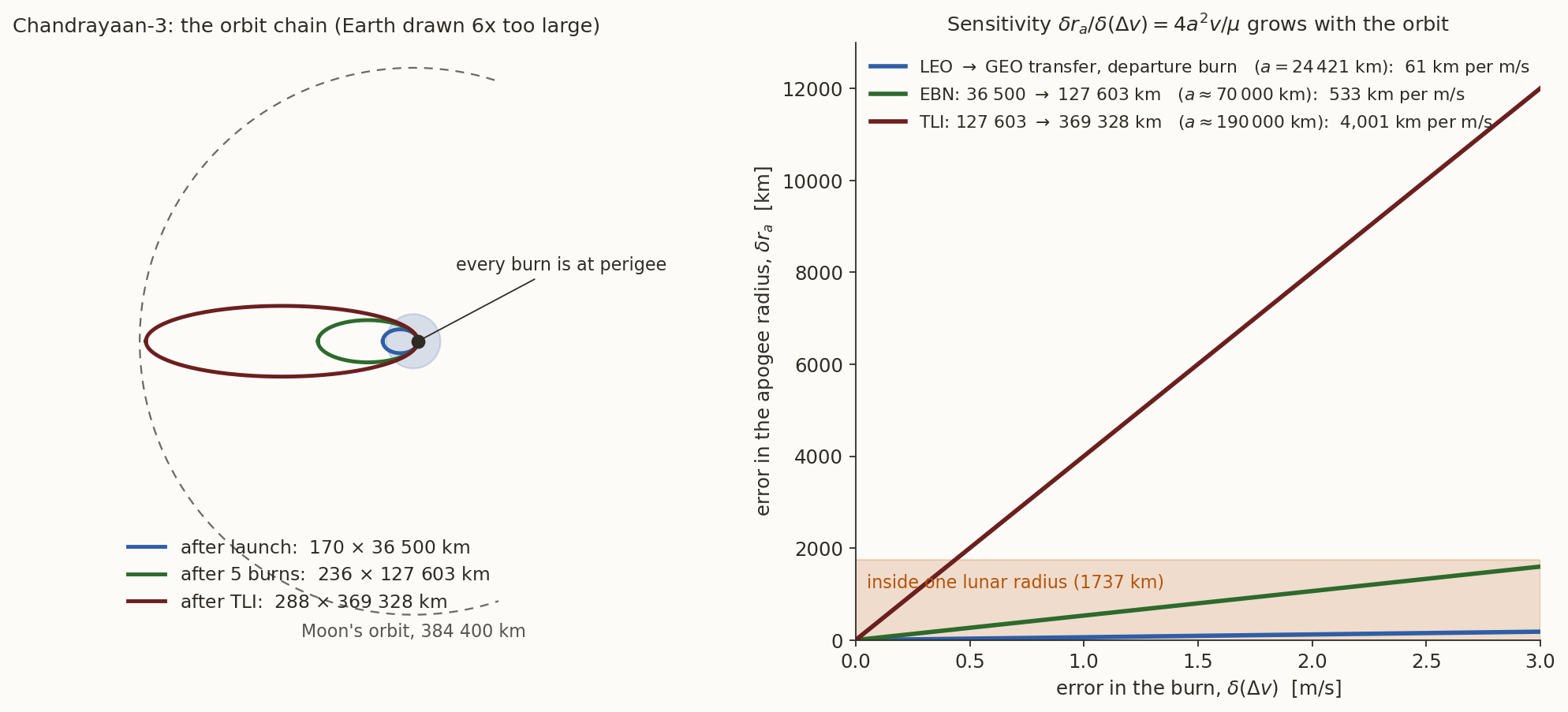
(a) Find the impulsive \(\Delta v\) for A \(\to\) B and B \(\to\) C. Show that doing A \(\to\) B in five burns costs the same as in one. What \(\Delta v\) would a direct \(200\) km circular LEO \(\to\) C need, and why is each m/s so much more productive at A?
Answer
Perigee speed, \(v_p=\sqrt{\mu\,(2/r_p-1/a)}\) with \(r_p=6578.137\) km:
| orbit | \(a\) [km] | \(e\) | period | \(v_p\) [km/s] |
|---|---|---|---|---|
| A | \(24\,728\) | \(0.7340\) | \(10.8\) h | \(10.2504\) |
| B | \(70\,280\) | \(0.9064\) | \(51.5\) h | \(10.7479\) |
| C | \(191\,142\) | \(0.9656\) | \(231\) h | \(10.9135\) |
\[ \begin{aligned} \Delta v_{AB}&=10.7479-10.2504=\boxed{497.5\ \mathrm{m/s}},\\ \Delta v_{BC}&=10.9135-10.7479=\boxed{165.6\ \mathrm{m/s}}\ (\text{TLI}),\\ \Delta v_{AC}&=663.1\ \mathrm{m/s}. \end{aligned} \]
Every burn is at the same point and along \(\mathbf v\), so the \(\Delta v\)’s are differences of the same speed and telescope: \(\sum\Delta v_i=v_p(B)-v_p(A)\) for any number of burns. Impulsively, five burns cost exactly as much as one. (Q2 and (b) show why they are still better.)
From a \(200\) km circular orbit (\(v_c=7.7843\) km/s): \(\Delta v=10.9135-7.7843=3129\) m/s. The launcher has already supplied most of this: at A the craft is moving at \(10.25\) km/s and each m/s adds energy at the rate \(v_p\) (\(\Delta\varepsilon=v_p\Delta v\)), \(32\%\) more than at LEO speed. The remaining \(0.66\) km/s is cheap.
(b) Find the duration and arc of each of the five equal burns (\(\Delta v=99.5\) m/s each), using \(t_b=\dfrac{m_0v_e}{F}\left(1-e^{-\Delta v/v_e}\right)\) and Kepler’s equation. Use Q2 to find the total extra \(\Delta v\). Compare with doing A \(\to\) B in one burn.
Answer
\(v_e=310\times9.80665=3040.1\) m/s. For burn 1, \(m_0=3900\) kg: \(m_0v_e/F=26\,947\) s and \(1-e^{-0.03273}=0.03220\), so \(t_b=868\) s. For the arc: \(T_A=38\,700\) s, \(n=1.6236\times10^{-4}\) rad/s, \(M=n(t_b/2)=0.0705\); \(E-0.734\sin E=0.0705\Rightarrow E=0.2571\); \(\tan\frac f2=\sqrt{1.734/0.266}\tan\frac E2\Rightarrow f=36.5^\circ\). Q2(b) then gives \(\eta=1-0.734(0.637)^{2}/(6\times1.734^{2})=0.9835\).
| burn | apogee before [km] | \(t_b\) | \(\theta\) | \(\eta\) | loss [m/s] |
|---|---|---|---|---|---|
| 1 | \(36\,500\) | \(868\) s | \(36.5^\circ\) | \(0.9835\) | \(1.6\) |
| 2 | \(43\,706\) | \(840\) s | \(35.7^\circ\) | \(0.9841\) | \(1.6\) |
| 3 | \(53\,479\) | \(813\) s | \(35.0^\circ\) | \(0.9847\) | \(1.5\) |
| 4 | \(67\,487\) | \(787\) s | \(34.2^\circ\) | \(0.9853\) | \(1.5\) |
| 5 | \(89\,239\) | \(761\) s | \(33.5^\circ\) | \(0.9859\) | \(1.4\) |
The total extra \(\Delta v\) is \(\boxed{\approx7.6\ \mathrm{m/s}\ (1.5\%)}\). (Direct integration of the thrust gives \(8.9\) m/s, and also shows the perigee creeping from \(200\) to \(224\) km: the finite burn lifts the perigee, as the real ones did.)
One burn, A \(\to\) B: \(\Delta v_{AB}=497.5\) m/s needs \(t_b=4068\) s (\(68\) min) and spans \(\pm103^\circ\). The small-arc formula is no longer good there; integrating the orbit with thrust gives \(86\) min and \(\boxed{645\ \mathrm{m/s}}\) to reach the same energy: \(147\) m/s (\(30\%\)) more, with the perigee thrown up to \(694\) km.
(c) Find the TLI burn duration (mass after the five burns: \(3900\,e^{-497.5/3040}=3311\) kg), its arc, and its extra \(\Delta v\).
Answer
\(t_b=\dfrac{3311(3040.1)}{440}\left(1-e^{-165.6/3040.1}\right)=22\,877\times0.05302=1213\) s (\(20.2\) min). In orbit B: \(T=185\,400\) s, \(n=3.388\times10^{-5}\) rad/s, \(M=n(606.5)=0.02055\), \(E=0.2053\), \(f=49.8^\circ\). \(\eta=1-0.9064(0.869)^{2}/(6\times1.9064^{2})=0.9685\), so the loss is \(3.2\%\times165.6=\boxed{5.2\ \mathrm{m/s}}\) (integration: \(6.4\) m/s, \(3.9\%\)).
(d) How far does a \(1\) m/s error in the TLI burn move the apogee? Compare with the LEO \(\to\) GEO departure burn of Q1. How accurate must the TLI be if the apogee must be within \(5000\) km?
Answer
By Q1(a), \(\delta r_a=\dfrac{4a^{2}v}{\mu}\,\delta(\Delta v)\) for a burn at periapsis. With the TLI orbit (\(a=191\,142\) km, \(v=10.9135\) km/s):
\[ \frac{\delta r_a}{\delta(\Delta v)}=\frac{4(191\,142)^{2}(10.9135)}{398600}=4.00\times10^{6}\ \frac{\rm km}{\rm km/s} \]
\[ =\boxed{4000\ \mathrm{km\ per\ m/s}}, \]
against \(61\) km per m/s for LEO \(\to\) GEO, \(533\) for burn 5 of A \(\to\) B: the gain grows as \(a^{2}v\). For \(5000\) km: \(\delta(\Delta v)<1.25\) m/s, i.e. \(0.75\%\) of the \(165.6\) m/s burn; a \(0.3\%\) burn error (\(0.5\) m/s) is already \(2000\) km, more than a lunar radius. A lunar mission therefore cannot be flown open-loop: the TLI is followed by trajectory-correction burns, and the tiny \(\Delta v\) of TLI (165 m/s) is deceptive about how accurately it must be delivered.
Q6 — Mangalyaan: a 22-minute burn
Mangalyaan’s trans-Mars injection (1 December 2013) was flown from an orbit of \(252\times192\,874\) km. The \(440\) N engine burned for \(1328.89\) s and the reported \(\Delta v\) was \(648\) m/s (rounded ISRO figures; take \(I_{sp}=310\) s and constant thrust acceleration). The burn was centred in time on periapsis.
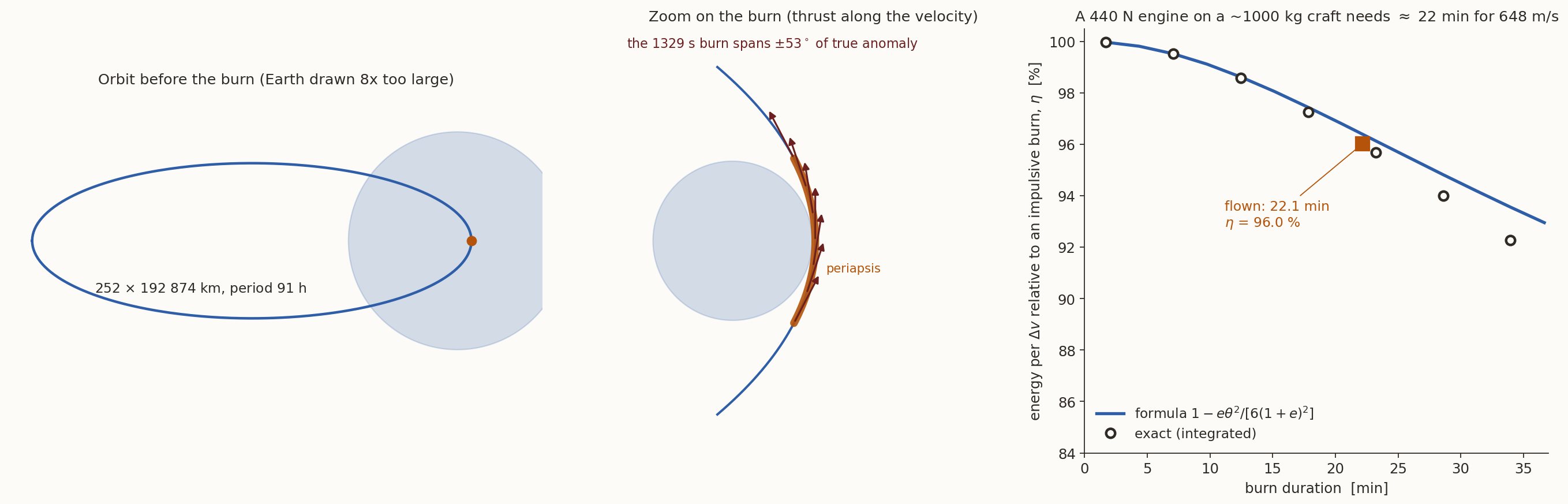
(a) Find \(e\), \(a\), the period, \(v_p\), and the true-anomaly arc spanned by the burn.
Answer
\(r_p=6630.137\) km, \(r_a=199\,252.137\) km, so \(a=102\,941\) km and \(e=0.93559\). The period is \(T=2\pi\sqrt{a^{3}/\mu}=328\,700\) s (\(91.3\) h), \(v_p=10.7873\) km/s, \(v_{\rm esc}=\sqrt{2\mu/r_p}=10.9654\) km/s and \(\varepsilon_0=-\mu/2a=-1.9361\) km\(^{2}\)/s\(^{2}\).
Arc: half the burn is \(664.4\) s; \(n=1.9116\times10^{-5}\) rad/s, so \(M=0.01270\). Solving \(E-0.93559\sin E=M\) gives \(E=0.1825\), and \(\tan\frac f2=\sqrt{1.93559/0.06441}\tan\frac E2=0.5016\Rightarrow\boxed{\theta=53.3^\circ}\).
(b) Use Q2 to find \(\eta\) and the energy delivered. Hence find the \(v_\infty\) and \(C_3\) the burn gave, and the impulsive \(\Delta v\) that would have done the same.
Answer
\(\eta=1-\dfrac{e\theta^{2}}{6(1+e)^{2}}=1-\dfrac{0.93559(0.9301)^{2}}{6(1.93559)^{2}}=\boxed{0.964}\) (integrating the orbit: \(0.960\)). From Q2(a), \(\Delta\varepsilon=\eta\,v_p\Delta v+\tfrac12\Delta v^{2}\):
\[ \Delta\varepsilon=0.964(10.7873)(0.648)+\tfrac12(0.648)^{2}=6.739+0.210=6.949\ \mathrm{km^{2}/s^{2}}, \]
\[ \varepsilon_f=-1.936+6.949=5.013\ \Rightarrow\ \]
\[ \boxed{v_\infty=\sqrt{2\varepsilon_f}=3.17\ \mathrm{km/s},\quad C_3=10.0\ \mathrm{km^{2}/s^{2}}} \]
(Numerical integration of the burn: \(v_\infty=3.14\) km/s, \(C_3=9.9\).) An impulsive burn at periapsis giving the same \(v_\infty\) needs \(v=\sqrt{v_{\rm esc}^{2}+v_\infty^{2}}=11.413\) km/s, i.e. \(\Delta v_{\rm imp}=\boxed{626\ \mathrm{m/s}}\). The finite burn “wastes” about \(22\) m/s (\(3.4\%\); \(28\) m/s by integration). The \(C_3\approx10\) is above the Hohmann minimum (\(v_\infty=2.94\) km/s, \(C_3=8.6\)), as it must be for a real launch window.
(c) What was the spacecraft mass at the start of the burn, and the propellant used?
Answer
\(\dot m=F/(I_{sp}g_0)=440/3040.1=0.14473\) kg/s, so \(m_{\rm prop}=0.14473\times1328.89=\boxed{192\ \mathrm{kg}}\), and from \(\Delta v=v_e\ln(m_0/m_1)\):
\[ m_0=\frac{m_{\rm prop}}{1-e^{-648/3040.1}}=\frac{192.3}{0.19196}=\boxed{1002\ \mathrm{kg}},\qquad m_1=810\ \mathrm{kg}. \]
(d) The engine cuts off \(1\) s late. By how much does \(v_\infty\) change, and what miss does it cause after a \(300\)-day cruise?
Answer
A second more of thrust is \(\delta(\Delta v)=a_T\cdot1\,\mathrm{s}=648/1329=0.49\) m/s. Near cutoff the craft is at \(v\approx11.4\) km/s and \(d\varepsilon=v\,d(\Delta v)\), so \(v_\infty\,dv_\infty=v\,d(\Delta v)\):
\[ \frac{dv_\infty}{d(\Delta v)}=\frac{11.4}{3.17}=3.6\ \Rightarrow\ \delta v_\infty=1.8\ \mathrm{m/s}. \]
Cruising for \(300\) d \(=2.6\times10^{7}\) s, a velocity error of \(1.8\) m/s becomes \(\approx4.7\times10^{4}\) km if the path were straight. In the Sun’s field the error is amplified rather than just carried: \(4a^{2}v/\mu_\odot\approx3.5\times10^{4}\) km per m/s for a Mars Hohmann arc. Either way the miss is \(10^{4}\) to \(10^{5}\) km, against the few hundred km needed to hit the Mars capture window.
(e) A correction made \(t\) days after TMI removes a miss \(d\) for \(\Delta v\approx d/(T_{\rm flight}-t)\). Evaluate for \(d=4.7\times10^{4}\) km, \(T=300\) d, at \(t=10\), \(100\), \(250\) d. When would you do TCM-1?
Answer
\[ \Delta v=\frac{4.7\times10^{7}\ \mathrm{m}}{(300-t)\times86\,400\ \mathrm{s}}: \]
\[ t=10\ \mathrm{d}:\ 1.9\ \mathrm{m/s},\quad 100\ \mathrm{d}:\ 2.7\ \mathrm{m/s},\quad 250\ \mathrm{d}:\ \boxed{10.9\ \mathrm{m/s}}. \]
The same miss costs \(6\) times more at \(250\) d than at \(10\) d: correct early. But the orbit must first be determined well enough to know the error (a few days of tracking), so TCM-1 is flown \(\sim10\) days after injection, with later TCMs trimming what navigation then refines. Compare the \(1.9\) m/s with the \(0.49\) m/s one second of cutoff error: the correction is about the size of the error it removes.
Q7 — ISS rendezvous: three hours or two days?
A visiting vehicle trails the ISS (circular, altitude \(400\) km, \(r=6778.137\) km) by \(\Delta\theta=20^\circ\) and closes the gap in \(k\) revolutions with the two-burn phasing of Q3. The Soyuz/Progress “fast” profile takes about two orbits (about \(3\) h); the standard profile about \(34\) orbits (about \(2\) days). The phasing perigee must stay above \(200\) km. Vehicle: \(7000\) kg, \(I_{sp}=300\) s.
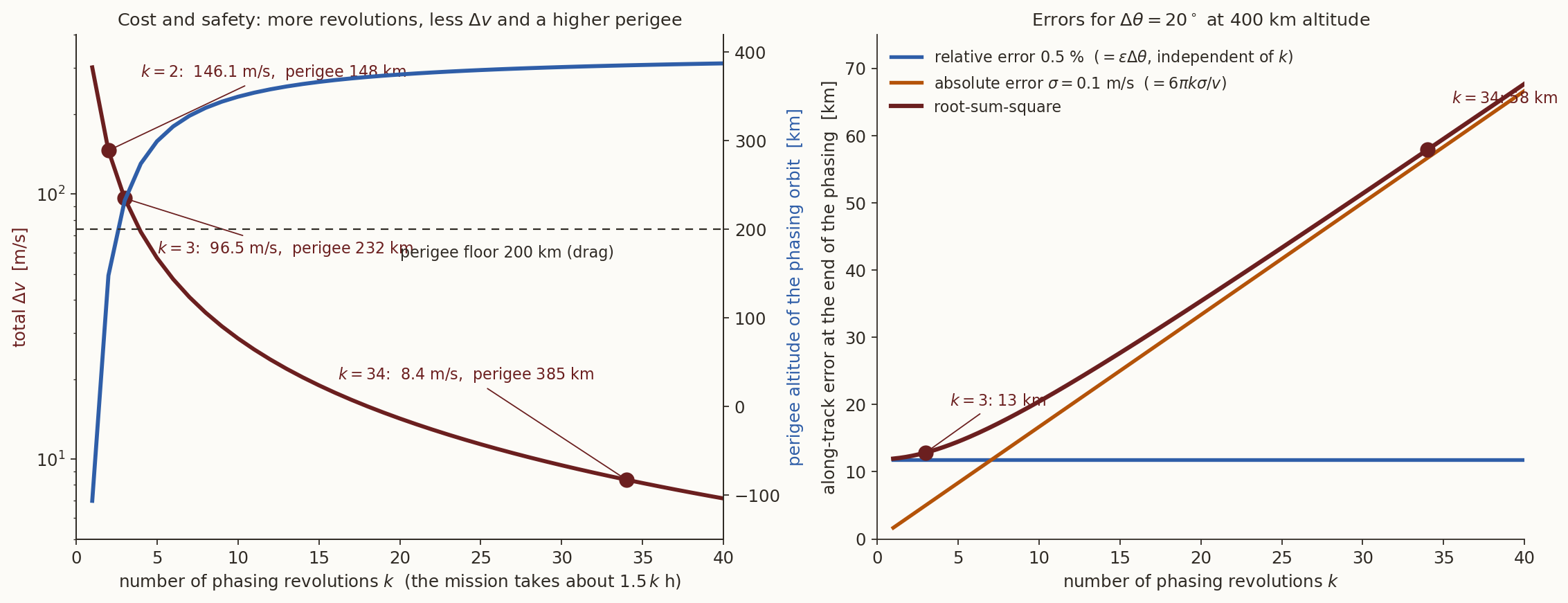
(a) For \(k=2\), \(3\) and \(34\) find \(T_{ph}\), \(a_{ph}\), the perigee altitude, \(\Delta v_{\rm total}\) and the mission duration. Which \(k\) are admissible?
Answer
\(T=2\pi\sqrt{r^{3}/\mu}=5553.6\) s, \(v=7.6686\) km/s. \(T_{ph}=T(1-\Delta\theta/2\pi k)\), \(a_{ph}=(\mu(T_{ph}/2\pi)^{2})^{1/3}\), \(r_p=2a_{ph}-r\), \(\Delta v_{\rm total}=2(v-v_{ph})\) with \(v_{ph}=\sqrt{\mu(2/r-1/a_{ph})}\):
| \(k\) | \(T_{ph}\) [s] | \(a_{ph}\) [km] | perigee alt. | \(\Delta v_{\rm total}\) | mission |
|---|---|---|---|---|---|
| 2 | \(5399.4\) | \(6652.0\) | \(148\) km | \(146.1\) m/s | \(3.0\) h |
| 3 | \(5450.8\) | \(6694.2\) | \(232\) km | \(96.5\) m/s | \(4.5\) h |
| 34 | \(5544.5\) | \(6770.8\) | \(385\) km | \(8.4\) m/s | \(52.4\) h |
\(k=2\) puts the perigee at \(148\) km, inside the drag layer: not admissible. \(k_{\min}=3\) (Q3(d)). The fast profile is therefore not a pure phasing manoeuvre; real fast rendezvous gets its phasing from launch timing and a lower insertion orbit, and the burns above are the equivalent cost.
(b) Propellant for \(k=3\) and \(k=34\). What does the fast profile cost?
Answer
\(m_{\rm prop}=m_0\left(1-e^{-\Delta v/(I_{sp}g_0)}\right)\) with \(I_{sp}g_0=2941.995\) m/s:
\[ k=3:\ 7000\left(1-e^{-96.46/2942}\right)=\boxed{226\ \mathrm{kg}},\qquad k=34:\ 7000\left(1-e^{-8.37/2942}\right)=\boxed{20\ \mathrm{kg}}. \]
About \(206\) kg of propellant buys \(48\) hours. On a cargo vehicle \(206\) kg is mass that cannot be cargo.
(c) The phasing burn has a relative error \(0.5\%\) and an absolute error \(\sigma=0.1\) m/s (\(1\sigma\)). Find the along-track error at the end for \(k=3\) and \(k=34\).
Answer
By Q3(c): relative part \(\varepsilon\Delta\theta=0.005\times20^\circ=0.100^\circ\) (\(11.8\) km), the same for both. Absolute part \(6\pi k\sigma/v\):
\[ \begin{aligned} k=3:&\quad 6\pi(3)(0.1)/7668.6=7.4\times10^{-4}\ \mathrm{rad}=0.042^\circ\ (5.0\ \mathrm{km}),\\ &\quad\mathrm{RSS}=0.109^\circ=\boxed{12.8\ \mathrm{km}}\\ k=34:&\quad 6\pi(34)(0.1)/7668.6=8.4\times10^{-3}\ \mathrm{rad}=0.479^\circ\ (56.6\ \mathrm{km}),\\ &\quad\mathrm{RSS}=0.489^\circ=\boxed{57.9\ \mathrm{km}} \end{aligned} \]
Here \(k^{*}=7.1\): the two-day profile is dominated by the absolute error. Tens of km are still inside a radar acquisition range, but this is why the long profile carries scheduled correction burns, and why it trades propellant for operations and time.
Q8 — GTO \(\to\) GEO: Kourou, Sriharikota or the Cape?
A \(3000\) kg satellite (\(I_{sp}=315\) s, \(F=440\) N) is in a GTO of \(185\times35\,786\) km. At apogee it makes one burn that circularises at GEO and removes the inclination. Compare the three launch sites (rounded GTO inclinations): Kourou \(7^\circ\), Sriharikota \(19.2^\circ\), Cape Canaveral \(28.5^\circ\).
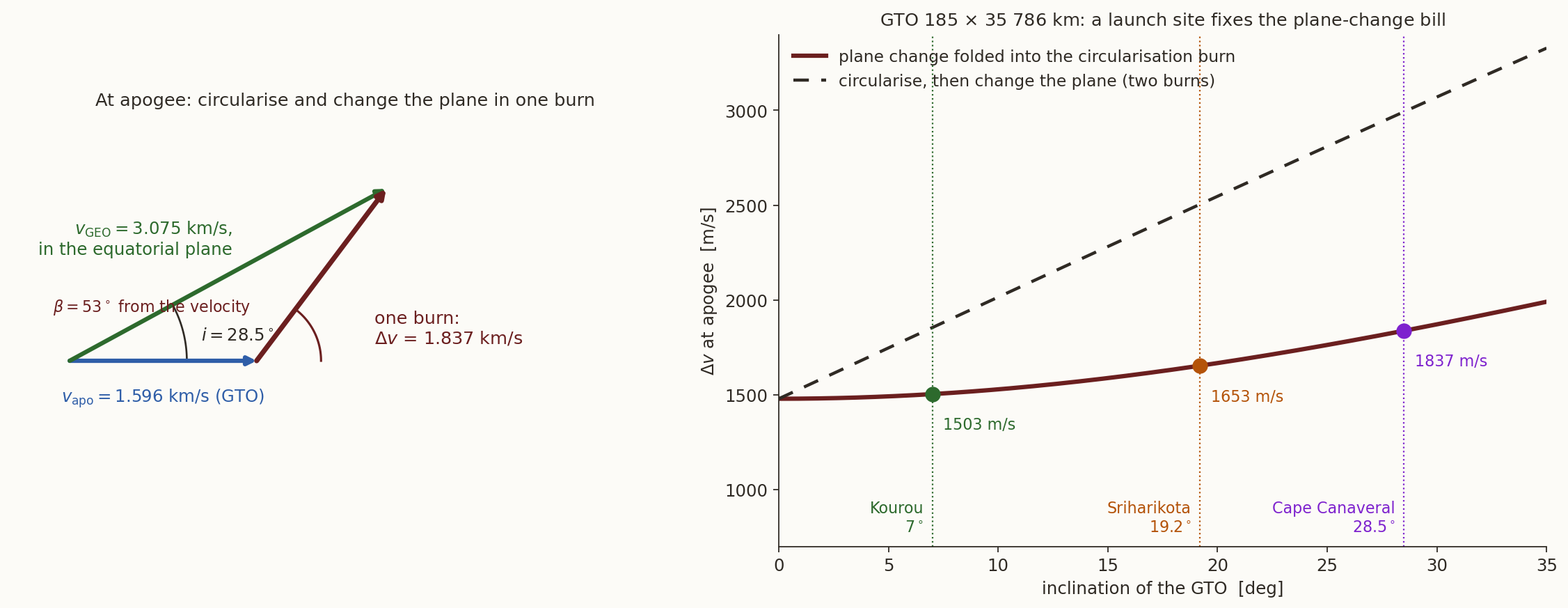
(a) Find \(\Delta v\), the thrust direction \(\beta\) from the velocity, and the propellant mass for each site. How much does folding the plane change into the circularisation save?
Answer
GTO: \(a=24\,363.6\) km, \(v_{\rm apo}=1.5958\) km/s; GEO: \(v_{\rm GEO}=3.0747\) km/s. The law of cosines and the triangle of the figure:
\[ \Delta v=\sqrt{v_{\rm apo}^{2}+v_{\rm GEO}^{2}-2v_{\rm apo}v_{\rm GEO}\cos i},\qquad \tan\beta=\frac{v_{\rm GEO}\sin i}{v_{\rm GEO}\cos i-v_{\rm apo}}, \]
\[ m_p=m_0\left(1-e^{-\Delta v/(I_{sp}g_0)}\right) \]
| site | \(i\) | \(\Delta v\) [m/s] | \(\beta\) | \(m_p\) | two burns [m/s] |
|---|---|---|---|---|---|
| Kourou | \(7^\circ\) | \(1503\) | \(14^\circ\) | \(1156\) kg (\(38.5\%\)) | \(1854\) |
| Sriharikota | \(19.2^\circ\) | \(1653\) | \(38^\circ\) | \(1243\) kg (\(41.4\%\)) | \(2504\) |
| Cape Canaveral | \(28.5^\circ\) | \(1837\) | \(53^\circ\) | \(1345\) kg (\(44.8\%\)) | \(2993\) |
The “two burns” column is \((v_{\rm GEO}-v_{\rm apo})+2v_{\rm GEO}\sin(i/2)\): \(1479\) m/s to circularise plus the plane change at GEO speed. Combining saves \(351\), \(851\) and \(1156\) m/s (\(19\), \(34\), \(39\%\)): the plane change is done at \(1.6\) km/s, not \(3.1\). The Cape-to-Kourou difference (\(334\) m/s) is \(189\) kg of propellant: about \(6\%\) of the satellite.
(b) The burn lasts \(t_b=\dfrac{m_0v_e}{F}\left(1-e^{-\Delta v/v_e}\right)\). For the three sites find \(t_b\) and the arc at apogee (\(\dot f_a=v_{\rm apo}/r_a\)), and the loss \(\tfrac{\theta^{2}}{6}\Delta v\) (\(\theta\) = half the arc) if the thrust direction is held fixed in inertial space, so that the misalignment runs from \(-\theta\) to \(+\theta\), in one burn against three equal burns.
Answer
\(v_e=3089.1\) m/s, \(\dot f_a=1.5958/42164=3.785\times10^{-5}\) rad/s.
| site | \(t_b\) | arc \(\dot f_at_b\) | loss, 1 burn | loss, 3 burns |
|---|---|---|---|---|
| Kourou | \(8116\) s (\(2.25\) h) | \(17.6^\circ\) | \(5.9\) m/s (\(0.39\%\)) | \(0.7\) m/s |
| Sriharikota | \(8728\) s (\(2.42\) h) | \(18.9^\circ\) | \(7.5\) m/s (\(0.45\%\)) | \(0.8\) m/s |
| Cape | \(9443\) s (\(2.62\) h) | \(20.5^\circ\) | \(9.8\) m/s (\(0.53\%\)) | \(1.1\) m/s |
The misalignment is spread uniformly over \(\pm\theta\) (\(\theta=\) half the arc), so the mean loss per unit \(\Delta v\) is \(\langle1-\cos\delta\rangle\approx\langle\delta^{2}\rangle/2=\theta^{2}/6\), and it is \(1/9\) of that when each burn is \(1/3\) as long: the same \(1/n^{2}\) as in Q2. A \(2.5\)-hour burn spreads over an arc of \(\sim20^\circ\).
(c) A yaw error of \(1^\circ\) in the thrust direction: how much inclination is left over, and what does it cost to remove at GEO?
Answer
The final inclination follows \(\tan\Delta i=\dfrac{\Delta v\sin\beta}{v_{\rm apo}+\Delta v\cos\beta}\). Differentiating, \(\dfrac{d\tan\Delta i}{d\beta}=\dfrac{\Delta v\,(v_{\rm apo}\cos\beta+\Delta v)}{(v_{\rm apo}+\Delta v\cos\beta)^{2}}\), then \(d(\Delta i)/d\beta=\dfrac{1}{1+\tan^{2}\Delta i}\,\dfrac{d\tan\Delta i}{d\beta}\). For the Cape (\(\Delta v=1.837\), \(\beta=53^\circ\), \(\Delta i=28.5^\circ\)): \(0.544\). So \(1^\circ\) of yaw leaves \(0.54^\circ\) of inclination at GEO. Removing it later costs
\[ 2v_{\rm GEO}\sin\frac{0.544^\circ}{2}=\boxed{29\ \mathrm{m/s}}\ (\text{Kourou: }26,\ \text{Sriharikota: }27), \]
more than half a year of north-south station-keeping (\(\approx50\) m/s/yr, Q10). A yaw error is paid for in propellant that was supposed to last for years.
(d) The burn has a \(1\%\) (\(1\sigma\)) magnitude error. Compare the final orbit after a single Cape burn with the last of three equal burns (whose error the earlier ones, tracked from the ground, have not left to correct). Use \(\delta a=(2a^{2}v/\mu)\,\delta(\Delta v)\) at GEO and \(\delta T/T=1.5\,\delta a/a\).
Answer
At GEO radius \(2a^{2}v/\mu=27.4\) km per m/s.
| \(1\%\) error | \(\delta a\) | \(\delta T/T\) | drift | |
|---|---|---|---|---|
| single burn, \(1837\) m/s | \(18.4\) m/s | \(504\) km | \(1.8\%\) | \(\boxed{6.4^\circ\mathrm{/day}}\) |
| last of 3, \(612\) m/s | \(6.1\) m/s | \(168\) km | \(0.60\%\) | \(\boxed{2.2^\circ\mathrm{/day}}\) |
The drift is \(360^\circ\times\delta T/T\) per day. A drift of \(6.4^\circ\)/day sweeps through the whole GEO belt in two months; the cost of stopping it (\(\approx v\,\delta T/(3T)\), here \(18\) m/s) would be over a third of a year’s north-south budget. Splitting the burn, with an orbit determination between burns to size the last one, cuts the final error by \(n\); a short trim burn at the end cuts it by a further factor \(\sim10\).
Q9 — Bi-elliptic to lunar distance
A relay spacecraft is to be placed into a circular orbit at the Moon’s distance (\(r_2=384\,400\) km) from a \(300\) km LEO (\(r_1=6678.137\) km), so \(R=57.56\). Compare the Hohmann transfer with a bi-elliptic transfer whose intermediate apoapsis is \(r_b=10^{6}\) km.
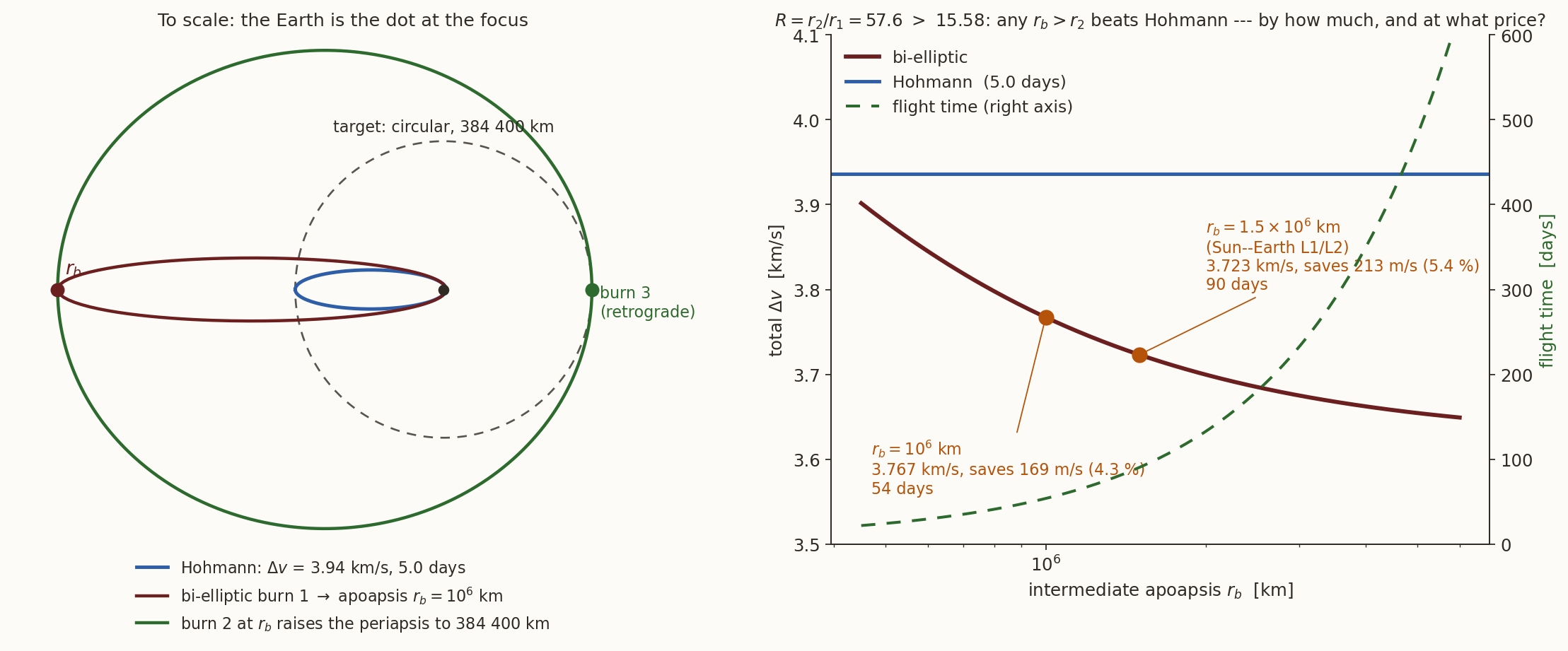
(a) Hohmann: \(\Delta v_1\), \(\Delta v_2\), total and flight time. (b) Bi-elliptic: the three burns, total, saving, flight time.
Answer
(a) \(a_t=195\,539\) km: \(v_{t1}=10.8322\), \(v_{c1}=7.7258\), \(v_{t2}=0.18819\), \(v_{c2}=1.01830\) km/s,
\[ \Delta v_1=3.1064,\quad\Delta v_2=0.8301,\quad\boxed{\Delta v_{\rm H}=3.9365\ \mathrm{km/s}},\quad t=\pi\sqrt{a_t^{3}/\mu}=\boxed{4.98\ \mathrm{d}}. \]
(b) \(a_{t1}=503\,339\) km, \(a_{t2}=692\,200\) km.
| burn | where | from \(\to\) to [km/s] | \(\Delta v\) |
|---|---|---|---|
| 1 | \(r_1\) | \(7.7258\to10.8896\) | \(3.1638\) |
| 2 | \(r_b\) | \(0.0727\to0.4705\) | \(0.3978\) |
| 3 | \(r_2\) | \(1.2239\to1.0183\) (retrograde) | \(0.2056\) |
\[ \Delta v_{\rm bi}=\boxed{3.7672\ \mathrm{km/s}},\quad\text{saving }\boxed{169\ \mathrm{m/s}\ (4.3\%)},\quad t=20.6+33.2=\boxed{53.7\ \mathrm{d}}. \]
At \(r_b\) the craft moves at only \(73\) m/s, so \(0.40\) km/s lifts the periapsis by \(378\,000\) km. For \(r_b=1.5\times10^{6}\) km the saving is \(213\) m/s (\(5.4\%\)) and the time \(90\) d.
(c) \(R=57.6>15.58\). What does the deck’s theorem say? Why does the bi-elliptic transfer keep saving more as \(r_b\) grows, and where does it stop being worth it?
Answer
For \(R>15.58\) every \(r_b>r_2\) beats Hohmann, by a margin that grows with \(r_b\): the saving is \(169\) m/s at \(10^{6}\) km, \(213\) at \(1.5\times10^{6}\), \(262\) (\(6.7\%\)) at \(3\times10^{6}\) km (the figure). The saving grows because the far burn is made where the speed is smallest (\(d\varepsilon=v\,\Delta v\), small \(v\)) and changes the periapsis, which costs almost nothing. It stops being worth it because the flight time grows as \(r_b^{3/2}\) (\(5\to54\to233\) d), and because the two-body model fails at large \(r_b\) (part (e)).
(d) Compute the error gain \(\delta r/\delta(\Delta v)=4a^{2}v/\mu\) of Hohmann burn 1 (on \(r_a\)), bi-elliptic burn 1 (on \(r_b\)) and burn 2 (on the periapsis). Is the first bi-elliptic burn’s huge gain a problem?
Answer
\[ \text{Hohmann burn 1: }\frac{4(195\,539)^{2}(10.832)}{398600}=4160\ \frac{\rm km}{\rm m/s}, \]
\[ \text{bi-elliptic burn 1: }\frac{4(503\,339)^{2}(10.890)}{398600}=\boxed{27\,700}\ \frac{\rm km}{\rm m/s}, \]
\[ \text{bi-elliptic burn 2: }\frac{4(692\,200)^{2}(0.4705)}{398600}=2260\ \frac{\rm km}{\rm m/s}. \]
A \(1\) m/s error in burn 1 moves \(r_b\) by \(27\,700\) km (\(2.8\%\)) but that is harmless: the total cost is flat in \(r_b\) (\(d\Delta v/dr_b=-12.7\) m/s per \(10^{5}\) km), so a \(2.8\%\) error in \(r_b\) changes the total by only \(\approx3.5\) m/s, and burn 2 is simply computed from the orbit actually achieved (it is made at the measured apoapsis). The burn that must be right is burn 2 (the periapsis it sets, \(2260\) km per m/s) and, for the Hohmann route, burn 1 (which sets the arrival radius at \(4160\) km per m/s). The bi-elliptic route trades a precision requirement at the start for a real-time design at the apoapsis.
(e) The solar tide on the spacecraft at distance \(r\) from the Earth is about \(2\mu_\odot r/d^{3}\) (\(d=1\) AU). Compare it with the Earth’s pull at \(r_b=10^{6}\) and \(1.5\times10^{6}\) km. Is the two-body analysis valid? Is the bi-elliptic transfer worth flying?
Answer
\[ r_b=10^{6}\ \mathrm{km}:\quad \frac{2\mu_\odot r}{d^{3}}=7.9\times10^{-5}\ \mathrm{m/s^{2}},\ \ \frac{\mu_\oplus}{r^{2}}=3.99\times10^{-4} \]
\[ \text{ratio }\boxed{0.20}, \]
\[ r_b=1.5\times10^{6}\ \mathrm{km}:\quad 1.19\times10^{-4}\ \mathrm{vs}\ 1.77\times10^{-4}\ \mathrm{m/s^{2}}:\ \ \text{ratio }\boxed{0.67}. \]
The Earth’s Hill radius is \(1.50\times10^{6}\) km, so \(r_b=1.5\times10^{6}\) km (the Sun–Earth L1/L2 distance, where JWST and Aditya-L1 operate) is at the edge of the sphere where the Earth controls the motion. At \(10^{6}\) km the Sun’s tide is \(20\%\) of the Earth’s pull, and it acts for weeks of the climb and fall: the two-body \(\Delta v\) is an estimate, not a guarantee. Verdict: a \(169\) m/s saving (\(4.3\%\)) for \(49\) extra days, three burns and a poorly predictable apoapsis. Not worth it for this target. The theorem is right; its assumptions run out. A real design of this kind would use the Sun’s perturbation deliberately (weak-stability transfers, Part VII of the deck).
Q10 — The \(\Delta v\) budget of a GEO satellite, and its uncertainty
A \(3000\) kg GEO satellite is to operate for \(15\) years. From the deck: north–south station-keeping \(50\) m/s/yr, east–west \(3\) m/s/yr, graveyard disposal \(11\) m/s. Chemical propulsion has \(I_{sp}=320\) s; electric propulsion \(1800\) s.
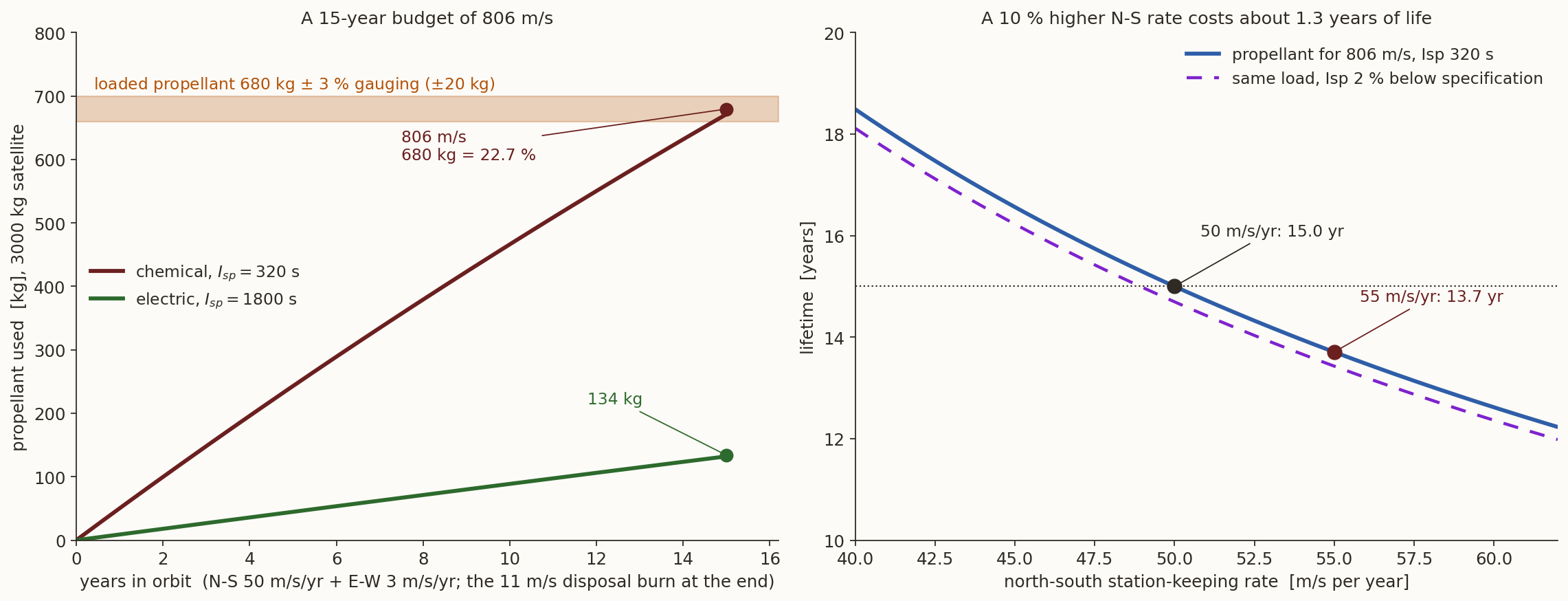
(a) Total \(\Delta v\), and the propellant mass for chemical and for electric propulsion. How much heavier is the chemical satellite at launch?
Answer
\[ \Delta v=15(50+3)+11=\boxed{806\ \mathrm{m/s}}\quad(750+45+11). \]
\(v_e=320\times9.80665=3138.1\) m/s: \(m_p=3000\left(1-e^{-806/3138.1}\right)=\boxed{680\ \mathrm{kg}}\) (\(22.7\%\)). Electric (\(v_e=17\,652\) m/s): \(3000\left(1-e^{-806/17652}\right)=\boxed{134\ \mathrm{kg}}\) (\(4.5\%\)). The chemical satellite carries \(546\) kg more propellant, \(18\%\) of the launch mass, which electric propulsion converts to payload or launch cost.
(b) The propellant gauge is good to \(\pm3\%\) of the loaded mass. Find the uncertainty in the remaining \(\Delta v\) at the end of life, and in years.
Answer
End-of-life mass \(3000-680=2320\) kg. A \(3\%\) error on \(680\) kg is \(\pm20.4\) kg, so
\[ \delta(\Delta v)=v_e\,\frac{\delta m}{m_f}=3138\times\frac{20.4}{2320}=\boxed{\pm27.7\ \mathrm{m/s}}=\pm0.52\ \mathrm{yr}. \]
The operator cannot know the end of life to better than \(\pm6\) months and must reserve the \(11\) m/s disposal burn with margin: a spacecraft that runs out one month early cannot be moved out of the GEO belt.
(c) The north–south rate is not known in advance: \(50\) m/s/yr is the mean, with \(\sigma=3\) m/s/yr. (i) With the propellant of (a), find the lifetime if the rate turns out to be \(55\) m/s/yr. (ii) What propellant guarantees \(15\) years at \(3\sigma\)?
Answer
\(\text{life}=\dfrac{806-11}{55+3}=\boxed{13.7\ \mathrm{yr}}\): a \(10\%\) higher rate costs \(1.3\) years (\(9\%\) of the life). (At \(45\): \(16.6\) yr.)
\(3\sigma\): \(50+9=59\) m/s/yr, so \(\Delta v=15(59+3)+11=941\) m/s and \(m_p=3000\left(1-e^{-941/3138.1}\right)=\boxed{777\ \mathrm{kg}}\): \(98\) kg (\(14\%\)) more than the nominal \(680\). The margin costs a lot: that is the price of an uncertain \(\Delta v\).
(d) The delivered \(I_{sp}\) is \(2\%\) below specification. What is the effect on the propellant for \(806\) m/s, or on the life with the propellant of (a)?
Answer
With \(v_e\to0.98\times3138.1=3075.3\) m/s: \(m_p=3000\left(1-e^{-806/3075.3}\right)=692\) kg: \(12\) kg more for the same \(\Delta v\). Or, with \(680\) kg loaded, the available \(\Delta v\) is \(3075.3\ln(3000/2320)=790\) m/s and the life \((790-11)/53=\boxed{14.7\ \mathrm{yr}}\): three months lost. (Compare: a \(10\%\) N–S excess costs \(1.3\) years; an \(I_{sp}\) shortfall of \(2\%\) only \(0.3\).)
Sources and caveats
- Chandrayaan-3 (Q5): orbits A, B, C are ISRO’s reported values for the orbit after launch, after the fifth Earth-bound burn, and after TLI (rounded); the spacecraft mass, thrust and \(I_{sp}\) are round values; the five burns are taken as equal (the real ones were not) and the perigee is held at 200 km (the real one rose from 170 to 236 km).
- Mangalyaan (Q6): the orbit \(252\times192\,874\) km, the burn time \(1328.89\) s and the \(648\) m/s are ISRO’s reported values; \(I_{sp}\) and a constant thrust acceleration are assumed. The \(v_\infty\) and \(C_3\) that follow are a consistency check, not a quoted mission figure.
- ISS, GTO and GEO (Q7, Q8, Q10): representative values: ISS altitude \(400\) km; GTO inclinations \(7^\circ\) (Kourou), \(19.2^\circ\) (Sriharikota) and \(28.5^\circ\) (Cape); the station-keeping rates are those of the Orbital Maneuvers deck.
- Q9 is a design exercise, not a flown mission: JWST and Aditya-L1 are cited only for the distance of the Sun–Earth L1/L2 points.
- All scripts:
codes/fig-mq-*.py, run from this directory, writeimg/fig-mq-*.png.