Orbital Manoeuvres
1 Rotating the apse line
1.1 A purely radial impulse
Suppose we want to turn the orbit’s line of apsides by an angle \(\eta\), keeping its size and shape: same \(p\) and \(e\), new argument of periapsis \(\omega+\eta\). The two orbits cross at two points (the equal-radius condition below always has two solutions), and at a crossing a single impulse can switch from one to the other (Figure 1).
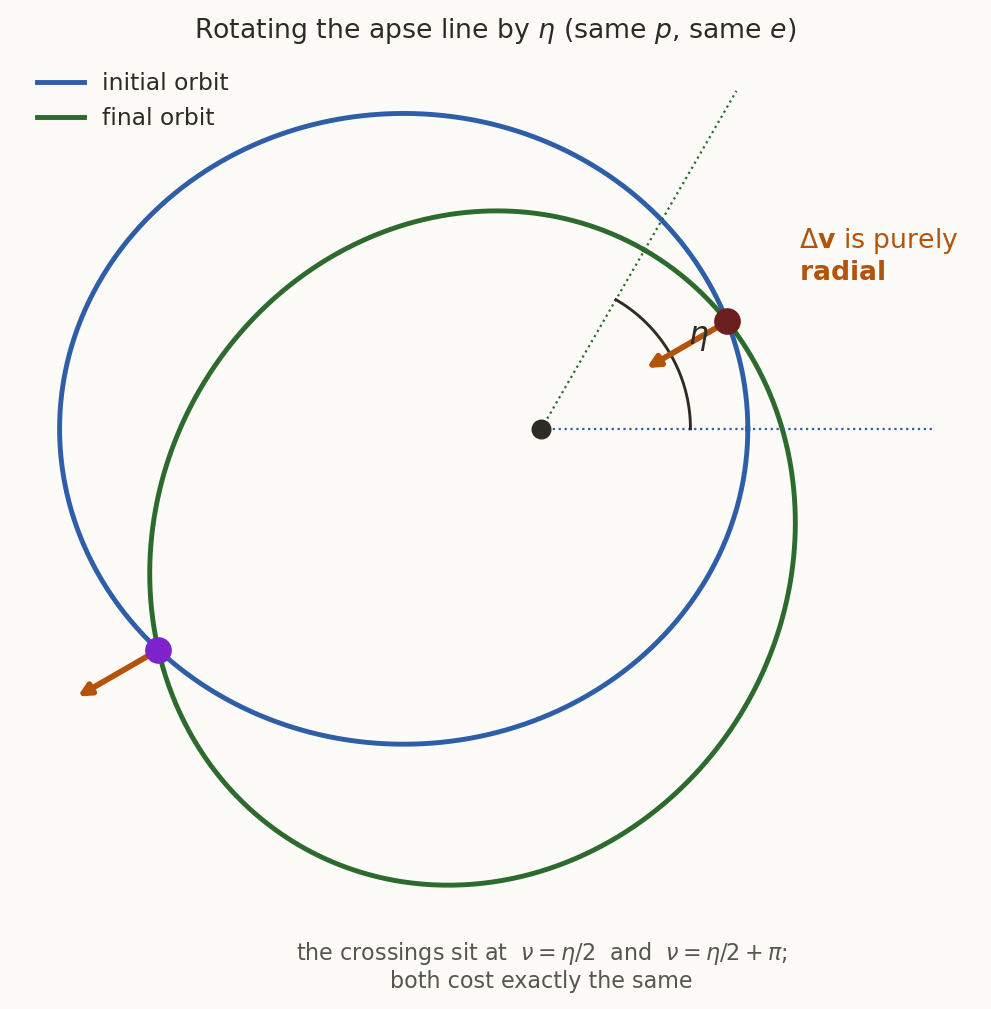
A point at true anomaly \(f\) on the first orbit is at \(f-\eta\) on the second. Equal radii require
\[ \frac{p}{1+e\cos f}=\frac{p}{1+e\cos(f-\eta)} \quad\Longrightarrow\quad \cos f=\cos(f-\eta), \]
whose solutions (other than the trivial \(\eta=0\)) are \(f=\eta/2\) and \(f=\eta/2+\pi\).
At the first crossing the initial orbit has \(f=\eta/2\) and the final orbit has \(f'=-\eta/2\). With \(v_r=\sqrt{\mu/p}\,e\sin f\) and \(v_\theta=\sqrt{\mu/p}\,(1+e\cos f)\),
Use the parity of cosine and sine to compare \((v_r,v_\theta)\) on the two orbits at the crossing. What is the impulse?
What you should find
\(\cos\) is even and \(\sin\) is odd, so \(v_\theta'=v_\theta\) and \(v_r'=-v_r\). The transverse components agree and the radial ones are opposite, so \(\Delta\mathbf v=-2v_r\,\hat{\mathbf r}\): purely radial.\[ \boxed{\;\Delta v=2\sqrt{\frac{\mu}{p}}\,e\sin\frac\eta2=2v\sin\gamma ,\;} \tag{1}\]
where \(\gamma\) is the flight path angle at the crossing. The second form is worth seeing geometrically: the impulse leaves the speed unchanged and reflects \(\mathbf v\) in the local horizontal (\(\gamma\to-\gamma\)). It turns \(\mathbf v\) through \(2\gamma\) at constant speed, the same isosceles triangle as a plane change (?@eq-plane-change), so \(\Delta v=2v\sin(2\gamma/2)\).
Equation 1 contains no \(r\). The two crossings are at very different radii; which is cheaper?
Answer
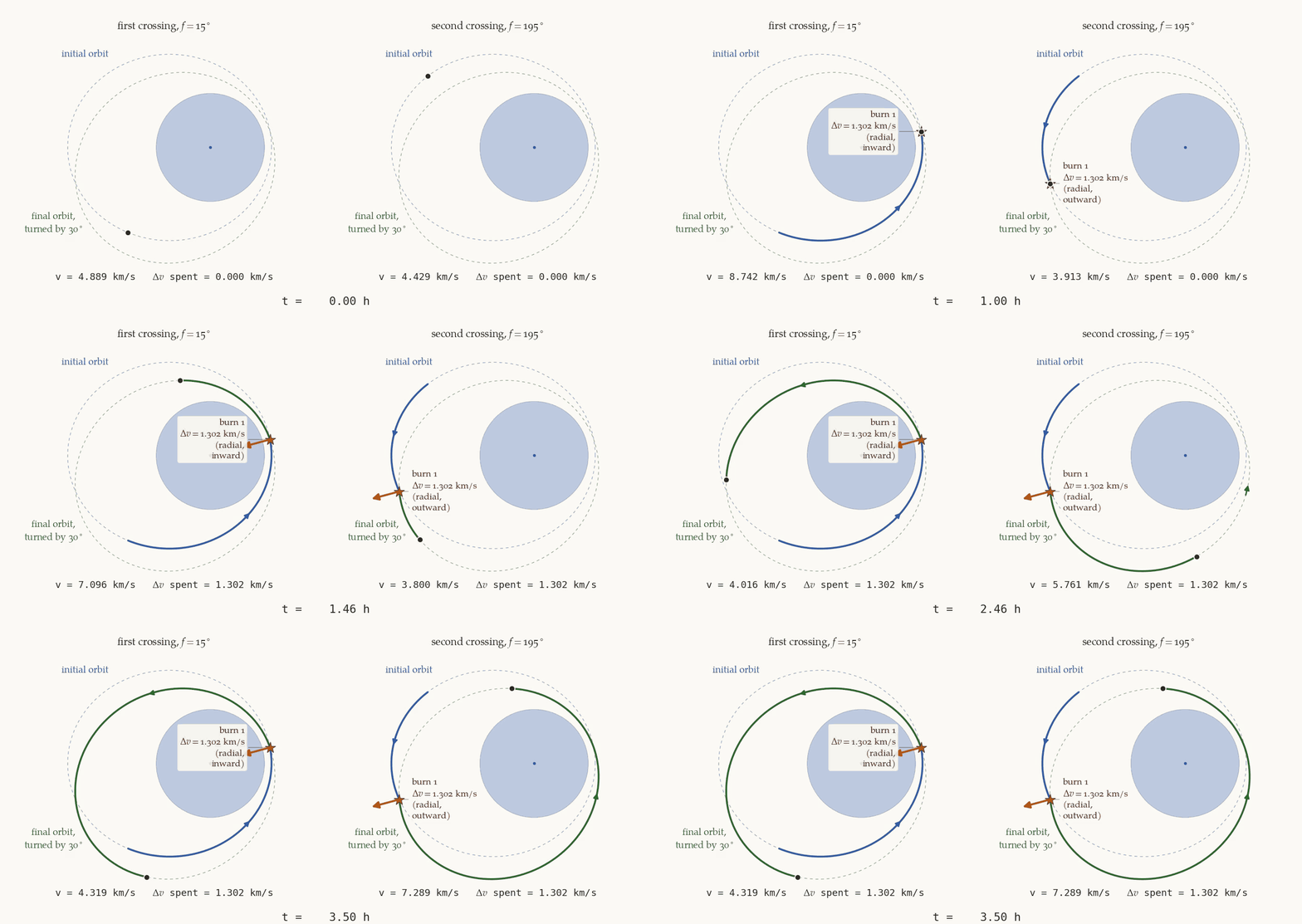
Neither: both cost the same. At the second crossing \(v\) is smaller but \(|\gamma|\) larger, and the product \(v|\sin\gamma|=|v_r|\) is the same. For the example below: \(v=8.742\) km/s, \(\gamma=4.271^\circ\) at \(f=15^\circ\), and \(v=3.913\) km/s, \(\gamma=-9.576^\circ\) at \(f=195^\circ\); both give \(1.30204\) km/s.Example. \(a=12\,000\) km, \(e=0.4\), so \(p=10\,080\) km and \(\sqrt{\mu/p}=6.288378\) km/s; rotate by \(\eta=30^\circ\). At \(f=15^\circ\), \(r=7270.79\) km, \(v_r=0.651021\), \(v_\theta=8.718020\), and
\[ \Delta v=2(0.651021)=1.30204\ \text{km/s},\qquad\gamma=\arctan\frac{v_r}{v_\theta}=4.271^\circ . \]
1.2 Going round instead
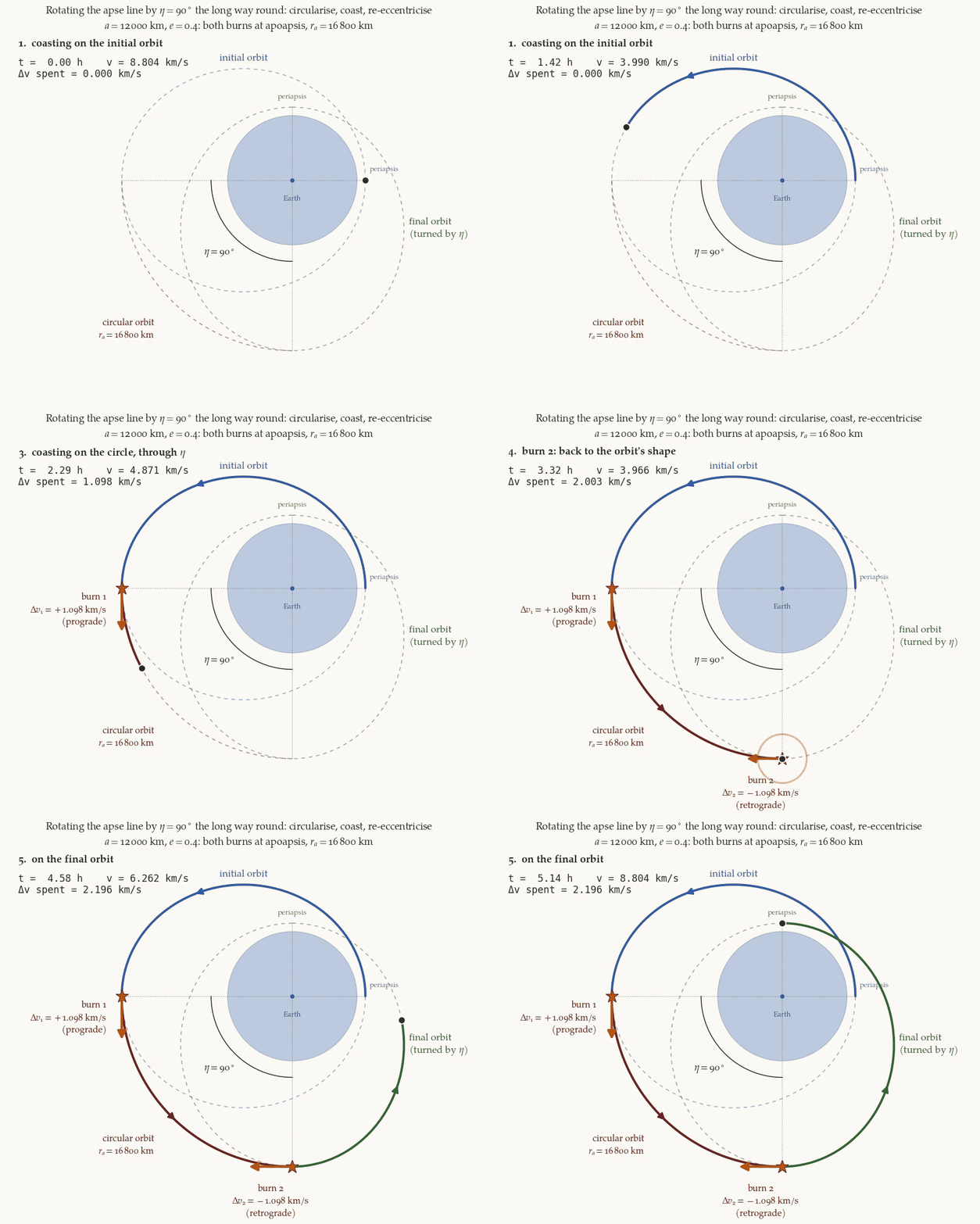
There is a two-burn alternative: circularise at apoapsis, coast round the circle through the angle \(\eta\), then re-eccentricise there with the apse line in the new direction (Figure 3 follows the whole route, for \(\eta=90^\circ\)). Its cost does not depend on \(\eta\) at all; only the coast does. For the example it is \(2(4.870956-3.773027)=2.196\) km/s: one change of speed to the circular speed, and one back.
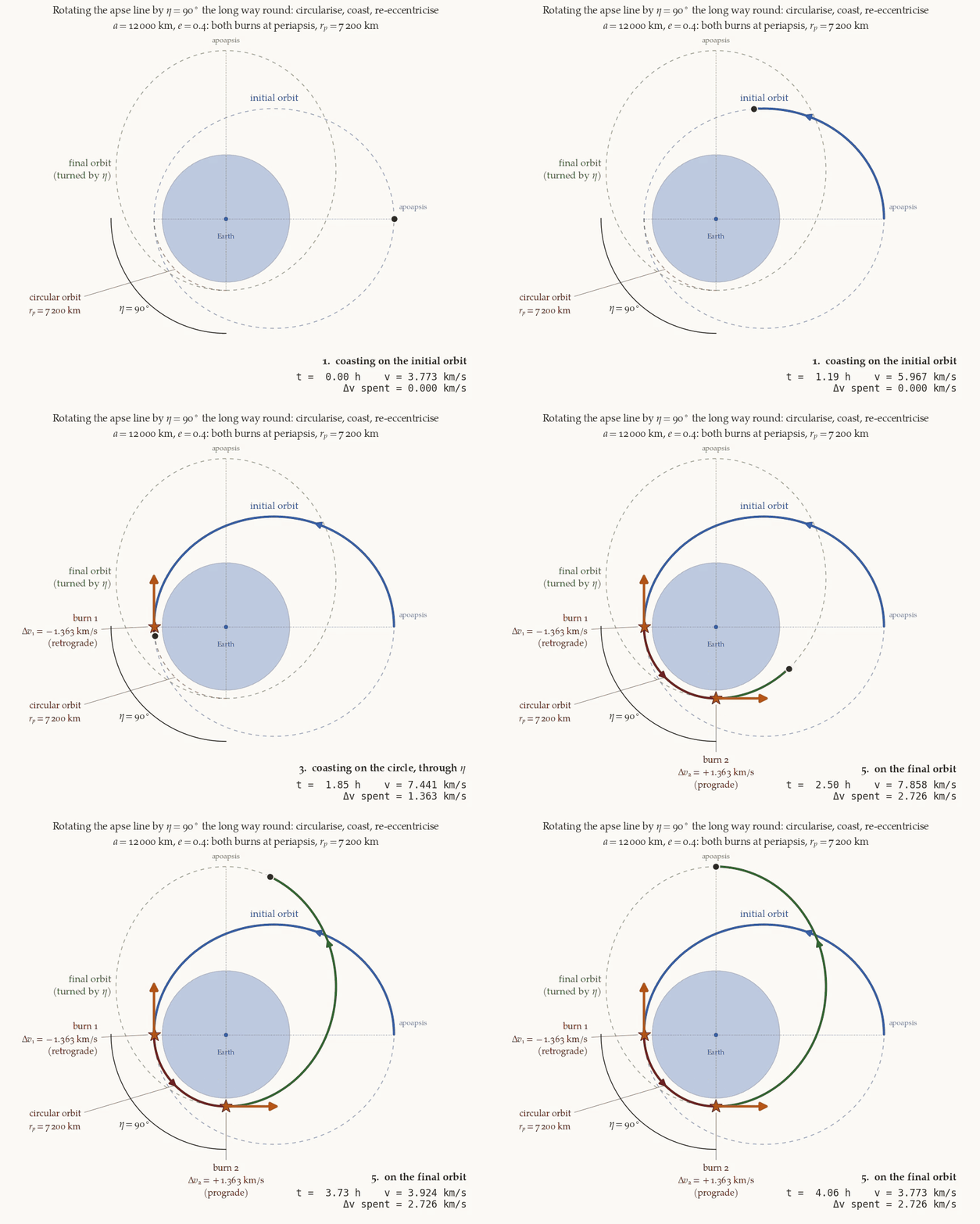
Why apoapsis, and not periapsis? The same route can be flown with both burns at periapsis, as in Figure 4 below: the first burn is then a brake, the second a kick, and the coast is over much sooner. Which end is cheaper? The two burns are equal and opposite, so the route costs twice the mismatch \(|v_c-v|\) between the circular speed \(v_c=\sqrt{\mu/r}\) and the orbit’s own speed \(v\) at the burn radius \(r\). At an apse the velocity is already perpendicular to the radius, as it is on a circle, so the burn only has to change the speed; that is why the two apsides are the places to compare. Measure speeds in units of \(\sqrt{\mu/a}\) and write
\[ s=\sqrt{1+e},\qquad t=\sqrt{1-e},\qquad s^2+t^2=2, \]
so that \(r_p=a(1-e)=at^2\) and \(r_a=a(1+e)=as^2\). The circular speeds are \(v_c=1/t\) at periapsis and \(v_c=1/s\) at apoapsis. Vis-viva, \(v^2=(\mu/a)(2a/r-1)\), gives \(v_p^2=(2-t^2)/t^2=s^2/t^2\) and \(v_a^2=(2-s^2)/s^2=t^2/s^2\), because \(2-t^2=s^2\) and \(2-s^2=t^2\). One burn therefore costs
\[ \Delta v_p=\frac st-\frac1t=\frac{s-1}{t},\qquad \Delta v_a=\frac1s-\frac ts=\frac{1-t}{s}. \]
Periapsis is the dearer end when \((s-1)/t>(1-t)/s\). Multiplying by \(st>0\) turns this into \(s^2-s>t-t^2\), that is \(s^2+t^2>s+t\), and with \(s^2+t^2=2\) into
\[ s+t<2 . \]
This holds for every \(0<e<1\), because \((s+t)^2=s^2+t^2+2st=2+2\sqrt{1-e^2}<4\). So the apoapsis route is the cheaper one for every eccentric orbit; the two coincide only on a circle (\(e=0\), \(s=t=1\)).
How much cheaper? The ratio of the two costs is
\[ \frac{\Delta v_p}{\Delta v_a}=\frac st\cdot\frac{s-1}{1-t}, \]
a product of two factors that pull in opposite directions.
What periapsis buys is time. The coast through \(\eta\) takes \(\eta\sqrt{r^3/\mu}\), which grows as \(r^{3/2}\): for \(\eta=90^\circ\) it is \(0.42\) h round the circle of radius \(r_p\) and \(1.51\) h round that of radius \(r_a\), longer by \((r_a/r_p)^{3/2}=3.56\).
For the same orbit, compute the cost of the two-burn route, and the rotation angle \(\eta\) above which it beats the single radial impulse.
What you should find
At \(r_a=16\,800\) km, \(v_c=4.870956\) and \(v_a=3.773027\) km/s, so \(\Delta v_{\rm alt}=2(4.870956-3.773027)=2.19586\) km/s. Setting \(2\sqrt{\mu/p}\,e\sin(\eta/2)=2.19586\) gives \(\eta_{\rm cross}=51.8^\circ\). Below it (\(30^\circ\): \(1.30\) km/s) rotate directly; above it (\(180^\circ\) would cost \(5.03\) km/s) go via the circle.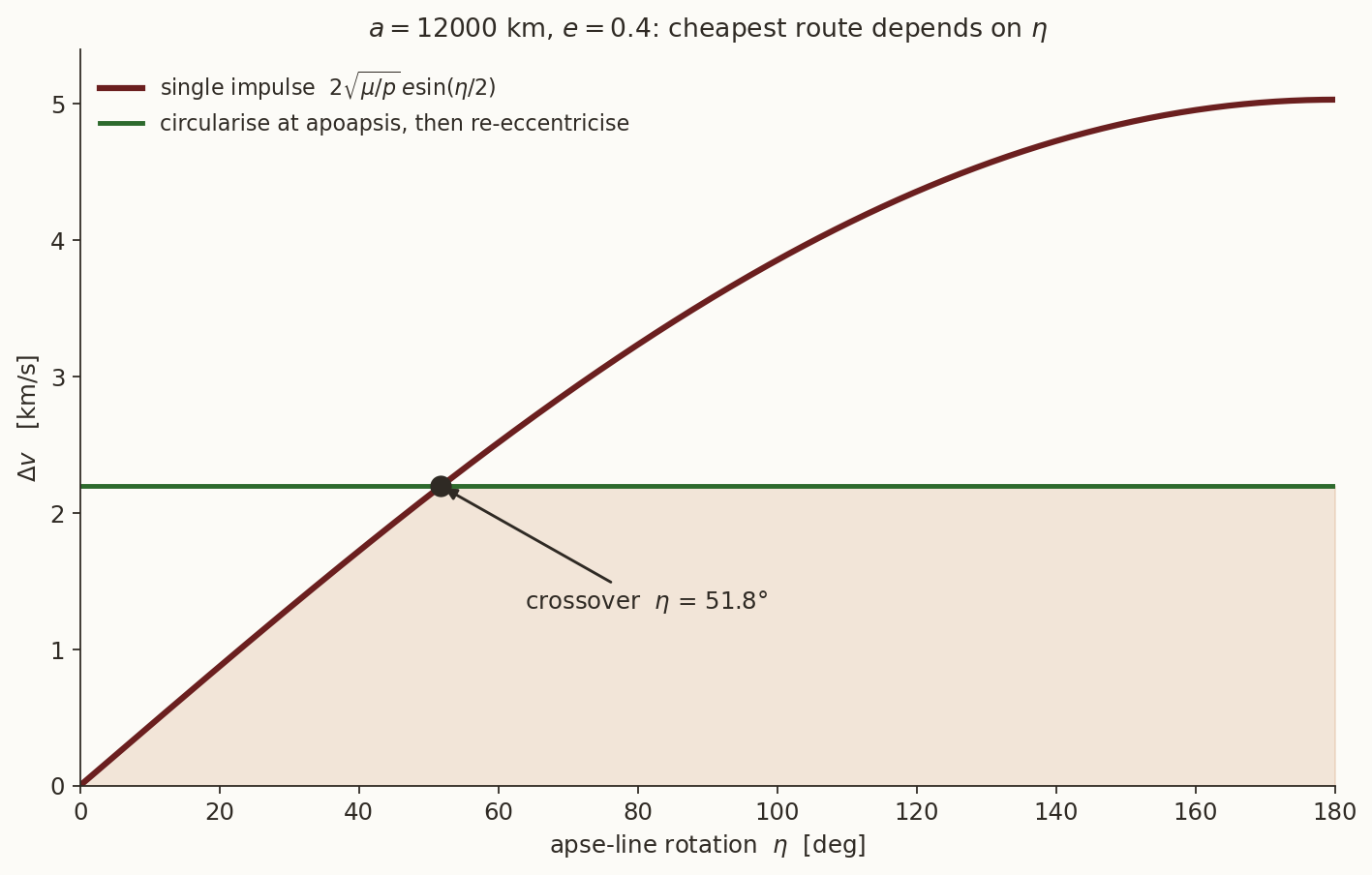
A direct rotation costs \(\propto\sin(\eta/2)\) and grows without saturating at a small value, while the detour costs a constant. Large reorientations are made by changing the shape of the orbit, not by rotating it.