Orbital Manoeuvres
1 Rotating the apse line
Suppose we want to turn the orbit’s line of apsides by an angle \(\eta\), keeping its size and shape: same \(p\) and \(e\). This will result in a new argument of periapsis \(\omega+\eta\).
1.1 A purely radial impulse
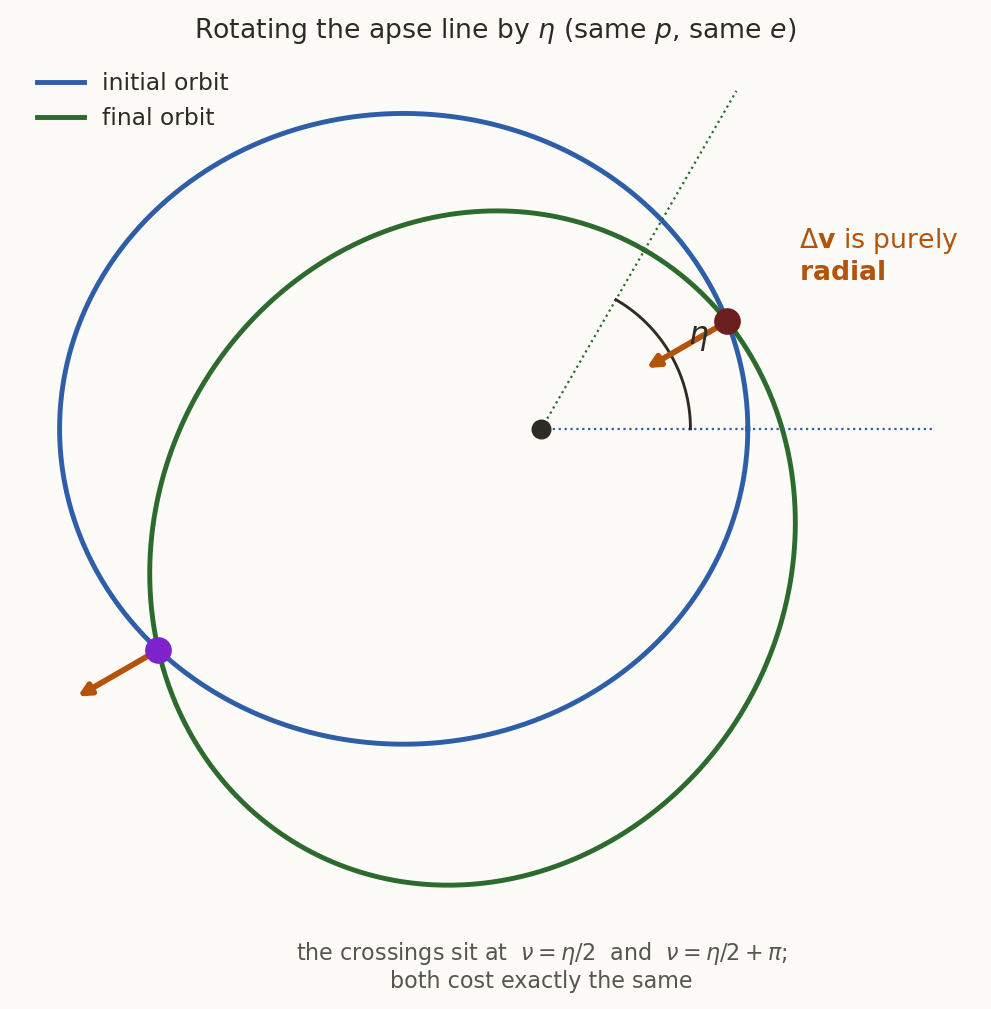
The figure above shows the original orbit in green and the desired orbit in blue. The angle between the apse lines is \(\eta\). We wish to find the point of intersection. We will show that these orbits always intersect at two points.
Consider a point at true anomaly \(f\) on the original orbit is at \(f-\eta\) on the second. Equal radii require
\[ \frac{p}{1+e\cos f}=\frac{p}{1+e\cos(f-\eta)} \quad\Longrightarrow\quad \cos f=\cos(f-\eta), \]
whose solutions (other than the trivial \(\eta=0\)) are
\[ f = (f - \eta) \quad \Rightarrow \quad f = \eta/2 \]
\[ f = 2\pi - (f - \eta) \quad \Rightarrow \quad f = \pi + \eta/2 \]
At the first crossing the initial orbit has \(f=\eta/2\) and the final orbit has \(f'=-\eta/2\). Similarly, at the second crossing the initial orbit has \(f = \pi + \eta/2\) and the final orbit has \(f' = \pi - \eta/2\).
With \(v_r=\sqrt{\mu/p}\,e\sin f\) and \(v_\theta=\sqrt{\mu/p}\,(1+e\cos f)\), use the parity of cosine and sine to compare \((v_r,v_\theta)\) on the two orbits at the crossing. What is the impulse?
What you should find
\(\cos\) is even and \(\sin\) is odd, so \(v_\theta'=v_\theta\) and \(v_r'=-v_r\). The transverse components agree and the radial ones are opposite, so \(\Delta\mathbf v=-2v_r\,\hat{\mathbf r}\): purely radial.\[ \boxed{\;\Delta v=2\sqrt{\frac{\mu}{p}}\,e\sin\frac\eta2=2v\sin\gamma ,\;} \tag{1}\]
where \(\gamma\) is the flight path angle at the crossing. The second form is worth seeing geometrically: the impulse leaves the speed unchanged and reflects \(\mathbf v\) in the local horizontal (\(\gamma\to-\gamma\)). It turns \(\mathbf v\) through \(2\gamma\) at constant speed, the same isosceles triangle as a plane change (?@eq-plane-change), so \(\Delta v=2v\sin(2\gamma/2)\).
Equation 1 contains no \(r\). The two crossings are at very different radii; which is cheaper?
Answer
Neither: both cost the same. At the second crossing \(v\) is smaller but \(|\gamma|\) larger, and the product \(v|\sin\gamma|=|v_r|\) is the same.
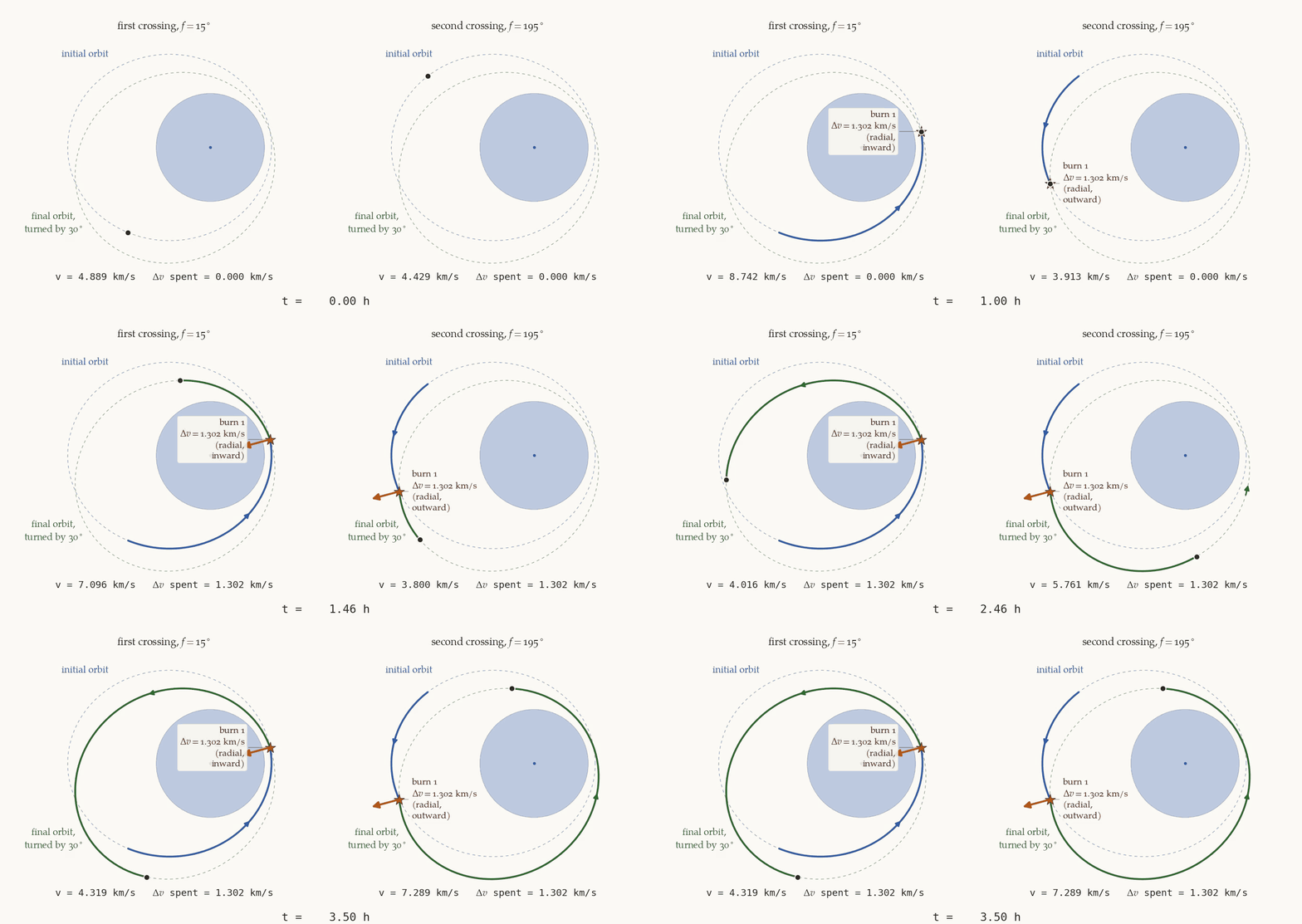
For the example below: \(v=8.742\) km/s, \(\gamma=4.271^\circ\) at \(f=15^\circ\), and \(v=3.913\) km/s, \(\gamma=-9.576^\circ\) at \(f=195^\circ\); both give \(1.30204\) km/s.
NOTE TO CLAUDE: This number has come out of nowhere. So should not be included. ALso, even if you were to give this numerical example, it is not adding to the general understanding of the student. So it disrupts the flow of the problem. So should not be included.Example. \(a=12\,000\) km, \(e=0.4\), so \(p=10\,080\) km and \(\sqrt{\mu/p}=6.288378\) km/s; rotate by
NOTE TO CLAUDE: This is not written in the standard question and answer format. You do not mention the required rotation required and it has to be inferred only from the caption of the figure. So first you should state the problem as I show below.
Example. For an orbit with \(a=12\,000\) km, and \(e=0.4\), find the required impulse to rotate the apse line by \(30^{0}\). At what true anomaly of the original orbit should the impulse be imparted.
Solution: So \(p=10\,080\) km and \(\sqrt{\mu/p}=6.288378\) km/s; At \(f=15^\circ\), \(r=7270.79\) km, \(v_r=0.651021\), \(v_\theta=8.718020\), and
\[ \Delta v=2(0.651021)=1.30204\ \text{km/s},\qquad\gamma=\arctan\frac{v_r}{v_\theta}=4.271^\circ . \]
1.2 Going round instead
NOTE TO CLAUDE: DO NOT USE : all the time in the document.
There is also a two-burn alternative. First we circularise at apoapsis, coast round the circle through the angle \(\eta\), then re-eccentricise there with the apse line in the new direction (Figure 3 follows the whole route, for \(\eta=90^\circ\)). As we will show, its cost does not depend on \(\eta\) at all. Only the time required for the coast changes.
NOTE TO CLAUDE: No need of a numerical at this stage. We are introducing the idea. So first we show that the cost is independent of and only then we give a numerical.
DELET THIS: For the example it is \(2(4.870956-3.773027)=2.196\) km/s: one change of speed to the circular speed, and one back.
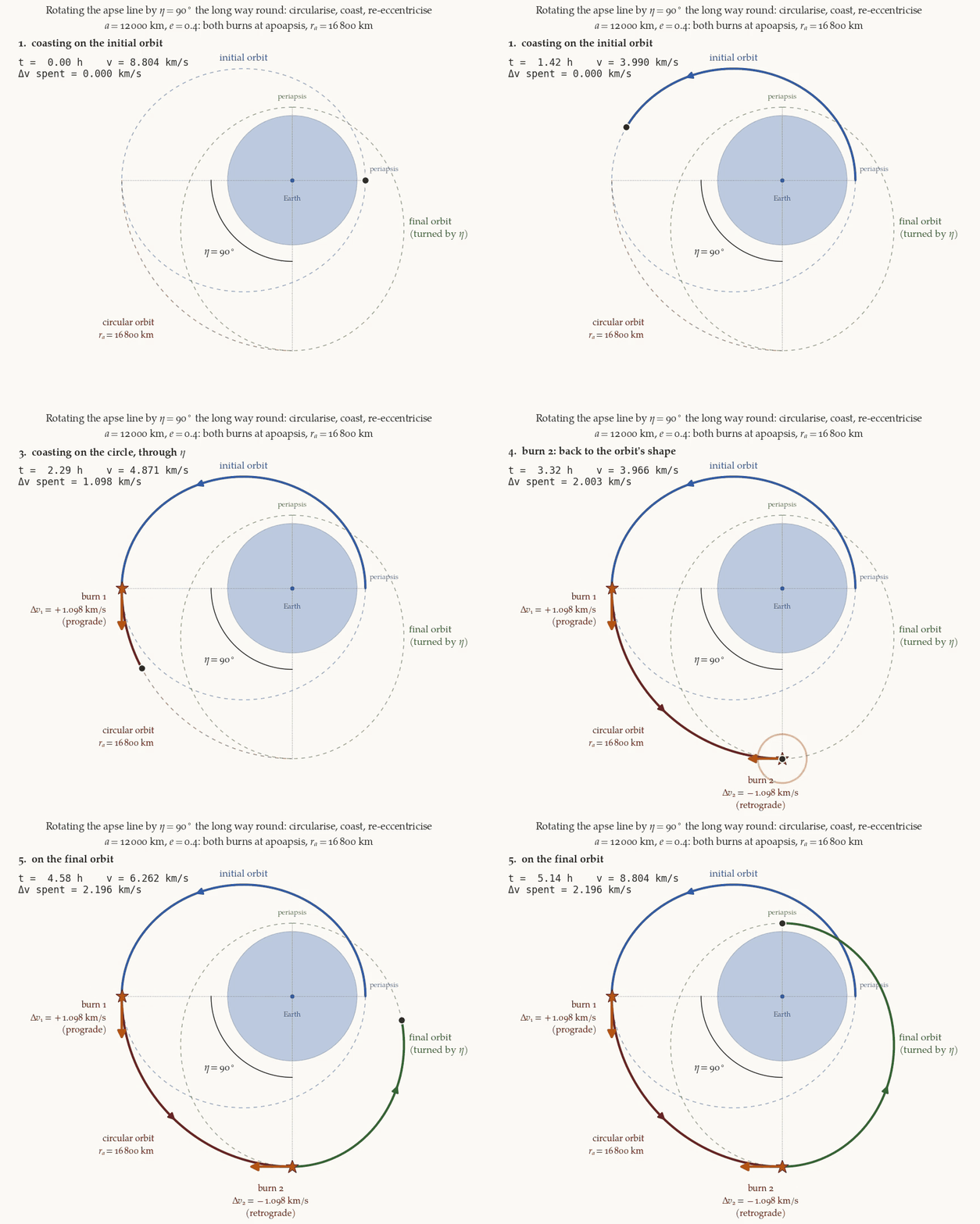
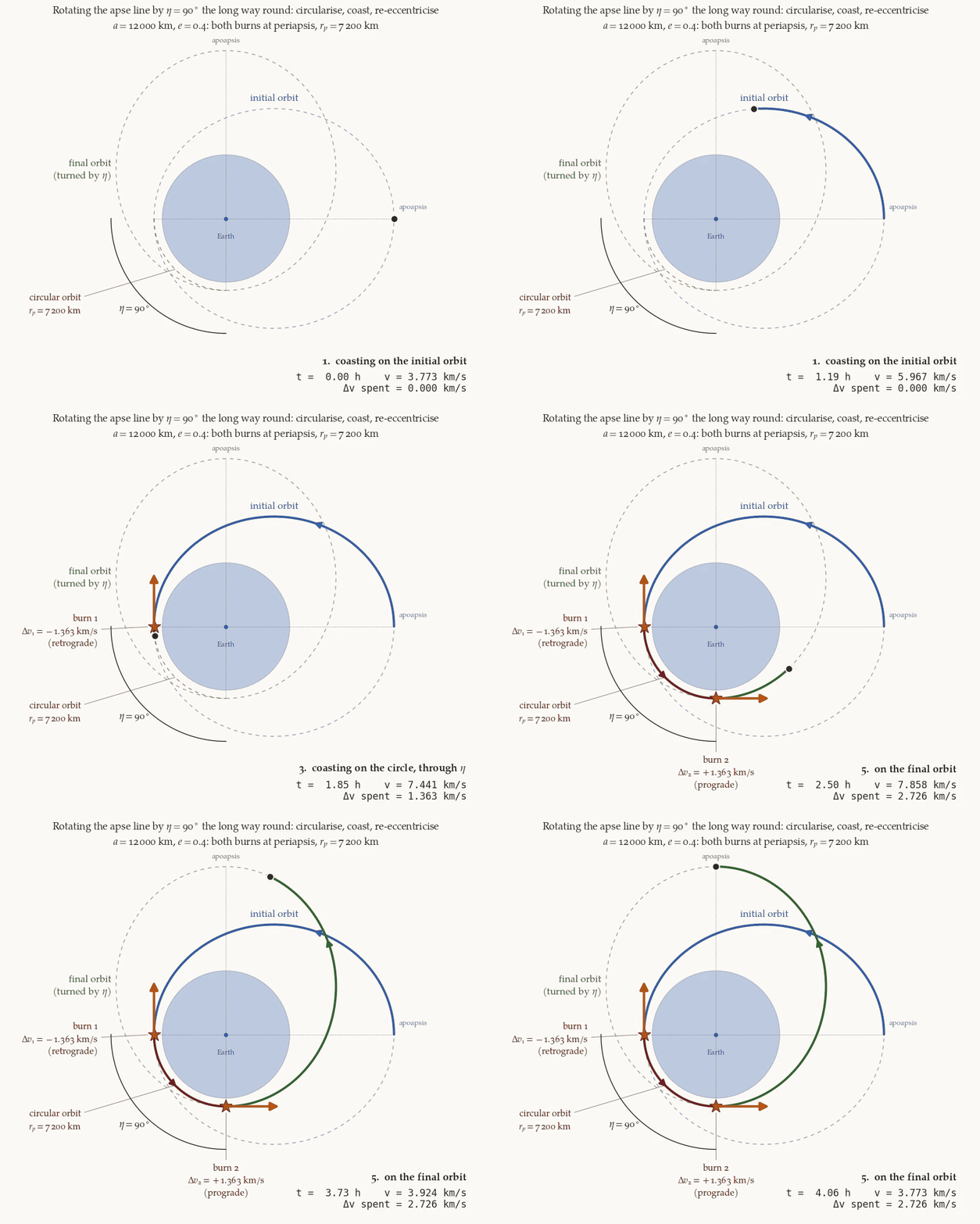
Why apoapsis, and not periapsis? The same route can be flown with both burns at periapsis, as in Figure 4 below: the first burn is then a brake, the second a kick, and the coast is much smaller.
So the natural questions is, which end is cheaper? The two burns are equal and opposite, so the route costs twice the mismatch \(|v_c-v|\) between the circular speed \(v_c=\sqrt{\mu/r}\) and the orbit’s own speed \(v\) at the burn radius \(r\). At an apse the velocity is already perpendicular to the radius, as it is on a circle, so the burn only has to change the speed; that is why the two apsides are the places to compare.
NOTE TO CLAUDE: Here you are answering the question of why only the apsides are considered. So logically this should have come first. We should have said: I want to use two impulses. So what points I should do them? show the apsides. Then say collinear velocities. so only magnitude has to be changed. so we choose those. Then we show the diagram and discussion for apoapsis, show that it is independent of . then we show that perapsis is worse than apoapsis.
Lets measure speeds in units of \(\sqrt{\mu/a}\) and write
\[ s=\sqrt{1+e},\qquad t=\sqrt{1-e},\qquad s^2+t^2=2, \]
so that \(r_p=a(1-e)=at^2\) and \(r_a=a(1+e)=as^2\). The circular speeds are \(v_c=1/t\) at periapsis and \(v_c=1/s\) at apoapsis. Vis-viva, \(v^2=(\mu/a)(2a/r-1)\), gives \(v_p^2=(2-t^2)/t^2=s^2/t^2\) and \(v_a^2=(2-s^2)/s^2=t^2/s^2\), because \(2-t^2=s^2\) and \(2-s^2=t^2\). One burn therefore costs
\[ \Delta v_p=\frac st-\frac1t=\frac{s-1}{t},\qquad \Delta v_a=\frac1s-\frac ts=\frac{1-t}{s}. \]
Periapsis is the dearer end when \((s-1)/t>(1-t)/s\). Multiplying by \(st>0\) turns this into \(s^2-s>t-t^2\), that is \(s^2+t^2>s+t\), and with \(s^2+t^2=2\) into
\[ s+t<2 . \]
This holds for every \(0<e<1\), because \((s+t)^2=s^2+t^2+2st=2+2\sqrt{1-e^2}<4\). So the apoapsis route is the cheaper one for every eccentric orbit; the two coincide only on a circle (\(e=0\), \(s=t=1\)).
How much cheaper? The ratio of the two costs is
\[ \frac{\Delta v_p}{\Delta v_a}=\frac st\cdot\frac{s-1}{1-t}, \]
a product of two factors that pull in opposite directions.
What periapsis buys is time. The coast through \(\eta\) takes \(\eta\sqrt{r^3/\mu}\), which grows as \(r^{3/2}\): for \(\eta=90^\circ\) it is \(0.42\) h round the circle of radius \(r_p\) and \(1.51\) h round that of radius \(r_a\), longer by \((r_a/r_p)^{3/2}=3.56\).
For the same orbit, compute the cost of the two-burn route, and the rotation angle \(\eta\) above which it beats the single radial impulse.
What you should find
At \(r_a=16\,800\) km, \(v_c=4.870956\) and \(v_a=3.773027\) km/s, so \(\Delta v_{\rm alt}=2(4.870956-3.773027)=2.19586\) km/s. Setting \(2\sqrt{\mu/p}\,e\sin(\eta/2)=2.19586\) gives \(\eta_{\rm cross}=51.8^\circ\). Below it (\(30^\circ\): \(1.30\) km/s) rotate directly; above it (\(180^\circ\) would cost \(5.03\) km/s) go via the circle.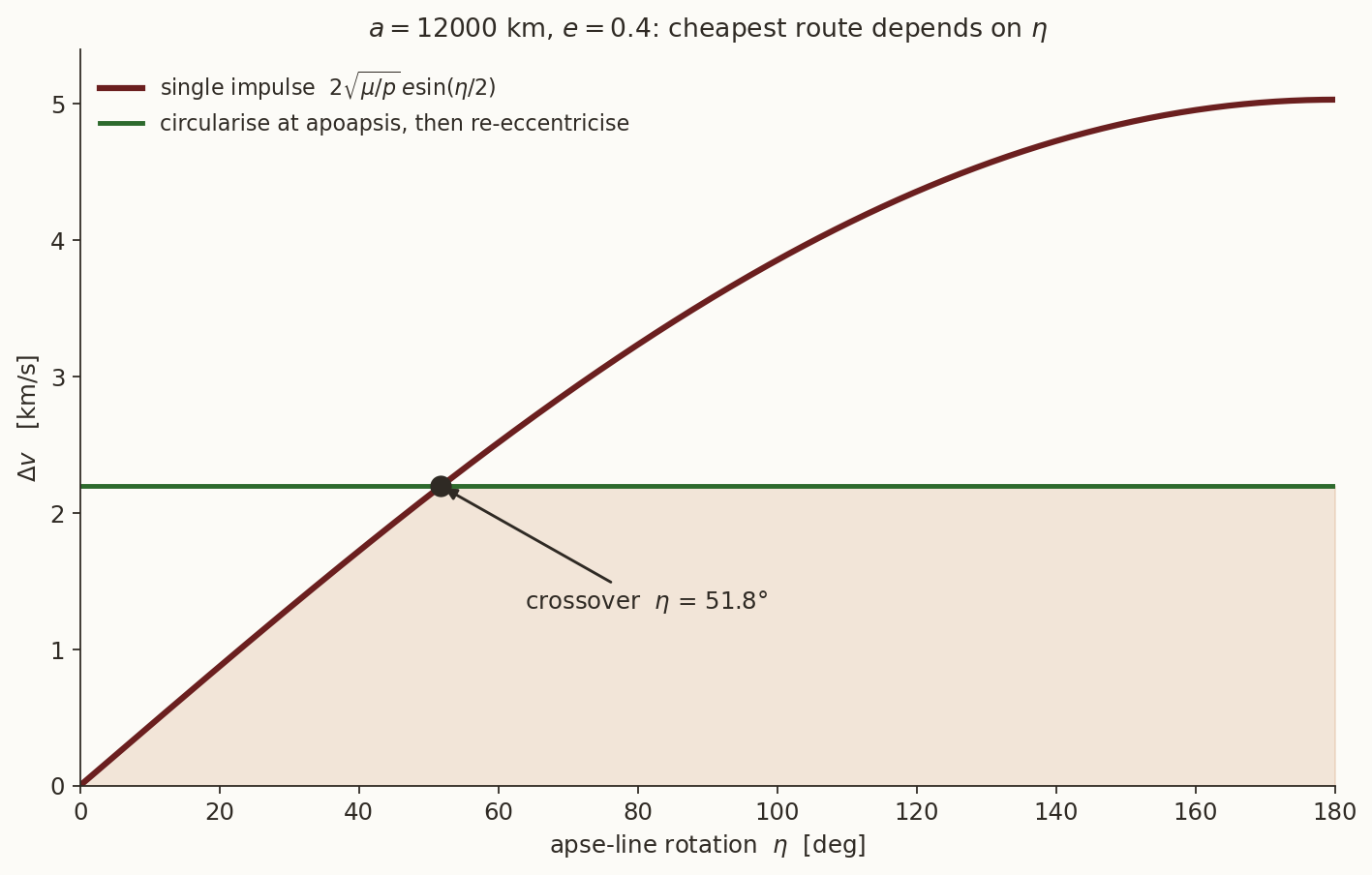
A direct rotation costs \(\propto\sin(\eta/2)\) and grows without saturating at a small value, while the detour costs a constant. Large reorientations are made by changing the shape of the orbit, not by rotating it.