Objective Questions
200 questions on the n-body problem, the two-body problem, orbital elements and orbital maneuvers
How to use these questions
There are \(50\) questions on each of the four topics. Within each topic they come in three levels, which make up \(40\%\), \(30\%\) and \(30\%\) of the set:
| level | per topic | in all | what it asks |
|---|---|---|---|
| 1 — very easy | \(20\) | \(80\) | one definition, one fact, or one formula used once |
| 2 — a little difficult | \(15\) | \(60\) | two or three steps, or a formula used with care |
| 3 — hard | \(15\) | \(60\) | several steps, a limit, a symmetry, or a point that is easy to get wrong |
Every question has exactly one correct option. Choose it before opening the Answer, which gives the reason and, for a number, the calculation. The wrong options are mostly the results of common mistakes, and several answers say which mistake each one comes from. All the answers are listed together in the answer key at the end.
Every number in the questions and answers is recomputed by codes/objective-questions-verify.py. The figures are drawn by codes/fig-oq-objective.py.
Data, unless a question says otherwise. \(\mu_\oplus=398\,600\ \mathrm{km^3/s^2}\), \(R_\oplus=6378\) km, \(g_0=9.80665\ \mathrm{m/s^2}\), \(G=6.674\times10^{-11}\ \mathrm{m^3\,kg^{-1}\,s^{-2}}\), \(\mu_\odot=1.327\times10^{11}\ \mathrm{km^3/s^2}\), \(1\ \mathrm{AU}=1.496\times10^8\) km, \(M_\odot/m_{\rm Jupiter}=1047.6\), \(J_2=1.08263\times10^{-3}\). Burns are impulsive and orbits are two-body, unless a question says otherwise. Angles in Kepler’s equation are in radians.
The \(n\)-body problem
Level 1 — very easy (Q1–20)
1. The \(n\)-body problem in three dimensions, written as first-order equations for the positions and velocities, is a system of how many scalar ODEs?
- \(10\)
- \(6n-10\)
- \(6n\)
- \(3n\)
Answer
(C) Each body has three position and three velocity components, so the state has \(6n\) numbers, and each needs its own first-order equation.
2. How many classical integrals (constants of the motion) does the \(n\)-body problem have?
- \(6\)
- \(9\)
- \(10\)
- \(12\)
Answer
(C) Three for the velocity of the centre of mass, three for its initial position, three for the total angular momentum, and one for the total energy: \(3+3+3+1=10\).
3. Which of the following is not one of the classical integrals of the \(n\)-body problem?
- The total angular momentum
- The total energy \(T+V\)
- The total linear momentum
- The eccentricity vector of each body
Answer
(D) Each body’s eccentricity vector is conserved only in the two-body problem. In the \(n\)-body problem every body is perturbed by the others, so its \(\mathbf e\) changes; only the ten system-wide integrals survive.
4. For an isolated system of \(n\) point masses, the centre of mass
- is always at rest
- moves on a conic section
- moves in a straight line at constant speed
- moves towards the heaviest body
Answer
(C) The internal forces cancel in pairs, so \(\sum m_i\ddot{\mathbf R}_i=\mathbf 0\). Integrating twice gives \(\mathbf R_{\rm cm}=\mathbf C_1t/M+\mathbf C_2/M\): uniform straight-line motion. We may choose a frame in which it is at rest, but that is a choice.
5. The invariable (Laplace) plane of the solar system is the plane through the barycentre that is
- the plane of the Earth’s orbit
- perpendicular to the total angular momentum of the system
- perpendicular to the Sun’s axis of rotation
- the plane of Jupiter’s orbit
Answer
(B) \(\mathbf H=\sum m_i\mathbf R_i\times\dot{\mathbf R}_i\) is constant in magnitude and direction, so the plane perpendicular to it is fixed in space. The ecliptic (Earth’s orbit) wobbles; the invariable plane does not.
6. The distance between two point masses is halved. The gravitational force between them becomes
- half as large
- twice as large
- four times as large
- eight times as large
Answer
(C) \(F=Gm_1m_2/r^2\), so \(r\to r/2\) multiplies \(F\) by \(2^2=4\).
7. The SI units of the gravitational constant \(G\) are
- \(\mathrm{m^2\,kg^{-1}\,s^{-2}}\)
- \(\mathrm{m^3\,kg^{-1}\,s^{-2}}\)
- \(\mathrm{kg\,m^{-3}\,s^{2}}\)
- \(\mathrm{N\,kg^{-2}}\)
Answer
(B) From \(F=Gm_1m_2/r^2\): \(G=Fr^2/(m_1m_2)\) has units \(\mathrm{kg\,m\,s^{-2}\cdot m^2\cdot kg^{-2}}=\mathrm{m^3\,kg^{-1}\,s^{-2}}\).
8. The mutual potential energy of two point masses, \(\Phi_{ij}=-Gm_im_j/r_{ij}\), is
- zero at \(r_{ij}=0\)
- negative, and falls further as \(r_{ij}\) grows
- positive, and decreases as \(r_{ij}\) grows
- negative, and rises towards zero as \(r_{ij}\) grows
Answer
(D) It is negative for every finite separation and tends to \(0\) as \(r_{ij}\to\infty\). Pulling the masses apart raises it, which is why work must be done against gravity to separate them.
9. The total potential energy of the Sun and eight planets is a sum over pairs. How many terms does it have?
- \(81\)
- \(72\)
- \(36\)
- \(9\)
Answer
(C) The number of pairs among \(n=9\) bodies is \(n(n-1)/2=9\cdot8/2=36\). Summing over \(i\) and \(j\) separately would count each pair twice, which is where the factor \(\tfrac12\) in \(V\) comes from.
10. The gravitational field of a point mass, \(\mathbf g=-GM\mathbf r/r^3\), has
- zero divergence and non-zero curl
- zero curl everywhere except at the mass itself
- a curl directed along \(\mathbf r\)
- a curl that falls off as \(1/r^3\)
Answer
(B) \(\mathbf g=-\nabla\phi\) with \(\phi=-GM/r\), and the curl of a gradient is zero. Any central field \(g(r)\hat{\mathbf r}\) is irrotational.
11. A probe is moved from point A to point B in the field of a planet, along three different paths. The work done by gravity is
- the same for all three paths
- zero for every path
- largest along the path that passes closest to the planet
- largest along the shortest path
Answer
(A) Gravity is conservative: \(W=\Phi(A)-\Phi(B)\) depends only on the end points. (The fuel needed is a different matter; see the deck’s question on this.)
12. The ratio of the Sun’s radius (\(6.96\times10^5\) km) to the Sun–Earth distance (\(1\ \mathrm{AU}\)) is closest to
- \(4.7\times10^{-1}\)
- \(4.7\times10^{-2}\)
- \(4.7\times10^{-3}\)
- \(4.7\times10^{-5}\)
Answer
(C) \(6.96\times10^5/1.496\times10^8=4.65\times10^{-3}\). The bodies are tiny compared with their separations, which is the first justification for treating them as point masses.
13. Kepler’s three laws were obtained
- from Newton’s law of gravitation
- from the shape of the Moon’s orbit
- from the conservation of angular momentum
- from Tycho Brahe’s observations, without any theory of force
Answer
(D) Kepler fitted Tycho’s observations of Mars (1609, 1619). Newton later explained the laws with his law of gravitation.
14. A planet has four times the semi-major axis of another. By Kepler’s third law its period is larger by a factor of
- \(2\)
- \(4\)
- \(8\)
- \(16\)
Answer
(C) \(T\propto a^{3/2}\), so \(T_2/T_1=4^{3/2}=8\).
15. In the \(n\)-body problem, \(\mathbf F_{ij}=-\mathbf F_{ji}\) for every pair. Which integral follows directly from this?
- conservation of total linear momentum
- conservation of each body’s energy
- conservation of each body’s angular momentum
- conservation of total energy
Answer
(A) Adding all the equations of motion, the internal forces cancel pair by pair, so \(\frac{d}{dt}\sum m_i\dot{\mathbf R}_i=\mathbf 0\).
16. In the \(n\)-body equations, the acceleration \(\ddot{\mathbf R}_i\) of body \(i\) depends on
- the masses of the other bodies and their positions, but not on \(m_i\)
- its own mass \(m_i\) and the masses of the others
- only the mass of the heaviest body
- only the total mass of the system
Answer
(A) Dividing \(m_i\ddot{\mathbf R}_i=\sum_j Gm_im_j\hat{\mathbf r}_{ij}/r_{ij}^2\) by \(m_i\) removes it: all bodies fall alike in a given field.
17. For solar-system dynamics, the best practical choice of origin for an inertial frame is
- the barycentre of the solar system
- the centre of Jupiter
- the centre of the Earth
- the centre of the Sun
Answer
(A) The barycentre moves uniformly (to excellent accuracy); the Sun’s centre circles it, mostly under Jupiter’s pull, by about a solar radius.
18. The gravitational potential (energy per unit mass) at distance \(r\) from a point mass \(M\) is
- \(+GM/r\)
- \(-GM/r\)
- \(-GM/r^2\)
- \(-GMr\)
Answer
(B) \(\phi=-GM/r\), so that \(\mathbf g=-\nabla\phi=-GM\hat{\mathbf r}/r^2\) points towards the mass. The mutual potential energy of a mass \(m\) there is \(m\phi\).
19. With \(G=6.674\times10^{-11}\) SI, \(M_\odot=1.989\times10^{30}\) kg, \(M_\oplus=5.972\times10^{24}\) kg and \(1\ \mathrm{AU}=1.496\times10^{11}\) m, the Sun’s pull on the Earth is about
- \(3.5\times10^{24}\) N
- \(3.5\times10^{22}\) N
- \(3.5\times10^{20}\) N
- \(3.5\times10^{18}\) N
Answer
(B) \(F=GM_\odot M_\oplus/r^2=6.674\times10^{-11}\times1.989\times10^{30}\times5.972\times10^{24}/(1.496\times10^{11})^2=3.54\times10^{22}\) N.
20. The invariable plane of the solar system is inclined to the ecliptic by about
- \(23.4^\circ\)
- \(7.3^\circ\)
- \(1.6^\circ\)
- \(0^\circ\)
Answer
(C) The deck quotes \(1.57^\circ\). (\(7.25^\circ\) is the tilt of the Sun’s equator to the ecliptic; \(23.44^\circ\) is the Earth’s obliquity.)
Level 2 — a little difficult (Q21–35)
21. Jupiter (\(m_J=M_\odot/1047.6\)) is at \(5.203\) AU. Treating the Sun and Jupiter as a two-body pair, the Sun–Jupiter barycentre is at a distance from the Sun’s centre of about (\(R_\odot=6.96\times10^5\) km)
- \(0.1\,R_\odot\), deep inside the Sun
- \(0.5\,R_\odot\)
- \(1.07\,R_\odot\), just outside the Sun’s surface
- \(10\,R_\odot\)
Answer
(C) \(d=a_J\,m_J/(M_\odot+m_J)=5.203\times1.496\times10^8/1048.6=7.42\times10^5\) km \(=1.07\,R_\odot\). The Sun really does orbit a point outside itself.
22. The Earth–Moon distance is \(384\,400\) km and \(M_\oplus/M_{\rm Moon}=81.3\). The Earth–Moon barycentre lies
- halfway between the Earth and the Moon
- about \(4670\) km from the Earth’s centre, inside the Earth
- at the Earth’s centre
- about \(4670\) km above the Earth’s surface
Answer
(B) \(d=384\,400/(1+81.3)=4670\) km, which is less than \(R_\oplus=6378\) km. The Earth wobbles about a point about \(1700\) km below its surface.
23. With \(\mu_\odot=1.327\times10^{11}\ \mathrm{km^3/s^2}\), \(m_J=M_\odot/1047.6\) and \(a_J=5.203\) AU, the acceleration of the Sun caused by Jupiter is about
- \(2\times10^{-11}\ \mathrm{m/s^2}\)
- \(2\times10^{-7}\ \mathrm{m/s^2}\)
- \(2\times10^{-4}\ \mathrm{m/s^2}\)
- \(6\times10^{-3}\ \mathrm{m/s^2}\)
Answer
(B) \(a=\mu_J/a_J^2=(\mu_\odot/1047.6)/(7.784\times10^8\ \mathrm{km})^2=2.09\times10^{-10}\ \mathrm{km/s^2}=2.09\times10^{-7}\ \mathrm{m/s^2}\). A heliocentric frame therefore accelerates, and is not exactly inertial.
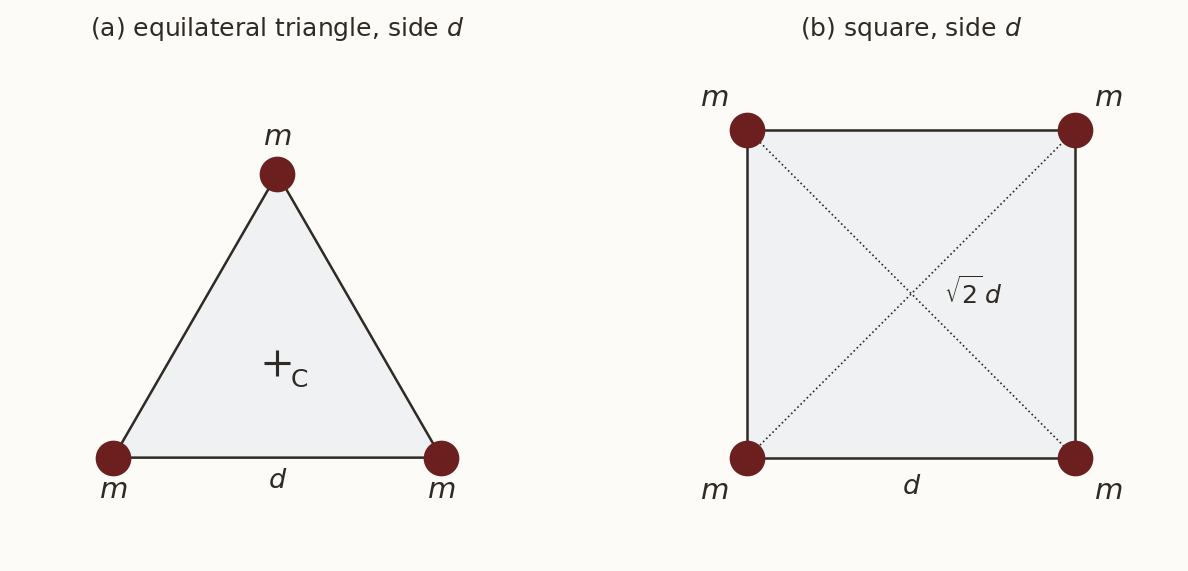
24. Three equal masses \(m\) sit at the corners of an equilateral triangle of side \(d\) (Figure 1, left). The total potential energy is
- \(-Gm^2/d\)
- \(-3Gm^2/d\)
- \(-2Gm^2/d\)
- \(-6Gm^2/d\)
Answer
(B) There are three pairs, each at distance \(d\), each contributing \(-Gm^2/d\). Counting ordered pairs would give the wrong answer \(-6Gm^2/d\).
25. A \(1\) kg mass moves at \((3,0)\) m/s and a \(2\) kg mass at \((0,3)\) m/s. The speed of their centre of mass is
- \(1.0\) m/s
- \(2.0\) m/s
- \(2.24\) m/s
- \(3.0\) m/s
Answer
(C) \(\mathbf V_{\rm cm}=(1\cdot(3,0)+2\cdot(0,3))/3=(1,2)\) m/s, whose magnitude is \(\sqrt5=2.24\) m/s.
26. A direct-summation code integrates \(1000\) bodies. How many distinct pair forces must it evaluate at each step?
- \(1000\)
- \(10^5\)
- \(499\,500\)
- \(10^6\)
Answer
(C) \(n(n-1)/2=1000\times999/2=499\,500\); Newton’s third law gives the other half for free. The cost grows like \(n^2\), which is why the numerical solution is expensive.
27. At new moon, compare the Sun’s pull on the Moon with the Earth’s pull on the Moon (\(M_\odot/M_\oplus=3.33\times10^5\), \(r_{\rm EM}=384\,400\) km, \(r_{\rm SM}\approx1\) AU). The ratio is about
- \(0.01\)
- \(0.5\)
- \(2.2\)
- \(180\)
Answer
(C) \((M_\odot/M_\oplus)(r_{\rm EM}/r_{\rm SM})^2=3.33\times10^5\times(384\,400/1.496\times10^8)^2=2.2\). Yet the Earth–Moon relative motion is well modelled as two-body, because the Sun pulls the Earth almost equally.
28. The solar system as a whole accelerates towards the galactic centre at about \(2\times10^{-10}\ \mathrm{m/s^2}\). Why can this be ignored in planetary dynamics?
- Because the barycentre does not move
- Because it is smaller than any planet’s acceleration
- Because the galactic centre is too far for gravity to act
- Because it is almost the same for every body, so it cancels from their relative motion
Answer
(D) A uniform acceleration shifts every body equally and drops out of the relative equations of motion. Only its difference across the solar system, a tidal term, could matter, and that is utterly negligible.
29. Two equal masses \(m\) are a distance \(d\) apart. At the midpoint, the gravitational field and potential are
- field \(0\), potential \(0\)
- field \(8Gm/d^2\), potential \(-2Gm/d\)
- field \(2Gm/d^2\), potential \(0\)
- field \(0\), potential \(-4Gm/d\)
Answer
(D) The two fields are equal and opposite, so they cancel. Potentials are scalars and add: \(2\times(-Gm/(d/2))=-4Gm/d\).
30. Which of these force fields is not conservative?
- the field of an oblate Earth
- the field of a point mass
- the field of two fixed point masses
- \(\mathbf F=k\,(-y,\ x,\ 0)\)
Answer
(D) Its curl is \((0,0,2k)\ne\mathbf 0\). Every gravitational field, however irregular the body, is a superposition of point-mass fields and so has zero curl.
31. The conservation of the total angular momentum of \(n\) bodies requires that the mutual forces
- are equal and opposite and act along the line joining each pair
- are equal and opposite only
- are attractive
- fall off as \(1/r^2\)
Answer
(A) Equal and opposite forces cancel in the sum of forces, but their torques cancel only if they also act along \(\mathbf r_{ij}\) (the “strong” form of the third law). Gravity satisfies both; the \(1/r^2\) law itself is not needed.
32. At closest approach Jupiter is \(4.203\) AU from the Earth. Its direct pull on the Earth, as a fraction of the Sun’s pull, is about (\(m_J=M_\odot/1047.6\))
- \(5\times10^{-3}\)
- \(5\times10^{-4}\)
- \(5\times10^{-5}\)
- \(5\times10^{-7}\)
Answer
(C) \((1/1047.6)\times(1\ \mathrm{AU}/4.203\ \mathrm{AU})^2=5.4\times10^{-5}\). Small, but it accumulates: this is why the planets are only nearly on Kepler orbits.
33. An isolated three-body system has total energy \(E<0\). Which statement is correct?
- The centre of mass must be at rest
- The motion must be periodic
- All three bodies must stay within a bounded region forever
- One body may still be ejected to infinity, leaving the other two more tightly bound
Answer
(D) \(E<0\) means the system as a whole cannot fly apart completely, but one body can carry away positive energy while the remaining pair sinks deeper. Ejections of this kind are common in numerical three-body runs.
34. In a numerical \(n\)-body integration, the most common check of accuracy is
- that every body stays on its initial Kepler ellipse
- that the total energy and angular momentum stay constant
- that the bodies keep their initial order of distance from the barycentre
- that the time step stays constant
Answer
(B) The ten classical integrals are exact properties of the true solution, so their drift in the computed solution measures the numerical error.
35. The invariable plane lies closest to the orbital plane of
- Mercury
- Jupiter
- the Earth
- Neptune
Answer
(B) The plane is perpendicular to the total angular momentum, which is dominated by Jupiter (\(\approx60\%\)) and Saturn. Jupiter’s orbit is inclined only about \(0.3^\circ\) to it.
Level 3 — hard (Q36–50)
36. Treat Jupiter (\(1.898\times10^{27}\) kg, \(5.203\) AU) and Saturn (\(5.683\times10^{26}\) kg, \(9.537\) AU) as on circular orbits about the Sun. The ratio of their orbital angular momenta, \(L_J/L_S\), is about
- \(1.8\)
- \(2.5\)
- \(3.3\)
- \(6.1\)
Answer
(B) For a circular orbit \(L=m\sqrt{\mu a}\), so \(L_J/L_S=(m_J/m_S)\sqrt{a_J/a_S}=3.340\times0.7386=2.47\). Saturn’s larger distance makes up part of its smaller mass.
37. The three-body problem is of order \(18\). Using all ten classical integrals reduces its order to
- \(6\)
- \(8\)
- \(12\)
- \(16\)
Answer
(B) \(18-10=8\). Eliminating the time and the node (Jacobi) lowers it by two more, to \(6\), but no further integrals exist in general, so the problem cannot be solved by quadratures.
38. Three bodies of arbitrary masses sit at the corners of an equilateral triangle. The net gravitational force on each body
- points towards the common centre of mass, with magnitude proportional to the body’s distance from it
- points towards the heaviest body
- points towards the centre of mass only if the masses are equal
- is zero
Answer
(A) \(\mathbf F_i=\sum_j Gm_im_j(\mathbf R_j-\mathbf R_i)/d^3=Gm_iM(\mathbf R_{\rm cm}-\mathbf R_i)/d^3\). This is what allows the whole triangle to rotate rigidly: Lagrange’s equilateral solution.
39. Four equal masses \(m\) sit at the corners of a square of side \(d\) (Figure 1, right). The total potential energy is
- \(-(4+\sqrt2)\,Gm^2/d\)
- \(-8Gm^2/d\)
- \(-4Gm^2/d\)
- \(-(4+2\sqrt2)\,Gm^2/d\)
Answer
(A) Six pairs: four sides at \(d\) and two diagonals at \(\sqrt2\,d\). \(V=-Gm^2/d\,(4+2/\sqrt2)=-(4+\sqrt2)Gm^2/d\approx-5.41\,Gm^2/d\).
40. Jupiter moves at about \(13.06\) km/s about the Sun, and \(M_\odot/m_J=1047.6\). The speed of the Sun about the Sun–Jupiter barycentre is about
- \(1.2\) m/s
- \(12.5\) m/s
- \(125\) m/s
- \(13\) km/s
Answer
(B) Momentum balance about the barycentre: \(M_\odot v_\odot=m_Jv_J\), so \(v_\odot=13.06/1047.6\) km/s \(=12.5\) m/s. Stellar wobbles of this size are how many exoplanets are found.
41. For planet \(i\) moving about the Sun in the \(n\)-body problem, the heliocentric equation contains, for each other planet \(j\), the term \(-Gm_j\,\mathbf r_j/r_j^3\). This “indirect” term
- is the pull of planet \(j\) on planet \(i\)
- arises from the Sun’s rotation
- vanishes when \(m_j\ll M_\odot\)
- arises because planet \(j\) accelerates the Sun, and hence the heliocentric frame
Answer
(D) The direct term is \(Gm_j\mathbf r_{ij}/r_{ij}^3\). The indirect term is minus the Sun’s acceleration due to \(j\), which every heliocentric coordinate feels. It is small but of the same order as the direct one.
42. Let \(I=\sum m_i|\mathbf R_i-\mathbf R_{\rm cm}|^2\). For gravity, \(\ddot I=4T+2V=2E+2T\). What follows for a system with total energy \(E>0\)?
- It must be periodic
- Nothing, because \(T\) can be negative
- It collapses to a point in finite time
- It cannot stay bounded: at least one mutual distance grows without limit
Answer
(D) \(T\ge0\), so \(\ddot I\ge2E>0\) and \(I\) grows at least like \(Et^2\). This is the Lagrange–Jacobi identity.
43. A bound gravitating system (all distances stay finite) has total energy \(E\). The long-time average of its kinetic energy is
- \(-E\)
- \(E\)
- \(2E\)
- \(-E/2\)
Answer
(A) Averaging \(\ddot I=4T+2V\) over a long time gives \(0\) for a bounded system, so \(2\langle T\rangle+\langle V\rangle=0\) (the virial theorem). With \(E=\langle T\rangle+\langle V\rangle\), \(\langle T\rangle=-E\).
44. Three equal masses \(m\) on an equilateral triangle of side \(d\) rotate rigidly about their centre of mass. The angular velocity satisfies
- \(\omega^2=3Gm/d^3\)
- \(\omega^2=Gm/d^3\)
- \(\omega^2=Gm/(3d^3)\)
- \(\omega^2=\sqrt3\,Gm/d^3\)
Answer
(A) The net force on one mass is \(2(Gm^2/d^2)\cos30^\circ=\sqrt3\,Gm^2/d^2\), towards the centre at distance \(d/\sqrt3\). So \(m\omega^2d/\sqrt3=\sqrt3\,Gm^2/d^2\), i.e. \(\omega^2=3Gm/d^3=G(3m)/d^3\), Kepler’s third law with the total mass.
45. The tide-raising acceleration of a body of mass \(M\) at distance \(D\) scales as \(M/D^3\). The ratio of the Moon’s tidal effect on the Earth to the Sun’s is about (\(M_{\rm Moon}=7.342\times10^{22}\) kg, \(M_\odot=1.989\times10^{30}\) kg, \(384\,400\) km, \(1\) AU)
- \(0.46\)
- \(1.0\)
- \(2.2\)
- \(180\)
Answer
(C) \((7.342\times10^{22}/1.989\times10^{30})\times(1.496\times10^8/384\,400)^3=2.18\). The Sun pulls the Earth \(180\) times harder than the Moon does, but its pull varies less across the Earth.
46. Two planets have orbital angular momenta \(L_1\) and \(L_2=L_1/2\), and their orbit planes are inclined at \(6^\circ\) to each other. The invariable plane is inclined to the plane of planet 1 by about
- \(0.5^\circ\)
- \(2.0^\circ\)
- \(3.0^\circ\)
- \(4.0^\circ\)
Answer
(B) \(\mathbf H=\mathbf L_1+\mathbf L_2\). Its angle from \(\mathbf L_1\) is \(\arctan\dfrac{L_2\sin6^\circ}{L_1+L_2\cos6^\circ}=\arctan\dfrac{0.0523}{1.497}=2.0^\circ\): the larger angular momentum keeps the invariable plane closer to its own plane.
47. Every mass in an \(n\)-body system is multiplied by \(4\), and the initial positions are kept. To retrace exactly the same paths, the initial velocities must be multiplied by
- \(1/2\), and the motion takes twice as long
- \(16\), and the timing is unchanged
- \(4\), and the motion takes a quarter of the time
- \(2\), and the motion takes half as long
Answer
(D) At the same positions every acceleration is \(4\) times larger. Putting \(t'=t/2\) keeps \(d^2\mathbf R/dt'^2\) matched, so the same paths are followed twice as fast, with velocities doubled.
48. All initial positions in an \(n\)-body system are doubled, the masses are kept, and the velocities are scaled so that the same (scaled) paths are followed. The time to go round them changes by a factor of
- \(1/\sqrt2\)
- \(4\)
- \(2\)
- \(2\sqrt2\)
Answer
(D) Accelerations scale as \(1/L^2\) and must equal \(L/t^2\), so \(t\propto L^{3/2}\): \(2^{3/2}=2\sqrt2\). This is Kepler’s third law for any number of bodies. Velocities scale as \(L^{-1/2}\).
49. For the planets in heliocentric coordinates, \(\sum_{\rm planets}m_i\,\mathbf r_i\times\dot{\mathbf r}_i\) is
- not exactly conserved, because the heliocentric frame accelerates
- exactly conserved, as in any frame
- conserved only if the orbits are circular
- always zero
Answer
(A) The ten integrals hold in an inertial frame. The heliocentric frame is accelerated by the planets themselves (Question 41), so the naive heliocentric sum is only approximately constant.
50. Which statement about the famous “figure-eight” solution of the three-body problem is true?
- It exists only in a rotating frame
- It is chaotic: neighbouring orbits separate exponentially
- It needs one body much heavier than the other two
- Three equal masses chase one another round one curve, and the total angular momentum is zero
Answer
(D) Found numerically by Moore (1993) and proved by Chenciner and Montgomery (2000), it is periodic, uses equal masses, and has zero total angular momentum. It is one of the few exact periodic solutions known.
The two-body problem
Level 1 — very easy (Q51–70)
51. In the relative two-body equation \(\ddot{\mathbf r}=-\mu\,\mathbf r/r^3\), the gravitational parameter is
- \(G(m_1+m_2)\)
- \(Gm_1m_2/(m_1+m_2)\)
- \(Gm_1\)
- \(Gm_2\)
Answer
(A) Subtracting the two equations of motion, \(\ddot{\mathbf R}_2-\ddot{\mathbf R}_1=-G(m_1+m_2)\mathbf r/r^3\). Both bodies accelerate towards each other, so their masses add.
52. The vector \(\mathbf r\) in \(\ddot{\mathbf r}=-\mu\,\mathbf r/r^3\) is
- the position of body 2 relative to body 1
- the position of the smaller body in an inertial frame
- the position of body 1 relative to the centre of mass
- the position of the centre of mass
Answer
(A) \(\mathbf r=\mathbf R_2-\mathbf R_1\). The equation describes the relative motion; the motion of each body about the barycentre follows from it.
53. Why does a two-body orbit lie in a fixed plane?
- Because \(\mathbf h=\mathbf r\times\dot{\mathbf r}\) is constant, and \(\mathbf r\) is always perpendicular to it
- Because the energy is conserved
- Because the force is inverse-square
- Because the centre of mass is at rest
Answer
(A) \(\dot{\mathbf h}=\mathbf r\times\ddot{\mathbf r}=\mathbf 0\) for any central force. Since \(\mathbf r\cdot\mathbf h=0\) at every instant, \(\mathbf r\) stays in the plane perpendicular to the fixed vector \(\mathbf h\).
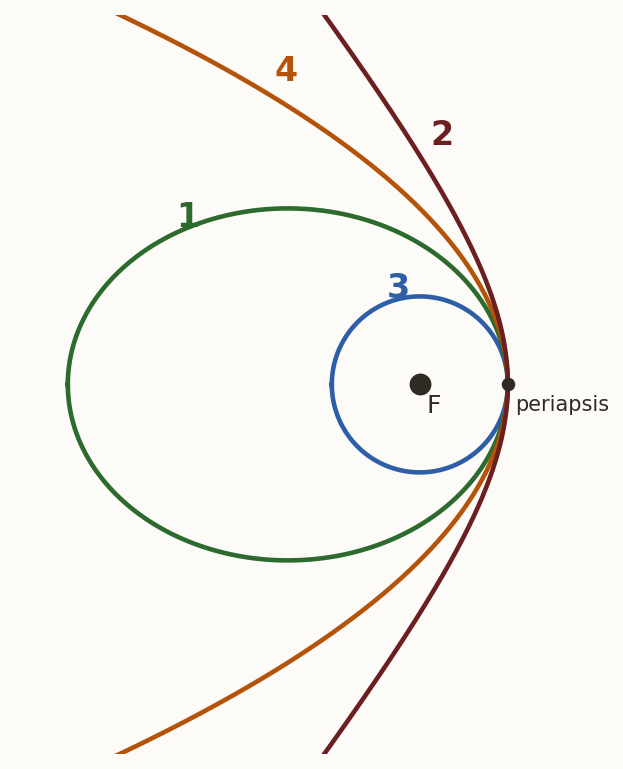
54. Figure 2 shows four trajectories with the same periapsis, \(e=0\), \(0.6\), \(1\) and \(1.6\). Which curve is the parabola?
- 1
- 2
- 3
- 4
Answer
(D) At \(f=90^\circ\) every curve is at \(r=p=r_p(1+e)\), so a larger \(e\) lies farther out. From the inside: circle (3), ellipse (1), parabola (4), hyperbola (2). The parabola’s arms keep bending back towards the axis direction; the hyperbola’s straighten out along its asymptotes.
55. In Figure 2, which trajectories have positive specific energy \(\varepsilon\)?
- 2 only
- 2 and 4
- 1 and 3
- all four
Answer
(A) \(\varepsilon=-\mu/(2a)\) is negative for the circle and the ellipse, zero for the parabola (4), and positive only for the hyperbola (2).
56. On any elliptical orbit, at the points where \(r=a\) the speed is
- the largest on the orbit
- zero
- \(\sqrt{2\mu/a}\)
- \(\sqrt{\mu/a}\), the circular speed at that radius
Answer
(D) Vis-viva: \(v^2=\mu(2/r-1/a)=\mu/a\) at \(r=a\). These are the ends of the minor axis.
57. The escape speed at radius \(r\) is larger than the circular speed at \(r\) by a factor of
- \(2\sqrt2\)
- \(2\)
- \(\sqrt2\)
- \(1\)
Answer
(C) \(v_{\rm esc}=\sqrt{2\mu/r}\) and \(v_c=\sqrt{\mu/r}\).
58. The period of a circular orbit of radius \(6678\) km (about \(300\) km altitude) is about
- \(24\) h
- \(98\) min
- \(90.5\) min
- \(84\) min
Answer
(C) \(T=2\pi\sqrt{r^3/\mu}=2\pi\sqrt{6678^3/398\,600}=5431\) s \(=90.5\) min.
59. The circular speed at \(r=7000\) km is
- \(10.67\) km/s
- \(7.91\) km/s
- \(7.55\) km/s
- \(5.34\) km/s
Answer
(C) \(v_c=\sqrt{\mu/r}=\sqrt{398\,600/7000}=7.546\) km/s. (\(10.67\) km/s is the escape speed there.)
60. An ellipse has \(a=10\,000\) km and \(e=0.2\). Its periapsis and apoapsis radii are
- \(8000\) and \(10\,000\) km
- \(8000\) and \(12\,000\) km
- \(9800\) and \(10\,200\) km
- \(2000\) and \(18\,000\) km
Answer
(B) \(r_p=a(1-e)=8000\) km and \(r_a=a(1+e)=12\,000\) km.
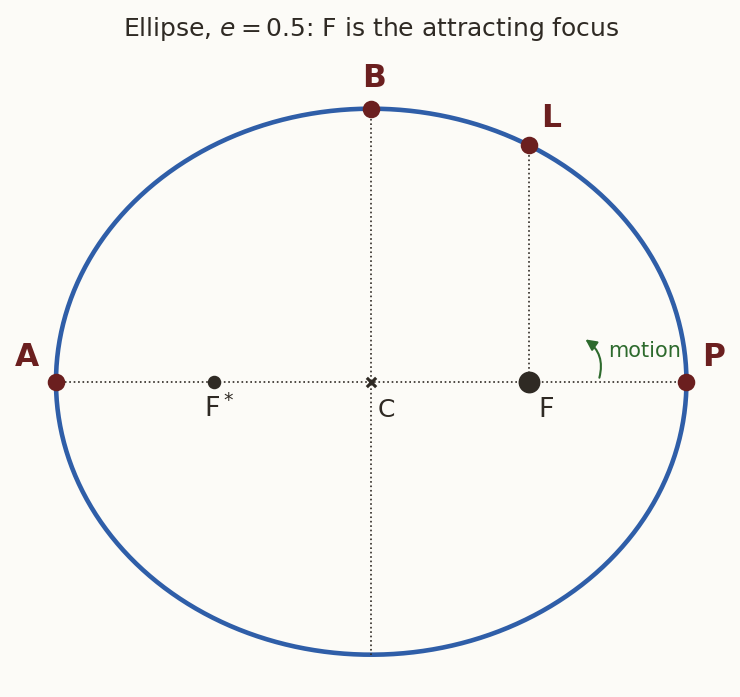
61. The semi-latus rectum \(p\) of a conic is the radius at
- true anomaly \(f=\pm90^\circ\)
- periapsis
- the end of the minor axis
- apoapsis
Answer
(A) \(r=p/(1+e\cos f)\) equals \(p\) when \(\cos f=0\). In Figure 3 this is the point L.
62. In Figure 3, at which points is the flight-path angle zero?
- B only
- B and L
- L only
- P and A
Answer
(D) \(\tan\gamma=e\sin f/(1+e\cos f)\) vanishes at \(f=0\) and \(f=180^\circ\), the apsides, where the velocity is perpendicular to \(\mathbf r\).
63. Kepler’s second law (equal areas in equal times) is equivalent to the conservation of
- the eccentricity vector
- angular momentum
- linear momentum
- energy
Answer
(B) The areal velocity is \(\tfrac12|\mathbf r\times\dot{\mathbf r}|=h/2\). It is constant for any central force.
64. Kepler’s equation, relating the mean anomaly \(M\) to the eccentric anomaly \(E\), is
- \(M=E-e\sin E\)
- \(\tan\frac M2=\sqrt{\frac{1-e}{1+e}}\tan\frac E2\)
- \(M=E-e\cos E\)
- \(M=E+e\sin E\)
Answer
(A) \(M=n(t-t_p)=E-e\sin E\). The last option relates \(E\) to the true anomaly, with \(f\) in place of \(M\).
65. The mean motion of an elliptical orbit is
- \(\sqrt{\mu/p^3}\)
- \(\sqrt{\mu/a}\)
- \(2\pi\sqrt{a^3/\mu}\)
- \(\sqrt{\mu/a^3}\)
Answer
(D) \(n=2\pi/T=\sqrt{\mu/a^3}\), the average angular rate. The last option is the period itself.
66. The geostationary orbit has period one sidereal day, \(23.934\) h. Its radius is about
- \(35\,786\) km
- \(42\,164\) km
- \(42\,241\) km
- \(384\,400\) km
Answer
(B) \(r=(\mu T^2/4\pi^2)^{1/3}=(398\,600\times86\,162^2/4\pi^2)^{1/3}=42\,164\) km. (\(35\,786\) km is the altitude; using \(24\) h instead of the sidereal day gives \(42\,241\) km.)
67. The eccentricity vector \(\mathbf e\) of an orbit points
- from the focus towards apoapsis
- along \(\mathbf h\)
- from the focus towards periapsis
- along the velocity at periapsis
Answer
(C) At periapsis, \(\mathbf v\times\mathbf h/\mu\) and \(\hat{\mathbf r}\) both point outwards, and \(\mathbf e\) is their difference, of length \(e\), along the line to periapsis.
68. In Figure 3, where is the orbital speed greatest?
- L
- P
- A
- B
Answer
(B) By vis-viva, \(v\) is largest where \(r\) is smallest: at periapsis P.
69. An orbit has \(e=0.5\). The ratio of periapsis speed to apoapsis speed is
- \(4\)
- \(3\)
- \(2\)
- \(1.5\)
Answer
(B) \(h=r_pv_p=r_av_a\), so \(v_p/v_a=r_a/r_p=(1+e)/(1-e)=1.5/0.5=3\).
70. On a circular orbit, the ratio of the kinetic energy to the magnitude of the potential energy is
- \(2\)
- \(1\)
- \(1/2\)
- \(1/4\)
Answer
(C) \(v^2/2=\mu/(2r)\) and \(|-\mu/r|=\mu/r\). Hence \(\varepsilon=-\mu/(2r)\), half the potential energy.
Level 2 — a little difficult (Q71–85)
71. An orbit has \(r_p=7000\) km and \(r_a=14\,000\) km. Its semi-major axis and eccentricity are
- \(a=14\,000\) km, \(e=1/3\)
- \(a=10\,500\) km, \(e=1/3\)
- \(a=10\,500\) km, \(e=0.5\)
- \(a=7000\) km, \(e=0.5\)
Answer
(B) \(a=(r_p+r_a)/2=10\,500\) km and \(e=(r_a-r_p)/(r_a+r_p)=7000/21\,000=1/3\).
72. For the orbit of Question 71, the speed at periapsis is
- \(7.55\) km/s
- \(8.71\) km/s
- \(9.27\) km/s
- \(10.67\) km/s
Answer
(B) \(v_p=\sqrt{\dfrac{2\mu r_a}{r_p(r_p+r_a)}}=\sqrt{\dfrac{2\times398\,600\times14\,000}{7000\times21\,000}}=8.713\) km/s.
73. For the ellipse of Figure 3 (\(e=0.5\)), the greatest flight-path angle is
- \(60^\circ\), at B
- \(30^\circ\), at L
- \(26.6^\circ\), at L
- \(30^\circ\), at B
Answer
(D) \(\tan\gamma=e\sin f/(1+e\cos f)\) is greatest at \(\cos f=-e\), where \(\sin\gamma=e\): \(\gamma_{\max}=\arcsin0.5=30^\circ\). That point has \(r=a\), the end of the minor axis, B. At L, \(\gamma=\arctan e=26.6^\circ\).
74. On an ellipse, the body is at \(r=a\) when
- \(\sin f=e\)
- \(\cos f=-e\)
- \(f=90^\circ\)
- \(\cos f=e\)
Answer
(B) \(a(1-e^2)/(1+e\cos f)=a\) gives \(1+e\cos f=1-e^2\), i.e. \(\cos f=-e\). In Figure 3 this is B, beyond the focus on the apoapsis side.
75. At \(r=7000\) km a spacecraft moves at \(12\) km/s. Its hyperbolic excess speed is about
- \(8.70\) km/s
- \(7.55\) km/s
- \(5.49\) km/s
- \(1.33\) km/s
Answer
(C) \(v_\infty^2=v^2-2\mu/r=144-113.9=30.1\), so \(v_\infty=5.49\) km/s. Subtracting the escape speed itself (\(12-10.67\)) is the common mistake.
76. A hyperbolic flyby has \(e=2\). The velocity is turned through
- \(120^\circ\)
- \(90^\circ\)
- \(60^\circ\)
- \(30^\circ\)
Answer
(C) \(\delta=2\arcsin(1/e)=2\arcsin\tfrac12=60^\circ\). (\(120^\circ\) is the true anomaly of the asymptote, \(f_\infty=\arccos(-1/e)\); the turn is \(2f_\infty-180^\circ\).)
77. Kepler’s third law with \(\mu=GM_\oplus\) predicts the Moon’s period for its observed \(a\). Including the Moon’s mass (\(M_\oplus/M_{\rm Moon}=81.3\)) changes the predicted period by
- about \(-1.2\%\)
- about \(-0.6\%\)
- about \(+0.6\%\)
- nothing
Answer
(B) \(T\propto1/\sqrt{G(M+m)}\), so the period is multiplied by \(1/\sqrt{1+1/81.3}=0.9939\): about \(0.6\%\) shorter.
78. An orbit has specific energy \(\varepsilon=-20\ \mathrm{km^2/s^2}\) and \(h=60\,000\ \mathrm{km^2/s}\). Its eccentricity is about
- \(0.91\)
- \(0.55\)
- \(0.31\)
- \(0.09\)
Answer
(C) \(e^2=1+2\varepsilon h^2/\mu^2=1-2\times20\times3.6\times10^9/398\,600^2=1-0.906=0.094\), so \(e=0.306\).
79. The hodograph (the curve traced by the tip of the velocity vector) of a Kepler orbit is
- a circle of radius \(\mu/h\)
- a circle of radius \(h/\mu\)
- an ellipse similar to the orbit
- a straight line
Answer
(A) \(\mathbf v=(\mu/h)\bigl(\hat{\mathbf h}\times\mathbf e+\hat{\mathbf h}\times\hat{\mathbf r}\bigr)\): a fixed vector of length \(e\mu/h\) plus a rotating vector of length \(\mu/h\). So the tip of \(\mathbf v\) runs round a circle of radius \(\mu/h\).
80. At \(r=8000\) km a spacecraft moves at \(8\) km/s, in any direction. Its semi-major axis is about
- \(8000\) km
- \(11\,180\) km
- \(13\,600\) km
- \(22\,360\) km
Answer
(B) \(1/a=2/r-v^2/\mu=2/8000-64/398\,600=8.944\times10^{-5}\ \mathrm{km^{-1}}\), so \(a=11\,181\) km. The direction does not enter: \(a\) depends only on the energy.
81. On a parabolic orbit, the speed at every point is
- the escape speed there
- the circular speed there
- zero
- constant
Answer
(A) \(e=1\) means \(\varepsilon=0\), so \(v^2/2=\mu/r\) at every point.
82. A hyperbolic flyby has \(r_p=7000\) km and \(v_\infty=3\) km/s. Its eccentricity is about
- \(2.16\)
- \(1.58\)
- \(1.16\)
- \(1.02\)
Answer
(C) \(|a|=\mu/v_\infty^2=44\,289\) km, and \(r_p=|a|(e-1)\), so \(e=1+r_pv_\infty^2/\mu=1+63\,000/398\,600=1.158\).
83. On an ellipse with \(0<e<1\), the eccentric anomaly \(E\) equals the true anomaly \(f\)
- only at the ends of the minor axis
- everywhere
- nowhere
- only at periapsis and apoapsis
Answer
(D) \(\tan\frac f2=\sqrt{\frac{1+e}{1-e}}\tan\frac E2\), so \(E=f\) only where \(\tan\frac E2=0\) or is infinite: \(E=0\) and \(E=\pi\).
84. In Figure 3, where is the radial velocity \(v_r\) greatest?
- B
- halfway between P and L
- P
- L
Answer
(D) \(v_r=(\mu/h)\,e\sin f\) is greatest at \(f=90^\circ\), which is L, the end of the latus rectum. (The flight-path angle peaks later, at B.)
85. The two-body problem has the integrals \(\mathbf h\) (3 numbers), \(\mathbf e\) (3) and \(\varepsilon\) (1). How many of these seven numbers are independent?
- \(7\)
- \(6\)
- \(5\)
- \(3\)
Answer
(C) The Casimir relations \(\mathbf h\cdot\mathbf e=0\) and \(\mu^2(e^2-1)=2\varepsilon h^2\) remove two. The sixth element, the time of periapsis, is not a function of the state alone.
Level 3 — hard (Q86–100)
86. On an orbit with \(e=0.5\), what fraction of the period does the body take to go from periapsis to \(f=90^\circ\)?
- \(0.050\)
- \(0.098\)
- \(0.167\)
- \(0.250\)
Answer
(B) \(\tan\frac E2=\sqrt{\frac{1-e}{1+e}}\tan45^\circ=1/\sqrt3\), so \(E=60^\circ\). Then \(M=\pi/3-0.5\sin60^\circ=0.614\), and \(M/2\pi=0.098\). A quarter of the angle takes under a tenth of the time.
87. On an orbit with \(e=0.5\), what fraction of each period does the body spend inside the circle \(r=a\)?
- \(0.25\)
- \(0.34\)
- \(0.50\)
- \(0.66\)
Answer
(B) \(r<a\) when \(\cos E>0\), i.e. \(|E|<90^\circ\). At \(E=90^\circ\), \(M=\pi/2-e\). So the fraction is \((\pi-2e)/(2\pi)=\frac12-\frac e\pi=0.341\).
88. At \(r=7000\) km a body moves at \(8.266\) km/s with flight-path angle \(10^\circ\) (so \(rv^2/\mu=1.2\)). Its eccentricity is about
- \(0.35\)
- \(0.26\)
- \(0.20\)
- \(0.14\)
Answer
(B) With \(\nu=rv^2/\mu\), \(e^2=1-\nu(2-\nu)\cos^2\gamma=1-1.2\times0.8\times\cos^210^\circ=0.0689\), so \(e=0.263\). With \(\gamma=0\) it would be \(|\nu-1|=0.2\).
89. For which conic does the origin of the velocity plane lie on the hodograph circle?
- parabola
- ellipse
- circle
- hyperbola
Answer
(A) The hodograph is a circle of radius \(\mu/h\) whose centre is \(e\mu/h\) from the origin. The origin is on it when \(e=1\): the speed then tends to zero, which happens only at infinity on a parabola.
90. For an orbit with \(e=0.6\), the time average of the distance \(r\) over one period is
- \(0.80\,a\)
- \(a\)
- \(1.18\,a\)
- \(1.36\,a\)
Answer
(C) Using \(dt\propto(1-e\cos E)\,dE\): \(\langle r\rangle_t=\frac{a}{2\pi}\oint(1-e\cos E)^2dE=a(1+e^2/2)=1.18\,a\). The body lingers far out. (\(0.80\,a=b\) is the average over true anomaly.)
91. Solve \(M=E-e\sin E\) for \(M=1\) rad, \(e=0.1\) by Newton’s method starting from \(E_0=M\). After one step, \(E_1\) is
- \(1.0947\)
- \(1.0890\)
- \(1.0886\)
- \(1.0841\)
Answer
(B) \(E_1=E_0-\dfrac{E_0-e\sin E_0-M}{1-e\cos E_0}=1+\dfrac{0.08415}{0.94597}=1.0890\). The converged root is \(1.0886\): one step already gives three correct figures.
92. In the two-body problem, body 1 moves about the barycentre on
- an ellipse with the barycentre at its centre
- a circle
- the same ellipse as body 2
- an ellipse with the same \(e\) and period as the relative orbit, scaled by \(m_2/(m_1+m_2)\)
Answer
(D) \(\mathbf R_1-\mathbf R_{\rm cm}=-\frac{m_2}{m_1+m_2}\mathbf r\): a scaled, point-reflected copy of the relative orbit, with the barycentre at its focus.
93. If the Moon were stopped dead in its orbit, how long would it take to fall to the Earth? (Moon’s sidereal period \(27.32\) d; treat both as point masses.)
- \(2.4\) d
- \(4.8\) d
- \(6.8\) d
- \(13.7\) d
Answer
(B) The fall is half of a degenerate ellipse (\(e\to1\)) with \(a=r/2\). Its time is \(\tfrac12\cdot2\pi\sqrt{(r/2)^3/\mu}=T/(4\sqrt2)=27.32/5.657=4.83\) d.
94. A hyperbola has \(e=\sqrt2\). The true anomaly of its asymptote is
- \(90^\circ\)
- \(120^\circ\)
- \(135^\circ\)
- \(150^\circ\)
Answer
(C) \(\cos f_\infty=-1/e=-1/\sqrt2\), so \(f_\infty=135^\circ\), and the velocity is turned through \(2f_\infty-180^\circ=90^\circ\).
95. On an ellipse with \(e=0.8\), the flight-path angle is greatest at a true anomaly of
- \(143.1^\circ\)
- \(126.9^\circ\)
- \(90^\circ\)
- \(36.9^\circ\)
Answer
(A) \(\gamma\) peaks where \(\cos f=-e=-0.8\), i.e. \(f=143.1^\circ\), and there \(\gamma=\arcsin0.8=53.1^\circ\).
96. A spacecraft approaches a planet (\(\mu=398\,600\ \mathrm{km^3/s^2}\)) at \(v_\infty=3\) km/s, aimed to pass with \(r_p=7000\) km. Its impact parameter (the miss distance of the asymptote) is about
- \(7000\) km
- \(9900\) km
- \(25\,900\) km
- \(44\,300\) km
Answer
(C) \(h=bv_\infty=r_pv_p\) with \(v_p^2=v_\infty^2+2\mu/r_p\), so \(b=r_p\sqrt{1+2\mu/(r_pv_\infty^2)}=7000\times3.695=25\,866\) km. Gravity focuses the incoming stream.
97. The constancy of the eccentricity vector (the apse line stays fixed) is special to
- the inverse-square force
- every central force
- motion in a plane
- forces derivable from a potential
Answer
(A) A small extra force like \(1/r^3\) keeps the orbit planar and conserves \(\mathbf h\) and \(\varepsilon\), but \(\mathbf e\) is no longer constant: the apse line precesses. That \(\mathbf e\) is conserved is the hidden symmetry of the Kepler problem.
98. A body on a parabola has \(r_p=7000\) km about the Earth. Using Barker’s equation, \(t-t_p=\dfrac{p^2}{2h}\Bigl(D+\dfrac{D^3}{3}\Bigr)\) with \(D=\tan\frac f2\), the time from periapsis to \(f=90^\circ\) is about
- \(58.3\) min
- \(43.7\) min
- \(29.2\) min
- \(14.6\) min
Answer
(C) \(p=2r_p=14\,000\) km and \(h=\sqrt{\mu p}\), so \(p^2/(2h)=p^{3/2}/(2\sqrt\mu)\). With \(D=1\): \(t=\frac{p^{3/2}}{2\sqrt\mu}\cdot\frac43=\frac23\,\frac{14\,000^{3/2}}{631.3}=1749\) s \(=29.2\) min.
99. Two satellites have the same semi-major axis; one orbit is circular and the other has \(e=0.7\). Their time-averaged values of \(v^2\) are
- equal
- equal only if the periods differ
- larger for the circular orbit
- larger for the eccentric orbit
Answer
(A) Vis-viva gives \(\langle v^2\rangle=\mu(2\langle1/r\rangle-1/a)\), and \(\langle1/r\rangle_t=1/a\) for every ellipse, so \(\langle v^2\rangle=\mu/a\) for both.
100. In the two-body problem, the period of body 1 about the barycentre, compared with the period of the relative orbit, is
- the same
- the same only for circular orbits
- shorter by the factor \(m_2/(m_1+m_2)\)
- longer by the factor \((m_1+m_2)/m_2\)
Answer
(A) Body 1’s position about the barycentre is a fixed multiple of \(\mathbf r\) (Question 92), so it goes round exactly once per relative orbit.
Orbital elements
Level 1 — very easy (Q101–120)
101. Why are exactly six classical orbital elements needed?
- Because the two-body equations of motion need six initial conditions
- Because the orbit lies in a plane
- Because the ellipse has six symmetries
- Because there are six integrals of motion
Answer
(A) The relative motion is three second-order ODEs, i.e. six first-order ones, so a state needs six numbers; the elements are just a more meaningful choice of those six.
102. The inclination \(i\) of an orbit is the angle between
- the eccentricity vector and the equator
- \(\hat{\mathbf I}\) and the node vector
- the orbit plane and the ecliptic
- \(\hat{\mathbf K}\) and the angular momentum \(\mathbf h\)
Answer
(D) \(\cos i=h_K/h\), measured from the north pole \(\hat{\mathbf K}\) to \(\mathbf h\). It is also the angle between the orbit plane and the equator.
103. An orbit with \(i=120^\circ\) is
- equatorial
- prograde
- polar
- retrograde
Answer
(D) For \(90^\circ<i\le180^\circ\), \(h_K<0\): the body moves westward, against the Earth’s rotation.
104. The node vector \(\mathbf n=\hat{\mathbf K}\times\mathbf h\) points towards
- the descending node
- periapsis
- the vernal equinox
- the ascending node
Answer
(D) At the ascending node the body crosses the equator going north. The deck shows that \(\hat{\mathbf K}\times\mathbf h\) picks out that node, not the descending one.
105. The right ascension of the ascending node \(\Omega\) is measured
- in the equatorial plane, from \(\hat{\mathbf I}\) to the ascending node
- in the ecliptic, from the Sun to the node
- from \(\hat{\mathbf K}\) to \(\mathbf h\)
- in the orbit plane, from the node to periapsis
Answer
(A) \(\Omega\) is the angle from \(\hat{\mathbf I}\) to \(\mathbf n\), measured about \(\hat{\mathbf K}\), between \(0^\circ\) and \(360^\circ\).
106. The argument of periapsis \(\omega\) is measured
- from the ascending node to the body
- from periapsis to the body
- in the equatorial plane, from \(\hat{\mathbf I}\) to periapsis
- in the orbit plane, from the ascending node to periapsis, in the direction of motion
Answer
(D) It is the angle from \(\mathbf n\) to \(\mathbf e\) about \(\hat{\mathbf h}\). The angle from the node to the body is the argument of latitude \(u\).
107. For a circular orbit, which element is undefined?
- \(\Omega\)
- \(a\)
- \(i\)
- \(\omega\)
Answer
(D) \(e=0\), so \(\mathbf e=\mathbf 0\) has no direction and there is no periapsis to measure \(\omega\) (or \(f\)) from.
108. For an equatorial orbit (\(i=0\)), which element is undefined?
- \(\Omega\)
- \(f\)
- \(a\)
- \(e\)
Answer
(A) \(\mathbf n=\hat{\mathbf K}\times\mathbf h=\mathbf 0\) when \(\mathbf h\parallel\hat{\mathbf K}\): the orbit never crosses the equator, so it has no node.
109. The direction \(\hat{\mathbf I}\) of the geocentric equatorial frame points towards
- the vernal equinox, along the line where the equator meets the ecliptic
- the Greenwich meridian
- the Sun at noon
- the north celestial pole
Answer
(A) It is where the Sun crosses the equator going north, around 20 March. It is fixed to the sky, not to the rotating Earth.
110. The precession of the equinoxes moves \(\hat{\mathbf I}\) round the ecliptic once in about
- \(1\) year
- \(18.6\) years
- \(2600\) years
- \(26\,000\) years
Answer
(D) The Earth’s axis precesses with a period of about \(26\,000\) years, about \(50''\) per year. (\(18.6\) years is the period of the Moon’s nodal regression.) That is why every set of elements needs an epoch.
111. The argument of latitude \(u\) is
- \(\Omega+\omega+f\)
- \(\Omega+\omega\)
- \(f-\omega\)
- \(\omega+f\)
Answer
(D) \(u\) is the angle in the orbit plane from the ascending node to the body. \(\Omega+\omega\) is the longitude of periapsis, and \(\Omega+\omega+f\) the true longitude.
112. Which two elements fix the size and shape of an orbit?
- \(i\) and \(\Omega\)
- \(\omega\) and \(f\)
- \(e\) and \(\omega\)
- \(a\) and \(e\)
Answer
(D) \(a\) fixes the size (and the energy and period), and \(e\) the shape. \(i\), \(\Omega\), \(\omega\) orient the orbit, and \(f\) places the body on it.
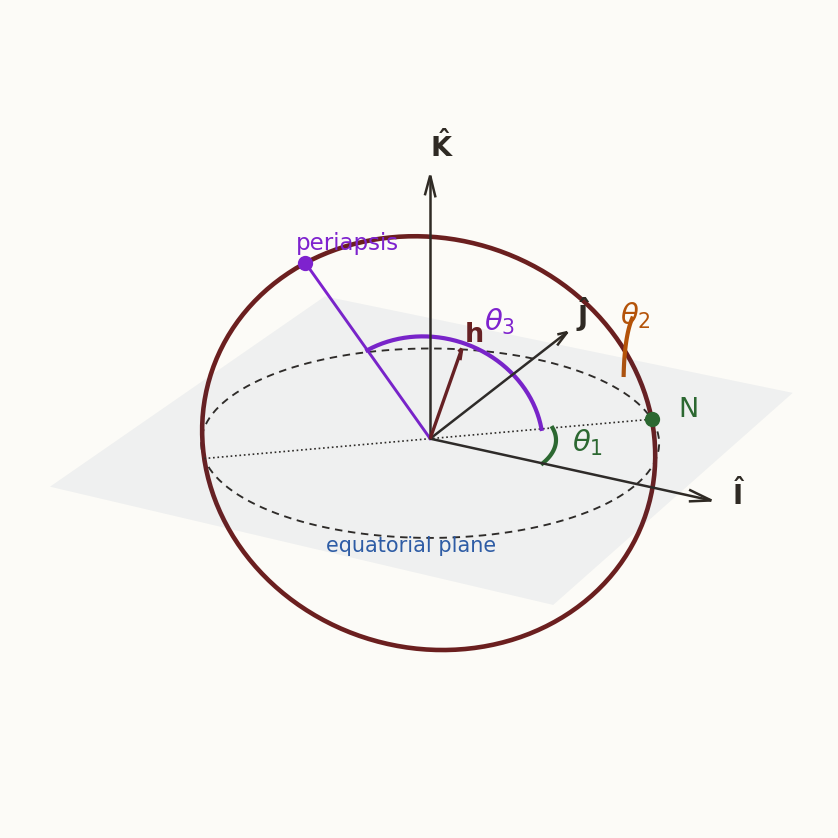
113. In Figure 4, which angle is the argument of periapsis?
- \(\theta_1\)
- \(\theta_2\)
- \(\theta_3\)
- none of them
Answer
(C) \(\theta_3\) lies in the orbit plane, from the ascending node N to periapsis. \(\theta_1\) (in the equator, from \(\hat{\mathbf I}\) to N) is \(\Omega\), and \(\theta_2\) (between the planes, at the node) is \(i\).
114. A polar orbit has inclination
- \(180^\circ\)
- \(90^\circ\)
- \(45^\circ\)
- \(0^\circ\)
Answer
(B) \(i=90^\circ\) makes \(\mathbf h\) lie in the equatorial plane, so the orbit passes over both poles.
115. A sun-synchronous orbit is one whose
- apse line points at the Sun
- period is one solar day
- plane always contains the Sun
- node moves east at the Sun’s mean rate, about \(0.986^\circ\) per day
Answer
(D) \(\dot\Omega=360^\circ/365.2422\ \mathrm d=0.9856^\circ/\)day keeps the orbit plane at a fixed angle to the Sun, so the local solar time of each pass is fixed.
116. An orbit has \(\mathbf h=(0,\ -h,\ 0)\). Its inclination is
- undefined
- \(180^\circ\)
- \(90^\circ\)
- \(0^\circ\)
Answer
(C) \(\cos i=h_K/h=0\), so \(i=90^\circ\): \(\mathbf h\) lies in the equatorial plane.
117. In the perifocal frame \(\{\hat{\mathbf P},\hat{\mathbf Q},\hat{\mathbf W}\}\), the unit vector \(\hat{\mathbf P}\) points
- towards the ascending node
- from the focus to periapsis
- along \(\mathbf h\)
- towards the vernal equinox
Answer
(B) \(\hat{\mathbf P}=\mathbf e/e\), \(\hat{\mathbf W}=\mathbf h/h\), and \(\hat{\mathbf Q}=\hat{\mathbf W}\times\hat{\mathbf P}\) is \(90^\circ\) ahead of periapsis in the direction of motion.
118. The rotation from the perifocal frame to the equatorial frame is the 3-1-3 sequence through the angles
- \(\omega\), \(\Omega\), \(i\)
- \(\Omega\), \(i\), \(\omega\)
- \(i\), \(\Omega\), \(\omega\)
- \(\Omega\), \(\omega\), \(i\)
Answer
(B) Turn about \(\hat{\mathbf K}\) by \(\Omega\) to the node line, tilt about it by \(i\), then turn about \(\hat{\mathbf h}\) by \(\omega\) to periapsis: \(\mathsf Q=\mathsf R_3(\Omega)\mathsf R_1(i)\mathsf R_3(\omega)\) maps perifocal to equatorial components.
119. Why does a set of orbital elements need an epoch for its reference frame (for example J2000)?
- Because the equator and the equinox themselves move slowly, so \(\hat{\mathbf I}\) and \(\hat{\mathbf K}\) must be fixed at a stated date
- Because the elements are not unique
- Because the Earth rotates
- Because the orbit changes with time
Answer
(A) Precession and nutation move the frame directions. Without an epoch, \(i\) and \(\Omega\) of the same physical orbit would differ between catalogues.
120. The deck computes \(\Omega=\arccos(n_I/n)\). When must this be replaced by \(360^\circ-\arccos(n_I/n)\)?
- when \(e_K<0\)
- when \(h_K<0\)
- when \(n_I<0\)
- when \(n_J<0\)
Answer
(D) \(\arccos\) returns \(0^\circ\) to \(180^\circ\). The node is in the lower half of the equator (\(180^\circ<\Omega<360^\circ\)) exactly when \(n_J<0\).
Level 2 — a little difficult (Q121–135)
121. An orbit has \(\mathbf h\) along \((0,\ -\sqrt3,\ 1)\). Its inclination is
- \(150^\circ\)
- \(120^\circ\)
- \(60^\circ\)
- \(30^\circ\)
Answer
(C) \(|\mathbf h|\propto2\), so \(\cos i=1/2\) and \(i=60^\circ\). Also \(\mathbf n\propto(\sqrt3,\,0,\,0)\), so \(\Omega=0^\circ\).
122. An orbit has \(\mathbf h\) along \((1,\ 1,\ 1)\). Its right ascension of the ascending node is
- \(315^\circ\)
- \(225^\circ\)
- \(135^\circ\)
- \(45^\circ\)
Answer
(C) \(\mathbf n=\hat{\mathbf K}\times\mathbf h=(-h_J,\ h_I,\ 0)\propto(-1,\ 1,\ 0)\), which is at \(135^\circ\) from \(\hat{\mathbf I}\). (Its inclination is \(\arccos(1/\sqrt3)=54.7^\circ\).)
123. The eccentricity vector of an inclined orbit has \(e_K<0\). Then
- the orbit is retrograde
- \(\Omega>180^\circ\)
- \(0^\circ<\omega<180^\circ\)
- \(180^\circ<\omega<360^\circ\)
Answer
(D) \(e_K=e\sin i\sin\omega\), with \(\sin i>0\). So \(e_K<0\) means \(\sin\omega<0\): periapsis is south of the equator.
124. At some instant \(\mathbf r\cdot\mathbf v<0\). Then the true anomaly is
- between \(0^\circ\) and \(180^\circ\)
- undefined
- exactly \(180^\circ\)
- between \(180^\circ\) and \(360^\circ\)
Answer
(D) \(\mathbf r\cdot\mathbf v=rv_r\) and \(v_r=(\mu/h)e\sin f\). Negative \(v_r\) means the body is falling towards periapsis, so \(\sin f<0\).
125. A satellite has \(i=98^\circ\). The greatest latitude its ground track reaches is
- \(98^\circ\)
- \(90^\circ\)
- \(82^\circ\)
- \(8^\circ\)
Answer
(C) \(\sin\delta=\sin i\sin u\), so \(|\delta|_{\max}=i\) for a prograde orbit and \(180^\circ-i=82^\circ\) for a retrograde one.
126. Sriharikota is at latitude \(13.7^\circ\) N. Ignoring range-safety limits on the launch azimuth, the smallest inclination reachable by a direct launch from there is
- \(76.3^\circ\)
- \(13.7^\circ\)
- \(6.9^\circ\)
- \(0^\circ\)
Answer
(B) \(\cos i=\cos\phi\sin\beta\le\cos\phi\), so \(i\ge\phi\), with equality for a launch due east. Lower inclinations need a plane change later.
127. Why must a sun-synchronous orbit be retrograde?
- Because \(J_2\) makes \(\dot\Omega\propto-\cos i\), and the node must move east (\(\dot\Omega>0\))
- Because the Earth rotates eastward
- Because the Sun moves westward in the sky
- Because only retrograde orbits are polar
Answer
(A) \(\dot\Omega=-\tfrac32nJ_2(R_\oplus/p)^2\cos i\). A positive rate needs \(\cos i<0\), i.e. \(i>90^\circ\).
128. For a polar orbit, the \(J_2\) drift of the node is
- zero
- the largest possible
- equal to the Sun’s rate
- westward
Answer
(A) \(\dot\Omega\propto\cos i=0\) at \(i=90^\circ\): the plane stays fixed in inertial space. (The apse line still drifts.)
129. A body is at \(\mathbf r=(7000,0,0)\) km with \(\mathbf v=(0,8,0)\) km/s. Its eccentricity is about
- \(0.50\)
- \(0.25\)
- \(0.12\)
- \(0.06\)
Answer
(C) The velocity is horizontal, so the body is at an apsis, with \(e=|\nu-1|\) for \(\nu=rv^2/\mu=7000\times64/398\,600=1.124\). Hence \(e=0.124\); \(\nu>1\), so this is periapsis, \(f=0^\circ\).
130. For the state of Question 129, the semi-major axis is about
- \(7000\) km
- \(7990\) km
- \(8930\) km
- \(56\,500\) km
Answer
(B) \(a=r/(2-\nu)=7000/0.876=7990\) km. Check: \(r_p=a(1-e)=7000\) km.
131. For a circular equatorial orbit, which single angle can describe where the body is?
- \(\Omega+\omega\)
- \(\omega+f\)
- \(f\)
- the true longitude, \(\Omega+\omega+f\), measured from \(\hat{\mathbf I}\)
Answer
(D) Neither \(\Omega\) nor \(\omega\) exists, but the angle from \(\hat{\mathbf I}\) to the body does. It is what \(\Omega+\omega+f\) tends to as \(i\) and \(e\) go to zero.
132. The longitude of periapsis \(\varpi\) is
- \(\Omega+\omega\)
- \(\omega\) measured in the ecliptic
- \(\omega+f\)
- \(\Omega-\omega\)
Answer
(A) \(\varpi=\Omega+\omega\), a “broken” angle: \(\Omega\) in the equator, then \(\omega\) in the orbit plane. It stays defined as \(i\to0\), where \(\Omega\) does not.
133. A satellite is at \(\mathbf r=(0,\ 7000,\ 0)\) km with \(\mathbf v=(0,\ 0,\ 7.546)\) km/s. Its \(i\) and \(\Omega\) are
- \(i=90^\circ\), \(\Omega=270^\circ\)
- \(i=0^\circ\), \(\Omega\) undefined
- \(i=90^\circ\), \(\Omega=90^\circ\)
- \(i=90^\circ\), \(\Omega=0^\circ\)
Answer
(C) \(\mathbf h=\mathbf r\times\mathbf v=(7000\times7.546,\ 0,\ 0)\), along \(+\hat{\mathbf I}\), so \(i=90^\circ\). \(\mathbf n=\hat{\mathbf K}\times\mathbf h\) is along \(+\hat{\mathbf J}\), so \(\Omega=90^\circ\). The body is at the ascending node, moving north.
134. The ISS orbit has \(i=51.6^\circ\). When its argument of latitude is \(u=30^\circ\), its latitude is about
- \(15.0^\circ\)
- \(23.1^\circ\)
- \(25.8^\circ\)
- \(30.0^\circ\)
Answer
(B) \(\sin\delta=\sin i\sin u=0.7837\times0.5=0.392\), so \(\delta=23.1^\circ\). (Halving \(i\), \(25.8^\circ\), is the common mistake.)
135. A program finds \(\arccos(n_I/n)=60^\circ\) and \(n_J<0\). The correct \(\Omega\) is
- \(300^\circ\)
- \(240^\circ\)
- \(120^\circ\)
- \(60^\circ\)
Answer
(A) With \(n_J<0\) the node is in the lower half-plane, so \(\Omega=360^\circ-60^\circ=300^\circ\).
Level 3 — hard (Q136–150)
136. The velocity of a satellite is reversed at some instant, \(\mathbf v\to-\mathbf v\). Its new \((i,\Omega,\omega)\) are
- \((180^\circ-i,\ \Omega+180^\circ,\ 180^\circ-\omega)\)
- \((i,\ \Omega,\ \omega)\)
- \((i,\ \Omega+180^\circ,\ \omega+180^\circ)\)
- \((180^\circ-i,\ \Omega,\ \omega)\)
Answer
(A) \(\mathbf h\to-\mathbf h\) but \(\mathbf e\) is unchanged. So \(\cos i\) flips, the node becomes the old descending node, and since \(e_K=e\sin i\sin\omega\) keeps its value while \(\cos\omega\) flips, \(\omega\to180^\circ-\omega\). The last option is the reflection in the equator.
137. A rocket is launched from latitude \(13.72^\circ\) on an inertial azimuth of \(135^\circ\) (south-east). The inclination of the orbit is about
- \(13.7^\circ\)
- \(45.0^\circ\)
- \(46.6^\circ\)
- \(133.4^\circ\)
Answer
(C) \(\cos i=\cos\delta\sin\beta=\cos13.72^\circ\times\sin135^\circ=0.687\), so \(i=46.6^\circ\). Launching south-east or north-east gives the same inclination.
138. For an exactly equatorial orbit, a program evaluates \(\Omega=\operatorname{atan2}(h_I,-h_J)\). What happens?
- It returns \(90^\circ\)
- It raises an error
- It returns NaN
- It returns \(0\) without any warning
Answer
(D) \(h_I=h_J=0\), and \(\operatorname{atan2}(0,0)\) is defined to be \(0\) in most libraries. The program prints a confident \(\Omega=0\), so a test on \(\sin i\) is still needed.
139. A small impulse along \(\hat{\mathbf h}\) is applied exactly at the ascending node. To first order it changes
- \(i\) only
- \(a\) and \(e\)
- \(\Omega\) only
- \(i\) and \(\Omega\)
Answer
(A) An out-of-plane push rotates the orbit about \(\mathbf r\). At the node \(\mathbf r\) lies along the node line, so the rotation tilts the plane about that line (\(\Delta i=r\Delta v/h\)) and leaves \(\Omega\) and \(\omega\) alone.
140. An orbit has \(e=10^{-4}\). A small error \(\delta e=10^{-5}\) in the eccentricity vector, perpendicular to it, changes \(\omega\) by about
- \(57^\circ\)
- \(5.7^\circ\)
- \(0.06^\circ\)
- \(0.0006^\circ\)
Answer
(B) \(\delta\omega=|\delta\mathbf e|/e=0.1\) rad \(=5.7^\circ\). For a nearly circular orbit \(\omega\) is ill-conditioned, although the position barely changes; \((e\cos\omega,e\sin\omega)\) are well behaved.
141. A Molniya orbit has \(e=0.74\) and \(\omega=270^\circ\). The fraction of each period it spends north of the equator is about
- \(50\%\)
- \(74\%\)
- \(92\%\)
- \(99\%\)
Answer
(C) The southern arc is the half centred on periapsis, \(|f|<90^\circ\), which takes \((\arccos e-e\sqrt{1-e^2})/\pi=0.076\) of the period. So \(92\%\) is spent north, near apoapsis.
142. With \(J_2=1.08263\times10^{-3}\), a circular sun-synchronous orbit at \(700\) km altitude needs an inclination of about
- \(90.0^\circ\)
- \(96.5^\circ\)
- \(98.2^\circ\)
- \(101.4^\circ\)
Answer
(C) \(n=\sqrt{\mu/a^3}=1.060\times10^{-3}\) rad/s for \(a=7078\) km. Then \(\cos i=-\dfrac{2\dot\Omega_\odot}{3nJ_2(R_\oplus/a)^2}=-\dfrac{2\times1.991\times10^{-7}}{3\times9.32\times10^{-7}}=-0.142\), so \(i=98.2^\circ\).
143. The \(\hat{\mathbf K}\) component of the perifocal unit vector \(\hat{\mathbf P}\) (towards periapsis) is
- \(\sin\Omega\sin i\)
- \(\sin i\cos\omega\)
- \(\cos i\)
- \(\sin i\sin\omega\)
Answer
(D) In the node frame periapsis is at \((\cos\omega,\sin\omega,0)\). Tilting by \(i\) about the node line gives \(K\) component \(\sin i\sin\omega\), and the turn by \(\Omega\) about \(\hat{\mathbf K}\) leaves it alone. This is why the sign of \(e_K\) fixes the quadrant of \(\omega\).
144. A body is at \(\mathbf r=(7000,0,0)\) km with \(\mathbf v=(1,\ 7.546,\ 0)\) km/s, where \(7.546\) km/s is the circular speed at \(7000\) km. Its eccentricity and true anomaly are
- \(e=0\), \(f\) undefined
- \(e=0.13\), \(f=90^\circ\)
- \(e=0.13\), \(f=0^\circ\)
- \(e=0.13\), \(f=270^\circ\)
Answer
(B) The transverse speed is circular, so \(h^2/\mu=r\): the body is at \(r=p\), i.e. \(\cos f=0\). Moving outwards (\(v_r>0\)) gives \(f=90^\circ\), and \(e=v_r/(\mu/h)=1/7.546=0.13\).
145. Why is \(i=\operatorname{atan2}\bigl(\sqrt{h_I^2+h_J^2},\ h_K\bigr)\) preferred to \(i=\arccos(h_K/h)\) for nearly equatorial orbits?
- They give different answers for retrograde orbits
- \(\arccos\) is very steep near \(1\), so it loses precision as \(i\to0\)
- \(\arccos\) cannot return angles below \(1^\circ\)
- \(\operatorname{atan2}\) gives the quadrant of \(i\)
Answer
(B) \(\cos i\approx1-i^2/2\), so a rounding error in \(h_K/h\) becomes a much larger error in \(i\); below \(i\approx10^{-8}\) rad, \(\arccos\) returns exactly \(0\). The \(\operatorname{atan2}\) form uses \(\sqrt{h_I^2+h_J^2}\approx h\,i\) directly.
146. A satellite’s state is reflected in the equatorial plane, \((x,y,z,\dot x,\dot y,\dot z)\to(x,y,-z,\dot x,\dot y,-\dot z)\). Its new \((i,\Omega,\omega)\) are
- \((i,\ \Omega+180^\circ,\ \omega+180^\circ)\)
- \((-i,\ \Omega,\ \omega)\)
- \((180^\circ-i,\ \Omega+180^\circ,\ 180^\circ-\omega)\)
- \((i,\ \Omega,\ -\omega)\)
Answer
(A) \(\mathbf h\) is a pseudovector: \(\mathbf h\to(-h_I,-h_J,h_K)\), so \(i\) is kept and the node turns by \(180^\circ\). \(\mathbf e\) reflects like \(\mathbf r\), so \(e_K\) flips sign and \(\omega\) moves by \(180^\circ\).
147. A small push along \(\hat{\mathbf h}\) is applied at \(u=90^\circ\) to an orbit with \(i=0.5^\circ\). Which statement is correct?
- \(\Omega\) and \(\omega\) change by large, nearly opposite amounts, while \(\Omega+\omega\) hardly changes
- only \(i\) changes
- \(a\) changes
- \(\Omega\) and \(\omega\) hardly change
Answer
(A) \(\Delta\Omega\propto1/\sin i\) is large and \(\Delta\omega=-\cos i\,\Delta\Omega\) nearly cancels it: \(\Delta\varpi=(1-\cos i)\Delta\Omega\to0\). The orbit barely moves; only the split into \(\Omega\) and \(\omega\) is ill-defined.
148. A small impulse purely along \(\hat{\mathbf r}\) is applied at a general point of an elliptical orbit. To first order, which quantities are certainly unchanged?
- \(i\), \(\Omega\) and \(p\); while \(a\), \(e\), \(\omega\) and \(f\) may all change
- \(a\) and \(e\) only
- \(a\), \(i\) and \(\Omega\); while \(e\), \(\omega\) and \(f\) change
- none of the elements
Answer
(A) \(\mathbf r\times\Delta\mathbf v=\mathbf 0\), so \(\mathbf h\) is unchanged in size and direction: the plane (\(i\), \(\Omega\)) and \(p=h^2/\mu\) stay fixed. But the energy changes by \(v_r\,\Delta v\), which is first order unless the burn is at an apsis (\(v_r=0\)). So \(a\) changes in general, and with it \(e\), the apse line and \(f\).
149. The equinox drifts along the ecliptic by about \(50.3''\) per year. Over a century this is about
- \(0.014^\circ\)
- \(0.14^\circ\)
- \(1.4^\circ\)
- \(14^\circ\)
Answer
(C) \(50.3''\times100=5030''=1.40^\circ\). Elements referred to a frame a century old can be off by more than a degree in \(\Omega\), which is why the epoch must be stated.
150. At \(i=0\) the 3-1-3 rotation \(\mathsf R_3(\Omega)\mathsf R_1(i)\mathsf R_3(\omega)\) becomes singular because
- the orbit has no periapsis
- the matrix is not orthogonal
- \(\cos i=1\) cannot be inverted
- the first and third rotations are about the same axis, so only \(\Omega+\omega\) is determined
Answer
(D) With \(i=0\), \(\mathsf R_1(0)=\mathsf I\) and the product is \(\mathsf R_3(\Omega+\omega)\). Any pair with the same sum gives the same orbit: the gimbal lock of Euler angles.
Orbital maneuvers
Level 1 — very easy (Q151–170)
151. A burn may be treated as impulsive when
- it is made at periapsis
- its duration is short compared with the orbital period, so the position barely changes during it
- the engine has a high specific impulse
- its \(\Delta v\) is small compared with the orbital speed
Answer
(B) The impulsive model changes \(\mathbf v\) instantly at fixed \(\mathbf r\). That is accurate when the spacecraft moves through only a small arc while the engine fires.
152. An engine with \(I_{sp}=300\) s burns until the mass has halved. The \(\Delta v\) delivered is about (\(g_0=9.80665\ \mathrm{m/s^2}\))
- \(4.08\) km/s
- \(2.94\) km/s
- \(2.04\) km/s
- \(1.47\) km/s
Answer
(C) Rocket equation: \(\Delta v=g_0I_{sp}\ln(m_0/m_f)=9.80665\times300\times\ln2=2039\) m/s.
153. A Hohmann transfer between coplanar circles consists of
- three burns, the middle one at infinity
- one burn at the crossing point of the circles
- two radial burns
- two tangential burns, at the periapsis and the apoapsis of the transfer ellipse
Answer
(D) The transfer ellipse touches the inner circle at its periapsis and the outer circle at its apoapsis; both burns are along the velocity.
154. The semi-major axis of the Hohmann transfer ellipse between circles \(r_1\) and \(r_2\) is
- \(2r_1r_2/(r_1+r_2)\)
- \(r_2-r_1\)
- \(\sqrt{r_1r_2}\)
- \((r_1+r_2)/2\)
Answer
(D) Its apsides are \(r_1\) and \(r_2\), so \(2a_t=r_1+r_2\). (\(\sqrt{r_1r_2}\) is its semi-minor axis and \(2r_1r_2/(r_1+r_2)\) its semi-latus rectum.)
155. The total \(\Delta v\) of a coplanar Hohmann transfer from a \(6678\) km circle to GEO (\(42\,164\) km) is about
- \(2.43\) km/s
- \(3.89\) km/s
- \(4.33\) km/s
- \(5.40\) km/s
Answer
(B) \(\Delta v_1=v_{t1}-v_{c1}=10.151-7.726=2.426\) km/s and \(\Delta v_2=v_{c2}-v_{t2}=3.075-1.608=1.467\) km/s; the total is \(3.893\) km/s.
156. The transfer time of that Hohmann transfer is about
- \(2.6\) h
- \(5.3\) h
- \(10.5\) h
- \(23.9\) h
Answer
(B) Half the period of the ellipse with \(a_t=24\,421\) km: \(\pi\sqrt{a_t^3/\mu}=18\,990\) s \(=5.28\) h.
157. To change the plane of an orbit most cheaply, the burn should be made where
- the speed is greatest
- the orbit crosses the ecliptic
- the spacecraft is at periapsis
- the speed is least, for example at apoapsis
Answer
(D) A pure plane change costs \(2v\sin(\Delta i/2)\), proportional to the speed at the burn. It must be made on the line where the two planes meet, at the slower of the two crossings.
158. A spacecraft moving at \(7.5\) km/s turns its orbit plane by \(60^\circ\) without changing speed. The cost is
- \(15.0\) km/s
- \(7.50\) km/s
- \(6.50\) km/s
- \(3.75\) km/s
Answer
(B) \(\Delta v=2v\sin(\Delta i/2)=2\times7.5\times\sin30^\circ=7.5\) km/s: a \(60^\circ\) turn costs as much as the whole orbital speed.
159. Comparing Hohmann and bi-elliptic transfers between coplanar circles of ratio \(R=r_2/r_1\),
- Hohmann is cheaper than every bi-elliptic for \(R<11.94\), and every bi-elliptic is cheaper for \(R>15.58\)
- bi-elliptic is cheaper for \(R<11.94\)
- Hohmann is always cheaper
- bi-elliptic is always cheaper
Answer
(A) Between \(11.94\) and \(15.58\) the answer depends on the intermediate apoapsis \(r_b\). The bi-elliptic transfer always takes much longer.
160. A chaser on the same circular orbit as its target is \(20^\circ\) behind it. To catch up with a phasing manoeuvre, it should enter a phasing orbit that is
- larger, with a longer period
- circular and higher
- the same size, but inclined
- smaller, with a shorter period
Answer
(D) It must complete its revolutions in less time than the target needs for \(2\pi k-\Delta\theta\). A shorter period needs a smaller \(a\), so it slows down (retrograde burn) to drop into a lower ellipse.
161. To add a given amount of orbital energy with the least \(\Delta v\), a tangential burn should be made
- at the end of the minor axis
- anywhere, because energy is path-independent
- where the speed is least, at apoapsis
- where the speed is greatest, at periapsis
Answer
(D) \(\Delta\varepsilon\approx v\,\Delta v\), so each m/s buys most energy where \(v\) is largest: the Oberth effect.
162. The return Hohmann transfer, from the outer circle back to the inner one, costs
- less, because gravity helps
- the same, with each burn retrograde instead of prograde
- more, because the spacecraft must fight gravity
- the same only if the burns are made at the same points
Answer
(B) The two speeds at each end are the same either way, so \(|v_t-v_{\rm orbit}|\) is unchanged. Impulsive \(\Delta v\) is symmetric under time reversal.
163. The \(\Delta v\) to escape from a circular orbit of radius \(6678\) km is about
- \(2.26\) km/s
- \(3.20\) km/s
- \(7.73\) km/s
- \(10.93\) km/s
Answer
(B) \(\Delta v=(\sqrt2-1)v_c=0.4142\times7.726=3.200\) km/s. (\(10.93\) km/s is the escape speed itself.)
164. A small prograde tangential burn at periapsis
- raises the apoapsis and leaves the periapsis where it is
- lowers the apoapsis
- raises the periapsis
- rotates the apse line
Answer
(A) The radius at the burn is unchanged and the velocity stays horizontal there, so it remains the periapsis. The extra energy goes into the far side of the orbit.
165. A small purely radial impulse is applied to a spacecraft on a circular orbit. To first order it
- leaves the energy and \(a\) unchanged, and makes the orbit slightly eccentric
- raises the orbit’s energy
- changes the inclination
- leaves the orbit circular
Answer
(A) On a circle \(v_r=0\), so \(\mathbf v\cdot\Delta\mathbf v=0\) and \(\Delta\varepsilon=\tfrac12\Delta v^2\) is second order. The new radial velocity makes \(e=\Delta v/v_c\).
166. Why is aerobraking attractive when arriving at a planet?
- It raises the periapsis
- It changes the inclination
- The atmosphere supplies the retrograde impulse at no propellant cost
- It provides prograde impulses free
Answer
(C) Capture and lowering of the apoapsis need retrograde \(\Delta v\); drag provides it. Nothing comparable supplies prograde impulses for departure.
167. Among all two-impulse transfers between two coplanar circular orbits, the Hohmann transfer
- is the only one with tangential burns
- is the cheapest only for \(R>15.58\)
- has the shortest transfer time
- has the least total \(\Delta v\)
Answer
(D) The deck proves Hohmann optimal among two-impulse transfers (A3). Faster two-impulse transfers exist, but cost more.
168. In units of \(v_{c1}\), the total cost of a Hohmann transfer is greatest at a radius ratio of about
- \(3.3\)
- \(11.9\)
- \(15.6\)
- it keeps increasing with \(R\)
Answer
(C) The cost rises until \(R=15.58\) and then falls towards \(\sqrt2-1\). (\(11.94\) is where the bi-parabolic transfer first beats Hohmann.)
169. An apse-line rotation keeping \(p\) and \(e\) is done with a single impulse at a point where the old and new orbits cross. That impulse is
- tangential
- inclined at \(45^\circ\)
- along \(\mathbf h\)
- purely radial
Answer
(D) At the crossing both orbits have the same \(r\), the same \(h\) (same \(p\)) and the same energy. So they share \(v_\theta\) and \(|v_r|\), and only the sign of \(v_r\) changes: \(\Delta v=2|v_r|\).
170. At GEO arrival, combining the plane change with the circularisation burn into one burn is cheaper than doing them separately because
- the magnitude of a vector sum is less than the sum of the magnitudes
- the transfer time is shorter
- plane changes cost nothing at apoapsis
- the combined burn is made at higher speed
Answer
(A) Two burns \(\Delta\mathbf v_a\) and \(\Delta\mathbf v_b\) cost \(|\Delta\mathbf v_a|+|\Delta\mathbf v_b|\), while one burn achieving both costs \(|\Delta\mathbf v_a+\Delta\mathbf v_b|\), which is smaller unless they are parallel (triangle inequality).
Level 2 — a little difficult (Q171–185)
171. A spacecraft on a \(7000\) km circle raises its apoapsis to \(14\,000\) km with one tangential burn. The burn is about
- \(8.71\) km/s
- \(1.54\) km/s
- \(1.17\) km/s
- \(0.58\) km/s
Answer
(C) \(v_p=\sqrt{2\mu r_a/(r_p(r_p+r_a))}=8.713\) km/s and \(v_c=7.546\) km/s, so \(\Delta v=1.167\) km/s.
172. A GEO satellite is to catch up a slot \(45^\circ\) ahead of it in one revolution of a phasing orbit. The phasing period must be about (GEO period \(23.934\) h)
- \(26.93\) h
- \(23.93\) h
- \(20.94\) h
- \(11.97\) h
Answer
(C) The target covers \(360^\circ-45^\circ\) while the chaser goes round once, so \(T_{ph}=T(1-45/360)=0.875\times23.934=20.94\) h.
173. At GEO arrival (\(v_{t2}=1.608\) km/s, \(v_{c2}=3.075\) km/s), a \(28.5^\circ\) plane change is combined with circularisation. The single burn costs about
- \(1.47\) km/s
- \(1.83\) km/s
- \(2.98\) km/s
- \(4.68\) km/s
Answer
(B) \(\Delta v=\sqrt{v_{t2}^2+v_{c2}^2-2v_{t2}v_{c2}\cos28.5^\circ}=1.830\) km/s. Done separately it would cost \(1.467+2\times3.075\sin14.25^\circ=2.981\) km/s.
174. To leave a \(6678\) km circular orbit with \(v_\infty=3\) km/s needs a single prograde burn of about
- \(3.00\) km/s
- \(3.20\) km/s
- \(3.60\) km/s
- \(6.20\) km/s
Answer
(C) The speed needed at \(r\) is \(\sqrt{v_\infty^2+2\mu/r}=\sqrt{9+119.38}=11.330\) km/s, so \(\Delta v=11.330-7.726=3.605\) km/s. Adding \(v_\infty\) to the escape burn (\(3.20+3\)) is the common mistake.
175. In a bi-elliptic transfer to a very distant circle, where does the saving over Hohmann come from?
- from the middle burn at \(r_b\), which is tiny because the spacecraft moves very slowly there
- from the shorter transfer time
- from avoiding the first burn
- from making all burns radial
Answer
(A) The first burn is nearly the escape burn either way. The middle burn at the far apoapsis costs little, and it lets the spacecraft fall back to \(r_2\) needing only a small final burn.
176. A Hohmann transfer from the Earth’s orbit (\(1\) AU) to Mars’s orbit (\(1.524\) AU), both taken circular and coplanar, takes about
- \(146\) d
- \(259\) d
- \(343\) d
- \(517\) d
Answer
(B) \(a_t=1.262\) AU, and half its period is \(\tfrac12(1.262)^{3/2}\) yr \(=0.709\) yr \(=259\) d.
177. Mars has a sidereal period of \(686.98\) d. Launch windows for a Hohmann transfer from the Earth recur every
- \(1052\) d
- \(780\) d
- \(687\) d
- \(365\) d
Answer
(B) The synodic period is \(1/(1/365.25-1/686.98)=780\) d, about \(2.1\) years: the relative geometry repeats only that often.
178. In any Hohmann transfer outward between circles,
- which burn is larger depends on \(R\)
- the two burns are always equal
- the burn on the outer circle is always the larger
- the burn on the inner circle is always the larger
Answer
(D) \(\Delta v_1-\Delta v_2=\sqrt\mu\,\bigl(\sqrt{2(r_1+r_2)}-\sqrt{r_1}-\sqrt{r_2}\bigr)/\sqrt{r_1r_2}>0\), because the arithmetic mean of \(\sqrt{r_1}\), \(\sqrt{r_2}\) is below their root-mean-square.
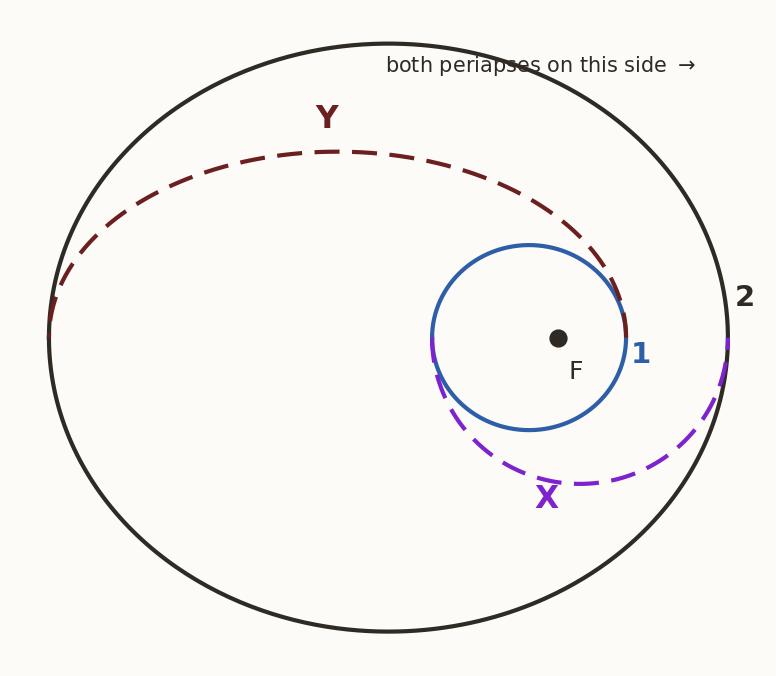
179. In Figure 5, orbit 1 is to be transferred to orbit 2. Which route is cheaper?
- X, because its transfer ellipse is smaller
- Y, but only for these particular orbits
- they cost the same
- Y, and it is cheaper for every pair of aligned orbits with \(r_{p1}<r_{p2}\), \(r_{a1}<r_{a2}\)
Answer
(D) Y leaves orbit 1 at its periapsis (deep, fast: efficient) and arrives at orbit 2 at its apoapsis (where orbit 2 is slow: cheap to match). The deck proves this always wins for aligned apsides (A12). Here Y costs \(1.855\) km/s against \(2.499\) km/s.
180. An ellipse is to be turned into a circle with a single burn. The cheapest place to burn is
- apoapsis
- an end of the latus rectum
- periapsis
- an end of the minor axis
Answer
(A) At an apsis the burn is tangential. At apoapsis it costs \(\sqrt{\mu/p}\,s_-(1-s_-)\) with \(s_\pm=\sqrt{1\pm e}\), always less than the periapsis cost \(\sqrt{\mu/p}\,s_+(s_+-1)\). The ends of the latus rectum are the dearest places.
181. An orbit with \(p=10\,000\) km and \(e=0.3\) has its apse line turned by \(60^\circ\) with one impulse. The cost is about
- \(3.79\) km/s
- \(3.28\) km/s
- \(1.89\) km/s
- \(0.95\) km/s
Answer
(C) \(\Delta v=2\sqrt{\mu/p}\,e\sin(\eta/2)=2\times6.314\times0.3\times0.5=1.894\) km/s.
182. A circular orbit with \(v=7.5\) km/s and \(i=30^\circ\) has its node moved by \(60^\circ\) at constant inclination. The single burn costs
- \(1.88\) km/s
- \(3.75\) km/s
- \(6.50\) km/s
- \(7.50\) km/s
Answer
(B) \(\Delta v=2v\sin i\sin(\Delta\Omega/2)=2\times7.5\times0.5\times0.5=3.75\) km/s, half of what an inclination change of \(60^\circ\) would cost.
183. A stage with \(I_{sp}=450\) s must deliver \(3\) km/s. The fraction of its initial mass that is propellant is about
- \(68\%\)
- \(49\%\)
- \(39\%\)
- \(25\%\)
Answer
(B) \(m_f/m_0=e^{-\Delta v/(g_0I_{sp})}=e^{-0.680}=0.507\), so the propellant is \(49.3\%\) of the initial mass.
184. By Lambert’s theorem, the time of flight between two points on a Kepler orbit depends only on
- the eccentricity and \(a\)
- \(r_1\), \(r_2\) and the transfer angle
- the angular momentum
- the semi-major axis, \(r_1+r_2\) and the chord \(c\) between the points
Answer
(D) \(t=t(a,\ r_1+r_2,\ c)\): the orbit’s eccentricity and orientation do not enter. This is what makes the Lambert problem solvable by one-variable iteration.
185. Two satellites are on circular orbits a few kilometres apart in radius. Relative to the upper one, the lower one
- stays fixed below it
- oscillates up and down without drifting
- drifts behind
- drifts ahead, because its period is shorter
Answer
(D) Lower circular orbits are faster. This is the basis of phasing by a small altitude offset, and of the along-track drift in the Clohessy–Wiltshire equations.
Level 3 — hard (Q186–200)
186. A chaser on a \(7000\) km circle trails its target by \(30^\circ\) and uses circular phasing with \(k\) revolutions. Taking \(R_\oplus=6378\) km, the smallest \(k\) that keeps the phasing perigee above the Earth’s surface is
- \(1\)
- \(2\)
- \(3\)
- \(4\)
Answer
(B) With \(k=1\), \(a=7000(11/12)^{2/3}=6605\) km and the perigee \(2a-7000=6211\) km is below the surface. With \(k=2\), \(a=7000(23/24)^{2/3}=6804\) km and the perigee is \(6608\) km.
187. For \(R=r_2/r_1=20\), compare the Hohmann transfer (cost \(0.535\,v_{c1}\)) with the bi-parabolic transfer (\(r_b\to\infty\)). Which is cheaper?
- bi-parabolic, by about \(5\%\)
- Hohmann, by about \(5\%\)
- they cost the same
- bi-parabolic, by about \(50\%\)
Answer
(A) Bi-parabolic: escape from \(r_1\), then fall back from infinity and slow to \(v_{c2}\): \((\sqrt2-1)(1+1/\sqrt{20})\,v_{c1}=0.507\,v_{c1}\). So it is cheaper by \(0.028\,v_{c1}\), about \(5\%\), as expected beyond \(R=15.58\) (but it takes forever).
188. The ratio \(R^\ddagger=15.58\) at which the Hohmann cost is greatest is
- \((1+\sqrt2)^2\)
- the only root above \(1\) of \(R^3-15R^2-9R-1=0\)
- the root of \(R^3-5R^2-5R-1=0\)
- \(9+4\sqrt5\)
Answer
(B) Setting \(dg/dR=0\) and clearing the roots gives \(2(1+3R)^2=(1+R)^3\), i.e. the stated cubic. The last cubic gives the peak of the arrival burn alone (\(R\approx5.88\)).
189. To turn the plane of a circular orbit by \(50^\circ\), the spacecraft first raises its apoapsis to \(Kr_1\), turns the plane there, and comes back. The best \(K\) is about
- \(1\) (turn directly)
- \(1.37\)
- \(2.73\)
- \(\infty\)
Answer
(C) With \(\sigma=\sin25^\circ=0.4226\), the optimum is \(K^*=\sigma/(1-2\sigma)=2.73\) (valid for \(\tfrac13<\sigma<\tfrac12\)). It costs \(0.794\,v_c\), against \(0.845\,v_c\) for the direct turn.
190. A spacecraft on a circle of radius \(r\) is to escape with excess speed \(v_\infty\). Diving first to a low periapsis and burning there pays off exactly when
- \(v_\infty>v_c\)
- \(v_\infty>0\)
- never
- \(v_\infty>\sqrt2\,v_c\), the local escape speed
Answer
(D) The deepest dive costs \(v_c\) (all the cost is in stopping); the direct burn costs \(\sqrt{v_\infty^2+2v_c^2}-v_c\). These are equal at \(v_\infty=\sqrt2\,v_c\), and the slope test for a shallow dive gives the same threshold.
191. A small plane change \(\Delta i\) is shared between the two burns of a Hohmann transfer. To lowest order, the optimum gives the inner (first) burn
- less than half of \(\Delta i\), for every \(R>1\)
- more than half, because it is the larger burn
- exactly half
- all of it
Answer
(A) The extra cost of each burn is \(\propto v\,v'\,\delta^2/\Delta v_{\rm burn}\). The speeds at the inner circle are higher by \(R^{3/2}\), which outweighs its larger \(\Delta v\), so most of the turn goes to the outer burn (\(9.4\%\) to the inner one for LEO \(\to\) GEO, in the small-angle limit).
192. An orbit with \(e=0.4\) is to have its apse line turned by \(\eta\), either with one radial burn or by circularising at apoapsis and leaving the circle again. The single burn is cheaper only for \(\eta\) below about
- \(30.0^\circ\)
- \(43.6^\circ\)
- \(51.8^\circ\)
- \(60.0^\circ\)
Answer
(C) The crossover is \(\sin(\eta_c/2)=s_-/(1+s_-)\) with \(s_-=\sqrt{0.6}=0.7746\): \(0.4365\), so \(\eta_c=51.8^\circ\). It tends to \(60^\circ\) as \(e\to0\).
193. A chaser on a \(7000\) km circle trails its target by \(10^\circ\) and closes the gap by phasing in about one day. Using \(\Delta v_{\rm total}\,t\approx\tfrac23\,r\,\Delta\theta\), the total cost is about
- \(94\) m/s
- \(28\) m/s
- \(9.4\) m/s
- \(0.9\) m/s
Answer
(C) \(\tfrac23\times7000\times0.1745=814.5\) km, divided by \(86\,400\) s: \(9.4\times10^{-3}\) km/s. Halving the time would double the cost.
194. A circle of radius \(p\) crosses an ellipse of the same semi-latus rectum \(p\) (as in Midsem 2026, Q6). A single impulse at the crossing transfers between them. Compared with all other one-burn circle-to-ellipse switches, this point is
- the dearest, costing \(e\sqrt{\mu/p}\)
- the cheapest
- impossible, since the orbits do not touch
- equal in cost to an apsidal burn
Answer
(A) The one-burn cost satisfies \(\Delta v^2=(\mu/p)\bigl[e^2-(x-1)^2(2x+1)\bigr]\) with \(x^2=1+e\cos f\); it is largest at \(x=1\), i.e. \(f=\pm90^\circ\), which is exactly where \(r=p\). The burn there is purely radial.
195. For coaxial ellipses with anti-aligned apsides, the two apsidal routes (periapsis-to-periapsis and apoapsis-to-apoapsis) compare as follows:
- either can be cheaper, depending on the four radii
- apoapsis-to-apoapsis is always cheaper
- periapsis-to-periapsis is always cheaper
- they always cost the same
Answer
(A) The periapsis of orbit 1 and the apoapsis of orbit 2 are on the same side, so no route can obey both “leave deep” and “arrive slow”. When orbit 1 is a circle apoapsis-to-apoapsis wins; when orbit 2 is a circle periapsis-to-periapsis wins.
196. For a Hohmann transfer to a very distant circle (\(R\to\infty\)), the ratio \(\Delta v_1/\Delta v_2\) behaves like
- \(1\)
- \(R^{3/2}\)
- \((\sqrt2-1)\sqrt R\)
- \(\sqrt2-1\)
Answer
(C) \(\Delta v_1\to(\sqrt2-1)v_{c1}\), the escape burn, while \(\Delta v_2\approx v_{c1}/\sqrt R\), the target’s own circular speed.
197. From a \(6678\) km circle, a spacecraft must depart with \(v_\infty=3\) km/s. One plan burns directly (\(3.60\) km/s). Another first goes to GEO by Hohmann (\(3.89\) km/s) and departs from there. The second plan costs in total about
- \(6.10\) km/s
- \(5.10\) km/s
- \(3.60\) km/s
- \(2.21\) km/s
Answer
(A) From GEO, \(\sqrt{9+2\times9.454}-3.075=2.208\) km/s, so the total is \(3.893+2.208=6.10\) km/s. Climbing out first throws away the Oberth advantage of the deep, fast burn.
198. A satellite on a \(500\) km circular orbit (\(R_\oplus=6378\) km) lowers its perigee to \(80\) km altitude for re-entry with one retrograde burn. The burn is about
- \(12\) m/s
- \(121\) m/s
- \(242\) m/s
- \(1.2\) km/s
Answer
(B) \(v_c=\sqrt{\mu/6878}=7.6127\) km/s. The new apoapsis speed is \(\sqrt{2\mu r_p/(r_a(r_a+r_p))}=7.4919\) km/s with \(r_p=6458\) km, so \(\Delta v=0.1208\) km/s.
199. In the Clohessy–Wiltshire equations, which relative position is an equilibrium (the chaser stays put relative to the target)?
- any cross-track offset
- only the origin
- any radial offset, with zero relative velocity
- any along-track offset, with zero relative velocity
Answer
(D) A chaser displaced only along the track is on the same circular orbit, a little behind or ahead, and stays there. A radial offset with zero relative velocity puts it on an ellipse with a different period, so it drifts.
200. For a Lambert transfer from \(r_1=7000\) km to \(r_2=14\,000\) km through \(90^\circ\), the minimum-energy transfer ellipse has \(a_{\min}=s/2\), where \(s\) is the semi-perimeter of the triangle formed by the focus and the two points. \(a_{\min}\) is about
- \(7826\) km
- \(9163\) km
- \(10\,500\) km
- \(18\,326\) km
Answer
(B) The chord is \(c=\sqrt{7000^2+14\,000^2}=15\,652\) km, so \(s=(7000+14\,000+15\,652)/2=18\,326\) km and \(a_{\min}=9163\) km. (\(10\,500\) km is the Hohmann value, for a \(180^\circ\) transfer.)
Answer key
All \(200\) answers, by topic.
Answer
The \(n\)-body problem
| 1 C | 2 C | 3 D | 4 C | 5 B | 6 C | 7 B | 8 D | 9 C | 10 B |
| 11 A | 12 C | 13 D | 14 C | 15 A | 16 A | 17 A | 18 B | 19 B | 20 C |
| 21 C | 22 B | 23 B | 24 B | 25 C | 26 C | 27 C | 28 D | 29 D | 30 D |
| 31 A | 32 C | 33 D | 34 B | 35 B | 36 B | 37 B | 38 A | 39 A | 40 B |
| 41 D | 42 D | 43 A | 44 A | 45 C | 46 B | 47 D | 48 D | 49 A | 50 D |
The two-body problem
| 51 A | 52 A | 53 A | 54 D | 55 A | 56 D | 57 C | 58 C | 59 C | 60 B |
| 61 A | 62 D | 63 B | 64 A | 65 D | 66 B | 67 C | 68 B | 69 B | 70 C |
| 71 B | 72 B | 73 D | 74 B | 75 C | 76 C | 77 B | 78 C | 79 A | 80 B |
| 81 A | 82 C | 83 D | 84 D | 85 C | 86 B | 87 B | 88 B | 89 A | 90 C |
| 91 B | 92 D | 93 B | 94 C | 95 A | 96 C | 97 A | 98 C | 99 A | 100 A |
Orbital elements
| 101 A | 102 D | 103 D | 104 D | 105 A | 106 D | 107 D | 108 A | 109 A | 110 D |
| 111 D | 112 D | 113 C | 114 B | 115 D | 116 C | 117 B | 118 B | 119 A | 120 D |
| 121 C | 122 C | 123 D | 124 D | 125 C | 126 B | 127 A | 128 A | 129 C | 130 B |
| 131 D | 132 A | 133 C | 134 B | 135 A | 136 A | 137 C | 138 D | 139 A | 140 B |
| 141 C | 142 C | 143 D | 144 B | 145 B | 146 A | 147 A | 148 A | 149 C | 150 D |
Orbital maneuvers
| 151 B | 152 C | 153 D | 154 D | 155 B | 156 B | 157 D | 158 B | 159 A | 160 D |
| 161 D | 162 B | 163 B | 164 A | 165 A | 166 C | 167 D | 168 C | 169 D | 170 A |
| 171 C | 172 C | 173 B | 174 C | 175 A | 176 B | 177 B | 178 D | 179 D | 180 A |
| 181 C | 182 B | 183 B | 184 D | 185 D | 186 B | 187 A | 188 B | 189 C | 190 D |
| 191 A | 192 C | 193 C | 194 A | 195 A | 196 C | 197 A | 198 B | 199 D | 200 B |