Q6. One push or two?
Worked solution, Mid-Semester Examination 2026, Space Flight Mechanics (AE313 / AE613)
Every number and identity below is checked by q6-verify.py, which proves the algebra symbolically in \(\mu\), \(r_1\), \(r_a\), \(r_p\), \(e\) and then re-derives the burns by integrating the orbits numerically. The figure is drawn by fig_crossing.py.
0. Set-up
0.1 Notation
All symbols keep their dimensions throughout. Let \(\mu = \mu_\oplus = 3.986\times10^5\ \mathrm{km^3\,s^{-2}}\), let \(r_1 = 10\,000\) km be the radius of the circle, and let \[ v_c = \sqrt{\frac{\mu}{r_1}} = \sqrt{\frac{398\,600}{10\,000}} = \sqrt{39.86} = 6.3135\ \mathrm{km/s} \] be the speed on the circle. Because the target has \(p = r_1\), \[ \sqrt{\frac{\mu}{p}} = \sqrt{\frac{\mu}{r_1}} = v_c, \qquad h = \sqrt{\mu p} = \sqrt{\mu r_1} = r_1 v_c . \] So the circle and the target ellipse have the same angular momentum, and every speed on the target will turn out to be a pure number times \(v_c\). “In units of \(v_c\)” in the question means dividing a speed by \(v_c\); we keep \(v_c\) written explicitly in all the algebra below.
Which orbit does a symbol belong to? Four orbits appear: the circle, the target ellipse, and the two transfer ellipses of part (c), which we call \(\mathrm{T_i}\) (route i) and \(\mathrm{T_{ii}}\) (route ii). A symbol without a subscript (\(e\), \(p\), \(a\), \(h\), \(r_p\), \(r_a\)) always belongs to the target. The transfer ellipses carry the subscripts i and ii (the route labels), so that their eccentricities, for example, are never confused with the target’s \(e = 0.3\). (The subscript 1 is not used for them, because it already appears in \(r_1\), the radius of the circle, and in \(\Delta v_1\), the single impulse.)
| Orbit | Eccentricity | Semi-latus rectum | Semi-major axis | Angular momentum | Periapsis radius | Apoapsis radius |
|---|---|---|---|---|---|---|
| circle | \(0\) | \(r_1\) | \(r_1\) | \(r_1 v_c\) | \(r_1\) | \(r_1\) |
| target | \(e = 0.3\) | \(p = r_1\) | \(a\) | \(h = r_1 v_c\) | \(r_p\) | \(r_a\) |
| \(\mathrm{T_i}\), route (i) | \(e_{\mathrm{i}}\) | \(p_{\mathrm{i}}\) | \(a_{\mathrm{i}}\) | \(h_{\mathrm{i}}\) | \(r_1\) | \(r_a\) |
| \(\mathrm{T_{ii}}\), route (ii) | \(e_{\mathrm{ii}}\) | \(p_{\mathrm{ii}}\) | \(a_{\mathrm{ii}}\) | \(h_{\mathrm{ii}}\) | \(r_p\) | \(r_1\) |
Note that \(p = r_1\) holds only for the target. \(\mathrm{T_i}\) and \(\mathrm{T_{ii}}\) share apsidal radii with the circle and the target, but their shapes are different (their \(e_{\mathrm{i}}, p_{\mathrm{i}}, e_{\mathrm{ii}}, p_{\mathrm{ii}}\) are worked out in c.2 and c.3).
0.2 Four facts about conics
All four are standard results of the course. The two that carry the whole solution (F2 and F4) are derived here, so that nothing is quoted from memory. They hold for any ellipse. They are written with the generic symbols \(e, p, a, h\) and with \(R_p\), \(R_a\) for the periapsis and apoapsis radii. In (a) and (b) they are applied to the target, where \(R_p = r_p\) and \(R_a = r_a\). In (c) they are applied to \(\mathrm{T_i}\) and \(\mathrm{T_{ii}}\), with \(e, p, a, h\) replaced by \(e_{\mathrm{i}}, p_{\mathrm{i}}, a_{\mathrm{i}}, h_{\mathrm{i}}\) or \(e_{\mathrm{ii}}, p_{\mathrm{ii}}, a_{\mathrm{ii}}, h_{\mathrm{ii}}\) and with the apsidal radii from the table above.
F1. Orbit equation and angular momentum. On a conic with the focus at the origin, \[ r = \frac{p}{1 + e\cos f}, \qquad h = r^2\dot f = \sqrt{\mu p} \quad (\text{constant}). \tag{F1} \]
F2. Radial and transverse velocity. Differentiate the orbit equation with respect to \(f\): \[ \frac{dr}{df} = -p\,(1 + e\cos f)^{-2}\,(-e\sin f) = \frac{p\,e\sin f}{(1 + e\cos f)^2} = \frac{r^2}{p}\,e\sin f, \] where the last step uses \(r^2 = p^2/(1 + e\cos f)^2\). By the chain rule and \(\dot f = h/r^2\), \[ v_r = \dot r = \frac{dr}{df}\,\dot f = \frac{r^2 e\sin f}{p}\cdot\frac{h}{r^2} = \frac{h}{p}\,e\sin f . \] Since \(h/p = \sqrt{\mu p}/p = \sqrt{\mu/p}\), \[ \boxed{\,v_r = \sqrt{\frac{\mu}{p}}\;e\sin f, \qquad v_\theta = r\dot f = \frac{h}{r} = \frac{h}{p}\,(1 + e\cos f) = \sqrt{\frac{\mu}{p}}\,(1 + e\cos f)\,} \tag{F2} \]
Check against vis-viva. Adding the squares, \[ v^2 = \frac{\mu}{p}\left[e^2\sin^2 f + 1 + 2e\cos f + e^2\cos^2 f\right] = \frac{\mu}{p}\left(1 + 2e\cos f + e^2\right). \] The vis-viva equation gives the same result. With \(1/a = (1-e^2)/p\) and \(1/r = (1 + e\cos f)/p\), \[ v^2 = \mu\left(\frac{2}{r} - \frac1a\right) = \frac{\mu}{p}\left[2(1 + e\cos f) - (1 - e^2)\right] = \frac{\mu}{p}\left(1 + 2e\cos f + e^2\right). \checkmark \]
F3. Apsidal radii. The extreme radii occur at \(f = 0\) (periapsis) and \(f = \pi\) (apoapsis). Putting these into (F1), \[ R_p = \frac{p}{1 + e}, \qquad R_a = \frac{p}{1 - e}. \tag{F3} \] Their sum and difference are \[ R_a + R_p = p\,\frac{(1 - e) + (1 + e)}{1 - e^2} = \frac{2p}{1 - e^2}, \qquad R_a - R_p = p\,\frac{(1 + e) - (1 - e)}{1 - e^2} = \frac{2pe}{1 - e^2}. \] The semi-major axis is half the sum, \(a = \tfrac12(R_p + R_a) = p/(1 - e^2)\), and dividing the difference by the sum recovers the eccentricity from the two radii: \[ e = \frac{R_a - R_p}{R_a + R_p}. \tag{F3a} \] Moreover \(R_p R_a = p^2/(1 - e^2) = a\,p\), so \[ p = \frac{R_p R_a}{a} = \frac{2\,R_p R_a}{R_p + R_a}. \tag{F3b} \] Thus an ellipse is fixed completely by its two apsidal radii.
F4. Speed at an apse. At an apse \(\sin f = 0\), so \(v_r = 0\) by (F2): the velocity is purely transverse, perpendicular to the radius vector. Then \(v = v_\theta = h/r\), i.e. the speeds at periapsis and apoapsis are \[ v_{\rm peri} = \frac{h}{R_p}, \qquad v_{\rm apo} = \frac{h}{R_a}, \qquad h^2 = \mu p = \frac{2\mu\,R_p R_a}{R_p + R_a}. \tag{F4} \] The last equality is (F3b). Two consequences drive part (c).
- An orbit is tangent to another at an apse point they share (their velocities are both perpendicular to the same radius). So a burn there is along the velocity, and its size is just the difference of the two speeds, with no vector algebra.
- The speeds at the two apses are tied together by \(v_{\rm peri} R_p = v_{\rm apo} R_a = h\).
(a) The target ellipse and where it meets the circle
Semi-major axis. From (F3), with \(R_p = r_p\) and \(R_a = r_a\) for the target, \[ a = \frac{r_p + r_a}{2} = \frac p2\left[\frac{1}{1+e} + \frac{1}{1-e}\right] = \frac p2\cdot\frac{(1-e) + (1+e)}{(1+e)(1-e)} = \frac{p}{1 - e^2}. \]
Numbers (\(p = 10\,000\) km, \(e = 0.3\), \(1 - e^2 = 0.91\)): \[ \begin{aligned} a &= \frac{10\,000}{0.91} = 10\,989\ \text{km},\\ r_p &= \frac{10\,000}{1.3} = 7\,692\ \text{km},\\ r_a &= \frac{10\,000}{0.7} = 14\,286\ \text{km}. \end{aligned} \] As a check, \(\tfrac12(7\,692.3 + 14\,285.7) = 10\,989.0\) km \(= a\), and (F3a) returns the eccentricity: \((r_a - r_p)/(r_a + r_p) = 6\,593.4/21\,978.0 = 0.3 = e\).
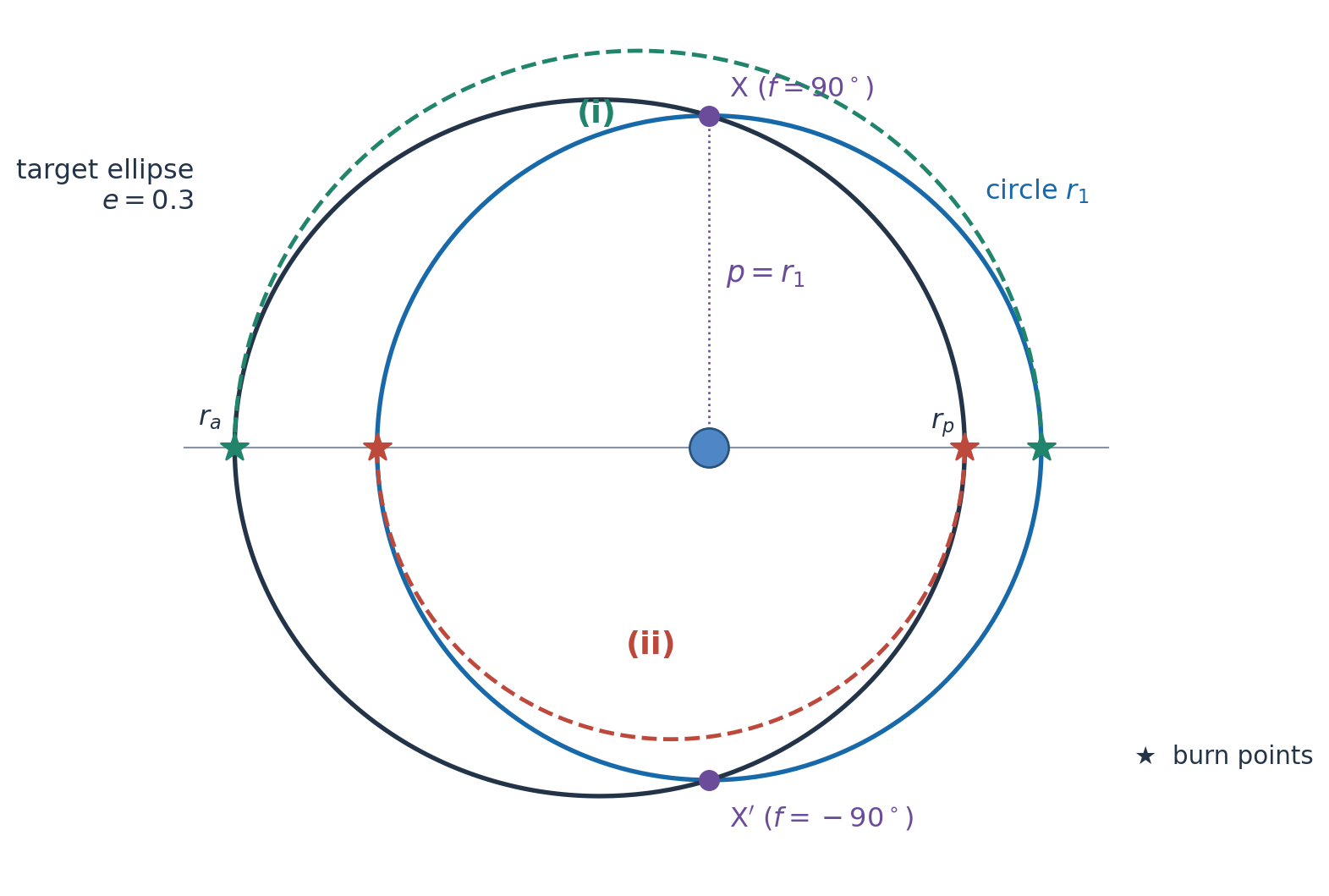
Where the circle meets the ellipse. A point lies on both curves if its distance from the focus is \(r_1\) and it satisfies the orbit equation. Put \(r = r_1 = p\) in (F1): \[ \frac{p}{1 + e\cos f} = p \;\Longrightarrow\; 1 + e\cos f = 1 \;\Longrightarrow\; e\cos f = 0 \;\Longrightarrow\; \cos f = 0, \] because \(e = 0.3 \neq 0\). In \([-\pi, \pi]\) this has exactly two solutions, \[ \boxed{f = +90^\circ \ (\text{X}), \qquad f = -90^\circ\ (\text{X}')} \] so the orbits meet at exactly two points, X \(= (0, +r_1)\) and X\(' = (0, -r_1)\) in the figure. Geometrically, \(f = \pm 90^\circ\) are the ends of the latus rectum, whose focal distance is \(p\) by definition. So “\(p = r_1\)” says exactly that the circle passes through the ends of the latus rectum.
They cross; they are not tangent. For \(|f| < 90^\circ\), \(\cos f > 0\) and \(r < p\): the ellipse is inside the circle (periapsis \(7\,692 < 10\,000\)). For \(90^\circ < |f| < 180^\circ\), \(\cos f < 0\) and \(r > p\): the ellipse is outside the circle (apoapsis \(14\,286 > 10\,000\)). At X the ellipse passes from inside to outside, at an angle, \(\gamma = \arctan e = 16.7^\circ\), to the circle (shown in (b)). A single burn at X must therefore turn the velocity vector through \(16.7^\circ\).
(b) The single impulse
Velocity on the ellipse at X. Put \(f = 90^\circ\) (\(\sin f = 1\), \(\cos f = 0\)) in (F2) and use \(\sqrt{\mu/p} = \sqrt{\mu/r_1} = v_c\): \[ \boxed{\,v_r = e\,v_c, \qquad v_\theta = v_c\,} \] Numerically, \(v_r = 0.3 \times 6.3135 = 1.894\) km/s and \(v_\theta = 6.3135\) km/s.
Velocity on the circle at X. The orbit is circular, so \(v_r = 0\) and \(v_\theta = \sqrt{\mu/r_1} = v_c\).
The burn. At X the spacecraft is at the same position before and after the burn, so the burn is the difference of the two velocity vectors, component by component: \[ \Delta v_r = e\,v_c - 0 = e\,v_c, \qquad \Delta v_\theta = v_c - v_c = 0 . \] The transverse component already equals the target’s, so nothing is added along the velocity. The burn is purely radial, directed outward at X. Its magnitude is \[ \boxed{\Delta v_1 = e\,v_c = 0.3\times 6.3135 = 1.894\ \text{km/s}} \] At X\('\) (\(f = -90^\circ\)) we get \(v_r = -e\,v_c\), so the burn is the same size but directed inward.
Why there is no freedom here. The burn at X must give the spacecraft the ellipse’s velocity at X, and that vector is fixed. So there is nothing to optimise, and X and X\('\) cost the same. Contrast this with part (c), where we choose the transfer orbit.
Two independent checks.
- Cosine rule. After the burn the speed is \(v_c\sqrt{1+e^2} = 6.5915\) km/s, at flight-path angle \(\gamma\) with \(\tan\gamma = v_r/v_\theta = e\), so \(\cos\gamma = 1/\sqrt{1+e^2}\). The burn is the third side of the triangle formed by the velocity before and after, so \[ \Delta v^2 = v_c^2 + v_c^2(1+e^2) - 2\,v_c\cdot v_c\sqrt{1+e^2}\cdot\frac{1}{\sqrt{1+e^2}} = v_c^2\,(1 + 1 + e^2 - 2) = e^2 v_c^2. \checkmark \]
- Energy. The specific energies are \(\varepsilon_{\rm circle} = -\mu/(2r_1) = -\tfrac12 v_c^2\) and \(\varepsilon_{\rm ellipse} = -\mu/(2a) = -\tfrac12 v_c^2\,(1 - e^2)\) (using \(a = p/(1-e^2)\) and \(\mu/p = v_c^2\)), so \[ \Delta\varepsilon = \tfrac12 e^2 v_c^2 . \] An impulse \(\Delta\mathbf v\) applied to velocity \(\mathbf v\) changes the energy by \(\tfrac12|\mathbf v + \Delta\mathbf v|^2 - \tfrac12|\mathbf v|^2 = \mathbf v\cdot\Delta\mathbf v + \tfrac12|\Delta\mathbf v|^2\). For a radial burn on the circle, \(\mathbf v\cdot\Delta\mathbf v = 0\), so \(\tfrac12\Delta v^2 = \tfrac12 e^2 v_c^2\), i.e. \(\Delta v = e\,v_c\). \(\checkmark\) Note also that both orbits have the same angular momentum, \(h = r_1 v_c = \sqrt{\mu r_1} = \sqrt{\mu p}\), and a radial burn leaves \(h\) unchanged. The two orbits differ only in energy.
(c) Two tangential impulses
c.1 Idea and data
Rather than force the velocity vector to turn at the crossing, use a transfer ellipse that touches the circle at one apse and the target at its other apse. At each contact point the two orbits are tangent (F4), so both burns are along the velocity. Each transfer ellipse therefore has one apse on the circle and its other apse at an apse of the target. The target has two apsides, so there are two such ellipses, which we call \(\mathrm{T_i}\) and \(\mathrm{T_{ii}}\) (Figure 1):
| Route | Leaves the circle at | Transfer apsides | Joins the target at |
|---|---|---|---|
| (i), ellipse \(\mathrm{T_i}\) | \((+r_1, 0)\), the transfer’s periapsis | \(r_1\) and \(r_a\) | \((-r_a, 0)\), the target’s apoapsis |
| (ii), ellipse \(\mathrm{T_{ii}}\) | \((-r_1, 0)\), the transfer’s apoapsis | \(r_p\) and \(r_1\) | \((+r_p, 0)\), the target’s periapsis |
The data of the circle and of the target (unsubscripted symbols), from (F3), (F4) and \(p = r_1\):
| Orbit | Apsidal radii | \(h\) | Speed at periapsis | Speed at apoapsis |
|---|---|---|---|---|
| circle | \(r_1\) | \(\sqrt{\mu r_1} = r_1 v_c\) | \(v_c\) | \(v_c\) |
| target | \(r_p = \dfrac{r_1}{1+e}\), \(\ r_a = \dfrac{r_1}{1-e}\) | \(\sqrt{\mu p} = r_1 v_c\) | \(\dfrac{h}{r_p} = (1+e)\,v_c\) | \(\dfrac{h}{r_a} = (1-e)\,v_c\) |
The target’s speeds follow from \(h/r_p = r_1 v_c\,(1+e)/r_1\) and \(h/r_a = r_1 v_c\,(1-e)/r_1\). We also need the two ratios, which hold for the target’s \(e\): \[ \frac{r_1}{r_a} = 1 - e, \qquad \frac{r_1}{r_p} = 1 + e . \tag{c0} \]
c.2 Route (i): periapsis on the circle, apoapsis on the target
The transfer ellipse \(\mathrm{T_i}\) has periapsis radius \(r_1\) and apoapsis radius \(r_a\) (the target’s). Its own parameters carry the subscript i: \(e_{\mathrm{i}}\), \(p_{\mathrm{i}}\), \(a_{\mathrm{i}}\), \(h_{\mathrm{i}}\), and its speeds at periapsis and apoapsis are \(v_{p,\mathrm i}\) and \(v_{a,\mathrm i}\). We keep \(r_a\) general and put in \(r_a = r_1/(1-e)\) only at the end, where \(e\) is the target’s eccentricity.
Step 1: angular momentum of \(\mathrm{T_i}\) and its speed at \(r_1\). By (F4) with \(R_p = r_1\) and \(R_a = r_a\), \[ h_{\mathrm{i}}^2 = \mu\,p_{\mathrm{i}} = \frac{2\mu\,r_1 r_a}{r_1 + r_a}. \] The speed of \(\mathrm{T_i}\) at its periapsis \(r_1\) is \(v_{p,\mathrm i} = h_{\mathrm{i}}/r_1\). Square it and compare with \(v_c^2 = \mu/r_1\): \[ v_{p,\mathrm i}^2 = \frac{h_{\mathrm{i}}^2}{r_1^2} = \frac{2\mu\,r_a}{r_1\,(r_1 + r_a)} = \frac{\mu}{r_1}\cdot\frac{2r_a}{r_1 + r_a} = v_c^2\,\frac{2}{\rho}, \qquad \rho \equiv \frac{r_1 + r_a}{r_a} = 1 + \frac{r_1}{r_a}. \] Hence \[ v_{p,\mathrm i} = v_c\sqrt{\frac{2}{\rho}} . \] Since \(r_1 < r_a\), we have \(1 < \rho < 2\), so \(2/\rho > 1\) and \(v_{p,\mathrm i} > v_c\): the first burn speeds the spacecraft up.
Shape of \(\mathrm{T_i}\) (it is not the target). By (F3a) and (F3b), \[ e_{\mathrm{i}} = \frac{r_a - r_1}{r_a + r_1} = \frac{1 - r_1/r_a}{1 + r_1/r_a} = \frac{2 - \rho}{\rho}, \qquad p_{\mathrm{i}} = \frac{h_{\mathrm{i}}^2}{\mu} = \frac{2r_1 r_a}{r_1 + r_a} = \frac{2r_1}{\rho}. \] (In \(e_{\mathrm{i}}\) we divided numerator and denominator by \(r_a\) and used \(r_1/r_a = \rho - 1\).) So \(e_{\mathrm{i}}\) and \(p_{\mathrm{i}}\) are not the target’s \(e\) and \(p = r_1\). \(\mathrm{T_i}\) only shares its two apsidal radii with the circle and the target.
Step 2: speed at \(r_a\). By (F4), \(v\,R = h\) at both apses, and \(h_{\mathrm{i}} = r_1 v_{p,\mathrm i}\), so on \(\mathrm{T_i}\) \[ v_{a,\mathrm i} = \frac{h_{\mathrm{i}}}{r_a} = \frac{r_1}{r_a}\,v_{p,\mathrm i} = (\rho - 1)\,v_{p,\mathrm i}, \] using \(r_1/r_a = \rho - 1\). On the target the apoapsis speed is \(v_a = h/r_a\) with \(h = r_1 v_c\), so \[ v_a = \frac{r_1}{r_a}\,v_c = (\rho - 1)\,v_c . \]
Step 3: the two burns. Both are tangential (F4), so each is a difference of speeds.
- Burn A, at \((+r_1, 0)\), from the circle onto \(\mathrm{T_i}\) (prograde): \[ \Delta v_A = v_{p,\mathrm i} - v_c = v_c\left(\sqrt{\frac{2}{\rho}} - 1\right). \]
- Burn B, at \((-r_a, 0)\), from \(\mathrm{T_i}\) onto the target (retrograde, since \(v_{a,\mathrm i} > v_a\)): \[ \Delta v_B = v_{a,\mathrm i} - v_a = (\rho - 1)\,(v_{p,\mathrm i} - v_c) = (\rho - 1)\,\Delta v_A . \]
Step 4: total. \[ \Delta v_{\text{(i)}} = \Delta v_A + \Delta v_B = \big[1 + (\rho - 1)\big]\,\Delta v_A = \rho\,v_c\left(\sqrt{\frac{2}{\rho}} - 1\right) = v_c\left(\rho\sqrt{\frac{2}{\rho}} - \rho\right). \] Now \(\rho\sqrt{2/\rho} = \sqrt{\rho^2\cdot 2/\rho} = \sqrt{2\rho}\), so for any outward apse \(r_a > r_1\), \[ \Delta v_{\text{(i)}} = v_c\left(\sqrt{2\rho} - \rho\right), \qquad \rho = 1 + \frac{r_1}{r_a} . \] Insert the target. By (c0), \(r_1/r_a = 1 - e\), so \(\rho = 1 + (1 - e) = 2 - e\) and \[ \boxed{\;\Delta v_{\text{(i)}} = v_c\left[\sqrt{2(2-e)} - (2-e)\right]\;} \tag{c1} \] The same substitution gives the shape of \(\mathrm{T_i}\) in terms of the target’s \(e\): \(e_{\mathrm{i}} = (2 - \rho)/\rho = e/(2 - e)\).
Numbers (\(e = 0.3\)). \(r_1 + r_a = 10\,000 + 14\,285.7 = 24\,285.7\) km, so \(\rho = 24\,285.7/14\,285.7 = 1.7 = 2 - e\) and \(\sqrt{2/\rho} = \sqrt{2/1.7} = 1.08465\). Then
| Quantity | Value |
|---|---|
| eccentricity of \(\mathrm{T_i}\): \(e_{\mathrm{i}} = e/(2-e) = 0.3/1.7\) | 0.1765 (the target has \(e = 0.3\)) |
| semi-latus rectum of \(\mathrm{T_i}\): \(p_{\mathrm{i}} = 2r_1/\rho = 20\,000/1.7\) | 11 765 km (the target has \(p = r_1 = 10\,000\) km) |
| speed on \(\mathrm{T_i}\) at \(r_1\): \(v_{p,\mathrm i} = 1.08465\,v_c\) | 6.848 km/s |
| speed on \(\mathrm{T_i}\) at \(r_a\): \(v_{a,\mathrm i} = (\rho-1)\,v_{p,\mathrm i} = 0.7\,v_{p,\mathrm i}\) | 4.794 km/s |
| speed on the target at \(r_a\): \(v_a = (\rho-1)\,v_c = 0.7\,v_c\) | 4.419 km/s |
| \(\Delta v_A = v_{p,\mathrm i} - v_c = 0.08465\,v_c\) | 0.534 km/s |
| \(\Delta v_B = (\rho-1)\,\Delta v_A = 0.7\times 0.08465\,v_c = 0.05926\,v_c\) | 0.374 km/s |
| \(\Delta v_{\text{(i)}} = \rho\,\Delta v_A = 1.7\times 0.08465\,v_c = 0.14391\,v_c\) | 0.909 km/s |
As a check of (c1), \(\sqrt{2\times1.7} - 1.7 = 1.84391 - 1.7 = 0.14391\). \(\checkmark\)
c.3 Route (ii): apoapsis on the circle, periapsis on the target
The transfer ellipse \(\mathrm{T_{ii}}\) has periapsis radius \(r_p\) (the target’s) and apoapsis radius \(r_1\). Its own parameters carry the subscript ii: \(e_{\mathrm{ii}}\), \(p_{\mathrm{ii}}\), \(a_{\mathrm{ii}}\), \(h_{\mathrm{ii}}\), and its speeds at periapsis and apoapsis are \(v_{p,\mathrm{ii}}\) and \(v_{a,\mathrm{ii}}\). Again \(r_p\) stays general until the last step, and \(e\) is the target’s eccentricity.
Step 1: angular momentum of \(\mathrm{T_{ii}}\) and its speed at \(r_1\). By (F4) with \(R_p = r_p\) and \(R_a = r_1\), \[ h_{\mathrm{ii}}^2 = \mu\,p_{\mathrm{ii}} = \frac{2\mu\,r_p r_1}{r_p + r_1}. \] The speed of \(\mathrm{T_{ii}}\) at its apoapsis \(r_1\) is \(v_{a,\mathrm{ii}} = h_{\mathrm{ii}}/r_1\). Then \[ v_{a,\mathrm{ii}}^2 = \frac{h_{\mathrm{ii}}^2}{r_1^2} = \frac{2\mu\,r_p}{r_1\,(r_p + r_1)} = \frac{\mu}{r_1}\cdot\frac{2r_p}{r_p + r_1} = v_c^2\,\frac{2}{\sigma}, \qquad \sigma \equiv \frac{r_p + r_1}{r_p} = 1 + \frac{r_1}{r_p}, \] so \[ v_{a,\mathrm{ii}} = v_c\sqrt{\frac{2}{\sigma}} . \] Since \(r_p < r_1\), we have \(\sigma > 2\), so \(2/\sigma < 1\) and \(v_{a,\mathrm{ii}} < v_c\): the first burn slows the spacecraft down.
Shape of \(\mathrm{T_{ii}}\) (it is not the target). By (F3a) and (F3b), dividing numerator and denominator of \(e_{\mathrm{ii}}\) by \(r_p\) and using \(r_1/r_p = \sigma - 1\), \[ e_{\mathrm{ii}} = \frac{r_1 - r_p}{r_1 + r_p} = \frac{r_1/r_p - 1}{r_1/r_p + 1} = \frac{\sigma - 2}{\sigma}, \qquad p_{\mathrm{ii}} = \frac{h_{\mathrm{ii}}^2}{\mu} = \frac{2r_p r_1}{r_p + r_1} = \frac{2r_1}{\sigma}. \] Again \(e_{\mathrm{ii}}\) and \(p_{\mathrm{ii}}\) differ from the target’s \(e\) and \(p = r_1\).
Step 2: speed at \(r_p\). With \(v\,R = h\) at both apses and \(h_{\mathrm{ii}} = r_1 v_{a,\mathrm{ii}}\), on \(\mathrm{T_{ii}}\) \[ v_{p,\mathrm{ii}} = \frac{h_{\mathrm{ii}}}{r_p} = \frac{r_1}{r_p}\,v_{a,\mathrm{ii}} = (\sigma - 1)\,v_{a,\mathrm{ii}}, \] using \(r_1/r_p = \sigma - 1\). On the target the periapsis speed is \(v_p = h/r_p\) with \(h = r_1 v_c\), so \[ v_p = \frac{r_1}{r_p}\,v_c = (\sigma - 1)\,v_c . \]
Step 3: the two burns.
- Burn A, at \((-r_1, 0)\), from the circle onto \(\mathrm{T_{ii}}\) (retrograde): \[ \Delta v_A = v_c - v_{a,\mathrm{ii}} = v_c\left(1 - \sqrt{\frac{2}{\sigma}}\right). \]
- Burn B, at \((+r_p, 0)\), from \(\mathrm{T_{ii}}\) onto the target (prograde, since \(v_{p,\mathrm{ii}} < v_p\)): \[ \Delta v_B = v_p - v_{p,\mathrm{ii}} = (\sigma - 1)\,(v_c - v_{a,\mathrm{ii}}) = (\sigma - 1)\,\Delta v_A . \]
Step 4: total. \[ \Delta v_{\text{(ii)}} = \big[1 + (\sigma - 1)\big]\,\Delta v_A = \sigma\,v_c\left(1 - \sqrt{\frac{2}{\sigma}}\right) = v_c\left(\sigma - \sigma\sqrt{\frac{2}{\sigma}}\right) = v_c\left(\sigma - \sqrt{2\sigma}\right), \] because \(\sigma\sqrt{2/\sigma} = \sqrt{2\sigma}\). This holds for any inward apse \(r_p < r_1\).
Insert the target. By (c0), \(r_1/r_p = 1 + e\), so \(\sigma = 1 + (1+e) = 2 + e\) and \[ \boxed{\;\Delta v_{\text{(ii)}} = v_c\left[(2+e) - \sqrt{2(2+e)}\right]\;} \tag{c2} \] The same substitution gives the shape of \(\mathrm{T_{ii}}\) in terms of the target’s \(e\): \(e_{\mathrm{ii}} = (\sigma - 2)/\sigma = e/(2 + e)\).
Numbers (\(e = 0.3\)). \(r_p + r_1 = 7\,692.3 + 10\,000 = 17\,692.3\) km, so \(\sigma = 17\,692.3/7\,692.3 = 2.3 = 2 + e\) and \(\sqrt{2/\sigma} = \sqrt{2/2.3} = 0.93250\). Then
| Quantity | Value |
|---|---|
| eccentricity of \(\mathrm{T_{ii}}\): \(e_{\mathrm{ii}} = e/(2+e) = 0.3/2.3\) | 0.1304 (the target has \(e = 0.3\)) |
| semi-latus rectum of \(\mathrm{T_{ii}}\): \(p_{\mathrm{ii}} = 2r_1/\sigma = 20\,000/2.3\) | 8 696 km (the target has \(p = r_1 = 10\,000\) km) |
| speed on \(\mathrm{T_{ii}}\) at \(r_1\): \(v_{a,\mathrm{ii}} = 0.93250\,v_c\) | 5.887 km/s |
| speed on \(\mathrm{T_{ii}}\) at \(r_p\): \(v_{p,\mathrm{ii}} = (\sigma-1)\,v_{a,\mathrm{ii}} = 1.3\,v_{a,\mathrm{ii}}\) | 7.654 km/s |
| speed on the target at \(r_p\): \(v_p = (\sigma-1)\,v_c = 1.3\,v_c\) | 8.208 km/s |
| \(\Delta v_A = v_c - v_{a,\mathrm{ii}} = 0.06750\,v_c\) | 0.426 km/s |
| \(\Delta v_B = (\sigma-1)\,\Delta v_A = 1.3\times 0.06750\,v_c = 0.08774\,v_c\) | 0.554 km/s |
| \(\Delta v_{\text{(ii)}} = \sigma\,\Delta v_A = 2.3\times 0.06750\,v_c = 0.15524\,v_c\) | 0.980 km/s |
As a check of (c2), \(2.3 - \sqrt{4.6} = 2.3 - 2.14476 = 0.15524\). \(\checkmark\)
c.4 Both routes beat the single impulse
The single impulse costs \(e\,v_c\), by part (b). Divide each inequality by \(v_c > 0\).
Route (i). Using (c1), \[ \begin{aligned} \Delta v_{\text{(i)}} < e\,v_c &\iff \sqrt{2(2-e)} - (2-e) < e \\ &\iff \sqrt{2(2-e)} < e + (2 - e) = 2 \\ &\iff 2(2-e) < 4 \\ &\iff 4 - 2e < 4 \\ &\iff e > 0 . \end{aligned} \]
Route (ii). Using (c2), \[ \begin{aligned} \Delta v_{\text{(ii)}} < e\,v_c &\iff (2+e) - \sqrt{2(2+e)} < e \\ &\iff 2 < \sqrt{2(2+e)} \\ &\iff 4 < 2(2+e) \\ &\iff 4 < 4 + 2e \\ &\iff e > 0 . \end{aligned} \]
In both chains the third line comes from squaring, which is an equivalence because both sides are positive. The last line of each chain is true for every \(e > 0\), and every step is an equivalence, so each inequality holds for every \(0 < e < 1\). \(\blacksquare\) (At \(e = 0\) the orbits coincide and every cost is zero.)
c.5 Which route is cheaper, and by how much
Subtract (c1) from (c2): \[ \begin{aligned} \Delta v_{\text{(ii)}} - \Delta v_{\text{(i)}} &= v_c\left\{(2+e) + (2-e) - \sqrt2\left[\sqrt{2+e} + \sqrt{2-e}\right]\right\} \\ &= v_c\left(4 - \sqrt2\,S\right), \qquad S \equiv \sqrt{2+e} + \sqrt{2-e}. \end{aligned} \] Square \(S\): \[ S^2 = (2+e) + (2-e) + 2\sqrt{(2+e)(2-e)} = 4 + 2\sqrt{4 - e^2} < 4 + 2\cdot 2 = 8 \] for \(e > 0\), because then \(\sqrt{4 - e^2} < 2\). Hence \(S < 2\sqrt2\) and \(\sqrt2\,S < 4\), so \[ \Delta v_{\text{(ii)}} - \Delta v_{\text{(i)}} > 0 \quad \text{for every } 0 < e < 1. \] Route (i), which overshoots to the apoapsis and then comes back, is always the cheaper of the two.
Small \(e\). Expand with \(\sqrt{1 \mp x} = 1 \mp \tfrac x2 - \tfrac{x^2}{8} + \dots\) and \(x = e/2\): \[ \sqrt{2(2-e)} = 2\sqrt{1 - \tfrac e2} = 2 - \tfrac e2 - \tfrac{e^2}{16} - \dots, \qquad \sqrt{2(2+e)} = 2\sqrt{1 + \tfrac e2} = 2 + \tfrac e2 - \tfrac{e^2}{16} + \dots \] so that \[ \Delta v_{\text{(i)}} = v_c\left(\tfrac e2 - \tfrac{e^2}{16} - \dots\right), \qquad \Delta v_{\text{(ii)}} = v_c\left(\tfrac e2 + \tfrac{e^2}{16} - \dots\right) \] For a nearly circular target both routes cost about \(\tfrac12 e\,v_c\): half of the single impulse, and the \(\pm e^2/16\) terms are what separate the two routes.
Limit \(e \to 1\). \(\Delta v_{\text{(i)}} \to (\sqrt2 - 1)\,v_c = 0.414\,v_c\) and \(\Delta v_{\text{(ii)}} \to (3 - \sqrt6)\,v_c = 0.551\,v_c\), against \(v_c\) for the single impulse.
| \(e\) | single, \(e\) | route (i) | route (ii) | saving (i) | saving (ii) |
|---|---|---|---|---|---|
| 0.1 | 0.1000 | 0.04936 | 0.05061 | 50.6 % | 49.4 % |
| 0.3 | 0.3000 | 0.14391 | 0.15524 | 52.0 % | 48.3 % |
| 0.5 | 0.5000 | 0.23205 | 0.26393 | 53.6 % | 47.2 % |
| 0.7 | 0.7000 | 0.31245 | 0.37621 | 55.4 % | 46.3 % |
| 0.9 | 0.9000 | 0.38324 | 0.49168 | 57.4 % | 45.4 % |
Table 1 shows that route (i) saves more as \(e\) grows, while route (ii) saves less. For the problem’s numbers the three plans cost \[ \Delta v_1 = 1.894\ \text{km/s}, \qquad \Delta v_{\text{(i)}} = 0.909\ \text{km/s}, \qquad \Delta v_{\text{(ii)}} = 0.980\ \text{km/s}. \]
c.6 Why the radial burn is so wasteful
An impulse changes the energy by \(\mathbf v\cdot\Delta\mathbf v + \tfrac12|\Delta\mathbf v|^2\). A burn along \(\mathbf v\) changes the energy at first order, by \(v\,\Delta v\). A burn across \(\mathbf v\), such as the radial burn at X, changes it only at second order, by \(\tfrac12\Delta v^2\). The two orbits have the same angular momentum and differ in energy by \(\tfrac12 e^2 v_c^2\). The radial burn leaves \(h\) alone, but because it buys energy only at second order it must be as large as \(e\,v_c\) to buy \(\tfrac12 e^2 v_c^2\): it mostly turns the velocity vector instead of changing its length. The tangential burns do change the energy at first order, but they also change \(h\), so each route needs a second burn to restore it. The series in c.5 shows the net result: about \(\tfrac12 e\,v_c\) in total, half the radial cost.
(d) A mission reason for the single impulse
Main reason: time. The single impulse puts the spacecraft on the target ellipse immediately. Route (i) needs a coast of half the transfer period, \[ t_{\text{(i)}} = \pi\sqrt{\frac{a_{\mathrm{i}}^3}{\mu}}, \qquad a_{\mathrm{i}} = \frac{r_1 + r_a}{2} = 12\,143\ \text{km} \;\Rightarrow\; t_{\text{(i)}} = 111\ \text{min}, \] and route (ii) needs \[ t_{\text{(ii)}} = \pi\sqrt{\frac{a_{\mathrm{ii}}^3}{\mu}}, \qquad a_{\mathrm{ii}} = \frac{r_p + r_1}{2} = 8\,846\ \text{km} \;\Rightarrow\; t_{\text{(ii)}} = 69\ \text{min}. \] That matters when the schedule is tight, for example a short maneuver window or a time-critical observation or relay pass.
Other legitimate reasons, any one of which earns the mark:
- One burn instead of two. There is one ignition, one attitude slew and one chance for something to fail. This is decisive for a vehicle with a single-shot engine such as a solid kick motor, which cannot restart for the second burn.
- Where and when the vehicle joins the ellipse. With the single impulse the vehicle joins the target at \(f = \pm90^\circ\) at the moment of the burn, and it can choose between X and X\('\). With the routes it joins at an apse, after a fixed coast. If something (a station, a relay, a piece of debris) already occupies the ellipse, the phasing requirement can favour any of the three plans.
What the extra \(\Delta v\) costs. The rocket equation gives a propellant fraction \(1 - \exp\!\big(-\Delta v/(g_0 I_{sp})\big)\). For an illustrative \(I_{sp} = 300\) s, \(g_0 I_{sp} = 2.943\) km/s, and the three plans use
| Plan | \(\Delta v\) (km/s) | Propellant fraction |
|---|---|---|
| single impulse | 1.894 | 47.5 % |
| route (i) | 0.909 | 26.6 % |
| route (ii) | 0.980 | 28.3 % |
For this \(I_{sp}\) the single impulse uses roughly twenty percentage points more of the vehicle’s initial mass as propellant, so it is worth choosing only when time, simplicity or arrival phasing is worth that much.
Summary of answers
| Part | Result |
|---|---|
| (a) | \(a = 10\,989\) km, \(r_p = 7\,692\) km, \(r_a = 14\,286\) km; \(r = r_1 \Rightarrow \cos f = 0 \Rightarrow f = \pm90^\circ\) |
| (b) | \(v_r = e\,v_c\), \(v_\theta = v_c\) on the ellipse at X; \(v_r = 0\), \(v_\theta = v_c\) on the circle; burn purely radial, \(\Delta v_1 = e\,v_c = 1.894\) km/s |
| (c) | \(\Delta v_{\text{(i)}} = v_c\left(\sqrt{2\rho} - \rho\right)\) with \(\rho = 1 + r_1/r_a = 2 - e\), and \(\Delta v_{\text{(ii)}} = v_c\left(\sigma - \sqrt{2\sigma}\right)\) with \(\sigma = 1 + r_1/r_p = 2 + e\); each is less than \(e\,v_c\) iff \(e > 0\); (i) is always cheaper than (ii); at \(e = 0.3\): \(0.909\) and \(0.980\) km/s |
| (d) | Time: no 69–111 min coast. Also one burn only, and the choice of where and when to join the ellipse. |