Mid-Semester Examination
Space Flight Mechanics (AE313 / AE613), IIST 2026
| Duration | 2 hours |
| Maximum marks | 30 |
| Part A — objective (Q1–Q4) | 15 marks |
| Part B — numerical and derivation (Q5–Q6) | 15 marks |
Instructions
- All questions are compulsory.
- The whole paper is one conversation between Johannes Kepler and Isaac Newton. In Part A they leave sentences unfinished. Each gap is a blank such as (c) [1] ________, with its marks in brackets. Write the question number, the blank label and your answer in the answer book. Do not copy the dialogue.
- “Answering as Johannes” means using geometry, observation and his three laws only: no forces and no calculus. “Answering as Isaac” allows any mathematics.
- Use the data table unless a question says otherwise. Planetary orbits are circular and coplanar, and engine burns are impulsive, unless a question says otherwise.
- Diagrams and write-up that are not legible will not be graded.
Data
| Quantity | Value |
|---|---|
| Earth: gravitational parameter \(\mu_\oplus\); radius \(R_\oplus\) | \(3.986\times10^{5}\ \mathrm{km^3\,s^{-2}}\); \(6378\) km |
| Standard gravity \(g_0\) | \(9.81\ \mathrm{m\,s^{-2}}\) |
| Geostationary orbit | radius \(42\,164\) km; period (one sidereal day) \(23.934\) h |
| Sun: gravitational parameter \(\mu_\odot\); radius \(R_\odot\) | \(1.327\times10^{11}\ \mathrm{km^3\,s^{-2}}\); \(6.96\times10^{5}\) km |
| Astronomical unit | \(1\ \mathrm{AU} = 1.496\times10^{8}\) km |
| Year; Earth’s orbital speed | \(365.25\) d; \(v_\oplus = 29.78\) km/s |
| Moon | orbit radius \(384\,400\) km; sidereal period \(27.32\) d |
| Venus | orbit radius \(0.723\) AU |
| Mars | orbit radius \(1.524\) AU; sidereal period \(686.98\) d |
| Jupiter | orbit radius \(5.203\) AU; \(m_J/M_\odot = 1/1047.6\) |
| Saturn | orbit radius \(9.537\) AU |
Prologue: two visitors
This paper looks at the first half of the course from two viewpoints: pure geometry (Kepler’s view) and dynamics (Newton’s view). It shows how far geometry and a few assumptions can take us, and where dynamics is really needed. To set this up, I have written a dialogue between Johannes and Isaac, as if they had been transported to 2026. Each arrived knowing only what he knew on the day he died.
To avoid ambiguity, here is what each of them knew on his deathbed.
- Johannes Kepler (1571–1630)
- Had Tycho Brahe’s observations of Mars, the geometry of conics, and logarithms.
- Assumed that the orbits were elliptical, and knew his three laws (1609, 1619).
- Believed that the Sun drives the planets with a force that weakens as \(1/r\), and that comets move in straight lines.
- Isaac Newton (1643–1727)
- Discovered the laws of motion and the law of gravitation, and invented fluxions (calculus).
- Knew Kepler’s three laws.
- Never learned the value of the gravitational constant \(G\) (Cavendish, 1798), and never saw Halley’s comet return (1758).
Since July, both have been sitting in the back row of AE313. Isaac takes careful notes; Johannes argues with the slides. It is the night before the mid-semester examination, and they are revising together. In Part A, you finish the lines they leave unfinished. In Part B, they set each other problems.
Part A — The revision (15 marks)
Q1. The crowd [2.5 marks]
Scene: the hostel common room, nine in the evening. Isaac opens his notebook.
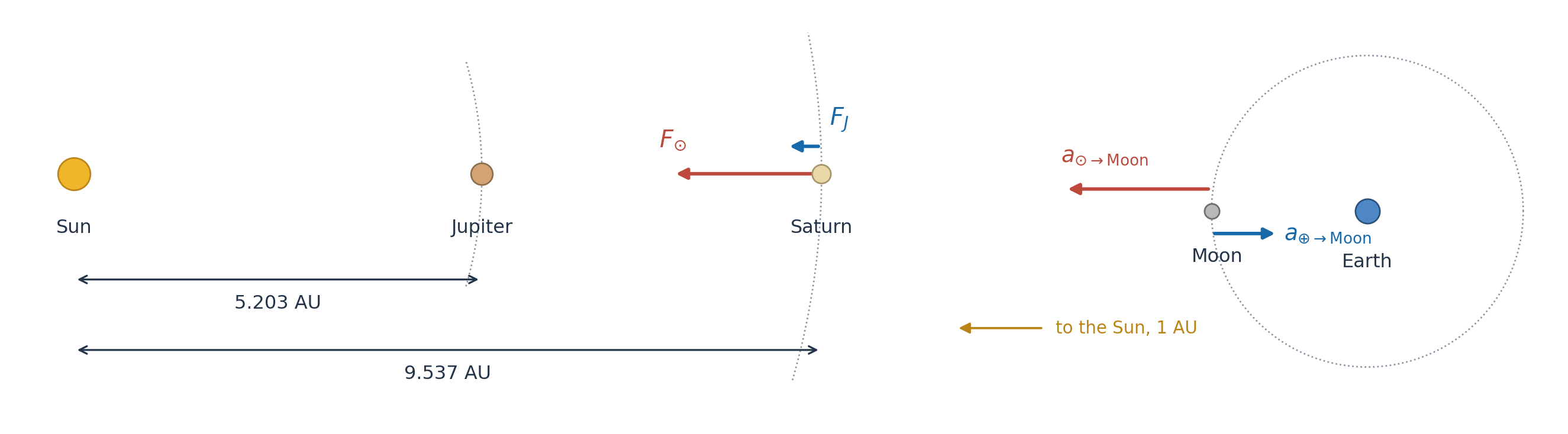
Isaac: The course began where I began: every body attracts every other. Treat the Sun, the planets and the moons as \(n\) point masses \(m_i\) at positions \(\mathbf R_i\) in an inertial frame. In the Principia I reckoned that, at conjunction, Jupiter pulls on Saturn with about \(1/211\) of the Sun’s pull (Figure 1, left panel). With today’s data the ratio is \(1/\)(a) [1.5] __________.
Johannes (pointing at the right panel): Then look at the Moon. At new moon the Sun pulls it one way and the Earth pulls it the other, and the Sun pulls more than twice as hard. So the Moon is really the Sun’s satellite, and any two-body model of the Earth and the Moon must fail.
(b) [1] True or false? Justify in one line. ____________________
Q2. The pair [4.5 marks]
Johannes: Enough of crowds. Give me two bodies and nothing else. My ellipse! Before I found the ellipse, I believed that a planet’s speed is inversely proportional to its distance from the Sun.
Isaac: Not the speed. In Figure 2, the quantity that is exactly proportional to \(1/r\) at every point of the orbit is (a) [1] ________ [(A) the speed \(v\) (B) the radial velocity \(v_r\) (C) the transverse velocity \(v_\theta\) (D) the areal velocity].
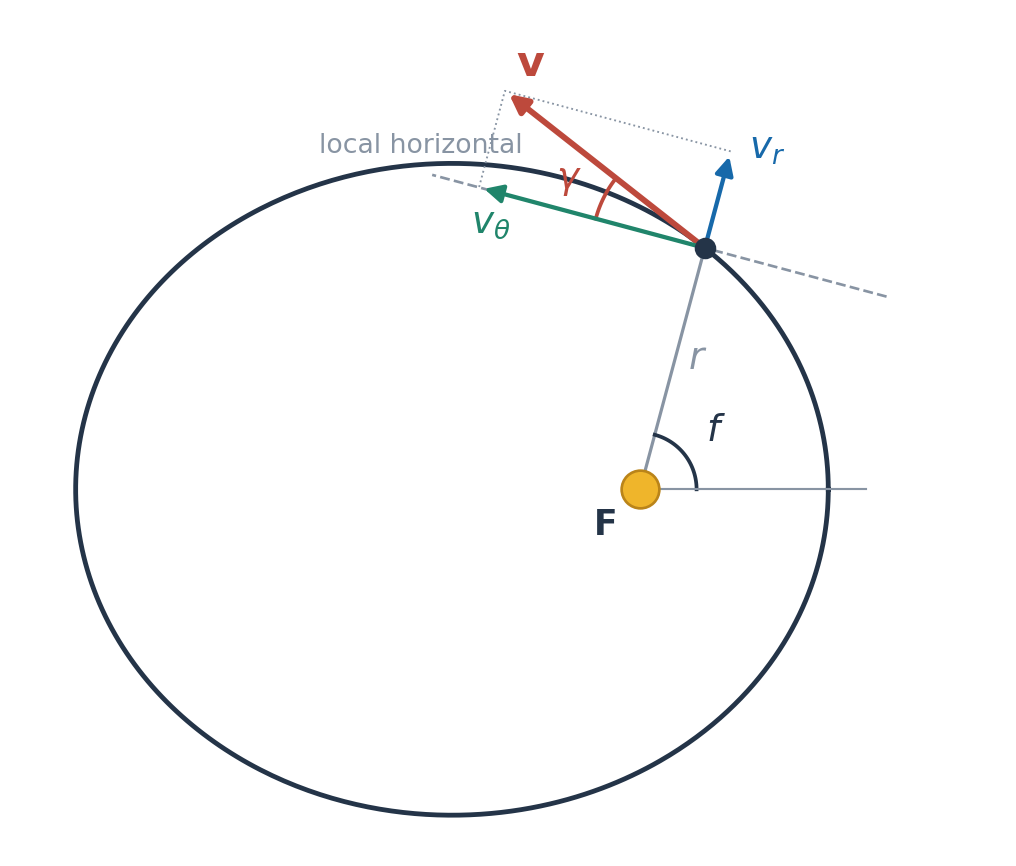
Johannes: Look at the same figure. My path is most steeply inclined to the local horizontal where the planet is at its mean distance, \(r = a\).
(b) [1.5] True or false? Justify, and give the greatest flight-path angle in terms of \(e\). ____________________
Isaac: I did not trust the inverse square until I had tried it on the Moon. The Moon’s centripetal acceleration is (c) [1] ________ \(\mathrm{m\,s^{-2}}\), and \(g_0\) divided by it is ________. Compare this with \((r_{\rm Moon}/R_\oplus)^2 = 3632\).
Isaac: Also, I used Huygens’ moon of Saturn to weigh Saturn against the Sun. Titan circles Saturn at \(1\,221\,870\) km, once in \(15.945\) days. Compared with the Earth’s orbit, this gives \(m_{\rm Saturn}/M_\odot\) closest to (d) [1] ________ [(A) 1/1050 (B) 1/3500 (C) 1/19 400 (D) 1/333 000].
Q3. The ferry [5 marks]
Scene: one in the morning, a mission-control video playing on a laptop.
Johannes: In 1610 I wrote to Galileo that once there are ships with sails fit for the heavenly breezes, men will be found to brave even that emptiness. And there on the screen are the ships. This Hohmann ferry of 1925 is merely half of one of my ellipses. It touches the inner circle at perihelion and the outer circle at aphelion (Figure 3).
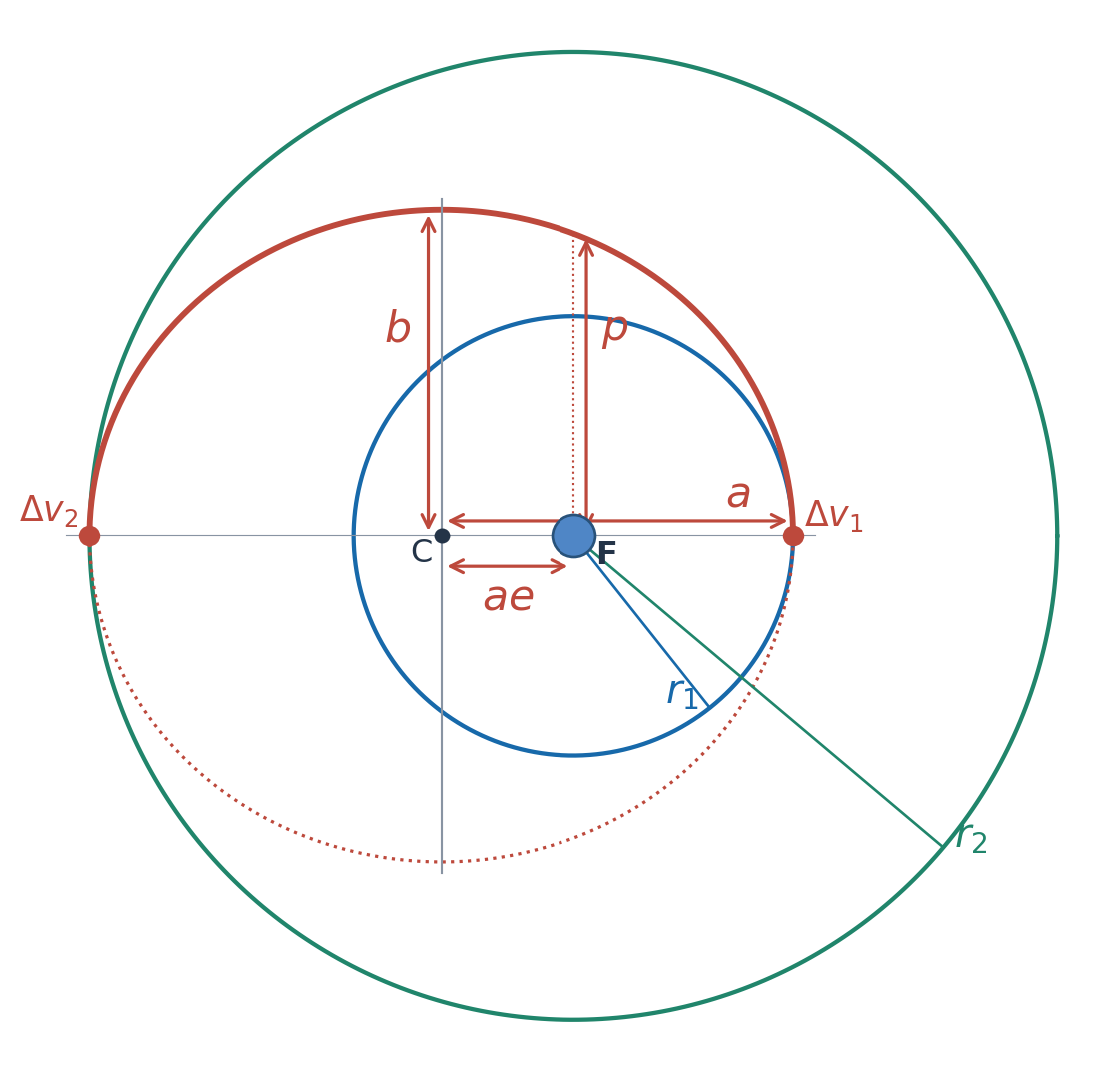
(a) [2] Match each length marked in Figure 3 with a mean of \(r_1\) and \(r_2\). One entry in the right-hand column is not used.
| Length | Mean of \(r_1\) and \(r_2\) |
|---|---|
| P. \(a\) | 1. geometric mean |
| Q. \(b\) | 2. harmonic mean |
| R. \(p\) | 3. arithmetic mean |
| S. \(ae\) | 4. half the difference, \((r_2 - r_1)/2\) |
| 5. root-mean-square |
Johannes: With my third law alone, I can tell you how long the ferry takes from the Earth’s orbit to Venus’s orbit: (b) [1] ________ days.
Isaac: Going outwards, one can also overshoot and fall back. Figure 4 compares three plans, all starting from a circular orbit of radius \(r_1\):
- a Hohmann transfer to a circular orbit of radius \(r_2 = R\,r_1\);
- a bi-elliptic transfer to the same orbit, with its intermediate apoapsis pushed out to infinity;
- a single burn that escapes from \(r_1\).
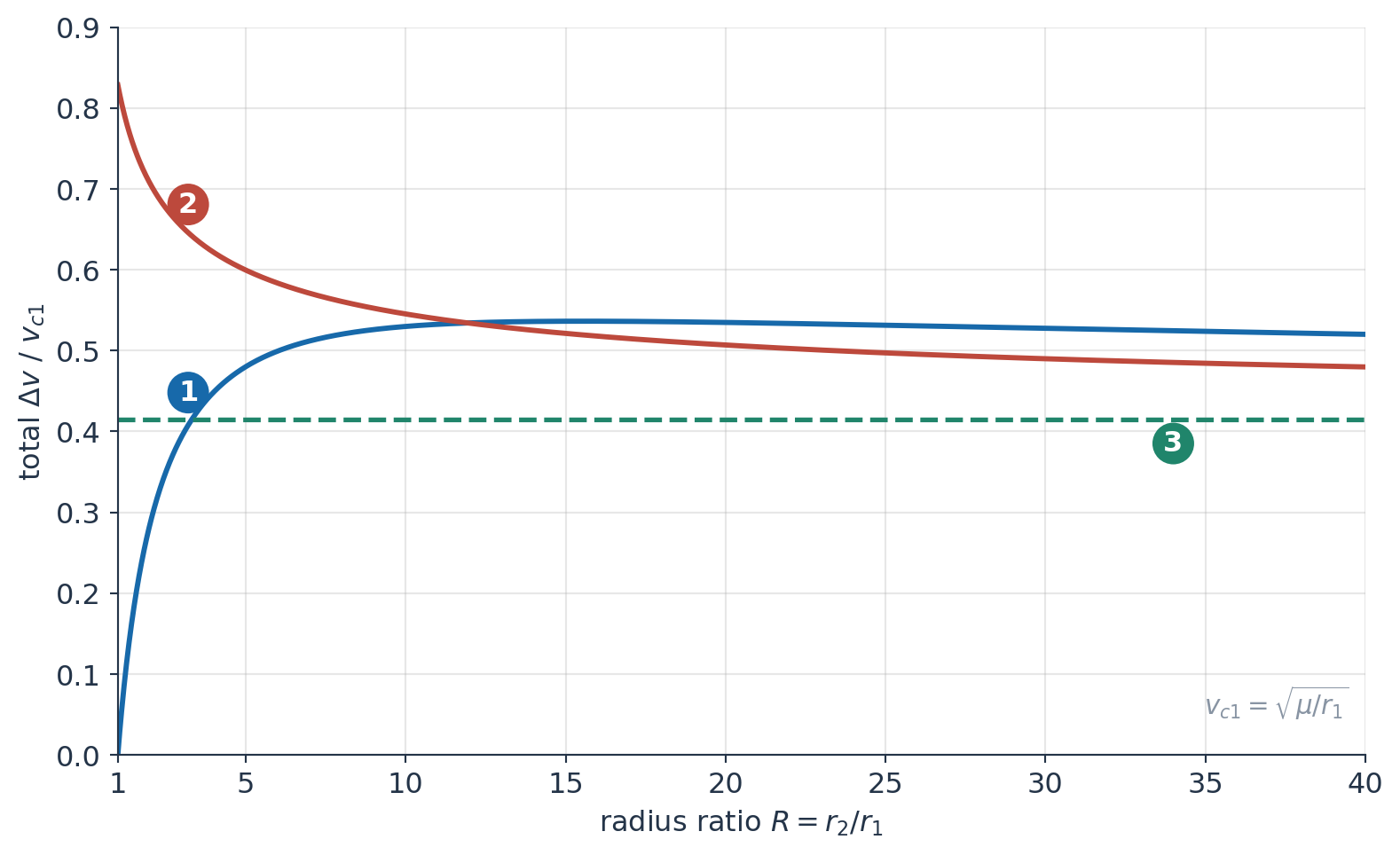
(c) [1] Identify curves 1, 2 and 3. ________
Isaac: Between coplanar circular orbits, the Hohmann transfer is cheaper than every bi-elliptic transfer whenever \(r_2/r_1\) is below about (d) [1] ________ [(A) 3.3 (B) 11.94 (C) 15.58 (D) 100].
Q4. The door [3 marks]
Scene: three in the morning, under the stars.
Johannes: This Voyager 1 (not visible even to Johannes) is now about 170 AU from the Sun and still moves at about 17.0 km/s. Will it ever come back?
Isaac: Ignoring the planets, the local escape speed from the Sun at 170 AU is (a) [1] ________ km/s, and Voyager’s hyperbolic excess speed is ________ km/s.
Johannes: In 2025 astronomers found 3I/ATLAS, a visitor from another star that crosses the solar system once and will never return. Here at last is my straight-line comet!
Isaac: Nearly, Johannes. It moves on a hyperbola about the Sun. For 3I/ATLAS, with \(e = 6.14\) \(\delta =\) (b) [1] ________ degrees. The first visitor, 1I/ʻOumuamua (2017), had \(e \approx 1.20\) and was turned through ________ degrees. Your straight lines, Johannes, are the limit of my hyperbolas as (c) [1] ________.
Part B — Problems they set each other (15 marks)
Q5. Who needs whom? [8 marks]
Johannes: Isaac, I think people make far too much of your achievement in finding the law of gravitation. As I shall show, I can derive your law from my three laws alone.
(a) Write Johannes’ derivation. Starting from Kepler’s three laws, show that each planet has an acceleration directed towards the Sun, of magnitude \(\mu/r^2\), with the same constant \(\mu\) for every planet. What must Isaac add to turn this into his law of universal gravitation? [3]
Isaac: I agree. I think your work was far harder. There was a great deal of trial and error and speculation, because you did not know why the heavens moved. Your third law fascinates me most. You stated \(T^2 = k a^3\), with \(k\) a constant. To arrive at it, you needed the ratios \(a_i/a_j\) for planets \(i\) and \(j\). How did you find them?
Johannes: I am glad you asked. It was a clever trick of geometry. I had Tycho’s data. Every 687 days Mars returns to exactly the same place in its orbit, while the Earth is at a different place in its own. Look at Figure 5, where I show a simplified case with Mars and the Earth orbiting in the same plane. At each return of Mars I know the angle \(\alpha_i\) at the Sun between the directions to the Earth and to Mars, and I measure the angle \(\beta_i\) at the Earth between the Sun and Mars.
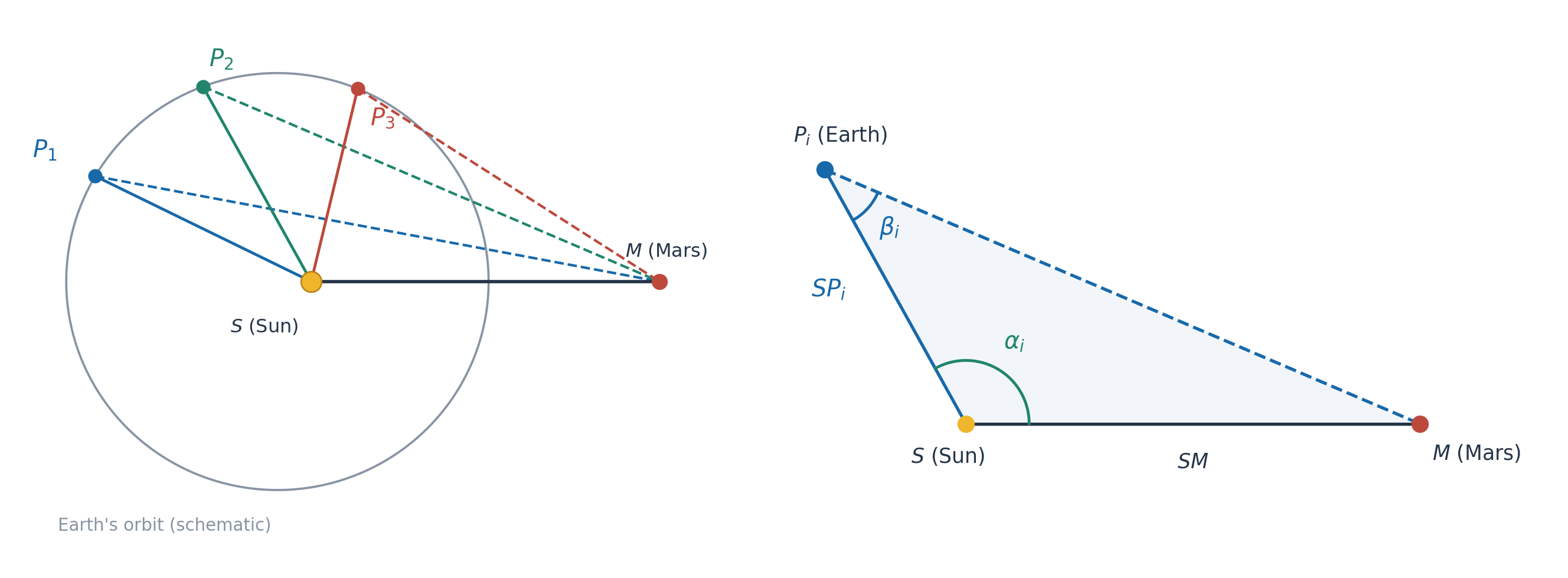
(b) Write down the formula Johannes uses to obtain the ratio \(SP_i/SM\) of the Earth–Sun and Mars–Sun distances from the angles \(\alpha_i\) and \(\beta_i\). [2]
Once we have these ratios at enough points, spread over many years, we can map out the whole orbit of the Earth in units of \(SM\), and hence find the ratio \(a_E/a_M\).
Isaac: That is clever indeed. But remember that I never knew the value of the universal gravitational constant either. Only last night I read about the experiment Mr Cavendish performed in 1798, seventy years after my death. Figure 6 shows his apparatus, seen from above.
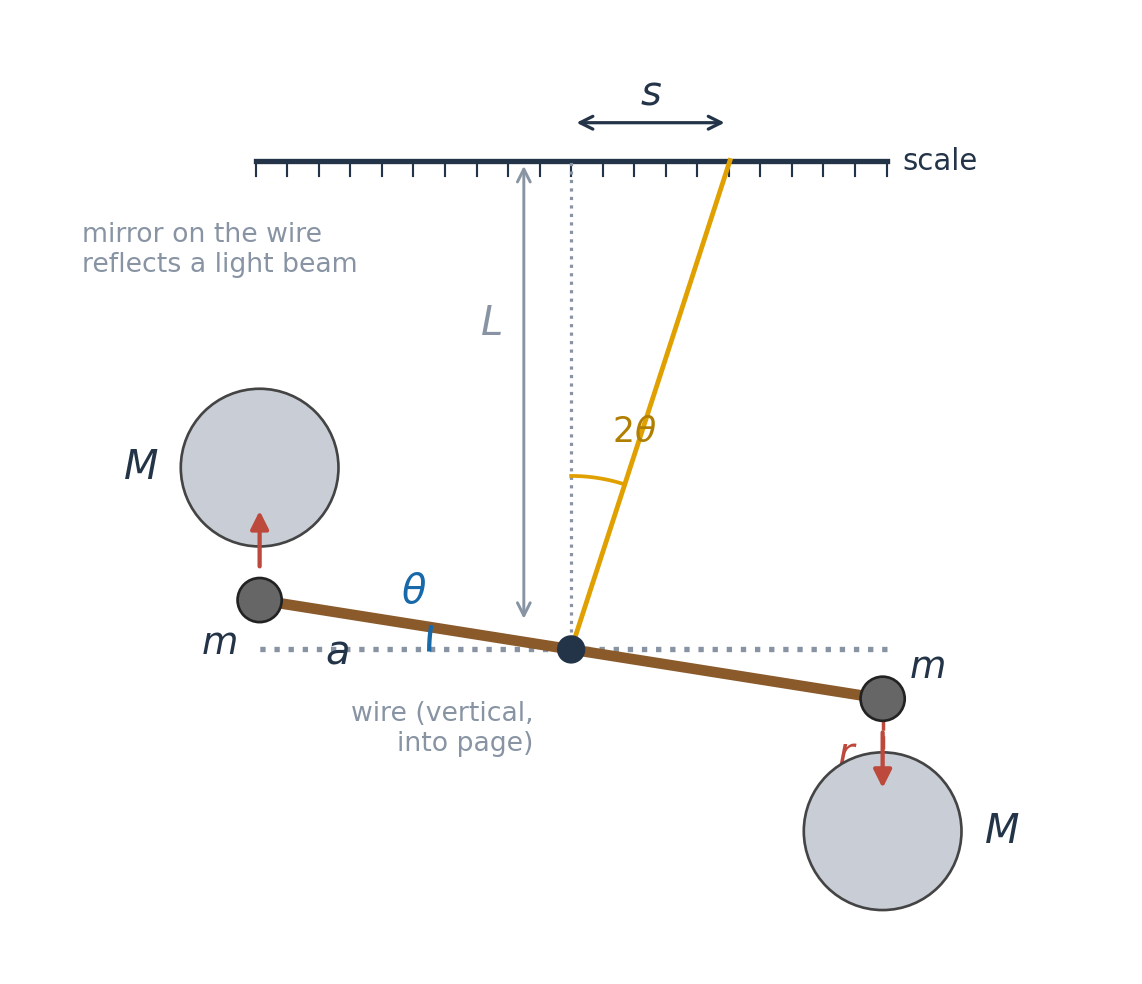
Isaac (continuing): The difficulty is that the attraction between two lumps of lead is absurdly small, far too small for any balance that weighs things. So Cavendish did not try to measure the force; he measured an angle. He hung a light rod, with a small lead ball of mass \(m\) at each end, from a long, thin wire. When the rod turns, the wire twists and pushes back with a torque proportional to the twist, \(\kappa\theta\). He then brought two great lead balls of mass \(M\) close to the small ones, one on each side, so that both attractions turn the rod the same way. The rod turns until the twist of the wire balances the pull of the great balls. The angle is tiny, so he fixed a small mirror to the wire and read the deflection of a reflected beam of light on a distant scale. He did not know the stiffness \(\kappa\) of his wire either. Instead, he let the rod swing freely and timed one full oscillation, \(T_{\text{osc}} = 2\pi\sqrt{I/\kappa}\), where \(I\) is the moment of inertia of the system. That period gave him \(\kappa\). So from a length, a distance, a mass, an angle and a time, he found my constant.
(c) Derive an expression for \(G\) in terms of \(M\), \(a\), \(r\), \(\theta\) and \(T_{\text{osc}}\). Treat the rod as massless and the spheres as point masses, and neglect the attraction of each large sphere on the far small sphere. Also relate \(\theta\) to the scale reading \(s\) and the distance \(L\). [3]
Q6. One push or two? [7 marks]
Johannes: Here is a circle, and here is one of my ellipses, crossing it. Surely a single push at the crossing is the cheapest way from one to the other: no waiting, no second burn.
Isaac: Perhaps. Let us calculate before we judge.
A spacecraft is in a circular Earth orbit of radius \(r_1 = 10\,000\) km. It must be transferred to a coplanar elliptical orbit of eccentricity \(e = 0.3\), whose semi-latus rectum equals the radius of the circle, \(p = r_1\) (Figure 7).
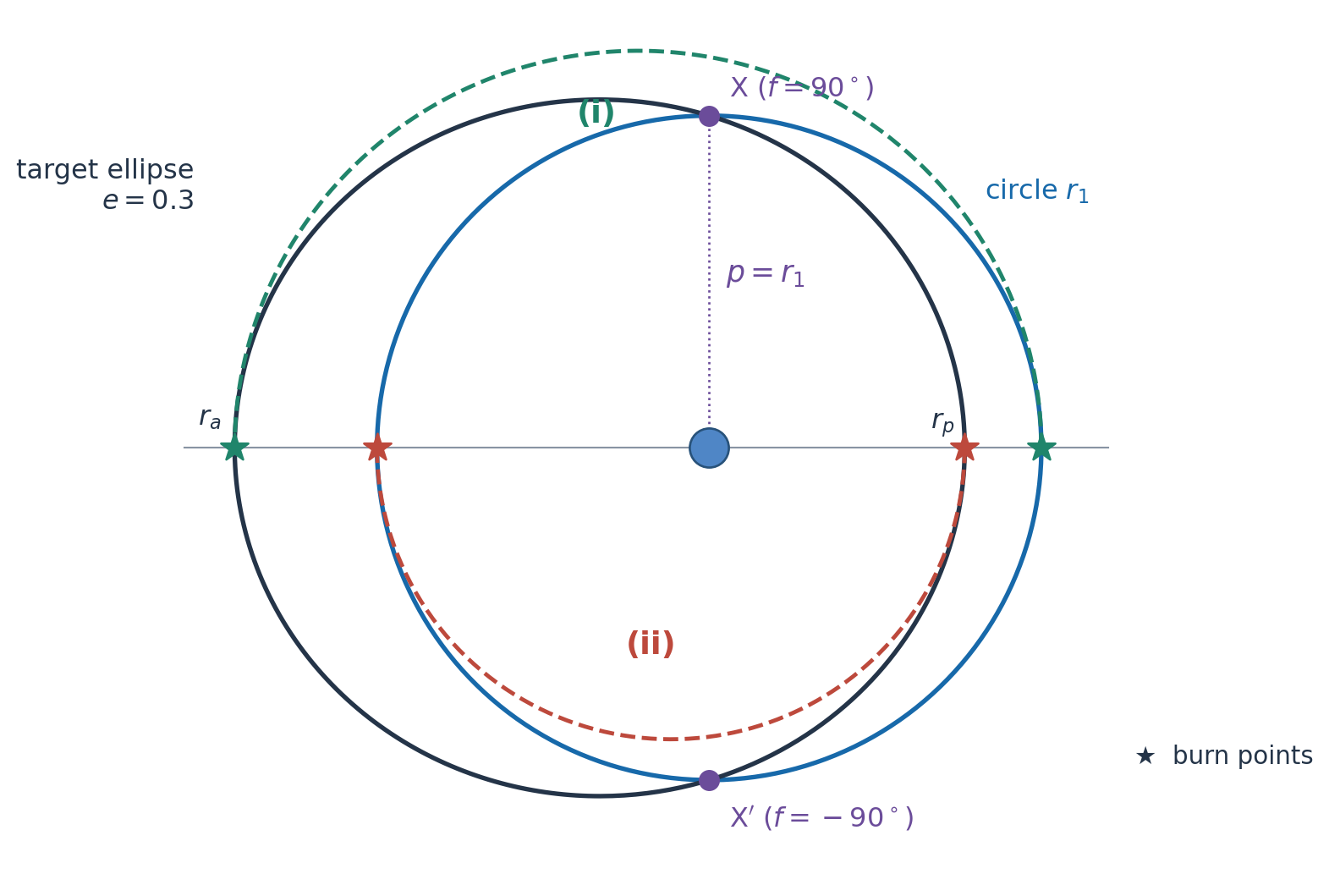
(a) Find the semi-major axis, the periapsis radius and the apoapsis radius of the target ellipse. Show that the circle meets the ellipse at true anomaly \(f = \pm 90^\circ\). [2]
(b) Single impulse. At the crossing point X, find the radial and transverse velocity components on the ellipse. Show that the insertion burn is purely radial, and that its magnitude is \[ \Delta v_{1} = e\,v_c, \qquad v_c = \sqrt{\mu / r_1}. \] [2]
(c) Show that, in units of \(v_c\), \[ \begin{aligned} \Delta v_{\text{(i)}} &= \sqrt{2(2-e)} - (2-e), \\ \Delta v_{\text{(ii)}} &= (2+e) - \sqrt{2(2+e)}, \end{aligned} \] and hence prove that both two-impulse transfers are cheaper than the single impulse for every \(0 < e < 1\). [2]
(d) Give one mission reason for choosing it anyway. [1]
Epilogue
Johannes: So the heavenly breezes were never needed: only the right push, at the right place, on the right ellipse.
Isaac: Your ellipse, Johannes. I only explained it.
End of paper.