Mid-Semester Examination, October 2025
| Course | Spaceflight Mechanics (AE313), Aerospace Engineering, IIST |
| Examination | Mid-Semester, 9 October 2025, 2:00 PM to 4:00 PM, venue D4 |
| Maximum marks | 30 |
| Q1 | 19 marks |
| Q2 | 2 marks |
| Q3 | 3 marks |
| Q4 | 3 marks |
| Q5 | 3 marks |
Instructions
- All questions are compulsory.
- Clearly state all the assumptions/approximations in the derivations/answers.
- Diagrams and write-up that are not legible will not be graded.
The questions are reproduced as they were set, with their marks. Added for this page: the table of marks above, the folded solution under each question, and the figures of the solutions. Spelling slips have been corrected. Two statements in Q1 are printed as they were set although they contain a slip, in blanks (m) and (u), and the solution points each one out. The paper has no official answer key, so the answers to the open blanks are our reading of them.
Data and formulae
| Planet | Mass (kg) | Semi-major axis (AU) |
|---|---|---|
| Mercury | \(3.3011\times10^{23}\) | \(0.387098\) |
| Venus | \(4.8675\times10^{24}\) | \(0.723332\) |
| Earth | \(5.97237\times10^{24}\) | \(1.000000\) |
| Mars | \(6.4171\times10^{23}\) | \(1.523679\) |
| Jupiter | \(1.8982\times10^{27}\) | \(5.20260\) |
| Saturn | \(5.6834\times10^{26}\) | \(9.5549\) |
| Uranus | \(8.6810\times10^{25}\) | \(19.2184\) |
| Neptune | \(1.02413\times10^{26}\) | \(30.110\) |
| Pluto | \(1.303\times10^{22}\) | \(39.482\) |
| Quantity | Value |
|---|---|
| Gravitational constant, \(G\) | \(6.67430\times10^{-11}\ \mathrm{m^3\,kg^{-1}\,s^{-2}}\) |
| Mass of Earth, \(M_E\) | \(5.976\times10^{24}\) kg |
| Radius of Earth, \(R_E\) | \(6.371\times10^{6}\) m |
| Gravitational parameter of Earth, \(\mu_E\) | \(3.986\times10^{14}\ \mathrm{m^3\,s^{-2}}\) |
| Speed of light, \(c\) | \(3\times10^{8}\) m/s |
Velocity on an ellipse:
\[ v=\sqrt{\mu\left(\frac2r-\frac1a\right)} \]
Mean anomaly for a parabolic orbit:
\[ M_p=\frac{\mu^2t}{h^3} \]
Solution to Barker’s equation for a parabolic orbit:
\[ \tan\frac f2=\left(3M_p+\sqrt{9M_p^2+1}\right)^{1/3}-\left(3M_p+\sqrt{9M_p^2+1}\right)^{-1/3} \]
Law of cosines:
\[ c^2=a^2+b^2-2ab\cos\theta \]
Q1 [19 marks]
Now that I have your undivided attention, let’s do a quick partial review of the course.
The aim of this course is to predict the movement of planets, moons, asteroids and satellites. As a first step we listed all the forces acting on these bodies. It is clear from the outset that apart from the gravitational force (a) [0.5 marks] __________ is the next leading order source of acceleration. If we are considering an object like a satellite, then the most important force apart from the above two forces is the (b) [0.5 marks] __________. Relativistic effects will have to be considered for objects that have a velocity \(v>0.1c\) where \(c\) is the speed of light. Luckily for us the fastest planet in the solar system has a speed of (assuming circular orbits) (c) [1.5 marks] __________ which is well below \(0.1c\).
We found that this problem is difficult to solve in the general form. Therefore we decided to start with the most important force which is gravitation. We also noted that gravitational potential can be defined as the gravitational force is a (d) [0.5 marks] __________ force unlike the viscous force. Units of the gravitational potential in SI units are (e) [0.5 marks] __________. If the bodies are sufficiently far apart then we can consider them as point masses. Under this assumption the total force on a body of mass \(m\) due to \(n\) other bodies of masses \(M_i\) is given by (f) [0.5 marks] __________.
The total gravitational potential is given by (g) [1 mark] __________.
Applying Newton’s second law (in universal inertial reference frame) we get the governing differential equations of the form (h) [0.5 marks] __________.
This equation is nonlinear in (i) [0.5 marks] __________ variable. This does not have a general analytical solution.
So we made further assumptions and moved to the two body approximation. The most convenient reference frame for writing these equations was found to be (j) [0.5 marks] __________ where the position vector (\(\mathbf r\)) of the origin in terms of a universal inertial reference frame is given by (k) [0.5 marks] __________.
The main justification for using 2BP assumption is the special nature of our solar system. To drive home this point, let us assume that our solar system is only made up of two planets Saturn and Jupiter. In such a case, only (l) [2 marks] __________ percentage errors are being introduced in the 2-body approximation of the motion of Saturn and Jupiter.
Now, when considering the motion of satellites around the Earth, the point mass assumption is much more difficult to justify. However, here is a proof that the point mass assumption is valid if we assume that Earth is a perfect sphere of radius \(R\) and density \(\rho=f(r)\) where \(r>R\) is the distance from the centre of the Earth and \(f\) is a sufficiently smooth function of \(r\).
(m) [2 marks] __________
Along the way, we started looking for things that brilliant people in the past have done. For example, Kepler’s laws of planetary motion. One of the neglected aspects of Kepler’s laws is the third law which states that
(n) [1 mark] __________
We came to know that the planets move in elliptical orbits with Sun at one of the foci. The general equation for the ellipse with origin at a focus is
\[ r=\frac{h^2/\mu}{1+e\cos f} \]
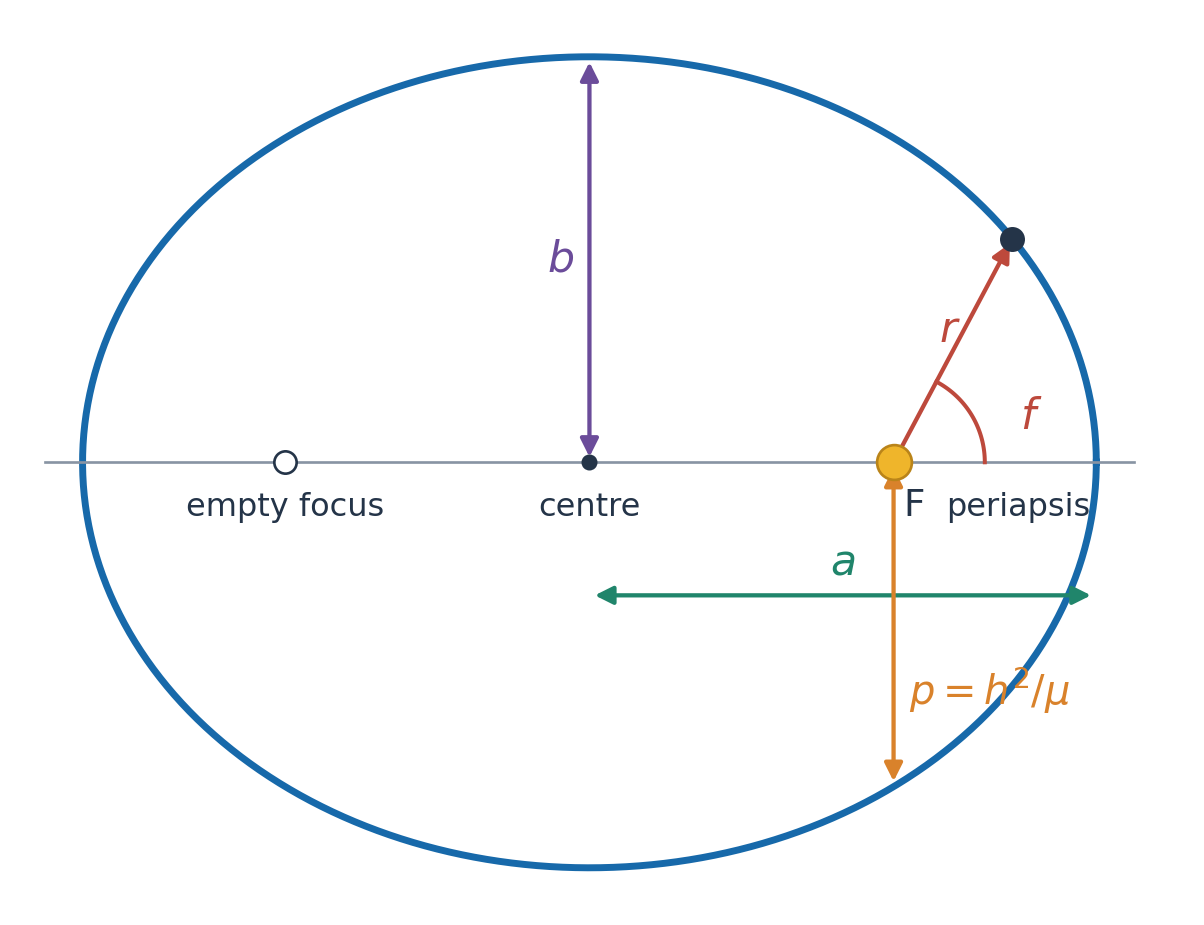
where all the symbols have their usual meaning. Following is a diagram of an ellipse where we show the semi-major axis \(a\), semi-minor axis \(b\), the semi-latus rectum \(p\), the distance \(r\) and the angle \(f\).
(o) [1 mark]
If \(h\), and \(\mu\) are fixed then the orbit is completely determined by \(e\). The semi-major axis \(a\) of this ellipse is a function of \(e\) and \(h^2/\mu\) as derived below from pure geometry and using the polar form of the equation of ellipse as given above.
(p) [2 marks]
To give you a better insight into the formula, we plot the trajectory of three planets orbiting around a star which all have the same angular momentum \(h\) but different masses \(m_1>m_2>m_3\).
(q) [2 marks]
Apart from the elliptical orbits, we have parabolic and hyperbolic orbits. We derived a lot of analytical formulae for all types of these orbits. We saw that given the position vector and the velocity vector of a body at any instant of time, we can find all the orbital parameters. Here we list the algorithm for finding the orbital parameters from the position and velocity vectors.
- Find the specific angular momentum \(\mathbf h=\mathbf r\times\mathbf v\).
- Find the eccentricity vector \(\mathbf e=\dfrac{\mathbf v\times\mathbf h}{\mu}-\dfrac{\mathbf r}{r}\).
- Find the semi-major axis \(a=\left(\dfrac2r-\dfrac{v^2}{\mu}\right)^{-1}\).
- Find the true anomaly \(f=\cos^{-1}\left(\dfrac{\mathbf e\cdot\mathbf r}{er}\right)\).
The eccentricity vector points towards the (r) [0.25 marks] __________ direction of the orbit. The total energy of the orbit is given by (s) [0.5 marks] __________. This tells us that (t) [0.25 marks] __________ orbits have positive energy.
All these equations only give us position as a function of the true anomaly \(f\). But going to the position as a function of time is more complex and required the use of the concept of Mean Anomaly. Given the eccentric anomaly, solving for mean anomaly requires an iterative algorithm. (u) [0.5 marks] __________ is an example of such an algorithm. This process is orbit specific and not general. Hence we came up with the (v) [0.5 marks] __________ to overcome it. I think we will stop the review now and move back to the standard form of questions.
Solution to Q1
Where a blank has a short answer it is in the table. The longer ones are worked below it.
| Blank | Answer | Basis |
|---|---|---|
| (a) | solar radiation pressure | our reading: it acts on every sunlit body, and no other non-gravitational force does |
| (b) | atmospheric drag | our reading: it is the main non-gravitational force on a satellite in low orbit, and it does not act on a planet |
| (c) | \(47.9\) km/s (Mercury) | see below |
| (d) | conservative | its work does not depend on the path, so it is the gradient of a potential |
| (e) | \(\mathrm{J/kg}\), which is \(\mathrm{m^2/s^2}\) | potential is energy per unit mass |
| (f) | \(\mathbf F=Gm\displaystyle\sum_{i=1}^{n}M_i\frac{\mathbf r_i-\mathbf r}{\lvert\mathbf r_i-\mathbf r\rvert^3}\) | Newton’s law for each pair, added as vectors |
| (g) | \(\phi(\mathbf r)=-G\displaystyle\sum_{i=1}^{n}\frac{M_i}{\lvert\mathbf r-\mathbf r_i\rvert}\) | potential per unit mass, with \(\mathbf F=-m\nabla\phi\) |
| (h) | \(\ddot{\mathbf r}=G\displaystyle\sum_{i=1}^{n}M_i\frac{\mathbf r_i-\mathbf r}{\lvert\mathbf r_i-\mathbf r\rvert^3}\), one such equation for each body | \(m\ddot{\mathbf r}=\mathbf F\), and the mass \(m\) cancels |
| (i) | the position | the unknown positions appear inside \(\lvert\mathbf r_i-\mathbf r\rvert^{-3}\) |
| (j) | the centre-of-mass (barycentric) frame | the centre of mass of the two bodies moves uniformly, so this frame is inertial |
| (k) | \(\mathbf r_{\rm cm}=\dfrac{m_1\mathbf R_1+m_2\mathbf R_2}{m_1+m_2}\) | the definition of the centre of mass |
| (l) | \(0.041\%\) for Jupiter and \(0.46\%\) for Saturn | see below |
| (m) | see below | the shell integral |
| (n) | \(T^2=\dfrac{4\pi^2}{\mu}a^3\) | the square of the period is proportional to the cube of the semi-major axis, with the same constant for every planet of the Sun |
| (o) | see below | the labelled figure |
| (p) | \(a=\dfrac{h^2/\mu}{1-e^2}\) | see below |
| (q) | see below | our reading of the question is stated there |
| (r) | periapsis | \(\mathbf e\) runs from the focus towards the point of closest approach |
| (s) | \(\varepsilon=\dfrac{v^2}{2}-\dfrac{\mu}{r}=-\dfrac{\mu}{2a}\) | energy per unit mass |
| (t) | hyperbolic | a parabola has zero energy and an ellipse has negative energy |
| (u) | Newton–Raphson | see below |
| (v) | universal variable formulation (the universal anomaly) | one Kepler equation that holds for all conics |
(c) A planet on a circle has \(v=\sqrt{\mu_\odot/a}\), so the fastest planet is the one with the smallest \(a\), which is Mercury. The table does not give the mass of the Sun, but the Earth’s own orbit gives it. The Earth covers a circle of radius \(1\) AU in one year, \(T=365.25\) days, and \(T^2=4\pi^2a^3/\mu_\odot\) gives
\[ \mu_\odot=\frac{4\pi^2(1.496\times10^{11})^3}{(365.25\times86\,400)^2}=1.327\times10^{20}\ \mathrm{m^3/s^2}. \]
Then
\[ v=\sqrt{\frac{1.327\times10^{20}}{0.387098\times1.496\times10^{11}}}=47.9\text{ km/s}. \]
This is \(v/c=1.6\times10^{-4}\), or \(0.16\%\) of the limit \(0.1c\) that the question sets.
(l) The two-body model of a planet about the Sun leaves out the pull of the other planet. We measure the error by the ratio of the force left out to the force kept. We take the worst case, which is the moment when the two planets are closest. With circular orbits that is conjunction, when they are in line on the same side of the Sun and are \(d=a_S-a_J=9.5549-5.2026=4.3523\) AU apart. The question asks for each planet separately, because the two ratios are different. For Jupiter, with \(M_\odot=\mu_\odot/G=1.989\times10^{30}\) kg from the calculation in (c),
\[ \frac{Gm_S/d^2}{GM_\odot/a_J^2}=\frac{m_S}{M_\odot}\left(\frac{a_J}{d}\right)^2=(2.858\times10^{-4})(1.429)=4.08\times10^{-4}\approx0.041\%, \]
and for Saturn
\[ \frac{Gm_J/d^2}{GM_\odot/a_S^2}=\frac{m_J}{M_\odot}\left(\frac{a_S}{d}\right)^2=(9.546\times10^{-4})(4.820)=4.60\times10^{-3}\approx0.46\%. \]
Saturn suffers about \(11\) times the error of Jupiter. Jupiter is the heavier of the two, and Saturn is held more weakly by the Sun because it is farther out. The Sun’s mass is what makes the two-body model work. These are the two largest planets, and even at their closest the error is below half a percent.
(m) A slip in the question. The density must be defined inside the Earth, so the condition should read \(r<R\), not \(r>R\). We prove the result for \(\rho=f(r)\) with \(r<R\). The plan is to split the sphere into thin shells, to find the potential of one shell at an outside point, and then to add up the shells.
Take a point at a distance \(D>R\) from the centre. Take a thin shell of radius \(s<R\) and mass \(dm=4\pi s^2f(s)\,ds\), which is uniform because the density depends only on the radius. Let \(\theta\) be the polar angle on the shell, measured from the line joining the centre to our point. The ring between \(\theta\) and \(\theta+d\theta\) holds the fraction \(\tfrac12\sin\theta\,d\theta\) of the shell’s mass. Every point of this ring is at the same distance \(\ell\) from our point, where
\[ \ell^2=s^2+D^2-2sD\cos\theta . \]
The potential of the shell at our point is therefore
\[ d\phi=-G\,dm\int_0^\pi\frac{\tfrac12\sin\theta\,d\theta}{\ell} . \]
This integral is simple in terms of \(\ell\). Differentiating the expression for \(\ell^2\) gives \(2\ell\,d\ell=2sD\sin\theta\,d\theta\), so \(\sin\theta\,d\theta/\ell=d\ell/(sD)\). As \(\theta\) goes from \(0\) to \(\pi\), \(\ell\) goes from \(D-s\) to \(D+s\). Hence
\[ \int_0^\pi\frac{\tfrac12\sin\theta\,d\theta}{\ell}=\frac{1}{2sD}\int_{D-s}^{D+s}d\ell=\frac{2s}{2sD}=\frac1D . \]
So \(d\phi=-G\,dm/D\), which is the potential of the mass \(dm\) placed at the centre. This holds for every shell, whatever its density. Adding up the shells gives
\[ \phi(D)=-\frac GD\int_0^R4\pi s^2f(s)\,ds=-\frac{GM}{D}, \]
and the force per unit mass is \(-d\phi/dD=-GM/D^2\) towards the centre. So the Earth attracts every outside point as if all its mass were at its centre. Size does not enter the result, only the spherical symmetry.
(o) Figure 1 shows the required labels. The focus is at the origin of the polar equation, and \(f\) is measured from the periapsis. The semi-latus rectum \(p=h^2/\mu\) is the value of \(r\) at \(f=90^\circ\).
(p) The two ends of the major axis are the points closest to and farthest from the focus. The polar equation gives them at \(f=0\) and at \(f=\pi\):
\[ r_p=\frac{h^2/\mu}{1+e},\qquad r_a=\frac{h^2/\mu}{1-e}. \]
The geometry of the ellipse says that the length of the major axis is \(2a=r_p+r_a\). So
\[ 2a=\frac{h^2}{\mu}\left(\frac{1}{1+e}+\frac{1}{1-e}\right)=\frac{h^2}{\mu}\,\frac{2}{1-e^2}, \qquad\text{that is}\qquad a=\frac{h^2/\mu}{1-e^2}. \]
(q) Our reading. The symbol \(h\) in this paper is the specific angular momentum, and the plot must show the effect of the mass through the formula of (p). That effect enters through \(\mu=G(M+m)\), where \(M\) is the star’s mass. We also take the same \(e\) for all three, since the question gives no other value. With \(h\) and \(e\) fixed,
\[ a=\frac{h^2}{G(M+m)(1-e^2)}, \]
so the heavier the planet, the smaller the orbit. Figure 2 shows three similar ellipses that share the star as a focus and have their periapses on the same side, with \(m_1\) inside and \(m_3\) outside.
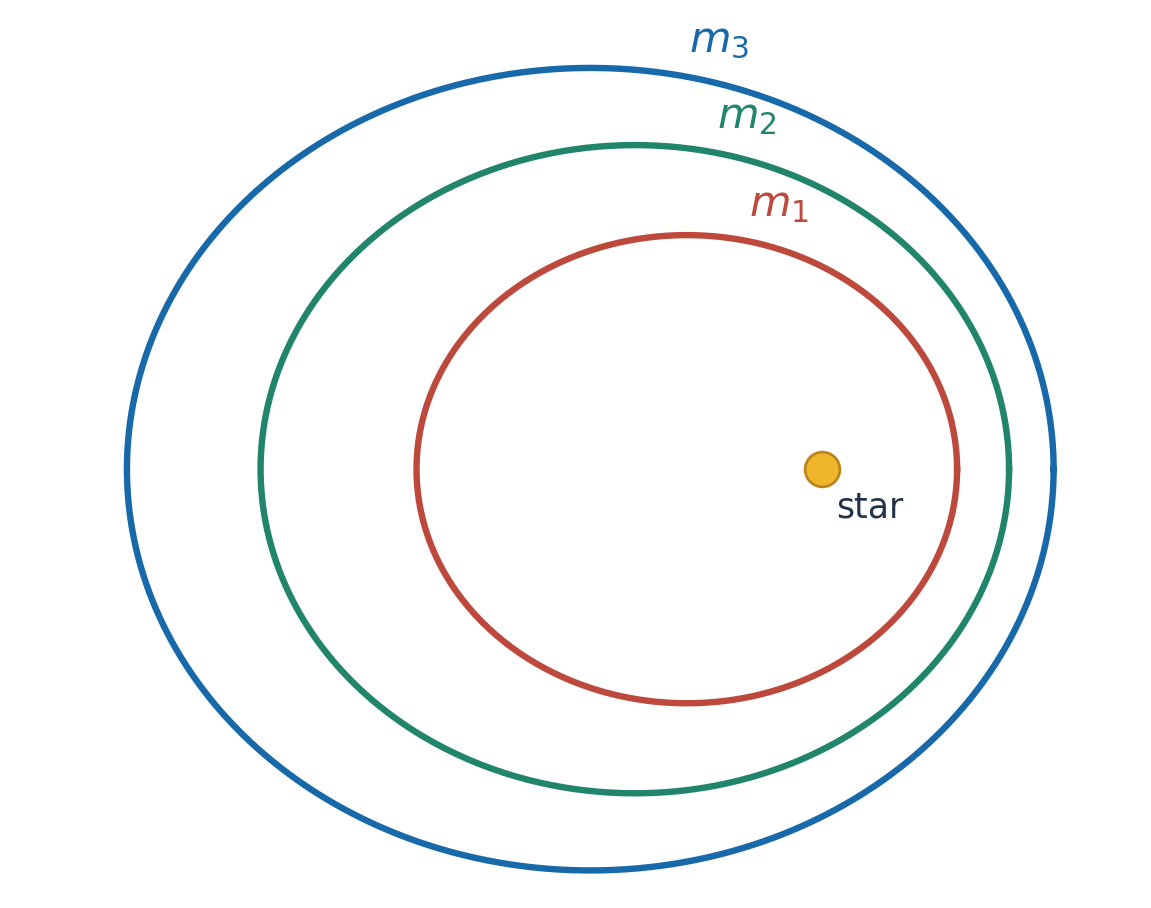
For real planets \(m\ll M\), so \(\mu\approx GM\) and the three curves would lie almost on top of each other. If “angular momentum” is instead read as the total \(L=mh\) of each planet, then \(h=L/m\) and \(a\propto1/m^2\). The orbits then differ strongly, but the order is the same, with \(m_1\) inside.
(u) A slip in the question. The sentence has the two anomalies the wrong way round. Given \(E\), the mean anomaly follows at once from Kepler’s equation, \(M_e=E-e\sin E\). It is the reverse problem that needs iteration: given \(M_e\) (that is, given the time), find \(E\). Newton–Raphson solves this by the update \(E_{k+1}=E_k-(E_k-e\sin E_k-M_e)/(1-e\cos E_k)\).
Q2 [2 marks]
The perigee of a satellite in a parabolic geocentric trajectory is \(7000\) km. Find the distance \(d\) between points \(P_1\) and \(P_2\) on the orbit which are \(8000\) km and \(16\,000\) km, respectively, from the center of the earth.
Q3 [3 marks]
India wants to deorbit non-functional INSAT-1A satellite from its GSO (\(h_{GSO}=35786\) km) orbit in order to declutter the orbit. As a first step, it has been decided to bring it down to the LEO (\(h_{LEO}=300\) km) orbit. Assuming that both the orbits are circular, recommend a minimum fuel strategy for orbit transfer using two impulse maneuver.
Q4 [3 marks]
Derive the expression for velocity in the perifocal reference frame (with origin at the focus and \(x\)-axis towards the periapsis and \(y\)-axis perpendicular to it) in terms of the standard conic parameters \(h\), \(\mu\), \(e\) and \(f\).
Q5 [3 marks]
We will derive the mean anomaly equation for ellipse here in a different way than the one shown in class. Let us define
- \(E\): eccentric anomaly,
- \(f\): true anomaly,
- \(M_e\): mean anomaly,
- \(n=\sqrt{\mu/a^3}\): mean motion,
- \(\tau\): time of periapsis passage.
The mean anomaly is defined as \(M_e=n(t-\tau)\). Since \(n=\dfrac{2\pi}{T}\) where \(T\) is the time period of the orbit, we can write
\[ M_e=\frac{2\pi}{T}(t-\tau). \]
Clearly, \(\tau\) and \(T\) are constants. Therefore \(M_e\) is a linear function of time. This means that the area swept by the radius vector in time \(t-\tau\) is proportional to \(M_e\).
Using this definition and the fact that the area swept by the radius vector in infinitesimal time \(dt\) is given by \(dA=\frac12(x\,dy-y\,dx)\), derive Kepler’s equation. The equation of ellipse in the perifocal frame in terms of eccentric anomaly is given by \(x=a(\cos E-e)\), \(y=b\sin E\) where \(b=a\sqrt{1-e^2}\).
All the numbers and identities in these solutions are checked by midsem-2025-verify.py.