Assignment 01
In a different universe, a pair of particles move through space under the action of a law of gravitation for which the force of attraction between the particles is directly proportional to the product of their masses and directly proportional to their separation. Derive the shape of the orbit of one body about another. Solve for conditions under which their orbits are bounded.
Determine the true anomaly θ of the point(s) on an elliptical orbit at which the speed equals the speed of a circular orbit with the same radius, i.e., \(\nu_{\text{ellipse}}= \nu_{\text{circle}}\). Calculate the flight path angle at those points.
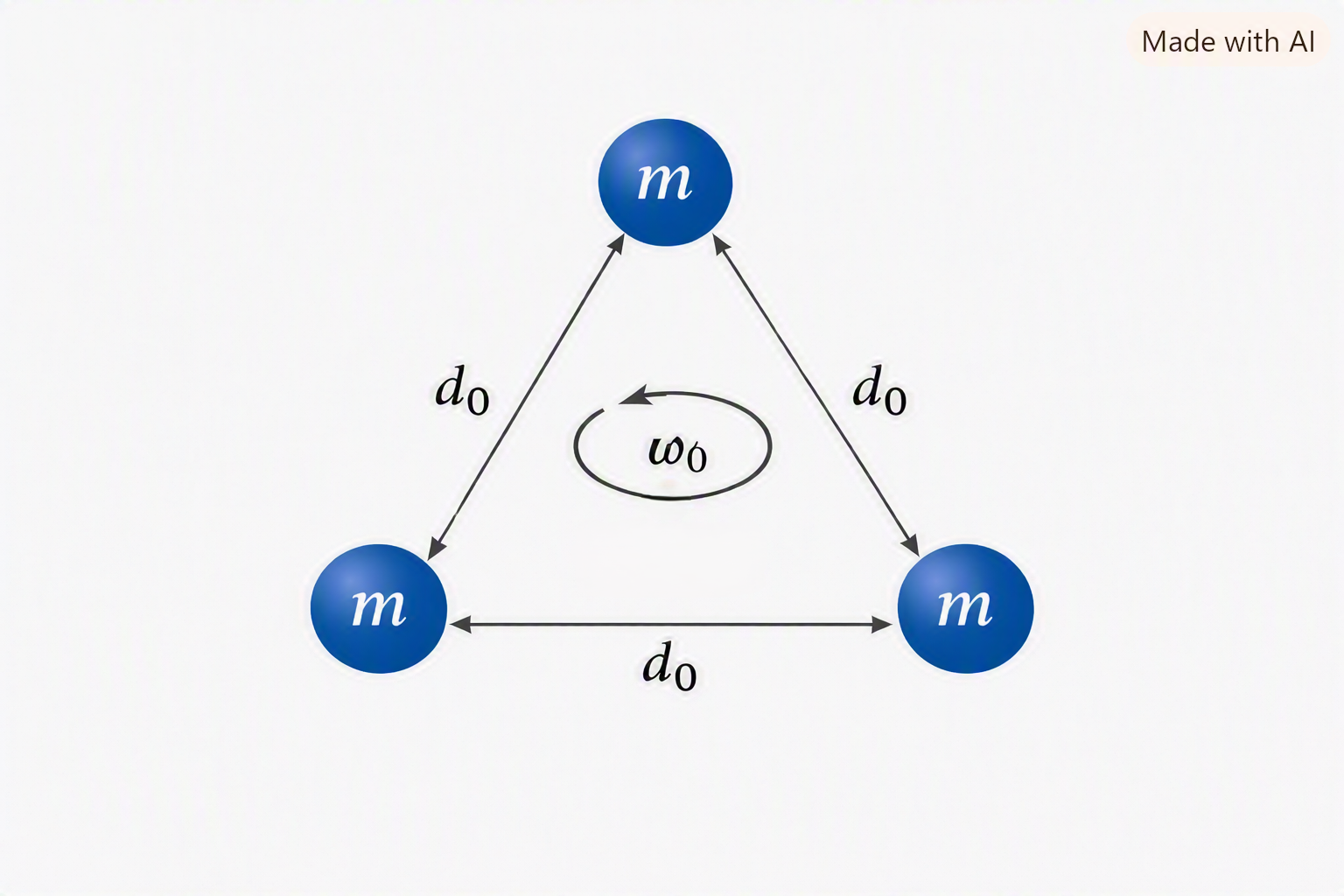
Consider a special case of a 3-body problem in which three equal mass particles are in an equilateral triangle configuration. Determine the required constant angular velocity \(\omega_0\) to maintain a constant separation distance \(d_0\) between the masses.
An object was observed at a distance of \((1.05)^{\frac{2}{3}}\) Earth radii from the center of the Earth. Sixteen minutes later, the same object was observed at a position 60 deg (measured at the Earth center) from the original position. Show whether the object is in a circular orbit. Assume that \(\mu = 0.00553\) (ER³/min²).
Tracking data of a satellite in orbit about the Earth indicates its altitude = 600 km, radial velocity = 3.5 km/s and transverse velocity = 7 km/s. Determine orbital period, eccentricity, and true anomaly of the satellite. Assume \(\mu = 398600\) km³/s² and \(R_E\) = 6378 km.